

How did the mental health of children and adolescents change during early lockdown during the COVID-19 pandemic in the UK?
Open accessThe DOI matches its Crossref record; 22 of the 22 references it cites were found in a registry or an index.
Abstract
BackgroundThe COVID-19 pandemic has caused extensive disruption to the lives of children and young people. Understanding the psychological effects on children and young people, in the context of known risk factors, is crucial to mitigate the effects of the pandemic. This study set out to explore how mental health symptoms in children and adolescents changed over a month of full lockdown in the UK in response to the pandemic.MethodsUK-based parents and carers (n = 2,673) of school-aged children and young people aged between 4 and 16 years completed an online survey about their child’s mental health at two time points between March and May 2020, during early lockdown. The survey examined changes in emotional symptoms, conduct problems and hyperactivity/inattention.ResultsThe findings highlighted particular deteriorations in mental health symptoms among pre-adolescent children, which translated to a 10% increase in those meeting possible/probable caseness criteria for emotional symptoms, a 20% increase in hyperactivity/inattention, and a 35% increase in conduct problems. In contrast, changes among adolescents were smaller (4% and 8% increase for hyperactivity/inattention and conduct problems respectively) with a small reduction in emotional symptoms (reflecting a 3% reduction in caseness). Overall, there were few differences in change in symptoms or caseness over time according to demographic characteristics, but children and young people in low income households and those with special educational needs and/or neurodevelopmental disorders, exhibited elevated symptoms (and caseness) at both time points. ConclusionsThe findings highlight important areas of concern in terms of the potential impact of lockdown on children and young people’s adjustment. Developing an understanding of who has been most severely affected by the pandemic, and in what ways, is crucial in order to target effective support where it is most needed.
Overview
The claims and statistics of this paper haven’t been checked yet.
Free: it reads the open-access text and checks the first 5 claims that cite a source we can check. Create a free account to check every claim.
Integrity signals
Registry
Cites
Statistics
Figures
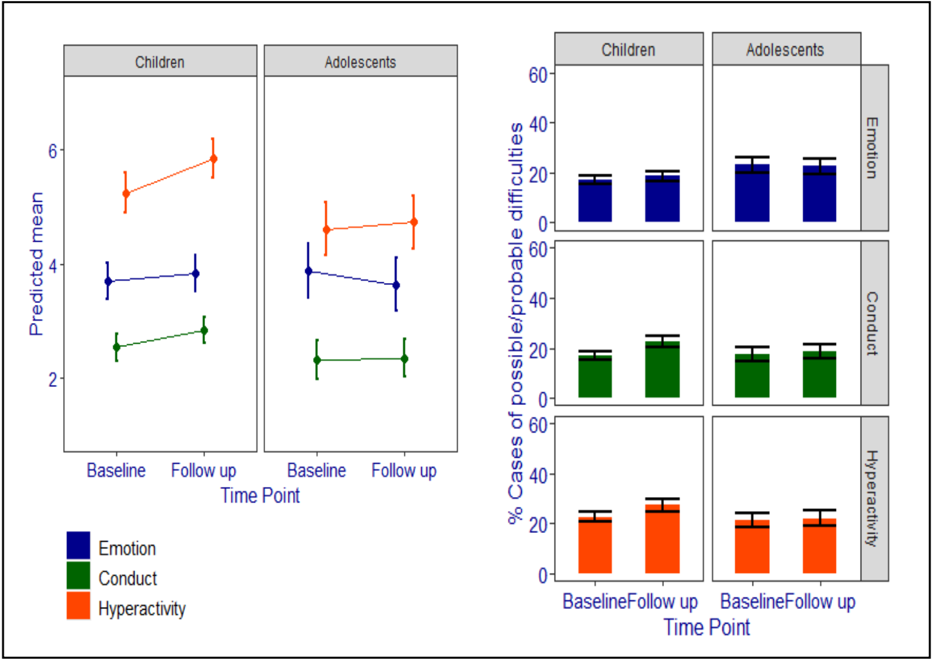
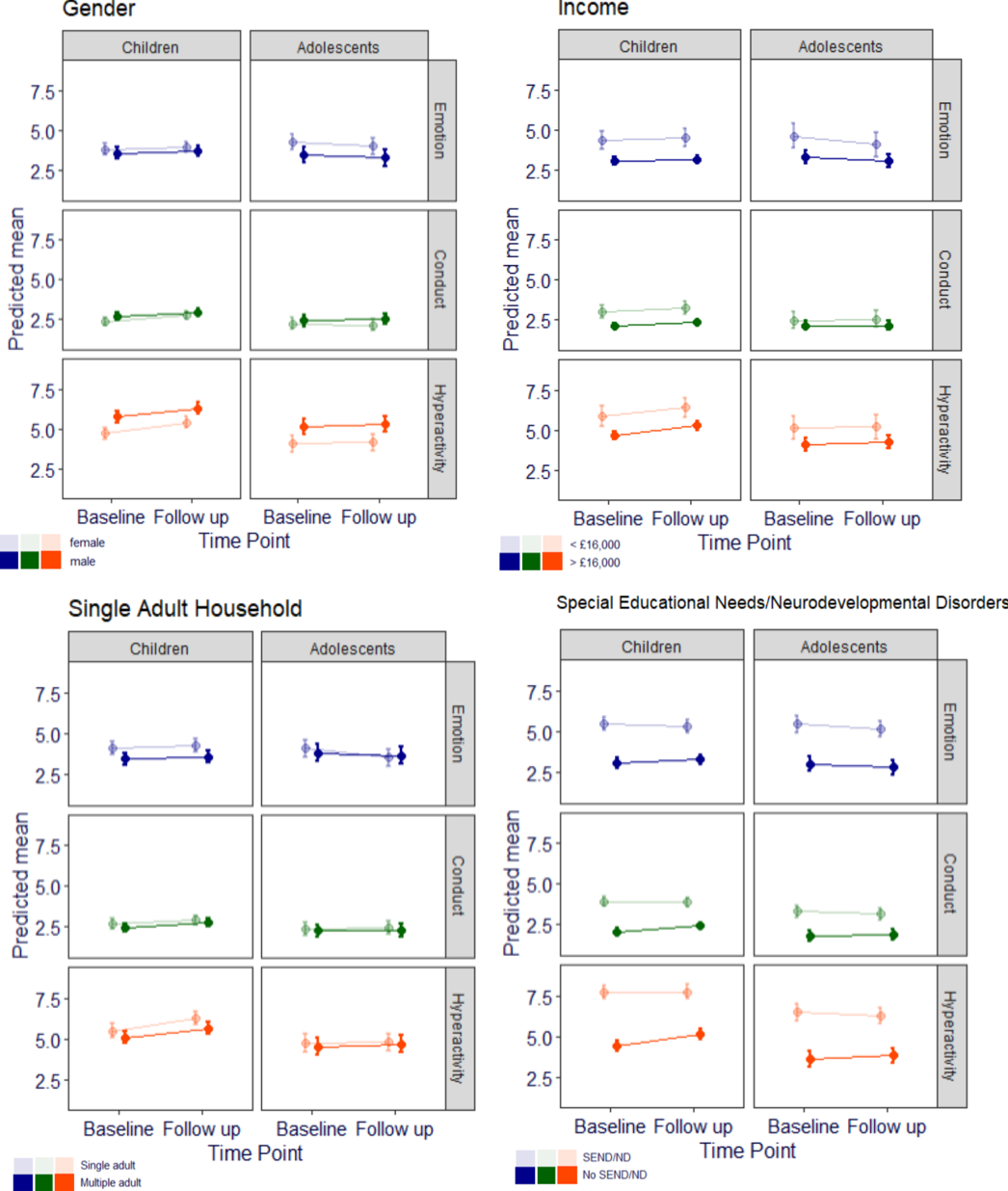
Verification
Claims the paper makes
The claims and statistics of this paper haven’t been checked yet.
Free: it reads the open-access text and checks the first 5 claims that cite a source we can check. Create a free account to check every claim.
Claims other papers make about this one
Each is checked against this paper’s own text: does it say what the citing paper says it does?
In the citing paper
“These experiences were likely felt most acutely by those already affected by socioeconomic marginalisation and deprivation.”
Self-check
Percentages, sums and reported differences re-computed from the paper’s own numbers.
The self-check needs the paper’s full text.
Citations
Cites
Kessler, R. C., Berglund, P., Demler, O., Jin, R., Merikangas, K. R., & Walters, E. E. (2005) · Archives of General Psychiatry · doi:10.1001/archpsyc.62.6.593 · Cited by 20,391
The Strengths and Difficulties Questionnaire: A research note
Goodman, R. (1997) · Journal of Child Psychology and Psychiatry · doi:10.1111/j.1469-7610.1997.tb01545.x · Cited by 14,908
Holmes, E. A., O'Connor, R. C., Perry, V. H., Tracey, I., Wessely, S., Arseneault, L., Ballard, C., Christensen, H., Cohen Silver, R., Everall, I., et al. (2020) · The Lancet Psychiatry · doi:10.1016/s2215-0366(20)30168-1 · Cited by 5,715
Induced root-secreted phenolic compounds as a belowground plant defense
Lanoue, A., Burlat, V., Schurr, U., & Röse, U. S. R. (2010) · Plant Signaling & Behavior · doi:10.4161/psb.5.8.12337 · Cited by 5,461
Goodman, R., Meltzer, H., & Bailey, V. (1998) · European Child & Adolescent Psychiatry · doi:10.1007/s007870050057 · Cited by 2,238
Goodman, R., Ford, T., Simmons, H., Gatward, R., & Meltzer, H. (2000) · British Journal of Psychiatry · doi:10.1192/bjp.177.6.534 · Cited by 1,818
Goodman, R. (1999) · Journal of Child Psychology and Psychiatry · doi:10.1017/s0021963099004096 · Cited by 1,756
Stone, L. L., Otten, R., Engels, R. C. M. E., Vermulst, A. A., & Janssens, J. M. A. M. (2010) · Clinical Child and Family Psychology Review · doi:10.1007/s10567-010-0071-2 · Cited by 1,031
Xie, X., Xue, Q., Zhou, Y., Zhu, K., Liu, Q., Zhang, J., & Song, R. (2020) · JAMA Pediatrics · doi:10.1001/jamapediatrics.2020.1619 · Cited by 1,001
Autonomy, conflict, and harmony in the family relationship.
Steinberg, L. D. (1990) · Cited by 783
Research works printed but not linked: 2
- Angold, A., & Costello, E. (1993). Depressive comorbidity in children and adolescents. American journal of psychiatry, 150(12), 1779-1791.
- Levita, L. (2020). COVID-19 PSYCHOLOGICAL RESEARCH CONSORTIUM (C19PRC): Report 2. https://psyarxiv.com/s32j8/.
Cited by
The impact of COVID-19 lockdown on child and adolescent mental health: systematic review
Panchal, U., Salazar de Pablo, G., Franco, M., Moreno, C., Parellada, M., Arango, C., & Fusar-Poli, P. (2023) · European Child & Adolescent Psychiatry · doi:10.1007/s00787-021-01856-w · Cited by 1,028
“Children and adolescents with special educational needs and neurodevelopmental disorders (NDD) showed more emotional symptoms, conduct problems, and hyperactivity/inattention scores than those without special educational needs and neurodevelopmental disorders [100].”
BackgroundResultInfluentialRavens-Sieberer, U., Erhart, M., Devine, J., Gilbert, M., Reiss, F., Barkmann, C., Siegel, N. A., Simon, A. M., Hurrelmann, K., Schlack, R., et al. (2022) · Journal of Adolescent Health · doi:10.1016/j.jadohealth.2022.06.022 · Cited by 401
Ravens-Sieberer, U., Kaman, A., Erhart, M., Otto, C., Devine, J., Löffler, C., Hurrelmann, K., Bullinger, M., Barkmann, C., Siegel, N. A., et al. (2023) · European Child & Adolescent Psychiatry · doi:10.1007/s00787-021-01889-1 · Cited by 334
Child mental health in England before and during the COVID-19 lockdown
Newlove-Delgado, T., McManus, S., Sadler, K., Thandi, S., Vizard, T., Cartwright, C., & Ford, T. (2021) · The Lancet Psychiatry · doi:10.1016/s2215-0366(20)30570-8 · Cited by 266
Mental health of children and young people during pandemic
Ford, T., John, A., & Gunnell, D. (2021) · BMJ · doi:10.1136/bmj.n614 · Cited by 203
Hards, E., Loades, M. E., Higson‐Sweeney, N., Shafran, R., Serafimova, T., Brigden, A., Reynolds, S., Crawley, E., Chatburn, E., Linney, C., et al. (2022) · British Journal of Clinical Psychology · doi:10.1111/bjc.12331 · Cited by 162
“These closures are associated with significant harm to children and young people, including poorer mental and physical health, a reduction in child protection referrals, fewer self-harm and psychiatric attendances indicating an unmet mental health need, and a rise in suicide (Ford, John, & Gunnell, 2021; Viner et al.,…”
BackgroundRavens‐Sieberer, U., Devine, J., Napp, A.-K., Kaman, A., Saftig, L., Gilbert, M., Reiß, F., Löffler, C., Simon, A., Hurrelmann, K., et al. (2023) · Frontiers in Public Health · doi:10.3389/fpubh.2023.1129073 · Cited by 166
Anderson, T., Valiauga, R., Tallo, C., Hong, C. B., Manoranjithan, S., Domingo, C. N., Paudel, M., Untaroiu, A., Barr, S., & Goldhaber, K. (2024) · Journal of Child and Adolescent Psychiatric Nursing · doi:10.1111/jcap.70009 · Cited by 143
Mental health and wellbeing of children and adolescents during the covid-19 pandemic
Rider, E. A., Ansari, E., Varrin, P., & Sparrow, J. (2021) · BMJ · doi:10.1136/bmj.n1730 · Cited by 136
McKinlay, A. R., May, T., Dawes, J., Fancourt, D., & Burton, A. (2022) · BMJ Open · doi:10.1136/bmjopen-2021-053676 · Cited by 115
(2021) · doi:10.1101/2021.04.11.21254776 · Cited by 115
The legacy of Covid-19 in education
Werner, K., & Woessmann, L. (2024) · Economic Policy · doi:10.1093/epolic/eiad016 · Cited by 100
Widnall, E., Adams, E. A., Plackett, R., Winstone, L., Haworth, C. M. A., Mars, B., & Kidger, J. (2022) · International Journal of Environmental Research and Public Health · doi:10.3390/ijerph19127163 · Cited by 73
Mendolia, S., Suziedelyte, A., & Zhu, A. (2022) · Economics Letters · doi:10.1016/j.econlet.2022.110458 · Cited by 67
Mental health symptoms in children and adolescents during COVID-19 in Australia
Sicouri, G., March, S., Pellicano, E., De Young, A. C., Donovan, C. L., Cobham, V. E., Rowe, A., Brett, S., Russell, J. K., Uhlmann, L., et al. (2023) · Australian & New Zealand Journal of Psychiatry · doi:10.1177/00048674221090174 · Cited by 66
The impact of COVID ‐19 lockdown on children's and adolescents' mental health in Greece
Magklara, K., Lazaratou, H., Barbouni, A., Poulas, K. A., & Farsalinos, K. E. (2022) · Children & Society · doi:10.1111/chso.12605 · Cited by 64
Widnall, E., Winstone, L., Plackett, R., Adams, E. A., Haworth, C. M. A., Mars, B., & Kidger, J. (2022) · International Journal of Environmental Research and Public Health · doi:10.3390/ijerph19116768 · Cited by 59
“Existing studies have shown both older adolescents [44] and younger children [14] overall experienced poorer mental health, which differs from our findings on early adolescents.”
BackgroundResultFriedman, S., Imrie, S., Fink, E., Gedikoglu, M., & Hughes, C. H. (2021) · People and Nature · doi:10.1002/pan3.10270 · Cited by 67
Longitudinal impact of COVID-19 pandemic on mental health of children in the ABCD study cohort
Hamatani, S., Hiraoka, D., Makita, K., Tomoda, A., & Mizuno, Y. (2022) · Scientific Reports · doi:10.1038/s41598-022-22694-z · Cited by 55
Digital access constraints predict worse mental health among adolescents during COVID-19
Metherell, T. E., Ghai, S., McCormick, E. M., Ford, T. J., & Orben, A. C. (2022) · Scientific Reports · doi:10.1038/s41598-022-23899-y · Cited by 55
Changes in psychosocial functioning among urban, school-age children during the COVID-19 pandemic
Spencer, A. E., Oblath, R., Dayal, R. R., Loubeau, J. K., Lejeune, J., Sikov, J., Savage, M., Posse, C., Jain, S., Zolli, N., et al. (2021) · Child and Adolescent Psychiatry and Mental Health · doi:10.1186/s13034-021-00419-w · Cited by 53
Holst, C. G., Bowes, L., Waite, P., Skripkauskaitė, S., Shum, A., Pearcey, S., Raw, J., Patalay, P., & Creswell, C. (2023) · JCPP Advances · doi:10.1002/jcv2.12153 · Cited by 51
Self-citationWenter, A., Schickl, M., Sevecke, K., Juen, B. H., & Exenberger, S. (2022) · Frontiers in Psychology · doi:10.3389/fpsyg.2022.901205 · Cited by 48
McCluskey, G., Fry, D., Hamilton, S., King, A., Laurie, M., McAra, L., & Stewart, T. M. (2021) · Emotional and Behavioural Difficulties · doi:10.1080/13632752.2021.1903182 · Cited by 45
“These included the Co-Space project led by Cathy Creswell (e.g. Waite et al. 2020), the Oxfordshire Online Mental Health and Wellbeing Survey 2020 led by Mansfield, which published preliminary findings after completion of our INISS study (Mansfield, Jindra, and Fazel 2020); and the TeenCovidLife…”
MethodDelvecchio, E., Orgilés, M., Morales, A., Espada, J. P., Francisco, R., Pedro, M. F., & Mazzeschi, C. (2022) · Journal of Applied Developmental Psychology · doi:10.1016/j.appdev.2022.101390 · Cited by 49
Kishida, K., Tsuda, M., Waite, P., Creswell, C., & Ishikawa, S. (2021) · Psychiatry Research · doi:10.1016/j.psychres.2021.114276 · Cited by 49
Self-citationEssler, S., Christner, N., & Paulus, M. (2023) · European Child & Adolescent Psychiatry · doi:10.1007/s00787-023-02215-7 · Cited by 45
Hen, M., Shenaar‐Golan, V., & Yatzker, U. (2022) · Frontiers in Psychiatry · doi:10.3389/fpsyt.2022.865435 · Cited by 47
Herpertz‐Dahlmann, B., Dempfle, A., & Eckardt, S. (2022) · European Psychiatry · doi:10.1192/j.eurpsy.2022.2345 · Cited by 42
Life satisfaction and mental health from age 17 to 21 years in a general population sample
Marquez, J., Katsantonis, I., Sellers, R., & Knies, G. (2022) · Current Psychology · doi:10.1007/s12144-022-03685-9 · Cited by 33
Geweniger, A., Haddad, A. D. M., Barth, M., Högl, H., Mund, A., Insan, S., & Langer, T. (2022) · BMJ Paediatrics Open · doi:10.1136/bmjpo-2022-001509 · Cited by 30
Bloom, J., Lachman, A., Gaxo, E., Pillay, J., & Seedat, S. (2022) · Child and Adolescent Psychiatry and Mental Health · doi:10.1186/s13034-022-00499-2 · Cited by 27
Shoshani, A., & Kor, A. (2023) · European Child & Adolescent Psychiatry · doi:10.1007/s00787-023-02269-7 · Cited by 29
Longitudinal Changes in Youth Mental Health From Before to During the COVID-19 Pandemic
Blackwell, C. K., Wu, G., Chandran, A., Arizaga, J. A., Enlow, M. B., Brennan, P. A., Burton, P., Bush, N. R., Cella, D., Cummins, C., et al. (2024) · JAMA Network Open · doi:10.1001/jamanetworkopen.2024.30198 · Cited by 26
Dekker, L. P., Hooijman, L. W. E., Louwerse, A., Visser, K., Bastiaansen, D., ten Hoopen, L. W., de Nijs, P., Dieleman, G. C., Ester, W. A., van Rijen, S., et al. (2022) · BMJ Open · doi:10.1136/bmjopen-2021-049336 · Cited by 29
“A graded compensation was set up to promote long-term participation and minimise drop-out.”
BackgroundChzhen, Y., Symonds, J. E., Devine, D., Mikolai, J., Harkness, S., Sloan, S., & Sainz, G. M. (2022) · Child Indicators Research · doi:10.1007/s12187-022-09922-8 · Cited by 25
Camping at home: escapism, self-care, and social bonding during the COVID-19 pandemic
Morris, N., & Orton‐Johnson, K. (2022) · Annals of Leisure Research · doi:10.1080/11745398.2022.2082992 · Cited by 22
Santosh, P., Cortese, S., Hollis, C. P., Bölte, S., Daley, D., Coghill, D., Holtmann, M. H., Sonuga-Barke, E. J. S., Buitelaar, J. K., Banaschewski, T., et al. (2023) · European Child & Adolescent Psychiatry · doi:10.1007/s00787-023-02148-1 · Cited by 23
Morgül, E., Kallitsoglou, A., Essau, C. A., & Castro, S. (2022) · Frontiers in Education · doi:10.3389/feduc.2022.838938 · Cited by 22
Muth, L., Leven, K.-H., Moll, G. H., Kratz, O., & Horndasch, S. (2022) · International Journal of Environmental Research and Public Health · doi:10.3390/ijerph19148480 · Cited by 25
Panchal, U. R., Vaquerizo‐Serrano, J., Conde-Ghigliazza, I., Genç, H. A., Marchini, S., Pociūtė, K., Ocakoğlu, B. K., Sanchez-Roman, S., Őri, D., Catalán, A., et al. (2023) · The European Journal of Psychiatry · doi:10.1016/j.ejpsy.2023.06.003 · Cited by 24
“59 Children seem to cope better with shorter lock-downs 64 and face more mental health dif fi culties with longer lockdowns, 65,66 showing further that resilience in children may have a limit.”
BackgroundBraksiek, M., Lindemann, U., & Pahmeier, I. (2022) · International Journal of Environmental Research and Public Health · doi:10.3390/ijerph19148274 · Cited by 21
Paterson, J., McCarthy, M., & Triantafyllopoulou, P. (2023) · Journal of Research in Special Educational Needs · doi:10.1111/1471-3802.12608 · Cited by 26
Mindfulness supports emotional resilience in children during the COVID-19 pandemic
Treves, I. N., Li, C. E., Wang, K. L., Ozernov-Palchik, O., Olson, H. A., & Gabrieli, J. D. E. (2023) · PLoS ONE · doi:10.1371/journal.pone.0278501 · Cited by 19
Chan, R. C. H. (2022) · Family Process · doi:10.1111/famp.12760 · Cited by 20
Changes in UK parental mental health symptoms over 10 months of the COVID‐19 pandemic
Skripkauskaitė, S., Creswell, C., Shum, A., Pearcey, S., Lawrence, P. J., Dodd, H. F., & Waite, P. (2023) · JCPP Advances · doi:10.1002/jcv2.12139 · Cited by 19
Self-citationCOVID-19–Related Changes in Adolescents' Daily-Life Social Interactions and Psychopathology Symptoms
Achterhof, R., Myin‐Germeys, I., Bamps, E., Hagemann, N., Hermans, K. S. F. M., Hiekkaranta, A. P., Janssens, J. J., Lecei, A., Lafit, G., & Kirtley, O. J. (2025) · The Journal of Nervous and Mental Disease · doi:10.1097/nmd.0000000000001826 · Cited by 20
Pereira, A. I. (2021) · Revista de Psicología Clínica con Niños y Adolescentes · doi:10.21134/rpcna.2021.08.3.4 · Cited by 18
Kaltiala‐Heino, R., Aalto‐Setälä, T., & Kiviruusu, O. H. (2023) · Scandinavian Journal of Public Health · doi:10.1177/14034948231166466 · Cited by 18
The ecology of youth psychological wellbeing in the COVID-19 pandemic.
Salmon, K. (2021) · Journal of Applied Research in Memory and Cognition · doi:10.1016/j.jarmac.2021.11.002 · Cited by 18
Lockyer, B., Endacott, C., Dickerson, J., & Sheard, L. (2022) · BMC Psychology · doi:10.1186/s40359-022-00851-3 · Cited by 18
Ching, B. C. F., Downs, J. M., Zhang, S., Cader, H., Penhallow, J., Voraite, E., Popnikolova, T., Wickersham, A., Parlatini, V., & Simonoff, E. A. (2025) · Journal of Child Psychology and Psychiatry · doi:10.1111/jcpp.14117 · Cited by 18
Strömmer, S., Sivaramakrishnan, D., Shaw, S., Morrison, K., Barrett, M., Manner, J., Jenner, S., Hughes, T., Hardy‐Johnson, P., Andreas, M., et al. (2022) · BMC Public Health · doi:10.1186/s12889-022-12755-3 · Cited by 18
Loneliness and mental health related impacts of COVID-19: a narrative review
Jamil, A., Syed, J., Kanwal, S., Ain, Q. U., Namroz, N., Gul, A., & Jamil, A. (2022) · International Journal of Adolescent Medicine and Health · doi:10.1515/ijamh-2022-0032 · Cited by 19
Newman, K. L., Sayal, K. S., Ewart, C., Lang, A. R., Bhardwaj, A., Dubicka, B., Marshall, T., & Thomson, L. (2024) · SSM - Mental Health · doi:10.1016/j.ssmmh.2024.100343 · Cited by 17
Wang, J., Yang, Y., Lin, H., Richards, M., Yang, S., Liang, H., Chen, X., & Fu, C. (2021) · Translational Pediatrics · doi:10.21037/tp-21-300 · Cited by 15
Orbach, L., Fritz, A., Haase, V. G., Dowker, A., & Räsänen, P. (2023) · Frontiers in Education · doi:10.3389/feduc.2023.1083074 · Cited by 16
Creswell, C. (2022) · Journal of Child Psychology and Psychiatry · doi:10.1111/jcpp.13626 · Cited by 15
Self-citationDessain, A., Parlatini, V., Singh, A., Bruin, M. D., Cortese, S., Sonuga-Barke, E. J. S., & Vaquerizo‐Serrano, J. (2023) · Neuroscience & Biobehavioral Reviews · doi:10.1016/j.neubiorev.2023.105502 · Cited by 15
Castle, V. E., Sideropoulos, V., Jones, C. L., Zhang, D., Herwegen, J. V., & Palikara, O. (2024) · Review Journal of Autism and Developmental Disorders · doi:10.1007/s40489-024-00453-2 · Cited by 19
“Interestingly, Raw et al. (2021) and Waite et al. (2021) alternatively found that emotional problems for children with SEND actually decreased more over time, yet this was likely due to the particularly high reported emotional problems at baseline for these children.”
Read, S., Salmela‐Aro, K., Kiuru, N. H., Helenius, J., & Junttila, N. (2024) · PLoS ONE · doi:10.1371/journal.pone.0312579 · Cited by 15
Hall, C. L., Marston, L., Khan, K., Brown, B. J., Sanderson, C., Andrén, P., Bennett, S. D., Heyman, I., Mataix‐Cols, D., Serlachius, E., et al. (2022) · Child Psychiatry & Human Development · doi:10.1007/s10578-022-01348-1 · Cited by 15
“8% to 2017 to 16% in July 2020 [8], with respondents from lower socioeconomic groups reporting the greatest mental health deterioration [9].”
BackgroundFoley, S., Ronchi, L., Lecce, S., Feng, X., Chan, M. H.-M., & Hughes, C. H. (2022) · International Journal of Methods in Psychiatric Research · doi:10.1002/mpr.1933 · Cited by 15
Bretton, O. M. (2023) · Medicine Health Care and Philosophy · doi:10.1007/s11019-023-10157-9 · Cited by 13
Boyle, C., Sanders, M. R., Ma, T., Hodges, J., Allen, K., Cobham, V. E., Darmawan, I., Dittman, C. K., Healy, K. L., Hepburn, S., et al. (2023) · BMC Public Health · doi:10.1186/s12889-023-16962-4 · Cited by 12
Pun, B. L. F., & Fung, A. Y. H. (2023) · Springer eBooks · doi:10.1007/978-3-031-14961-0_22 · Cited by 11
Bobo, E., Fongaro, E., Lin, L., Gétin, C., Gamon, L., Picot, M.-C., & Purper‐Ouakil, D. (2022) · Frontiers in Psychiatry · doi:10.3389/fpsyt.2022.902245 · Cited by 11
Mason, C., Mansfield, R., Demkowicz, O., & Humphrey, N. (2025) · School Mental Health · doi:10.1007/s12310-025-09830-6 · Cited by 13
Calling for the integration of children's mental health and protection into COVID-19 responses
Solerdelcoll, M., Arango, C., & Sugranyes, G. (2021) · Revista de Psiquiatría y Salud Mental (English Edition) · doi:10.1016/j.rpsm.2021.02.004 · Cited by 10
A weekly‐diary study of students' schoolwork motivation and parental support
Wu, Y., Hilpert, P., Tenenbaum, H. R., & Ng‐Knight, T. (2022) · British Journal of Educational Psychology · doi:10.1111/bjep.12532 · Cited by 10
Effects of COVID-19 lockdown on weight in a cohort of allergic children and adolescents
Brindisi, G., Marino, V. P. D., Olivero, F., Canditiis, D. D., Castro, G. D., Zicari, A. M., & Anania, C. (2022) · The Italian Journal of Pediatrics/Italian journal of pediatrics · doi:10.1186/s13052-022-01273-y · Cited by 10
de Maat, D. A., der Hallen, R. V., de Nijs, P. F. A., Visser, K., Bastiaansen, D., Truijens, F. L., van Rijen, E. H. M., Ester, W. A., Prinzie, P., Jansen, P. W., et al. (2023) · Journal of Autism and Developmental Disorders · doi:10.1007/s10803-022-05846-y · Cited by 11
Irvine, T. J., Aults, C. D., & Menon, M. (2022) · Psychological Reports · doi:10.1177/00332941211061699 · Cited by 11
Kirsten, C., Kahre, E., Blankenburg, J., Schumm, L., Haag, L., Galow, L., Unrath, M., Czyborra, P., Schneider, J., Lück, C., et al. (2022) · Infection · doi:10.1007/s15010-022-01824-9 · Cited by 10
“Given these facts and the clearly documented negative effects of school closures on the student population in terms of education [24], mental health [25], social contacts and control [17] as well as children’s nutrition [18], school closures seem unreasonable in most circumstances both as general pandemic control meas…”
BackgroundHolst, C. G., Oncioiu, S. I., Creswell, C., & Bowes, L. (2023) · JAACAP Open · doi:10.1016/j.jaacop.2023.05.003 · Cited by 13
Self-citationPsychopathology, Protective Factors, and COVID-19 among Adolescents: A Structural Equation Model
Scheiner, C., Seis, C., Kleindienst, N., & Buerger, A. (2023) · International Journal of Environmental Research and Public Health · doi:10.3390/ijerph20032493 · Cited by 11
Pan, T., Gallo, M. E., Donald, K. A., Webb, K., & Bath, K. G. (2024) · Brain Behavior & Immunity - Health · doi:10.1016/j.bbih.2024.100760 · Cited by 10
Koca, S. B., Bükülmez, A., Oflu, A. T., Tahta, E. G., & Demirbilek, H. (2022) · Acta Endocrinologica (Bucharest) · doi:10.4183/aeb.2022.40 · Cited by 9
Wright, N., Kounali, D., Paul, E., Kwong, A. S. F., Major‐Smith, D., Costantini, I., Lawlor, D. A., Sayal, K. S., Bould, H., Timpson, N. J., et al. (2020) · JCPP Advances · doi:10.1002/jcv2.70068 · Cited by 9
Knipe, D. W., García, S. D. O., Salhi, L., Afzal, N., Sammut, S., Mainstone-Cotton, L., Sefi, A., Marchant, A. L., & John, A. M. (2025) · PLoS ONE · doi:10.1371/journal.pone.0316468 · Cited by 8
Pybus, K. J., Kelly, B., Hou, B., Ajebon, M. O., McIvor, C., Bingham, D. D., McEachan, R., Pickett, K. E., & Dickerson, J. (2022) · Wellcome Open Research · doi:10.12688/wellcomeopenres.17642.1 · Cited by 8
Palmer, M. L., Chandler, S., Leno, V. C., Mgaieth, F., Yorke, I., Hollocks, M. J., Pickles, A. R., Slonims, V., Scott, S., Charman, T., et al. (2023) · Autism · doi:10.1177/13623613231153694 · Cited by 9
Lockhart, G., Jones, C. J., & Sopp, V. (2021) · The Cognitive Behaviour Therapist · doi:10.1017/s1754470x21000301 · Cited by 7
“…early indications and widespread consensus that it is likely to lead to a further rise in mental health difficulties for CYP (Banks and Xu, 2020; Bignardi et al ., 2020; Fancourt et al ., 2021; Levita et al ., 2020; Raw et al ., 2021; Shum et al ., 2021; Vizard et al ., 2020; Waite et al ., 2020).”
Doyle, A. E., Colvin, M. K., Beery, C. S., Koven, M. R., Vuijk, P. J., & Braaten, E. B. (2022) · Child and Adolescent Psychiatry and Mental Health · doi:10.1186/s13034-022-00441-6 · Cited by 8
Kaya, M., & McCabe, C. (2022) · International Journal of Environmental Research and Public Health · doi:10.3390/ijerph19158927 · Cited by 10
Einhorn, J., James, M., Kennedy, N., Marchant, E., & Brophy, S. T. (2024) · Frontiers in Public Health · doi:10.3389/fpubh.2024.1285687 · Cited by 7
Wong, K. K., Loke, K., & Melville, K. M. K.-L. (2022) · UCL Open Environment · doi:10.14324/111.444/ucloe.000041 · Cited by 7
Lawrence, P. J., Skripkauskaitė, S., Shum, A., Waite, P., & Dodd, H. F. (2023) · JCPP Advances · doi:10.1002/jcv2.12163 · Cited by 7
Self-citationCattan, S., Farquharson, C., Krutikova, S., McKendrick, A., & Sevilla, A. (2023) · doi:10.1920/re.ifs.2023.0267 · Cited by 7
Zysset, A. (2022) · Jus Cogens · doi:10.1007/s42439-022-00065-6 · Cited by 6
Holm, M. E., Sainio, P., Lehtola, S. M. H., Gissler, M., Luoma, M., Salmela‐Aro, K., & Kiviruusu, O. H. (2025) · Disability and health journal · doi:10.1016/j.dhjo.2025.101841 · Cited by 6
Hasan, T., Bonny, M. Z., Das, R. K., Sultana, S., Islam, M. T., & Sattar, A. (2024) · International Journal on Advanced Science Engineering and Information Technology · doi:10.18517/ijaseit.14.3.18534 · Cited by 6
Effects of COVID-19 Pandemic and Earthquake on the Mental Health of Adults in Croatia
Vukelić, D. J., Brajković, L., & Kopilaš, V. (2022) · American Journal of Applied Psychology · doi:10.11648/j.ajap.20221102.13 · Cited by 7
Fendt, M. T. C., Hölling, H., Lampert, T., & Waldhauer, J. (2023) · Das Gesundheitswesen · doi:10.1055/a-1916-9664 · Cited by 7
The development of ReGoal, a serious mobile game for young people with conduct problems*
Livanou, M., Manitsa, I., Hulusić, V., Samara, M. M., Bull, M., & De, A. (2024) · Behaviour and Information Technology · doi:10.1080/0144929x.2024.2404241 · Cited by 6
Fattah, N. R. A., Yousef, A. M., Mohamed, A. E., & Amin, S. I. (2022) · Middle East Current Psychiatry · doi:10.1186/s43045-022-00198-w · Cited by 7
“found that children placed in lockdown for 3 months exhibited more severe behavioral problems [27].”
BackgroundBloch, E. A., Carbó, A. G., Martínez, J. V. B., Pérez-Porcuna, T. M., Juncosa, O. S., Gimeno, E. F., & Garcia, P. Á. (2023) · Anales de Pediatría · doi:10.1016/j.anpedi.2023.03.010 · Cited by 6
Badrick, E., Moss, R. H., McIvor, C., Endacott, C., Crossley, K. L., Tanveer, Z., Pickett, K. E., McEachan, R., & Dickerson, J. (2024) · Wellcome Open Research · doi:10.12688/wellcomeopenres.20752.1 · Cited by 5
Measuring and understanding contemporary English educational inequalities
Reay, D. (2024) · Oxford Open Economics · doi:10.1093/ooec/odad027 · Cited by 9
Metadata
- Authors
- Waite, P., Pearcey, S., Shum, A., Raw, J., Patalay, P., & Creswell, C.
- Affiliations
- University of Oxford (GB)
- MRC Unit for Lifelong Health and Ageing (GB)
- Publisher
- Center for Open Science
- Published
- 2020-12-08
- OpenAlex
- W3113146037
- Cited by
- 28
- References
- 22
- Citations by year
- 2024: 2 · 2023: 4 · 2022: 10 · 2021: 12
- Type
- posted content
- Language
- en
- Open access
- green
- doi.org
- Locations
- PsyArXiv (OSF Preprints) (submittedVersion, cc-by)
- PsyArXiv (OSF Preprints) (submittedVersion)
- Funders
- UK Research and Innovation
- National Institute for Health and Care Research (PDF-2016-09-092)
- Department of Health and Social Care
- Topics
- Social Sciences › Psychology › Clinical Psychology › COVID-19 and Mental Health
- Social Sciences › Psychology › Clinical Psychology › Child and Adolescent Psychosocial and Emotional Development
- Health Sciences › Medicine › Public Health, Environmental and Occupational Health › Maternal Mental Health During Pregnancy and Postpartum
- Keywords
- child mental health, adolescent mental health, COVID-19 lockdown, emotional symptoms, conduct problems, hyperactivity/inattention, preadolescents, low-income households, special educational needs, neurodevelopmental disorders, parent report
About these checks
Registry, retraction, Cites and statistics results are computed, not judged, with one exception: a printed reference that no index lists is read once by a model before it counts as a citation error. Claims are extracted by a model and kept only when their quote appears verbatim in the text; each cited source is then checked, with a model’s help, for whether it says what the claim relies on. Those verdicts can be wrong — read the claim’s quote and the cited source before relying on one.
Statistics and arithmetic are recomputed, not judged.
Confidence bands are shown only for fields calibrated on our annotated test set. None is calibrated yet, so no band is shown.
What counts as a claim ›How we measure confidence ›How we check this ›
Are you an author, or do you see a problem with this page? Request a review
Data sources
Bibliographic data: Semantic Scholar, OpenAlex, Crossref.
Contains information from the Semantic Scholar Academic Graph Datasets, made available under the ODC Attribution License (ODC-BY 1.0).
Semantic Scholar’s data is described in: Kinney, R., et al. (2023). The Semantic Scholar Open Data Platform. arXiv:2301.10140.
