

How did the mental health of children and adolescents change during early lockdown during the COVID-19 pandemic in the UK?
Open accessThe DOI matches its Crossref record; 22 of the 22 references it cites were found in a registry or an index.
Abstract
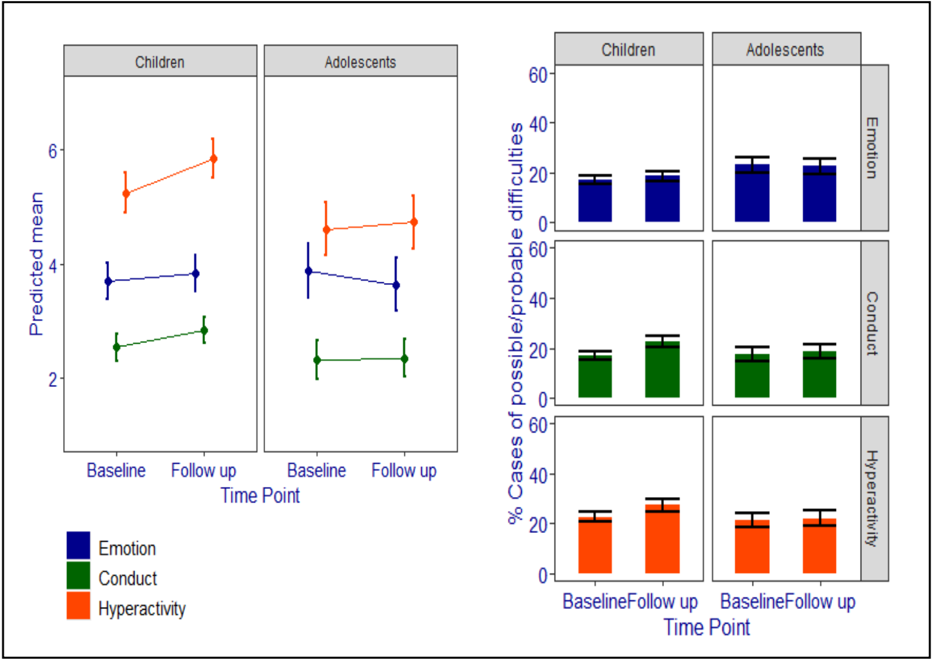
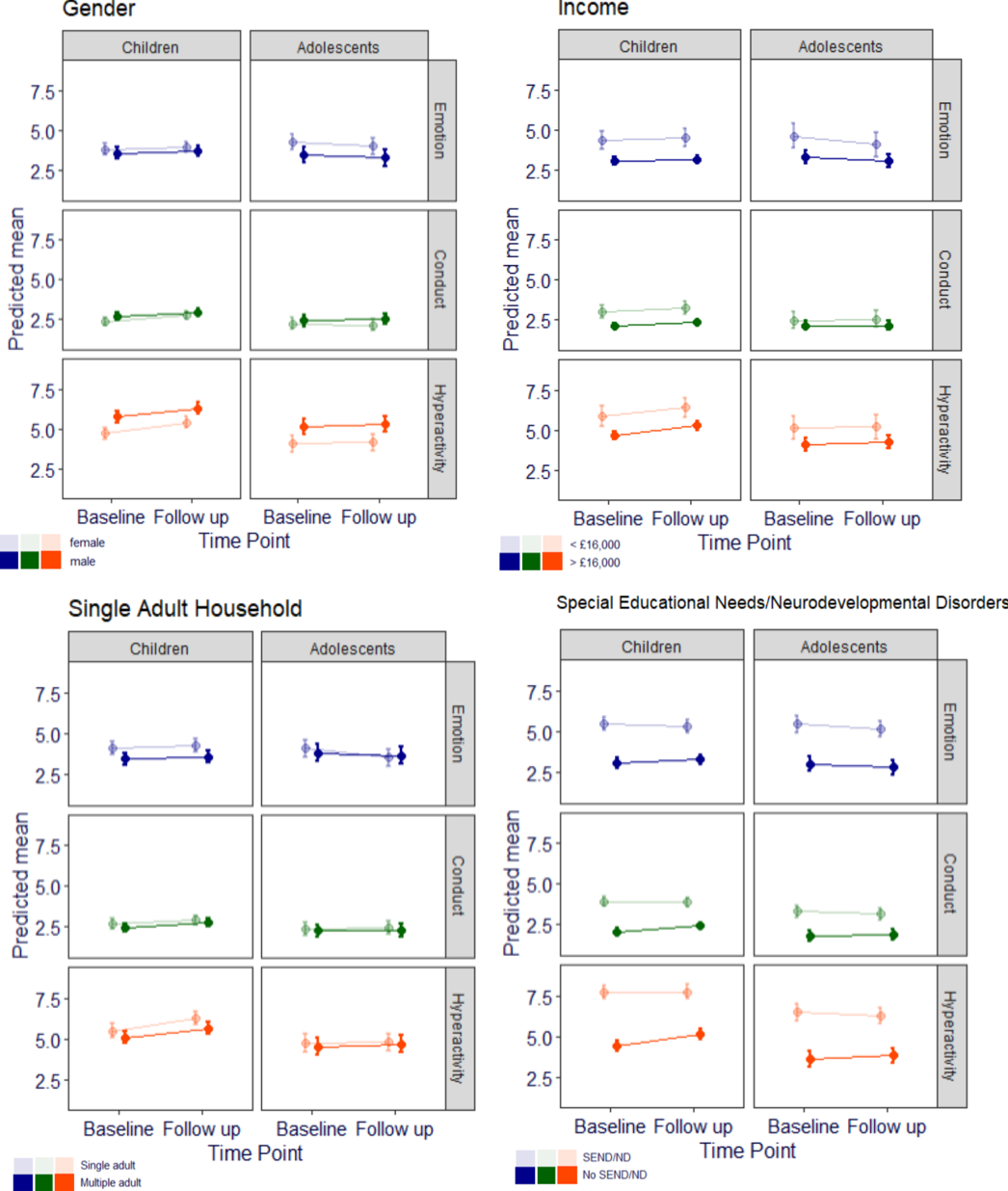
BackgroundThe COVID-19 pandemic has caused extensive disruption to the lives of children and young people. Understanding the psychological effects on children and young people, in the context of known risk factors, is crucial to mitigate the effects of the pandemic. This study set out to explore how mental health symptoms in children and adolescents changed over a month of full lockdown in the UK in response to the pandemic.MethodsUK-based parents and carers (n = 2,673) of school-aged children and young people aged between 4 and 16 years completed an online survey about their child’s mental health at two time points between March and May 2020, during early lockdown. The survey examined changes in emotional symptoms, conduct problems and hyperactivity/inattention.ResultsThe findings highlighted particular deteriorations in mental health symptoms among pre-adolescent children, which translated to a 10% increase in those meeting possible/probable caseness criteria for emotional symptoms, a 20% increase in hyperactivity/inattention, and a 35% increase in conduct problems. In contrast, changes among adolescents were smaller (4% and 8% increase for hyperactivity/inattention and conduct problems respectively) with a small reduction in emotional symptoms (reflecting a 3% reduction in caseness). Overall, there were few differences in change in symptoms or caseness over time according to demographic characteristics, but children and young people in low income households and those with special educational needs and/or neurodevelopmental disorders, exhibited elevated symptoms (and caseness) at both time points. ConclusionsThe findings highlight important areas of concern in terms of the potential impact of lockdown on children and young people’s adjustment. Developing an understanding of who has been most severely affected by the pandemic, and in what ways, is crucial in order to target effective support where it is most needed.
Overview
The claims and statistics of this paper haven’t been checked yet.
Free: it reads the open-access text and checks the first 5 claims that cite a source we can check. Create a free account to check every claim.
Integrity signals
Registry
Cites
Statistics
Figures
Verification
Claims the paper makes
The claims and statistics of this paper haven’t been checked yet.
Free: it reads the open-access text and checks the first 5 claims that cite a source we can check. Create a free account to check every claim.
Claims other papers make about this one
Each is checked against this paper’s own text: does it say what the citing paper says it does?
In the citing paper
“These experiences were likely felt most acutely by those already affected by socioeconomic marginalisation and deprivation.”
Self-check
Percentages, sums and reported differences re-computed from the paper’s own numbers.
The self-check needs the paper’s full text.
Citations
Cites
Kessler, R. C., Berglund, P., Demler, O., Jin, R., Merikangas, K. R., & Walters, E. E. (2005) · Archives of General Psychiatry · doi:10.1001/archpsyc.62.6.593 · Cited by 20,391
The Strengths and Difficulties Questionnaire: A research note
Goodman, R. (1997) · Journal of Child Psychology and Psychiatry · doi:10.1111/j.1469-7610.1997.tb01545.x · Cited by 14,908
Holmes, E. A., O'Connor, R. C., Perry, V. H., Tracey, I., Wessely, S., Arseneault, L., Ballard, C., Christensen, H., Cohen Silver, R., Everall, I., et al. (2020) · The Lancet Psychiatry · doi:10.1016/s2215-0366(20)30168-1 · Cited by 5,715
Induced root-secreted phenolic compounds as a belowground plant defense
Lanoue, A., Burlat, V., Schurr, U., & Röse, U. S. R. (2010) · Plant Signaling & Behavior · doi:10.4161/psb.5.8.12337 · Cited by 5,461
Goodman, R., Meltzer, H., & Bailey, V. (1998) · European Child & Adolescent Psychiatry · doi:10.1007/s007870050057 · Cited by 2,238
Goodman, R., Ford, T., Simmons, H., Gatward, R., & Meltzer, H. (2000) · British Journal of Psychiatry · doi:10.1192/bjp.177.6.534 · Cited by 1,818
Goodman, R. (1999) · Journal of Child Psychology and Psychiatry · doi:10.1017/s0021963099004096 · Cited by 1,756
Stone, L. L., Otten, R., Engels, R. C. M. E., Vermulst, A. A., & Janssens, J. M. A. M. (2010) · Clinical Child and Family Psychology Review · doi:10.1007/s10567-010-0071-2 · Cited by 1,031
Xie, X., Xue, Q., Zhou, Y., Zhu, K., Liu, Q., Zhang, J., & Song, R. (2020) · JAMA Pediatrics · doi:10.1001/jamapediatrics.2020.1619 · Cited by 1,001
Autonomy, conflict, and harmony in the family relationship.
Steinberg, L. D. (1990) · Cited by 783
Goodman, R., Ford, T., Simmons, H., Gatward, R., & Meltzer, H. (2003) · International Review of Psychiatry · doi:10.1080/0954026021000046128 · Cited by 706
Erskine, H. E., Norman, R. E., Ferrari, A. J., Chan, G. C. K., Copeland, W. E., Whiteford, H. A., & Scott, J. G. (2016) · Journal of the American Academy of Child & Adolescent Psychiatry · doi:10.1016/j.jaac.2016.06.016 · Cited by 555
Child and adolescent mental illness during COVID-19: A rapid review
Racine, N., Cooke, J. E., Eirich, R., Korczak, D. J., McArthur, B., & Madigan, S. (2020) · Psychiatry Research · doi:10.1016/j.psychres.2020.113307 · Cited by 383
Dunn, J., Deater-Deckard, K., Pickering, K., O'Connor, T. G., & Golding, J. (1998) · Journal of Child Psychology and Psychiatry · doi:10.1017/s0021963098003266 · Cited by 242
Nonweiler, J., Rattray, F., Baulcomb, J., Happé, F., & Absoud, M. (2020) · Children · doi:10.3390/children7090128 · Cited by 170
Psychiatric symptoms in children with intellectual disability
Linna, S., Moilanen, I., Ebeling, H. E., Piha, J., Kumpulainen, K., Tamminen, T., & Almqvist, F. (1999) · European Child & Adolescent Psychiatry · doi:10.1007/pl00010704 · Cited by 151
Patterns of agreement among parent, teacher and youth ratings in a referred sample
Salbach-Andrae, H., Lenz, K., & Lehmkuhl, U. (2009) · European Psychiatry · doi:10.1016/j.eurpsy.2008.07.008 · Cited by 148
Wickham, S., Whitehead, M., Taylor-Robinson, D., & Barr, B. (2017) · The Lancet Public Health · doi:10.1016/s2468-2667(17)30011-7 · Cited by 135
Psychosocial functioning of young children with learning problems
Gadeyne, E., Ghesquière, P., & Onghena, P. (2004) · Journal of Child Psychology and Psychiatry · doi:10.1111/j.1469-7610.2004.00241.x · Cited by 86
Nielsen, L. G., Rimvall, M. K., Clemmensen, L., Munkholm, A., Elberling, H., Olsen, E. M., Rask, C. U., Skovgaard, A. M., & Jeppesen, P. (2019) · PLoS ONE · doi:10.1371/journal.pone.0217707 · Cited by 58
Spencer, N. (2005) · Journal of Epidemiology & Community Health · doi:10.1136/jech.2004.020248 · Cited by 55
Children of the new century: mental health findings from the Millennium Cohort Study
Gutman, L. M., Joshi, H., Parsonage, M., & Schoon, I. (2015) · UCL Discovery (University College London) · Cited by 39
Research works printed but not linked: 2
- Angold, A., & Costello, E. (1993). Depressive comorbidity in children and adolescents. American journal of psychiatry, 150(12), 1779-1791.
- Levita, L. (2020). COVID-19 PSYCHOLOGICAL RESEARCH CONSORTIUM (C19PRC): Report 2. https://psyarxiv.com/s32j8/.
Cited by
The impact of COVID-19 lockdown on child and adolescent mental health: systematic review
Panchal, U., Salazar de Pablo, G., Franco, M., Moreno, C., Parellada, M., Arango, C., & Fusar-Poli, P. (2023) · European Child & Adolescent Psychiatry · doi:10.1007/s00787-021-01856-w · Cited by 1,028
“Children and adolescents with special educational needs and neurodevelopmental disorders (NDD) showed more emotional symptoms, conduct problems, and hyperactivity/inattention scores than those without special educational needs and neurodevelopmental disorders [100].”
BackgroundResultInfluentialRavens-Sieberer, U., Erhart, M., Devine, J., Gilbert, M., Reiss, F., Barkmann, C., Siegel, N. A., Simon, A. M., Hurrelmann, K., Schlack, R., et al. (2022) · Journal of Adolescent Health · doi:10.1016/j.jadohealth.2022.06.022 · Cited by 401
Ravens-Sieberer, U., Kaman, A., Erhart, M., Otto, C., Devine, J., Löffler, C., Hurrelmann, K., Bullinger, M., Barkmann, C., Siegel, N. A., et al. (2023) · European Child & Adolescent Psychiatry · doi:10.1007/s00787-021-01889-1 · Cited by 334
Child mental health in England before and during the COVID-19 lockdown
Newlove-Delgado, T., McManus, S., Sadler, K., Thandi, S., Vizard, T., Cartwright, C., & Ford, T. (2021) · The Lancet Psychiatry · doi:10.1016/s2215-0366(20)30570-8 · Cited by 266
Mental health of children and young people during pandemic
Ford, T., John, A., & Gunnell, D. (2021) · BMJ · doi:10.1136/bmj.n614 · Cited by 203
Metadata
- Authors
- Waite, P., Pearcey, S., Shum, A., Raw, J., Patalay, P., & Creswell, C.
- Affiliations
- University of Oxford (GB)
- MRC Unit for Lifelong Health and Ageing (GB)
- Publisher
- Center for Open Science
- Published
- 2020-12-08
- OpenAlex
- W3113146037
- Cited by
- 28
- References
- 22
- Citations by year
- 2024: 2 · 2023: 4 · 2022: 10 · 2021: 12
- Type
- posted content
- Language
- en
- Open access
- green
- doi.org
- Locations
- PsyArXiv (OSF Preprints) (submittedVersion, cc-by)
- PsyArXiv (OSF Preprints) (submittedVersion)
- Funders
- UK Research and Innovation
- National Institute for Health and Care Research (PDF-2016-09-092)
- Department of Health and Social Care
- Topics
- Social Sciences › Psychology › Clinical Psychology › COVID-19 and Mental Health
- Social Sciences › Psychology › Clinical Psychology › Child and Adolescent Psychosocial and Emotional Development
- Health Sciences › Medicine › Public Health, Environmental and Occupational Health › Maternal Mental Health During Pregnancy and Postpartum
- Keywords
- child mental health, adolescent mental health, COVID-19 lockdown, emotional symptoms, conduct problems, hyperactivity/inattention, preadolescents, low-income households, special educational needs, neurodevelopmental disorders, parent report
About these checks
Registry, retraction, Cites and statistics results are computed, not judged, with one exception: a printed reference that no index lists is read once by a model before it counts as a citation error. Claims are extracted by a model and kept only when their quote appears verbatim in the text; each cited source is then checked, with a model’s help, for whether it says what the claim relies on. Those verdicts can be wrong — read the claim’s quote and the cited source before relying on one.
Statistics and arithmetic are recomputed, not judged.
Confidence bands are shown only for fields calibrated on our annotated test set. None is calibrated yet, so no band is shown.
What counts as a claim ›How we measure confidence ›How we check this ›
Are you an author, or do you see a problem with this page? Request a review
Data sources
Bibliographic data: Semantic Scholar, OpenAlex, Crossref.
Contains information from the Semantic Scholar Academic Graph Datasets, made available under the ODC Attribution License (ODC-BY 1.0).
Semantic Scholar’s data is described in: Kinney, R., et al. (2023). The Semantic Scholar Open Data Platform. arXiv:2301.10140.
