

The DOI matches its Crossref record; 251 of the 251 references it cites were found in a registry or an index.
Neural systems underlying approach and avoidance in anxiety disorders
Open accessAbstract
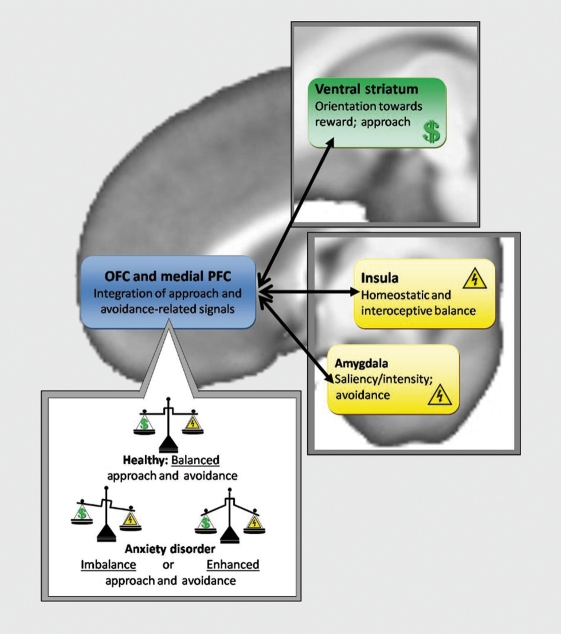
Approach-avoidance conflict is an important psychological concept that has been used extensively to better understand cognition and emotion. This review focuses on neural systems involved in approach, avoidance, and conflict decision making, and how these systems overlap with implicated neural substrates of anxiety disorders. In particular, the role of amygdala, insula, ventral striatal, and prefrontal regions are discussed with respect to approach and avoidance behaviors. Three specific hypotheses underlying the dysfunction in anxiety disorders are proposed, including: (i) over-representation of avoidance valuation related to limbic overactivation; (ii) under- or over-representation of approach valuation related to attenuated or exaggerated striatal activation respectively; and (iii) insufficient integration and arbitration of approach and avoidance valuations related to attenuated orbitofrontal cortex activation. These dysfunctions can be examined experimentally using versions of existing decision-making paradigms, but may also require new translational and innovative approaches to probe approach-avoidance conflict and related neural systems in anxiety disorders.
Overview
The claims and statistics of this paper haven’t been checked yet.
Run the check — free, no account needed. It reads the open-access text and checks the sources it cites.
Integrity signals
Registry
Cites
Statistics
Figures
Verification
Claims the paper makes
The claims and statistics of this paper haven’t been checked yet.
Run the check — free, no account needed. It reads the open-access text and checks the sources it cites.
Claims other papers make about this one
Each is checked against this paper’s own text: does it say what the citing paper says it does?
The source backs part of the claim, not all of it — or backs it for a different population, condition or comparison.
In the citing paper
“The PFC likely regulates play in a multifactorial manner, contributing to expression of the behavior through its roles in suppressing aggression, monitoring approach/avoid conflict, and modulating the stress response via its projections to the MeA and other stress-modulatory nodes (Aupperle & Paulus, 2010; McEwen & Morrison, 2013; Takahashi et al., 2014).”
From Developmental origins of sex differences in the neural circuitry of play (2020) · cites this paper as Aupperle & Paulus, 2010
Experimental — accuracy not yet measuredIn the citing paper
“For example, anxiety disorders and mood disorders share hyperactive amygdala responses to negatively valenced stimuli [2,3]”
From Reward circuitry dysfunction in psychiatric and neurodevelopmental disorders and genetic syndromes: animal models and clinical findings (2012) · cites this paper as [2]
Self-check
Percentages, sums and reported differences re-computed from the paper’s own numbers.
The self-check needs the paper’s full text.
Citations
Cites
Items 201–251 of 251
Vermetten, E. H. G. J. M., MD, PhD, Schmahl, C. G., MD, Southwick, S. M., MD, Bremner, A. J. D., & MD (2025) · Psychopharmacology Bulletin · doi:10.64719/pb.4128 · Cited by 126
Lanius, R. A., Frewen, P. A., Girotti, M., Neufeld, R. W. J., Stevens, T. K., & Densmore, M. (2007) · Psychiatry Research: Neuroimaging · doi:10.1016/j.pscychresns.2006.11.006 · Cited by 126
General mechanisms for making decisions?
Rushworth, M. F. S., Mars, R. B., & Summerfield, C. (2009) · Current Opinion in Neurobiology · doi:10.1016/j.conb.2009.02.005 · Cited by 124
Predicting danger: The nature, consequences, and neural mechanisms of predictive fear learningPreprint
McNally, G. P., & Westbrook, R. F. (2006) · Learning & Memory · doi:10.1101/lm.196606 · Cited by 124
Variations in the human cannabinoid receptor (CNR1) gene modulate striatal responses to happy faces
Chakrabarti, B., Kent, L., Suckling, J., Bullmore, E. T., & Baron‐Cohen, S. (2006) · European Journal of Neuroscience · doi:10.1111/j.1460-9568.2006.04697.x · Cited by 123
fMRI of fearful facial affect recognition in panic disorder: The cingulate gyrus–amygdala connection
Pillay, S. S., Gruber, S. A., Rogowska, J., Simpson, N. S., & Yurgelun-Todd, D. A. (2006) · Journal of Affective Disorders · doi:10.1016/j.jad.2006.04.007 · Cited by 121
Hopper, J. W., Pitman, R. K., Su, Z., Heyman, G. M., Lasko, N. B., Macklin, M. L., Orr, S. P., Lukas, S. E., & Elman, I. (2008) · Journal of Psychiatric Research · doi:10.1016/j.jpsychires.2007.10.008 · Cited by 119
Effects of lesions of the central nucleus of the amygdala on anxiety-like behaviors in the rat
Kopchia, K. L., Altman, H. J., & Commissaris, R. L. (1992) · Pharmacology Biochemistry and Behavior · doi:10.1016/0091-3057(92)90176-g · Cited by 119
The effects of insula damage on decision-making for risky gains and losses
Weller, J. A., Levin, I. P., Shiv, B., & Bechara, A. (2009) · Social Neuroscience · doi:10.1080/17470910902934400 · Cited by 119
Functional neuroimaging of mentalizing during the trust game in social anxiety disorder
Sripada, C., Angstadt, M., Banks, S., Nathan, P. J., Liberzon, I., & Phan, K. L. (2009) · Neuroreport · doi:10.1097/wnr.0b013e32832d0a67 · Cited by 119
Lindauer, R. J. L., Booij, J., Habraken, J. B. A., Uylings, H. B. M., Olff, M., Carlier, I. V. E., den Heeten, G. J., van Eck-Smit, B. L. F., & Gersons, B. P. R. (2004) · Biological Psychiatry · doi:10.1016/j.biopsych.2004.08.003 · Cited by 119
Yoon, K. L., Fitzgerald, D. A., Angstadt, M., McCarron, R., & Phan, K. L. (2006) · Psychiatry Research Neuroimaging · doi:10.1016/j.pscychresns.2006.05.004 · Cited by 117
Distinct brain systems underlie the processing of valence and arousal of affective pictures
Nielen, M. M. A., Heslenfeld, D. J., Heinen, K., Van Strien, J. W., Witter, M. P., Jonker, C., & Veltman, D. J. (2009) · Brain and Cognition · doi:10.1016/j.bandc.2009.05.007 · Cited by 114
Brain regions showing increased activation by threat-related words in panic disorder
Maddock, R. J., Buonocore, M. H., Kile, S. J., & Garrett, A. S. (2003) · Neuroreport · doi:10.1097/00001756-200303030-00006 · Cited by 112
Mueller, E. M., Nguyen, J., Ray, W. J., & Borkovec, T. D. (2009) · Journal of Behavior Therapy and Experimental Psychiatry · doi:10.1016/j.jbtep.2009.12.002 · Cited by 109
Northoff, G., Grimm, S., Boeker, H., Schmidt, C. F., Bermpohl, F., Heinzel, A., Hell, D., & Boesiger, P. (2005) · Human Brain Mapping · doi:10.1002/hbm.20202 · Cited by 103
Perfectionism and self-consciousness in social phobia and panic disorder with agoraphobia
Saboonchi, F., Lundh, L., & Öst, L. (1999) · Behaviour Research and Therapy · doi:10.1016/s0005-7967(98)00183-1 · Cited by 103
Orbitofrontal cortex lesions disrupt risk assessment in a novel serial decision-making task for rats
Pais-Vieira, M., Lima, D., & Galhardo, V. (2007) · Neuroscience · doi:10.1016/j.neuroscience.2006.11.058 · Cited by 98
Neural activation in the “reward circuit” shows a nonlinear response to facial attractiveness
Liang, X., Zebrowitz, L. A., & Zhang, Y. (2010) · Social Neuroscience · doi:10.1080/17470911003619916 · Cited by 95
Tonically active neurons in the monkey striatum do not preferentially respond to appetitive stimuli
Ravel, S., Legallet, E., & Apicella, P. (1999) · Experimental Brain Research · doi:10.1007/s002210050876 · Cited by 93
Striatal Function in Generalized Social Phobia: A Functional Magnetic Resonance Imaging Study
Sareen, J., Campbell, D. W., Leslie, W. D., Malisza, K. L., Stein, M. B., Paulus, M. P., Kravetsky, L. B., Kjernisted, K. D., Walker, J. R., & Reiss, J. P. (2006) · Biological Psychiatry · doi:10.1016/j.biopsych.2006.05.043 · Cited by 92
Diminished medial prefrontal cortex activity in blood-injection-injury phobia
Hermann, A., Schäfer, A., Walter, B., Stark, R., Vaitl, D., & Schienle, A. (2007) · Biological Psychology · doi:10.1016/j.biopsycho.2007.01.002 · Cited by 91
Probing reward function in post-traumatic stress disorder with beautiful facial images
Elman, I., Dan Ariely, C., Mažar, N., Aharon, I., Lasko, N. B., Macklin, M. L., Orr, S. P., Lukas, S. E., & Pitman, R. K. (2005) · Psychiatry Research · doi:10.1016/j.psychres.2005.04.002 · Cited by 91
Seedat, S., Warwick, J., van Heerden, B., Hugo, C., Zungu‐Dirwayi, N., van Kradenburg, J., & Stein, D. J. (2003) · Journal of Affective Disorders · doi:10.1016/s0165-0327(03)00047-8 · Cited by 90
Is the delay discounting paradigm useful in understanding social anxiety?
Rounds, J., Beck, J. G., & Grant, D. M. (2006) · Behaviour Research and Therapy · doi:10.1016/j.brat.2006.06.007 · Cited by 84 · cited 1×
“Seasonal affective disorder (SAD) has been associated with intact performance on reward/punishment learning,(41) but with exaggerated delayed discounting (greater preference for immediate over delayed rewards).(42) Panic disorder has been associated with intact IGT performance,(43) but with increased sensitivity to er…”
Neural basis of reward and craving - a homeostatic point of view
Paulus, M. P. (2007) · Dialogues in Clinical Neuroscience · doi:10.31887/dcns.2007.9.4/mpaulus · Cited by 82
Melcher, T., Falkai, P., & Gruber, O. (2008) · Brain Research Reviews · doi:10.1016/j.brainresrev.2008.06.003 · Cited by 79
Nucleus accumbens lesions decrease sensitivity to rapid changes in the delay to reinforcement
Acheson, A., Farrar, A. M., Patak, M., Hausknecht, K. A., Kieres, A. K., CHOI, S., de Wit, H., & RICHARDS, J. (2006) · Behavioural Brain Research · doi:10.1016/j.bbr.2006.06.024 · Cited by 79
Recognition of happy facial affect in panic disorder: An fMRI study
Pillay, S. S., Rogowska, J., Gruber, S. A., Simpson, N. S., & Yurgelun-Todd, D. A. (2006) · Journal of Anxiety Disorders · doi:10.1016/j.janxdis.2006.04.001 · Cited by 78
fMRI amygdala activation during a spontaneous panic attack in a patient with panic disorder
Pfleiderer, B., Zinkirciran, S., Arolt, V., Heindel, W. L., Deckert, J., & Domschke, K. (2007) · The World Journal of Biological Psychiatry · doi:10.1080/15622970701216673 · Cited by 77
Relationships between affective states and decision-making
Werner, N. S., Duschek, S., & Schandry, R. (2009) · International Journal of Psychophysiology · doi:10.1016/j.ijpsycho.2009.09.010 · Cited by 76 · cited 1×
“Individuals with high trait anxiety or specific phobia have reportedly exhibited impairment on the Iowa Gambling Task (IGT), a risk-based decision-making task(Aupperle RL et al, unpublished material).(37,38) GAD has been associated with intact performance on the IGT,(39) but increased errors during differential reward…”
Long-term effects of cognitive behavior therapy on brain activation in spider phobia
Schienle, A., Schäfer, A., Stark, R. M., & Vaitl, D. (2009) · Psychiatry Research Neuroimaging · doi:10.1016/j.pscychresns.2008.11.005 · Cited by 71
Time-varying amygdala response to emotional faces in generalized social phobia
Campbell, D. W., Sareen, J., Paulus, M. P., Goldin, P. R., Stein, M. B., & Reiss, J. P. (2007) · Biological Psychiatry · doi:10.1016/j.biopsych.2006.09.017 · Cited by 70
Self-citationBrain activation to phobia-related words in phobic subjects
Straube, T., Mentzel, H. J., Glauer, M., & Miltner, W. H. R. (2004) · Neuroscience Letters · doi:10.1016/j.neulet.2004.09.050 · Cited by 65
Resstel, L. B. M., de Souza, R. F., & Guimarães, F. S. (2007) · Physiology & Behavior · doi:10.1016/j.physbeh.2007.08.009 · Cited by 64
Behavioral and neural predictors of upcoming decisions
Cohen, M. X., & Ranganath, C. (2005) · Cognitive Affective & Behavioral Neuroscience · doi:10.3758/cabn.5.2.117 · Cited by 64
Visual presentation of phobic stimuli: Amygdala activation via an extrageniculostriate pathway?
Goossens, L., Schruers, K. R. J., Peeters, R. R., Griez, E. J. L., & Sunaert, S. G. (2007) · Psychiatry Research Neuroimaging · doi:10.1016/j.pscychresns.2006.12.005 · Cited by 58
The neural basis of risk ratings: Evidence from a functional magnetic resonance imaging (fMRI) study
Vorhold, V., Gießing, C., Wiedemann, P. M., Schütz, H., Gauggel, S., & Fink, G. R. (2007) · Neuropsychologia · doi:10.1016/j.neuropsychologia.2007.06.023 · Cited by 47
Hua, Q.-P., Zeng, X.-Z., Liu, J.-Y., Wang, J.-Y., Guo, J.-Y., & Luo, F. (2008) · Cellular and Molecular Neurobiology · doi:10.1007/s10571-007-9228-z · Cited by 40
The Neuronal Substrate of Risky Choice
Vorhold, V. (2008) · Annals of the New York Academy of Sciences · doi:10.1196/annals.1399.006 · Cited by 37
Principles of intrapersonal conflict
Brown, J. S. (1957) · Conflict Resolution · doi:10.1177/002200275700100204 · Cited by 34 · cited 1×
“Although these two fields used disparate experimental approaches, the similarities between Freud’s concept of psychic conflict and Pavlov’s use of conflicting conditioned reflexes to produce “experimental neuroses” were soon recognized.(7,8) Since that time, various experimental methods, paradigms, and self-report mea…”
DeVido, J. J., Jones, M., Geraci, M. F., Hollon, N. G., Blair, J., Pine, D. S., & Blair, K. S. (2008) · Psychological Medicine · doi:10.1017/s003329170800487x · Cited by 32 · cited 1×
“Generalized anxiety disorder (GAD) has been associated with intact performance on the IGT,(40) but increased errors during differential reward/punishment learning.(41) Seasonal affective disorder (SAD) has been associated with intact performance on reward/punishment learning,(41) but with exaggerated delayed discounti…”
‘Do I like this person?’ A network analysis of midline cortex during a social preference task
Chen, A. C., Welsh, R. C., Liberzon, I., & Taylor, S. F. (2010) · NeuroImage · doi:10.1016/j.neuroimage.2010.02.044 · Cited by 30
Martis, B., Wright, C. I., McMullin, K. G., Shin, L. M., & Rauch, S. L. (2004) · American Journal of Psychiatry · doi:10.1176/appi.ajp.161.1.67 · Cited by 27
Decision-making strategies by panic disorder subjects are more sensitive to errors
Ludewig, S. (2002) · Journal of Affective Disorders · doi:10.1016/s0165-0327(02)00089-7 · Cited by 27 · cited 1×
“Panic disorder has been associated with intact IGT performance,(43) but with increased sensitivity to errors during a two-choice prediction task.(44) Obviously these findings are mixed, making it difficult to draw any firm conclusions regarding the extent or specificity of decision-making dysfunction across anxiety di…”
Localisation of regions of intense pleasure response evoked by soccer goals
McLean, J., Brennan, D., Wyper, D. J., Condon, B. R., Hadley, D. M., & Cavanagh, J. (2008) · Psychiatry Research Neuroimaging · doi:10.1016/j.pscychresns.2008.02.005 · Cited by 24
Increased alcohol intake and behavioral disinhibition in rats with ventral striatal neuron loss
Johansson, Å., & Hansen, S. (2000) · Physiology & Behavior · doi:10.1016/s0031-9384(00)00284-5 · Cited by 23
Worry tendencies predict brain activation during aversive imagery
Schienle, A., Schäfer, A., Pignanelli, R., & Vaitl, D. (2009) · Neuroscience Letters · doi:10.1016/j.neulet.2009.06.041 · Cited by 22
Alvarez, E. O., & Ruarte, M. B. (2001) · Behavioural Brain Research · doi:10.1016/s0166-4328(01)00190-5 · Cited by 19
Beaufour, C., Bihan, C. L., Hamon, M., & Thiébot, M.-H. (2001) · Behavioral Neuroscience · doi:10.1037/0735-7044.115.1.125 · Cited by 8
Research works printed but not linked: 4
- American Psychiatric Association.Diagnostic and Statistical Manual of Mental Disorders. 4th ed, Text Revision. Washington, DC: American Psychiatric Association;2000
- BarlowDH.Anxiety and its Disorders: the Nature and Treatment of Anxiety and Panic. New York, NY: Guilford Press; 2002
- SavageCR.The role of emotion in strategic behavior: insights from psychopathology. In: Barrett LF, Salovey P, Mayer J, eds.The Wisdom in Feeling: Psychological Processes in Emotional Intelligence. New York, NY: Guilford Press; 2002211236
- 10.1002/1520-6394(2000)12:1 <69::AID-DA9>3.0.CO;2-K · DOI
Cited by
Sorted by citations
Uncertainty and anticipation in anxiety: an integrated neurobiological and psychological perspective
Grupe, D. W., & Nitschke, J. B. (2013) · Nature Reviews Neuroscience · doi:10.1038/nrn3524 · Cited by 2,007
Emotion Regulation and Psychopathology
Sheppes, G., Suri, G., & Gross, J. J. (2015) · Annual Review of Clinical Psychology · doi:10.1146/annurev-clinpsy-032814-112739 · Cited by 1,214
Executive function and PTSD: disengaging from trauma.
Aupperle, R. L., Melrose, A. J., Stein, M. B., & Paulus, M. P. (2012) · Neuropharmacology · doi:10.1016/j.neuropharm.2011.02.008 · Cited by 657
“digms therefore offer a useful framework for teasing apart PFC dysfunction in PTSD and other anxiety disorders (Aupperle and Paulus, 2010).”
Self-citationThe GABA system in anxiety and depression and its therapeutic potential
Möhler, H. (2011) · Neuropharmacology · doi:10.1016/j.neuropharm.2011.08.040 · Cited by 627
“An enhanced amygdala activation and a hypoactivation of the orbitofrontal (OFC) and medial prefrontal cortex (mPFC) was frequently reported in patients during processing of negative emotional stimuli, in particular in SAD and PTSD but also in GAD (Aupperle and Paulus, 2010; Elman et al., 2009; Goldin et al., 2009; New…”
A Corticostriatal Path Targeting Striosomes Controls Decision-Making under Conflict
Friedman, A., Homma, D., Gibb, L. G., Amemori, K.-I., Rubin, S. J., Hood, A. S., Riad, M. H., & Graybiel, A. M. (2015) · Cell · doi:10.1016/j.cell.2015.04.049 · Cited by 309
“A uthor M anuscript A uthor M anuscript A uthor M anuscript A uthor M anuscript function remain largely unknown (Aupperle and Paulus, 2010).”
Metadata
- Authors
- Robin L., A., & Martin, P. P.
- Affiliations
- Department of Psychiatry, University of California, San Diego (UCSD), California, USA
- Psychiatry Service, Veterans Affairs San Diego Health Care System, San Diego, California, USA
- Venue
- Dialogues in Clinical Neuroscience
- Publisher
- Informa UK Limited
- Published
- 2010-12-31
- Volume
- 12
- Issue
- 4
- Pages
- 517-531
- ISSN
- 1294-8322 (ISSN-L)
- 1958-5969
- PMC
- PMC3181993
- OpenAlex
- W1574357942
- Cited by
- 227
- References
- 251
- Citations by year
- 2026: 17 · 2025: 18 · 2024: 18 · 2023: 22 · 2022: 25 · 2021: 18 · 2020: 21 · 2019: 8 · 2018: 7 · 2017: 11 · 2016: 15 · 2015: 12 · 2014: 14 · 2013: 8 · 2012: 7
- FWCI
- 8.66
- Type
- journal article
- Language
- en
- Open access
- diamond
- doi.org
- Licence
- Locations
- Dialogues in Clinical Neuroscience (publishedVersion, cc-by-nc-nd)
- Europe PMC (PubMed Central) (publishedVersion, cc-by-nc-nd)
- PubMed Central (publishedVersion, cc-by-nc-nd)
- PubMed (publishedVersion)
- Topics
- Social Sciences › Psychology › Experimental and Cognitive Psychology › Anxiety, Depression, Psychometrics, Treatment, Cognitive Processes
- Life Sciences › Neuroscience › Cognitive Neuroscience › Neural and Behavioral Psychology Studies
- Life Sciences › Neuroscience › Cognitive Neuroscience › Memory and Neural Mechanisms
- Keywords
- approach-avoidance conflict, anxiety disorders, decision-making, amygdala, insula, ventral striatum, orbitofrontal cortex
- MeSH terms
- Anxiety Disorders, Avoidance Learning, Brain, Decision Making, Emotions, Humans, Models, Biological, Social Behavior
About these checks
Registry, retraction, Cites and statistics results are computed, not judged, with one exception: a printed reference that no index lists is read once by a model before it counts as a citation error. Claims are extracted by a model and kept only when their quote appears verbatim in the text; each cited source is then checked, with a model’s help, for whether it says what the claim relies on. Those verdicts can be wrong — read the claim’s quote and the cited source before relying on one.
Statistics and arithmetic are recomputed, not judged.
Confidence bands are shown only for fields calibrated on our annotated test set. None is calibrated yet, so no band is shown.
What counts as a claim ›How we measure confidence ›How we check this ›
Are you an author, or do you see a problem with this page? Request a review
