

The DOI matches its Crossref record; 37 of the 37 references it cites were found in a registry or an index.
Dopamine reward prediction error coding
Open accessAbstract
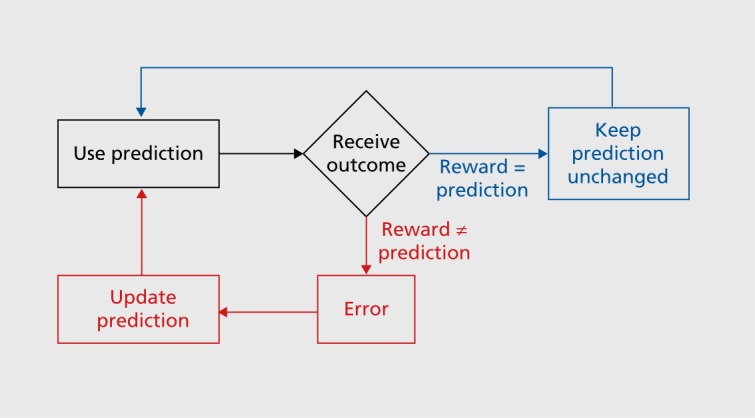
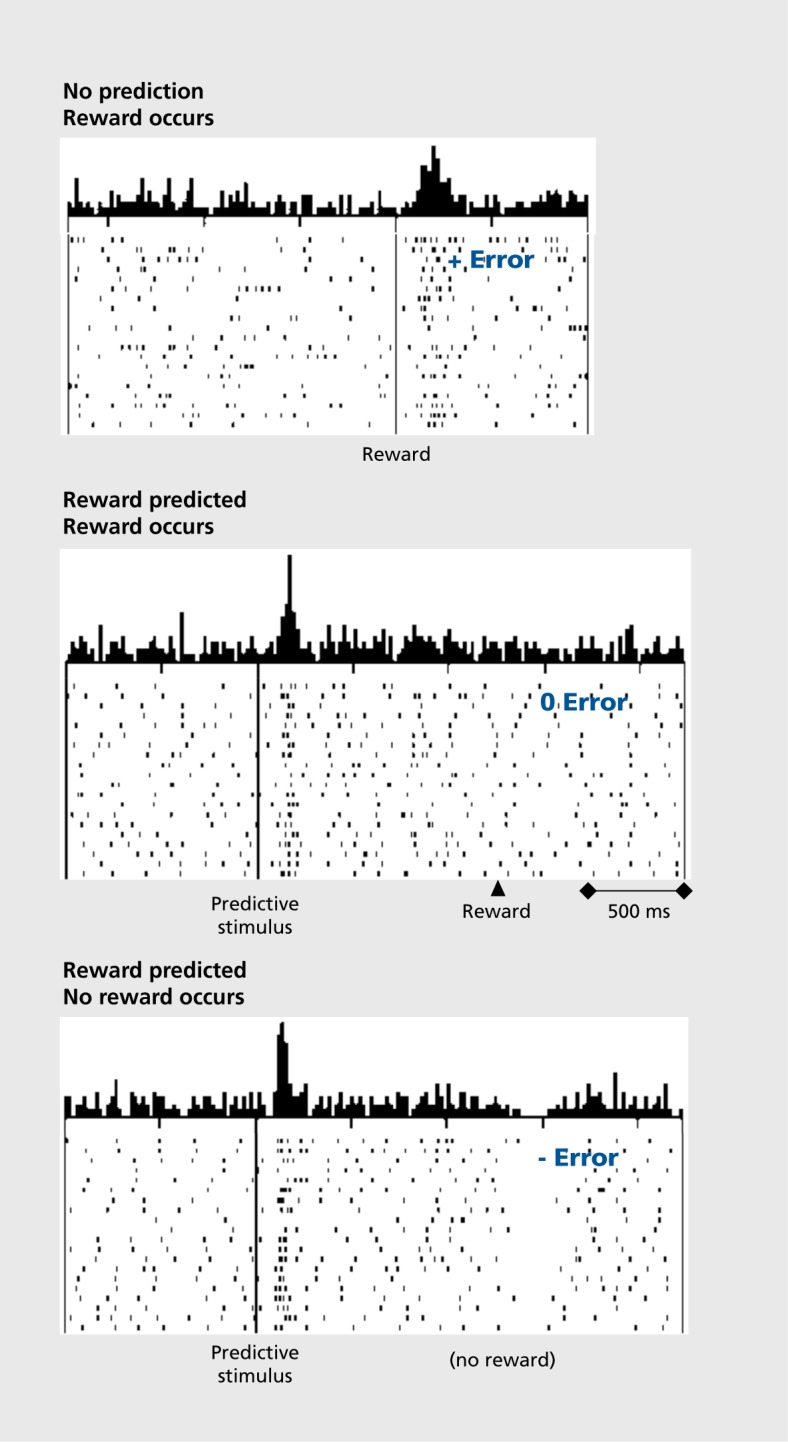
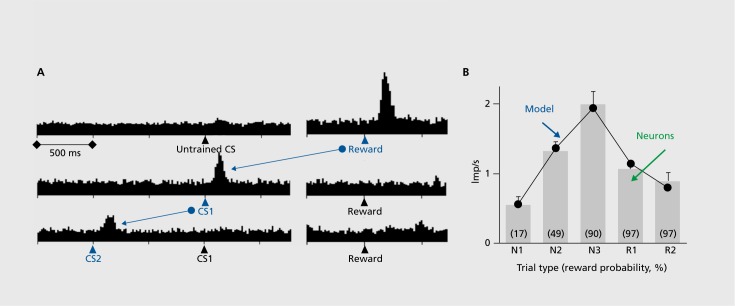
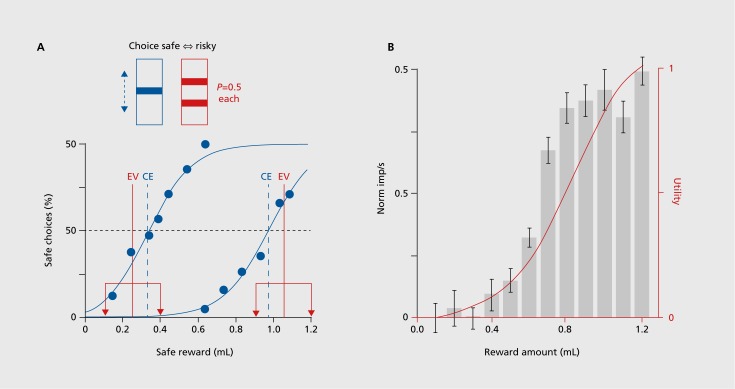
Reward prediction errors consist of the differences between received and predicted rewards. They are crucial for basic forms of learning about rewards and make us strive for more rewards-an evolutionary beneficial trait. Most dopamine neurons in the midbrain of humans, monkeys, and rodents signal a reward prediction error; they are activated by more reward than predicted (positive prediction error), remain at baseline activity for fully predicted rewards, and show depressed activity with less reward than predicted (negative prediction error). The dopamine signal increases nonlinearly with reward value and codes formal economic utility. Drugs of addiction generate, hijack, and amplify the dopamine reward signal and induce exaggerated, uncontrolled dopamine effects on neuronal plasticity. The striatum, amygdala, and frontal cortex also show reward prediction error coding, but only in subpopulations of neurons. Thus, the important concept of reward prediction errors is implemented in neuronal hardware.
Overview
The claims and statistics of this paper haven’t been checked yet.
Run the check — free, no account needed. It reads the open-access text and checks the sources it cites.
Integrity signals
Registry
Cites
Statistics
Figures
Verification
Claims the paper makes
The claims and statistics of this paper haven’t been checked yet.
Run the check — free, no account needed. It reads the open-access text and checks the sources it cites.
Claims other papers make about this one
Each is checked against this paper’s own text: does it say what the citing paper says it does?
The source backs part of the claim, not all of it — or backs it for a different population, condition or comparison.
In the citing paper
“This facilitates the formation of LTM cause/effect relations between particular needs and their adequate aims and objects, which in turn yields the iterative “reward prediction error” cycle that codes ongoing learning from experience (see Schultz, 2016).”
From The Hard Problem of Consciousness and the Free Energy Principle (2019) · cites this paper as Schultz, 2016
Experimental — accuracy not yet measuredIn the citing paper
“The reward prediction error, in which changes in dopamine firing encode differences between an expected vs. actual reward outcome, allows for dynamic learning from experience and updates in reward expectations (Gradin et al., 2011; Schultz, 2016).”
From The effects of early life stress on reward processing (2018) · cites this paper as Schultz, 2016
In the citing paper
“Dopamine signaling to the basal ganglia, including the nucleus accumbens, also plays a role in what is known as the reward prediction error, a subconstruct of approach motivation.”
From The effects of early life stress on reward processing (2018) · cites this paper as Schultz, 2016
In the citing paper
“It was thus shown that dopaminergic neurons increase the firing rate for unpredicted reward outcomes only, whereas expected rewards provoke no change in dopamine firing rate.”
From Circuit Mechanisms of Reward, Anhedonia, and Depression (2019) · cites this paper as Schultz, 2016
In the citing paper
“This is also true for aversive stimuli, with decreased firing rates of dopaminergic neurons below baseline.”
From Circuit Mechanisms of Reward, Anhedonia, and Depression (2019) · cites this paper as Schultz, 2016
In the citing paper
“The increase of firing rate is affected in a size-dependent manner (Schultz, 2016).”
From Circuit Mechanisms of Reward, Anhedonia, and Depression (2019) · cites this paper as Schultz, 2016
In the citing paper
“given that, according to reinforcement learning theory, the US response is a driver of learning, while the CS response is considered a consequence of learning6,18–20.”
From Dopamine dynamics as a regulatory mechanism for shifting between defensive and reward-seeking behaviors (2026) · cites this paper as [20]
Self-check
Percentages, sums and reported differences re-computed from the paper’s own numbers.
The self-check needs the paper’s full text.
Citations
Cites
A neural substrate of prediction and reward
Schultz, W., Dayan, P., & Montague, P. R. (1997) · Science · doi:10.1126/science.275.5306.1593 · Cited by 9,388
Rao, R. P. N., & Ballard, D. H. (1999) · Nature Neuroscience · doi:10.1038/4580 · Cited by 5,483
Predictive reward signal of dopamine neurons
Schultz, W. (1998) · Journal of Neurophysiology · doi:10.1152/jn.1998.80.1.1 · Cited by 4,564
Increasing risk: I. A definition
Rothschild, M., & Stiglitz, J. (1970) · Journal of Economic Theory · doi:10.1016/0022-0531(70)90038-4 · Cited by 3,760
Olds, J., & Milner, P. (1954) · Journal of Comparative and Physiological Psychology · doi:10.1037/h0058775 · Cited by 3,176
Kapur, S. (2003) · American Journal of Psychiatry · doi:10.1176/appi.ajp.160.1.13 · Cited by 2,813
Dopamine-dependent prediction errors underpin reward-seeking behaviour in humans
Pessiglione, M., Seymour, B., Flandin, G., Dolan, R. J., & Frith, C. D. (2006) · Nature · doi:10.1038/nature05051 · Cited by 1,584
Temporal difference models and reward-related learning in the human brain
O'Doherty, J. P., Dayan, P., Friston, K., Critchley, H., & Dolan, R. J. (2003) · Neuron · doi:10.1016/s0896-6273(03)00169-7 · Cited by 1,522
Toward a modern theory of adaptive networks: Expectation and prediction.
Sutton, R. S., & Barto, A. G. (1981) · Psychological Review · doi:10.1037/0033-295x.88.2.135 · Cited by 1,450
Two types of dopamine neuron distinctly convey positive and negative motivational signals
Matsumoto, M., & Hikosaka, O. (2009) · Nature · doi:10.1038/nature08028 · Cited by 1,378
Neuron-type-specific signals for reward and punishment in the ventral tegmental area
Cohen, J. Y., Haesler, S., Vong, L., Lowell, B. B., & Uchida, N. (2012) · Nature · doi:10.1038/nature10754 · Cited by 1,318
Lateral habenula as a source of negative reward signals in dopamine neurons
Matsumoto, M., & Hikosaka, O. (2007) · Nature · doi:10.1038/nature05860 · Cited by 1,292
Schultz, W., Apicella, P., & Ljungberg, T. (1993) · The Journal of Neuroscience · doi:10.1523/jneurosci.13-03-00900.1993 · Cited by 1,291
Animal intelligence; experimental studies
Thorndike, E. L. (1911) · doi:10.5962/bhl.title.55072 · Cited by 1,100
Temporal Prediction Errors in a Passive Learning Task Activate Human Striatum
McClure, S. M., Berns, G. S., & Montague, P. R. (2003) · Neuron · doi:10.1016/s0896-6273(03)00154-5 · Cited by 917
Choice Under Uncertainty: Problems Solved and Unsolved
Machina, M. J. (1987) · The Journal of Economic Perspectives · doi:10.1257/jep.1.1.121 · Cited by 907
Preferential activation of midbrain dopamine neurons by appetitive rather than aversive stimuli
Mirenowicz, J., & Schultz, W. (1996) · Nature · doi:10.1038/379449a0 · Cited by 829
Self-citationAddiction as a Computational Process Gone Awry
Redish, A. D. (2004) · Science · doi:10.1126/science.1102384 · Cited by 556
Is the short-latency dopamine response too short to signal reward error?
Redgrave, P., Prescott, T. J., & Gurney, K. (1999) · Trends in Neurosciences · doi:10.1016/s0166-2236(98)01373-3 · Cited by 506
Double dissociation of value computations in orbitofrontal and anterior cingulate neurons
Kennerley, S. W., Behrens, T. E. J., & Wallis, J. D. (2011) · Nature Neuroscience · doi:10.1038/nn.2961 · Cited by 485
Influence of Reward Delays on Responses of Dopamine Neurons
Kobayashi, S., & Schultz, W. (2008) · Journal of Neuroscience · doi:10.1523/jneurosci.1600-08.2008 · Cited by 440
Pan, W.-X., Schmidt, R., Wickens, J. R., & Hyland, B. I. (2005) · The Journal of Neuroscience · doi:10.1523/jneurosci.1478-05.2005 · Cited by 429
Responses of midbrain dopamine neurons to behavioral trigger stimuli in the monkey
Schultz, W. (1986) · Journal of Neurophysiology · doi:10.1152/jn.1986.56.5.1439 · Cited by 390
Expectation modulates neural responses to pleasant and aversive stimuli in primate amygdala
Belova, M. A., Paton, J. J., Morrison, S. E., & Salzman, C. D. (2007) · Neuron · doi:10.1016/j.neuron.2007.08.004 · Cited by 349
The globus pallidus sends reward-related signals to the lateral habenula
Hong, S., & Hikosaka, O. (2008) · Neuron · doi:10.1016/j.neuron.2008.09.035 · Cited by 346
Seo, H., & Lee, D. (2007) · The Journal of Neuroscience · doi:10.1523/jneurosci.2369-07.2007 · Cited by 324
Caudate Encodes Multiple Computations for Perceptual Decisions
Ding, L., & Gold, J. I. (2010) · Journal of Neuroscience · doi:10.1523/jneurosci.2894-10.2010 · Cited by 299
Activation of the human brain by monetary reward
Thut, G., Schultz, W., Roelcke, U., Nienhusmeier, M., Missimer, J. H., Maguire, R. P., & Leenders, K. L. (1997) · Neuroreport · doi:10.1097/00001756-199703240-00033 · Cited by 273
Corbett, D., & Wise, R. A. (1980) · Brain Research · doi:10.1016/0006-8993(80)90666-6 · Cited by 264
Human substantia nigra neurons encode unexpected financial rewards
Zaghloul, K. A., Blanco, J. A., Weidemann, C. T., McGill, K., Jaggi, J. L., Baltuch, G. H., & Kahana, M. J. (2009) · Science · doi:10.1126/science.1167342 · Cited by 264
Dopamine prediction error responses integrate subjective value from different reward dimensions
Lak, A., Stauffer, W. R., & Schultz, W. (2014) · Proceedings of the National Academy of Sciences · doi:10.1073/pnas.1321596111 · Cited by 257
Self-citationDopamine Reward Prediction Error Responses Reflect Marginal Utility
Stauffer, W. R., Lak, A., & Schultz, W. (2014) · Current Biology · doi:10.1016/j.cub.2014.08.064 · Cited by 204
Temporally Extended Dopamine Responses to Perceptually Demanding Reward-Predictive Stimuli
Nomoto, K., Schultz, W., Watanabe, T., & Sakagami, M. (2010) · The Journal of Neuroscience · doi:10.1523/jneurosci.4828-09.2010 · Cited by 158
Self-citationFiorillo, C. D., Song, M. R., & Yun, S. R. (2013) · The Journal of Neuroscience · doi:10.1523/jneurosci.3883-12.2013 · Cited by 98
Dopamine neurons learn to encode the long-term value of multiple future rewards
Enomoto, K., Matsumoto, N., Nakai, S., Satoh, T., Sato, T. K., Ueda, Y., Inokawa, H., Haruno, M., & Kimura, M. (2011) · Proceedings of the National Academy of Sciences · doi:10.1073/pnas.1014457108 · Cited by 83
Apicella, P., Deffains, M., Ravel, S., & Legallet, E. (2009) · European Journal of Neuroscience · doi:10.1111/j.1460-9568.2009.06872.x · Cited by 68
Supplementary Eye Field Encodes Reward Prediction Error
So, N., & Stuphorn, V. (2012) · Journal of Neuroscience · doi:10.1523/jneurosci.4419-11.2012 · Cited by 59
Research works printed but not linked: 3
- Pavlov PI., 1927, Conditioned Reflexes. London, UK: Oxford University Press:
- Rescorla RA., 1972, Classical Conditioning II: Current Research and Theory. New York, NY: Appleton Century Crofts:, 64
- von Neumann J., 1944, The Theory of Games and Economic Behavior. Princeton, NJ: Princeton University Press:
Cited by
Sorted by citations
Jauhar, S., Johnstone, M., & McKenna, P. J. (2022) · The Lancet · doi:10.1016/s0140-6736(21)01730-x · Cited by 1,116
The entropic brain - revisited
Carhart-Harris, R. L. (2018) · Neuropharmacology · doi:10.1016/j.neuropharm.2018.03.010 · Cited by 522
Neural Circuitry of Reward Prediction Error
Watabe-Uchida, M., Eshel, N., & Uchida, N. (2017) · Annual Review of Neuroscience · doi:10.1146/annurev-neuro-072116-031109 · Cited by 437
Luijten, M., Schellekens, A. F., Kühn, S., Machielse, M. W. J., & Sescousse, G. (2017) · JAMA Psychiatry · doi:10.1001/jamapsychiatry.2016.3084 · Cited by 402
Dopamine: The Neuromodulator of Long-Term Synaptic Plasticity, Reward and Movement Control
Speranza, L., di Porzio, U., Viggiano, D., Donato, A. D., & Volpicelli, F. (2021) · Cells · doi:10.3390/cells10040735 · Cited by 472
Metadata
- Authors
- Schultz, W.
- Affiliations
- University of Cambridge (GB)
- Corresponding author
- Schultz, Wolfram
- ORCID
- Schultz, Wolfram
- Venue
- Dialogues in Clinical Neuroscience
- Publisher
- Informa UK Limited
- Published
- 2016-03-31
- Volume
- 18
- Issue
- 1
- Pages
- 23-32
- ISSN
- 1294-8322 (ISSN-L)
- 1958-5969
- PMC
- PMC4826767
- OpenAlex
- W2419438565
- Cited by
- 597
- References
- 37
- Citations by year
- 2026: 84 · 2025: 83 · 2024: 77 · 2023: 68 · 2022: 64 · 2021: 53 · 2020: 36 · 2019: 62 · 2018: 45 · 2017: 20 · 2016: 4
- FWCI
- 24.37
- Type
- journal article
- Language
- en
- Open access
- diamond
- doi.org
- Licence
- Locations
- Dialogues in Clinical Neuroscience (publishedVersion, cc-by-nc-nd)
- Europe PMC (PubMed Central) (publishedVersion, cc-by-nc-nd)
- PubMed Central (publishedVersion, cc-by-nc-nd)
- PubMed (publishedVersion)
- Funders
- Wellcome Trust (093875)
- Topics
- Life Sciences › Neuroscience › Cellular and Molecular Neuroscience › Neurotransmitter Receptor Influence on Behavior
- Life Sciences › Neuroscience › Cognitive Neuroscience › Neural and Behavioral Psychology Studies
- Life Sciences › Neuroscience › Cognitive Neuroscience › Neural dynamics and brain function
- Keywords
- dopamine, reward prediction error, midbrain dopaminergic neurons, reward learning, drug addiction, neuroplasticity, striatum, amygdala, frontal cortex
- MeSH terms
- Animals, Brain, Dopamine, Forecasting, Humans, Learning, Nerve Net, Neuronal Plasticity, Reward
About these checks
Registry, retraction, Cites and statistics results are computed, not judged, with one exception: a printed reference that no index lists is read once by a model before it counts as a citation error. Claims are extracted by a model and kept only when their quote appears verbatim in the text; each cited source is then checked, with a model’s help, for whether it says what the claim relies on. Those verdicts can be wrong — read the claim’s quote and the cited source before relying on one.
Statistics and arithmetic are recomputed, not judged.
Confidence bands are shown only for fields calibrated on our annotated test set. None is calibrated yet, so no band is shown.
What counts as a claim ›How we measure confidence ›How we check this ›
Are you an author, or do you see a problem with this page? Request a review
