

Molecular dynamics simulation of an entire cell
Open accessThe DOI matches its Crossref record; 83 of the 85 references it cites were found in a registry or an index; 30 of the 40 sources its claims cite were checked for support.
Abstract
The ultimate microscope, directed at a cell, would reveal the dynamics of all the cell’s components with atomic resolution. In contrast to their real-world counterparts, computational microscopes are currently on the brink of meeting this challenge. In this perspective, we show how an integrative approach can be employed to model an entire cell, the minimal cell, JCVI-syn3A, at full complexity. This step opens the way to interrogate the cell’s spatio-temporal evolution with molecular dynamics simulations, an approach that can be extended to other cell types in the near future.
Overview
CoChat Summary
TL;DR
The paper presents an integrative Martini coarse-grained model of the entire minimal cell JCVI-syn3A, comprising 561 million beads representing more than six billion atoms. It is a proof-of-principle construction and roadmap toward whole-cell molecular dynamics, but an actual MD simulation of the full cell has not yet been performed.
Key findings
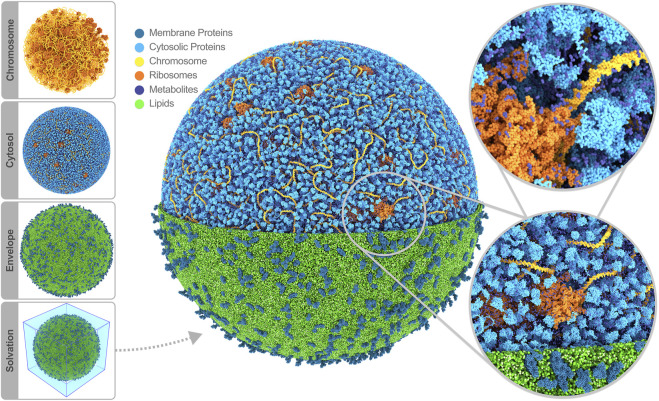
- A complete Martini model of JCVI-syn3A was built with 561 million CG beads, representing >6 billion atoms, including 60,887 soluble proteins, 2,200 membrane proteins, 503 ribosomes, a 543 kbp circular dsDNA, 1.3 million lipids, 1.7 million metabolites, 14 million ions, and 447 million water beads.
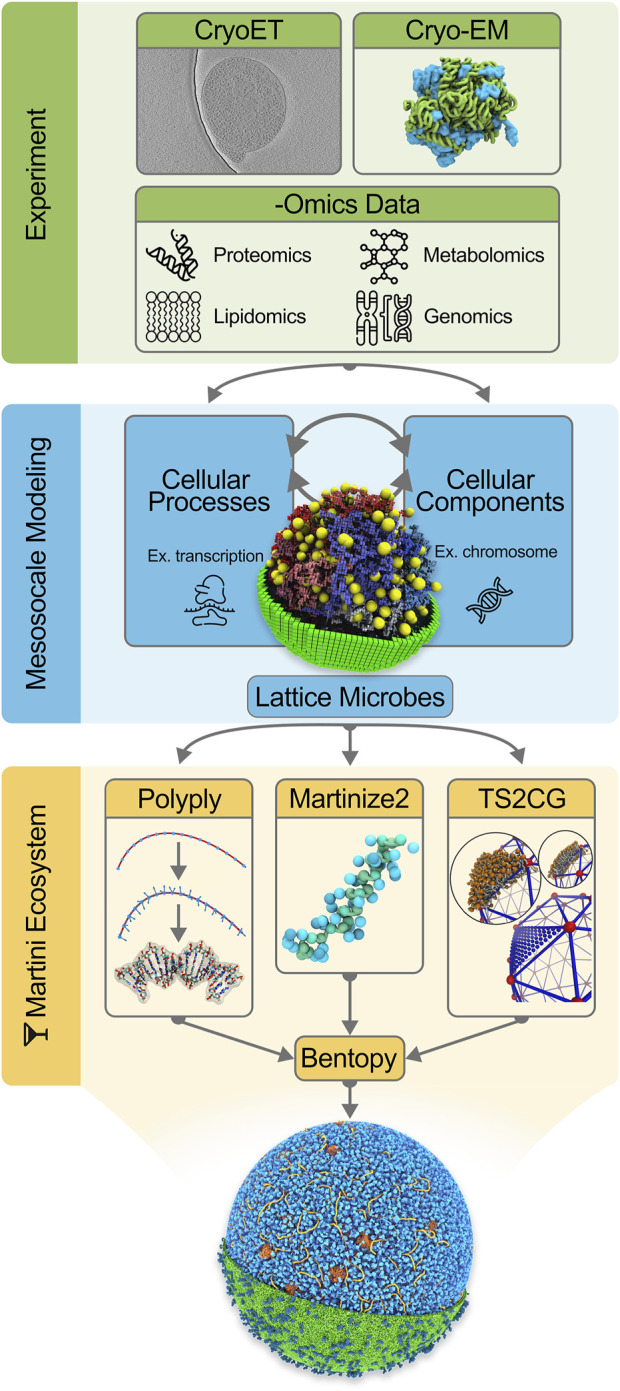
- The model integrates experimental and computational data—cryo-electron tomography, proteomics, metabolomics, lipidomics, and AlphaFold2 structures—using Martini ecosystem tools: Polyply, Martinize2, TS2CG, and Bentopy.
- The authors report that running the full-cell MD simulation is currently non-trivial because Gromacs has difficulties handling hundreds of millions of particles, especially with large molecules such as the genome spread over multiple domains; ddcMD and OpenMM are suggested alternatives.
- They anticipate reaching 10–100 µs timescales in the foreseeable future, which would still be insufficient to equilibrate an entire cell, so generated ensembles would remain dependent on the starting state.
Methods
- This is a perspective/integrative modeling study: experimental data from cryoET, cryo-EM, -omics, and a prior whole-cell kinetic model inform construction of the in silico cell.
- The chromosome was modeled as a fractal globule, relaxed with Brownian dynamics, and backmapped to a Martini one-bead-per-base-pair representation using Polyply; cytosolic proteins were packed with Bentopy; the membrane was built with TS2CG; and the system was solvated in a rhombic dodecahedron with 135 mM NaCl.
- No production MD simulation of the full cell is reported; the paper describes the construction workflow and prospects for future simulation.
Limitations
- Stated: the model uses Martini 2 because Martini 3 models for nucleic acids and other essential components are still under development; Martini cannot sample protein secondary conformational changes, and protein–protein/protein–lipid interaction details may be affected.
- Stated: the cytosol includes only a subset of metabolites (1.7 million metabolites, about 55% of the complete metabolome), AlphaFold2 provided only monomeric protein structures, and multimeric proteins such as ribosomes and membrane transport complexes are omitted or represented by homologs.
- Stated and evident: solvent/ion and lipid-leaflet balance is non-trivial and may cause osmotic or curvature stress; whole-cell equilibration is not achievable at expected timescales; classical MD cannot capture non-reactive, out-of-equilibrium cellular processes, and the model reflects average steady-state concentrations.
Model-written summary. Check it against the paper before relying on it.
Integrity signals
Registry
Cites
Statistics
Figures
Verification
Claims the paper makes
22 Valid · 6 Not valid · 6 Not checked · 31 Own results and interpretations
Every source the paper cites for this claim was checked and supports it.
In the paper
“The nucleoid structure of Syn3A was previously modeled by Gilbert et al. (2021) based on the ribosome distribution and cell boundary determined by cryo-electron tomography.”
§ Molecular dynamics simulation of an entire cell > Building cells with the Martini ecosystem > Chromosome building
What the sources say
- Supportedcites Gilbert et al., 2021 matched to “‘Generating chromosome geometries in a minimal cell from cryo-electron tomograms and chromosome conformation capture maps’” (2021) source
Methods §2.2 says the Syn3A chromosome model was designed to match the cell boundary and ribosome distribution. The Abstract and Figure 1 workflow state that these constraints came from cryo-electron tomograms and were used to generate chromosome configurations. (LLM, conf=0.94)
plain- Asserted: passes — The authors put it forward as true.
- Checkable: passes — It can be checked against evidence.
- Load-bearing: unclear — It is unclear whether the paper’s conclusions depend on it.
- Based: passes — The paper gives a reason why it holds.
- Supported
The cited sources support only part of this claim — read each source’s verdict below.
In the paper
“Unbalanced systems might experience strong osmotic pressures and membrane (curvature) stress, causing unwanted shape deformations all the way to membrane rupture.”
§ Molecular dynamics simulation of an entire cell > Discussion
What the sources say
- Partly supportedcites Pezeshkian et al., 2021 matched to “Molecular architecture and dynamics of SARS-CoV-2 envelope by integrative modeling” (2021) sourceExperimental — accuracy not yet measured
In “Constructing the viral envelope” (page unavailable), the paper reports that excess solvent particles led to pore formation and membrane rupture. In “4. Lipid fingerprinting analysis” (page unavailable), it says an imbalance in surface-area-to-volume ratio could deform the particle. These passages support deformation and rupture in unbalanced simulations, but do not identify strong osmotic pressure or membrane curvature stress as the causes. (LLM, conf=0.84)
- Supportedcites Vermaas et al., 2022 matched to “‘Assembly and analysis of cell-scale membrane envelopes’” (2022) source
In Results and Analysis, “Protocell Stability Assessment,” the paper says overfilling a closed lipid compartment can rupture its membrane, while underfilling can cause significant deformation. The same section links the observed deformations to pressure differences across the membrane and discusses the role of curvature. It does not report rupture in its simulated systems, but the claim presents rupture as a possibility. (LLM, conf=0.91)
hedgedstates a possible cause- Asserted: passes — The authors put it forward as true.
- Checkable: passes — It can be checked against evidence.
- Load-bearing: passes — The paper’s conclusions depend on it.
- Based: passes — The paper gives a reason why it holds.
- Partly supported
Every source the paper cites for this claim was checked and supports it.
In the paper
“The workflow used in Martinize2 additionally performs quality checks on the atomistic protein structures and alerts to potential problems making it ideal for such a high-complexity use case (Kroon et al., 2022).”
§ Molecular dynamics simulation of an entire cell > Building cells with the Martini ecosystem
What the sources say
- Supportedcites Kroon et al., 2022 matched to “Martinize2 and Vermouth: Unified Framework for Topology Generation” (2022) source
The Martinize2 section describes checks that identify missing or additional atoms in input structures. The Discussion reports that Martinize2 warns users about problems it cannot automatically resolve and issued a warning or error for all structures with seriously malformed residues in two benchmark sets. It also describes the program as fit for high-throughput and high-complexity tasks. Page numbers were not supplied. (LLM, conf=0.94)
plainstates a cause- Asserted: passes — The authors put it forward as true.
- Checkable: passes — It can be checked against evidence.
- Load-bearing: unclear — It is unclear whether the paper’s conclusions depend on it.
- Based: passes — The paper gives a reason why it holds.
- Supported
The cited sources support only part of this claim — read each source’s verdict below.
In the paper
“The Martini force field employs a four-to-one mapping scheme, where up to four heavy atoms and associated hydrogens are represented by one CG bead.”
§ Molecular dynamics simulation of an entire cell > Introduction
What the sources say
- Partly supportedcites Marrink et al., 2022 matched to “Two decades of Martini: Better beads, broader scope” (2023) sourceExperimental — accuracy not yet measured
Section 3.4 (Best practices and tips; page unavailable) describes regular Martini beads as mapping four atoms to one bead, alongside small three-to-one and tiny two-to-one beads. This supports the claim’s “up to four” mapping, but the passage does not specify that the counted atoms are heavy atoms or state how their associated hydrogens are represented. (LLM, conf=0.82)
plain- Asserted: passes — The authors put it forward as true.
- Checkable: passes — It can be checked against evidence.
- Load-bearing: passes — The paper’s conclusions depend on it.
- Based: passes — The paper gives a reason why it holds.
- Partly supported
The cited sources support only part of this claim — read each source’s verdict below.
In the paper
“Gromacs (Abraham et al., 2015), the main MD engine to run Martini-based simulations, is having difficulties handling systems comprising hundreds of millions of particles, in particular featuring large molecules such as the genome spread over multiple domains.”
§ Molecular dynamics simulation of an entire cell > Building cells with the Martini ecosystem > Solvating and simulating the cell
What the sources say
- Partly supportedcites Abraham et al., 2015 matched to “‘GROMACS: High performance molecular simulations through multi-level parallelism from laptops to supercomputers’” (2015) sourceExperimental — accuracy not yet measured
The Software description (p. unavailable) describes practical limits on GROMACS parallelism, but its example concerns a 150,000-atom system on a million cores—not a system with hundreds of millions of particles. The paper says MARTINI uses GROMACS infrastructure, but does not identify it as the main engine for MARTINI simulations or discuss difficulties with genome-sized molecules spanning domains. (LLM, conf=0.82)
plainstates a cause- Asserted: passes — The authors put it forward as true.
- Checkable: passes — It can be checked against evidence.
- Load-bearing: passes — The paper’s conclusions depend on it.
- Based: passes — The paper gives a reason why it holds.
- Partly supported
20 more claims · 6 with their cited sources checked
Create a free account to see all 65 claims and every source verdict.
- Probably not a substantial claim. 23
- It may state two separate claims as one. 25
Claims other papers make about this one
Each is checked against this paper’s own text: does it say what the citing paper says it does?
The cited source says what the claim attributes to it.
In the citing paper
“Since this pioneering work, genome-wide models have been developed to represent other bacterial organisms, including Escherichia coli.8,20–22”
From How to build the virtual cell with artificial intelligence: Priorities and opportunities (2024) · cites this paper as [20]
The cited source says what the claim attributes to it.
In the citing paper
“At the finest level of resolution, a near-atomic structure of a minimal bacterium (JCVI-syn3A) has been modeled using the coarse-grained Martini force field.”
From Bringing the genetically minimal cell to life on a computer in 4D (2026) · cites this paper as [6]
Self-check
Percentages, sums and reported differences re-computed from the paper’s own numbers.
Each contradiction between two passages listed here was confirmed by an independent check.
Rated minor: it would not touch a result — a value no result rests on, a p-value that stays on the same side of the significance level, or a conflict that is clerical, resolved elsewhere in the paper, or outside its own findings.
In the paper
§ Molecular dynamics simulation of an entire cell > Discussion
“Even though our in silico cell contains more than 500 unique CG molecules and thereby presumably qualifies as the most complex system simulated to date”
§ Molecular dynamics simulation of an entire cell > Building cells with the Martini ecosystem > Solvating and simulating the cell
“Having constructed a starting model for Syn3A, the current challenge is to perform an actual MD simulation.”
Citations
Cites
Highly accurate protein structure prediction with AlphaFold
Jumper, J., Evans, R., Pritzel, A., Green, T., Figurnov, M., Ronneberger, O., Tunyasuvunakool, K., Bates, R., Žídek, A., Potapenko, A., et al. (2021) · Nature · doi:10.1038/s41586-021-03819-2 · Cited by 43,764 · cited 3×
“Secondly, since AlphaFold2 was used to predict the protein structures of the whole proteome, only monomeric structures were initially available.”
MethodInfluentialAbraham, M. J., Murtola, T., Schulz, R., Páll, S., Smith, J. C., Hess, B., & Lindahl, E. (2015) · SoftwareX · doi:10.1016/j.softx.2015.06.001 · Cited by 27,190 · cited 1×
“Gromacs (Abraham et al., 2015), the main MD engine to run Martini-based simulations, is having difficulties handling systems comprising hundreds of millions of particles, in particular featuring large molecules such as the genome spread over multiple domains.”
OpenMM 7: Rapid development of high performance algorithms for molecular dynamics
Eastman, P., Swails, J., Chodera, J. D., McGibbon, R. T., Zhao, Y., Beauchamp, K. A., Wang, L.-P., Simmonett, A. C., Harrigan, M. P., Stern, C. D., et al. (2017) · PLOS Computational Biology · doi:10.1371/journal.pcbi.1005659 · Cited by 2,748 · cited 1×
“Possible other software engines to consider are ddcMD (Zhang et al., 2020) and openMM (Eastman et al., 2017), both of which are supporting Martini and offer simulation speeds comparable to those of Gromacs.”
ResultMartini 3: A general purpose force field for coarse-grained molecular dynamics
Souza, P. C. T., Alessandri, R., Barnoud, J., Thallmair, S., Faustino, I., Grünewald, F., Patmanidis, I., Abdizadeh, H., Bruininks, B. M. H., Wassenaar, T. A., et al. (2021) · Nature Methods · doi:10.1038/s41592-021-01098-3 · Cited by 1,551 · cited 1×
“With over 800 different bead types and a recalibrated interaction matrix, Martini 3 offers an improved framework for CG MD simulations (Souza et al., 2021).”
MethodSelf-citationDesign and synthesis of a minimal bacterial genome
Hutchison, C. A., Chuang, R.-Y., Noskov, V. N., Assad-Garcia, N., Deerinck, T. J., Ellisman, M. H., Gill, J., Kannan, K., Karas, B. J., Ma, L., et al. (2016) · Science · doi:10.1126/science.aad6253 · Cited by 1,500 · cited 2×
“To showcase this possibility, we consider one of the simplest cells known to date: the minimal cell created by the J. Craig Venter Institute (Hutchison et al., 2016), a stripped-down version of a Mycoplasma bacterium.”
Background‘Improved parameters for the Martini coarse-grained protein force field’
de Jong, D. H., Singh, G., Bennett, W. F. D., Arnarez, C., Wassenaar, T. A., Schäfer, L. V., Periole, X., Tieleman, D. P., & Marrink, S. J. (2013) · Journal of Chemical Theory and Computation · doi:10.1021/ct300646g · Cited by 1,486
A Whole-Cell Computational Model Predicts Phenotype from Genotype
Karr, J. R., Sanghvi, J. C., Macklin, D. N., Gutschow, M. V., Jacobs, J. M., Bolival, B., Assad-Garcia, N., Glass, J. I., & Covert, M. W. (2012) · Cell · doi:10.1016/j.cell.2012.05.044 · Cited by 1,300 · cited 1×
“…cell-scale structures such as cellPACK (Johnson et al., 2015; Maritan et al., 2022), genome-scale well-stirred reaction models for metabolism (Karr et al., 2012; Macklin et al., 2014; Karr et al., 2015; Breuer et al., 2019; Macklin et al., 2020), or mesoscale kinetic models that attempt to…”
BackgroundBiomolecular Simulation: A Computational Microscope for Molecular Biology
Dror, R. O., Dirks, R. M., Grossman, J. P., Xu, H., & Shaw, D. E. (2012) · Annual Review of Biophysics · doi:10.1146/annurev-biophys-042910-155245 · Cited by 1,198 · cited 1×
“Over the past decades, MD has matured into a powerful tool that functions as a computational microscope (Lee et al., 2009; Dror et al., 2012).”
BackgroundWassenaar, T. A., Ingólfsson, H. I., Böckmann, R. A., Tieleman, D. P., & Marrink, S. J. (2015) · Journal of Chemical Theory and Computation · doi:10.1021/acs.jctc.5b00209 · Cited by 1,174
Machine Learning for Molecular Simulation
Noé, F., Tkatchenko, A., Müller, K.-R., & Clementi, C. (2020) · Annual Review of Physical Chemistry · doi:10.1146/annurev-physchem-042018-052331 · Cited by 956 · cited 1×
“Furthermore, machine-learning can be invoked to extract interaction patterns and other emergent behavior that might be missed by standard analysis tools (Noé et al., 2020; Wang et al., 2020; Kaptan and Vattulainen, 2022).”
Background
Research works printed but not linked: 1
- Blender Online Community (2022). ‘Blender - a 3D modelling and rendering package’. Amsterdam: Blender Foundation. Stichting Blender Foundation. Available at: http://www.blender.org
Cited by
How to build the virtual cell with artificial intelligence: Priorities and opportunities
Bunne, C., Roohani, Y., Rosen, Y., Gupta, A., Zhang, X., Roed, M., Alexandrov, T., AlQuraishi, M., Brennan, P., Burkhardt, D. B., et al. (2024) · Cell · doi:10.1016/j.cell.2024.11.015 · Cited by 393
“8 20–22 Despite their widespread use in modeling biological systems, approaches to date fall short of capturing many aspects of the operations of both bacterial and more complex systems, such as human cells.”
Martinize2 and Vermouth provide a unified framework for molecular topology generation
Kroon, P. C., Grünewald, F., Barnoud, J., van Tilburg, M., Brasnett, C., Souza, P. C., Wassenaar, T. A., & Marrink, S. J. (2025) · eLife · doi:10.7554/elife.90627 · Cited by 124
Self-citationMartinize2 and Vermouth: Unified Framework for Topology Generation
Kroon, P. C., Grünewald, F., Barnoud, J., van Tilburg, M., Brasnett, C., Souza, P. C. T., Wassenaar, T. A., & Marrink, S.-J. (2022) · arXiv · doi:10.48550/arxiv.2212.01191 · Cited by 124
Self-citationMcCafferty, C. L., Klumpe, S., Amaro, R. E., Kukulski, W., Collinson, L., & Engel, B. D. (2024) · Cell · doi:10.1016/j.cell.2024.01.005 · Cited by 106
“219 The cell geometry and location of ribosomes were provided by cryo-ET, and the time-dependent behavior of metabolic processes, transcription, and translation were modeled using two different methods.”
GōMartini 3: From large conformational changes in proteins to environmental bias corrections
Souza, P. C. T., Borges-Araújo, L., Brasnett, C., Moreira, R. A., Grünewald, F., Park, P., Wang, L., Razmazma, H., Borges-Araújo, A. C., Cofas-Vargas, L. F., et al. (2025) · Nature Communications · doi:10.1038/s41467-025-58719-0 · Cited by 98
“Thus, simulations of crowded membranes 8 and even future cell-simulations 104 may still rely on simple EN approaches.”
Self-citationCHARMM-GUI Multicomponent Assembler for modeling and simulation of complex multicomponent systems
Kern, N. R., Lee, J., Choi, Y. K., & Im, W. (2024) · Nature Communications · doi:10.1038/s41467-024-49700-4 · Cited by 94
“For example, PACKMOL and cellPACK can pack molecules into complex shapes such as budding vesicles and viral capsids 10,11,24 ;polyplyandpysimmcanmodellongpolymerchains(e.g., DNA/RNA) densely packed with proteins in a cytoplasm 29,67 .”
Pragmatic Coarse-Graining of Proteins: Models and Applications
Borges-Araújo, L., Patmanidis, I., Singh, A. P., Santos, L. H. S., Sieradzan, A. K., Vanni, S., Czaplewski, C., Pantano, S., Shinoda, W., Monticelli, L., et al. (2023) · Journal of Chemical Theory and Computation · doi:10.1021/acs.jctc.3c00733 · Cited by 78
Self-citationThe Martini 3 Lipidome: Expanded and Refined Parameters Improve Lipid Phase Behavior
Pedersen, K. B., Ingólfsson, H. I., Ramirez-Echemendía, D. P., Borges-Araújo, L., Andreasen, M. D., Empereur‐mot, C., Melcr, J., Öztürk, T. N., Bennet, W. F. D., Kjølbye, L. R., et al. (2025) · ACS Central Science · doi:10.1021/acscentsci.5c00755 · Cited by 106
Self-citationKlein, F., Sóñora, M., Santos, L. H., Frigini, E. N., Ballesteros‐Casallas, A., Machado, M. R., & Pantano, S. (2023) · Journal of Structural Biology · doi:10.1016/j.jsb.2023.107985 · Cited by 68
33 Unresolved Questions in Nanoscience and Nanotechnology
Mirkin, C. A., Petrosko, S. H., Artzi, N., Aydın, K., Biaggne, A., Brinker, C. J., Bujold, K. E., Cao, Y. C., Chan, R. R., Chen, C., et al. (2025) · ACS Nano · doi:10.1021/acsnano.5c12854 · Cited by 69
Kelley, R., Khavnekar, S., Righetto, R. D., Heebner, J., Obr, M., Zhang, X., Chakraborty, S., Tagiltsev, G., Michael, A. K., van Dorst, S., et al. (2025) · Molecular Cell · doi:10.1016/j.molcel.2025.11.029 · Cited by 75
Bringing the Genetically Minimal Cell to Life on a Computer in 4D
Thornburg, Z. R., Maytin, A., Kwon, J., Brier, T. A., Gilbert, B. R., Fu, E., Gao, Y.-L., Quenneville, J., Wu, T., Li, H., et al. (2025) · doi:10.1101/2025.06.10.658899 · Cited by 44
Self-citationPedersen, K. B., Borges-Araújo, L., Stange, A. D., Souza, P. C. T., Marrink, . J., & Schiøtt, B. (2024) · Journal of Chemical Theory and Computation · doi:10.1021/acs.jctc.4c00553 · Cited by 44
Self-citationBuilding the next generation of virtual cells to understand cellular biology
Johnson, G. T., Agmon, E., Akamatsu, M., Lundberg, E. K., Lyons, B. M., Ouyang, W., Quintero, O. A., Riel-Mehan, M. M., Rafelski, S. M., & Horwitz, R. (2023) · Biophysical Journal · doi:10.1016/j.bpj.2023.04.006 · Cited by 51
“They allow for the simulation of perturbations that can be used to test hypotheses about how changes in components affect the overall system, outcomes, or other cause-and-effect relationships (11–14).”
BackgroundAutomatic Optimization of Lipid Models in the Martini Force Field Using SwarmCG
Empereur‐mot, C., Pedersen, K. B., Capelli, R., Crippa, M., Caruso, C., Perrone, M., Souza, P. C. T., Marrink, . J., & Pavan, G. M. (2023) · Journal of Chemical Information and Modeling · doi:10.1021/acs.jcim.3c00530 · Cited by 40
Self-citationMora, D. B., Gelpí, J. L., & Orozco, M. (2023) · Nucleic Acids Research · doi:10.1093/nar/gkad991 · Cited by 40
“The picosecond-long trajectories of systems containing a few thousand atoms obtained in the 1970s have led to millisecond-long trajectories on systems containing millions of atoms ( 9–12 ).”
Bringing the genetically minimal cell to life on a computer in 4D
Thornburg, Z. R., Maytin, A., Kwon, J., Brier, T. A., Gilbert, B. R., Fu, E., Gao, Y.-L., Quenneville, J., Wu, T., Li, H., et al. (2026) · Cell · doi:10.1016/j.cell.2026.02.009 · Cited by 44
Self-citationReduction-to-synthesis: the dominant approach to genome-scale synthetic biology
Kim, K., Choe, D., Cho, S., Palsson, B. Ø., & Cho, B. (2024) · Trends in biotechnology · doi:10.1016/j.tibtech.2024.02.008 · Cited by 30
Computational Methods for Modeling Lipid-Mediated Active Pharmaceutical Ingredient Delivery
Paloncýová, M., Valério, M., dos Santos, R. N., Kührová, P., Šrejber, M., Čechová, P., Dobchev, D. A., Balsubramani, A., Banáš, P., Agarwal, V., et al. (2025) · Molecular Pharmaceutics · doi:10.1021/acs.molpharmaceut.4c00744 · Cited by 38
Martinize2 and Vermouth: Unified Framework for Topology GenerationPreprint
Kroon, P., Grunewald, F., Barnoud, J., van Tilburg, M., Souza, P., Wassenaar, T. A., & Marrink, . J. (2024) · eLife · doi:10.7554/elife.90627.2 · Cited by 74
Self-citationProgress, Challenges and Opportunities of NMR and XL-MS for Cellular Structural Biology
Zhang, Z., Zhao, Q., Gong, Z., Du, R., Liu, M., Zhang, Y., Zhang, L., & Li, C. (2024) · JACS Au · doi:10.1021/jacsau.3c00712 · Cited by 28
Changing Your Martini Can Still Give You a Hangover
Loose, T. D., Sahrmann, P. G., Qu, T. S., & Voth, G. A. (2024) · Journal of Chemical Theory and Computation · doi:10.1021/acs.jctc.4c00868 · Cited by 26
Martini 3 Building Blocks for Lipid Nanoparticle Design
Kjølbye, L. R., Valério, M., Paloncýová, M., Borges-Araújo, L., Pestana-Nobles, R., Grünewald, F., Bruininks, B. M. H., Araya‐Osorio, R., Šrejber, M., Mera‐Adasme, R., et al. (2025) · Journal of Chemical Theory and Computation · doi:10.1021/acs.jctc.5c01207 · Cited by 36
Self-citationMesoscale simulation of biomembranes with FreeDTS
Pezeshkian, W., & Ipsen, J. H. (2024) · Nature Communications · doi:10.1038/s41467-024-44819-w · Cited by 24
Guruge, A. G., Warren, D. B., Pouton, C. W., & Chalmers, D. K. (2023) · Molecular Pharmaceutics · doi:10.1021/acs.molpharmaceut.3c00049 · Cited by 25
Martinize2 and Vermouth: Unified Framework for Topology GenerationPreprint
Kroon, P. C., Grünewald, F., Barnoud, J., van Tilburg, M., Brasnett, C., Souza, P. C. T., Wassenaar, T. A., & Marrink, . J. (2025) · eLife · doi:10.7554/elife.90627.3 · Cited by 55
Self-citationMieres‐Pérez, J., Almeida‐Hernández, Y., Sander, W., & Sánchez‐García, E. (2025) · Chemical Reviews · doi:10.1021/acs.chemrev.4c00807 · Cited by 23
Interactions of nanoparticles with living and synthetic bio-membranes
Kariuki, R., Mirihana, K. A., Penman, R., Hung, A., Meftahi, N., Bryant, G., Ramsland, P. A., Voïtchovsky, K., Conn, C. E., Contini, C., et al. (2025) · Chemical Society Reviews · doi:10.1039/d5cs00841g · Cited by 26
An integrative modelling approach to the mitochondrial cristae
Brown, C. M., Westendorp, M. S. S., Zarmiento-Garcia, R., Stevens, J. A., Rouse, S. L., Marrink, S. J., & Wassenaar, T. A. (2024) · doi:10.1101/2024.09.23.613389 · Cited by 21
Self-citationComputational microbiology of bacteria: Advancements in molecular dynamics simulations
Khalid, S., Brandner, A. F., Juraschko, N., Newman, K. E., Pedebos, C., Prakaash, D., Smith, I. P. S., Waller, C., & Weerakoon, D. (2023) · Structure · doi:10.1016/j.str.2023.09.012 · Cited by 21
Multi-scale models of whole cells: progress and challenges
Georgouli, K., Yeom, J.-S., Blake, R., & Navid, A. (2023) · Frontiers in Cell and Developmental Biology · doi:10.3389/fcell.2023.1260507 · Cited by 27
“The creation of these models has led to the development of whole-cell structural models (Maritan et al., 2022; Stevens et al., 2023) and even multicellular whole community models (Skalnik et al., 2023).”
BackgroundPermeability Benchmarking: Guidelines for Comparing in Silico, in Vitro, and in Vivo Measurements
Jorgensen, C., Linville, R. M., Galea, I., Lambden, E., Vögele, M., Chen, C. H., Troendle, E. P., Ruggiu, F., Ulmschneider, M. B., Schiøtt, B., et al. (2025) · Journal of Chemical Information and Modeling · doi:10.1021/acs.jcim.4c01815 · Cited by 26
“To capture such effects in silico , we are thus advocating for users to move on from model membranes to complex simulation setups, such as those mimicking the full cell, 181 but this comes at a considerable computational cost and is not routine.”
Dynamics of chromosome organization in a minimal bacterial cell
Gilbert, B. R., Thornburg, Z. R., Brier, T. A., Stevens, J. A., Grünewald, F., Stone, J. E., Marrink, S. J., & Luthey-Schulten, Z. (2023) · Frontiers in Cell and Developmental Biology · doi:10.3389/fcell.2023.1214962 · Cited by 19
“Researchers have previously completed molecular dynamics (MD) simulations of representative volumes of bacterial cytoplasm (Yu et al., 2016; Rickard et al., 2019; Heo et al., 2022), but only recently has it become possible to prepare a MD simulation of an entire bacterium (Stevens et al., 2023).”
Self-citationChen, L., & Hu, J. (2024) · Critical Reviews in Food Science and Nutrition · doi:10.1080/10408398.2023.2301427 · Cited by 21
“Marrink and colleagues have recently unveiled a detailed model of a minimal cell, the JCVI-Syn3a, at the Martini level of resolution (Stevens et al. 2023).”
Felsztyna, I., Galassi, V. V., & Wilke, N. (2025) · Biophysical Reviews · doi:10.1007/s12551-025-01309-7 · Cited by 26
“However, advances in modeling and computing power are beginning to allow simulating entire viral particles (Soñora et al. 2021) and even whole cells (Stevens et al. 2023).”
Brown, C. M., & Marrink, . J. (2024) · Current Opinion in Structural Biology · doi:10.1016/j.sbi.2024.102837 · Cited by 20
Self-citationSteinegger, K. M., Allmendinger, L., Sturm, S., Sieber‐Schäfer, F., Kromer, A. P. E., Müller‐Caspary, K., Winkeljann, B., & Merkel, O. M. (2024) · Nano Letters · doi:10.1021/acs.nanolett.4c04291 · Cited by 22
An integrative modelling approach to the mitochondrial cristae
(2025) · doi:10.1038/s42003-025-08381-5 · Cited by 21
“To make the most accurate representation of a biological system, integrative modelling can be employed 33,34,36 .”
Self-citationSchuhmann, F., Akkaya, K. C., Puchkov, D., Hohensee, S., Lehmann, M., Liu, F., & Pezeshkian, W. (2025) · Angewandte Chemie International Edition · doi:10.1002/anie.202417804 · Cited by 18
Recent Progress in Modeling and Simulation of Biomolecular Crowding and Condensation Inside Cells
Mathur, A., Ghosh, R., & Nunes‐Alves, A. (2024) · Journal of Chemical Information and Modeling · doi:10.1021/acs.jcim.4c01520 · Cited by 26
Trebesch, N., Hasdemir, H. S., Chen, T., Wen, P., & Tajkhorshid, E. (2025) · Current Opinion in Structural Biology · doi:10.1016/j.sbi.2025.103071 · Cited by 18
Advancing Force Fields Parameterization: A Directed Graph Attention Networks Approach
Chen, G., Inizan, T. J., Plé, T., Lagardère, L., Piquemal, J., & Maday, Y. (2024) · Journal of Chemical Theory and Computation · doi:10.1021/acs.jctc.3c01421 · Cited by 25
Bonollo, G., Trèves, G., Komarov, D., Mansoor, S., Moroni, E., & Colombo, G. (2025) · The Journal of Physical Chemistry Letters · doi:10.1021/acs.jpclett.5c00652 · Cited by 16
A brief history of visualizing membrane systems in molecular dynamics simulations
Corey, R. A., Baaden, M., & Chavent, M. (2023) · Frontiers in Bioinformatics · doi:10.3389/fbinf.2023.1149744 · Cited by 16
“Due to its optimized rendering algorithms and, user-friendly and exhaustive user interface, Blender3D program allowed efficiently managing the rendering of an entire minimal cell model (Stevens et al., 2023).”
BackgroundMethodApplication of computational approaches in biomembranes: From structure to function
Guo, J., Bao, Y., Li, M., Li, S., Xi, L., Xin, P., Wu, L., Liu, H., & Mu, Y. (2023) · Wiley Interdisciplinary Reviews Computational Molecular Science · doi:10.1002/wcms.1679 · Cited by 18
Martini 3 OliGo̅mers: A Scalable Approach for Multimers and Fibrils in GROMACS
Korshunova, K., Kiuru, J., Liekkinen, J., Enkavi, G., Vattulainen, I., & Bruininks, B. M. H. (2024) · Journal of Chemical Theory and Computation · doi:10.1021/acs.jctc.4c00677 · Cited by 21
Physical models of bacterial chromosomes
Harju, J., & Broedersz, C. P. (2024) · Molecular Microbiology · doi:10.1111/mmi.15257 · Cited by 15
“…an ensemble model for the C. crescentus chromosome by first converting Hi-C scores to expected distances between loci based on previous calibration data (Umbarger et al., 2011), and then constraining distances between a subset of monomer pairs in a plectonemic model using spring-like interactions.”
Schuhmann, F., Stevens, J. A., Rahmani, N., Lindahl, I., Brown, C. M., Brasnett, C., Anastasiou, D., Vidal, A. B., Geiger, B. J., Marrink, . J., et al. (2025) · Journal of Chemical Theory and Computation · doi:10.1021/acs.jctc.5c00833 · Cited by 18
Self-citationAll-Atom Biomolecular Simulation in the Exascale Era
Beck, T. L., Carloni, P., & Asthagiri, D. N. (2024) · Journal of Chemical Theory and Computation · doi:10.1021/acs.jctc.3c01276 · Cited by 17
From complex data to clear insights: visualizing molecular dynamics trajectories
Belghit, H., Spivak, M., Dauchez, M., Baaden, M., & Jonquet, J. (2024) · Frontiers in Bioinformatics · doi:10.3389/fbinf.2024.1356659 · Cited by 18
In-Cell Dynamics: The Next Focus of All-Atom Simulations
Samuel, P. P., Alaeen, S., & Pogorelov, T. V. (2023) · The Journal of Physical Chemistry B · doi:10.1021/acs.jpcb.3c05166 · Cited by 15
Scaling of the GROMACS Molecular Dynamics Code to 65k CPU Cores on an HPC Cluster
Kutzner, C., Miletić, V., Palacio‐Rodríguez, K., Rampp, M., Hummer, G., de Groot, B. L., & Grubmüller, H. (2025) · Journal of Computational Chemistry · doi:10.1002/jcc.70059 · Cited by 11
“These developments suggest that it may soon be possible to simulate an entire biological cell, which would comprise 500 million to six billion particles [4].”
Martini on the Rocks: Can a Coarse-Grained Force Field Model Crystals?
Hosseini, A., & van der Spoel, D. (2024) · The Journal of Physical Chemistry Letters · doi:10.1021/acs.jpclett.4c00012 · Cited by 13
Bonds and bytes: The odyssey of structural biology
Hoff, S., Zinke, M. C., Izadi‐Pruneyre, N., & Bonomi, M. (2023) · Current Opinion in Structural Biology · doi:10.1016/j.sbi.2023.102746 · Cited by 11
“Furthermore, over the years Molecular Dynamics (MD) simulations have provided precious insights into the dynamics of individual proteins and larger complexes at atomistic detail, and more recently up to the entire cell at a more coarse-grained resolution [8].”
BackgroundCGsmiles: A Versatile Line Notation for Molecular Representations across Multiple Resolutions
Grünewald, F., Seute, L., Alessandri, R., König, M., & Kroon, P. C. (2025) · Journal of Chemical Information and Modeling · doi:10.1021/acs.jcim.5c00064 · Cited by 13
Self-citationBordin, J. R., Ilha, A. V., Côrtes, P. R. B., Silva-Oliveira, W., Pinheiro, L. A., de Moraes, E. E., Grison, T. G., & Köhler, M. H. (2023) · Theoretical and Experimental Plant Physiology · doi:10.1007/s40626-023-00284-2 · Cited by 13
Plant protein–lipid interfaces studied by molecular dynamics simulations
Neubergerová, M., & Pleskot, R. (2024) · Journal of Experimental Botany · doi:10.1093/jxb/erae228 · Cited by 10
Sokolovskii, I., Morozov, D. I., & Groenhof, G. (2024) · The Journal of Chemical Physics · doi:10.1063/5.0227515 · Cited by 15
Development of a Data-Driven Integrative Model of a Bacterial Chromosome
Wasim, A., Bera, P., & Mondal, J. (2023) · Journal of Chemical Theory and Computation · doi:10.1021/acs.jctc.3c00118 · Cited by 9
Atomistic Polymer Modeling: Recent Advances and Challenges in Building and Parametrization Workflows
Turney, H. N., & Matta, M. (2025) · Macromolecules · doi:10.1021/acs.macromol.5c01166 · Cited by 18
The Secret Ballet Inside Multivesicular Bodies
Mayorga, L. S., & Masone, D. (2024) · ACS Nano · doi:10.1021/acsnano.4c01590 · Cited by 9
Giulini, M., Fiorentini, R., Tubiana, L., Potestio, R., & Menichetti, R. (2024) · Journal of Chemical Information and Modeling · doi:10.1021/acs.jcim.4c00490 · Cited by 12
“14 Such models are conceived so as to entail the necessary amount of information and detail to reproduce specific target properties, and enable the investigation of emergent processes and phenomena on length and time scales that would be out of reach by means of more refined descriptions, 15 such…”
BackgroundMethodGuruge, A. G., Makki, H., & Troisi, A. (2024) · Journal of Materials Chemistry C · doi:10.1039/d4tc03066d · Cited by 13
Cofas‐Vargas, L. F., Moreira, R. A., Poblete, S., Chwastyk, M., & Poma, A. B. (2024) · Acta Physica Polonica A · doi:10.12693/aphyspola.145.s9 · Cited by 9
“…approach[1] for proteins offers versatility by combining the latest Martini 3 force field[2] for proteins and other biomolecules (e.g. lipids, carbohydrates, nucleic acids, etc) and its cost-effective edge renders this approach ideal for large-scale applications in cellular environments[3].”
BackgroundBiriukov, D., & Vácha, R. (2024) · ACS Physical Chemistry Au · doi:10.1021/acsphyschemau.4c00003 · Cited by 8
There and back again: bridging meso- and nano-scales to understand lipid vesicle patterning
Cornet, J., Coulonges, N., Pezeshkian, W., Penissat-mahaut, M., Desgrez-Dautet, H., Marrink, . J., Destainville, N., Chavent, M. G., & Manghi, M. (2024) · Soft Matter · doi:10.1039/d4sm00089g · Cited by 8
Self-citationBiomolecular simulations at the exascale: From drug design to organelles and beyond
Gapsys, V., Kopeć, W., Matthes, D., & de Groot, B. L. (2024) · Current Opinion in Structural Biology · doi:10.1016/j.sbi.2024.102887 · Cited by 8
Development of Coarse-Grained Lipid Force Fields Based on a Graph Neural Network
Liao, Z., Si, T., Wang, T., Kai, J., Chipot, C. J., & Fan, J. (2025) · Journal of Chemical Theory and Computation · doi:10.1021/acs.jctc.5c01071 · Cited by 8
Brueckner, A. C., Shields, B., Kirubakaran, P., Suponya, A., Panda, M., Posy, S., Johnson, S. R., & Lakkaraju, S. K. (2024) · Journal of Computer-Aided Molecular Design · doi:10.1007/s10822-024-00564-2 · Cited by 19
“…computing infrastructure [19– 22] and optimization of MD algorithms [23–25] to enable running MD with biological systems of increasing size [26–28] and complexity [29–31], the process of setting up, running, and analyzing data from MD simulations continues to be multi-step [32, 33] and cumbersome.”
Fast Parametrization of Martini3 Models for Fragments and Small Molecules
Szczuka, M., Pereira, G. P., Walter, L. J., Guéroult, M., Poulain, P., Bereau, T., Souza, P. C. T., & Chavent, M. G. (2025) · Journal of Chemical Theory and Computation · doi:10.1021/acs.jctc.5c01178 · Cited by 18
Bonneau, K., Pasos-Trejo, A. S., Plainer, M., Sagresti, L., Venturin, J., Zaporozhets, I., Caruso, A., Rolando, E., Guljas, A., Klein, L., et al. (2026) · Wiley Interdisciplinary Reviews Computational Molecular Science · doi:10.1002/wcms.70064 · Cited by 13
Integrative modeling of JCVI-Syn3A nucleoids with a modular approach
Goodsell, D. S., & Autin, L. (2024) · Current Research in Structural Biology · doi:10.1016/j.crstbi.2023.100121 · Cited by 6
“In addition, these models have been used to generate models compatible with the Martini force field, opening the door to whole-cell molecular dynamics simulations of this synthetic organism (Gilbert et al., 2023; Stevens et al., 2023).”
MethodAll-atom virus simulations to tackle airborne disease
Dommer, A. C., Wauer, N. A., Marrink, . J., & Amaro, R. E. (2025) · Current Opinion in Structural Biology · doi:10.1016/j.sbi.2025.103048 · Cited by 7
Self-citationVTX: real-time high-performance molecular structure and dynamics visualization software
Maria, M., Guionnière, S., Dacquay, N., Plateau–Holleville, C., Guillaume, V., Larroque, V., Lardé, J., Naïmi, Y., Piquemal, J., Levieux, G., et al. (2025) · Bioinformatics · doi:10.1093/bioinformatics/btaf295 · Cited by 9
“…pilus machine (Chang et al. 2016) (Walton et al. 2023) (PDB ID: 8J07 and 8GLV) and a reconstruction of a bacteroides phage crAss001 (Bayfield et al. 2023) (PDB ID: 8CKB) for a total of 11 003 162 atoms; and (iv) the 2023 Martini minimal whole cell model from (Stevens et al. 2023) displayed in Fig.”
Cantero, J., Ballesteros‐Casallas, A., Santos, L. H., et al. (2024) · The Journal of Physical Chemistry B · doi:10.1021/acs.jpcb.4c03278 · Cited by 6
Ribosomal L12 stalks recruit elongation factors to speed protein synthesis in Escherichia coli
Hofmann, J. L., Yang, T. S., Sunol, A. M., & Zia, R. N. (2025) · Communications Biology · doi:10.1038/s42003-025-08366-4 · Cited by 6
“Explicit representation of molecular size in the crowded cytoplasm – modeled as systems of polydisperse spheres – was cru-20 cial to recover the qualitative speedup in elongation with growth rate ( Fig.”
Feedback Inhibition of DszC, a Crucial Enzyme for Crude Oil Biodessulfurization
Neves, R. P. P., Araújo, B., Ramos, M. J., et al. (2023) · Catalysts · doi:10.3390/catal13040736 · Cited by 6
Chraa, F., Meskini, D. E., Kandoussi, I., Bouyahya, A., Ming, L. C., Chew, J., Moshawih, S., Jaoudi, R. E., Ouadghiri, M., & Aanniz, T. (2025) · Scientific Reports · doi:10.1038/s41598-025-18001-1 · Cited by 10
“MD simulations are a powerful computational method that provides dynamic insights into atomic-level processes within a given system 70 .”
Compartment‐guided assembly of large‐scale molecular models with Bentopy
Westendorp, M. S. S., Stevens, J. A., Brown, C. M., Dommer, A. C., Wassenaar, T. A., Bruininks, B. M. H., & Marrink, . J. (2026) · Protein Science · doi:10.1002/pro.70480 · Cited by 7
Self-citationSupercomputing in the biological sciences: Toward Zettascale and Yottascale simulations
Sanbonmatsu, K. Y. (2024) · Current Opinion in Structural Biology · doi:10.1016/j.sbi.2024.102889 · Cited by 7
Spatiotemporal organization of the bacterial cytoplasm
Linnik, D., & Poolman, B. (2025) · Current Opinion in Microbiology · doi:10.1016/j.mib.2025.102635 · Cited by 7
Prass, T. M., Garidel, P., Blech, M., & Schäfer, L. V. (2025) · The Journal of Physical Chemistry Letters · doi:10.1021/acs.jpclett.5c03003 · Cited by 4
Garai, U., Pal, A. S., Ghosh, K., Salunke, D. B., & Garain, U. (2026) · Communications Chemistry · doi:10.1038/s42004-026-01916-9 · Cited by 7
Devereux, H. L., Cockrell, C., Elena, A. M., Bush, I. J., Chalk, A. B. G., Madge, J., Scivetti, I., Wilkins, J. S., Todorov, I. T., Smith, W., et al. (2026) · Computer Physics Communications · doi:10.1016/j.cpc.2026.110128 · Cited by 6
Coarse‐Grained DNA Models: Bridging Scales Through Extended Dynamics
Sóñora, M., Santos, L. H., Alba, A., Ballesteros‐Casallas, A., & Pantano, S. (2025) · Wiley Interdisciplinary Reviews Computational Molecular Science · doi:10.1002/wcms.70028 · Cited by 6
Liu, D., Xu, Y. M., Zhang, X., Yin, F., Cao, J., Liu, Z., Zhou, D., Feng, A., & Li, C. (2025) · Foods · doi:10.3390/foods14162890 · Cited by 6
“Further progress has enabled the successful simulation of an entire cell, JCVI-syn3A [80].”
Zhang, H., Wang, H., Ding, L., et al. (2024) · Dyes and Pigments · doi:10.1016/j.dyepig.2024.112501 · Cited by 4
Peksaglam, Z., Kumar, R., de Araújo, M. E. G., Glass, S. A., Rodriguez, R., Goshia, T., & Glass, J. I. (2025) · ACS Synthetic Biology · doi:10.1021/acssynbio.5c00159 · Cited by 3
Analyzing lipid distributions and curvature in molecular dynamics simulations of complex membranes
Cino, E. A., Ramirez-Echemendía, D. P., Hu, S., & Tieleman, D. P. (2024) · Methods in enzymology on CD-ROM/Methods in enzymology · doi:10.1016/bs.mie.2024.03.014 · Cited by 3
Srivastava, A. K. (2025) · Current Opinion in Structural Biology · doi:10.1016/j.sbi.2025.103128 · Cited by 4
The Matter/Life Nexus in Biological Cells
Sivasankar, V. S., & Zia, R. N. (2025) · Annual Review of Chemical and Biomolecular Engineering · doi:10.1146/annurev-chembioeng-100722-104442 · Cited by 5
Whole-cell particle-based digital twin simulations from 4D lattice light-sheet microscopy data
Arkfeld, E., Wang, Z., Hakozaki, H., & Schöneberg, J. (2026) · Cell · doi:10.1016/j.cell.2026.06.010 · Cited by 3
Maria, M., Guillaume, V., Guionnière, S., Dacquay, N., Plateau–Holleville, C., Larroque, V., Lardé, J., Naïmi, Y., Piquemal, J., Levieux, G., et al. (2025) · Frontiers in Bioinformatics · doi:10.3389/fbinf.2025.1588661 · Cited by 4
“In this work, we demonstrate the performance of VTX [10] on large molecular datasets by visualizing a 114 million Martini-beads minimal whole cell model published in 2023 [7], which pre-figures future massive molecular systems for molecular dynamics simulation.”
InfluentialHow PGL finds a sweet spot in phospholipid membranes: A combined multiscale MD and NMR study
Schahl, A., Réat, V., Malaga, W., Birbes, C., Czaplicki, G., Jolibois, F., Yamamoto, E., Ramos, P., Milon, A., Saurel, O., et al. (2025) · Biophysical Journal · doi:10.1016/j.bpj.2025.07.040 · Cited by 4
Recent Methods from Statistical Inference for Integrative Structural Modeling
Arvindekar, S. M., Majila, K., & Viswanath, S. (2025) · Springer handbooks · doi:10.1007/978-3-031-81728-1_47 · Cited by 8
ReVesicle: Curation and Equilibration of Lipid Vesicles for Mesoscale Simulations
Castelli, M., Casalino, L., & Amaro, R. E. (2026) · Journal of Chemical Theory and Computation · doi:10.1021/acs.jctc.6c00219 · Cited by 2
Heisler, J. C., Hofmann, J. L., Tan, Z., Zarzar, J., Izadi, S., & Carter, P. J. (2026) · Proceedings of the National Academy of Sciences · doi:10.1073/pnas.2526550123 · Cited by 3
Brasnett, C., Brown, C. M., Grünewald, L., Stevens, J. A., & Marrink, . J. (2026) · Journal of Chemical Theory and Computation · doi:10.1021/acs.jctc.6c00463 · Cited by 2
Self-citationExploring Long-Range Order in Diblock Copolymers through Cell Dynamic Simulations
Iqbal, M. J., Soomro, I., Mahar, M. H., et al. (2024) · VFAST Transactions on Software Engineering · doi:10.21015/vtse.v12i2.1795 · Cited by 2
Evolutionary algorithms simulating molecular evolution: a new field proposal
Browning, J., Tauritz, D. R., & Beckmann, J. F. (2024) · Briefings in Bioinformatics · doi:10.1093/bib/bbae360 · Cited by 2
“The current state of many areas of computer science could be defined similarly — while astounding advancements have surely been made in the field of deep learning, and this has yielded very impressive results in some cases, these results are ultimately facsimiles of what is, not a true…”
Metadata
- Authors
- Stevens, J. A., Grünewald, F., van Tilburg, P. A. M., König, M., Gilbert, B. R., Brier, T. A., Thornburg, Z. R., Luthey-Schulten, Z., & Marrink, S. J.
- Affiliations
- University of Groningen (NL)
- University of Illinois Urbana-Champaign (US)
- Corresponding author
- Marrink, Siewert J.
- ORCID
- Venue
- Frontiers in Chemistry
- Publisher
- Frontiers Media SA
- Published
- 2023-01-18
- Volume
- 11
- Pages
- 1106495-1106495
- ISSN
- 2296-2646 (ISSN-L)
- PMC
- PMC9889929
- OpenAlex
- W4317104064
- Cited by
- 156
- References
- 85
- Citations by year
- 2026: 35 · 2025: 52 · 2024: 48 · 2023: 21
- FWCI
- 13.86
- Type
- journal article
- Language
- en
- Open access
- gold
- doi.org
- Licence
- Locations
- Frontiers in Chemistry (publishedVersion, cc-by)
- PubMed Central (publishedVersion, cc-by)
- PubMed (publishedVersion)
- University of Groningen research database (University of Groningen / Centre for Information Technology) (publishedVersion, cc-by)
- DOAJ (DOAJ: Directory of Open Access Journals) (submittedVersion, cc-by-sa)
- University of Groningen research database (University of Groningen / Centre for Information Technology) (submittedVersion, other-oa)
- Funders
- National Science Foundation (2221237, 1505008, 1430124)
- Nederlandse Organisatie voor Wetenschappelijk Onderzoek (NWA.1292.19.170)
- HORIZON EUROPE European Research Council (101053661)
- Topics
- Life Sciences › Biochemistry, Genetics and Molecular Biology › Molecular Biology › Protein Structure and Dynamics
- Physical Sciences › Chemistry › Physical and Theoretical Chemistry › Advanced Physical and Chemical Molecular Interactions
- Life Sciences › Biochemistry, Genetics and Molecular Biology › Molecular Biology › RNA and protein synthesis mechanisms
- Keywords
- minimal cell, synthetic biology, computational microscopy, integrative modeling
About these checks
Registry, retraction, Cites and statistics results are computed, not judged, with one exception: a printed reference that no index lists is read once by a model before it counts as a citation error. Claims are extracted by a model and kept only when their quote appears verbatim in the text; each cited source is then checked, with a model’s help, for whether it says what the claim relies on. Those verdicts can be wrong — read the claim’s quote and the cited source before relying on one.
The claim verdicts this report counts are experimental: their accuracy is not yet measured.
A language model drew the claims from the paper on 2026-10-10, under version 3 of the claim definition (model deepseek-v4.1-flash, prompt extract-v3).
A second model labelled each claim on 2026-10-10 (model jev-1.13-20260917, definition revision gold-guideline-v0.2).
Cited sources are checked with a language model’s help (gpt-6-sol).
Statistics and arithmetic are recomputed, not judged.
Confidence bands are shown only for fields calibrated on our annotated test set. None is calibrated yet, so no band is shown.
What counts as a claim ›How we measure confidence ›How we check this ›
Are you an author, or do you see a problem with this page? Request a review
Data sources
Bibliographic data: Semantic Scholar, OpenAlex, Crossref.
Contains information from the Semantic Scholar Academic Graph Datasets, made available under the ODC Attribution License (ODC-BY 1.0).
Semantic Scholar’s data is described in: Kinney, R., et al. (2023). The Semantic Scholar Open Data Platform. arXiv:2301.10140.
