

Molecular dynamics simulation of an entire cell
Open accessThe DOI matches its Crossref record; 83 of the 85 references it cites were found in a registry or an index; 30 of the 40 sources its claims cite were checked for support.
Abstract
The ultimate microscope, directed at a cell, would reveal the dynamics of all the cell’s components with atomic resolution. In contrast to their real-world counterparts, computational microscopes are currently on the brink of meeting this challenge. In this perspective, we show how an integrative approach can be employed to model an entire cell, the minimal cell, JCVI-syn3A, at full complexity. This step opens the way to interrogate the cell’s spatio-temporal evolution with molecular dynamics simulations, an approach that can be extended to other cell types in the near future.
Overview
CoChat Summary
TL;DR
The paper presents an integrative Martini coarse-grained model of the entire minimal cell JCVI-syn3A, comprising 561 million beads representing more than six billion atoms. It is a proof-of-principle construction and roadmap toward whole-cell molecular dynamics, but an actual MD simulation of the full cell has not yet been performed.
Key findings
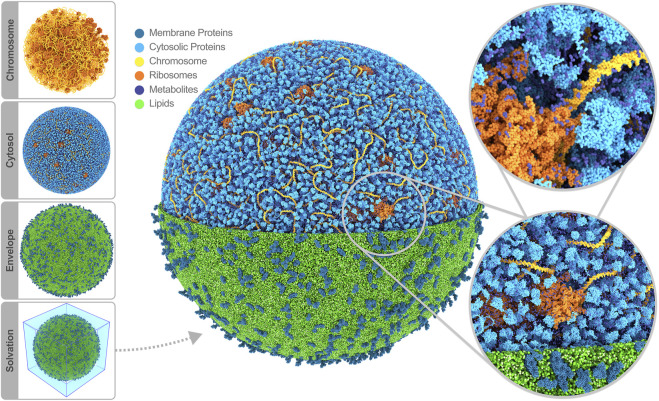
- A complete Martini model of JCVI-syn3A was built with 561 million CG beads, representing >6 billion atoms, including 60,887 soluble proteins, 2,200 membrane proteins, 503 ribosomes, a 543 kbp circular dsDNA, 1.3 million lipids, 1.7 million metabolites, 14 million ions, and 447 million water beads.
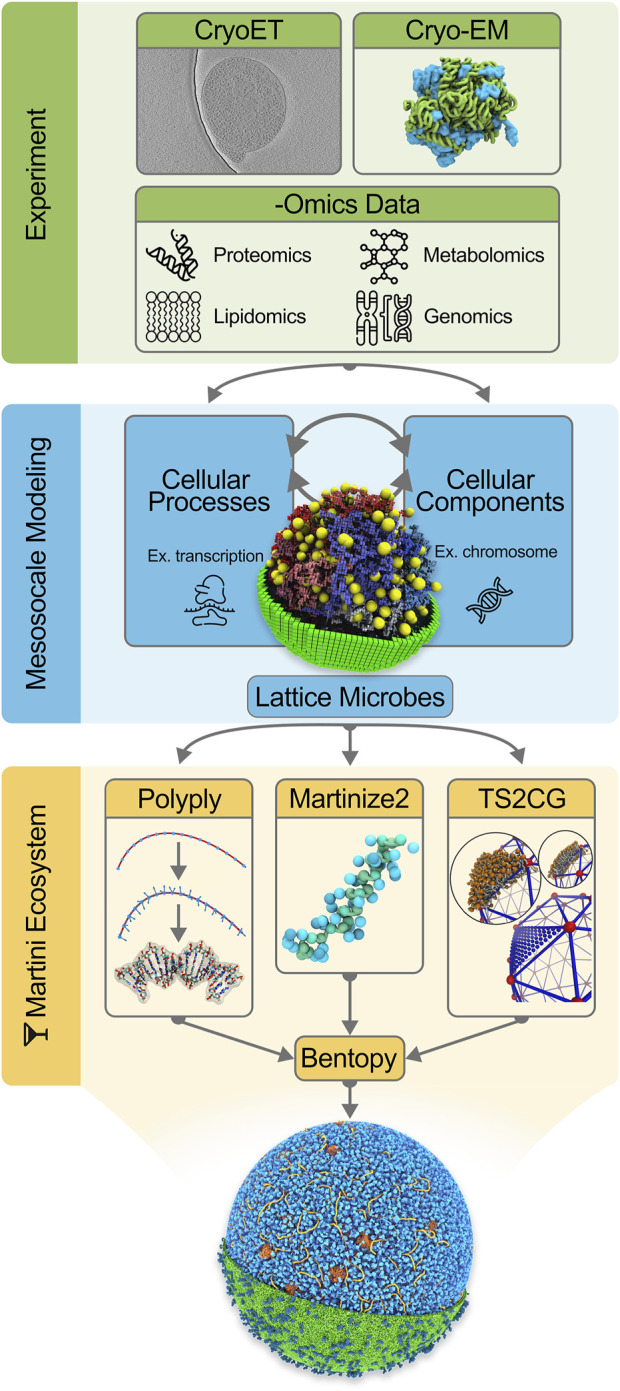
- The model integrates experimental and computational data—cryo-electron tomography, proteomics, metabolomics, lipidomics, and AlphaFold2 structures—using Martini ecosystem tools: Polyply, Martinize2, TS2CG, and Bentopy.
- The authors report that running the full-cell MD simulation is currently non-trivial because Gromacs has difficulties handling hundreds of millions of particles, especially with large molecules such as the genome spread over multiple domains; ddcMD and OpenMM are suggested alternatives.
- They anticipate reaching 10–100 µs timescales in the foreseeable future, which would still be insufficient to equilibrate an entire cell, so generated ensembles would remain dependent on the starting state.
Methods
- This is a perspective/integrative modeling study: experimental data from cryoET, cryo-EM, -omics, and a prior whole-cell kinetic model inform construction of the in silico cell.
- The chromosome was modeled as a fractal globule, relaxed with Brownian dynamics, and backmapped to a Martini one-bead-per-base-pair representation using Polyply; cytosolic proteins were packed with Bentopy; the membrane was built with TS2CG; and the system was solvated in a rhombic dodecahedron with 135 mM NaCl.
- No production MD simulation of the full cell is reported; the paper describes the construction workflow and prospects for future simulation.
Limitations
- Stated: the model uses Martini 2 because Martini 3 models for nucleic acids and other essential components are still under development; Martini cannot sample protein secondary conformational changes, and protein–protein/protein–lipid interaction details may be affected.
- Stated: the cytosol includes only a subset of metabolites (1.7 million metabolites, about 55% of the complete metabolome), AlphaFold2 provided only monomeric protein structures, and multimeric proteins such as ribosomes and membrane transport complexes are omitted or represented by homologs.
- Stated and evident: solvent/ion and lipid-leaflet balance is non-trivial and may cause osmotic or curvature stress; whole-cell equilibration is not achievable at expected timescales; classical MD cannot capture non-reactive, out-of-equilibrium cellular processes, and the model reflects average steady-state concentrations.
Model-written summary. Check it against the paper before relying on it.
Integrity signals
Registry
Cites
Statistics
Figures
Verification
Claims the paper makes
22 Valid · 6 Not valid · 6 Not checked · 31 Own results and interpretations
Every source the paper cites for this claim was checked and supports it.
In the paper
“The nucleoid structure of Syn3A was previously modeled by Gilbert et al. (2021) based on the ribosome distribution and cell boundary determined by cryo-electron tomography.”
§ Molecular dynamics simulation of an entire cell > Building cells with the Martini ecosystem > Chromosome building
What the sources say
- Supportedcites Gilbert et al., 2021 matched to “‘Generating chromosome geometries in a minimal cell from cryo-electron tomograms and chromosome conformation capture maps’” (2021) source
Methods §2.2 says the Syn3A chromosome model was designed to match the cell boundary and ribosome distribution. The Abstract and Figure 1 workflow state that these constraints came from cryo-electron tomograms and were used to generate chromosome configurations. (LLM, conf=0.94)
plain- Asserted: passes — The authors put it forward as true.
- Checkable: passes — It can be checked against evidence.
- Load-bearing: unclear — It is unclear whether the paper’s conclusions depend on it.
- Based: passes — The paper gives a reason why it holds.
- Supported
The cited sources support only part of this claim — read each source’s verdict below.
In the paper
“Unbalanced systems might experience strong osmotic pressures and membrane (curvature) stress, causing unwanted shape deformations all the way to membrane rupture.”
§ Molecular dynamics simulation of an entire cell > Discussion
What the sources say
- Partly supportedcites Pezeshkian et al., 2021 matched to “Molecular architecture and dynamics of SARS-CoV-2 envelope by integrative modeling” (2021) sourceExperimental — accuracy not yet measured
In “Constructing the viral envelope” (page unavailable), the paper reports that excess solvent particles led to pore formation and membrane rupture. In “4. Lipid fingerprinting analysis” (page unavailable), it says an imbalance in surface-area-to-volume ratio could deform the particle. These passages support deformation and rupture in unbalanced simulations, but do not identify strong osmotic pressure or membrane curvature stress as the causes. (LLM, conf=0.84)
- Supportedcites Vermaas et al., 2022 matched to “‘Assembly and analysis of cell-scale membrane envelopes’” (2022) source
In Results and Analysis, “Protocell Stability Assessment,” the paper says overfilling a closed lipid compartment can rupture its membrane, while underfilling can cause significant deformation. The same section links the observed deformations to pressure differences across the membrane and discusses the role of curvature. It does not report rupture in its simulated systems, but the claim presents rupture as a possibility. (LLM, conf=0.91)
hedgedstates a possible cause- Asserted: passes — The authors put it forward as true.
- Checkable: passes — It can be checked against evidence.
- Load-bearing: passes — The paper’s conclusions depend on it.
- Based: passes — The paper gives a reason why it holds.
- Partly supported
Every source the paper cites for this claim was checked and supports it.
In the paper
“The workflow used in Martinize2 additionally performs quality checks on the atomistic protein structures and alerts to potential problems making it ideal for such a high-complexity use case (Kroon et al., 2022).”
§ Molecular dynamics simulation of an entire cell > Building cells with the Martini ecosystem
What the sources say
- Supportedcites Kroon et al., 2022 matched to “Martinize2 and Vermouth: Unified Framework for Topology Generation” (2022) source
The Martinize2 section describes checks that identify missing or additional atoms in input structures. The Discussion reports that Martinize2 warns users about problems it cannot automatically resolve and issued a warning or error for all structures with seriously malformed residues in two benchmark sets. It also describes the program as fit for high-throughput and high-complexity tasks. Page numbers were not supplied. (LLM, conf=0.94)
plainstates a cause- Asserted: passes — The authors put it forward as true.
- Checkable: passes — It can be checked against evidence.
- Load-bearing: unclear — It is unclear whether the paper’s conclusions depend on it.
- Based: passes — The paper gives a reason why it holds.
- Supported
The cited sources support only part of this claim — read each source’s verdict below.
In the paper
“The Martini force field employs a four-to-one mapping scheme, where up to four heavy atoms and associated hydrogens are represented by one CG bead.”
§ Molecular dynamics simulation of an entire cell > Introduction
What the sources say
- Partly supportedcites Marrink et al., 2022 matched to “Two decades of Martini: Better beads, broader scope” (2023) sourceExperimental — accuracy not yet measured
Section 3.4 (Best practices and tips; page unavailable) describes regular Martini beads as mapping four atoms to one bead, alongside small three-to-one and tiny two-to-one beads. This supports the claim’s “up to four” mapping, but the passage does not specify that the counted atoms are heavy atoms or state how their associated hydrogens are represented. (LLM, conf=0.82)
plain- Asserted: passes — The authors put it forward as true.
- Checkable: passes — It can be checked against evidence.
- Load-bearing: passes — The paper’s conclusions depend on it.
- Based: passes — The paper gives a reason why it holds.
- Partly supported
The cited sources support only part of this claim — read each source’s verdict below.
In the paper
“Gromacs (Abraham et al., 2015), the main MD engine to run Martini-based simulations, is having difficulties handling systems comprising hundreds of millions of particles, in particular featuring large molecules such as the genome spread over multiple domains.”
§ Molecular dynamics simulation of an entire cell > Building cells with the Martini ecosystem > Solvating and simulating the cell
What the sources say
- Partly supportedcites Abraham et al., 2015 matched to “‘GROMACS: High performance molecular simulations through multi-level parallelism from laptops to supercomputers’” (2015) sourceExperimental — accuracy not yet measured
The Software description (p. unavailable) describes practical limits on GROMACS parallelism, but its example concerns a 150,000-atom system on a million cores—not a system with hundreds of millions of particles. The paper says MARTINI uses GROMACS infrastructure, but does not identify it as the main engine for MARTINI simulations or discuss difficulties with genome-sized molecules spanning domains. (LLM, conf=0.82)
plainstates a cause- Asserted: passes — The authors put it forward as true.
- Checkable: passes — It can be checked against evidence.
- Load-bearing: passes — The paper’s conclusions depend on it.
- Based: passes — The paper gives a reason why it holds.
- Partly supported
20 more claims · 6 with their cited sources checked
Create a free account to see all 65 claims and every source verdict.
- Probably not a substantial claim. 23
- It may state two separate claims as one. 25
Claims other papers make about this one
Each is checked against this paper’s own text: does it say what the citing paper says it does?
The cited source says what the claim attributes to it.
In the citing paper
“Since this pioneering work, genome-wide models have been developed to represent other bacterial organisms, including Escherichia coli.8,20–22”
From How to build the virtual cell with artificial intelligence: Priorities and opportunities (2024) · cites this paper as [20]
The cited source says what the claim attributes to it.
In the citing paper
“At the finest level of resolution, a near-atomic structure of a minimal bacterium (JCVI-syn3A) has been modeled using the coarse-grained Martini force field.”
From Bringing the genetically minimal cell to life on a computer in 4D (2026) · cites this paper as [6]
Self-check
Percentages, sums and reported differences re-computed from the paper’s own numbers.
Each contradiction between two passages listed here was confirmed by an independent check.
Rated minor: it would not touch a result — a value no result rests on, a p-value that stays on the same side of the significance level, or a conflict that is clerical, resolved elsewhere in the paper, or outside its own findings.
In the paper
§ Molecular dynamics simulation of an entire cell > Discussion
“Even though our in silico cell contains more than 500 unique CG molecules and thereby presumably qualifies as the most complex system simulated to date”
§ Molecular dynamics simulation of an entire cell > Building cells with the Martini ecosystem > Solvating and simulating the cell
“Having constructed a starting model for Syn3A, the current challenge is to perform an actual MD simulation.”
Citations
Cites
Highly accurate protein structure prediction with AlphaFold
Jumper, J., Evans, R., Pritzel, A., Green, T., Figurnov, M., Ronneberger, O., Tunyasuvunakool, K., Bates, R., Žídek, A., Potapenko, A., et al. (2021) · Nature · doi:10.1038/s41586-021-03819-2 · Cited by 43,764 · cited 3×
“Secondly, since AlphaFold2 was used to predict the protein structures of the whole proteome, only monomeric structures were initially available.”
MethodInfluentialAbraham, M. J., Murtola, T., Schulz, R., Páll, S., Smith, J. C., Hess, B., & Lindahl, E. (2015) · SoftwareX · doi:10.1016/j.softx.2015.06.001 · Cited by 27,190 · cited 1×
“Gromacs (Abraham et al., 2015), the main MD engine to run Martini-based simulations, is having difficulties handling systems comprising hundreds of millions of particles, in particular featuring large molecules such as the genome spread over multiple domains.”
OpenMM 7: Rapid development of high performance algorithms for molecular dynamics
Eastman, P., Swails, J., Chodera, J. D., McGibbon, R. T., Zhao, Y., Beauchamp, K. A., Wang, L.-P., Simmonett, A. C., Harrigan, M. P., Stern, C. D., et al. (2017) · PLOS Computational Biology · doi:10.1371/journal.pcbi.1005659 · Cited by 2,748 · cited 1×
“Possible other software engines to consider are ddcMD (Zhang et al., 2020) and openMM (Eastman et al., 2017), both of which are supporting Martini and offer simulation speeds comparable to those of Gromacs.”
ResultMartini 3: A general purpose force field for coarse-grained molecular dynamics
Souza, P. C. T., Alessandri, R., Barnoud, J., Thallmair, S., Faustino, I., Grünewald, F., Patmanidis, I., Abdizadeh, H., Bruininks, B. M. H., Wassenaar, T. A., et al. (2021) · Nature Methods · doi:10.1038/s41592-021-01098-3 · Cited by 1,551 · cited 1×
“With over 800 different bead types and a recalibrated interaction matrix, Martini 3 offers an improved framework for CG MD simulations (Souza et al., 2021).”
MethodSelf-citationDesign and synthesis of a minimal bacterial genome
Hutchison, C. A., Chuang, R.-Y., Noskov, V. N., Assad-Garcia, N., Deerinck, T. J., Ellisman, M. H., Gill, J., Kannan, K., Karas, B. J., Ma, L., et al. (2016) · Science · doi:10.1126/science.aad6253 · Cited by 1,500 · cited 2×
“To showcase this possibility, we consider one of the simplest cells known to date: the minimal cell created by the J. Craig Venter Institute (Hutchison et al., 2016), a stripped-down version of a Mycoplasma bacterium.”
Background‘Improved parameters for the Martini coarse-grained protein force field’
de Jong, D. H., Singh, G., Bennett, W. F. D., Arnarez, C., Wassenaar, T. A., Schäfer, L. V., Periole, X., Tieleman, D. P., & Marrink, S. J. (2013) · Journal of Chemical Theory and Computation · doi:10.1021/ct300646g · Cited by 1,486
A Whole-Cell Computational Model Predicts Phenotype from Genotype
Karr, J. R., Sanghvi, J. C., Macklin, D. N., Gutschow, M. V., Jacobs, J. M., Bolival, B., Assad-Garcia, N., Glass, J. I., & Covert, M. W. (2012) · Cell · doi:10.1016/j.cell.2012.05.044 · Cited by 1,300 · cited 1×
“…cell-scale structures such as cellPACK (Johnson et al., 2015; Maritan et al., 2022), genome-scale well-stirred reaction models for metabolism (Karr et al., 2012; Macklin et al., 2014; Karr et al., 2015; Breuer et al., 2019; Macklin et al., 2020), or mesoscale kinetic models that attempt to…”
BackgroundBiomolecular Simulation: A Computational Microscope for Molecular Biology
Dror, R. O., Dirks, R. M., Grossman, J. P., Xu, H., & Shaw, D. E. (2012) · Annual Review of Biophysics · doi:10.1146/annurev-biophys-042910-155245 · Cited by 1,198 · cited 1×
“Over the past decades, MD has matured into a powerful tool that functions as a computational microscope (Lee et al., 2009; Dror et al., 2012).”
BackgroundWassenaar, T. A., Ingólfsson, H. I., Böckmann, R. A., Tieleman, D. P., & Marrink, S. J. (2015) · Journal of Chemical Theory and Computation · doi:10.1021/acs.jctc.5b00209 · Cited by 1,174
Machine Learning for Molecular Simulation
Noé, F., Tkatchenko, A., Müller, K.-R., & Clementi, C. (2020) · Annual Review of Physical Chemistry · doi:10.1146/annurev-physchem-042018-052331 · Cited by 956 · cited 1×
“Furthermore, machine-learning can be invoked to extract interaction patterns and other emergent behavior that might be missed by standard analysis tools (Noé et al., 2020; Wang et al., 2020; Kaptan and Vattulainen, 2022).”
BackgroundEllis, R. J., & Minton, A. P. (2003) · Nature · doi:10.1038/425027a · Cited by 894 · cited 1×
“Proteins comprise the bulk of a cell ’ s organic material, composing approximately 40% of the total intracellular volume (Ellis and Minton, 2003).”
BackgroundPlasma membranes are asymmetric in lipid unsaturation, packing and protein shape
Lorent, J. H., Levental, K. R., Ganesan, L., Rivera-Longsworth, G., Sezgin, E., Doktorova, M., Lyman, E., & Levental, I. (2020) · Nature Chemical Biology · doi:10.1038/s41589-020-0529-6 · Cited by 774 · cited 1×
“Obtaining such data with high spatial and dynamic detail, particularly in living cells, is very challenging, but exciting progress is being made in elucidating the architecture and stoichiometry of cellular components at unprecedented resolutions (Reading et al., 2017; Ando et al., 2018; Cheng, 2018; Chorev et al., 20…”
BackgroundDiffusion, Crowding & Protein Stability in a Dynamic Molecular Model of the Bacterial Cytoplasm
McGuffee, S. R., & Elcock, A. H. (2010) · PLoS Computational Biology · doi:10.1371/journal.pcbi.1000694 · Cited by 694 · cited 1×
“Viewing the cytosol from this perspective, we can observe emerging heterogeneities and viscosity gradients, following in the footsteps of other realistic models of the cytoplasm of various cell types (McGuffee and Elcock, 2010; Yu et al., 2016; Oliveira Bortot et al., 2020).”
Computational Modeling of Realistic Cell Membranes
Marrink, S. J., Corradi, V., Souza, P. C. T., Ingólfsson, H. I., Tieleman, D. P., & Sansom, M. S. P. (2019) · Chemical Reviews · doi:10.1021/acs.chemrev.8b00460 · Cited by 694 · cited 2×
“Lastly, modeling lipid membranes has historically been a leading application of the Martini force fi eld (Marrink et al., 2019).”
MethodSelf-citationSingle-particle cryo-EM—How did it get here and where will it go
Cheng, Y. (2018) · Science · doi:10.1126/science.aat4346 · Cited by 448 · cited 1×
“…made in elucidating the architecture and stoichiometry of cellular components at unprecedented resolutions (Reading et al., 2017; Ando et al., 2018; Cheng, 2018; Chorev et al., 2018; Christie et al., 2020; Lorent et al., 2020; Narasimhan et al., 2020; Wietrzynski et al., 2020; Š te fl et al.,…”
BackgroundMartini Coarse-Grained Force Field: Extension to Carbohydrates
López, C. A., Rzepiela, A. J., de Vries, A. H., Dijkhuizen, L., Hünenberger, P. H., & Marrink, S. J. (2009) · Journal of Chemical Theory and Computation · doi:10.1021/ct900313w · Cited by 411 · cited 1×
“…biomolecules are already available, including proteins (de Jong et al., 2013), lipids (Wassenaar et al., 2015), polynucleotides (Uusitalo et al., 2015; Uusitalo et al., 2017), carbohydrates (López et al., 2009; Grünewald and Punt, 2022) and metabolites (Sousa et al., 2021; Alessandri et al., 2022).”
BackgroundSelf-citationLipid–Protein Interactions Are Unique Fingerprints for Membrane Proteins
Corradi, V., Mendez-Villuendas, E., Ingólfsson, H. I., Gu, R.-X., Siuda, I., Melo, M. N., Moussatova, A., DeGagné, L. J., Sejdiu, B. I., Singh, G., et al. (2018) · ACS Central Science · doi:10.1021/acscentsci.8b00143 · Cited by 358
Self-citationAI-based structure prediction empowers integrative structural analysis of human nuclear pores
Mosalaganti, S., Obarska-Kosinska, A., Siggel, M., Taniguchi, R., Turoňová, B., Zimmerli, C. E., Buczak, K., Schmidt, F. H., Margiotta, E., Mackmull, M.-T., et al. (2022) · Science · doi:10.1126/science.abm9506 · Cited by 355 · cited 1×
“…hundreds of millions of atoms, include dynamic models of a photosynthetic chromatophore vesicle (Singharoy et al., 2019), the nuclear core complex (Mosalaganti et al., 2022), the membranes of a mitochondrion (Pezeshkian et al., 2020), the bacterial cytoplasm (Yu et al., 2016), and a virus…”
BackgroundDiscovery Through the Computational Microscope
Lee, E. H., Hsin, J., Sotomayor, M., Comellas, G., & Schulten, K. (2009) · Structure · doi:10.1016/j.str.2009.09.001 · Cited by 334 · cited 1×
“Over the past decades, MD has matured into a powerful tool that functions as a computational microscope (Lee et al., 2009; Dror et al., 2012).”
BackgroundMartini Coarse-Grained Force Field: Extension to DNA
Uusitalo, J. J., Ingólfsson, H. I., Akhshi, P., Tieleman, D. P., & Marrink, S. J. (2015) · Journal of Chemical Theory and Computation · doi:10.1021/acs.jctc.5b00286 · Cited by 320 · cited 1×
“, 2015), polynucleotides (Uusitalo et al., 2015; Uusitalo et al., 2017), carbohydrates (López et al.”
Self-citationSchmidt, R., Weihs, T., Wurm, C. A., Jansen, I., Rehman, J., Sahl, S. J., & Hell, S. W. (2021) · Nature Communications · doi:10.1038/s41467-021-21652-z · Cited by 306 · cited 1×
“For example, advanced MINFLUX microscopy from the Hell lab enables the tracking of particles as small as 1 – 2 nm for 100 s of microseconds (Eilers et al., 2018; Schmidt et al., 2021).”
MethodMachine learning approaches for analyzing and enhancing molecular dynamics simulations
Wang, Y., Lamim Ribeiro, J. M., & Tiwary, P. (2020) · Current Opinion in Structural Biology · doi:10.1016/j.sbi.2019.12.016 · Cited by 303 · cited 1×
“Furthermore, machinelearning can be invoked to extract interaction patterns and other emergent behavior that might be missed by standard analysis tools (Noé et al., 2020; Wang et al., 2020; Kaptan and Vattulainen, 2022).”
BackgroundYu, I., Mori, T., Ando, T., Harada, R., Jung, J., Sugita, Y., & Feig, M. (2016) · eLife · doi:10.7554/elife.19274 · Cited by 294 · cited 2×
“, 2020), the bacterial cytoplasm (Yu et al., 2016), and a virus particle embedded in a nanoscale aerosol droplet (Dommer et al.”
BackgroundMartini coarse-grained force field: Extension to RNA
Uusitalo, J. J., Ingólfsson, H. I., Marrink, S. J., & Faustino, I. (2017) · Biophysical Journal · doi:10.1016/j.bpj.2017.05.043 · Cited by 259 · cited 4×
“Concerning the ribosomes, we used bacterial homologs that we had already generated previously (Uusitalo et al., 2017), placing 503 ribosomes in random orientations near the positions originally determined from the cryo-electron tomography map (Gilbert et al., 2021).”
BackgroundMethodInfluentialTwo decades of Martini: Better beads, broader scope
Marrink, S. J., Monticelli, L., Melo, M. N., Alessandri, R., Tieleman, D. P., & Souza, P. C. T. (2023) · WIREs Computational Molecular Science · doi:10.1002/wcms.1620 · Cited by 255 · cited 2×
“In this regard, the Martini force field is an excellent candidate, as demonstrated by the wide range of application studies using Martini over the past 2 decades (Marrink et al., 2022).”
MethodPoma, A. B., Cieplak, M., & Theodorakis, P. E. (2017) · Journal of Chemical Theory and Computation · doi:10.1021/acs.jctc.6b00986 · Cited by 218 · cited 1×
“This problem could perhaps be resolved by using Go potentials (Poma et al., 2017; Souza et al., 2019), which are already integrated into Martinize2 and Bentopy.”
MethodComputation of rotation minimizing frames
Wang, W., Jüttler, B., Zheng, D., & Liu, Y. (2008) · ACM Transactions on Graphics · doi:10.1145/1330511.1330513 · Cited by 212 · cited 1×
“Rotation minimizing frames are then constructed along the chromosomal contour, providing a consistent reference to which the Martini DNA model can be backmapped (Wang et al., 2008).”
Martini 3 Coarse‐Grained Force Field: Small Molecules
Alessandri, R., Barnoud, J., Gertsen, A. S., Patmanidis, I., de Vries, A. H., Souza, P. C. T., & Marrink, S. J. (2022) · Advanced Theory and Simulations · doi:10.1002/adts.202100391 · Cited by 212
Self-citationProtein assemblies ejected directly from native membranes yield complexes for mass spectrometry
Chorev, D. S., Baker, L. A., Wu, D., Beilsten-Edmands, V., Rouse, S. L., Zeev-Ben-Mordehai, T., Jiko, C., Samsudin, F., Gerle, C., Khalid, S., et al. (2018) · Science · doi:10.1126/science.aau0976 · Cited by 191 · cited 1×
“…the architecture and stoichiometry of cellular components at unprecedented resolutions (Reading et al., 2017; Ando et al., 2018; Cheng, 2018; Chorev et al., 2018; Christie et al., 2020; Lorent et al., 2020; Narasimhan et al., 2020; Wietrzynski et al., 2020; Š te fl et al., 2020), setting the…”
BackgroundEssential metabolism for a minimal cell
Breuer, M., Earnest, E. E., Merryman, C., Wise, K. S., Sun, L., Lynott, M. R., Hutchison, C. A., Smith, H. O., Lapek, J. D., Gonzalez, D. J., et al. (2019) · eLife · doi:10.7554/elife.36842 · Cited by 190 · cited 4×
“The current strain, named JCVI-syn3A (Syn3A), contains only 493 genes and is still able to replicate independently (Breuer et al., 2019).”
BackgroundMethodInfluentialSelf-citation‘MINFLUX monitors rapid molecular jumps with superior spatiotemporal resolution’
Eilers, Y., Ta, H., Gwosch, K. C., Balzarotti, F., & Hell, S. W. (2018) · Proceedings of the National Academy of Sciences · doi:10.1073/pnas.1801672115 · Cited by 188 · cited 1×
“For example, advanced MINFLUX microscopy from the Hell lab enables the tracking of particles as small as 1 – 2 nm for 100 s of microseconds (Eilers et al., 2018; Schmidt et al., 2021).”
MethodAtoms to Phenotypes: Molecular Design Principles of Cellular Energy Metabolism
Singharoy, A., Maffeo, C., Delgado-Magnero, K. H., Swainsbury, D. J. K., Sener, M., Kleinekathöfer, U., Vant, J. W., Nguyen, J., Hitchcock, A., Isralewitz, B., et al. (2019) · Cell · doi:10.1016/j.cell.2019.10.021 · Cited by 175
Self-citationPolyply; a python suite for facilitating simulations of macromolecules and nanomaterials
Grünewald, F., Alessandri, R., Kroon, P. C., Monticelli, L., Souza, P. C. T., & Marrink, S. J. (2022) · Nature Communications · doi:10.1038/s41467-021-27627-4 · Cited by 166 · cited 4×
“…biomolecules are already available, including proteins (de Jong et al., 2013), lipids (Wassenaar et al., 2015), polynucleotides (Uusitalo et al., 2015; Uusitalo et al., 2017), carbohydrates (López et al., 2009; Grünewald and Punt, 2022) and metabolites (Sousa et al., 2021; Alessandri et al., 2022).”
BackgroundMethodInfluentialSelf-citationFundamental behaviors emerge from simulations of a living minimal cell
Thornburg, Z. R., Bianchi, D. M., Brier, T. A., Gilbert, B. R., Earnest, E. E., Melo, M. C. R., Safronova, N., Sáenz, J. P., Cook, A. T., Wise, K. S., et al. (2022) · Cell · doi:10.1016/j.cell.2021.12.025 · Cited by 165 · cited 1×
“…a large variety of biomolecules are already available, including proteins (de Jong et al., 2013), lipids (Wassenaar et al., 2015), polynucleotides (Uusitalo et al., 2015; Uusitalo et al., 2017), carbohydrates (López et al., 2009; Grünewald and Punt, 2022) and metabolites (Sousa et al., 2021;…”
BackgroundSelf-citationATP-Driven Separation of Liquid Phase Condensates in Bacteria
Guilhas, B., Walter, J.-C., Rech, J., David, G., Walliser, N. O., Palmeri, J., Mathieu-Demaziere, C., Parmeggiani, A., Bouet, J.-Y., Le Gall, A., et al. (2020) · Molecular Cell · doi:10.1016/j.molcel.2020.06.034 · Cited by 157
Backmapping triangulated surfaces to coarse-grained membrane models
Pezeshkian, W., König, M., Wassenaar, T. A., & Marrink, S. J. (2020) · Nature Communications · doi:10.1038/s41467-020-16094-y · Cited by 152 · cited 5×
“…chromatophore vesicle (Singharoy et al., 2019), the nuclear core complex (Mosalaganti et al., 2022), the membranes of a mitochondrion (Pezeshkian et al., 2020), the bacterial cytoplasm (Yu et al., 2016), and a virus particle embedded in a nanoscale aerosol droplet (Dommer et al.,…”
BackgroundInfluentialSelf-citationcellPACK: a virtual mesoscope to model and visualize structural systems biology
Johnson, G. T., Autin, L., Al-Alusi, M., Goodsell, D. S., Sanner, M. F., & Olson, A. J. (2015) · Nature Methods · doi:10.1038/nmeth.3204 · Cited by 151 · cited 1×
“The current state-of-the-art uses static representations of heterogeneous cell-scale structures such as cellPACK (Johnson et al., 2015; Maritan et al., 2022), genome-scale well-stirred reaction models for metabolism (Karr et al., 2012; Macklin et al., 2014; Karr et al., 2015; Breuer et al., 2019;…”
MethodSimultaneous cross-evaluation of heterogeneous E. coli datasets via mechanistic simulation
Macklin, D. N., Ahn-Horst, T. A., Choi, H., Ruggero, N. A., Carrera, J., Mason, J. C., Sun, G., Agmon, E., DeFelice, M. M., Maayan, I., et al. (2020) · Science · doi:10.1126/science.aav3751 · Cited by 151 · cited 1×
“, 2022), genome-scale well-stirred reaction models for metabolism (Karr et al., 2012; Macklin et al., 2014; Karr et al., 2015; Breuer et al., 2019; Macklin et al., 2020), or mesoscale kinetic models that attempt to include both structural and chemical states of the cell such as Lattice Microbes (Roberts et al.”
BackgroundAutomated Parametrization of the Coarse-Grained Martini Force Field for Small Organic Molecules
Bereau, T., & Kremer, K. (2015) · Journal of Chemical Theory and Computation · doi:10.1021/acs.jctc.5b00056 · Cited by 150 · cited 1×
“Future iterations of our whole-cell model will include Martini models for the complete metabolome, which comprises about 188 different compounds, and are expected to bene fi t from the ongoing development of dedicated automatic topology builders (Bereau and Kremer, 2015; Potter et al., 2021).”
MethodCG2AT2: An enhanced fragment-based approach for serial multi-scale molecular dynamics simulations
Vickery, O. N., & Stansfeld, P. J. (2021) · Journal of Chemical Theory and Computation · doi:10.1021/acs.jctc.1c00295 · Cited by 150 · cited 1×
“A number of such backmapping tools, optimized for Martini, already exist (Louison et al., 2021; Vickery and Stansfeld, 2021; López et al., 2022).”
MethodCharting the native architecture of Chlamydomonas thylakoid membranes with single-molecule precision
Wietrzynski, W., Schaffer, M., Tegunov, D., Albert, S., Kanazawa, A., Plitzko, J. M., Baumeister, W., & Engel, B. D. (2020) · eLife · doi:10.7554/elife.53740 · Cited by 148 · cited 1×
“…at unprecedented resolutions (Reading et al., 2017; Ando et al., 2018; Cheng, 2018; Chorev et al., 2018; Christie et al., 2020; Lorent et al., 2020; Narasimhan et al., 2020; Wietrzynski et al., 2020; Š te fl et al., 2020), setting the stage for spatially detailed simulations of whole cells.”
BackgroundThe 2018 correlative microscopy techniques roadmap
Ando, T., Bhamidimarri, S. P., Brending, N., Colin‐York, H., Collinson, L., de Jonge, N., de Pablo, P. J., Debroye, E., Eggeling, C., Franck, C., et al. (2018) · Journal of Physics D Applied Physics · doi:10.1088/1361-6463/aad055 · Cited by 138 · cited 1×
“…progress is being made in elucidating the architecture and stoichiometry of cellular components at unprecedented resolutions (Reading et al., 2017; Ando et al., 2018; Cheng, 2018; Chorev et al., 2018; Christie et al., 2020; Lorent et al., 2020; Narasimhan et al., 2020; Wietrzynski et al., 2020; Š…”
BackgroundRhine, K., Vidaurre, V., & Myong, S. (2020) · Annual Review of Biophysics · doi:10.1146/annurev-biophys-052118-115508 · Cited by 130 · cited 1×
“We can expect arising interaction patterns between proteins and metabolites, and probe the possible appearance of biomolecular condensates (Guilhas et al., 2020; Rhine et al., 2020).”
BackgroundMartinize2 and Vermouth: Unified Framework for Topology Generation
Kroon, P. C., Grünewald, F., Barnoud, J., van Tilburg, M., Brasnett, C., Souza, P. C. T., Wassenaar, T. A., & Marrink, S.-J. (2022) · arXiv · doi:10.48550/arxiv.2212.01191 · Cited by 124
Self-citationRoberts, E., Stone, J. E., & Luthey‐Schulten, Z. (2013) · Journal of Computational Chemistry · doi:10.1002/jcc.23130 · Cited by 117 · cited 6×
“Coupling our classic approach with approaches taking into account reactivity, such as the aforementioned Lattice Microbes simulations or other metabolic network models (see below), in principle, could capture the non-equilibrium aspect of real cells.”
BackgroundMethodInfluentialSelf-citationDommer, A. C., Casalino, L., Kearns, F. L., Rosenfeld, M. A., Wauer, N. A., Ahn, S.-H., Russo, J. D., Oliveira, A. S. F., Morris, C. K., Bogetti, A. T., et al. (2022) · The International Journal of High Performance Computing Applications · doi:10.1177/10943420221128233 · Cited by 116 · cited 2×
“, 2016), and a virus particle embedded in a nanoscale aerosol droplet (Dommer et al., 2022).”
BackgroundMartini 3 Coarse-Grained Force Field for Carbohydrates
Grünewald, F., Punt, M. H., Jefferys, E. E., Vainikka, P. A., König, M., Virtanen, V., Meyer, T. A., Pezeshkian, W., Gormley, A. J., Karonen, M., et al. (2022) · Journal of Chemical Theory and Computation · doi:10.1021/acs.jctc.2c00757 · Cited by 116
Self-citation‘Scaling molecular dynamics beyond 100, 000 processor cores for large-scale biophysical simulations’
Jung, J., Nishima, W., Daniels, M., Bascom, G., Kobayashi, C., Adedoyin, A., Wall, M., Lappala, A., Phillips, D., Fischer, W., et al. (2019) · Journal of Computational Chemistry · doi:10.1002/jcc.25840 · Cited by 114
‘Entropy-Based mechanism of ribosome-nucleoid segregation in E. coli cells’
Mondal, J., Bratton, B. P., Li, Y., Yethiraj, A., & Weisshaar, J. C. (2011) · Biophysical Journal · doi:10.1016/j.bpj.2011.04.030 · Cited by 110 · cited 1×
“Due to the size and near-uniform distribution of ribosomes present in the cytosol, the excluded volume interactions of these protein-RNA complexes are known to have a significant influence on the nucleoid organization (Mondal et al., 2011).”
BackgroundInterrogating Membrane Protein Conformational Dynamics within Native Lipid Compositions
Reading, E., Hall, Z., Martens, C., Haghighi, T., Findlay, H., Ahdash, Z., Politis, A., & Booth, P. J. (2017) · Angewandte Chemie International Edition · doi:10.1002/anie.201709657 · Cited by 97
Howard, M. P., Anderson, J. A., Nikoubashman, A., Glotzer, S. C., & Panagiotopoulos, A. Z. (2016) · Computer Physics Communications · doi:10.1016/j.cpc.2016.02.003 · Cited by 95 · cited 1×
“It uses an efficient collision detection scheme (Howard et al., 2016) to generate random packings of proteins and protein complexes within volumetric constraints.”
MethodTowards a synthetic cell cycle
Olivi, L., Berger, M., Creyghton, R. N. P., De Franceschi, N., Dekker, C., Mulder, B. M., Claassens, N. J., ten Wolde, P. R., & van der Oost, J. (2021) · Nature Communications · doi:10.1038/s41467-021-24772-8 · Cited by 90 · cited 1×
“In the long term, our computational framework will enable us to study a wide variety of mesoscopic systems, possibly informing the design of fully synthetic cells (Olivi et al., 2021) and modeling cells with more complex internal structures.”
BackgroundThe principles of whole-cell modeling
Karr, J. R., Takahashi, K., & Funahashi, A. (2015) · Current Opinion in Microbiology · doi:10.1016/j.mib.2015.06.004 · Cited by 87 · cited 1×
“…(Johnson et al., 2015; Maritan et al., 2022), genome-scale well-stirred reaction models for metabolism (Karr et al., 2012; Macklin et al., 2014; Karr et al., 2015; Breuer et al., 2019; Macklin et al., 2020), or mesoscale kinetic models that attempt to include both structural and chemical…”
BackgroundThe future of whole-cell modeling
Macklin, D. N., Ruggero, N. A., & Covert, M. W. (2014) · Current Opinion in Biotechnology · doi:10.1016/j.copbio.2014.01.012 · Cited by 80 · cited 1×
“…such as cellPACK (Johnson et al., 2015; Maritan et al., 2022), genome-scale well-stirred reaction models for metabolism (Karr et al., 2012; Macklin et al., 2014; Karr et al., 2015; Breuer et al., 2019; Macklin et al., 2020), or mesoscale kinetic models that attempt to include both…”
BackgroundBuilding structural models of a whole mycoplasma cell
Maritan, M., Autin, L., Karr, J., Covert, M. W., Olson, A. J., & Goodsell, D. S. (2022) · Journal of Molecular Biology · doi:10.1016/j.jmb.2021.167351 · Cited by 75 · cited 1×
“The current state-of-the-art uses static representations of heterogeneous cell-scale structures such as cellPACK (Johnson et al., 2015; Maritan et al., 2022), genome-scale well-stirred reaction models for metabolism (Karr et al., 2012; Macklin et al., 2014; Karr et al., 2015; Breuer et al., 2019;…”
MethodMartinize2 and Vermouth: Unified Framework for Topology Generation
Kroon, P. C., Grunewald, F., Barnoud, J., van Tilburg, M., Souza, P. C. T., Wassenaar, T. A., & Marrink, S. J. (2023) · eLife · doi:10.7554/elife.90627.1 · Cited by 68
Self-citationClustering and dynamics of crowded proteins near membranes and their influence on membrane bending
Nawrocki, G., Im, W., Sugita, Y., & Feig, M. (2019) · Proceedings of the National Academy of Sciences · doi:10.1073/pnas.1910771116 · Cited by 67
Potter, T. D., Barrett, E. L., & Miller, M. A. (2021) · Journal of Chemical Theory and Computation · doi:10.1021/acs.jctc.1c00322 · Cited by 67 · cited 1×
“Future iterations of our whole-cell model will include Martini models for the complete metabolome, which comprises about 188 different compounds, and are expected to benefit from the ongoing development of dedicated automatic topology builders (Bereau and Kremer, 2015; Potter et al., 2021).”
MethodThe ugly, bad, and good stories of large-scale biomolecular simulations
Gupta, C., Sarkar, D., Tieleman, D. P., & Singharoy, A. (2022) · Current Opinion in Structural Biology · doi:10.1016/j.sbi.2022.102338 · Cited by 66 · cited 1×
“Constructing whole-cell models requires the integration of a large amount of experimental data, i.e., relies on an integrative modeling approach (Bonvin, 2021; Luthey-Schulten, 2021; Gupta et al., 2022).”
MethodSouza, P. C. T., Thallmair, S., Marrink, S. J., & Mera-Adasme, R. (2019) · The Journal of Physical Chemistry Letters · doi:10.1021/acs.jpclett.9b02868 · Cited by 65 · cited 1×
“This problem could perhaps be resolved by using Go potentials (Poma et al., 2017; Souza et al., 2019), which are already integrated into Martinize2 and Bentopy.”
MethodSelf-citationMolecular architecture and dynamics of SARS-CoV-2 envelope by integrative modeling
Pezeshkian, W., Grünewald, F., Narykov, O., Lu, S., Arkhipova, V., Solodovnikov, A., Wassenaar, T. A., Marrink, S. J., & Korkin, D. (2021) · doi:10.1101/2021.09.15.459697 · Cited by 60 · cited 1×
“Previous works on large-scale membraneenveloped systems (Pezeshkian et al., 2021; Vermaas et al., 2022) have shown that finding this balance is a non-trivial task.”
BackgroundSelf-citationMolecular architecture and dynamics of SARS-CoV-2 envelope by integrative modeling
Pezeshkian, W., Grünewald, F., Narykov, O., Lu, S., Arkhipova, V., Solodovnikov, A., Wassenaar, T. A., Marrink, S. J., & Korkin, D. (2023) · Structure · doi:10.1016/j.str.2023.02.006 · Cited by 60
Self-citationFacilitating CG Simulations with MAD: The MArtini Database Server
Hilpert, C., Beranger, L., Souza, P. C. T., Vainikka, P. A., Nieto, V., Marrink, S. J., Monticelli, L., & Launay, G. (2023) · Journal of Chemical Information and Modeling · doi:10.1021/acs.jcim.2c01375 · Cited by 51
Christie, S. M., Shi, X., & Smith, A. W. (2020) · Accounts of Chemical Research · doi:10.1021/acs.accounts.9b00625 · Cited by 49 · cited 1×
“…and stoichiometry of cellular components at unprecedented resolutions (Reading et al., 2017; Ando et al., 2018; Cheng, 2018; Chorev et al., 2018; Christie et al., 2020; Lorent et al., 2020; Narasimhan et al., 2020; Wietrzynski et al., 2020; Š te fl et al., 2020), setting the stage for spatially…”
BackgroundModels for twistable elastic polymers in Brownian dynamics, and their implementation for LAMMPS
Brackley, C. A., Morozov, A. N., & Marenduzzo, D. (2014) · The Journal of Chemical Physics · doi:10.1063/1.4870088 · Cited by 46 · cited 1×
“The generated chromosome model is relaxed using Brownian dynamics and an energy function for modeling dsDNA as a twistable worm-like chain from (Brackley et al., 2014).”
Method‘Integrating experiments, theory and simulations into whole-cell models’
Luthey-Schulten, Z. (2021) · Nature Methods · doi:10.1038/s41592-021-01150-2 · Cited by 39 · cited 2×
“, relies on an integrative modeling approach (Bonvin, 2021; Luthey-Schulten, 2021; Gupta et al., 2022).”
MethodSelf-citationGlimps: A machine learning approach to resolution transformation for multiscale modeling
Louison, K. A., Dryden, I. L., & Laughton, C. A. (2021) · Journal of Chemical Theory and Computation · doi:10.1021/acs.jctc.1c00735 · Cited by 35 · cited 1×
“A number of such backmapping tools, optimized for Martini, already exist (Louison et al., 2021; Vickery and Stansfeld, 2021; López et al., 2022).”
MethodWhen Small becomes Too Big: Expanding the Use of In‐Cell Solid‐State NMR Spectroscopy
Narasimhan, S., Folkers, G. E., & Baldus, M. (2020) · ChemPlusChem · doi:10.1002/cplu.202000167 · Cited by 32 · cited 1×
“…at unprecedented resolutions (Reading et al., 2017; Ando et al., 2018; Cheng, 2018; Chorev et al., 2018; Christie et al., 2020; Lorent et al., 2020; Narasimhan et al., 2020; Wietrzynski et al., 2020; Š te fl et al., 2020), setting the stage for spatially detailed simulations of whole cells.”
BackgroundMachine learning in the analysis of biomolecular simulations
Kaptan, S., & Vattulainen, I. (2022) · Advances in Physics: X · doi:10.1080/23746149.2021.2006080 · Cited by 31 · cited 1×
“Furthermore, machine-learning can be invoked to extract interaction patterns and other emergent behavior that might be missed by standard analysis tools (Noé et al., 2020; Wang et al., 2020; Kaptan and Vattulainen, 2022).”
BackgroundSousa, F. M., Lima, L. M. P., Arnarez, C., Pereira, M. M., & Melo, M. N. (2021) · Journal of Chemical Information and Modeling · doi:10.1021/acs.jcim.0c01077 · Cited by 30
Gilbert, B. R., Thornburg, Z. R., Lam, V., Rashid, F.-Z. M., Glass, J. I., Villa, E., Dame, R. T., & Luthey-Schulten, Z. (2021) · Frontiers in Molecular Biosciences · doi:10.3389/fmolb.2021.644133 · Cited by 30
Self-citation‘Assembly and analysis of cell-scale membrane envelopes’
Vermaas, J. V., Mayne, C. G., Shinn, E., & Tajkhorshid, E. (2022) · Journal of Chemical Information and Modeling · doi:10.1021/acs.jcim.1c01050 · Cited by 30 · cited 1×
“Previous works on large-scale membrane-enveloped systems (Pezeshkian et al., 2021; Vermaas et al., 2022) have shown that fi nding this balance is a non-trivial task.”
BackgroundMaking Soup: Preparing and Validating Models of the Bacterial Cytoplasm for Molecular Simulation
Bortot, L. O., Bashardanesh, Z., & van der Spoel, D. (2019) · Journal of Chemical Information and Modeling · doi:10.1021/acs.jcim.9b00971 · Cited by 25
ddcMD: A fully GPU-accelerated molecular dynamics program for the Martini force field
Zhang, X., Sundram, S., Oppelstrup, T., Kokkila-Schumacher, S. I. L., Carpenter, T. S., Ingólfsson, H. I., Streitz, F. H., Lightstone, F. C., & Glosli, J. N. (2020) · The Journal of Chemical Physics · doi:10.1063/5.0014500 · Cited by 25 · cited 1×
“Possible other software engines to consider are ddcMD (Zhang et al., 2020) and openMM (Eastman et al.”
MethodIntegrating cellular and molecular structures and dynamics into whole-cell models
Luthey-Schulten, Z., Thornburg, Z. R., & Gilbert, B. R. (2022) · Current Opinion in Structural Biology · doi:10.1016/j.sbi.2022.102392 · Cited by 23 · cited 1×
“The natural next step is, arguably, the scale of entire cells (Bhat and Balaji, 2020; Khalid and Rouse, 2020; Luthey-Schulten et al., 2022; Thornburg et al., 2022).”
BackgroundSelf-citationToward the Complete Functional Characterization of a Minimal Bacterial Proteome
Bianchi, D. M., Pelletier, J. F., Hutchison, C. A., Glass, J. I., & Luthey-Schulten, Z. (2022) · The Journal of Physical Chemistry B · doi:10.1021/acs.jpcb.2c04188 · Cited by 22 · cited 1×
“A recent study by Bianchi et al. (2022) uses computational analyses to further elucidate the function of uncharacterized genes and work toward complete functional characterization of the proteome.”
BackgroundSelf-citation50 years of PDB: A catalyst in structural biology
Bonvin, A. M. J. J. (2021) · Nature Methods · doi:10.1038/s41592-021-01138-y · Cited by 21 · cited 1×
“Constructing whole-cell models requires the integration of a large amount of experimental data, i.e., relies on an integrative modeling approach (Bonvin, 2021; Luthey-Schulten, 2021; Gupta et al., 2022).”
MethodSequential Voxel-Based Leaflet Segmentation of Complex Lipid Morphologies
Bruininks, B. M. H., Thie, A. S., Souza, P. C. T., Wassenaar, T. A., Faraji, S., & Marrink, . J. (2021) · Journal of Chemical Theory and Computation · doi:10.1021/acs.jctc.1c00446 · Cited by 21 · cited 1×
“Another approach would be using a voxel-based method (Bruininks et al., 2021) to dynamically segment the whole-cell model into similarity regions, e.g., membrane periphery or chromosomal region.”
Self-citationLópez, C. A., Zhang, X., Aydin, F., Shrestha, R., Van, Q. N., Stanley, C. B., Carpenter, T. S., Nguyen, K., Patel, L. A., Chen, D., et al. (2022) · Journal of Chemical Theory and Computation · doi:10.1021/acs.jctc.2c00168 · Cited by 18 · cited 1×
“A number of such backmapping tools, optimized for Martini, already exist (Louison et al., 2021; Vickery and Stansfeld, 2021; López et al., 2022).”
MethodWhole-Cell Modeling and Simulation: A Brief Survey
Bhat, N. G., & Balaji, S. (2019) · New Generation Computing · doi:10.1007/s00354-019-00066-y · Cited by 13 · cited 1×
“The natural next step is, arguably, the scale of entire cells (Bhat and Balaji, 2020; Khalid and Rouse, 2020; Luthey-Schulten et al., 2022; Thornburg et al., 2022).”
BackgroundSingle-Color Fluorescence Lifetime Cross-Correlation Spectroscopy In Vivo
Štefl, M., Herbst, K., Rübsam, M., Benda, A., & Knop, M. (2020) · Biophysical Journal · doi:10.1016/j.bpj.2020.06.039 · Cited by 12
Simulation of subcellular structures
Khalid, S., & Rouse, S. L. (2020) · Current Opinion in Structural Biology · doi:10.1016/j.sbi.2019.12.017 · Cited by 11 · cited 1×
“The natural next step is, arguably, the scale of entire cells (Bhat and Balaji, 2020; Khalid and Rouse, 2020; Luthey-Schulten et al., 2022; Thornburg et al., 2022).”
BackgroundTowards extreme scale dissipative particle dynamics simulations using multiple GPGPUs
Castagna, J., Guo, X., Seaton, M., & O’Cais, A. (2020) · Computer Physics Communications · doi:10.1016/j.cpc.2020.107159 · Cited by 10
Untitled work
Uusitalo (2015) · doi:10.1021/acs.jctc.5b00286_file/ct5b00286_si_001.pdf
Research works printed but not linked: 1
- Blender Online Community (2022). ‘Blender - a 3D modelling and rendering package’. Amsterdam: Blender Foundation. Stichting Blender Foundation. Available at: http://www.blender.org
Cited by
How to build the virtual cell with artificial intelligence: Priorities and opportunities
Bunne, C., Roohani, Y., Rosen, Y., Gupta, A., Zhang, X., Roed, M., Alexandrov, T., AlQuraishi, M., Brennan, P., Burkhardt, D. B., et al. (2024) · Cell · doi:10.1016/j.cell.2024.11.015 · Cited by 393
“8 20–22 Despite their widespread use in modeling biological systems, approaches to date fall short of capturing many aspects of the operations of both bacterial and more complex systems, such as human cells.”
Martinize2 and Vermouth provide a unified framework for molecular topology generation
Kroon, P. C., Grünewald, F., Barnoud, J., van Tilburg, M., Brasnett, C., Souza, P. C., Wassenaar, T. A., & Marrink, S. J. (2025) · eLife · doi:10.7554/elife.90627 · Cited by 124
Self-citationMartinize2 and Vermouth: Unified Framework for Topology Generation
Kroon, P. C., Grünewald, F., Barnoud, J., van Tilburg, M., Brasnett, C., Souza, P. C. T., Wassenaar, T. A., & Marrink, S.-J. (2022) · arXiv · doi:10.48550/arxiv.2212.01191 · Cited by 124
Self-citationMcCafferty, C. L., Klumpe, S., Amaro, R. E., Kukulski, W., Collinson, L., & Engel, B. D. (2024) · Cell · doi:10.1016/j.cell.2024.01.005 · Cited by 106
“219 The cell geometry and location of ribosomes were provided by cryo-ET, and the time-dependent behavior of metabolic processes, transcription, and translation were modeled using two different methods.”
GōMartini 3: From large conformational changes in proteins to environmental bias corrections
Souza, P. C. T., Borges-Araújo, L., Brasnett, C., Moreira, R. A., Grünewald, F., Park, P., Wang, L., Razmazma, H., Borges-Araújo, A. C., Cofas-Vargas, L. F., et al. (2025) · Nature Communications · doi:10.1038/s41467-025-58719-0 · Cited by 98
“Thus, simulations of crowded membranes 8 and even future cell-simulations 104 may still rely on simple EN approaches.”
Self-citation
Metadata
- Authors
- Stevens, J. A., Grünewald, F., van Tilburg, P. A. M., König, M., Gilbert, B. R., Brier, T. A., Thornburg, Z. R., Luthey-Schulten, Z., & Marrink, S. J.
- Affiliations
- University of Groningen (NL)
- University of Illinois Urbana-Champaign (US)
- Corresponding author
- Marrink, Siewert J.
- ORCID
- Venue
- Frontiers in Chemistry
- Publisher
- Frontiers Media SA
- Published
- 2023-01-18
- Volume
- 11
- Pages
- 1106495-1106495
- ISSN
- 2296-2646 (ISSN-L)
- PMC
- PMC9889929
- OpenAlex
- W4317104064
- Cited by
- 156
- References
- 85
- Citations by year
- 2026: 35 · 2025: 52 · 2024: 48 · 2023: 21
- FWCI
- 13.86
- Type
- journal article
- Language
- en
- Open access
- gold
- doi.org
- Licence
- Locations
- Frontiers in Chemistry (publishedVersion, cc-by)
- PubMed Central (publishedVersion, cc-by)
- PubMed (publishedVersion)
- University of Groningen research database (University of Groningen / Centre for Information Technology) (publishedVersion, cc-by)
- DOAJ (DOAJ: Directory of Open Access Journals) (submittedVersion, cc-by-sa)
- University of Groningen research database (University of Groningen / Centre for Information Technology) (submittedVersion, other-oa)
- Funders
- National Science Foundation (2221237, 1505008, 1430124)
- Nederlandse Organisatie voor Wetenschappelijk Onderzoek (NWA.1292.19.170)
- HORIZON EUROPE European Research Council (101053661)
- Topics
- Life Sciences › Biochemistry, Genetics and Molecular Biology › Molecular Biology › Protein Structure and Dynamics
- Physical Sciences › Chemistry › Physical and Theoretical Chemistry › Advanced Physical and Chemical Molecular Interactions
- Life Sciences › Biochemistry, Genetics and Molecular Biology › Molecular Biology › RNA and protein synthesis mechanisms
- Keywords
- minimal cell, synthetic biology, computational microscopy, integrative modeling
About these checks
Registry, retraction, Cites and statistics results are computed, not judged, with one exception: a printed reference that no index lists is read once by a model before it counts as a citation error. Claims are extracted by a model and kept only when their quote appears verbatim in the text; each cited source is then checked, with a model’s help, for whether it says what the claim relies on. Those verdicts can be wrong — read the claim’s quote and the cited source before relying on one.
The claim verdicts this report counts are experimental: their accuracy is not yet measured.
A language model drew the claims from the paper on 2026-10-10, under version 3 of the claim definition (model deepseek-v4.1-flash, prompt extract-v3).
A second model labelled each claim on 2026-10-10 (model jev-1.13-20260917, definition revision gold-guideline-v0.2).
Cited sources are checked with a language model’s help (gpt-6-sol).
Statistics and arithmetic are recomputed, not judged.
Confidence bands are shown only for fields calibrated on our annotated test set. None is calibrated yet, so no band is shown.
What counts as a claim ›How we measure confidence ›How we check this ›
Are you an author, or do you see a problem with this page? Request a review
Data sources
Bibliographic data: Semantic Scholar, OpenAlex, Crossref.
Contains information from the Semantic Scholar Academic Graph Datasets, made available under the ODC Attribution License (ODC-BY 1.0).
Semantic Scholar’s data is described in: Kinney, R., et al. (2023). The Semantic Scholar Open Data Platform. arXiv:2301.10140.
