

The DOI matches its Crossref record; 115 of the 115 references it cites were found in a registry or an index.
Gut-Lung Crosstalk in Sepsis-Induced Acute Lung Injury
Open accessAbstract
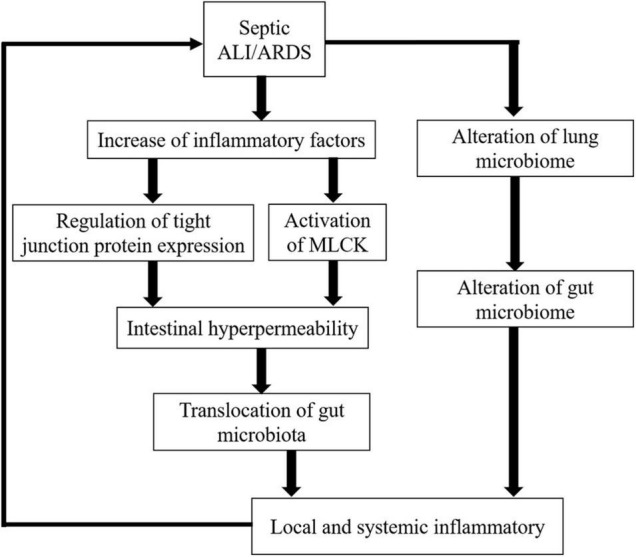
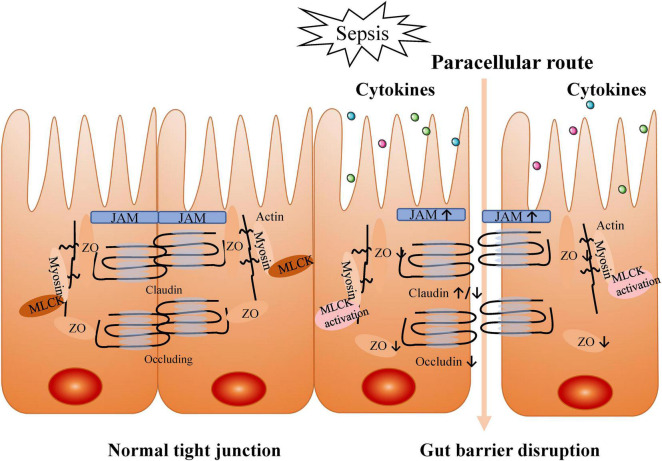
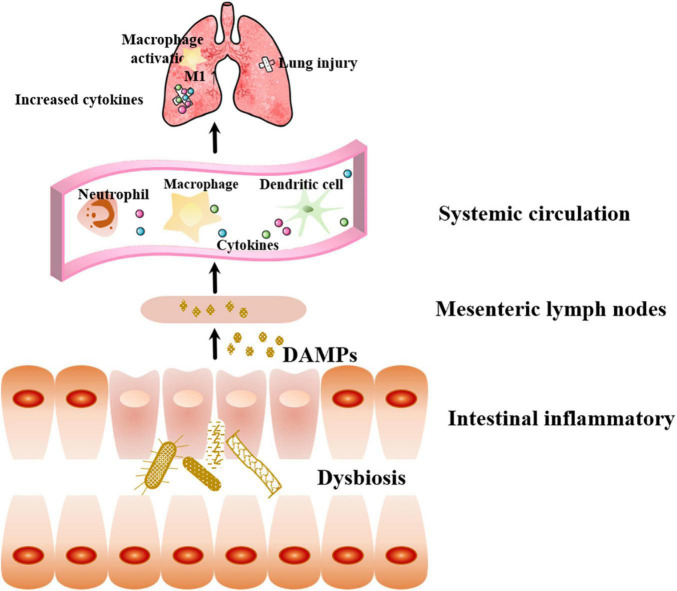
Acute lung injury (ALI) and acute respiratory distress syndrome (ARDS) are common acute and severe cases of the respiratory system with complicated pathogenesis and high mortality. Sepsis is the leading indirect cause of ALI/ARDS in the intensive care unit (ICU). The pathogenesis of septic ALI/ARDS is complex and multifactorial. In the development of sepsis, the disruption of the intestinal barrier function, the alteration of gut microbiota, and the translocation of the intestinal microbiome can lead to systemic and local inflammatory responses, which further alter the immune homeostasis in the systemic environment. Disruption of homeostasis may promote and propagate septic ALI/ARDS. In turn, when ALI occurs, elevated levels of inflammatory cytokines and the shift of the lung microbiome may lead to the dysregulation of the intestinal microbiome and the disruption of the intestinal mucosal barrier. Thus, the interaction between the lung and the gut can initiate and potentiate sepsis-induced ALI/ARDS. The gut–lung crosstalk may be a promising potential target for intervention. This article reviews the underlying mechanism of gut-lung crosstalk in septic ALI/ARDS.
Overview
The claims and statistics of this paper haven’t been checked yet.
Run the check — free, no account needed. It reads the open-access text and checks the sources it cites.
Integrity signals
Registry
Cites
Statistics
Figures
Verification
Claims the paper makes
The claims and statistics of this paper haven’t been checked yet.
Run the check — free, no account needed. It reads the open-access text and checks the sources it cites.
Claims other papers make about this one
Each is checked against this paper’s own text: does it say what the citing paper says it does?
The cited source says what the claim attributes to it.
In the citing paper
“The inflammatory cascade stemming from GI-released bacteria and endotoxins can exacerbate pulmonary dysfunction, leading to acute respiratory distress syndrome (ARDS) [27], worsening pulmonary outcomes [28].”
From Gastrointestinal function and nutritional interventions in septic shock (2025) · cites this paper as [27]
Self-check
Percentages, sums and reported differences re-computed from the paper’s own numbers.
The self-check needs the paper’s full text.
Citations
Cites
Bellani, G., Laffey, J. G., Pham, T., Fan, E., Brochard, L., Esteban, A., Gattinoni, L., van Haren, F., Larsson, A., McAuley, D. F., et al. (2016) · JAMA · doi:10.1001/jama.2016.0291 · Cited by 5,766 · cited 9×
“Sepsis is the leading indirect cause of ALI/ARDS in the intensive care unit (ICU).”
BackgroundInfluentialMacrophage plasticity, polarization, and function in health and disease
Shapouri‐Moghaddam, A., Mohammadian, S., Vazini, H., Taghadosi, M., Esmaeili, S., Mardani, F., Seifi, B., Mohammadi, A., Afshari, J. T., & Sahebkar, A. (2018) · Journal of Cellular Physiology · doi:10.1002/jcp.26429 · Cited by 4,930 · cited 1×
“Macrophages, commonly polarized into M1 (proinflammatory) and M2 (anti-inflammatory) types according to responses to environmental stimuli, are key orchestrators in the pathogenesis of ALI/ARDS (Shapouri-Moghaddam et al., 2018).”
BackgroundHost-gut microbiota metabolic interactions
Nicholson, J. K., Holmes, E., Kinross, J., Burcelin, R., Gibson, G., Jia, W., & Pettersson, S. (2012) · Science · doi:10.1126/science.1223813 · Cited by 4,760
Parada Venegas, D., De la Fuente, M. K., Landskron, G., González, M. J., Quera, R., Dijkstra, G., Harmsen, H. J. M., Faber, K. N., & Hermoso, M. A. (2019) · Frontiers in Immunology · doi:10.3389/fimmu.2019.00277 · Cited by 3,820
The human microbiome: at the interface of health and disease
Cho, I., & Blaser, M. J. (2012) · Nature Reviews Genetics · doi:10.1038/nrg3182 · Cited by 3,449 · cited 1×
“Notably, the differential immune responses to sepsis are determined by the microbiome (Cho and Blaser, 2012).”
BackgroundAcute respiratory distress syndrome
Matthay, M. A., Zemans, R. L., Zimmerman, G. A., Arabi, Y. M., Beitler, J. R., Mercat, A., Herridge, M. S., Randolph, A. G., & Calfee, C. S. (2019) · Nature Reviews Disease Primers · doi:10.1038/s41572-019-0069-0 · Cited by 2,514
A microbial symbiosis factor prevents intestinal inflammatory disease
Mazmanian, S. K., Round, J. L., & Kasper, D. L. (2008) · Nature · doi:10.1038/nature07008 · Cited by 2,340
The gut microbiota–brain axis in behaviour and brain disorders
Morais, L. H., Schreiber, H. L., & Mazmanian, S. K. (2021) · Nature Reviews Microbiology · doi:10.1038/s41579-020-00460-0 · Cited by 2,149
The microbiota in adaptive immune homeostasis and disease
Honda, K., & Littman, D. R. (2016) · Nature · doi:10.1038/nature18848 · Cited by 1,846
Bacteria as vitamin suppliers to their host: A gut microbiota perspective
LeBlanc, J. G., Milani, C., de Giori, G. S., Sesma, F., van Sinderen, D., & Ventura, M. (2013) · Current Opinion in Biotechnology · doi:10.1016/j.copbio.2012.08.005 · Cited by 1,613
Cited by
Sorted by citations
Lung microbiome: new insights into the pathogenesis of respiratory diseases
Li, R., Li, J., & Zhou, X. (2024) · Signal Transduction and Targeted Therapy · doi:10.1038/s41392-023-01722-y · Cited by 483
“16,137,138 The gut-lung axis is bidirectional, which means that the lung can affect gut homeostasis.”
BackgroundSelf-citationAcute lung injury caused by sepsis: how does it happen?
Sun, B., Lei, M., Zhang, J., Kang, H., Liu, H., & Zhou, F. (2023) · Frontiers in Medicine · doi:10.3389/fmed.2023.1289194 · Cited by 154
“It is also one of the most important causes of death of critically ill patients (4, 5).”
BackgroundQiu, F.-S., Wang, J., Guo, M.-Y., Li, X.-J., Shi, C.-Y., Wu, F., Zhang, H., Ying, H., & Yu, C.-H. (2023) · Biomedicine & Pharmacotherapy · doi:10.1016/j.biopha.2023.115007 · Cited by 110
Exploring immune-related pathogenesis in lung injury: Providing new insights Into ALI/ARDS
Zheng, J., Li, Y., Kong, X., & Guo, J. (2024) · Biomedicine & Pharmacotherapy · doi:10.1016/j.biopha.2024.116773 · Cited by 115
The leaky gut and the gut microbiome in sepsis – targets in research and treatment
Chancharoenthana, W., Kamolratanakul, S., Schultz, M. J., & Leelahavanichkul, A. (2023) · Clinical Science · doi:10.1042/cs20220777 · Cited by 86
Metadata
- Authors
- Zhou, X., & Liao, Y.
- Affiliations
- Wuhan University (CN)
- Corresponding author
- Zhou, Xin
- ORCID
- Zhou, Xin
- Venue
- Frontiers in Microbiology
- Publisher
- Frontiers Media SA
- Published
- 2021-12-23
- Volume
- 12
- Pages
- 779620-779620
- ISSN
- 1664-302X (ISSN-L)
- PMC
- PMC8733643
- OpenAlex
- W4200159901
- Cited by
- 153
- References
- 115
- Citations by year
- 2026: 36 · 2025: 48 · 2024: 38 · 2023: 25 · 2022: 6
- FWCI
- 2.64
- Type
- journal article
- Language
- en
- Open access
- gold
- doi.org
- Licence
- Locations
- Frontiers in Microbiology (publishedVersion, cc-by)
- PubMed Central (publishedVersion, cc-by)
- PubMed (publishedVersion)
- DOAJ (DOAJ: Directory of Open Access Journals) (submittedVersion, cc-by-sa)
- Topics
- Health Sciences › Medicine › Critical Care and Intensive Care Medicine › Sepsis Diagnosis and Treatment
- Health Sciences › Medicine › Pulmonary and Respiratory Medicine › Respiratory Support and Mechanisms
- Life Sciences › Biochemistry, Genetics and Molecular Biology › Molecular Biology › Gut microbiota and health
- Keywords
- sepsis, acute lung injury, acute respiratory distress syndrome, intestinal barrier dysfunction, gut microbiota, lung microbiome, inflammatory cytokines, immune dysregulation, sepsis pathogenesis
About these checks
Registry, retraction, Cites and statistics results are computed, not judged, with one exception: a printed reference that no index lists is read once by a model before it counts as a citation error. Claims are extracted by a model and kept only when their quote appears verbatim in the text; each cited source is then checked, with a model’s help, for whether it says what the claim relies on. Those verdicts can be wrong — read the claim’s quote and the cited source before relying on one.
Statistics and arithmetic are recomputed, not judged.
Confidence bands are shown only for fields calibrated on our annotated test set. None is calibrated yet, so no band is shown.
What counts as a claim ›How we measure confidence ›How we check this ›
Are you an author, or do you see a problem with this page? Request a review
