

Neural ensembles: role of intrinsic excitability and its plasticity
Open accessThe DOI matches its Crossref record; 65 of the 66 references it cites were found in a registry or an index.
Abstract
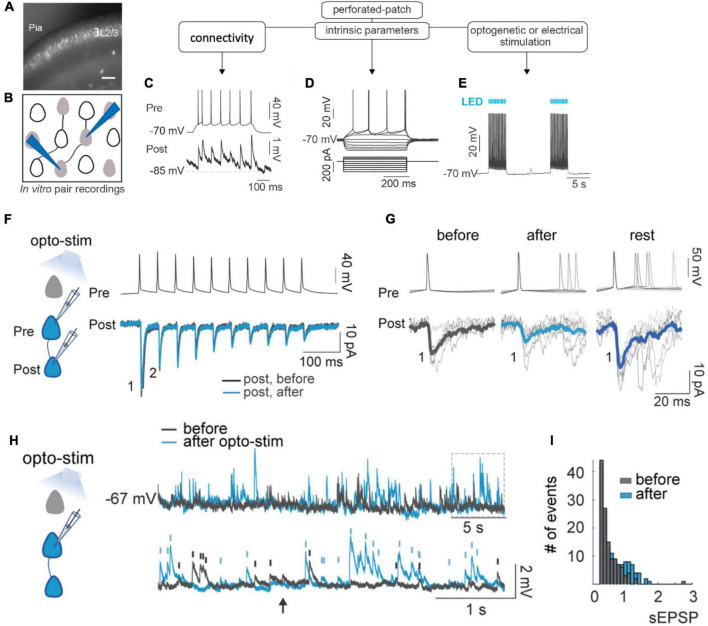
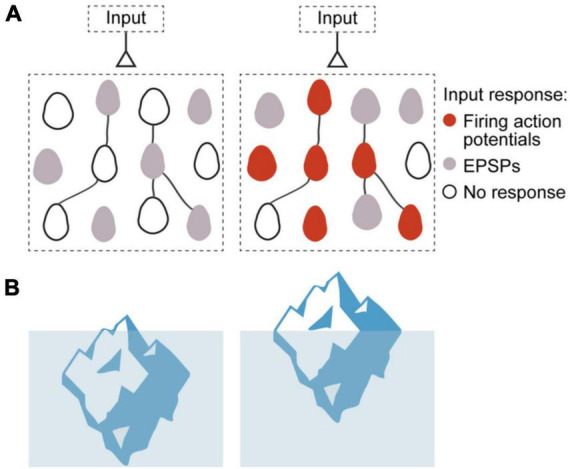
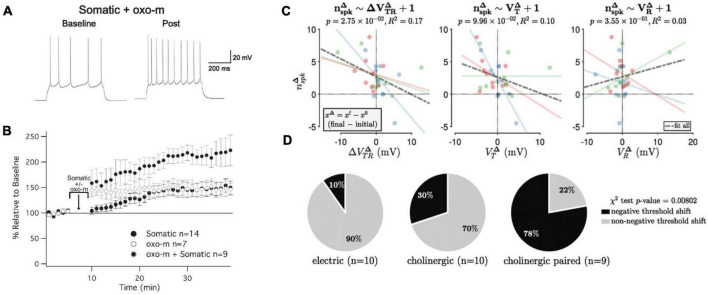
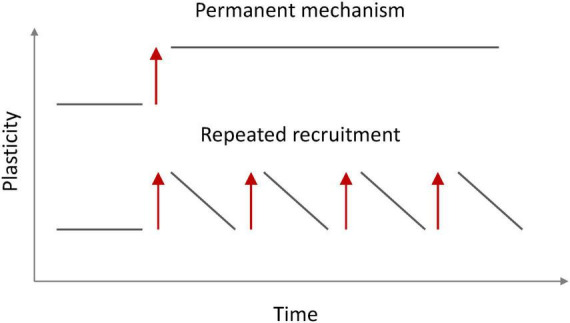
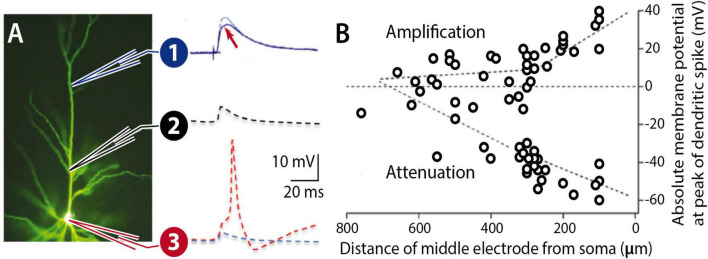
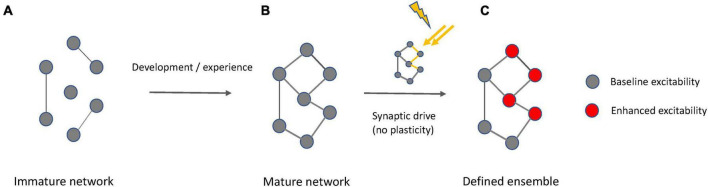
Synaptic connectivity defines groups of neurons that engage in correlated activity during specific functional tasks. These co-active groups of neurons form ensembles, the operational units involved in, for example, sensory perception, motor coordination and memory (then called an engram ). Traditionally, ensemble formation has been thought to occur via strengthening of synaptic connections via long-term potentiation (LTP) as a plasticity mechanism. This synaptic theory of memory arises from the learning rules formulated by Hebb and is consistent with many experimental observations. Here, we propose, as an alternative, that the intrinsic excitability of neurons and its plasticity constitute a second, non-synaptic mechanism that could be important for the initial formation of ensembles. Indeed, enhanced neural excitability is widely observed in multiple brain areas subsequent to behavioral learning. In cortical structures and the amygdala, excitability changes are often reported as transient, even though they can last tens of minutes to a few days. Perhaps it is for this reason that they have been traditionally considered as modulatory, merely supporting ensemble formation by facilitating LTP induction, without further involvement in memory function (memory allocation hypothesis). We here suggest−based on two lines of evidence—that beyond modulating LTP allocation, enhanced excitability plays a more fundamental role in learning. First, enhanced excitability constitutes a signature of active ensembles and, due to it, subthreshold synaptic connections become suprathreshold in the absence of synaptic plasticity ( iceberg model ). Second, enhanced excitability promotes the propagation of dendritic potentials toward the soma and allows for enhanced coupling of EPSP amplitude (LTP) to the spike output (and thus ensemble participation). This permissive gate model describes a need for permanently increased excitability, which seems at odds with its traditional consideration as a short-lived mechanism. We propose that longer modifications in excitability are made possible by a low threshold for intrinsic plasticity induction, suggesting that excitability might be on/off-modulated at short intervals. Consistent with this, in cerebellar Purkinje cells, excitability lasts days to weeks, which shows that in some circuits the duration of the phenomenon is not a limiting factor in the first place. In our model, synaptic plasticity defines the information content received by neurons through the connectivity network that they are embedded in. However, the plasticity of cell-autonomous excitability could dynamically regulate the ensemble participation of individual neurons as well as the overall activity state of an ensemble.
Overview
The claims and statistics of this paper haven’t been checked yet.
Free: it reads the open-access text and checks the first 5 claims that cite a source we can check. Create a free account to check every claim.
Integrity signals
Registry
Cites
Statistics
Figures
Verification
Claims the paper makes
The claims and statistics of this paper haven’t been checked yet.
Free: it reads the open-access text and checks the first 5 claims that cite a source we can check. Create a free account to check every claim.
Claims other papers make about this one
Each is checked against this paper’s own text: does it say what the citing paper says it does?
The source backs part of the claim, not all of it — or backs it for a different population, condition or comparison.
In the citing paper
“These changes can occur independently of synaptic remodeling yet powerfully influence circuit output and behavioral state [24,26].”
From Synaptic Plasticity—Intrinsic Excitability and Antidepressant Discovery (2026) · cites this paper as [26]
Experimental — accuracy not yet measuredThe cited source says what the claim attributes to it.
In the citing paper
“Unlike synaptic plasticity, which modifies the efficacy of connections between neurons, intrinsic excitability regulates neuronal gain and input–output transformations at the single cell level [24,25,26].”
From Synaptic Plasticity—Intrinsic Excitability and Antidepressant Discovery (2026) · cites this paper as [26]
The check wasn’t confident either way, so it gives no verdict — never disputed.
In the citing paper
“Chronic stress induces cell-type-specific shifts in intrinsic excitability within medial prefrontal and hippocampal neurons, biasing circuits toward vulnerability or resilience depending on channel composition and neuromodulatory state [25,26].”
From Synaptic Plasticity—Intrinsic Excitability and Antidepressant Discovery (2026) · cites this paper as [26]
Experimental — accuracy not yet measured
Self-check
Percentages, sums and reported differences re-computed from the paper’s own numbers.
The self-check needs the paper’s full text.
Citations
Cites
Bliss, T. V. P., & Gardner‐Medwin, A. R. (1973) · The Journal of Physiology · doi:10.1113/jphysiol.1973.sp010274 · Cited by 7,437
(2023) · doi:10.1126/science · Cited by 6,063
Journal of Biological Chemistry
(2021) · Journal of Biological Chemistry · doi:10.1074/jbc · Cited by 3,400
Experience-dependent structural synaptic plasticity in the mammalian brain
Holtmaat, A., & Svoboda, K. (2009) · Nature Reviews Neuroscience · doi:10.1038/nrn2699 · Cited by 1,934 · cited 1×
“LTP may also be accompanied by the emergence of new dendritic spines (Engert and Bonhoeffer, 1999; Yuste and Bonhoeffer, 2001) and spine growth (Holtmaat and Svoboda, 2009) making it the ideal plasticity mechanism to establish and update synaptic connectivity in an experience-dependent manner in…”
BackgroundDendritic spine changes associated with hippocampal long-term synaptic plasticity
Engert, F., & Bonhoeffer, T. (1999) · Nature · doi:10.1038/19978 · Cited by 1,412
CENTRAL CHOLINERGIC SYSTEMS AND COGNITION
Everitt, B. J., & Robbins, T. W. (1997) · Annual Review of Psychology · doi:10.1146/annurev.psych.48.1.649 · Cited by 1,348
Neural syntax: cell assemblies, synapsembles, and readers
Buzsáki, G. (2010) · Neuron · doi:10.1016/j.neuron.2010.09.023 · Cited by 1,289 · cited 2×
“As mentioned, neuronal ensembles (often referred to as assemblies) are coactive groups of neurons that have been shown to mediate perception and behavior (Buzsaki, 2010 ; Yuste et al., 2024).”
BackgroundMorphological Changes in Dendritic Spines Associated with Long-Term Synaptic Plasticity
Yuste, R., & Bonhoeffer, T. (2001) · Annual Review of Neuroscience · doi:10.1146/annurev.neuro.24.1.1071 · Cited by 1,269 · cited 2×
“As mentioned, neuronal ensembles (often referred to as assemblies) are coactive groups of neurons that have been shown to mediate perception and behavior (Buzsaki, 2010 ; Yuste et al., 2024).”
BackgroundSelf-citationMemory engrams: Recalling the past and imagining the future
Josselyn, S. A., & Tonegawa, S. (2020) · Science · doi:10.1126/science.aaw4325 · Cited by 1,087 · cited 1×
“…focus on cellular mechanisms of engram formation and recall, neurons are allocated to an engram that show high excitability at the time of learning, facilitating subsequent integration via LTP (Rogerson et al., 2014; Yiu et al., 2014; Josselyn and Frankland, 2018; Josselyn and Tonegawa, 2020).”
BackgroundEngineering a memory with LTD and LTP
Nabavi, S., Fox, R., Proulx, C. D., Lin, J. Y., Tsien, R. Y., & Malinow, R. (2014) · Nature · doi:10.1038/nature13294 · Cited by 980 · cited 1×
“…synaptic plasticity and memory was provided in 2014, when Malinow et al. optogenetically induced long-term depression (LTD) and LTP to inactivate and reactivate, respectively, a fear memory that was previously established using a fear-conditioning paradigm in the amygdala (Nabavi et al., 2014).”
Method(2014) · doi:10.1523/jneurosci · Cited by 715
Attractor dynamics of network UP states in the neocortex
Cossart, R., Aronov, D., & Yuste, R. (2003) · Nature · doi:10.1038/nature01614 · Cited by 659 · cited 1×
“%) of imaged neurons, which become coactive in a significant manner, within a small temporal window (Cossart et al., 2003: Miller et al., 2014; Carrillo-Reid et al., 2015).”
BackgroundSelf-citationCortical layer-specific critical dynamics triggering perception
Marshel, J. H., Kim, Y. S., Machado, T. A., Quirin, S., Benson, B., Kadmon, J., Raja, C., Chibukhchyan, A., Ramakrishnan, C., Inoue, M., et al. (2019) · Science · doi:10.1126/science.aaw5202 · Cited by 652
Beyond parallel fiber LTD: the diversity of synaptic and non-synaptic plasticity in the cerebellum
Hansel, C., Linden, D. J., & D'Angelo, E. (2001) · Nature Neuroscience · doi:10.1038/87419 · Cited by 615
Self-citationLong-Term Plasticity of Intrinsic Excitability: Learning Rules and Mechanisms
Daoudal, G., & Debanne, D. (2003) · Learning & Memory · doi:10.1101/lm.64103 · Cited by 543 · cited 1×
“In line with these and other findings, it has been suggested that there could be a “Memory from the dynamics of intrinsic membrane currents” (Marder et al., 1996), an idea that was followed up by several investigators soon after (Hansel et al., 2001; Daoudal and Debanne, 2003; Frick et al., 2004).”
ResultShen, W., Plotkin, J. L., Francardo, V., Ko, W. K. D., Xie, Z., Li, Q., Fieblinger, T., Wess, J., Neubig, R. R., Lindsley, C. W., et al. (2015) · HAL (Le Centre pour la Communication Scientifique Directe) · doi:10.1016/j.neuron · Cited by 452
SK channels and NMDA receptors form a Ca2+-mediated feedback loop in dendritic spines
Ngo-Anh, T. J., Bloodgood, B. L., Lin, M., Sabatini, B. L., Maylie, J., & Adelman, J. P. (2005) · Nature Neuroscience · doi:10.1038/nn1449 · Cited by 441
Yiu, A. P., Mercaldo, V., Yan, C., Richards, B., Rashid, A. J., Hsiang, H.-L. L., Pressey, J., Mahadevan, V., Tran, M. M., Kushner, S. A., et al. (2014) · Neuron · doi:10.1016/j.neuron.2014.07.017 · Cited by 437
LTP is accompanied by an enhanced local excitability of pyramidal neuron dendrites
Frick, A., Magee, J., & Johnston, D. (2004) · Nature Neuroscience · doi:10.1038/nn1178 · Cited by 426 · cited 1×
“In line with these and other findings, it has been suggested that there could be a “Memory from the dynamics of intrinsic membrane currents” (Marder et al., 1996), an idea that was followed up by several investigators soon after (Hansel et al., 2001; Daoudal and Debanne, 2003; Frick et al., 2004).”
ResultLarkum, M. E., Zhu, J. J., & Sakmann, B. (2001) · The Journal of Physiology · doi:10.1111/j.1469-7793.2001.0447a.x · Cited by 418
Calcium-Mediated Reduction of Ionic Currents: A Biophysical Memory Trace
Alkon, D. L. (1984) · Science · doi:10.1126/science.6093258 · Cited by 393 · cited 1×
“Similar findings were made previously following associative learning in the mollusk Hermissenda (Alkon, 1984) and subsequently following eyeblink conditioning in cerebellar Purkinje cells (Schreurs et al., 1998).”
ResultInfluential(2017) · eLife · doi:10.7554/elife · Cited by 361
Conditioning-specific membrane changes of rabbit hippocampal neurons measured in vitro.
Disterhoft, J. F., Coulter, D. A., & Alkon, D. L. (1986) · Proceedings of the National Academy of Sciences · doi:10.1073/pnas.83.8.2733 · Cited by 333
Controlling Visually Guided Behavior by Holographic Recalling of Cortical Ensembles
Carrillo-Reid, L., Han, S., Yang, W., Akrouh, A., & Yuste, R. (2019) · Cell · doi:10.1016/j.cell.2019.05.045 · Cited by 330
Self-citationSynaptic tagging during memory allocation
Rogerson, T., Cai, D. J., Frank, A., Sano, Y., Shobe, J., Lopez-Aranda, M. F., & Silva, A. J. (2014) · Nature Reviews Neuroscience · doi:10.1038/nrn3667 · Cited by 304 · cited 1×
“…focus on cellular mechanisms of engram formation and recall, neurons are allocated to an engram that show high excitability at the time of learning, facilitating subsequent integration via LTP (Rogerson et al., 2014; Yiu et al., 2014; Josselyn and Frankland, 2018; Josselyn and Tonegawa, 2020).”
BackgroundBrecht, M., Roth, A., & Sakmann, B. (2003) · The Journal of Physiology · doi:10.1113/jphysiol.2003.044222 · Cited by 295
Imprinting and recalling cortical ensembles
Carrillo-Reid, L., Yang, W., Bando, Y., Peterka, D. S., & Yuste, R. (2016) · Science · doi:10.1126/science.aaf7560 · Cited by 295
Self-citationInhibitory Autophosphorylation of CaMKII Controls PSD Association, Plasticity, and Learning
Elgersma, Y., Fedorov, N. B., Ikonen, S., Choi, E. S., Elgersma, M., Carvalho, O. M., Giese, K. P., & Silva, A. J. (2002) · Neuron · doi:10.1016/s0896-6273(02)01007-3 · Cited by 290
Visual stimuli recruit intrinsically generated cortical ensembles
Miller, J.-E. K., Ayzenshtat, I., Carrillo-Reid, L., & Yuste, R. (2014) · Proceedings of the National Academy of Sciences · doi:10.1073/pnas.1406077111 · Cited by 288 · cited 3×
“%) of imaged neurons, which become coactive in a significant manner, within a small temporal window (Cossart et al., 2003: Miller et al., 2014; Carrillo-Reid et al., 2015).”
BackgroundSelf-citationMemory from the dynamics of intrinsic membrane currents
Marder, E., Abbott, L. F., Turrigiano, G. G., Liu, Z., & Golowasch, J. (1996) · Proceedings of the National Academy of Sciences · doi:10.1073/pnas.93.24.13481 · Cited by 281 · cited 1×
“In line with these and other findings, it has been suggested that there could be a “Memory from the dynamics of intrinsic membrane currents” (Marder et al., 1996), an idea that was followed up by several investigators soon after (Hansel et al., 2001; Daoudal and Debanne, 2003; Frick et al., 2004).”
ResultUnique Roles of SK and Kv4.2 Potassium Channels in Dendritic Integration
Cai, X., Liang, C. W., Muralidharan, S., Kao, J. P. Y., Tang, C.-M., & Thompson, S. M. (2004) · Neuron · doi:10.1016/j.neuron.2004.09.026 · Cited by 266
Chloride Regulation: A Dynamic Equilibrium Crucial for Synaptic Inhibition
Doyon, N., Vinay, L., Prescott, S. A., & De Koninck, Y. (2016) · Neuron · doi:10.1016/j.neuron.2016.02.030 · Cited by 252
Engram Cell Excitability State Determines the Efficacy of Memory Retrieval
Pignatelli, M., Ryan, T. J., Roy, D. S., Lovett, C., Smith, L. M., Muralidhar, S., & Tonegawa, S. (2019) · Neuron · doi:10.1016/j.neuron.2018.11.029 · Cited by 245
Thompson, L. T., Moyer, J. R., & Disterhoft, J. F. (1996) · Journal of Neurophysiology · doi:10.1152/jn.1996.76.3.1836 · Cited by 237 · cited 1×
“…CA3 hippocampal pyramidal neurons following eyeblink conditioning in rabbits, enhanced excitability was observed for longer periods of time, but began to decline three days after learning (the conditioned behavior, in contrast, lasted for the full 180 days of recordings; Thompson et al., 1996).”
BackgroundInfluentialMemory Allocation: Mechanisms and Function
Josselyn, S. A., & Frankland, P. W. (2018) · Annual Review of Neuroscience · doi:10.1146/annurev-neuro-080317-061956 · Cited by 217 · cited 1×
“…focus on cellular mechanisms of engram formation and recall, neurons are allocated to an engram that show high excitability at the time of learning, facilitating subsequent integration via LTP (Rogerson et al., 2014; Yiu et al., 2014; Josselyn and Frankland, 2018; Josselyn and Tonegawa, 2020).”
BackgroundBuchanan, K. A., Petrovic, M. M., Chamberlain, S. E. L., Marrion, N. V., & Mellor, J. R. (2010) · Neuron · doi:10.1016/j.neuron.2010.11.018 · Cited by 184
Schreurs, B. G., Gusev, P. A., Tomsic, D., Alkon, D. L., & Shi, T. (1998) · The Journal of Neuroscience · doi:10.1523/jneurosci.18-14-05498.1998 · Cited by 171 · cited 2×
“Similar findings were made previously following associative learning in the mollusk Hermissenda (Alkon, 1984) and subsequently following eyeblink conditioning in cerebellar Purkinje cells (Schreurs et al., 1998).”
BackgroundResultInfluentialSourdet, V., Russier, M., Daoudal, G., Ankri, N., & Debanne, D. (2003) · The Journal of Neuroscience · doi:10.1523/jneurosci.23-32-10238.2003 · Cited by 171
Neuronal ensembles: Building blocks of neural circuits
Yuste, R., Cossart, R., & Yaksi, E. (2024) · Neuron · doi:10.1016/j.neuron.2023.12.008 · Cited by 159
Self-citationGiessel, A. J., & Sabatini, B. L. (2010) · Neuron · doi:10.1016/j.neuron.2010.09.004 · Cited by 156
Belmeguenai, A., Hosy, E., Bengtsson, F., Pedroarena, C. M., Piochon, C., Teuling, E., He, Q., Ohtsuki, G., De Jeu, M. T. G., Elgersma, Y., et al. (2010) · The Journal of Neuroscience · doi:10.1523/jneurosci.3226-10.2010 · Cited by 156
Self-citationOrganization and Regulation of Small Conductance Ca2+-activated K+Channel Multiprotein Complexes
Allen, D., Fakler, B., Maylie, J., & Adelman, J. P. (2007) · The Journal of Neuroscience · doi:10.1523/jneurosci.3565-06.2007 · Cited by 155
Endogenous Sequential Cortical Activity Evoked by Visual Stimuli
Carrillo-Reid, L., Miller, J.-E. K., Hamm, J. P., Jackson, J., & Yuste, R. (2015) · Journal of Neuroscience · doi:10.1523/jneurosci.5214-14.2015 · Cited by 140
Self-citationBliss, T. V. P., & Lømo, T. (1973) · The Journal of Physiology · doi:10.1113/jphysiol.1973.sp010273 · Cited by 135
LTD-like molecular pathways in developmental synaptic pruning
Piochon, C., Kano, M., & Hansel, C. (2016) · Nature Neuroscience · doi:10.1038/nn.4389 · Cited by 110 · cited 1×
“The synaptic plasticity machinery for these processes is available from early postnatal development onwards and the molecular pathways involved in LTD and LTP remain similar across these developmental stages (Piochon et al., 2016b).”
BackgroundSelf-citationImaging and Optically Manipulating Neuronal Ensembles
Carrillo‐Reid, L., Yang, W., Miller, J.-E. K., Peterka, D. S., & Yuste, R. (2017) · Annual Review of Biophysics · doi:10.1146/annurev-biophys-070816-033647 · Cited by 103
Self-citationRen, Y., Barnwell, L. F., Alexander, J. C., Lubin, F. D., Adelman, J. P., Pfaffinger, P. J., Schrader, L. A., & Anderson, A. E. (2006) · Journal of Biological Chemistry · doi:10.1074/jbc.m513125200 · Cited by 103
Long-term stability of cortical ensembles
Pérez-Ortega, J., Alejandre-García, T., & Yuste, R. (2021) · eLife · doi:10.7554/elife.64449 · Cited by 84
Self-citationIntrinsic excitability mechanisms of neuronal ensemble formation
Alejandre-García, T., Kim, S., Pérez-Ortega, J., & Yuste, R. (2022) · eLife · doi:10.7554/elife.77470 · Cited by 79
Self-citationSomato-dendritic synaptic plasticity and error-backpropagation in active dendrites
Schiess, M., Urbanczik, R., & Senn, W. (2016) · PLoS Computational Biology · doi:10.1371/journal.pcbi.1004638 · Cited by 75
Grasselli, G., Boele, H., Titley, H. K., Bradford, N., van Beers, L., Jay, L., Beekhof, G. C., Busch, S. E., Zeeuw, C. I. D., Schonewille, M., et al. (2020) · PLoS Biology · doi:10.1371/journal.pbio.3000596 · Cited by 71
Self-citationMultiple forms of activity‐dependent intrinsic plasticity in layer V cortical neurones in vivo
Paz, J. T., Mahon, S., Tiret, P., Genet, S., Delord, B., & Charpier, S. (2009) · The Journal of Physiology · doi:10.1113/jphysiol.2009.169334 · Cited by 60
Calcium threshold shift enables frequency-independent control of plasticity by an instructive signal
Piochon, C., Titley, H. K., Simmons, D. H., Grasselli, G., Elgersma, Y., & Hansel, C. (2016) · Proceedings of the National Academy of Sciences · doi:10.1073/pnas.1613897113 · Cited by 60
Self-citationPrion Protein Helix1 Promotes Aggregation but Is Not Converted into beta-Sheet
Watzlawik, J. O., Skóra, L., Frense, D., Griesinger, C., Zweckstetter, M., Schulz‐Schaeffer, W., & Kramer, M. L. (2006) · Journal of Biological Chemistry · doi:10.1074/jbc.m605141200 · Cited by 55
Plasticity of intrinsic excitability in mature granule cells of the dentate gyrus
Lopez-Rojas, J., Heine, M., & Kreutz, M. R. (2016) · Scientific Reports · doi:10.1038/srep21615 · Cited by 53
Kwon, T., Merchán-Pérez, A., Rial Verde, E. M., Rodríguez, J.-R., DeFelipe, J., & Yuste, R. (2019) · Cerebral Cortex · doi:10.1093/cercor/bhy143 · Cited by 44
Self-citationDrift of neural ensembles driven by slow fluctuations of intrinsic excitability
Delamare, G., Zaki, Y., Cai, D. J., & Clopath, C. (2024) · eLife · doi:10.7554/elife.88053 · Cited by 40
Chloride dynamics alter the input-output properties of neurons
Currin, C. B., Trevelyan, A. J., Akerman, C. J., & Raimondo, J. V. (2020) · PLOS Computational Biology · doi:10.1371/journal.pcbi.1007932 · Cited by 38
Ohtsuki, G., & Hansel, C. (2018) · iScience · doi:10.1016/j.isci.2018.02.001 · Cited by 33 · cited 1×
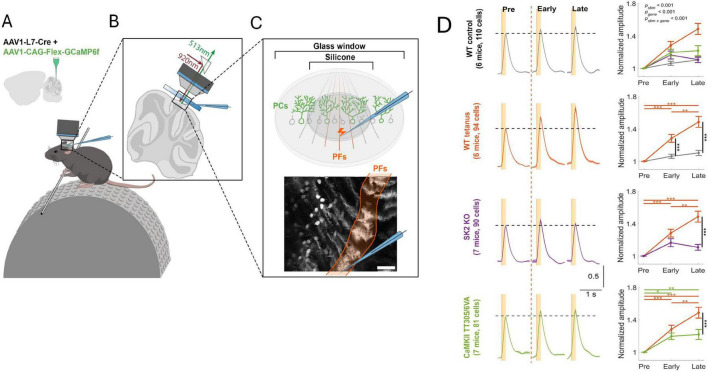
“…patch-clamp recordings from Purkinje cells in vitro , it was observed that either triggering intrinsic plasticity or bath-application of the SK channel antagonist apamin (10 nM) would enhance excitability and turn EPSP amplitude into a better predictor of spike output (Ohtsuki and Hansel, 2018).”
BackgroundSelf-citationKCC2 drives chloride microdomain formation in dendritic blebbing
Weilinger, N. L., Wicki‐Stordeur, L. E., Groten, C. J., LeDue, J. M., Kahle, K. T., & MacVicar, B. A. (2022) · Cell Reports · doi:10.1016/j.celrep.2022.111556 · Cited by 31 · cited 1×
“An example are somato-dendritic gradients of chloride that change with ongoing synaptic activity and can alter the efficacy of dendritic propagation (Currin et al., 2020; see also Doyon et al., 2014; Weilinger et al., 2022).”
BackgroundStimulus encoding by specific inactivation of cortical neurons
Pérez-Ortega, J., Akrouh, A., & Yuste, R. (2024) · Nature Communications · doi:10.1038/s41467-024-47515-x · Cited by 27
Self-citationLin, T., Busch, S. E., & Hansel, C. (2024) · Nature Communications · doi:10.1038/s41467-024-48373-3 · Cited by 26
Self-citationGill, D., & Hansel, C. (2020) · eNeuro · doi:10.1523/eneuro.0453-19.2020 · Cited by 24
Self-citationPham, T. D., & Hansel, C. (2022) · The Journal of Physiology · doi:10.1113/jp283473 · Cited by 9
Self-citationContiguity in perception: origins in cellular associative computations
Hansel, C. (2024) · Trends in Neurosciences · doi:10.1016/j.tins.2024.01.001 · Cited by 6 · cited 1×
“Synaptic plasticity mechanisms may be the main mechanism that neurons use to detect and learn associative input relationships and establish neural circuits based on connectivity principles informed by such associative structures (Hansel, 2024).”
BackgroundSelf-citationNeuronal ensembles in visual cortex reactivate during hypnagogic sleep onsetPreprint
Lines, J., & Yuste, R. (2023) · bioRxiv (Cold Spring Harbor Laboratory) · doi:10.1101/2023.04.26.538480 · Cited by 5
Self-citation
Research works printed but not linked: 1
- 29. Hebb, D. O. (1949). The organization of behaviour. Hoboken, NJ: Wiley.
Cited by
Zhai, S., Cui, Q., Wokosin, D. L., Sun, L., Tkatch, T., Crittenden, J. R., Graybiel, A. M., & Surmeier, D. J. (2025) · Science Advances · doi:10.1126/sciadv.adv8224 · Cited by 15
Designing Neural Dynamics: From Digital Twin Modeling to Regeneration
Tătaru, C. P., Dumitru, A. V., Dobrin, N., Rădoi, M. P., Ciurea, A. V., Munteanu, O., & Munteanu, L. V. (2025) · International Journal of Molecular Sciences · doi:10.3390/ijms27010122 · Cited by 9
“Changes in intrinsic excitability plasticity—through alterations in the expression or phosphorylation of ion channels—also modify the input/output characteristics of neurons, thereby modifying basin stability independent of changes in the wiring diagram [214].”
The precision principle: driving biological self-organization
Roy, R., Sidhu, K., Byczynski, G., D’Angiulli, A., & Dresp, B. (2025) · Frontiers in Network Physiology · doi:10.3389/fnetp.2025.1678473 · Cited by 7
Hadžibegović, S., Zhu, L., Ginger, M. R., Costa, M. G., Menéndez, P. R., Sa, R. D., Corf, K. L., Feuvre, Y. L., Nicole, O., Bontempi, B., et al. (2025) · Nature Communications · doi:10.1038/s41467-025-66975-3 · Cited by 10
“Neuron-wide IE plasticity would tune the responsiveness of that neuron to the majority of its synaptic inputs (i.e., synaptic penetrance 17 ) and might prime it to undergo further plasticity, such as in synaptic strength and connectivity 17 .”
Treur, J. (2026) · Studies in systems, decision and control · doi:10.1007/978-3-032-17029-3_4 · Cited by 10
Metadata
- Authors
- Hansel, C., & Yuste, R.
- Affiliations
- University of Chicago (US)
- Columbia University (US)
- Corresponding author
- Hansel, Christian
- Yuste, Rafael
- Venue
- Frontiers in Cellular Neuroscience
- Publisher
- Frontiers Media SA
- Published
- 2024-07-31
- Volume
- 18
- Pages
- 1440588-1440588
- ISSN
- 1662-5102 (ISSN-L)
- PMC
- PMC11322048
- OpenAlex
- W4401194868
- Cited by
- 33
- References
- 59
- Citations by year
- 2026: 9 · 2025: 22 · 2024: 2
- FWCI
- 2.07
- Type
- journal article
- Language
- en
- Open access
- gold
- doi.org
- Licence
- Locations
- Frontiers in Cellular Neuroscience (publishedVersion, cc-by)
- PubMed Central (publishedVersion, cc-by)
- PubMed (publishedVersion)
- Knowledge@UChicago (University of Chicago) (submittedVersion, cc-by-nc-nd)
- DOAJ (DOAJ: Directory of Open Access Journals) (submittedVersion, cc-by-sa)
- University of Chicago (cc-by)
- Funders
- National Institutes of Health (5r01mh115900-05)
- National Institute of Mental Health (R01-MH115900)
- National Eye Institute (R01EY035248)
- National Institute of Neurological Disorders and Stroke (R01NS062771, RM1NS132981)
- Topics
- Life Sciences › Neuroscience › Cellular and Molecular Neuroscience › Neuroscience and Neuropharmacology Research
- Life Sciences › Neuroscience › Cognitive Neuroscience › Memory and Neural Mechanisms
- Life Sciences › Neuroscience › Cognitive Neuroscience › Neural dynamics and brain function
- Keywords
- neuronal ensembles, intrinsic excitability, intrinsic plasticity, synaptic plasticity, long-term potentiation, iceberg model, engram, Hebbian learning, Purkinje cells, ensemble participation
About these checks
Registry, retraction, Cites and statistics results are computed, not judged, with one exception: a printed reference that no index lists is read once by a model before it counts as a citation error. Claims are extracted by a model and kept only when their quote appears verbatim in the text; each cited source is then checked, with a model’s help, for whether it says what the claim relies on. Those verdicts can be wrong — read the claim’s quote and the cited source before relying on one.
Statistics and arithmetic are recomputed, not judged.
Confidence bands are shown only for fields calibrated on our annotated test set. None is calibrated yet, so no band is shown.
What counts as a claim ›How we measure confidence ›How we check this ›
Are you an author, or do you see a problem with this page? Request a review
Data sources
Bibliographic data: Semantic Scholar, OpenAlex, Crossref.
Contains information from the Semantic Scholar Academic Graph Datasets, made available under the ODC Attribution License (ODC-BY 1.0).
Semantic Scholar’s data is described in: Kinney, R., et al. (2023). The Semantic Scholar Open Data Platform. arXiv:2301.10140.
