

The DOI matches its Crossref record; 126 of the 127 references it cites were found in a registry or an index.
The Many Faces of Astrocytes in Alzheimer's Disease
Open accessAbstract
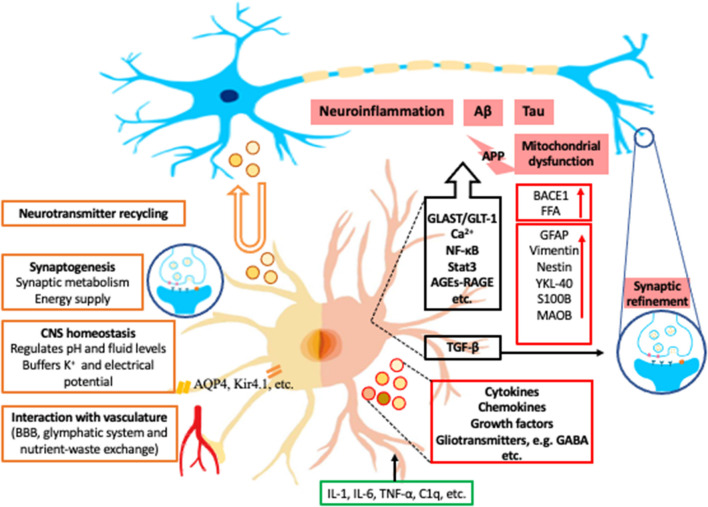
Alzheimer's disease (AD) is a progressive neurodegenerative disease and is the most common cause of dementia in an aging population. The majority of research effort has focused on the role of neurons in neurodegeneration and current therapies have limited ability to slow disease progression. Recently more attention has been given to the role of astrocytes in the process of neurodegeneration. Specifically, reactive astrocytes have both advantageous and adverse effects during neurodegeneration. The ability to isolate and depict astrocyte phenotype has been challenging. However, with the recent development of single-cell sequencing technologies researchers are provided with the resource to delineate specific biomarkers associated with reactive astrocytes in AD. In this review, we will focus on the role of astrocytes in normal conditions and the pathological development of AD. We will further review recent developments in the understanding of astrocyte heterogeneity and associated biomarkers. A better understanding of astrocyte contributions and phenotypic changes in AD can ultimately lead to more effective therapeutic targets.
Overview
The claims and statistics of this paper haven’t been checked yet.
Run the check — free, no account needed. It reads the open-access text and checks the sources it cites.
Integrity signals
Registry
Cites
Statistics
Figures
Verification
Claims the paper makes
The claims and statistics of this paper haven’t been checked yet.
Run the check — free, no account needed. It reads the open-access text and checks the sources it cites.
Claims other papers make about this one
Each is checked against this paper’s own text: does it say what the citing paper says it does?
The source backs part of the claim, not all of it — or backs it for a different population, condition or comparison.
In the citing paper
“As we have discussed above, glial cells are the primary cells involved in neuroinflammation and neurodegeneration. Their crucial function in the development and progression of neurodegenerative diseases has also been elaborated in many reviews in the past year.275,468,469”
From Role of neuroinflammation in neurodegeneration development (2023) · cites this paper as [468]
Experimental — accuracy not yet measured
Self-check
Percentages, sums and reported differences re-computed from the paper’s own numbers.
The self-check needs the paper’s full text.
Citations
Cites
1 retracted
Bialas, A. R., & Stevens, B. (2013) · Nature Neuroscience · doi:10.1038/nn.3560 · Cited by 519
RetractedNeurotoxic reactive astrocytes are induced by activated microglia
Liddelow, S. A., Guttenplan, K. A., Clarke, L. E., Bennett, F. C., Bohlen, C. J., Schirmer, L., Bennett, M. L., Münch, A. E., Chung, W.-S., Peterson, T. C., et al. (2017) · Nature · doi:10.1038/nature21029 · Cited by 7,971
Neuroinflammation in Alzheimer's disease
Heneka, M. T., Carson, M. J., Khoury, J. E., Landreth, G. E., Brosseron, F., Feinstein, D. L., Jacobs, A. H., Wyss-Coray, T., Vitorica, J., Ransohoff, R. M., et al. (2015) · The Lancet Neurology · doi:10.1016/s1474-4422(15)70016-5 · Cited by 6,226
2016 Alzheimer's disease facts and figures
Alzheimer's Association (2016) · Alzheimer's & Dementia · doi:10.1016/j.jalz.2016.03.001 · Cited by 5,069
Danbolt, N. C. (2001) · Progress in Neurobiology · doi:10.1016/s0301-0082(00)00067-8 · Cited by 4,227
Neuropathological alterations in Alzheimer disease
Serrano-Pozo, A., Frosch, M. P., Masliah, E., & Hyman, B. T. (2011) · Cold Spring Harbor Perspectives in Medicine · doi:10.1101/cshperspect.a006189 · Cited by 3,345
Single-cell transcriptomic analysis of Alzheimer’s disease
Mathys, H., Davila-Velderrain, J., Peng, Z., Gao, F., Mohammadi, S., Young, J. Z., Menon, M., He, L., Abdurrob, F., Jiang, X., et al. (2019) · Nature · doi:10.1038/s41586-019-1195-2 · Cited by 2,568
Reactive astrocyte nomenclature, definitions, and future directions
Escartin, C., Galea, E., Lakatos, A., O’Callaghan, J. P., Petzold, G. C., Serrano-Pozo, A., Steinhäuser, C., Volterra, A., Carmignoto, G., Agarwal, A., et al. (2021) · Nature Neuroscience · doi:10.1038/s41593-020-00783-4 · Cited by 2,513
Self-citation2020 Alzheimer's disease facts and figures
(2020) · Alzheimer's & Dementia · doi:10.1002/alz.12068 · Cited by 2,353
The glymphatic system: a beginner's guide
Jessen, N. A., Munk, A. S. F., Lundgaard, I., & Nedergaard, M. (2015) · Neurochemical Research · doi:10.1007/s11064-015-1581-6 · Cited by 2,075
Cited by
Sorted by citations
Role of neuroinflammation in neurodegeneration development
Zhang, W., Xiao, D., Mao, Q., & Xia, H. (2023) · Signal Transduction and Targeted Therapy · doi:10.1038/s41392-023-01486-5 · Cited by 1,668
“Their crucial function in the development and progression of neurodegenerative diseases has also been elaborated in many reviews in the past year.(275,468,469) Besides microglia and astrocytes, other cells, including endothelial cells, pericytes, CNS borderassociated macrophages (BAMs) and oligodendrocytes, also play…”
BackgroundDi Benedetto, G., Burgaletto, C., Bellanca, C. M., Munafò, A., Bernardini, R., & Cantarella, G. (2022) · Cells · doi:10.3390/cells11172728 · Cited by 189
Rodríguez-Giraldo, M., González-Reyes, R. E., Ramírez-Guerrero, S., Bonilla-Trilleras, C. E., Guardo-Maya, S., & Nava-Mesa, M. O. (2022) · International Journal of Molecular Sciences · doi:10.3390/ijms232113630 · Cited by 122
Organ‐On‐A‐Chip Models of the Blood–Brain Barrier: Recent Advances and Future Prospects
Kawakita, S., Mandal, K., Mou, L., Mecwan, M. M., Zhu, Y., Li, S., Sharma, S., Hernández, A. L., Nguyen, H. T., Maity, S., et al. (2022) · Small · doi:10.1002/smll.202201401 · Cited by 103
Amyloid-β specific regulatory T cells attenuate Alzheimer’s disease pathobiology in APP/PS1 mice
Yeapuri, P., Machhi, J., Lu, Y., Abdelmoaty, M. M., Kadry, R., Patel, M., Bhattarai, S., Lu, E., Namminga, K. L., Olson, K. E., et al. (2023) · Molecular Neurodegeneration · doi:10.1186/s13024-023-00692-7 · Cited by 85
Metadata
- Authors
- Monterey, M. D., Wei, H., Wu, X., & Wu, J. Q.
- Affiliations
- The University of Texas Health Science Center at Houston (US)
- Brown Foundation Institute of Molecular Medicine for the Prevention of Human Diseases (US)
- The University of Texas MD Anderson Cancer Center (US)
- Corresponding author
- Wu, Jia Qian
- Venue
- Frontiers in Neurology
- Publisher
- Frontiers Media SA
- Published
- 2021-08-31
- Volume
- 12
- Pages
- 619626-619626
- ISSN
- 1664-2295 (ISSN-L)
- PMC
- PMC8438135
- OpenAlex
- W3197066362
- Cited by
- 117
- References
- 127
- Citations by year
- 2026: 12 · 2025: 27 · 2024: 34 · 2023: 29 · 2022: 15
- FWCI
- 2.80
- Type
- journal article
- Language
- en
- Open access
- gold
- doi.org
- Licence
- Locations
- Frontiers in Neurology (publishedVersion, cc-by)
- Europe PMC (PubMed Central) (publishedVersion, other-oa)
- PubMed Central (publishedVersion, cc-by)
- PubMed (publishedVersion)
- DOAJ (DOAJ: Directory of Open Access Journals) (submittedVersion, cc-by-sa)
- Funders
- National Institutes of Health
- National Eye Institute (R21EY028647)
- National Institute of Neurological Disorders and Stroke (R21NS113068, R01NS088353)
- Topics
- Life Sciences › Neuroscience › Cellular and Molecular Neuroscience › Alzheimer's disease research and treatments
- Life Sciences › Neuroscience › Neurology › Neuroinflammation and Neurodegeneration Mechanisms
- Life Sciences › Neuroscience › Cellular and Molecular Neuroscience › Neuroscience and Neuropharmacology Research
- Keywords
- Alzheimer's disease, astrocytes, reactive astrocytes, astrocyte heterogeneity, neurodegeneration, single-cell sequencing, therapeutic target
About these checks
Registry, retraction, Cites and statistics results are computed, not judged, with one exception: a printed reference that no index lists is read once by a model before it counts as a citation error. Claims are extracted by a model and kept only when their quote appears verbatim in the text; each cited source is then checked, with a model’s help, for whether it says what the claim relies on. Those verdicts can be wrong — read the claim’s quote and the cited source before relying on one.
Statistics and arithmetic are recomputed, not judged.
Confidence bands are shown only for fields calibrated on our annotated test set. None is calibrated yet, so no band is shown.
What counts as a claim ›How we measure confidence ›How we check this ›
Are you an author, or do you see a problem with this page? Request a review
