

The DOI matches its Crossref record; 28 of the 29 references it cites were found in a registry or an index.
Differential effect of motivational features on training improvements in school-based cognitive training
Open accessAbstract
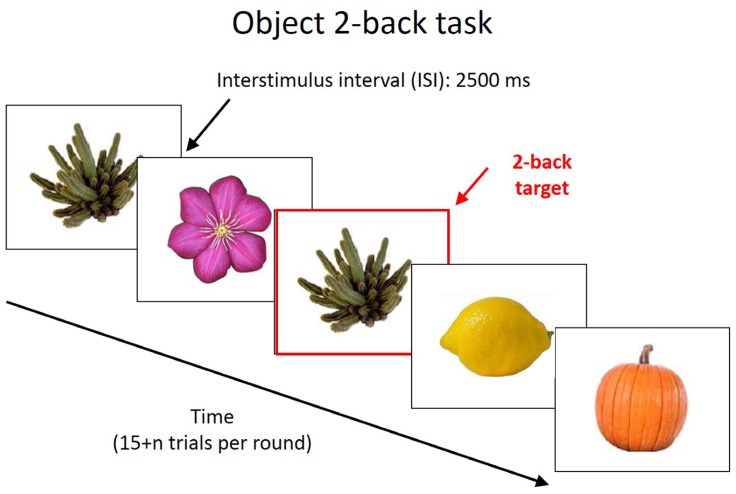
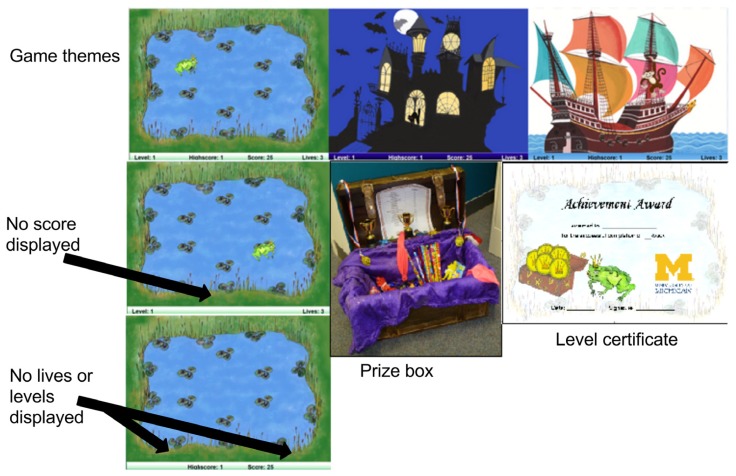
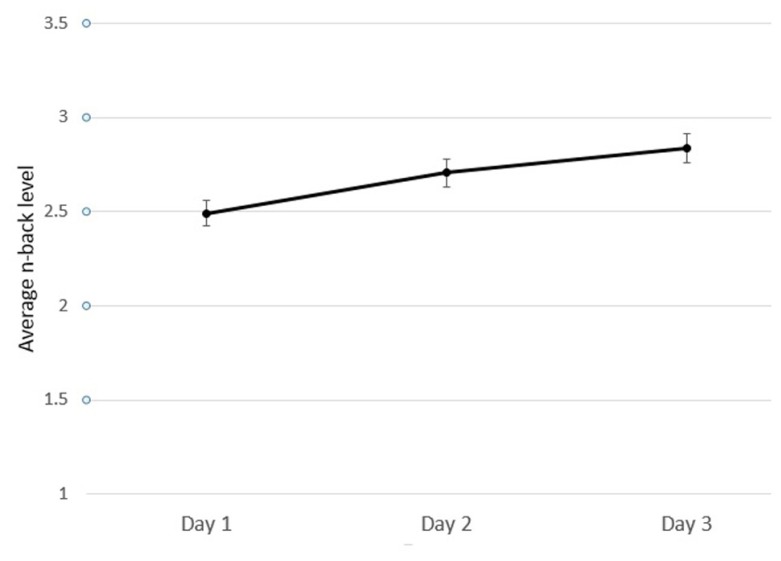
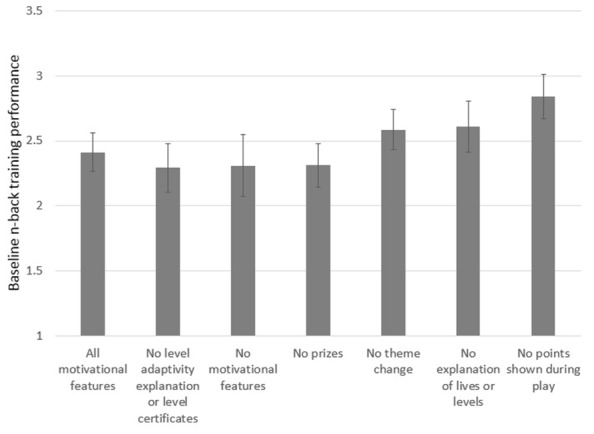
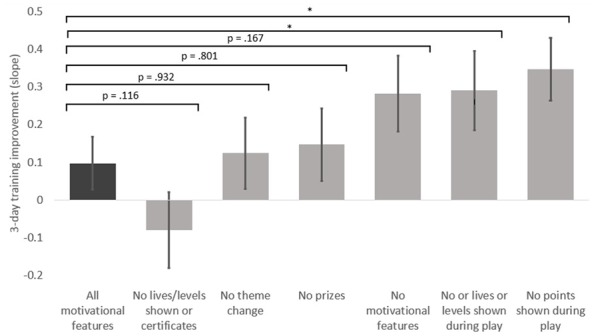
Cognitive training often utilizes game-like motivational features to keep participants engaged. It is unclear how these elements, such as feedback, reward, and theming impact player performance during training. Recent research suggests that motivation and engagement are closely related to improvements following cognitive training. We hypothesized that training paradigms featuring game-like motivational elements would be more effective than a version with no motivational elements. Five distinct motivational features were chosen for examination: a real-time scoring system, theme changes, prizes, end-of-session certificates, and scaffolding to explain the lives and leveling system included in the game. One version of the game was created with all these motivational elements included, and one was created with all of them removed. Other versions removed a single element at a time. Seven versions of a game-like n-back working memory task were then created and administered to 128 students in second through eight grade at school-based summer camps in southeastern Michigan. The inclusion of real-time scoring during play, a popular motivational component in both entertainment games and cognitive training, was found to negatively impact training improvements over the three day period. Surprisingly, scaffolding to explain lives and levels also negatively impacted training gains. The other game adjustments did not significantly impact training improvement compared to the original version of the game with all features included. These findings are preliminary and are limited by both the small sample size and the brevity of the intervention. Nonetheless, these findings suggest that certain motivational elements may distract from the core cognitive training task, reducing task improvement, especially at the initial stage of learning.
Overview
The claims and statistics of this paper haven’t been checked yet.
Run the check — free, no account needed. It reads the open-access text and checks the sources it cites.
Integrity signals
Registry
Cites
Statistics
Figures
Verification
Claims the paper makes
The claims and statistics of this paper haven’t been checked yet.
Run the check — free, no account needed. It reads the open-access text and checks the sources it cites.
Claims other papers make about this one
Each is checked against this paper’s own text: does it say what the citing paper says it does?
In the citing paper
“and none of the conditions made any difference on subjective motivation scores.”
From Gamification of Cognitive Assessment and Cognitive Training: A Systematic Review of Applications and Efficacy (2016) · cites this paper as [34]
In the citing paper
“The fully gamified condition had one of the shallowest improvement slopes”
From Gamification of Cognitive Assessment and Cognitive Training: A Systematic Review of Applications and Efficacy (2016) · cites this paper as [34]
In the citing paper
“They compared training improvement across conditions and found that the greatest training effect was caused by versions with minimal motivational features.”
From Gamification of Cognitive Assessment and Cognitive Training: A Systematic Review of Applications and Efficacy (2016) · cites this paper as [34]
In the citing paper
“and there were some indications that it may actually worsen it [17,18,34,36].”
From Gamification of Cognitive Assessment and Cognitive Training: A Systematic Review of Applications and Efficacy (2016) · cites this paper as [34]
In the citing paper
“However, Katz et al [34] and Miranda and Palmer [36] highlight that this can be difficult balancing act, with several game mechanics having unforeseen deleterious effects on performance.”
From Gamification of Cognitive Assessment and Cognitive Training: A Systematic Review of Applications and Efficacy (2016) · cites this paper as [34]
In the citing paper
“Thus, and consistent with previous studies, motivation this result highlights the importance of considering individual motivation through training, since it is related to greater improvements that could result in greater transfer effects (Mather and Carstensen, 2005; Jaeggi et al., 2013; Katz et al., 2014).”
From Training on Working Memory and Inhibitory Control in Young Adults (2016) · cites this paper as Katz et al., 2014
Self-check
Percentages, sums and reported differences re-computed from the paper’s own numbers.
The self-check needs the paper’s full text.
Citations
Cites
The motivational pull of video games: a self-determination theory approach
Ryan, R. M., Rigby, C. S., & Przybylski, A. (2006) · Motivation and Emotion · doi:10.1007/s11031-006-9051-8 · Cited by 3,332
McAuley, E., Duncan, T., & Tammen, V. V. (1989) · Research Quarterly for Exercise and Sport · doi:10.1080/02701367.1989.10607413 · Cited by 2,694
Toward a Theory of Intrinsically Motivating Instruction*
Malone, T. W. (1981) · Cognitive Science · doi:10.1207/s15516709cog0504_2 · Cited by 2,197
Improving fluid intelligence with training on working memory
Jaeggi, S. M., Buschkuehl, M., Jonides, J., & Perrig, W. J. (2008) · Proceedings of the National Academy of Sciences · doi:10.1073/pnas.0801268105 · Cited by 2,187
Self-citationComputerized training of working memory in children with ADHD – a randomized, controlled trial
Klingberg, T., Fernell, E., Olesen, P. J., Johnson, M., Gustafsson, P., Dahlström, K., Gillberg, C. G., Forssberg, H., & Westerberg, H. (2005) · Journal of the American Academy of Child & Adolescent Psychiatry · doi:10.1097/00004583-200502000-00010 · Cited by 1,949
Video game training enhances cognitive control in older adults
Anguera, J. A., Boccanfuso, J., Rintoul, J. L., Al-Hashimi, O., Faraji, F., Janowich, J., Kong, E., Larraburo, Y., Rolle, C., Johnston, E., et al. (2013) · Nature · doi:10.1038/nature12486 · Cited by 1,666
A Motivational Model of Video Game Engagement
Przybylski, A. K., Rigby, C. S., & Ryan, R. M. (2010) · Review of General Psychology · doi:10.1037/a0019440 · Cited by 1,422 · cited 2×
“Psychologists who study motivation are also interested in gamebased motivational features (Ryan et al., 2006; Przybylski et al., 2010), possibly because games are an ideal context for understanding the tension between intrinsic motivation and extrinsic reward.”
BackgroundLepper, M. R., Corpus, J. H., & Iyengar, S. S. (2005) · Journal of Educational Psychology · doi:10.1037/0022-0663.97.2.184 · Cited by 1,298
Training, maturation, and genetic influences on the development of executive attention
Rueda, M. R., Rothbart, M. K., McCandliss, B. D., Saccomanno, L., & Posner, M. I. (2005) · Proceedings of the National Academy of Sciences · doi:10.1073/pnas.0506897102 · Cited by 1,110
Adaptive training leads to sustained enhancement of poor working memory in children
Holmes, J., Gathercole, S. E., & Dunning, D. L. (2009) · Developmental Science · doi:10.1111/j.1467-7687.2009.00848.x · Cited by 961
Research works printed but not linked: 1
- Toups, 2009, “Motivating play through score,†in, ACM Computer Human Interaction 2009 Workshop on Engagement by Design
Cited by
Sorted by citations
Items 101–142 of 142
Mistarz, N. T., Knudsen, L. V., Mejldal, A., Andersen, K., Goudriaan, A. E., Skøt, L., Michel, T. M., & Mellentin, A. I. (2025) · JMIR Mental Health · doi:10.2196/67167 · Cited by 2
Outcomes of Varied Activities in Working Memory Training for Children: A Randomized Controlled Trial
Hrysanidis, C., Anderson, P. J., Lau, R. C., Gathercole, S. E., Wiley, J. F., & Spencer‐Smith, M. M. (2026) · Developmental Science · doi:10.1111/desc.70130 · Cited by 2
Feasibility of a Home-Based Task-Switching Training in Middle-Aged Caregivers
Lanfer, S. S. L., Enge, S., Melzer, M., Wegge, J., & Kliegel, M. (2022) · Journal of Cognitive Enhancement · doi:10.1007/s41465-021-00237-0 · Cited by 2
Designing and Evaluating MahjongBrain: A Digital Cognitive Assessment Tool Through Gamification
Yang, J., Jiang, R., Ding, H., Au, R., Chen, J., Li, C., & An, N. (2023) · Lecture notes in computer science · doi:10.1007/978-3-031-48041-6_19 · Cited by 2
Gorman, T. E., & Green, C. S. (2017) · Elsevier eBooks · doi:10.1016/b978-0-12-809481-5.00006-7 · Cited by 2
The relevance of Freeman Chain Code for copying activities
Husain, N. H., Diah, N. M., & Hanum, H. M. (2017) · IEEE Conference on e-Learning, e-Management and e-Services (IC3e) · doi:10.1109/ic3e.2017.8409252 · Cited by 2
Levac, D. E., Taylor, M. M., Payne, B. R., & Ward, N. (2019) · International Conference on Virtual Rehabilitation · doi:10.1109/icvr46560.2019.8994487 · Cited by 2
Neural correlates of Sudoku play: a systematic review of brain imaging studies
Williams, M. J., Williamson, E. J., & Brooks, S. J. (2026) · Frontiers in Neuroimaging · doi:10.3389/fnimg.2026.1756394 · Cited by 1
Hanusová, J., Štěpánková, T., Tomanová, J., Dočkalová, S., & Papežová, H. (2016) · IGI Global eBooks · doi:10.4018/978-1-5225-0778-9.ch012 · Cited by 1
Raising Intelligence by Means of Behavioral Training
Jaušovec, N., & Pahor, A. (2017) · Elsevier eBooks · doi:10.1016/b978-0-12-809407-5.00003-8 · Cited by 1
Is working memory training efficient? Effects on IQ and school performance in Brazilian children
Barbosa‐Pereira, D., Martins, P. S. R., Ferreira‐Junior, L. A., da Costa, M. F. A., Paixão, J. P. C., Costa, R. R., Saldanha‐Silva, R., & Mansur‐Alves, M. (2022) · Applied Cognitive Psychology · doi:10.1002/acp.3921 · Cited by 1
Tan, A. S. L., Lau, R. C., Anderson, P. J., Gathercole, S. E., Bellgrove, M. A., Wiley, J. F., & Spencer‐Smith, M. M. (2024) · Journal of Cognition · doi:10.5334/joc.348 · Cited by 2
Contreras-Somoza, L. M., Toribio-Guzmán, J. M., Irazoki, E., Viñas-Rodríguez, M. J., Gil-Martínez, S., Castaño-Aguado, M., Lucas-Cardoso, E., Parra−Vidales, E., Bartolomé, M. V. P., & Franco, M. (2024) · Health Informatics Journal · doi:10.1177/14604582241295938 · Cited by 2
Applications of Expectancy-Value Theory in Promoting Motivated Behavior in Cognitive Training
Anthony, L. E., Cochrane, A., Klaas, V., Hecht, C. A., & Green, C. S. (2025) · Journal of Cognitive Enhancement · doi:10.1007/s41465-025-00332-6 · Cited by 3
Evaluating planning through play: Exploring the use of mini games to assess planning abilities
Cunningham, E. G., Bavelier, D., & Green, C. S. (2025) · Acta Psychologica · doi:10.1016/j.actpsy.2025.105252 · Cited by 1
Boosting Engagement with Educational Software Using Near Wins
Khajah, M. M., Mozer, M. C., Kelly, S. P., & Milne, B. (2018) · Lecture notes in computer science · doi:10.1007/978-3-319-93846-2_31 · Cited by 1
Working memory training does not improve executive functioning or fluid intelligencePreprint
Rodas, J. A., & Greene, C. M. (2020) · PsyArXiv (OSF Preprints) · doi:10.31234/osf.io/8nh35 · Cited by 1
Tang, W. S. W., Ng, T. J. Y., Wong, J. Z. A., & Ho, C. S. H. (2022) · doi:10.2196/preprints.39527 · Cited by 1
The Near and Far Transfer Effects of Multimedia Cognitive Training
McGinnis, A. M. (2016) · Digital Commons - ACU (Abilene Christian University)
Czy treningi poznawcze mogą być skuteczne?
Sarzyńska‐Wawer, J., & Żelechowska, D. (2017) · Rocznik Kognitywistyczny · doi:10.4467/20843895rk.16.004.6410
No effect of gamification on attrition from a longitudinal cognitive testing studyPreprint
Lumsden, J., Skinner, A., Coyle, D., Lawrence, N., & Munafo, M. R. (2017) · doi:10.31234/osf.io/ya4sn
Evidence and Controversy about the Far Transfer Effect in Working Memory Training
覃, 丽. (2019) · Advances in Psychology · doi:10.12677/ap.2019.91009
Grinberg, A. (2020) · CUNY Academic Works (City University of New York)
Influence of biased feedback on performance in a Vernier discrimination task
Yang, C., Xu, Z., Zhong, Y., & Wang, T. (2023) · Frontiers in Psychology · doi:10.3389/fpsyg.2022.987042
(2023) · Elsevier eBooks · doi:10.1016/b978-0-443-18750-6.00028-6
Anderle, F., Cattoni, A., Venuti, P., & Pasqualotto, A. (2023) · SSRN Electronic Journal · doi:10.2139/ssrn.4535914
Gamified web-delivered attentional bias modification training for the management of chronic pain
Vermeir, J. F. (2023) · Queensland University of Technology · doi:10.5204/thesis.eprints.242456
To Play or Not to Play: An Investigation Into The Effect of Video Game Use on Executive Functions
Hipkiss, S. R. D. (2024) · Cronfa (Swansea University) · doi:10.23889/suthesis.66918
Bologna, W. J., Buckheit, K. P., Esser, K., de Larrea-Mancera, E. S. L., Stecker, G. C., Gallun, F. J., & Seitz, A. R. (2025) · Journal of Speech Language and Hearing Research · doi:10.1044/2025_jslhr-24-00794
Wang, Y., Su, F., & Lin, D. (2025) · Current Psychology · doi:10.1007/s12144-025-08691-1
Wang, Y. H., & Wang, H. H. (2025) · International Conference on Education and Multimedia Technology (ICEMT) · doi:10.1145/3761843.3761855
Learning to read : new remediation strategies and underlying cognitive mechanisms
Andreola, C. (2023) · theses.fr (ABES) · doi:10.70675/5c762d33zbc28z4a74zb9daz2e6c21738de6
Gamification Enhances User Engagement and Task Performance in Prosthetic Vision Testing
Turkstra, L. M., Johnson, B. A., Kartha, A., Dagnelie, G., & Beyeler, M. (2026) · Translational Vision Science & Technology · doi:10.1167/tvst.15.5.16
Working memory strategies in children aged 7–10 years
Hrysanidis, C., Lau, R. C., Anderson, P. J., Herrera, L. R., Gathercole, S. E., Wiley, J. F., & Spencer‐Smith, M. M. (2026) · Memory & Cognition · doi:10.3758/s13421-026-01916-z
Kanadlı, S., & Tokmak, H. S. (2026) · Review of Education · doi:10.1002/rev3.70223
Metadata
- Authors
- Katz, B., Jaeggi, S., Buschkuehl, M., Stegman, A., & Shah, P.
- Affiliations
- University of Michigan (US)
- University of California, Irvine (US)
- MIND Research Institute (US)
- Corresponding author
- Katz, Benjamin
- Venue
- Frontiers in Human Neuroscience
- Publisher
- Frontiers Media SA
- Published
- 2014-04-24
- Volume
- 8
- Pages
- 242-242
- ISSN
- 1662-5161 (ISSN-L)
- PMC
- PMC4006056
- OpenAlex
- W2097579685
- Cited by
- 142
- References
- 29
- Citations by year
- 2026: 5 · 2025: 9 · 2024: 7 · 2023: 17 · 2022: 13 · 2021: 15 · 2020: 14 · 2019: 17 · 2018: 8 · 2017: 15 · 2016: 13 · 2015: 8 · 2014: 1
- FWCI
- 17.11
- Type
- journal article
- Language
- en
- Open access
- gold
- doi.org
- Licence
- cc-by
- Locations
- Frontiers in Human Neuroscience (publishedVersion, cc-by)
- Europe PMC (PubMed Central) (publishedVersion, cc-by)
- PubMed Central (publishedVersion, cc-by)
- PubMed (publishedVersion)
- DOAJ (DOAJ: Directory of Open Access Journals) (submittedVersion, cc-by-sa)
- eScholarship (California Digital Library) (submittedVersion, cc-by)
- VTechWorks (Virginia Tech) (submittedVersion, cc-by)
- Topics
- Social Sciences › Psychology › Experimental and Cognitive Psychology › Cognitive Abilities and Testing
- Social Sciences › Psychology › Developmental and Educational Psychology › Educational Games and Gamification
- Social Sciences › Psychology › Neuropsychology and Physiological Psychology › Developmental and Educational Neuropsychology
- Keywords
- cognitive training, game-based learning, real-time scoring, scaffolding, transfer of training, student engagement
About these checks
Registry, retraction, Cites and statistics results are computed, not judged, with one exception: a printed reference that no index lists is read once by a model before it counts as a citation error. Claims are extracted by a model and kept only when their quote appears verbatim in the text; each cited source is then checked, with a model’s help, for whether it says what the claim relies on. Those verdicts can be wrong — read the claim’s quote and the cited source before relying on one.
Statistics and arithmetic are recomputed, not judged.
Confidence bands are shown only for fields calibrated on our annotated test set. None is calibrated yet, so no band is shown.
What counts as a claim ›How we measure confidence ›How we check this ›
Are you an author, or do you see a problem with this page? Request a review
