

The DOI matches its Crossref record; 28 of the 29 references it cites were found in a registry or an index.
Differential effect of motivational features on training improvements in school-based cognitive training
Open accessAbstract
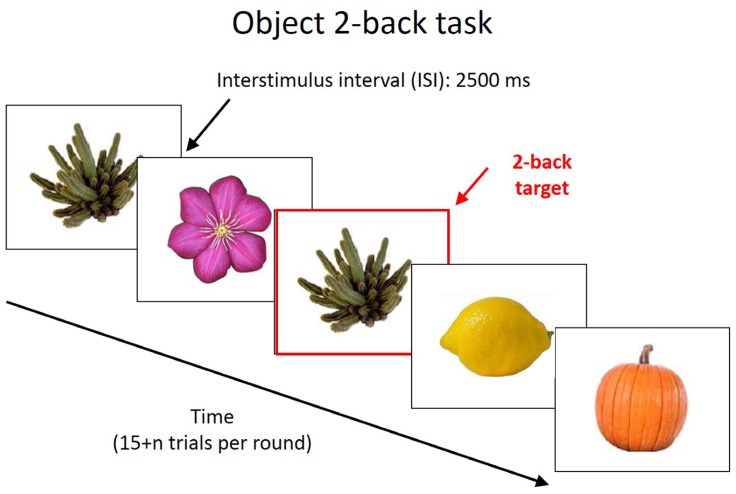
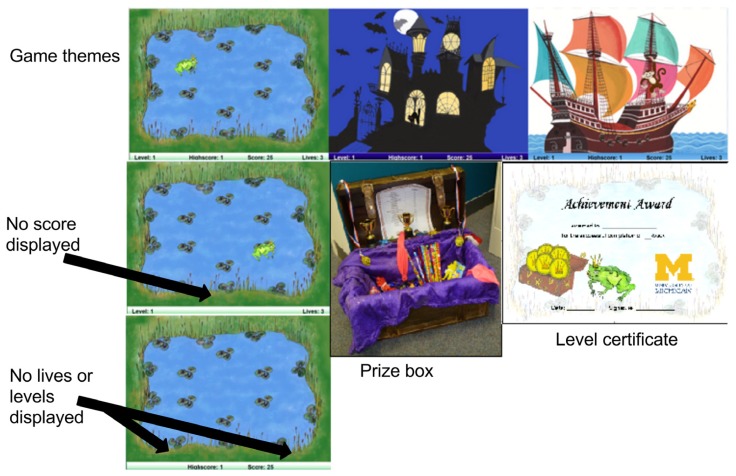
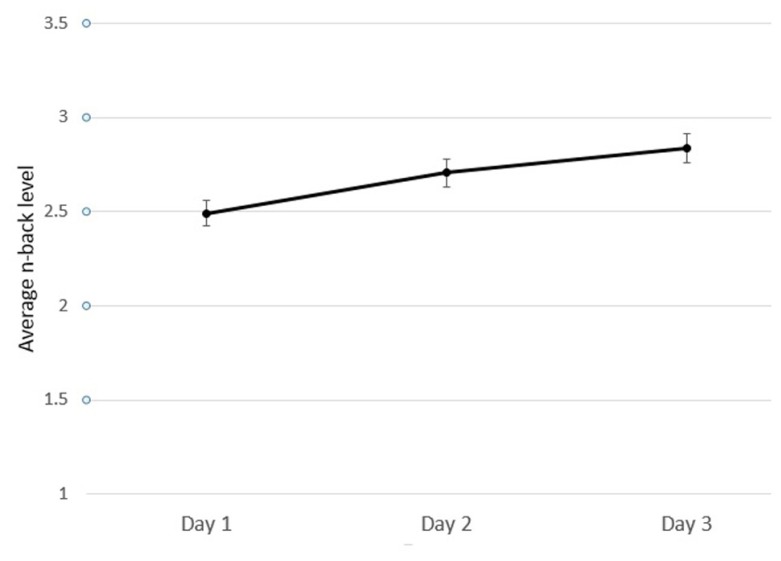
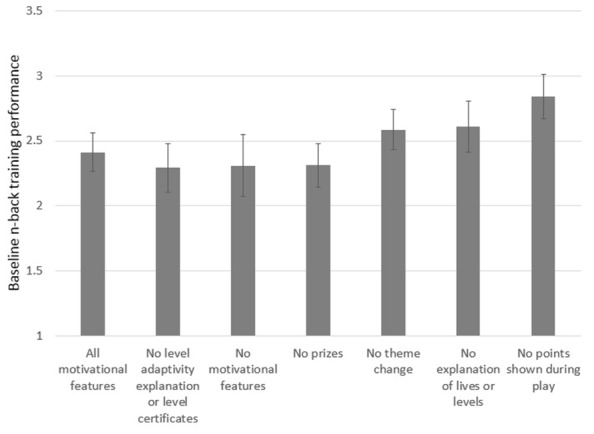
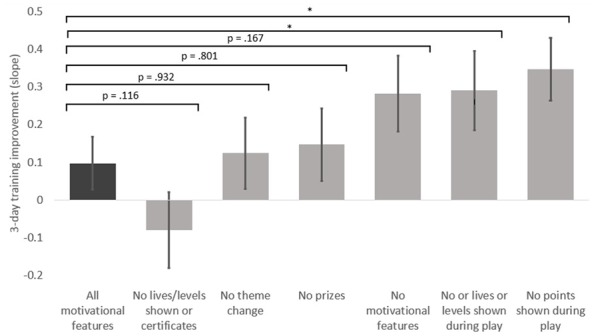
Cognitive training often utilizes game-like motivational features to keep participants engaged. It is unclear how these elements, such as feedback, reward, and theming impact player performance during training. Recent research suggests that motivation and engagement are closely related to improvements following cognitive training. We hypothesized that training paradigms featuring game-like motivational elements would be more effective than a version with no motivational elements. Five distinct motivational features were chosen for examination: a real-time scoring system, theme changes, prizes, end-of-session certificates, and scaffolding to explain the lives and leveling system included in the game. One version of the game was created with all these motivational elements included, and one was created with all of them removed. Other versions removed a single element at a time. Seven versions of a game-like n-back working memory task were then created and administered to 128 students in second through eight grade at school-based summer camps in southeastern Michigan. The inclusion of real-time scoring during play, a popular motivational component in both entertainment games and cognitive training, was found to negatively impact training improvements over the three day period. Surprisingly, scaffolding to explain lives and levels also negatively impacted training gains. The other game adjustments did not significantly impact training improvement compared to the original version of the game with all features included. These findings are preliminary and are limited by both the small sample size and the brevity of the intervention. Nonetheless, these findings suggest that certain motivational elements may distract from the core cognitive training task, reducing task improvement, especially at the initial stage of learning.
Overview
The claims and statistics of this paper haven’t been checked yet.
Run the check — free, no account needed. It reads the open-access text and checks the sources it cites.
Integrity signals
Registry
Cites
Statistics
Figures
Verification
Claims the paper makes
The claims and statistics of this paper haven’t been checked yet.
Run the check — free, no account needed. It reads the open-access text and checks the sources it cites.
Claims other papers make about this one
Each is checked against this paper’s own text: does it say what the citing paper says it does?
In the citing paper
“and none of the conditions made any difference on subjective motivation scores.”
From Gamification of Cognitive Assessment and Cognitive Training: A Systematic Review of Applications and Efficacy (2016) · cites this paper as [34]
In the citing paper
“The fully gamified condition had one of the shallowest improvement slopes”
From Gamification of Cognitive Assessment and Cognitive Training: A Systematic Review of Applications and Efficacy (2016) · cites this paper as [34]
In the citing paper
“They compared training improvement across conditions and found that the greatest training effect was caused by versions with minimal motivational features.”
From Gamification of Cognitive Assessment and Cognitive Training: A Systematic Review of Applications and Efficacy (2016) · cites this paper as [34]
In the citing paper
“and there were some indications that it may actually worsen it [17,18,34,36].”
From Gamification of Cognitive Assessment and Cognitive Training: A Systematic Review of Applications and Efficacy (2016) · cites this paper as [34]
In the citing paper
“However, Katz et al [34] and Miranda and Palmer [36] highlight that this can be difficult balancing act, with several game mechanics having unforeseen deleterious effects on performance.”
From Gamification of Cognitive Assessment and Cognitive Training: A Systematic Review of Applications and Efficacy (2016) · cites this paper as [34]
In the citing paper
“Thus, and consistent with previous studies, motivation this result highlights the importance of considering individual motivation through training, since it is related to greater improvements that could result in greater transfer effects (Mather and Carstensen, 2005; Jaeggi et al., 2013; Katz et al., 2014).”
From Training on Working Memory and Inhibitory Control in Young Adults (2016) · cites this paper as Katz et al., 2014
Self-check
Percentages, sums and reported differences re-computed from the paper’s own numbers.
The self-check needs the paper’s full text.
Citations
Cites
The motivational pull of video games: a self-determination theory approach
Ryan, R. M., Rigby, C. S., & Przybylski, A. (2006) · Motivation and Emotion · doi:10.1007/s11031-006-9051-8 · Cited by 3,332
McAuley, E., Duncan, T., & Tammen, V. V. (1989) · Research Quarterly for Exercise and Sport · doi:10.1080/02701367.1989.10607413 · Cited by 2,694
Toward a Theory of Intrinsically Motivating Instruction*
Malone, T. W. (1981) · Cognitive Science · doi:10.1207/s15516709cog0504_2 · Cited by 2,197
Improving fluid intelligence with training on working memory
Jaeggi, S. M., Buschkuehl, M., Jonides, J., & Perrig, W. J. (2008) · Proceedings of the National Academy of Sciences · doi:10.1073/pnas.0801268105 · Cited by 2,187
Self-citationComputerized training of working memory in children with ADHD – a randomized, controlled trial
Klingberg, T., Fernell, E., Olesen, P. J., Johnson, M., Gustafsson, P., Dahlström, K., Gillberg, C. G., Forssberg, H., & Westerberg, H. (2005) · Journal of the American Academy of Child & Adolescent Psychiatry · doi:10.1097/00004583-200502000-00010 · Cited by 1,949
Video game training enhances cognitive control in older adults
Anguera, J. A., Boccanfuso, J., Rintoul, J. L., Al-Hashimi, O., Faraji, F., Janowich, J., Kong, E., Larraburo, Y., Rolle, C., Johnston, E., et al. (2013) · Nature · doi:10.1038/nature12486 · Cited by 1,666
A Motivational Model of Video Game Engagement
Przybylski, A. K., Rigby, C. S., & Ryan, R. M. (2010) · Review of General Psychology · doi:10.1037/a0019440 · Cited by 1,422 · cited 2×
“Psychologists who study motivation are also interested in gamebased motivational features (Ryan et al., 2006; Przybylski et al., 2010), possibly because games are an ideal context for understanding the tension between intrinsic motivation and extrinsic reward.”
BackgroundLepper, M. R., Corpus, J. H., & Iyengar, S. S. (2005) · Journal of Educational Psychology · doi:10.1037/0022-0663.97.2.184 · Cited by 1,298
Training, maturation, and genetic influences on the development of executive attention
Rueda, M. R., Rothbart, M. K., McCandliss, B. D., Saccomanno, L., & Posner, M. I. (2005) · Proceedings of the National Academy of Sciences · doi:10.1073/pnas.0506897102 · Cited by 1,110
Adaptive training leads to sustained enhancement of poor working memory in children
Holmes, J., Gathercole, S. E., & Dunning, D. L. (2009) · Developmental Science · doi:10.1111/j.1467-7687.2009.00848.x · Cited by 961
Research works printed but not linked: 1
- Toups, 2009, “Motivating play through score,†in, ACM Computer Human Interaction 2009 Workshop on Engagement by Design
Cited by
Sorted by citations
Lumsden, J., Edwards, E. A., Lawrence, N. S., Coyle, D., & Munafò, M. R. (2016) · JMIR Serious Games · doi:10.2196/games.5888 · Cited by 555
“It is possible that even this minimal gamification was enough to induce increased motivation and that adding “distracting” game elements such as persistent score display may have a negative impact on performance by inducing unneeded stress or new cognitive demands [34].”
BackgroundMethodInfluentialThe effects of gamification on computerized cognitive training: Systematic review and meta-analysis
Vermeir, J. F., White, M. J., Johnson, D., Crombez, G., & Van Ryckeghem, D. M. L. (2020) · JMIR Serious Games · doi:10.2196/18644 · Cited by 172
Video games, cognitive exercises, and the enhancement of cognitive abilities
Anguera, J. A., & Gazzaley, A. H. (2015) · Current Opinion in Behavioral Sciences · doi:10.1016/j.cobeha.2015.06.002 · Cited by 140
Serious games for health: three steps forwards
Drummond, D., Hadchouel, A., & Tesnière, A. (2017) · Advances in Simulation · doi:10.1186/s41077-017-0036-3 · Cited by 135
Cognitive Bias Modification for adolescents with substance use problems – Can serious games help?
Boendermaker, W. J., Prins, P. J. M., & Wiers, R. W. H. J. (2015) · Journal of Behavior Therapy and Experimental Psychiatry · doi:10.1016/j.jbtep.2015.03.008 · Cited by 103
Traut, H. J., Guild, R. M., & Munakata, Y. (2021) · Frontiers in Psychology · doi:10.3389/fpsyg.2021.662139 · Cited by 100
Training on Working Memory and Inhibitory Control in Young Adults
Maraver, M. J., Bajo, M. T., & Gomez-Ariza, C. J. (2016) · Frontiers in Human Neuroscience · doi:10.3389/fnhum.2016.00588 · Cited by 96
“Also, participants received feedback on whether their performance was correct or not (Katz et al., 2014).”
BackgroundMethodInfluentialHow to build better memory training games
Deveau, J., Jaeggi, S. M., Zordan, V. B., Phung, C., & Seitz, A. R. (2015) · Frontiers in Systems Neuroscience · doi:10.3389/fnsys.2014.00243 · Cited by 101
Self-citationA Gamification Framework for Cognitive Assessment and Cognitive Training: Qualitative Study
Khaleghi, A., Aghaei, Z., & Mahdavi, M. A. (2021) · JMIR Serious Games · doi:10.2196/21900 · Cited by 110
Blumberg, F. C., Deater-Deckard, K., Calvert, S. L., Flynn, R. M., Green, C. S., Arnold, D., & Brooks, P. J. (2019) · Child Policy Nexus · doi:10.1002/sop2.3 · Cited by 96
Individual differences and long-term consequences of tdcs-augmented cognitive training
Katz, B., Au, J., Buschkuehl, M., Abagis, T., Zabel, C., Jaeggi, S. M., & Jonides, J. (2017) · Journal of Cognitive Neuroscience · doi:10.1162/jocn_a_01115 · Cited by 93
Self-citationSpaced cognitive training promotes training transfer.
Wang, Z., Zhou, R., & Shah, P. (2014) · Frontiers in Human Neuroscience · doi:10.3389/fnhum.2014.00217 · Cited by 81
Self-citationMaier, M., Ballester, B. R., Bañuelos, N. L., Duarte, E., & Verschure, P. F. M. J. (2020) · Journal of NeuroEngineering and Rehabilitation · doi:10.1186/s12984-020-0652-3 · Cited by 83
The Impacts of Video Games on Cognition (and How the Government Can Guide the Industry)
Green, C. S., & Seitz, A. R. (2015) · Policy Insights from the Behavioral and Brain Sciences · doi:10.1177/2372732215601121 · Cited by 88
Video Game Design for Learning to Learn
Pasqualotto, A., Parong, J. A., Green, C. S., & Bavelier, D. (2022) · International Journal of Human-Computer Interaction · doi:10.1080/10447318.2022.2110684 · Cited by 92
Exploring N -Back Cognitive Training for Children With ADHD
Jones, M. R., Katz, B., Buschkuehl, M., Jaeggi, S. M., & Shah, P. (2020) · Journal of Attention Disorders · doi:10.1177/1087054718779230 · Cited by 64
Self-citationMohammed, S., Flores, L., Deveau, J., Hoffing, R. C., Phung, C., Parlett, C., Sheehan, E., Lee, D. M., Au, J., Buschkuehl, M., et al. (2017) · Journal of Cognitive Enhancement · doi:10.1007/s41465-017-0047-y · Cited by 72
Self-citationLumsden, J., Skinner, A., Woods, A. T., Lawrence, N., & Munafo, M. R. (2016) · PeerJ · doi:10.7717/peerj.2184 · Cited by 61
Lumsden, J., Skinner, A., Coyle, D., Lawrence, N., & Munafo, M. R. (2017) · Journal of Medical Internet Research · doi:10.2196/jmir.8473 · Cited by 59
Ho, J. C., Hung, Y.-S., & Kwan, L. Y. ‐. (2021) · Education and Information Technologies · doi:10.1007/s10639-021-10770-2 · Cited by 67
Targeting self-regulation to promote health behaviors in children
Miller, A. L., Gearhardt, A. N., Fredericks, E. M., Katz, B., Shapiro, L. F., Holden, K., Kaciroti, N., Gonzalez, R., Hunter, C. M., & Lumeng, J. C. (2017) · Behaviour Research and Therapy · doi:10.1016/j.brat.2017.09.008 · Cited by 61
Self-citationRamani, G. B., Daubert, E. N., Lin, G. C., Kamarsu, S., Wodzinski, A., & Jaeggi, S. M. (2020) · Developmental Science · doi:10.1111/desc.12908 · Cited by 48
Self-citationLee, J. Y., Pyon, C. U., & Woo, J. (2023) · Electronics · doi:10.3390/electronics12153207 · Cited by 50
Cognitive training as a component of treatment of alcohol use disorder: A review.
Nixon, S. J., & Lewis, B. (2019) · Neuropsychology · doi:10.1037/neu0000575 · Cited by 50
Individual Differences and Motivational Effects
Katz, B., Jones, M. R., Shah, P., Buschkuehl, M., & Jaeggi, S. M. (2016) · Cognitive Training · doi:10.1007/978-3-319-42662-4_15 · Cited by 41
Self-citationZakariás, L., Keresztes, A., Marton, K., & Wartenburger, I. (2016) · Neuropsychological Rehabilitation · doi:10.1080/09602011.2016.1159579 · Cited by 46
Gamifying a Simulation: Do a Game Goal, Choice, Points, and Praise Enhance Learning?
Brom, C., Stárková, T., Bromová, E., & Děchtěrenko, F. (2018) · Journal of Educational Computing Research · doi:10.1177/0735633118797330 · Cited by 42
Khaleghi, A., Aghaei, Z., & Behnamghader, M. (2022) · Entertainment Computing · doi:10.1016/j.entcom.2022.100482 · Cited by 46
Harvey, P. D., Balzer, A. M., & Kotwicki, R. J. (2019) · Schizophrenia Research Cognition · doi:10.1016/j.scog.2019.100150 · Cited by 33
Suenderhauf, C., Walter, A., Lenz, C., Lang, U. E., & Borgwardt, S. (2016) · Neuroscience & Biobehavioral Reviews · doi:10.1016/j.neubiorev.2016.03.018 · Cited by 35
Cattoni, A., Anderle, F., Venuti, P., & Pasqualotto, A. (2024) · International Journal of Child-Computer Interaction · doi:10.1016/j.ijcci.2024.100633 · Cited by 58
The Influence of Feedback on Task-Switching Performance: A Drift Diffusion Modeling Account
Hoffing, R. C., Karvelis, P., Rupprechter, S., Seriès, P., & Seitz, A. R. (2018) · Frontiers in Integrative Neuroscience · doi:10.3389/fnint.2018.00001 · Cited by 31
Mahncke, H. W., Kim, S., Rose, A., Stasio, C., Buckley, P. F., Caroff, S. N., Duncan, E., Yasmin, S., Jarskog, L. F., Lamberti, J. S., et al. (2019) · Schizophrenia Research · doi:10.1016/j.schres.2019.03.006 · Cited by 30
Kakoschke, N., Page, R., de Courten, B. V., Verdejo‐García, A., & McCormack, J. (2021) · International Journal of Human-Computer Studies · doi:10.1016/j.ijhcs.2021.102626 · Cited by 30
Salemink, E., de Jong, S. R. C., Notebaert, L., MacLeod, C., & van Bockstaele, B. (2022) · Journal of Behavior Therapy and Experimental Psychiatry · doi:10.1016/j.jbtep.2022.101727 · Cited by 25
Chen, X., Ye, M., Chang, L., Chen, W., & Zhou, R. (2017) · Journal of Learning Disabilities · doi:10.1177/0022219417712015 · Cited by 28
Shaban, A., & Pearson, E. (2019) · CHI Conference Extended Abstracts on Human Factors in Computing Systems (CHI EA) · doi:10.1145/3290607.3312806 · Cited by 28
Jaeggi, S. M., Buschkuehl, M., Parlett-Pelleriti, C., Moon, S. M., Evans, M., Kritzmacher, A., Reuter‐Lorenz, P. A., Shah, P., & Jonides, J. J. (2019) · The Journals of Gerontology Series B · doi:10.1093/geronb/gbz090 · Cited by 28
Self-citationThe Role of Serious Video Games in the Treatment of Disordered Eating Behaviors: Systematic Review
Tang, W. S. W., Ng, T. J. Y., Wong, J. Z. A., & Ho, C. S. H. (2022) · Journal of Medical Internet Research · doi:10.2196/39527 · Cited by 21
Shaban, A., Pearson, E., & Chang, V. I. C. (2021) · Frontiers in Computer Science · doi:10.3389/fcomp.2021.617056 · Cited by 31
Individual Differences in Cognitive Training Research
Katz, B., Jones, M. R., Shah, P., Buschkuehl, M., & Jaeggi, S. M. (2020) · Springer eBooks · doi:10.1007/978-3-030-39292-5_8 · Cited by 33
Self-citationOram, R., & Rogers, M. (2022) · Canadian Journal of Education / Revue canadienne de l éducation · doi:10.53967/cje-rce.v45i3.5293 · Cited by 34
Gamification of cognitive training
Mora, A., González, C. S. G., Arnedo-Moreno, J., & Álvarez, A. (2016) · International Conference on Human Computer Interaction (Interacción) · doi:10.1145/2998626.2998663 · Cited by 28
Exploring the effects of using various designs of game-based materials on music learning
Wang, Y. (2021) · Interactive Learning Environments · doi:10.1080/10494820.2021.1894182 · Cited by 26
Cassetta, B. D., & Goghari, V. M. (2016) · Trials · doi:10.1186/s13063-016-1188-5 · Cited by 28
Walton, C. C., Lampit, A., Boulamatsis, C., Hallock, H., Barr, P., Ginige, J. A., Brodaty, H., Chau, T., Heffernan, M., Sachdev, P. S., et al. (2019) · JMIR Aging · doi:10.2196/13135 · Cited by 21
A Game-Based Online Tool to Measure Cognitive Functions in Students
Berg, V. (2021) · International Journal of Serious Games · doi:10.17083/ijsg.v8i1.410 · Cited by 22
Redlinger, E., Glas, B., & Rong, Y. (2022) · JMIR Serious Games · doi:10.2196/35295 · Cited by 24
Zhao, X., Xu, Y., Fu, J., & Maes, J. H. R. (2017) · Memory & Cognition · doi:10.3758/s13421-017-0773-5 · Cited by 22
Zakariás, L., Salis, C., & Wartenburger, I. (2018) · Journal of Neurolinguistics · doi:10.1016/j.jneuroling.2017.12.002 · Cited by 25
Nagle, A., Riener, R., & Wolf, P. (2015) · Frontiers in Psychology · doi:10.3389/fpsyg.2015.01774 · Cited by 21
Amano, T., Park, S., Morrow-Howell, N. L., & Carpenter, B. D. (2022) · Alzheimer Disease & Associated Disorders · doi:10.1097/wad.0000000000000486 · Cited by 20
Haesner, M., Steinert, A., O’Sullivan, J. L., & Weichenberger, M. (2015) · Journal of Gerontological Nursing · doi:10.3928/00989134-20150710-44 · Cited by 19
Transfer and Motivation After Cognitive Control Training for Remitted Depression in Healthy Sample
Vervaeke, J., Hoorelbeke, K., Baeken, C., LOOY, J. V., & Koster, E. H. W. (2019) · Journal of Cognitive Enhancement · doi:10.1007/s41465-019-00135-6 · Cited by 21
Miller, A. L., Lo, S. L., Albright, D. K., Lee, J. M., Hunter, C. M., Bauer, K. W., King, R. B., Clark, K. M., Chaudhry, K., Kaciroti, N., et al. (2020) · BMC Pediatrics · doi:10.1186/s12887-020-2012-7 · Cited by 20
Self-citationSchroeder, P. A., Lohmann, J., & Ninaus, M. (2021) · JMIR Serious Games · doi:10.2196/25063 · Cited by 19
Training with an auditory perceptual learning game transfers to speech in competition
de Larrea-Mancera, E. S. L., Philipp, M. A., Stavropoulos, T., Carrillo, A. A., Cheung, S., Koerner, T. K., Molis, M. R., Gallun, F. J., & Seitz, A. R. (2021) · Journal of Cognitive Enhancement · doi:10.1007/s41465-021-00224-5 · Cited by 22
Studer-Luethi, B., Törmänen, M. R. K., Margelisch, K., Hogrefe, A. B., & Perrig, W. J. (2022) · Journal of Cognitive Enhancement · doi:10.1007/s41465-022-00242-x · Cited by 19
Performance-Based Contingency Management in Cognitive Remediation Training: A Pilot Study
Kiluk, B. D., Buck, M. B., Devore, K. A., Babuscio, T. A., Nich, C., & Carroll, K. M. (2016) · Journal of Substance Abuse Treatment · doi:10.1016/j.jsat.2016.08.003 · Cited by 16
Dörrenbächer, S., & Kray, J. (2018) · Journal of Cognitive Enhancement · doi:10.1007/s41465-018-0083-2 · Cited by 17
Zhang, B., & Robb, N. (2021) · SAGE Open · doi:10.1177/21582440211014507 · Cited by 16
The Efficacy of the LearningRx Cognitive Training Program: Modality and Transfer Effects
Hill, O. W., Serpell, Z. N., & Faison, M. O. (2015) · The Journal of Experimental Education · doi:10.1080/00220973.2015.1065218 · Cited by 14
Adaptive habits: understanding executive function and its development
Niebaum, J. C., Zengilowski, A., Katz, B., Shah, P., & Munakata, Y. (2025) · Trends in Cognitive Sciences · doi:10.1016/j.tics.2025.10.016 · Cited by 14
Self-citationShaban, A., & Pearson, E. (2020) · International Web for All Conference (W4A) · doi:10.1145/3371300.3383341 · Cited by 16
Carcioppolo, N., Kim, S. Y., Sanchez, M. I., Mao, B., Malova, E., Ryan, A., Lun, D., Ewing, C., & Hu, S. (2022) · Social Science & Medicine · doi:10.1016/j.socscimed.2022.115281 · Cited by 12
Bernini, S., Gerbasi, A., Panzarasa, S., Quaglini, S., Ramusino, M. C., Costa, A. C., Avenali, M., Tassorelli, C., Vecchi, T., & Bottiroli, S. (2023) · Scientific Reports · doi:10.1038/s41598-022-26924-2 · Cited by 11
Redlinger, E., Glas, B., & Rong, Y. (2021) · International Conference on Artificial Intelligence and Virtual Reality (AIVR) · doi:10.1145/3480433.3480435 · Cited by 11
A Classroom-Embedded Video Game Intervention Improves Executive Functions in Kindergarteners
Nin, V., Delgado, H., Goldin, A. P., Slezak, D. F., Belloli, L. M. L., & Carboni, A. (2023) · Journal of Cognitive Enhancement · doi:10.1007/s41465-023-00262-1 · Cited by 13
IMPACT OF PLAYING VIDEO GAMES ON COGNITIVE FUNCTIONING AND LEARNING STYLES
Sattar, S., Khan, D. S., & Yousaf, R. (2021) · Sukkur IBA Journal of Computing and Mathematical Sciences · doi:10.30537/sjcms.v5i2.885 · Cited by 10
Using Serious Games to (Re)Train Cognition in Adolescents
Boendermaker, W. J., Peeters, M., Prins, P. J. M., & Wiers, R. W. H. J. (2017) · Springer eBooks · doi:10.1007/978-3-319-51645-5_14 · Cited by 12
Working memory training does not improve executive functioning or fluid intelligence
Rodas, J. A., & Greene, C. M. (2021) · Quarterly Journal of Experimental Psychology · doi:10.1177/17470218211039502 · Cited by 10
Gamification in Cognitive Assessment and Cognitive Training for Mild Cognitive Impairment
Groznik, V., & Sadikov, A. (2019) · Springer eBooks · doi:10.1007/978-3-030-15620-6_8 · Cited by 12
Does working memory training in children need to be adaptive? A randomized controlled trial
Lau, R. C., Anderson, P. J., Gathercole, S. E., Wiley, J. F., & Spencer‐Smith, M. M. (2024) · Child Development · doi:10.1111/cdev.14180 · Cited by 9
Effective engagement in computerized cognitive training for older adults
Guimarães, A. L., Lin, F. V., Panizzutti, R., & Turnbull, A. G. (2025) · Ageing Research Reviews · doi:10.1016/j.arr.2024.102650 · Cited by 8
Lo, S. L., Gearhardt, A. N., Fredericks, E. M., Katz, B., Sturza, J. S., Kaciroti, N., Gonzalez, R., Hunter, C. M., Sonneville, K. R., Chaudhry, K., et al. (2021) · Journal of Experimental Child Psychology · doi:10.1016/j.jecp.2021.105157 · Cited by 10
Self-citationStuder-Luethi, B., & Meier, B. (2020) · Journal of Cognitive Enhancement · doi:10.1007/s41465-020-00202-3 · Cited by 10
Lau, R. C., Anderson, P. J., Wiley, J. F., Huang, D., Surjatin, F., McIntosh, P., Gathercole, S. E., & Spencer‐Smith, M. M. (2023) · JMIR Research Protocols · doi:10.2196/47496 · Cited by 7
Working Memory Training in Children: A Review of Basic Methodological Criteria
Vernucci, S., Juric, L. C., Introzzi, I. M., & Richard’s, M. M. (2019) · Psychological Reports · doi:10.1177/0033294119832978 · Cited by 12
Effects of Environmental Enrichment and Training across Life Span in Cognition
Calero, M. D. (2019) · Cambridge University Press eBooks · doi:10.1017/9781316677018.020 · Cited by 9
New Directions in Training Designs
Cochrane, A., & Green, C. S. (2020) · Springer eBooks · doi:10.1007/978-3-030-39292-5_3 · Cited by 6
Liu, C., Wang, D., Hwang, G., Tu, Y., Li, N.-Y., & Wang, Y. (2023) · Interactive Learning Environments · doi:10.1080/10494820.2023.2205900 · Cited by 6
Jaeggi, S. M., Weaver, A. N., Carbone, E., Trane, F. E., Smith-Peirce, R. N., Buschkuehl, M., Flückiger, C., Carlson, M., Jonides, J., & Borella, E. (2023) · Aging Brain · doi:10.1016/j.nbas.2023.100083 · Cited by 8
Self-citationPahor, A., Jaeggi, S. M., & Seitz, A. R. (2018) · Wiley eBooks · doi:10.1002/9780470015902.a0028037 · Cited by 6
Self-citationEfeito de uma intervenção com jogos digitas e webgames na motivação intrínseca em escolares
Godtsfriedt, J., Godtsfriedt, C. E. S., & Cardoso, F. L. (2022) · journal of physical education · doi:10.4025/jphyseduc.v33i1.3325 · Cited by 5
Baseline capacities and motivation in executive control training of healthy older adults
Maraver, M. J., Gómez‐Ariza, C. J., Borella, E., & Bajo, M. T. (2020) · Aging & Mental Health · doi:10.1080/13607863.2020.1858755 · Cited by 6
Hanusová, J., Štěpánková, T., Tomanová, J., Dočkalová, S., & Papežová, H. (2015) · Advances in medical technologies and clinical practice book series · doi:10.4018/978-1-4666-9522-1.ch017 · Cited by 5
Shaban, A., Chang, V. I. C., Amodu, O. D., Attia, M. R., & Abdelhamid, G. S. M. (2024) · Education Sciences · doi:10.3390/educsci14111260 · Cited by 9
Rezende, G., Stanc, L. L., Menu, I., Cassotti, M., Aïte, A., Salvia, É., Houdé, O., Borst, G., & Cachia, A. (2023) · Journal of Experimental Child Psychology · doi:10.1016/j.jecp.2023.105741 · Cited by 7
A digital intervention to support childhood cognition after the COVID-19 pandemic: a pilot trial
Kirk, H., Spencer‐Smith, M. M., Jobson, L., Nicolaou, E., Cornish, K. M., Melzak, E., Hrysanidis, C., Moriarty, C., Davey, B., Whyman, T., et al. (2024) · Scientific Reports · doi:10.1038/s41598-024-63473-2 · Cited by 6
Maximizing the Impact of Cognitive Engagement Interventions for Older Adults
Wu, R., & Rebok, G. W. (2020) · Cambridge University Press eBooks · doi:10.1017/9781108552684.042 · Cited by 4
Zhang, D. (2023) · Frontiers in Psychiatry · doi:10.3389/fpsyt.2022.1100008 · Cited by 4
Применение компьютерных игровых технологий для развития регуляторных функций дошкольников
Veraksa, A. N., & Bukhalenkova, D. А. (2017) · Российский психологический журнал · doi:10.21702/rpj.2017.3.6 · Cited by 4
van Delden, A. E. Q., Band, G. P. H., & Slaets, J. P. J. (2020) · BMC Public Health · doi:10.1186/s12889-019-8135-9 · Cited by 7
Peer-reviewed working memory training
Brooks, S. J., Funk, S. G., Rabier, C., & Schiöth, H. B. (2019) · Elsevier eBooks · doi:10.1016/b978-0-12-815298-0.00018-6 · Cited by 3
Effects of Gamification on Assessment of Spatial Release From Masking
Bologna, W. J., Carrillo, A. A., Clamage, D. S., Coco, L., He, Y. J., de Larrea-Mancera, E. S. L., Stecker, G. C., Gallun, F. J., & Seitz, A. R. (2023) · American Journal of Audiology · doi:10.1044/2022_aja-22-00133 · Cited by 3
Class-Based Cognitive Reinforcement (CORE) Improves Executive Functions in Preschoolers
Nejati, V., & Zavarei, B. (2023) · Journal of Research in Childhood Education · doi:10.1080/02568543.2023.2187901 · Cited by 3
Digital games, cognitive skills, and motivation:
Ramos, D. K., Anastácio, B. S., da Silva, G. A., Venturieri, C., Stange, N., & Martins, M. E. D. O. (2020) · International Journal for Innovation Education and Research · doi:10.31686/ijier.vol8.iss5.2324 · Cited by 3
Shaban, A., Chang, V. I. C., & Bingham, A. (2021) · Journal of Global Information Management · doi:10.4018/jgim.20211101.oa47 · Cited by 3
Gilligan-Lee, K. A. (2019) · UCL Discovery (University College London) · Cited by 3
Gamifying a Simulation: Null Effects of a Game Goal, Choice, Points and PraisePreprint
Brom, C., Stárková, T., Bromová, E., & Děchtěrenko, F. (2017) · doi:10.31234/osf.io/uwrjb · Cited by 3
Metadata
- Authors
- Katz, B., Jaeggi, S., Buschkuehl, M., Stegman, A., & Shah, P.
- Affiliations
- University of Michigan (US)
- University of California, Irvine (US)
- MIND Research Institute (US)
- Corresponding author
- Katz, Benjamin
- Venue
- Frontiers in Human Neuroscience
- Publisher
- Frontiers Media SA
- Published
- 2014-04-24
- Volume
- 8
- Pages
- 242-242
- ISSN
- 1662-5161 (ISSN-L)
- PMC
- PMC4006056
- OpenAlex
- W2097579685
- Cited by
- 142
- References
- 29
- Citations by year
- 2026: 5 · 2025: 9 · 2024: 7 · 2023: 17 · 2022: 13 · 2021: 15 · 2020: 14 · 2019: 17 · 2018: 8 · 2017: 15 · 2016: 13 · 2015: 8 · 2014: 1
- FWCI
- 17.11
- Type
- journal article
- Language
- en
- Open access
- gold
- doi.org
- Licence
- cc-by
- Locations
- Frontiers in Human Neuroscience (publishedVersion, cc-by)
- Europe PMC (PubMed Central) (publishedVersion, cc-by)
- PubMed Central (publishedVersion, cc-by)
- PubMed (publishedVersion)
- DOAJ (DOAJ: Directory of Open Access Journals) (submittedVersion, cc-by-sa)
- eScholarship (California Digital Library) (submittedVersion, cc-by)
- VTechWorks (Virginia Tech) (submittedVersion, cc-by)
- Topics
- Social Sciences › Psychology › Experimental and Cognitive Psychology › Cognitive Abilities and Testing
- Social Sciences › Psychology › Developmental and Educational Psychology › Educational Games and Gamification
- Social Sciences › Psychology › Neuropsychology and Physiological Psychology › Developmental and Educational Neuropsychology
- Keywords
- cognitive training, game-based learning, real-time scoring, scaffolding, transfer of training, student engagement
About these checks
Registry, retraction, Cites and statistics results are computed, not judged, with one exception: a printed reference that no index lists is read once by a model before it counts as a citation error. Claims are extracted by a model and kept only when their quote appears verbatim in the text; each cited source is then checked, with a model’s help, for whether it says what the claim relies on. Those verdicts can be wrong — read the claim’s quote and the cited source before relying on one.
Statistics and arithmetic are recomputed, not judged.
Confidence bands are shown only for fields calibrated on our annotated test set. None is calibrated yet, so no band is shown.
What counts as a claim ›How we measure confidence ›How we check this ›
Are you an author, or do you see a problem with this page? Request a review
