

Monitoring skeletal muscle oxygen saturation kinetics during graded exercise testing in NCAA division I female rowers
Open accessThe DOI matches its Crossref record; 66 of the 66 references it cites were found in a registry or an index; 13 of the 47 sources its claims cite were checked for support.
Abstract
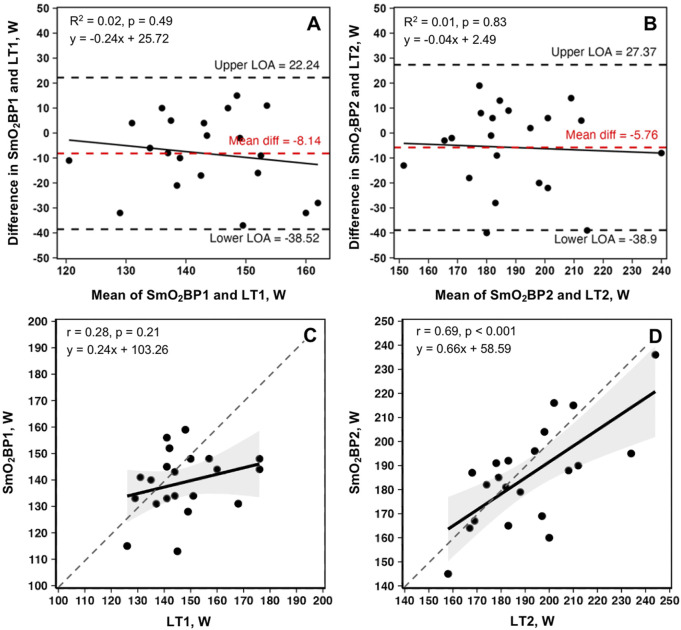
Purpose: The purpose of this study was to analyze changes in skeletal muscle oxygen saturation (SmO 2 ) kinetics during exercise in female rowers both acutely and longitudinally in relation to blood lactate (BLa). We also aimed to determine the agreement and statistical equivalence between physiological thresholds derived from SmO 2 and BLa kinetics. Methods: Twenty-three female NCAA Division I rowers were tested throughout the 2023–2024 academic year. Of these, 11 athletes completed at least two near-infrared spectroscopy (NIRS)-equipped GXTs, with physiological data analyzed for longitudinal changes. A 7x4-min discontinuous GXT protocol was performed by all athletes. First and second SmO 2 breakpoints (SmO 2 BP1 and SmO 2 BP2) were estimated via piecewise linear regression modeling, and BLa thresholds (LT 1 and LT 2 ) were calculated using ADAPT software. Paired-samples t-tests assessed differences, and equivalence was tested using two one-sided tests (TOST). Agreement was determined using Bland-Altman analysis yielding mean differences (MD) and 95% limits of agreement (LoA). Intraclass correlation coefficients (ICC 2,1 ) were also calculated. Results: No difference was found between SmO 2 BP2 and LT 2 (MD = −5.76W [95% LoA = −38.52 to 22.25W], p = 0.134), moderate-to-good levels of agreement (ICC 2,1 = 0.67 [95% CI: 0.36–0.85], p < 0.001), and no statistical equivalence (p = 0.117). This was not the case for SmO 2 BP1 and LT 1 , with NIRS significantly underestimating LT 1 (MD = −8.14W [95% LoA = −38.90 to 27.37W], p = 0.026), poor-to-moderate agreement (ICC 2,1 = 0.24 [95% CI: −0.13–0.58], p = 0.10), and no statistical equivalence (p = 0.487). Additionally, SmO 2 recovery kinetics (SmO 2 resat) during 1-min rest intervals increased in response to graded increases in exercise intensity (p < 0.001, η 2 p = 0.71), with higher intensities appearing to blunt this effect (step 6 – step 7: MD = −0.16%⋅s -1 , p = 0.69). No statistically significant changes were observed in LT’s or SmO 2 BP’s throughout the 2023–2024 season. Conclusion: In female collegiate rowers, NIRS may be a tool that compliments BLa testing when determining the second lactate threshold (i.e., LT 2 ). However, significant inter-individual variablility exists between SmO 2 BP2 and LT2 paired with a lack of statistical equivalence suggest the two are not interchangeable. While not a standalone replacement, if used in combination with traditional BLa testing methods NIRS may be a complimentary tool that helps inform individual athlete training zone prescription.
Overview
CoChat Summary
TL;DR
In NCAA Division I female rowers, NIRS-derived second SmO2 breakpoint showed no mean difference but was not statistically equivalent to LT2, while the first SmO2 breakpoint underestimated LT1. NIRS may complement blood lactate testing for threshold-based training prescription but does not appear interchangeable with it.
Key findings
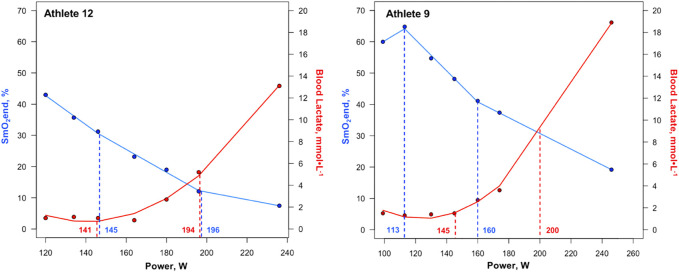
- SmO2BP2 vs LT2: no significant difference (MD = −5.76 W [95% LoA = −38.52 to 22.25 W], p = 0.134), moderate-to-good agreement (ICC2,1 = 0.67 [95% CI 0.36–0.85], p < 0.001), positive relationship (r = 0.69, p < 0.001), but no statistical equivalence (p = 0.117).
- SmO2BP1 vs LT1: NIRS significantly underestimated LT1 (MD = −8.14 W [95% LoA = −38.90 to 27.37 W], p = 0.026), poor-to-moderate agreement (ICC2,1 = 0.24 [95% CI −0.13–0.58], p = 0.10), and no statistical equivalence (p = 0.487).
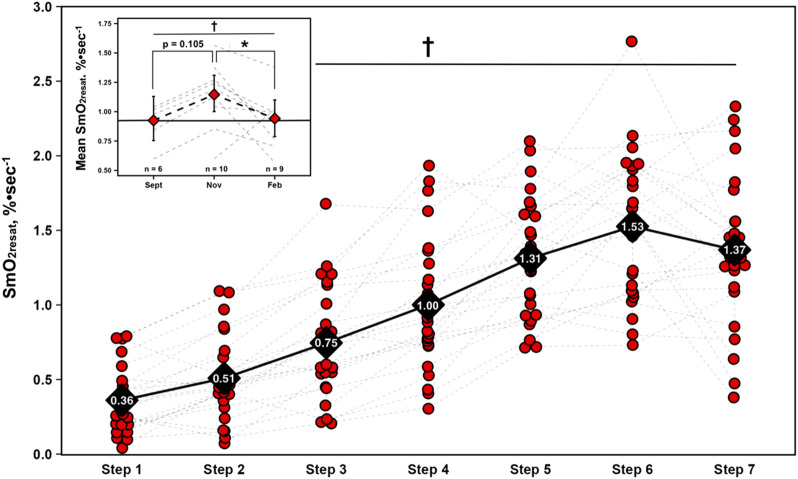
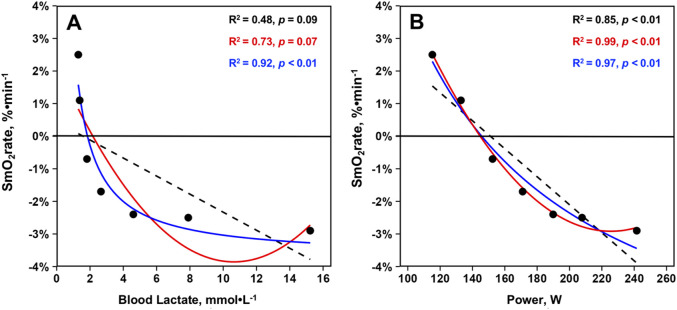
- SmO2resat increased with exercise intensity across the GXT (p < 0.001, η2p = 0.71), with high-intensity blunting (step 6 vs step 7: MD = −0.16%·s−1, p = 0.609 in results; abstract reports p = 0.69). SmO2rate vs BLa was best fit by inverse regression (R2 = 0.92, p < 0.01); SmO2rate vs power was best fit by a second-order polynomial (R2 = 0.99, p < 0.01).
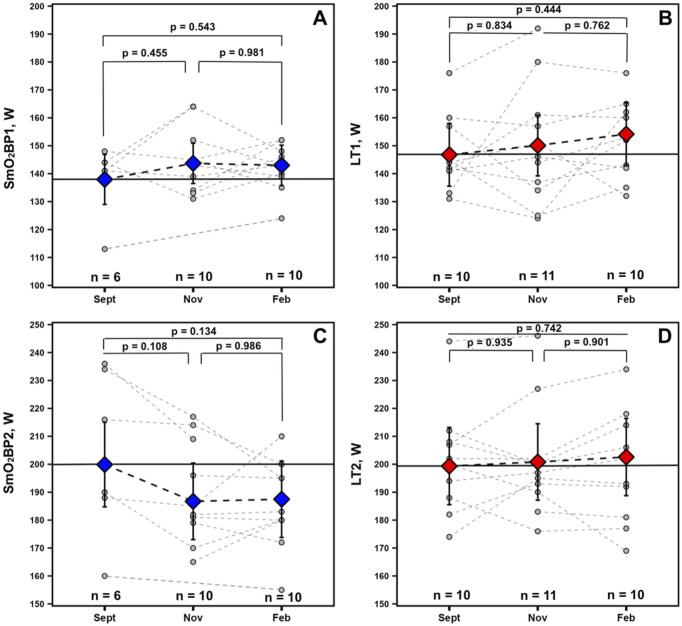
- No statistically significant longitudinal changes were observed in LT1, LT2, SmO2BP1, or SmO2BP2 across the season; mean SmO2resat decreased from Nov to Feb (MD = −0.21, SEE = 0.08, p = 0.044) after a near-significant Sept–Nov increase (p = 0.105).
Methods
- Cross-sectional and time-series design; 23 NCAA Division I female rowers (Tier 3) tested in September, November, and February during 2023–2024; 11 athletes completed at least two NIRS-equipped GXTs for longitudinal analysis.
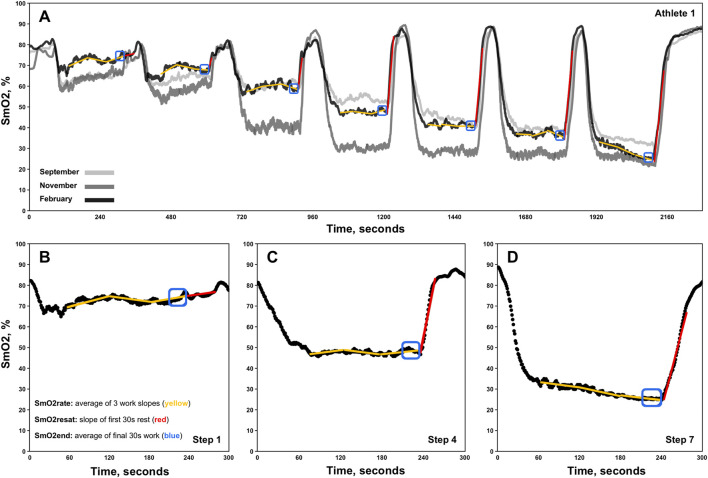
- A 7×4-min discontinuous rowing ergometer GXT individualized from recent 2KErg; finger-stick BLa during 1-min rests with LT1/LT2 via ADAPT; MOXY NIRS on the right vastus lateralis; SmO2BP1/SmO2BP2 via piecewise linear regression; SmO2resat from the first 30 s of each rest interval; SmO2rate from three 60-s slopes after the initial 60 s of each work step.
- Analyses included paired-samples t-tests, TOST equivalence testing, Bland-Altman analysis, ICC2,1, Pearson correlations, RMANOVA, linear mixed-effects models, and model selection using R2 and BIC.
Limitations
- Stated: skinfold/adipose thickness at the NIRS site was not measured, and SmO2 can be skewed when skinfold thickness exceeds 15 mm. Only 11 athletes had ≥2 NIRS GXTs, limiting longitudinal power. Energy intake/expenditure and relative energy deficiency in sport (REDs) were not accounted for and may affect SmO2 kinetics.
- Evident: 2 of 23 NIRS datasets could not be fit with two breakpoints (8.7% failure rate); wide 95% LoA and lack of statistical equivalence indicate the methods are not interchangeable despite some agreement. The single cohort of NCAA Division I female rowers limits generalizability, and GXT structure plus threshold calculation methods may influence results.
Model-written summary. Check it against the paper before relying on it.
Integrity signals
Registry
Cites
Statistics
Figures
Verification
Claims the paper makes
9 Valid · 1 Not valid · 22 Not checked · 57 Own results and interpretations
The cited sources that could be checked couldn’t confirm or dispute this claim.
In the paper
“Such a curvilinear relationship between SmO2rate and BLa accumulation is akin to data from the long-head of the BF in other reports (Snyder and Parmenter, 2009; Brooks et al., 2022)”
§ Monitoring skeletal muscle oxygen saturation kinetics during graded exercise testing in NCAA division I female rowers > Discussion
What the sources say
- Not checked — no full text of the sourcecites Snyder and Parmenter, 2009 matched to “Using Near-Infrared Spectroscopy to Determine Maximal Steady State Exercise Intensity” (2009) source
- Could not verifycites Brooks et al., 2022 matched to “Lactate in contemporary biology: a phoenix risen” (2022) sourceExperimental — accuracy not yet measured
The cell-cell lactate shuttle section discusses lactate production and uptake as muscle oxygen consumption changes, but it does not describe a curvilinear relationship between SmO2rate and blood lactate accumulation or data from the long head of the biceps femoris. Searches for those specific terms and their equivalents returned no passage addressing that comparison; page numbers were not available in our copy. (LLM, conf=0.72)
plainstates an association- Asserted: passes — The authors put it forward as true.
- Checkable: passes — It can be checked against evidence.
- Load-bearing: unclear — It is unclear whether the paper’s conclusions depend on it.
- Based: passes — The paper gives a reason why it holds.
Every source the paper cites for this claim was checked and supports it.
In the paper
“SmO2 variables can be significantly skewed in individuals with skinfold thicknesses above 15mm (Feldmann et al., 2019).”
§ Monitoring skeletal muscle oxygen saturation kinetics during graded exercise testing in NCAA division I female rowers > Discussion > Limitations and future recommendations
What the sources say
- Supportedcites Feldmann et al., 2019 matched to “Near-infrared spectroscopy-derived muscle oxygen saturation on a 0% to 100% scale: reliability and validity of the Moxy Monitor” (2019) source
The Results section ('Effect of Adipose Tissue Thickness') reports a significant relationship between adipose tissue thickness and minimum SmO2 at all four muscle sites. It identifies a threshold near 15 mm and says SmO2 values obtained above it should be considered suspect. The Methods section says skinfold calipers were used to assess that thickness. (LLM, conf=0.92)
plainstates an association- Asserted: passes — The authors put it forward as true.
- Checkable: passes — It can be checked against evidence.
- Load-bearing: passes — The paper’s conclusions depend on it.
- Based: passes — The paper gives a reason why it holds.
- Supported
The cited sources support only part of this claim — read each source’s verdict below.
In the paper
“these significant inflections in metabolic markers likely occur in a series of cascading events that take place during transitions across the exercise intensity spectrum and may influence one-another to some degree (Boone et al., 2016).”
§ Monitoring skeletal muscle oxygen saturation kinetics during graded exercise testing in NCAA division I female rowers > Discussion
What the sources say
- Partly supportedcites Boone et al., 2016 matched to “The interrelationship between muscle oxygenation, muscle activation, and pulmonary oxygen uptake to incremental ramp exercise: influence of aerobic fitness” (2016) sourceExperimental — accuracy not yet measured
The Discussion reports an association between a muscle-oxygenation breakpoint and maximal lactate steady state, and describes a cascade of oxygenation, activation, and respiratory breakpoints. The paper does not establish an association between SmO2 and blood-lactate kinetics specifically; its own reported cascade does not include a blood-lactate measurement. (LLM, conf=0.84)
hedgedstates an association- Asserted: passes — The authors put it forward as true.
- Checkable: passes — It can be checked against evidence.
- Load-bearing: unclear — It is unclear whether the paper’s conclusions depend on it.
- Based: passes — The paper gives a reason why it holds.
- Partly supported
Every source the paper cites for this claim was checked and supports it.
In the paper
“For example, continuous GXTs yield an unbroken time-series of SmO2 data (Feldmann et al., 2022) providing a greater quantity of data points to fit piecewise linear regression models”
§ Monitoring skeletal muscle oxygen saturation kinetics during graded exercise testing in NCAA division I female rowers > Discussion
What the sources say
- Supportedcites Feldmann et al., 2022 matched to “Muscle Oxygen Saturation Breakpoints Reflect Ventilatory Thresholds in Both Cycling and Running” (2022) source
The Methods (Design and Procedures; Measures) describe incremental cycling and running tests with SmO2 sampled every two seconds during exercise. The Methods (Statistical Analysis) then describe fitting segmented regression to those SmO2 data. The greater number of points is the citing authors’ inference following the citation, rather than a separate result attributed to Feldmann et al. (LLM, conf=0.89)
plainstates a cause- Asserted: passes — The authors put it forward as true.
- Checkable: passes — It can be checked against evidence.
- Load-bearing: unclear — It is unclear whether the paper’s conclusions depend on it.
- Based: passes — The paper gives a reason why it holds.
- Supported
The cited sources support only part of this claim — read each source’s verdict below.
In the paper
“Furthermore, BLa threshold determinations are highly dependent on the structure of the GXT protocol used and the method chosen to calculate LT1 and LT2 (Jamnick et al., 2018).”
§ Monitoring skeletal muscle oxygen saturation kinetics during graded exercise testing in NCAA division I female rowers > Discussion
What the sources say
- Partly supportedcites Jamnick et al., 2018 matched to “Manipulating graded exercise test variables affects the validity of the lactate threshold and V˙O2peak” (2018) sourceExperimental — accuracy not yet measured
The Discussion reports that lactate-threshold estimates varied with GXT protocol and calculation method, and the Results found an inverse relationship between stage length and calculated LT. The paper evaluates LT estimates against maximal lactate steady state, but does not establish the stated dependence separately for both LT1 and LT2. The indexed passages have section labels but no page numbers. (LLM, conf=0.86)
boostedstates an association- Asserted: passes — The authors put it forward as true.
- Checkable: passes — It can be checked against evidence.
- Load-bearing: unclear — It is unclear whether the paper’s conclusions depend on it.
- Based: passes — The paper gives a reason why it holds.
- Partly supported
37 more claims
Create a free account to see all 89 claims and to verify the 2 references still open.
- Probably not a substantial claim. 24
- It may state two separate claims as one. 29
Statistics recomputed
Every reported test result, recomputed from its test statistic and degrees of freedom. A result shows as not adding up only once an independent check has confirmed it.
- Consistentt(40) = 0.032reported p = .487 · recomputed p = .975
“t(40) = 0.032, p = .487”
The paper states a one-tailed test
- Consistentt(40) = 1.207reported p = .117 · recomputed p = .235
“t(40) = 1.207, p = .117”
The paper states a one-tailed test
Self-check
Percentages, sums and reported differences re-computed from the paper’s own numbers.
Each contradiction between two passages listed here was confirmed by an independent check.
Rated minor: it would not touch a result — a value no result rests on, a p-value that stays on the same side of the significance level, or a conflict that is clerical, resolved elsewhere in the paper, or outside its own findings.
In the paper
“No difference was found between SmO2BP2 and LT2 (MD = −5.76W [95% LoA = −38.52 to 22.25W], p = 0.134)”
§ Monitoring skeletal muscle oxygen saturation kinetics during graded exercise testing in NCAA division I female rowers > Abstract > Results
Reported -5.76 · recomputed -8.135
Rated minor: it would not touch a result — a value no result rests on, a p-value that stays on the same side of the significance level, or a conflict that is clerical, resolved elsewhere in the paper, or outside its own findings.
In the paper
“NIRS significantly underestimating LT1 (MD = −8.14W [95% LoA = −38.90 to 27.37W], p = 0.026)”
§ Monitoring skeletal muscle oxygen saturation kinetics during graded exercise testing in NCAA division I female rowers > Abstract > Results
Reported -8.14 · recomputed -5.765
Rated minor: it would not touch a result — a value no result rests on, a p-value that stays on the same side of the significance level, or a conflict that is clerical, resolved elsewhere in the paper, or outside its own findings.
In the paper
§ Monitoring skeletal muscle oxygen saturation kinetics during graded exercise testing in NCAA division I female rowers > Abstract > Results
“step 6 – step 7: MD = −0.16%⋅s-1, p = 0.69”
§ Monitoring skeletal muscle oxygen saturation kinetics during graded exercise testing in NCAA division I female rowers > Results > Acute SmO2 resaturation rates
“step 6 – step 7 (p = 0.609)”
Rated minor: it would not touch a result — a value no result rests on, a p-value that stays on the same side of the significance level, or a conflict that is clerical, resolved elsewhere in the paper, or outside its own findings.
In the paper
§ Monitoring skeletal muscle oxygen saturation kinetics during graded exercise testing in NCAA division I female rowers > Discussion
“when testing for statistical equivalence a very forgiving range of equivalence bounds (∆U and ∆L = −13.77–13.77 W) were used”
§ Monitoring skeletal muscle oxygen saturation kinetics during graded exercise testing in NCAA division I female rowers > Results > Differences and agreement between SmO2 breakpoints and lactate thresholds
“LT1 and SmO2BP1 were not statistically equivalent (t(40) = 0.032, p = 0.487, ∆U and ∆L = −8.33–8.33 W)”
Citations
Cites
Statistical Power Analysis for the Behavioral Sciences
Muller, K. (1989) · Technometrics · doi:10.1080/00401706.1989.10488618 · Cited by 99,167
A guideline of selecting and reporting intraclass correlation coefficients for reliability research
Koo, T. K., & Li, M. Y. (2016) · Journal of Chiropractic Medicine · doi:10.1016/j.jcm.2016.02.012 · Cited by 31,709
Intraclass correlations: Uses in assessing rater reliability.
Shrout, P. E., & Fleiss, J. L. (1979) · Psychological Bulletin · doi:10.1037/0033-2909.86.2.420 · Cited by 24,532
QUANTIFYING TEST-RETEST RELIABILITY USING THE INTRACLASS CORRELATION COEFFICIENT AND THE SEM
WEIR, J. P. (2005) · Journal of Strength and Conditioning Research · doi:10.1519/00124278-200502000-00038 · Cited by 4,842
Defining Training and Performance Caliber: A Participant Classification Framework
McKay, A. K. A., Stellingwerff, T., Smith, E. S., Martin, D. T., Mujika, I., Goosey-Tolfrey, V. L., Sheppard, J., & Burke, L. M. (2022) · International Journal of Sports Physiology and Performance · doi:10.1123/ijspp.2021-0451 · Cited by 3,093
Estimating regression models with unknown break‐points
Muggeo, V. M. R. (2003) · Statistics in Medicine · doi:10.1002/sim.1545 · Cited by 2,371
Anaerobic threshold and respiratory gas exchange during exercise.
Wasserman, K., Whipp, B. J., Koyl, S. N., & Beaver, W. L. (1973) · Journal of Applied Physiology · doi:10.1152/jappl.1973.35.2.236 · Cited by 2,094
segmented: An R package to Fit Regression Models with Broken-Line Relationships
Muggeo, V. M. R. (2008) · Nova Science Publishers (Nova Science Publishers, Inc.) · Cited by 1,899
Equivalence Testing for Psychological Research: A Tutorial
Lakens, D., Scheel, A. M., & Isager, P. M. (2018) · Advances in Methods and Practices in Psychological Science · doi:10.1177/2515245918770963 · Cited by 1,560
Mountjoy, M., Ackerman, K. E., Bailey, D. M., Burke, L. M., Constantini, N., Hackney, A. C., Heikura, I. A., Melin, A., Pensgaard, A. M., Stellingwerff, T., et al. (2023) · British Journal of Sports Medicine · doi:10.1136/bjsports-2023-106994 · Cited by 974
Self-citationLactate Threshold Concepts: How Valid are They?
Faude, O., Kindermann, W., & Meyer, T. (2009) · Sports Medicine · doi:10.2165/00007256-200939060-00003 · Cited by 882
Detecting the threshold of anaerobic metabolism in cardiac patients during exercise
Wasserman, K., & McIlroy, M. B. (1964) · The American Journal of Cardiology · doi:10.1016/0002-9149(64)90012-8 · Cited by 864
A possible role for malonyl-CoA in the regulation of hepatic fatty acid oxidation and ketogenesis.
McGarry, J. D., Mannaerts, G. P., & Foster, D. W. (1977) · Journal of Clinical Investigation · doi:10.1172/jci108764 · Cited by 736
Kindermann, W., Simon, G., & Keul, J. (1979) · European Journal of Applied Physiology and Occupational Physiology · doi:10.1007/bf00421101 · Cited by 699
Physiological tests for elite athletes
Gore, C. J. (2000) · Cited by 524
Understanding near infrared spectroscopy and its application to skeletal muscle research
Barstow, T. J. (2019) · Journal of Applied Physiology · doi:10.1152/japplphysiol.00166.2018 · Cited by 470
Acetyl-CoA carboxylase regulation of fatty acid oxidation in the heart.
Saddik, M., Gamble, J., Witters, L. A., & Lopaschuk, G. D. (1993) · Journal of Biological Chemistry · doi:10.1016/s0021-9258(19)74465-2 · Cited by 389
A New Approach for the Determination of Ventilatory and Lactate Thresholds
Cheng, B., Kuipers, H., Snyder, A., Keizer, H., Jeukendrup, A., & Hesselink, M. (1992) · International Journal of Sports Medicine · doi:10.1055/s-2007-1021309 · Cited by 371
AIC, BIC and Recent Advances in Model Selection
Chakrabarti, A., & Ghosh, J. K. (2011) · Philosophy of Statistics · doi:10.1016/b978-0-444-51862-0.50018-6 · Cited by 362
A Primer on the Use of Modern Missing-Data Methods in Psychosomatic Medicine Research
Enders, C. K. (2006) · Psychosomatic Medicine · doi:10.1097/01.psy.0000221275.75056.d8 · Cited by 274
Lactate in contemporary biology: a phoenix risen
Brooks, G. A., Arevalo, J. A., Osmond, A. D., Leija, R. G., Curl, C. C., & Tovar, A. P. (2022) · The Journal of Physiology · doi:10.1113/jp280955 · Cited by 269
Determinants of 2,000 m rowing ergometer performance in elite rowers
S., I., G., W., K., J., & A., N. (2002) · European Journal of Applied Physiology · doi:10.1007/s00421-002-0699-9 · Cited by 268
The relationship between plasma lactate parameters, Wpeak and 1-h cycling performance in women
BISHOP, D., JENKINS, D. G., & MACKINNON, L. T. (1998) · Medicine& Science in Sports & Exercise · doi:10.1097/00005768-199808000-00014 · Cited by 263
McManus, C. J., Collison, J., & Cooper, C. E. (2018) · Journal of Biomedical Optics · doi:10.1117/1.jbo.23.1.015007 · Cited by 205
Feldmann, A., Schmitz, R. W., & Erlacher, D. (2019) · Journal of Biomedical Optics · doi:10.1117/1.jbo.24.11.115001 · Cited by 203
Identification of Non-Invasive Exercise Thresholds: Methods, Strategies, and an Online App
Keir, D. A., Iannetta, D., Mattioni Maturana, F., Kowalchuk, J. M., & Murias, J. M. (2022) · Sports Medicine · doi:10.1007/s40279-021-01581-z · Cited by 193
Cardiac and skeletal muscle mitochondria have a monocarboxylate transporter MCT1
Brooks, G. A., Brown, M. A., Butz, C. E., Sicurello, J. P., & Dubouchaud, H. (1999) · Journal of Applied Physiology · doi:10.1152/jappl.1999.87.5.1713 · Cited by 185
Jamnick, N. A., Botella, J., Pyne, D. B., & Bishop, D. J. (2018) · PLOS ONE · doi:10.1371/journal.pone.0199794 · Cited by 178
Muscle metabolites and performance during high-intensity, intermittent exercise
Hargreaves, M., McKenna, M. J., Jenkins, D. G., Warmington, S. A., Li, J. L., Snow, R. J., & Febbraio, M. A. (1998) · Journal of Applied Physiology · doi:10.1152/jappl.1998.84.5.1687 · Cited by 173
Hagerman, F. C. (1984) · Sports Medicine · doi:10.2165/00007256-198401040-00005 · Cited by 154
Towards an Ideal Rowing Technique for Performance: The Contributions from Biomechanics
Soper, C., & Hume, P. A. (2004) · Sports Medicine · doi:10.2165/00007256-200434120-00003 · Cited by 147
Muscle blood flow and oxygen uptake in recovery from exercise
BANGSBO, J., & HELLSTEN, Y. (1998) · Acta Physiologica Scandinavica · doi:10.1046/j.1365-201x.1998.0331e.x · Cited by 118
Ventilatory Thresholds during a Graded Exercise Test
Bhambhani, Y., & Singh, M. (1985) · Respiration · doi:10.1159/000194758 · Cited by 103
Van Beekvelt, M. C. P., Shoemaker, J. K., Tschakovsky, M. E., Hopman, M. T. E., & Hughson, R. L. (2001) · American Journal of Physiology-Regulatory, Integrative and Comparative Physiology · doi:10.1152/ajpregu.2001.280.6.r1741 · Cited by 95
Yoshida, T., & Watari, H. (1993) · European Journal of Applied Physiology · doi:10.1007/bf00634298 · Cited by 83
Boone, J., Barstow, T. J., Celie, B., Prieur, F., & Bourgois, J. (2016) · Applied Physiology, Nutrition, and Metabolism · doi:10.1139/apnm-2015-0261 · Cited by 70
Effect of power output on muscle coordination during rowing
Turpin, N. A., Guével, A., Durand, S., & Hug, F. (2011) · European Journal of Applied Physiology · doi:10.1007/s00421-011-1928-x · Cited by 66
Kirby, B. S., Clark, D. A., Bradley, E. M., & Wilkins, B. W. (2021) · Journal of Applied Physiology · doi:10.1152/japplphysiol.00058.2021 · Cited by 66
Pilotto, A. M., Adami, A., Mazzolari, R., Brocca, L., Crea, E., Zuccarelli, L., Pellegrino, M. A., Bottinelli, R., Grassi, B., Rossiter, H. B., et al. (2022) · The Journal of Physiology · doi:10.1113/jp283267 · Cited by 64
Sendra-Pérez, C., Sanchez-Jimenez, J. L., Marzano-Felisatti, J. M., Encarnación-Martínez, A., Salvador-Palmer, R., & Priego-Quesada, J. I. (2023) · Scientific Reports · doi:10.1038/s41598-023-39651-z · Cited by 52
van der Zwaard, S., Weide, G., Levels, K., Eikelboom, M. R. I., Noordhof, D. A., Hofmijster, M. J., van der Laarse, W. J., de Koning, J. J., de Ruiter, C. J., & Jaspers, R. T. (2018) · Journal of Sports Sciences · doi:10.1080/02640414.2018.1439434 · Cited by 50
Reliability and validity of the lactate Pro 2 analyzer
Crotty, N. M., Boland, M., Mahony, N., Donne, B., & Fleming, N. (2021) · Measurement in Physical Education and Exercise Science · doi:10.1080/1091367x.2020.1865966 · Cited by 50
Iannetta, D., Qahtani, A., Mattioni Maturana, F., & Murias, J. M. (2017) · Journal of Science and Medicine in Sport · doi:10.1016/j.jsams.2017.01.237 · Cited by 48
Muscle oxygen saturation rates coincide with lactate-based exercise thresholds
Batterson, P. M., Kirby, B. S., Hasselmann, G., & Feldmann, A. (2023) · European Journal of Applied Physiology · doi:10.1007/s00421-023-05238-9 · Cited by 45
Keller, J. L., Traylor, M. K., Gray, S. M., Hill, E. C., & Weir, J. P. (2023) · Journal of Applied Physiology · doi:10.1152/japplphysiol.00174.2023 · Cited by 44
A comparison of electromyography and stroke kinematics during ergometer and on-water rowing
Fleming, N., Donne, B., & Mahony, N. (2014) · Journal of Sports Sciences · doi:10.1080/02640414.2014.886128 · Cited by 43
Pollock, C. L., Jones, I. C., Jenkyn, T. R., et al. (2010) · Scandinavian Journal of Medicine and Science in Sports · doi:10.1111/j.1600-0838.2010.01249.x · Cited by 41
Muscle Oxygen Saturation Breakpoints Reflect Ventilatory Thresholds in Both Cycling and Running
Feldmann, A., Ammann, L., Gächter, F., Zibung, M., & Erlacher, D. (2022) · Journal of Human Kinetics · doi:10.2478/hukin-2022-0054 · Cited by 41
ENERGY SYSTEMS EFFICIENCY INFLUENCES THE RESULTS OF 2,000 M RACE SIMULATION AMONG ELITE ROWERS
Martin, Ș. A., & Tomescu, V. (2016) · Medicine and Pharmacy Reports · doi:10.15386/cjmed-675 · Cited by 35
Using Near-Infrared Spectroscopy to Determine Maximal Steady State Exercise Intensity
Snyder, A. C., & Parmenter, M. A. (2009) · Journal of Strength and Conditioning Research · doi:10.1519/jsc.0b013e3181ad3362 · Cited by 32
Muscular Coordination of the Lower Extremities of Oarsmen during Ergometer Rowing
Janshen, L., Mattes, K., & Tidow, G. (2009) · Journal of Applied Biomechanics · doi:10.1123/jab.25.2.156 · Cited by 30
Analysis of Lower Limb Muscle Function in Ergometer Rowing
Wilson, J.-M. J., Robertson, D. G. E., & Stothart, J. P. (1988) · International Journal of Sport Biomechanics · doi:10.1123/ijsb.4.4.315 · Cited by 26
Recovery dynamics of skeletal muscle oxygen uptake during the exercise off-transient
Behnke, B. J., Ferreira, L. F., McDonough, P. J., Musch, T. I., & Poole, D. C. (2009) · Respiratory Physiology & Neurobiology · doi:10.1016/j.resp.2009.07.013 · Cited by 25
Klusiewicz, A., Rębiś, K., Ozimek, M., & Czaplicki, A. (2021) · Biology of Sport · doi:10.5114/biolsport.2021.103571 · Cited by 24
Body fat and muscle thickness distributions in untrained young females
Ishida, Y., Kanehisa, H., Carroll, J. F., et al. (1995) · Medicine & Science in Sports & Exercise · doi:10.1249/00005768-199502000-00018 · Cited by 21
Turnes, T., Penteado dos Santos, R., de Aguiar, R. A., Loch, T., Possamai, L. T., & Caputo, F. (2019) · International Journal of Sports Physiology and Performance · doi:10.1123/ijspp.2018-0675 · Cited by 19
The effect of severe intensity bouts on muscle oxygen saturation responses in trained cyclists
Yogev, A., Arnold, J. I., Nelson, H., Clarke, D. C., Guenette, J. A., Sporer, B. C., & Koehle, M. S. (2023) · Frontiers in Sports and Active Living · doi:10.3389/fspor.2023.1086227 · Cited by 19
Strength and Conditioning for Competitive Rowers
Nugent, F. J., Flanagan, E. P., Wilson, F., & Warrington, G. D. (2020) · Strength and conditioning journal · doi:10.1519/ssc.0000000000000531 · Cited by 16
Dasa, M. S., Friborg, O., Kristoffersen, M., Pettersen, G., Sagen, J. V., Torstveit, M. K., Sundgot‐Borgen, J., & Rosenvinge, J. H. (2024) · European Journal of Sport Science · doi:10.1002/ejsc.12129 · Cited by 15
Vucetic, V., Mozek, M., & Rakovac, M. (2015) · Journal of Strength and Conditioning Research · doi:10.1519/jsc.0000000000000725 · Cited by 9
Possamai, L. T., Borszcz, F. K., de Aguiar, R. A., Lucas, R. D. D., & Turnes, T. (2024) · Biology of Sport · doi:10.5114/biolsport.2024.129486 · Cited by 9
Arnold, J. I., Yogev, A., Nelson, H., van Hooff, M., & Koehle, M. S. (2024) · Frontiers in Physiology · doi:10.3389/fphys.2024.1449384 · Cited by 8
Eserhaut, D. A., DeLeo, J. M., & Fry, A. C. (2024) · The Journal of Strength and Conditioning Research · doi:10.1519/jsc.0000000000004913 · Cited by 5
Self-citationBatterson, P. M., Kirby, B. S., & Feldmann, A. (2024) · European Journal of Applied Physiology · doi:10.1007/s00421-023-05361-7 · Cited by 3
Muscle oxygenation during graded exercise in trained rowers
Lanigan, B. (n.d.) · Murdoch University Research Portal · Cited by 2
(2014) · Bucks New University Repository (Bucks New University)
Research works printed but not linked: 7
- Fortiori Design L. (2016). Muscle oxygen physiology course: Fortiori design. LLC. Available at: https://moxy-academy.teachable.com/.
- Kleshnev V. (2016). The biomechanics of rowing. United Kingdom: The Crowood Press.
- Mader A. (1976). Zur beurteilung der sportartspezifischen ausdauerleistungsfahigkeit. Sporttarzt Sportmed 27, 80– 88.
- Mader A. Heck H. Hollman W. (1978). “ Evaluation of lactic acid anaerobic energy contribution by determination of post exercise lactic acid concentration of ear capillary blood in middle-distance runners and swimmers,” in Exercise Physiology. Editors Landry F. Orban W. (Miami: Symposia Specialists), 187– 200.
- Rice A. J. (2013). Rowers. In: Tanner R. Gore C. J., editors. Physiological tests for elite.
- Sendra-Pérez C. Sanchez-Jimenez J. L. Marzano-Felisatti J. M. Encarnación-Martinez A. (2023). Salvador-palmer PMC10403529 37542055
- Sport AIo (1995). “ ADAPT. 6,” in Belconnen ACT: Australian Institute of sport. 7 ed.
Cited by
Eserhaut, D. A., DeLeo, J. M., Provost, J. A., & Fry, A. C. (2025) · Physiological Reports · doi:10.14814/phy2.70455 · Cited by 3
“Data for SmO 2 resaturation rates (SmO 2 resat) were calculated as the positive linear slope of the first 30 s of SmO 2 data during each 1 min interset rest period (Eserhaut et al., 2024, 2025).”
Self-citationForot, J., Schorderet, F., Burdet, C., Brocherie, F., & Millet, G. P. (2026) · Experimental Physiology · doi:10.1113/ep093311 · Cited by 1
“Our results align with previous studies (Batterson et al., 2023; Eserhaut et al., 2025; Feldmann et al., 2022; Reinpõld et al., 2024; van der Zwaard et al., 2016) that also highlight no correlation between BP1 and LT1.”
Gao, Y., He, T., Chu, X., & Qu, Q. (2026) · International Journal of Industrial Ergonomics · doi:10.1016/j.ergon.2026.103914 · Cited by 1
Fernández-Jarillo, I., Montraveta, J., Iglesias, X., McManus, C., Skotzke, P., & Chaverri, D. (2026) · European Journal of Applied Physiology · doi:10.1007/s00421-026-06357-9
Metadata
- Authors
- Eserhaut, D. A., DeLeo, J. M., Provost, J. A., Ackerman, K. E., & Fry, A. C.
- Affiliations
- University of Kansas (US)
- Boston Children's Hospital (US)
- Corresponding author
- Eserhaut, Drake A.
- Venue
- Frontiers in Physiology
- Publisher
- Frontiers Media SA
- Published
- 2025-02-17
- Volume
- 16
- Pages
- 1538465-1538465
- ISSN
- 1664-042X (ISSN-L)
- PMC
- PMC11873099
- OpenAlex
- W4407668523
- Semantic Scholar
- 6461b3811fa0f697587e6e0a826ccdb84c3deef7
- Cited by
- 7
- References
- 65
- Citations by year
- 2026: 5 · 2025: 2
- FWCI
- 3.06
- Type
- journal article
- Language
- en
- Open access
- gold
- doi.org
- Licence
- Locations
- Frontiers in Physiology (publishedVersion, cc-by)
- PubMed (publishedVersion)
- PubMed Central (publishedVersion, cc-by)
- DOAJ (DOAJ: Directory of Open Access Journals) (submittedVersion, cc-by-sa)
- Topics
- Health Sciences › Medicine › Physiology (medical) › Cardiovascular and exercise physiology
- Health Sciences › Medicine › Orthopedics and Sports Medicine › Sports Performance and Training
- Health Sciences › Medicine › Physiology (medical) › Exercise and Physiological Responses
- Keywords
- near-infrared spectroscopy, blood lactate, incremental exercise test, rowers, female athletes, exercise intensity thresholds, lactate threshold, piecewise linear regression
About these checks
Registry, retraction, Cites and statistics results are computed, not judged, with one exception: a printed reference that no index lists is read once by a model before it counts as a citation error. Claims are extracted by a model and kept only when their quote appears verbatim in the text; each cited source is then checked, with a model’s help, for whether it says what the claim relies on. Those verdicts can be wrong — read the claim’s quote and the cited source before relying on one.
The claim verdicts this report counts are experimental: their accuracy is not yet measured.
A language model drew the claims from the paper on 2026-10-13, under version 3 of the claim definition (model deepseek-v4.1-flash, prompt extract-v3).
A second model labelled each claim on 2026-10-13 (model jev-1.13-20260917, definition revision gold-guideline-v0.2).
Cited sources are checked with a language model’s help (gpt-6-sol).
Statistics and arithmetic are recomputed, not judged.
Confidence bands are shown only for fields calibrated on our annotated test set. None is calibrated yet, so no band is shown.
What counts as a claim ›How we measure confidence ›How we check this ›
Are you an author, or do you see a problem with this page? Request a review
Data sources
Bibliographic data: Semantic Scholar, OpenAlex, Crossref.
Contains information from the Semantic Scholar Academic Graph Datasets, made available under the ODC Attribution License (ODC-BY 1.0).
Semantic Scholar’s data is described in: Kinney, R., et al. (2023). The Semantic Scholar Open Data Platform. arXiv:2301.10140.
