

The DOI matches its Crossref record; 76 of the 80 references it cites were found in a registry or an index, and 4 are not checked yet; none of the 58 sources its claims cite is checked for support yet.
Individual Differences in Delay Discounting Under Acute Stress: The Role of Trait Perceived Stress
Open accessAbstract
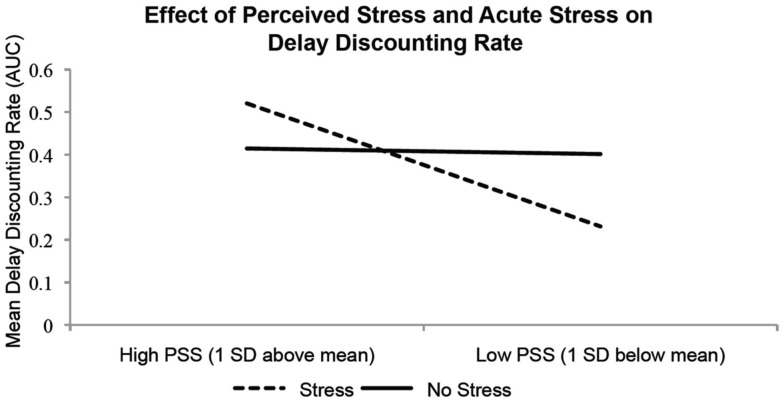
Delay discounting refers to the reduction of the value of a future reward as the delay to that reward increases. The rate at which individuals discount future rewards varies as a function of both individual and contextual differences, and high delay discounting rates have been linked with problematic behaviors, including drug abuse and gambling. The current study investigated the effects of acute anticipatory stress on delay discounting, while considering two important factors: individual perceptions of stress and whether the stressful situation is future-focused or present-focused. Half of the participants experienced acute stress by anticipating giving a videotaped speech. This stress was either future-oriented (speech about future job) or present-oriented (speech about physical appearance). They then performed a delay discounting task, in which they chose between smaller, immediate rewards, and larger, delayed rewards. Their scores on the Perceived Stress Scale were also collected. The way in which one appraises stressful situations interacts with acute stress to influence choices; under stressful conditions, delay discounting rate was highest in individuals with low trait perceived stress and lowest for individuals with high trait perceived stress. This result might be related to individual variation in reward responsiveness under stress. Furthermore, the time orientation of the task interacted with its stressfulness to affect the individual's propensity to choose immediate rewards. These findings add to our understanding of the intermediary factors between stress and decision-making.
Checked 2026-11-11 · 4 references not checked yet
Overview
AI snapshot
Written from the paper’s full text.
TL;DR
In a 2 × 2 acute stress and time-orientation experiment with 113 male participants, the interaction between acute stress and trait perceived stress predicted delay discounting rate. Under stress, low trait perceived stress was associated with steeper delay discounting, while high trait perceived stress was associated with less delay discounting.
Key findings
- Acute stress interacted with trait perceived stress to predict delay discounting rate: ΔR² = 0.06, ΔF(1, 108) = 6.71, p = 0.016; delay discounting was highest in low-PSS individuals under acute stress and lowest in high-PSS individuals under acute stress.
- The same interaction did not predict probability discounting rate: ΔR² = 0.01, ΔF(1, 108) = 0.230, p = 0.19.
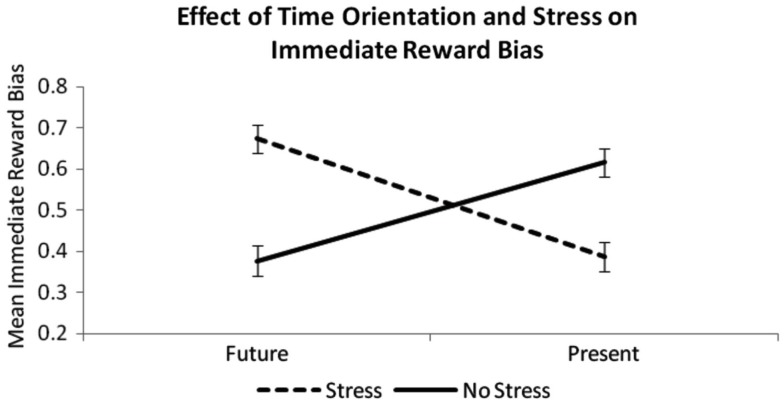
- Time orientation and acute stress interacted to affect immediate reward bias: F(1, 112) = 56.63, p < 0.001; immediate reward bias was highest in future-oriented stress and present-oriented non-stress groups, and lowest in future-oriented non-stress and present-oriented stress groups.
- Across all groups, greater cortisol increase from T1 to T2 was associated with steeper delay discounting (lower AUC): r = −0.19, p < 0.05.
Methods
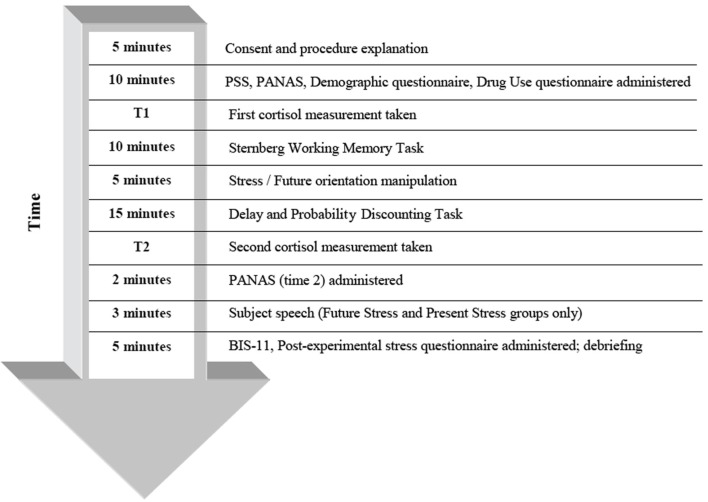
- 120 males were randomly assigned to four groups in a 2 × 2 design: acute stress vs. non-stress and future vs. present time orientation; final analysis included 113 participants (mean age = 20.46 years, SD = 3.74) after exclusions.
- Participants completed a computerized delay and probability discounting task with adjusting-amount trials, plus the Perceived Stress Scale, PANAS, BIS-11, a working memory task, and salivary cortisol at T1 and T2.
- Main analyses used moderated multiple regression with mean-centered PSS, dummy-coded acute stress, and time orientation, followed by confirmatory ANOVAs and correlations; delay discounting was indexed by area under the curve (AUC).
Limitations
- The paper states that only males were included, so results should not be generalized to the general population without future studies examining gender differences.
- The paper states that time-orientation groups differed in ways beyond time orientation (e.g., listing positive future events vs. listening to music; physical-appearance speech vs. future-job speech), and that immediate reward bias was less reliable than AUC and correlated with the number of choices faced (r = 0.609, p < 0.001).
- The paper also states that the AUC measure cannot distinguish effects on the discount parameter from effects on utility functions or time perception, and that sleep habits were not assessed.
Model-written summary. Check it against the paper before relying on it.
Integrity signals
Registry
Cites
Statistics
Figures
Verification
Claims the paper makes
46 Own result · 15 Check pending · 13 Own interpretation · 12 No full text of the sources · 9 Own method · 8 Not checked yet · 5 Sources not found · 3 No basis given
A result the paper reports from its own data — it cites no other source for it, so there is none to check. The quote shows it is in the paper.
In the paper
“In the first step of this regression, a model containing mean-centered PSS scores and the dummy-coded acute stress exposure and time orientation variables was not sufficient to predict delay discounting rate (R2 = 0.05, F(1, 109) = 1.80, p = 0.15).”
§ Individual Differences in Delay Discounting Under Acute Stress: The Role of Trait Perceived Stress > Results > Acute stress interacts with trait perceived stress to affect delay discounting
plain- Asserted: passes — The authors put it forward as true.
- Checkable: passes — It can be checked against evidence.
- Load-bearing: passes — The paper’s conclusions depend on it.
- Based: passes — The paper gives a reason why it holds.
A result the paper reports from its own data — it cites no other source for it, so there is none to check. The quote shows it is in the paper.
In the paper
“This analysis showed that the interaction between acute stress and PSS significantly predicted delay discounting rate [PSS range: 8–43, M = 23.56, SD = 6.57; ΔR2 = 0.06, ΔF(1, 108) = 6.71, p = 0.016; Figure 2], better than the model that included PSS, acute stress exposure, and time orientation of the stressor.”
§ Individual Differences in Delay Discounting Under Acute Stress: The Role of Trait Perceived Stress > Results > Acute stress interacts with trait perceived stress to affect delay discounting
plainstates an association- Asserted: passes — The authors put it forward as true.
- Checkable: passes — It can be checked against evidence.
- Load-bearing: passes — The paper’s conclusions depend on it.
- Based: passes — The paper gives a reason why it holds.
A result the paper reports from its own data — it cites no other source for it, so there is none to check. The quote shows it is in the paper.
In the paper
“When including certainty about receiving delayed rewards (as assessed by the post-task questionnaire) as another control variable in the first step of this analysis, the interaction remains significant (ΔR2 = 0.06, ΔF(1, 107) = 5.29, p = 0.007).”
§ Individual Differences in Delay Discounting Under Acute Stress: The Role of Trait Perceived Stress > Results > Acute stress interacts with trait perceived stress to affect delay discounting
plainstates an association- Asserted: passes — The authors put it forward as true.
- Checkable: passes — It can be checked against evidence.
- Load-bearing: passes — The paper’s conclusions depend on it.
- Based: passes — The paper gives a reason why it holds.
A result the paper reports from its own data — it cites no other source for it, so there is none to check. The quote shows it is in the paper.
In the paper
“There was no significant relationship between change in negative affect and change in cortisol, neither across all subjects (r = 0.05, p = 0.60) nor for participants in the stress groups (r = −0.04, p = 0.80).”
§ Individual Differences in Delay Discounting Under Acute Stress: The Role of Trait Perceived Stress > Results > Effects of acute stress manipulation
plainn = 111- Asserted: passes — The authors put it forward as true.
- Checkable: passes — It can be checked against evidence.
- Load-bearing: unclear — It is unclear whether the paper’s conclusions depend on it.
- Based: passes — The paper gives a reason why it holds.
A result the paper reports from its own data — it cites no other source for it, so there is none to check. The quote shows it is in the paper.
In the paper
“There was also a main effect of stress manipulation group on change in negative affect from T1 to T2 [F(1, 110) = 8.99, p = 0.003], indicating presence of greater negative affect after the stress manipulation than before it.”
§ Individual Differences in Delay Discounting Under Acute Stress: The Role of Trait Perceived Stress > Results > Effects of acute stress manipulation
hedgedstates a causen = 111 ·- Asserted: passes — The authors put it forward as true.
- Checkable: passes — It can be checked against evidence.
- Load-bearing: passes — The paper’s conclusions depend on it.
- Based: passes — The paper gives a reason why it holds.
A result the paper reports from its own data — it cites no other source for it, so there is none to check. The quote shows it is in the paper.
In the paper
“Furthermore, there were no differences in change in positive (t54 = −0.15, p = 0.89) or negative affect (t54 = −0.93, p = 0.36) from T1 to T2 between the two non-stress groups, PN and FN, demonstrating that they were similarly emotionally influenced by the non-stress manipulations.”
§ Individual Differences in Delay Discounting Under Acute Stress: The Role of Trait Perceived Stress > Results > Effects of acute stress manipulation
boosted- Asserted: passes — The authors put it forward as true.
- Checkable: passes — It can be checked against evidence.
- Load-bearing: unclear — It is unclear whether the paper’s conclusions depend on it.
- Based: passes — The paper gives a reason why it holds.
A result the paper reports from its own data — it cites no other source for it, so there is none to check. The quote shows it is in the paper.
In the paper
“All interactions were also non-significant [for probability discounting: F(1, 112) = 1.25, p = 0.27; for delay discounting: F(1, 112) = 0.41, p = 0.53].”
§ Individual Differences in Delay Discounting Under Acute Stress: The Role of Trait Perceived Stress > Results > Effect of time orientation and acute stress on immediate reward bias
plain- Asserted: passes — The authors put it forward as true.
- Checkable: passes — It can be checked against evidence.
- Load-bearing: unclear — It is unclear whether the paper’s conclusions depend on it.
- Based: passes — The paper gives a reason why it holds.
A result the paper reports from its own data — it cites no other source for it, so there is none to check. The quote shows it is in the paper.
In the paper
“There was an effect of acute stress manipulation on change in cortisol from T1 to T2, with stress groups showing significantly greater increases in cortisol than non-stress groups [F(1, 110) = 5.17, p = 0.025;”
§ Individual Differences in Delay Discounting Under Acute Stress: The Role of Trait Perceived Stress > Results > Effects of acute stress manipulation
plainstates a causen = 111 ·- Asserted: passes — The authors put it forward as true.
- Checkable: passes — It can be checked against evidence.
- Load-bearing: passes — The paper’s conclusions depend on it.
- Based: passes — The paper gives a reason why it holds.
A result the paper reports from its own data — it cites no other source for it, so there is none to check. The quote shows it is in the paper.
In the paper
“The multiple regression analysis revealed null results when probability discounting rate was entered as a dependent variable [ΔR2 = 0.01, ΔF(1, 108) = 0.230, p = 0.19].”
§ Individual Differences in Delay Discounting Under Acute Stress: The Role of Trait Perceived Stress > Results > Acute stress interacts with trait perceived stress to affect delay discounting
plain- Asserted: passes — The authors put it forward as true.
- Checkable: passes — It can be checked against evidence.
- Load-bearing: unclear — It is unclear whether the paper’s conclusions depend on it.
- Based: passes — The paper gives a reason why it holds.
A result the paper reports from its own data — it cites no other source for it, so there is none to check. The quote shows it is in the paper.
In the paper
“A one-way ANOVA indicated that PSS did not significantly vary by group (F = 0.315, p = 0.814).”
§ Individual Differences in Delay Discounting Under Acute Stress: The Role of Trait Perceived Stress > Results > Acute stress interacts with trait perceived stress to affect delay discounting
hedged- Asserted: passes — The authors put it forward as true.
- Checkable: passes — It can be checked against evidence.
- Load-bearing: passes — The paper’s conclusions depend on it.
- Based: passes — The paper gives a reason why it holds.
- It may state two separate claims as one. 24
- Probably not a substantial claim. 45
A result the paper reports from its own data — it cites no other source for it, so there is none to check. The quote shows it is in the paper.
In the paper
“Between the two stress groups, FS and PS, no differences in cortisol (t54 = 0.29, p = 0.77,) or negative affect (t55 = 1.09, p = 0.28) were observed, implying that participants in these groups exhibited similar stress reactivity associated with the two manipulations.”
§ Individual Differences in Delay Discounting Under Acute Stress: The Role of Trait Perceived Stress > Results > Effects of acute stress manipulation
plain- Asserted: passes — The authors put it forward as true.
- Checkable: passes — It can be checked against evidence.
- Load-bearing: passes — The paper’s conclusions depend on it.
- Based: passes — The paper gives a reason why it holds.
It may state two separate claims as one.
A result the paper reports from its own data — it cites no other source for it, so there is none to check. The quote shows it is in the paper.
In the paper
“Post hoc t-tests revealed that the PN group exhibited significantly higher immediate reward bias than the PS group (t55 = 4.44, p < 0.001) and the FN group (t54 = 4.61, p < 0.001).”
§ Individual Differences in Delay Discounting Under Acute Stress: The Role of Trait Perceived Stress > Results > Effect of time orientation and acute stress on immediate reward bias
plain- Asserted: passes — The authors put it forward as true.
- Checkable: passes — It can be checked against evidence.
- Load-bearing: passes — The paper’s conclusions depend on it.
- Based: passes — The paper gives a reason why it holds.
It may state two separate claims as one.
A result the paper reports from its own data — it cites no other source for it, so there is none to check. The quote shows it is in the paper.
In the paper
“In a 2 × 2 ANOVA, the effects of stress [F(1, 112) = 1.36, p = 0.25] and time orientation manipulation on choices about probabilistic rewards in this paradigm did not reach significance [although there was a trend for future orientation; F(1, 112) = 3.63, p = 0.06].”
§ Individual Differences in Delay Discounting Under Acute Stress: The Role of Trait Perceived Stress > Results > Effect of time orientation and acute stress on immediate reward bias
plain- Asserted: passes — The authors put it forward as true.
- Checkable: passes — It can be checked against evidence.
- Load-bearing: unclear — It is unclear whether the paper’s conclusions depend on it.
- Based: passes — The paper gives a reason why it holds.
It may state two separate claims as one.
A result the paper reports from its own data — it cites no other source for it, so there is none to check. The quote shows it is in the paper.
In the paper
“There were no significant main effects of any of the factors, but the interaction between PSS score group and acute stress group was significant [F(1, 112) = 5.188, p = 0.025].”
§ Individual Differences in Delay Discounting Under Acute Stress: The Role of Trait Perceived Stress > Results > Acute stress interacts with trait perceived stress to affect delay discounting
plainn = 113 ·- Asserted: passes — The authors put it forward as true.
- Checkable: passes — It can be checked against evidence.
- Load-bearing: passes — The paper’s conclusions depend on it.
- Based: passes — The paper gives a reason why it holds.
It may state two separate claims as one.
A result the paper reports from its own data — it cites no other source for it, so there is none to check. The quote shows it is in the paper.
In the paper
“There was no overall significant effect of future orientation on delay discounting rate [F(1, 112) = 0.37, p = 0.55], nor was there an overall effect of acute stress [F(1, 112) = 0.55, p = 0.46].”
§ Individual Differences in Delay Discounting Under Acute Stress: The Role of Trait Perceived Stress > Results > Effect of time orientation and acute stress on immediate reward bias
plain- Asserted: passes — The authors put it forward as true.
- Checkable: passes — It can be checked against evidence.
- Load-bearing: passes — The paper’s conclusions depend on it.
- Based: passes — The paper gives a reason why it holds.
It may state two separate claims as one.
A result the paper reports from its own data — it cites no other source for it, so there is none to check. The quote shows it is in the paper.
In the paper
“When inspecting the stress groups only, however, this relationship does not hold (r = −0.16, p = 0. 23), although the direction of the effect is the same.”
§ Individual Differences in Delay Discounting Under Acute Stress: The Role of Trait Perceived Stress > Results > Effect of cortisol on delay discounting
plain- Asserted: passes — The authors put it forward as true.
- Checkable: passes — It can be checked against evidence.
- Load-bearing: unclear — It is unclear whether the paper’s conclusions depend on it.
- Based: passes — The paper gives a reason why it holds.
It may state two separate claims as one.
A result the paper reports from its own data — it cites no other source for it, so there is none to check. The quote shows it is in the paper.
In the paper
“Participants tended to make far-sighted choices when they experienced present stress or when they thought about the future in a stress-free light.”
§ Individual Differences in Delay Discounting Under Acute Stress: The Role of Trait Perceived Stress > Discussion
plainstates a cause- Asserted: passes — The authors put it forward as true.
- Checkable: passes — It can be checked against evidence.
- Load-bearing: passes — The paper’s conclusions depend on it.
- Based: passes — The paper gives a reason why it holds.
It may state two separate claims as one.
A result the paper reports from its own data — it cites no other source for it, so there is none to check. The quote shows it is in the paper.
In the paper
“In addition, the FS group demonstrated higher immediate reward bias than the PS group (t55 = 6.10, p < 0.001) and the FN group (t54 = 6.34, p < 0.001).”
§ Individual Differences in Delay Discounting Under Acute Stress: The Role of Trait Perceived Stress > Results > Effect of time orientation and acute stress on immediate reward bias
plain- Asserted: passes — The authors put it forward as true.
- Checkable: passes — It can be checked against evidence.
- Load-bearing: passes — The paper’s conclusions depend on it.
- Based: passes — The paper gives a reason why it holds.
It may state two separate claims as one.
A result the paper reports from its own data — it cites no other source for it, so there is none to check. The quote shows it is in the paper.
In the paper
“There were no differences between the FS and PN groups in immediate reward bias (t52 = −0.16, p = 0.87), nor was there a significant difference between the FN and PS groups on this measure (t55 = 1.18, p = 0.24).”
§ Individual Differences in Delay Discounting Under Acute Stress: The Role of Trait Perceived Stress > Results > Effect of time orientation and acute stress on immediate reward bias
plain- Asserted: passes — The authors put it forward as true.
- Checkable: passes — It can be checked against evidence.
- Load-bearing: unclear — It is unclear whether the paper’s conclusions depend on it.
- Based: passes — The paper gives a reason why it holds.
It may state two separate claims as one.
A result the paper reports from its own data — it cites no other source for it, so there is none to check. The quote shows it is in the paper.
In the paper
“There were also no correlations found between delay discounting and working memory capacity”
§ Individual Differences in Delay Discounting Under Acute Stress: The Role of Trait Perceived Stress > Discussion
plain- Asserted: passes — The authors put it forward as true.
- Checkable: passes — It can be checked against evidence.
- Load-bearing: fails — The paper’s conclusions may not depend on it.
- Based: passes — The paper gives a reason why it holds.
Probably not a substantial claim. The paper’s conclusions may not depend on it.
What the paper did — it cites no source for this, so there is none to check. The quote shows it is in the paper.
In the paper
“Seven individuals were excluded from data analysis due to misunderstanding of instructions (n = 2), refusal to consent to video recording (n = 2), and naïveté issues (i.e., having done a similar stress-induction study previously; n = 3). Therefore, final analysis was conducted on 113 participants (mean age = 20.46 years, SD = 3.74).”
§ Individual Differences in Delay Discounting Under Acute Stress: The Role of Trait Perceived Stress > Materials and Methods > Participants
plainn = 7- Asserted: passes — The authors put it forward as true.
- Checkable: passes — It can be checked against evidence.
- Load-bearing: fails — The paper’s conclusions may not depend on it.
- Based: passes — The paper gives a reason why it holds.
Probably not a substantial claim. The paper’s conclusions may not depend on it. It may state two separate claims as one.
What the paper did — it cites no source for this, so there is none to check. The quote shows it is in the paper.
In the paper
“With our AUC measure of delay discounting, it is not clear if the differences reported above are due to effects on the discount parameter (i.e., to what degree are sooner rewards valued more than later rewards), or effects on the participants’ utility functions (i.e., how the objective reward amounts correspond to participants’ subjective values).”
§ Individual Differences in Delay Discounting Under Acute Stress: The Role of Trait Perceived Stress > Discussion
plain- Asserted: passes — The authors put it forward as true.
- Checkable: passes — It can be checked against evidence.
- Load-bearing: fails — The paper’s conclusions may not depend on it.
- Based: passes — The paper gives a reason why it holds.
Probably not a substantial claim. The paper’s conclusions may not depend on it.
A conclusion the paper draws from its own results — it cites no other source for it, so there is none to check. The quote shows it is in the paper.
In the paper
“However, all participants in the study were students, and most had similar class schedules, so it is unlikely that their sleeping patterns varied widely.”
§ Individual Differences in Delay Discounting Under Acute Stress: The Role of Trait Perceived Stress > Discussion
hedged- Asserted: passes — The authors put it forward as true.
- Checkable: passes — It can be checked against evidence.
- Load-bearing: fails — The paper’s conclusions may not depend on it.
- Based: passes — The paper gives a reason why it holds.
Probably not a substantial claim. The paper’s conclusions may not depend on it.
In the paper
“The BIS-11 provides a measure of real-world impulsivity (e.g., “I charge more than I earn”) and has been found to possess satisfactory reliability and validity (Patton et al., 1995).”
§ Individual Differences in Delay Discounting Under Acute Stress: The Role of Trait Perceived Stress > Materials and Methods > Self-report questionnaires
What the sources say
- Not checked — no full text of the sourcecites Patton et al., 1995 source
plain- Asserted: passes — The authors put it forward as true.
- Checkable: passes — It can be checked against evidence.
- Load-bearing: fails — The paper’s conclusions may not depend on it.
- Based: passes — The paper gives a reason why it holds.
Probably not a substantial claim. The paper’s conclusions may not depend on it. It may state two separate claims as one.
In the paper
“Participants under stress have been shown to make more risky choices in a risk-taking paradigm (Porcelli and Delgado, 2009), and exogenous cortisol administration has been shown to increase risk-seeking (Putman et al., 2010).”
§ Individual Differences in Delay Discounting Under Acute Stress: The Role of Trait Perceived Stress > Introduction
What the sources say
- Not matchedcites Putman et al., 2010
Couldn’t be matched to a paper in Crossref, so it can’t be checked.
plainstates a cause- Asserted: passes — The authors put it forward as true.
- Checkable: passes — It can be checked against evidence.
- Load-bearing: fails — The paper’s conclusions may not depend on it.
- Based: passes — The paper gives a reason why it holds.
Probably not a substantial claim. The paper’s conclusions may not depend on it.
- Not matched
In the paper
“Stress hormones can also impair hippocampal function and neurogenesis (McEwen, 1999).”
§ Individual Differences in Delay Discounting Under Acute Stress: The Role of Trait Perceived Stress > Discussion
What the sources say
- Not checked — no full text of the sourcecites McEwen, 1999 source
plainstates a cause- Asserted: passes — The authors put it forward as true.
- Checkable: passes — It can be checked against evidence.
- Load-bearing: fails — The paper’s conclusions may not depend on it.
- Based: passes — The paper gives a reason why it holds.
Probably not a substantial claim. The paper’s conclusions may not depend on it. It may state two separate claims as one.
What the paper did — it cites no source for this, so there is none to check. The quote shows it is in the paper.
In the paper
“A total of 120 males participated in this experiment; they were randomly assigned to each of the four groups.”
§ Individual Differences in Delay Discounting Under Acute Stress: The Role of Trait Perceived Stress > Materials and Methods > Participants
plain- Asserted: passes — The authors put it forward as true.
- Checkable: passes — It can be checked against evidence.
- Load-bearing: passes — The paper’s conclusions depend on it.
- Based: passes — The paper gives a reason why it holds.
Probably not a substantial claim.
In the paper
“In addition, prospection about future events has been found to reduce bias toward immediate reward in delay discounting tasks (Peters and Buchel, 2010; Benoit et al., 2011).”
§ Individual Differences in Delay Discounting Under Acute Stress: The Role of Trait Perceived Stress > Introduction
What the sources say
plainstates a cause- Asserted: passes — The authors put it forward as true.
- Checkable: passes — It can be checked against evidence.
- Load-bearing: passes — The paper’s conclusions depend on it.
- Based: passes — The paper gives a reason why it holds.
Probably not a substantial claim.
In the paper
“The PSS measures the degree to which situations in one’s life are appraised as stressful (Cohen et al., 1983). Higher scores indicate higher perceived stress in response to stressful situations.”
§ Individual Differences in Delay Discounting Under Acute Stress: The Role of Trait Perceived Stress > Materials and Methods > Self-report questionnaires
What the sources say
- Not checked — no full text of the sourcecites Cohen et al., 1983 source
plain- Asserted: passes — The authors put it forward as true.
- Checkable: passes — It can be checked against evidence.
- Load-bearing: passes — The paper’s conclusions depend on it.
- Based: passes — The paper gives a reason why it holds.
Probably not a substantial claim. It may state two separate claims as one.
In the paper
“Salivary free cortisol levels correspond well with plasma free cortisol levels. Therefore, collection of saliva is an easy and non-invasive means to obtain an index of the biologically active fraction of this hormone (Kirschbaum and Hellhammer, 1989).”
§ Individual Differences in Delay Discounting Under Acute Stress: The Role of Trait Perceived Stress > Materials and Methods > Cortisol
What the sources say
- Not matchedcites Kirschbaum and Hellhammer, 1989
Couldn’t be matched to a paper in Crossref, so it can’t be checked.
boostedstates an association- Asserted: passes — The authors put it forward as true.
- Checkable: passes — It can be checked against evidence.
- Load-bearing: passes — The paper’s conclusions depend on it.
- Based: passes — The paper gives a reason why it holds.
Probably not a substantial claim. It may state two separate claims as one.
- Not matched
In the paper
“Previous studies have found that delay discounting behavior can be explained by a combination of diminishing marginal utility and preference for sooner reward (Andersen et al., 2008; Pine et al., 2009).”
§ Individual Differences in Delay Discounting Under Acute Stress: The Role of Trait Perceived Stress > Discussion
What the sources say
plainstates a cause- Asserted: passes — The authors put it forward as true.
- Checkable: passes — It can be checked against evidence.
- Load-bearing: fails — The paper’s conclusions may not depend on it.
- Based: passes — The paper gives a reason why it holds.
Probably not a substantial claim. The paper’s conclusions may not depend on it.
In the paper
“Likewise, stress that is present-focused may decrease delay discounting rate by decreasing responsiveness to immediate reward (Bogdan and Pizzagalli, 2006).”
§ Individual Differences in Delay Discounting Under Acute Stress: The Role of Trait Perceived Stress > Introduction
What the sources say
- Not checked yetcites Bogdan and Pizzagalli, 2006 source
hedgedstates a possible cause- Asserted: passes — The authors put it forward as true.
- Checkable: passes — It can be checked against evidence.
- Load-bearing: passes — The paper’s conclusions depend on it.
- Based: passes — The paper gives a reason why it holds.
Probably not a substantial claim.
In the paper
“For instance, many studies have shown that drug addicts have higher discounting rates than non-drug users (Kirby et al., 1999; Kirby and Petry, 2004; Businelle et al., 2010), and people from Western cultures have higher discounting rates than those from Eastern cultures (Takahashi et al., 2009).”
§ Individual Differences in Delay Discounting Under Acute Stress: The Role of Trait Perceived Stress > Introduction
What the sources say
- Check pendingcites Takahashi et al., 2009
boostedstates an association- Asserted: passes — The authors put it forward as true.
- Checkable: passes — It can be checked against evidence.
- Load-bearing: fails — The paper’s conclusions may not depend on it.
- Based: passes — The paper gives a reason why it holds.
Probably not a substantial claim. The paper’s conclusions may not depend on it.
In the paper
“Preston et al. (2007) found that this speech topic elicited stress in both men and women.”
§ Individual Differences in Delay Discounting Under Acute Stress: The Role of Trait Perceived Stress > Materials and Methods > Stress and future orientation manipulation
What the sources say
- Not checked — no full text of the sourcecites Preston et al., 2007 source
plainstates a cause- Asserted: passes — The authors put it forward as true.
- Checkable: passes — It can be checked against evidence.
- Load-bearing: fails — The paper’s conclusions may not depend on it.
- Based: passes — The paper gives a reason why it holds.
Probably not a substantial claim. The paper’s conclusions may not depend on it.
What the paper did — it cites no source for this, so there is none to check. The quote shows it is in the paper.
In the paper
“As a theoretically neutral measure of delay discounting, the AUC makes no explicit assumptions regarding the form of the indifference curve. In this way, it is applicable to a wider range of indifference curves than other quantitative models, such as hyperbolic or exponential delay discounting models.”
§ Individual Differences in Delay Discounting Under Acute Stress: The Role of Trait Perceived Stress > Results > Data reduction
plain- Asserted: passes — The authors put it forward as true.
- Checkable: passes — It can be checked against evidence.
- Load-bearing: fails — The paper’s conclusions may not depend on it.
- Based: passes — The paper gives a reason why it holds.
Probably not a substantial claim. The paper’s conclusions may not depend on it. It may state two separate claims as one.
In the paper
“the association between blunted reward response and reduced delay discounting has also been found previously (Lempert and Pizzagalli, 2010).”
§ Individual Differences in Delay Discounting Under Acute Stress: The Role of Trait Perceived Stress > Discussion
What the sources say
- Check pendingcites Lempert and Pizzagalli, 2010 source
plainstates an association- Asserted: passes — The authors put it forward as true.
- Checkable: passes — It can be checked against evidence.
- Load-bearing: passes — The paper’s conclusions depend on it.
- Based: passes — The paper gives a reason why it holds.
Probably not a substantial claim.
In the paper
“Risk-taking is often found to be correlated with preference for immediate reward (Reynolds et al., 2004), and there may be similarities between the discounting functions for delayed and probabilistic rewards (Rachlin et al., 1991; Green and Myerson, 2004).”
§ Individual Differences in Delay Discounting Under Acute Stress: The Role of Trait Perceived Stress > Introduction
What the sources say
- Not checked — no full text of the sourcecites Reynolds et al., 2004 source
hedgedstates an association- Asserted: passes — The authors put it forward as true.
- Checkable: passes — It can be checked against evidence.
- Load-bearing: fails — The paper’s conclusions may not depend on it.
- Based: passes — The paper gives a reason why it holds.
Probably not a substantial claim. The paper’s conclusions may not depend on it.
In the paper
“Stress has also been found to increase risky decision-making in a driving task in older adults, but not in younger adults (Mather et al., 2009), and a few studies have reported gender differences in decision-making under stress (Preston et al., 2007; Lighthall et al., 2009; van den Bos et al., 2009; Takahashi et al., 2010).”
§ Individual Differences in Delay Discounting Under Acute Stress: The Role of Trait Perceived Stress > Introduction
What the sources say
- Check pendingcites Mather et al., 2009 source
plainstates a cause- Asserted: passes — The authors put it forward as true.
- Checkable: passes — It can be checked against evidence.
- Load-bearing: fails — The paper’s conclusions may not depend on it.
- Based: passes — The paper gives a reason why it holds.
Probably not a substantial claim. The paper’s conclusions may not depend on it. It may state two separate claims as one.
None of the sources cited for this claim have been checked yet.
In the paper
“Stress has also been found to increase risky decision-making in a driving task in older adults, but not in younger adults (Mather et al., 2009), and a few studies have reported gender differences in decision-making under stress (Preston et al., 2007; Lighthall et al., 2009; van den Bos et al., 2009; Takahashi et al., 2010).”
§ Individual Differences in Delay Discounting Under Acute Stress: The Role of Trait Perceived Stress > Introduction
What the sources say
plainstates an association- Asserted: passes — The authors put it forward as true.
- Checkable: passes — It can be checked against evidence.
- Load-bearing: fails — The paper’s conclusions may not depend on it.
- Based: passes — The paper gives a reason why it holds.
Probably not a substantial claim. The paper’s conclusions may not depend on it.
In the paper
“Ebert and Prelec (2007) found that manipulations of time sensitivity affected the valuation of near-future and far-future rewards differently.”
§ Individual Differences in Delay Discounting Under Acute Stress: The Role of Trait Perceived Stress > Discussion
What the sources say
- Not checked — no full text of the sourcecites Ebert and Prelec (2007) source
plainstates a cause- Asserted: passes — The authors put it forward as true.
- Checkable: passes — It can be checked against evidence.
- Load-bearing: fails — The paper’s conclusions may not depend on it.
- Based: passes — The paper gives a reason why it holds.
Probably not a substantial claim. The paper’s conclusions may not depend on it.
What the paper did — it cites no source for this, so there is none to check. The quote shows it is in the paper.
In the paper
“we did not assess participants’ sleep habits.”
§ Individual Differences in Delay Discounting Under Acute Stress: The Role of Trait Perceived Stress > Discussion
plain- Asserted: passes — The authors put it forward as true.
- Checkable: passes — It can be checked against evidence.
- Load-bearing: fails — The paper’s conclusions may not depend on it.
- Based: passes — The paper gives a reason why it holds.
Probably not a substantial claim. The paper’s conclusions may not depend on it.
In the paper
“late-risers and early risers may differ in their decision-making patterns (e.g., Tonetti et al., 2010).”
§ Individual Differences in Delay Discounting Under Acute Stress: The Role of Trait Perceived Stress > Discussion
What the sources say
- Not checked — no full text of the sourcecites Tonetti et al., 2010 source
hedgedstates an association- Asserted: passes — The authors put it forward as true.
- Checkable: passes — It can be checked against evidence.
- Load-bearing: fails — The paper’s conclusions may not depend on it.
- Based: passes — The paper gives a reason why it holds.
Probably not a substantial claim. The paper’s conclusions may not depend on it.
In the paper
“but they activate different receptors in PFC depending on the level of stress, and depending on the time of day (see Lupien et al., 2007 for a review).”
§ Individual Differences in Delay Discounting Under Acute Stress: The Role of Trait Perceived Stress > Discussion
What the sources say
- Not checked yetcites Lupien et al., 2007 source
plainstates a cause- Asserted: passes — The authors put it forward as true.
- Checkable: passes — It can be checked against evidence.
- Load-bearing: fails — The paper’s conclusions may not depend on it.
- Based: passes — The paper gives a reason why it holds.
Probably not a substantial claim. The paper’s conclusions may not depend on it.
A conclusion the paper draws from its own results — it cites no other source for it, so there is none to check. The quote shows it is in the paper.
In the paper
“Those who are more likely to perceive stressful situations as such show a preference for larger, delayed rewards, while those with low perceived stress discount delayed rewards at a higher rate.”
§ Individual Differences in Delay Discounting Under Acute Stress: The Role of Trait Perceived Stress > Discussion
plainstates an association- Asserted: passes — The authors put it forward as true.
- Checkable: passes — It can be checked against evidence.
- Load-bearing: passes — The paper’s conclusions depend on it.
- Based: passes — The paper gives a reason why it holds.
It may state two separate claims as one.
A conclusion the paper draws from its own results — it cites no other source for it, so there is none to check. The quote shows it is in the paper.
In the paper
“if the first immediate reward amount randomly generated by the task was very high, then it would have been more likely to be followed by more immediate reward choices; if the first number was low, then there would be fewer immediate choices at the beginning.”
§ Individual Differences in Delay Discounting Under Acute Stress: The Role of Trait Perceived Stress > Results > Effect of time orientation and acute stress on immediate reward bias
hedgedstates a possible cause- Asserted: passes — The authors put it forward as true.
- Checkable: passes — It can be checked against evidence.
- Load-bearing: fails — The paper’s conclusions may not depend on it.
- Based: passes — The paper gives a reason why it holds.
Probably not a substantial claim. The paper’s conclusions may not depend on it. It may state two separate claims as one.
In the paper
“the q parameter can be used to assess a subject’s consistency in intertemporal choice (Cajueiro, 2006; Takahashi et al., 2007).”
§ Individual Differences in Delay Discounting Under Acute Stress: The Role of Trait Perceived Stress > Results > Effect of time orientation and acute stress on immediate reward bias
What the sources say
- Not matchedcites Cajueiro, 2006
Couldn’t be matched to a paper in Crossref, so it can’t be checked.
- Check pendingcites Takahashi et al., 2007 source
plainstates an association- Asserted: passes — The authors put it forward as true.
- Checkable: passes — It can be checked against evidence.
- Load-bearing: passes — The paper’s conclusions depend on it.
- Based: passes — The paper gives a reason why it holds.
Probably not a substantial claim.
- Not matched
In the paper
“A growing literature shows that individuals may interpret stressful situations as either challenging or threatening, and that this might affect their choices (e.g., Kassam et al., 2009).”
§ Individual Differences in Delay Discounting Under Acute Stress: The Role of Trait Perceived Stress > Introduction
What the sources say
- Not checked yetcites Kassam et al., 2009 source
hedgedstates a possible cause- Asserted: passes — The authors put it forward as true.
- Checkable: passes — It can be checked against evidence.
- Load-bearing: passes — The paper’s conclusions depend on it.
- Based: passes — The paper gives a reason why it holds.
Probably not a substantial claim. It may state two separate claims as one.
What the paper did — it cites no source for this, so there is none to check. The quote shows it is in the paper.
In the paper
“there might be differences between our future non-stress and present non-stress groups independent of time orientation itself”
§ Individual Differences in Delay Discounting Under Acute Stress: The Role of Trait Perceived Stress > Discussion
hedged- Asserted: passes — The authors put it forward as true.
- Checkable: passes — It can be checked against evidence.
- Load-bearing: passes — The paper’s conclusions depend on it.
- Based: passes — The paper gives a reason why it holds.
Probably not a substantial claim.
In the paper
“In addition, the experiment was always conducted between the hours of 1:00 and 5:00 PM, as stress levels have been shown to fluctuate throughout the day (Izawa et al., 2010) and to control for circadian fluctuations in circulating cortisol (Federenko et al., 2004).”
§ Individual Differences in Delay Discounting Under Acute Stress: The Role of Trait Perceived Stress > Materials and Methods > Participants
What the sources say
- Not matchedcites Izawa et al., 2010
Couldn’t be matched to a paper in Crossref, so it can’t be checked.
- Check pendingcites Federenko et al., 2004 source
plain- Asserted: passes — The authors put it forward as true.
- Checkable: passes — It can be checked against evidence.
- Load-bearing: passes — The paper’s conclusions depend on it.
- Based: passes — The paper gives a reason why it holds.
Probably not a substantial claim.
- Not matched
In the paper
“Cortisol levels corresponding to the stress response tend to peak at this time (Kirschbaum et al., 1993).”
§ Individual Differences in Delay Discounting Under Acute Stress: The Role of Trait Perceived Stress > Materials and Methods > Cortisol
What the sources say
- Not matchedcites Kirschbaum et al., 1993
Couldn’t be matched to a paper in Crossref, so it can’t be checked.
hedged- Asserted: passes — The authors put it forward as true.
- Checkable: passes — It can be checked against evidence.
- Load-bearing: passes — The paper’s conclusions depend on it.
- Based: passes — The paper gives a reason why it holds.
Probably not a substantial claim.
- Not matched
In the paper
“This speech topic is commonly used as part of the Trier Social Stress Test (Kirschbaum et al., 1993), a manipulation that reliably elicits self-reported stress and cortisol release.”
§ Individual Differences in Delay Discounting Under Acute Stress: The Role of Trait Perceived Stress > Materials and Methods > Stress and future orientation manipulation
What the sources say
- Not matchedcites Kirschbaum et al., 1993
Couldn’t be matched to a paper in Crossref, so it can’t be checked.
plainstates a cause- Asserted: passes — The authors put it forward as true.
- Checkable: passes — It can be checked against evidence.
- Load-bearing: passes — The paper’s conclusions depend on it.
- Based: passes — The paper gives a reason why it holds.
Probably not a substantial claim. It may state two separate claims as one.
- Not matched
In the paper
“Contextual influences on delay discounting rate include a gambling context among pathological gamblers (Dixon et al., 2006) and episodic future thinking in normal subjects (Peters and Buchel, 2010; Benoit et al., 2011).”
§ Individual Differences in Delay Discounting Under Acute Stress: The Role of Trait Perceived Stress > Introduction
What the sources say
plainstates an association- Asserted: passes — The authors put it forward as true.
- Checkable: passes — It can be checked against evidence.
- Load-bearing: fails — The paper’s conclusions may not depend on it.
- Based: passes — The paper gives a reason why it holds.
Probably not a substantial claim. The paper’s conclusions may not depend on it. It may state two separate claims as one.
In the paper
“Listening to relaxing music is often used as a non-stressful control task in studies that involve stress manipulation (e.g., van den Bos et al., 2009).”
§ Individual Differences in Delay Discounting Under Acute Stress: The Role of Trait Perceived Stress > Materials and Methods > Stress and future orientation manipulation
What the sources say
- Not checked — no full text of the sourcecites van den Bos et al., 2009 source
plain- Asserted: passes — The authors put it forward as true.
- Checkable: passes — It can be checked against evidence.
- Load-bearing: fails — The paper’s conclusions may not depend on it.
- Based: passes — The paper gives a reason why it holds.
Probably not a substantial claim. The paper’s conclusions may not depend on it.
In the paper
“They seem to impair prefrontal cortex (PFC) function and executive control (Hains and Arnsten, 2008)”
§ Individual Differences in Delay Discounting Under Acute Stress: The Role of Trait Perceived Stress > Discussion
What the sources say
- Not checked yetcites Hains and Arnsten, 2008 source
hedgedstates a cause- Asserted: passes — The authors put it forward as true.
- Checkable: passes — It can be checked against evidence.
- Load-bearing: fails — The paper’s conclusions may not depend on it.
- Based: passes — The paper gives a reason why it holds.
Probably not a substantial claim. The paper’s conclusions may not depend on it. It may state two separate claims as one.
In the paper
“High scores on this measure have been associated with blunted hedonic capacity (Pizzagalli et al., 2007), especially in the presence of acute stress (Bogdan and Pizzagalli, 2006).”
§ Individual Differences in Delay Discounting Under Acute Stress: The Role of Trait Perceived Stress > Introduction
What the sources say
plainstates an association- Asserted: passes — The authors put it forward as true.
- Checkable: passes — It can be checked against evidence.
- Load-bearing: passes — The paper’s conclusions depend on it.
- Based: passes — The paper gives a reason why it holds.
Probably not a substantial claim.
In the paper
“For instance, many studies have shown that drug addicts have higher discounting rates than non-drug users (Kirby et al., 1999; Kirby and Petry, 2004; Businelle et al., 2010), and people from Western cultures have higher discounting rates than those from Eastern cultures (Takahashi et al., 2009).”
§ Individual Differences in Delay Discounting Under Acute Stress: The Role of Trait Perceived Stress > Introduction
What the sources say
boostedstates an association- Asserted: passes — The authors put it forward as true.
- Checkable: passes — It can be checked against evidence.
- Load-bearing: fails — The paper’s conclusions may not depend on it.
- Based: passes — The paper gives a reason why it holds.
Probably not a substantial claim. The paper’s conclusions may not depend on it.
A claim is checked only against the cited paper’s full text, never its abstract, and none is available for its sources.
In the paper
“While these findings point to more risky decision-making under stress, which may translate to higher delay discounting, high basal cortisol levels have actually been associated with less risky behavior on the Iowa Gambling Task (van Honk et al., 2003), as well as with lower delay discounting rates (Takahashi, 2004).”
§ Individual Differences in Delay Discounting Under Acute Stress: The Role of Trait Perceived Stress > Introduction
What the sources say
plainstates an association- Asserted: passes — The authors put it forward as true.
- Checkable: passes — It can be checked against evidence.
- Load-bearing: fails — The paper’s conclusions may not depend on it.
- Based: passes — The paper gives a reason why it holds.
Probably not a substantial claim. The paper’s conclusions may not depend on it. It may state two separate claims as one.
In the paper
“Participants under stress have been shown to make more risky choices in a risk-taking paradigm (Porcelli and Delgado, 2009), and exogenous cortisol administration has been shown to increase risk-seeking (Putman et al., 2010).”
§ Individual Differences in Delay Discounting Under Acute Stress: The Role of Trait Perceived Stress > Introduction
What the sources say
- Check pendingcites Porcelli and Delgado, 2009 source
plainstates a cause- Asserted: passes — The authors put it forward as true.
- Checkable: passes — It can be checked against evidence.
- Load-bearing: passes — The paper’s conclusions depend on it.
- Based: passes — The paper gives a reason why it holds.
Probably not a substantial claim.
What the paper did — it cites no source for this, so there is none to check. The quote shows it is in the paper.
In the paper
“Similarly, there may be differences between the stress groups that are unrelated to time orientation”
§ Individual Differences in Delay Discounting Under Acute Stress: The Role of Trait Perceived Stress > Discussion
hedged- Asserted: passes — The authors put it forward as true.
- Checkable: passes — It can be checked against evidence.
- Load-bearing: passes — The paper’s conclusions depend on it.
- Based: passes — The paper gives a reason why it holds.
Probably not a substantial claim.
In the paper
“Both high delay discounting (Yoon et al., 2007; Harty et al., 2011) and stress (Sinha, 2001) have been shown to be vulnerability factors for addiction and relapse.”
§ Individual Differences in Delay Discounting Under Acute Stress: The Role of Trait Perceived Stress > Discussion
What the sources say
- Not checked — no full text of the sourcecites Sinha, 2001 source
boostedstates an association- Asserted: passes — The authors put it forward as true.
- Checkable: passes — It can be checked against evidence.
- Load-bearing: passes — The paper’s conclusions depend on it.
- Based: passes — The paper gives a reason why it holds.
Probably not a substantial claim.
What the paper did — it cites no source for this, so there is none to check. The quote shows it is in the paper.
In the paper
“It is premature, however, to generalize our results about the effects of stress on decision-making in this sample to the general population”
§ Individual Differences in Delay Discounting Under Acute Stress: The Role of Trait Perceived Stress > Discussion
plain- Asserted: passes — The authors put it forward as true.
- Checkable: fails — It may be too vague to check against evidence.
- Load-bearing: fails — The paper’s conclusions may not depend on it.
- Based: passes — The paper gives a reason why it holds.
Probably not a substantial claim. It may be too vague to check against evidence. The paper’s conclusions may not depend on it.
A conclusion the paper draws from its own results — it cites no other source for it, so there is none to check. The quote shows it is in the paper.
In the paper
“Whether one is contemplating the present or the future during intertemporal choice affects the likelihood with which one chooses immediate rewards, but this effect is tempered by the stressfulness of the context.”
§ Individual Differences in Delay Discounting Under Acute Stress: The Role of Trait Perceived Stress > Discussion
plainstates a cause- Asserted: passes — The authors put it forward as true.
- Checkable: passes — It can be checked against evidence.
- Load-bearing: passes — The paper’s conclusions depend on it.
- Based: passes — The paper gives a reason why it holds.
It may state two separate claims as one.
A claim is checked only against the cited paper’s full text, never its abstract, and none is available for its sources.
In the paper
“Both high delay discounting (Yoon et al., 2007; Harty et al., 2011) and stress (Sinha, 2001) have been shown to be vulnerability factors for addiction and relapse.”
§ Individual Differences in Delay Discounting Under Acute Stress: The Role of Trait Perceived Stress > Discussion
What the sources say
boostedstates an association- Asserted: passes — The authors put it forward as true.
- Checkable: passes — It can be checked against evidence.
- Load-bearing: fails — The paper’s conclusions may not depend on it.
- Based: passes — The paper gives a reason why it holds.
Probably not a substantial claim. The paper’s conclusions may not depend on it.
In the paper
“the hippocampus is involved in future-directed thinking during delay discounting (Peters and Buchel, 2010).”
§ Individual Differences in Delay Discounting Under Acute Stress: The Role of Trait Perceived Stress > Discussion
What the sources say
- Check pendingcites Peters and Buchel, 2010 source
plainstates an association- Asserted: passes — The authors put it forward as true.
- Checkable: passes — It can be checked against evidence.
- Load-bearing: fails — The paper’s conclusions may not depend on it.
- Based: passes — The paper gives a reason why it holds.
Probably not a substantial claim. The paper’s conclusions may not depend on it.
In the paper
“It has also been hypothesized that stress might elicit suicidal behavior and other impulsive behaviors in depression, through modulation of delay discounting (Takahashi, 2011).”
§ Individual Differences in Delay Discounting Under Acute Stress: The Role of Trait Perceived Stress > Discussion
What the sources say
- Check pendingcites Takahashi, 2011 source
hedgedstates a possible cause- Asserted: fails — The authors may not put it forward as true.
- Checkable: passes — It can be checked against evidence.
- Load-bearing: fails — The paper’s conclusions may not depend on it.
- Based: passes — The paper gives a reason why it holds.
Probably not a substantial claim. The authors may not put it forward as true. The paper’s conclusions may not depend on it.
In the paper
“White matter volume in the hippocampus has been shown to be positively associated with delay discounting rate (Yu, 2012)”
§ Individual Differences in Delay Discounting Under Acute Stress: The Role of Trait Perceived Stress > Discussion
What the sources say
- Not matchedcites Yu, 2012
Couldn’t be matched to a paper in Crossref, so it can’t be checked.
plainstates an association- Asserted: passes — The authors put it forward as true.
- Checkable: passes — It can be checked against evidence.
- Load-bearing: fails — The paper’s conclusions may not depend on it.
- Based: passes — The paper gives a reason why it holds.
Probably not a substantial claim. The paper’s conclusions may not depend on it.
- Not matched
The paper relies on this without support.
The future-oriented and present-oriented speech topics successfully induced future versus present time orientation.
“Although time orientation was not the only factor that differed between the two conditions, we did not want to make the time orientation manipulation transparent to subjects, nor did we wish to include a new manipulation that might not have been effective in inducing stress.”
The paper relies on this without support.
The PSS administered at the beginning measures a stable trait perceived stress that is not altered by the acute stress manipulation.
“In the present study, we administered the PSS in order to measure participants’ general perception of life events as stressful. This trait perceived stress might represent an important intermediary factor in the relationship between acute stress and delay discounting; likewise, acute stress may mediate the relationship between trait perceived stress and delay discounting.”
The paper relies on this without support.
The time orientation manipulation successfully induced the intended time orientation (future vs present) in participants.
“The aim of the current study was to investigate the effects of acute stress on delay discounting, while controlling for the potential confound of time orientation.”
The paper relies on this without support.
Excluding the 26 participants for whom the q-exponential function could not be fitted did not bias the group comparisons.
“After excluding these subjects, a one-way ANOVA revealed no group differences in the consistency parameter q (F = 0.513; p = 0.679) or in the discounting parameter kq (F = 0.487; p = 0.692).”
The paper relies on this without support.
The immediate reward bias index is a less reliable measure than AUC.
“However, in this staircase procedure, it is important to bear in mind that the immediate reward bias index is a less reliable measure than AUC.”
Statistics that don’t add up
Each reported p-value recomputed from its test statistic and degrees of freedom.
Rated minor: it would not touch a result — a value no result rests on, a p-value that stays on the same side of the significance level, or a conflict that is clerical, resolved elsewhere in the paper, or outside its own findings.
In the paper
“F(1, 108) = 0.230, p = 0.19”
§ Individual Differences in Delay Discounting Under Acute Stress: The Role of Trait Perceived Stress > Results > Acute stress interacts with trait perceived stress to affect delay discounting
Reported p = .19 · recomputed p = .632
Rated minor: it would not touch a result — a value no result rests on, a p-value that stays on the same side of the significance level, or a conflict that is clerical, resolved elsewhere in the paper, or outside its own findings.
In the paper
“F(1, 107) = 5.29, p = 0.007”
§ Individual Differences in Delay Discounting Under Acute Stress: The Role of Trait Perceived Stress > Results > Acute stress interacts with trait perceived stress to affect delay discounting
Reported p = .007 · recomputed p = .023
Rated minor: it would not touch a result — a value no result rests on, a p-value that stays on the same side of the significance level, or a conflict that is clerical, resolved elsewhere in the paper, or outside its own findings.
In the paper
“F(1, 108) = 6.71, p = 0.016”
§ Individual Differences in Delay Discounting Under Acute Stress: The Role of Trait Perceived Stress > Results > Acute stress interacts with trait perceived stress to affect delay discounting
Reported p = .016 · recomputed p = .011
Rated minor: it would not touch a result — a value no result rests on, a p-value that stays on the same side of the significance level, or a conflict that is clerical, resolved elsewhere in the paper, or outside its own findings.
In the paper
“F(1, 109) = 1.80, p = 0.15”
§ Individual Differences in Delay Discounting Under Acute Stress: The Role of Trait Perceived Stress > Results > Acute stress interacts with trait perceived stress to affect delay discounting
Reported p = .15 · recomputed p = .183
Statistics recomputed
Every reported test result, recomputed from its test statistic and degrees of freedom. A result shows as not adding up only once an independent check has confirmed it.
- Doesn’t add upF(1, 108) = 6.71reported p = .016 · recomputed p = .011
“F(1, 108) = 6.71, p = .016”
- Doesn’t add upF(1, 107) = 5.29reported p = .007 · recomputed p = .023
“F(1, 107) = 5.29, p = .007”
- Doesn’t add upF(1, 109) = 1.8reported p = .15 · recomputed p = .183
“F(1, 109) = 1.80, p = .15”
- Doesn’t add upF(1, 108) = 0.23reported p = .19 · recomputed p = .632
“F(1, 108) = 0.230, p = .19”
- ConsistentF(1, 110) = 5.17reported p = .025 · recomputed p = .025
“F(1, 110) = 5.17, p = .025”
- ConsistentF(1, 110) = 8.99reported p = .003 · recomputed p = .003
“F(1, 110) = 8.99, p = .003”
- ConsistentF(1, 112) = 5.188reported p = .025 · recomputed p = .025
“F(1, 112) = 5.188, p = .025”
- ConsistentF(1, 112) = 1.36reported p = .25 · recomputed p = .246
“F(1, 112) = 1.36, p = .25”
- ConsistentF(1, 112) = 3.63reported p = .06 · recomputed p = .059
“F(1, 112) = 3.63, p = .06”
- ConsistentF(1, 112) = 0.37reported p = .55 · recomputed p = .544
“F(1, 112) = 0.37, p = .55”
- ConsistentF(1, 112) = 0.55reported p = .46 · recomputed p = .460
“F(1, 112) = 0.55, p = .46”
- ConsistentF(1, 112) = 1.25reported p = .27 · recomputed p = .266
“F(1, 112) = 1.25, p = .27”
- ConsistentF(1, 112) = 0.41reported p = .53 · recomputed p = .523
“F(1, 112) = 0.41, p = .53”
- ConsistentF(1, 112) = 0.47reported p = .5 · recomputed p = .494
“F(1, 112) = 0.47, p = .50”
- ConsistentF(1, 112) = 0.88reported p = .35 · recomputed p = .350
“F(1, 112) = 0.88, p = .35”
- ConsistentF(1, 112) = 56.63reported p < .001 · recomputed p < .001
“F(1, 112) = 56.63, p < .001”
- ConsistentF(1, 111) = 55.82reported p < .001 · recomputed p < .001
“F(1, 111) = 55.82, p < .001”
- ConsistentF(1, 111) = 56.63reported p < .001 · recomputed p < .001
“F(1, 111) = 56.63, p < .001”
Self-check
Percentages, sums and reported differences re-computed from the paper’s own numbers.
Each contradiction between two passages listed here was confirmed by an independent check.
Rated minor: it would not touch a result — a value no result rests on, a p-value that stays on the same side of the significance level, or a conflict that is clerical, resolved elsewhere in the paper, or outside its own findings.
In the paper
§ Individual Differences in Delay Discounting Under Acute Stress: The Role of Trait Perceived Stress > Results > Data reduction
“The indifference values and delay values (1, 2, 30, 180, and 365 days) were used as x-coordinates and y-coordinates, respectively, to construct a graph of the discounting data.”
§ Individual Differences in Delay Discounting Under Acute Stress: The Role of Trait Perceived Stress > Results > Data reduction
“where x1 and x2 are successive delays, and y1 and y2 are the indifference values associated with these delays”
Rated minor: it would not touch a result — a value no result rests on, a p-value that stays on the same side of the significance level, or a conflict that is clerical, resolved elsewhere in the paper, or outside its own findings.
In the paper
§ Individual Differences in Delay Discounting Under Acute Stress: The Role of Trait Perceived Stress > Results > Effect of time orientation and acute stress on immediate reward bias
“[F(1, 112) = 56.63, p < 0.001; Figure 3]”
§ Individual Differences in Delay Discounting Under Acute Stress: The Role of Trait Perceived Stress > Results > Effect of time orientation and acute stress on immediate reward bias
“[N = 112; F(1, 111) = 56.63, p < 0.001]”
Rated minor: it would not touch a result — a value no result rests on, a p-value that stays on the same side of the significance level, or a conflict that is clerical, resolved elsewhere in the paper, or outside its own findings.
In the paper
§ Individual Differences in Delay Discounting Under Acute Stress: The Role of Trait Perceived Stress > Introduction
“Higher probability discounting rates were indicative of greater risk-taking, or a greater propensity to discount odds against receiving an uncertain reward.”
§ Individual Differences in Delay Discounting Under Acute Stress: The Role of Trait Perceived Stress > Results > Data reduction
“Here, smaller area values indicate greater discounting by odds against receiving a reward; therefore, participants with lower AUC values were relatively risk-averse, while higher AUC values indicated greater risk-taking behavior.”
Citations
Cites
A Global Measure of Perceived Stress
Cohen, S., Kamarck, T., & Mermelstein, R. (1983) · Journal of Health and Social Behavior · doi:10.2307/2136404 · Cited by 32,807
Development and validation of brief measures of positive and negative affect: The PANAS scales.
Watson, D., Clark, L. A., & Tellegen, A. (1988) · Journal of Personality and Social Psychology · doi:10.1037/0022-3514.54.6.1063 · Cited by 32,433
Kirschbaum, C., Pirke, K.-M., & Hellhammer, D. H. (2008) · Neuropsychobiology · doi:10.1159/000119004 · Cited by 6,093
High-speed scanning in human memory
Sternberg, S. (1966) · Science · doi:10.1126/science.153.3736.652 · Cited by 3,576
Heroin addicts have higher discount rates for delayed rewards than non-drug-using controls.
Kirby, K. N., Petry, N. M., & Bickel, W. K. (1999) · Journal of Experimental Psychology: General · doi:10.1037/0096-3445.128.1.78 · Cited by 2,171
STRESS AND HIPPOCAMPAL PLASTICITY
McEwen, B. S. (1999) · Annual Review of Neuroscience · doi:10.1146/annurev.neuro.22.1.105 · Cited by 2,087
A Discounting Framework for Choice With Delayed and Probabilistic Rewards.
Green, L., & Myerson, J. (2004) · Psychological Bulletin · doi:10.1037/0033-2909.130.5.769 · Cited by 1,676
AREA UNDER THE CURVE AS A MEASURE OF DISCOUNTING
Myerson, J., Green, L., & Warusawitharana, M. (2001) · Journal of the Experimental Analysis of Behavior · doi:10.1901/jeab.2001.76-235 · Cited by 1,545
Salivary Cortisol in Psychobiological Research: An Overview
Kirschbaum, C., & Hellhammer, D. H. (2008) · Neuropsychobiology · doi:10.1159/000118611 · Cited by 1,532
How does stress increase risk of drug abuse and relapse?
Sinha, R. (2001) · Psychopharmacology · doi:10.1007/s002130100917 · Cited by 1,505
Research works printed but not linked: 2
- Henry J. P. (1980). “Present concept of stress theory,” in Catecholamines and Stress: Recent Advances, eds Usdin E. Kvetnansky R. Kopin I. J. (New York: Elsevier/North-Holland), 557– 571
- Izawa S. Sugaya N. Yamamoto R. Ogawa N. Nomura S. (2010). The cortisol awakening response and autonomic nervous system activity during nocturnal and early morning periods. Neuro Endocrinol. Lett. 31, 685– 689 21178943
Cited by
Sorted by citations
Emotion and Decision Making: Multiple Modulatory Neural Circuits
Phelps, E. A., Lempert, K. M., & Sokol‐Hessner, P. (2014) · Annual Review of Neuroscience · doi:10.1146/annurev-neuro-071013-014119 · Cited by 482
Self-citationChoice impulsivity: Definitions, measurement issues, and clinical implications.
Hamilton, K. R., Mitchell, M. R., Wing, V. C., Balodis, I. M., Bickel, W. K., Fillmore, M. T., Lane, S. D., Lejuez, C. W., Littlefield, A. K., Luijten, M., et al. (2015) · Personality Disorders Theory Research and Treatment · doi:10.1037/per0000099 · Cited by 296
Effects of stress on decisions under uncertainty: A meta-analysis.
Starcke, K., & Brand, M. (2016) · Psychological Bulletin · doi:10.1037/bul0000060 · Cited by 274
Stress and decision making: effects on valuation, learning, and risk-taking
Porcelli, A. J., & Delgado, M. R. (2016) · Current Opinion in Behavioral Sciences · doi:10.1016/j.cobeha.2016.11.015 · Cited by 273
Self-citationMaier, S. U., Makwana, A. B., & Hare, T. A. (2015) · Neuron · doi:10.1016/j.neuron.2015.07.005 · Cited by 270
Metadata
- Authors
- Lempert, K. M., Porcelli, A. J., Delgado, M. R., & Tricomi, E.
- Affiliations
- New York University (US)
- Marquette University (US)
- Rutgers, The State University of New Jersey (US)
- Corresponding author
- Tricomi, Elizabeth
- Venue
- Frontiers in Psychology
- Publisher
- Frontiers Media SA
- Published
- 2012
- Volume
- 3
- Pages
- 251-251
- ISSN
- 1664-1078 (ISSN-L)
- PMC
- PMC3400439
- OpenAlex
- W2161045592
- Cited by
- 112
- References
- 79
- Citations by year
- 2026: 6 · 2025: 2 · 2024: 15 · 2023: 5 · 2022: 4 · 2021: 15 · 2020: 8 · 2019: 5 · 2018: 9 · 2017: 7 · 2016: 15 · 2015: 8 · 2014: 7 · 2013: 5
- FWCI
- 4.37
- Type
- journal article
- Language
- en
- Open access
- gold
- doi.org
- Licence
- cc-by
- Locations
- Frontiers in Psychology (publishedVersion, cc-by)
- PubMed (publishedVersion)
- PubMed Central (publishedVersion)
- e-Publications@Marquette (Marquette University) (submittedVersion)
- DOAJ (DOAJ: Directory of Open Access Journals) (submittedVersion, cc-by-sa)
- Funders
- National Institute on Drug Abuse (R03DA029170, R01DA027764)
- Topics
- Social Sciences › Decision Sciences › General Decision Sciences › Decision-Making and Behavioral Economics
- Life Sciences › Neuroscience › Cognitive Neuroscience › Neural and Behavioral Psychology Studies
- Life Sciences › Neuroscience › Cellular and Molecular Neuroscience › Neurotransmitter Receptor Influence on Behavior
- Keywords
- delay discounting, acute stress, anticipatory stress, time orientation, decision-making, reward responsiveness, speaking tasks, Perceived Stress Scale, individual differences, impulsivity
About these checks
Registry, retraction, Cites and statistics results are computed, not judged, with one exception: a printed reference that no index lists is read once by a model before it counts as a citation error. Claims are extracted by a model and kept only when their quote appears verbatim in the text; each cited source is then checked, with a model’s help, for whether it says what the claim relies on. Those verdicts can be wrong — read the claim’s quote and the cited source before relying on one.
A language model drew the claims from the paper on 2026-11-11, under version 3 of the claim definition (model deepseek-v4.1-flash, prompt extract-v3).
A second model labelled each claim on 2026-11-11 (model jev-1.13-20260917, definition revision gold-guideline-v0.2).
Statistics and arithmetic are recomputed, not judged.
Confidence bands are shown only for fields calibrated on our annotated test set. None is calibrated yet, so no band is shown.
What counts as a claim ›How we measure confidence ›How we check this ›
Are you an author, or do you see a problem with this page? Request a review
