

The DOI matches its Crossref record; 81 of the 81 references it cites were found in a registry or an index.
Approach, avoidance, and affect: a meta-analysis of approach-avoidance tendencies in manual reaction time tasks
Open accessAbstract
Approach action tendencies toward positive stimuli and avoidance tendencies from negative stimuli are widely seen to foster survival. Many studies have shown that approach and avoidance arm movements are facilitated by positive and negative affect, respectively. There is considerable debate whether positively and negatively valenced stimuli prime approach and avoidance movements directly (i.e., immediate, unintentional, implicit, automatic, and stimulus-based), or indirectly (i.e., after conscious or non-conscious interpretation of the situation). The direction and size of these effects were often found to depend on the instructions referring to the stimulus object or the self, and on explicit vs. implicit stimulus evaluation. We present a meta-analysis of 29 studies included for their use of strongly positive and negative stimuli, with 81 effect sizes derived solely from the means and standard deviations (combined N = 1538), to examine the automaticity of the link between affective information processing and approach and avoidance, and to test whether it depends on instruction, type of approach-avoidance task, and stimulus type. Results show a significant small to medium-sized effect after correction for publication bias. The strongest arguments for an indirect link between affect and approach-avoidance were the absence of evidence for an effect with implicit evaluation, and the opposite directions of the effect with self and object-related interpretations. The link appears to be influenced by conscious or non-conscious intentions to deal with affective stimuli.
Overview
The claims and statistics of this paper haven’t been checked yet.
Run the check — free, no account needed. It reads the open-access text and checks the sources it cites.
Integrity signals
Registry
Cites
Statistics
Figures
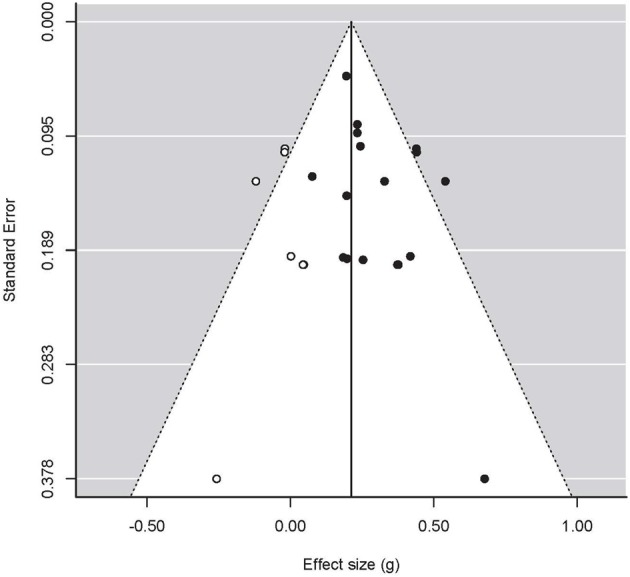
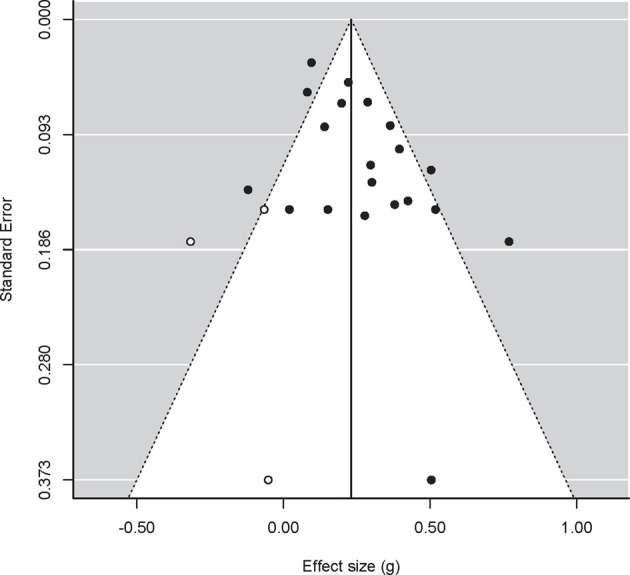
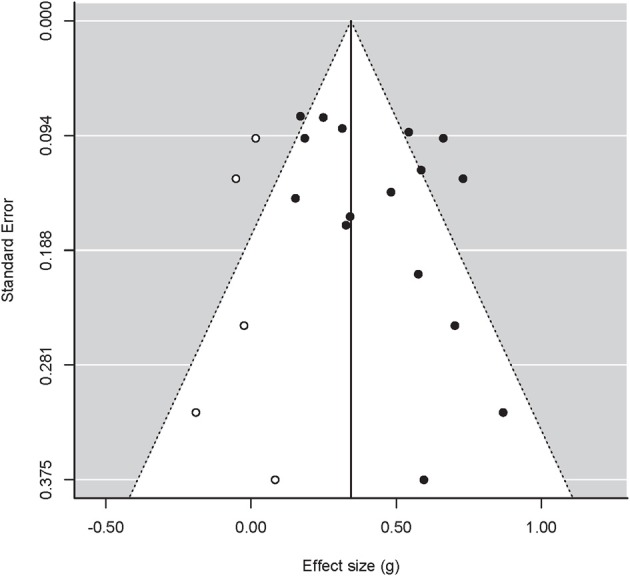
Verification
Claims the paper makes
The claims and statistics of this paper haven’t been checked yet.
Run the check — free, no account needed. It reads the open-access text and checks the sources it cites.
Claims other papers make about this one
Each is checked against this paper’s own text: does it say what the citing paper says it does?
The source backs part of the claim, not all of it — or backs it for a different population, condition or comparison.
In the citing paper
“These explicit instructions were based on meta-analytic findings that explicit instructions in AAT trainings are associated with greater effect sizes than instructions that attempt to conceal the purpose of the training by asking participants to focus on neutral aspects of the stimuli (e.g., push/pull based on the color or shape of the stimuli; Phaf et al., 2014).”
From Evaluating Mechanisms: Mapping Weekly Dynamics between Experiential Avoidance and SAD Symptoms (2021) · cites this paper as Phaf et al., 2014
Experimental — accuracy not yet measured
Self-check
Percentages, sums and reported differences re-computed from the paper’s own numbers.
The self-check needs the paper’s full text.
Citations
Cites
R: A Language and Environment for Statistical Computing
R Core Team (2000) · doi:10.32614/r.manuals · Cited by 355,893
Bias in meta-analysis detected by a simple, graphical test
Egger, M., Smith, G. D., Schneider, M., & Minder, C. (1997) · BMJ · doi:10.1136/bmj.315.7109.629 · Cited by 56,722
Conducting Meta-Analyses in R with the metafor Package
Viechtbauer, W. (2010) · Journal of Statistical Software · doi:10.18637/jss.v036.i03 · Cited by 20,464
Borenstein, M., Hedges, L. V., Higgins, J. P. T., & Rothstein, H. R. (2009) · doi:10.1002/9780470743386 · Cited by 14,225
Duval, S., & Tweedie, R. (2000) · Biometrics · doi:10.1111/j.0006-341x.2000.00455.x · Cited by 14,099
Wasserman, S. S., Hedges, L. V., & Olkin, I. (1988) · Journal of Educational Statistics · doi:10.2307/1164953 · Cited by 10,377
Borenstein, M., Hedges, L. V., Higgins, J. P. T., & Rothstein, H. R. (2021) · doi:10.1002/9781119558378 · Cited by 9,799
Feeling and thinking: Preferences need no inferences.
Zajonc, R. B. (1980) · American Psychologist · doi:10.1037/0003-066x.35.2.151 · Cited by 8,094
Statistical Methods for Meta-Analysis.
Freeman, P. R., Hedges, L. V., & Olkin, I. (1986) · Biometrics · doi:10.2307/2531069 · Cited by 4,840
Fears, phobias, and preparedness: toward an evolved module of fear and fear learning
Öhman, A., & Mineka, S. (2001) · Psychological Review · doi:10.1037/0033-295x.108.3.483 · Cited by 3,147
Research works printed but not linked: 1
- Frijda, 1986, The Emotions
Cited by
Sorted by citations
Affective–Reflective Theory of physical inactivity and exercise
Brand, R., & Panteleimon Ekkekakis, A. (2017) · German Journal of Exercise and Sport Research · doi:10.1007/s12662-017-0477-9 · Cited by 639
The challenge of abstract concepts.
Borghi, A. M., Binkofski, F., Castelfranchi, C., Cimatti, F., Scorolli, C., & Tummolini, L. (2017) · Psychological Bulletin · doi:10.1037/bul0000089 · Cited by 542
Pittig, A., Treanor, M., LeBeau, R. T., & Craske, M. G. (2018) · Neuroscience & Biobehavioral Reviews · doi:10.1016/j.neubiorev.2018.03.015 · Cited by 317
Loijen, A., Vrijsen, J. N., Egger, J. I. M., Becker, E. S., & Rinck, M. (2020) · Clinical Psychology Review · doi:10.1016/j.cpr.2020.101825 · Cited by 135
Pathways towards the proliferation of avoidance in anxiety and implications for treatment
Arnaudova, I., Kindt, M., Fanselow, M. S., & Beckers, T. (2017) · Behaviour Research and Therapy · doi:10.1016/j.brat.2017.04.004 · Cited by 134
Testosterone biases the amygdala toward social threat approach
Radke, S., Volman, I., Mehta, P., van Son, V., Enter, D., Sanfey, A., Toni, I., de Bruijn, E. R. A., & Roelofs, K. (2015) · Science Advances · doi:10.1126/sciadv.1400074 · Cited by 112
Dynamic grounding of emotion concepts
Winkielman, P., Seana Coulson, A., & Niedenthal, P. M. (2018) · Philosophical Transactions of the Royal Society B Biological Sciences · doi:10.1098/rstb.2017.0127 · Cited by 103
Grounding Abstractness: Abstract Concepts and the Activation of the Mouth
Borghi, A. M., & Zarcone, E. (2016) · Frontiers in Psychology · doi:10.3389/fpsyg.2016.01498 · Cited by 88
Rougier, M., Müller, D., Ric, F., Alexopoulos, T., Batailler, C., Smeding, A., & Aubé, B. (2017) · Journal of Experimental Social Psychology · doi:10.1016/j.jesp.2017.12.004 · Cited by 97
Theoretical Approaches to Emotion and Its Measurement
Coppin, G., & Sander, D. (2016) · Elsevier eBooks · doi:10.1016/b978-0-08-100508-8.00001-1 · Cited by 92
Approach and avoidance tendencies in depression and anxiety disorders
Struijs, S. Y., Lamers, F., Vroling, M. S., Roelofs, K., Spinhoven, P., & Penninx, B. W. J. H. (2017) · Psychiatry Research · doi:10.1016/j.psychres.2017.07.010 · Cited by 81
Lender, A., Meule, A., Rinck, M., Brockmeyer, T., & Jens Blechert, A. (2018) · Appetite · doi:10.1016/j.appet.2018.01.032 · Cited by 72
Snagowski, J., & Brand, M. (2015) · Frontiers in Psychology · doi:10.3389/fpsyg.2015.00653 · Cited by 69
Laham, S. M., Kashima, Y., Dix, J., & Wheeler, M. A. (2014) · Cognition & Emotion · doi:10.1080/02699931.2014.968096 · Cited by 78
Oxytocin reduces amygdala responses during threat approach
Radke, S., Volman, I., Kokal, I., Roelofs, K., de Bruijn, E. R. A., & Toni, I. (2017) · Psychoneuroendocrinology · doi:10.1016/j.psyneuen.2017.02.028 · Cited by 67
Lange, B., & Pauli, P. (2019) · PLoS ONE · doi:10.1371/journal.pone.0226805 · Cited by 72
Winkielman, P., & Gogolushko, Y. (2018) · Frontiers in Psychology · doi:10.3389/fpsyg.2017.02261 · Cited by 69
An Emotional Call to Action: Integrating Affective Neuroscience in Models of Motor Control
Blakemore, R. L., & Vuilleumier, P. O. (2017) · Emotion Review · doi:10.1177/1754073916670020 · Cited by 59
Struijs, S. Y., Lamers, F., Rinck, M., Roelofs, K., Spinhoven, P., & Penninx, B. W. J. H. (2018) · Depression and Anxiety · doi:10.1002/da.22760 · Cited by 74
Interactions between emotion and action in the brain
Portugal, L. C. L., Alves, R. D. C. S., Fernandes, O., Sanchez, T. A., Mocaiber, I., Volchan, E., Erthal, F. S., David, I. A., Kim, J., Oliveira, L., et al. (2020) · NeuroImage · doi:10.1016/j.neuroimage.2020.116728 · Cited by 67
Paulus, A., & Wentura, D. (2015) · Journal of Experimental Psychology Human Perception & Performance · doi:10.1037/xhp0000130 · Cited by 63
A mobile approach-avoidance task
Zech, H., Rotteveel, M., DIJK, W. W. V., & van Dillen, L. F. (2020) · Behavior Research Methods · doi:10.3758/s13428-020-01379-3 · Cited by 56
Self-citationOn the Control of Social Approach–Avoidance Behavior: Neural and Endocrine Mechanisms
Kaldewaij, R., Koch, S. B. J., Volman, I., Toni, I., & Roelofs, K. (2016) · Current topics in behavioral neurosciences · doi:10.1007/7854_2016_446 · Cited by 60
Janelle, C. M., Fawver, B. J., & Beatty, G. F. (2020) · Wiley eBooks · doi:10.1002/9781119568124.ch13 · Cited by 52
Bramson, B., Meijer, S. W., van Nuland, A. J. M., Toni, I., & Roelofs, K. (2023) · Nature Communications · doi:10.1038/s41467-023-40666-3 · Cited by 52
Fricke, K., & Vogel, S. (2020) · Neuroscience & Biobehavioral Reviews · doi:10.1016/j.neubiorev.2020.01.008 · Cited by 58
Gollan, J. K., Hoxha, D., Hunnicutt‐Ferguson, K., Norris, C. J., Rosebrock, L. E., Sankin, L. S., & Cacioppo, J. T. (2015) · Journal of Behavior Therapy and Experimental Psychiatry · doi:10.1016/j.jbtep.2015.09.005 · Cited by 55
Meule, A., Lender, A., Richard, A., Dinic, R., & Jens Blechert, A. (2019) · Appetite · doi:10.1016/j.appet.2019.03.002 · Cited by 45
Paslakis, G., Kühn, S., Grunert, S., & Erim, Y. (2017) · Nutrients · doi:10.3390/nu9101068 · Cited by 45
Rahn, G., Martiny, S. E., & Nikitin, J. (2020) · Work Aging and Retirement · doi:10.1093/workar/waaa005 · Cited by 56
Mechanisms underlying effects of approach-avoidance training on stimulus evaluation.
Dessel, P. V., Eder, A. B., & Hughes, S. (2018) · Journal of Experimental Psychology Learning Memory and Cognition · doi:10.1037/xlm0000514 · Cited by 43
How absent negativity relates to affect and motivation: an integrative relief model
Deutsch, R., Smith, K., Kordts-Freudinger, R., & Reichardt, R. (2015) · Frontiers in Psychology · doi:10.3389/fpsyg.2015.00152 · Cited by 51
Smith, L. K., & Wissel, E. F. (2019) · Perspectives on Psychological Science · doi:10.1177/1745691618809379 · Cited by 46
Cadet, L. B., Reynaud, E., & Chainay, H. (2021) · Virtual Reality · doi:10.1007/s10055-021-00537-y · Cited by 38
Avoidance of learnt fear: Models, potential mechanisms, and future directions
Wong, A. H. K., Wirth, F. M., & Pittig, A. (2022) · Behaviour Research and Therapy · doi:10.1016/j.brat.2022.104056 · Cited by 43
Measuring approach–avoidance tendencies towards food with touchscreen-based arm movements
Meule, A., Richard, A., Lender, A., Dinic, R., Brockmeyer, T., Rinck, M., & Jens Blechert, A. (2019) · Psychological Research · doi:10.1007/s00426-019-01195-1 · Cited by 41
The online-VAAST: A short and online tool to measure spontaneous approach and avoidance tendencies
Aubé, B., Rougier, M., Müller, D., Ric, F., & Yzerbyt, V. Y. (2019) · Acta Psychologica · doi:10.1016/j.actpsy.2019.102942 · Cited by 53
Food approach bias is moderated by the desire to eat specific foods
Kahveci, S., Meule, A., Lender, A., & Jens Blechert, A. (2020) · Appetite · doi:10.1016/j.appet.2020.104758 · Cited by 41
Improving emotional-action control by targeting long-range phase-amplitude neuronal coupling
Bramson, B., den Ouden, H. E. M., Toni, I., & Roelofs, K. (2020) · eLife · doi:10.7554/elife.59600 · Cited by 43
Keijsers, M., Vega-Corredor, M. C., Tomintz, M. N., & Hoermann, S. (2021) · Journal of Medical Internet Research · doi:10.2196/24307 · Cited by 58
Kozlik, J., Neumann, R., & Lozo, L. (2015) · Frontiers in Psychology · doi:10.3389/fpsyg.2015.00563 · Cited by 39
Personal distress and the influence of bystanders on responding to an emergency
Hortensius, R., Schutter, D. J. L. G., & de Gelder, B. (2016) · Cognitive Affective & Behavioral Neuroscience · doi:10.3758/s13415-016-0423-6 · Cited by 41
The Motivational Power of the Happy Face
Nikitin, J., & Freund, A. M. (2019) · Brain Sciences · doi:10.3390/brainsci9010006 · Cited by 38
Rotteveel, M., Gierholz, A., Koch, G., van Aalst, C., Pinto, Y., Matzke, D., Steingroever, H., Verhagen, J., Beek, T. F., Selker, R., et al. (2015) · Frontiers in Psychology · doi:10.3389/fpsyg.2015.00335 · Cited by 41
Self-citationStark, R., Kruse, O., Snagowski, J., Brand, M., Walter, B., Klucken, T., & Wehrum-Osinsky, S. (2017) · Sexual Addiction & Compulsivity · doi:10.1080/10720162.2017.1329042 · Cited by 36
Positive valence reduces susceptibility to return of fear and enhances approach behavior
Dour, H. J., Brown, L. A., & Craske, M. G. (2015) · Journal of Behavior Therapy and Experimental Psychiatry · doi:10.1016/j.jbtep.2015.09.010 · Cited by 36
Li, Y., Chao, M., & Shih, C. (2017) · International Emergency Nursing · doi:10.1016/j.ienj.2017.09.004 · Cited by 35
Moors, A., Fini, C., Everaert, T., Bardi, L., Bossuyt, E., Kuppens, P., & Braß, M. (2019) · PLoS ONE · doi:10.1371/journal.pone.0217266 · Cited by 34
Topolinski, S., Boecker, L., Erle, T. M., Bakhtiari, G., & Pecher, D. (2015) · Cognition & Emotion · doi:10.1080/02699931.2015.1073692 · Cited by 35
Klein, R. J., Jacobson, N. C., & Robinson, M. D. (2022) · Emotion · doi:10.1037/emo0001159 · Cited by 32
Li, C., Yan, Y., Cheng, J., Xiao, G., Gu, J., Zhang, L., Yuan, S., Wang, J., Shen, Y., & Zhou, Y. (2016) · Neuroscience Bulletin · doi:10.1007/s12264-016-0015-z · Cited by 33
Leisterer, S., & Paschold, E. (2022) · Frontiers in Psychology · doi:10.3389/fpsyg.2022.1015362 · Cited by 37
Compared to self-immersion, mindful attention reduces salivation and automatic food bias
Baquedano, C., Vergara, R. C., López, V., Fabar, C., Cosmelli, D. J., & Antoine Lutz, A. (2017) · Scientific Reports · doi:10.1038/s41598-017-13662-z · Cited by 37
Kahveci, S., van Alebeek, H., Berking, M., & Jens Blechert, A. (2021) · Appetite · doi:10.1016/j.appet.2021.105190 · Cited by 30
Psychopathy and the Regulation of Interpersonal Distance
Welsch, R., Hecht, H., & von Castell, C. (2018) · Clinical Psychological Science · doi:10.1177/2167702618788874 · Cited by 29
Neural correlates of reward-related response tendencies in an equiprobable Go/NoGo task
Asci, O., Braem, S., Park, H. R. P., Boehler, C. N., & Krebs, R. M. (2019) · Cognitive Affective & Behavioral Neuroscience · doi:10.3758/s13415-019-00692-5 · Cited by 27
Interpersonal Distance Regulation and Approach-Avoidance Reactions Are Altered in Psychopathy
Welsch, R., von Castell, C., & Hecht, H. (2019) · Clinical Psychological Science · doi:10.1177/2167702619869336 · Cited by 27
Theoretical approaches to emotion and its measurement
Coppin, G., & Sander, D. (2021) · Elsevier eBooks · doi:10.1016/b978-0-12-821124-3.00001-6 · Cited by 38
Fearing shades of grey: individual differences in fear responding towards generalisation stimuli
Arnaudova, I., Krypotos, A., Effting, M., Kindt, M., & Beckers, T. (2016) · Cognition & Emotion · doi:10.1080/02699931.2016.1204990 · Cited by 25
Physically attractive faces attract us physically
Kramer, R. S. S., Mulgrew, J., Anderson, N., Vasilyev, D., Kingstone, A. F., Reynolds, M. G., & Ward, R. D. (2020) · Cognition · doi:10.1016/j.cognition.2020.104193 · Cited by 26
Zech, H., Gable, P. A., DIJK, W. W. V., & van Dillen, L. F. (2022) · Behavior Research Methods · doi:10.3758/s13428-022-01920-6 · Cited by 26
Easy moves: Perceptual fluency facilitates approach-related action.
Carr, E. W., Rotteveel, M., & Winkielman, P. (2016) · Emotion · doi:10.1037/emo0000146 · Cited by 26
Self-citationHavenith, M. N., Leidenberger, M., Brasanac, J., Corvacho, M., Figueiredo, I., Schwarz, L., Uthaug, M. V., Rakusa, S., Bernardic, M., Vasquez-Mock, L., et al. (2025) · Communications Psychology · doi:10.1038/s44271-025-00247-0 · Cited by 30
Interactions between incentive valence and action information in a cued approach–avoidance task
Hoofs, V., Carsten, T., Boehler, C. N., & Krebs, R. M. (2018) · Psychological Research · doi:10.1007/s00426-018-0975-x · Cited by 25
Positive emotions and their upregulation increase willingness to consume healthy foods
Schubert, E., & Bode, S. (2022) · Appetite · doi:10.1016/j.appet.2022.106420 · Cited by 27
MDMA-induced indifference to negative sounds is mediated by the 5-HT2A receptor
Kuypers, K. P. C., de la Torre, R., Farré, M., Pizarro, N., Xicota, L., & Ramaekers, J. G. (2017) · Psychopharmacology · doi:10.1007/s00213-017-4699-1 · Cited by 26
Panagiotidis, D., Clemens, B., Habel, U., Schneider, F. W., Schneider, I., Wagels, L., & Votinov, M. (2017) · European Neuropsychopharmacology · doi:10.1016/j.euroneuro.2017.07.006 · Cited by 24
Simons, J. S., Maisto, S. A., Wray, T. B., & Emery, N. N. (2015) · Archives of Sexual Behavior · doi:10.1007/s10508-014-0477-x · Cited by 26
Looking into your eyes: observed pupil size influences approach-avoidance responses
Brambilla, M., Biella, M., & Kret, M. E. (2018) · Cognition & Emotion · doi:10.1080/02699931.2018.1472554 · Cited by 29
The role of psychopathic traits, social anxiety and cortisol in social approach avoidance tendencies
Dapprich, A. L., Lange, W., von Borries, A. K. L., Volman, I., Figner, B., & Karin Roelofs, A. (2021) · Psychoneuroendocrinology · doi:10.1016/j.psyneuen.2021.105207 · Cited by 27
Xia, X., Wang, D., Song, Y., Zhu, M., Li, Y., Chen, R., & Zhang, J. (2020) · NeuroImage · doi:10.1016/j.neuroimage.2020.117485 · Cited by 20
Fridland, E., & Wiers, C. E. (2017) · Phenomenology and the Cognitive Sciences · doi:10.1007/s11097-017-9508-0 · Cited by 21
Lebert, A., Vergilino‐Perez, D., & Chaby, L. (2024) · PLoS ONE · doi:10.1371/journal.pone.0298069 · Cited by 21
Carli, P. D., Riem, M. M. E., & Parolin, L. A. L. (2017) · Infant Behavior and Development · doi:10.1016/j.infbeh.2017.08.005 · Cited by 21
Kampmann, I. L., Emmelkamp, P. M. G., & Nexhmedin Morina, B. (2018) · PeerJ · doi:10.7717/peerj.5441 · Cited by 25
Recognising and reacting to angry and happy facial expressions: a diffusion model analysis
Tipples, J. (2018) · Psychological Research · doi:10.1007/s00426-018-1092-6 · Cited by 27
Mindfulness and equanimity moderate approach/avoidance motor responses
Juneau, C., Shankland, R., Knaüper, B., & Dambrun, M. (2021) · Cognition & Emotion · doi:10.1080/02699931.2021.1927674 · Cited by 20
Yamaguchi, M., Chen, J., Mishler, S., & Proctor, R. W. (2017) · Cognition & Emotion · doi:10.1080/02699931.2017.1381073 · Cited by 20
Embodiment of emotion and its situated nature
Carr, E. W., Kever, A., & Winkielman, P. (2018) · Oxford University Press eBooks · doi:10.1093/oxfordhb/9780198735410.013.30 · Cited by 20
Imaginal retraining reduces alcohol craving in problem drinkers: A randomized controlled trial
Moritz, S., Paulus, A. M., Hottenrott, B., Weierstall, R., Gallinat, J., & Kühn, S. (2019) · Journal of Behavior Therapy and Experimental Psychiatry · doi:10.1016/j.jbtep.2019.04.001 · Cited by 20
Wittekind, C. E., Jens Blechert, A., Schiebel, T., Lender, A., Kahveci, S., & Kühn, S. (2021) · Appetite · doi:10.1016/j.appet.2021.105294 · Cited by 19
The allocation of valenced concepts onto 3D space
Marmolejo‐Ramos, F., Tirado, C., Arshamian, E., Velez, J. I., & Arshamian, A. (2017) · Cognition & Emotion · doi:10.1080/02699931.2017.1344121 · Cited by 19
Emotional Response Inhibition Is Greater in Older Than Younger Adults
Waring, J. D., Greif, T. R., & Lenze, E. J. (2019) · Frontiers in Psychology · doi:10.3389/fpsyg.2019.00961 · Cited by 23
Arousal and exposure duration affect forward step initiation
Bouman, D., Stins, J. F., & Beek, P. J. (2015) · Frontiers in Psychology · doi:10.3389/fpsyg.2015.01667 · Cited by 19
Understanding Belief-Behavior Correspondence: Beliefs and Belief-to-Behavior Inferences
Samayoa, J. A. G., & Albarracín, D. (2025) · Psychological Inquiry · doi:10.1080/1047840x.2025.2482343 · Cited by 22
Effects of valence and arousal on implicit approach/ avoidance tendencies: A fMRI study
Ascheid, S., Wessa, M., & Linke, J. O. (2019) · Neuropsychologia · doi:10.1016/j.neuropsychologia.2019.05.028 · Cited by 19
Affective bias in visual working memory is associated with capacity
Xie, W., Li, H., Ying, X., Zhu, S., Fu, R., Zou, Y.-M., & Cui, Y. (2016) · Cognition & Emotion · doi:10.1080/02699931.2016.1223020 · Cited by 19
Radke, S., Kalt, T., Wagels, L., & Derntl, B. (2018) · Frontiers in Behavioral Neuroscience · doi:10.3389/fnbeh.2018.00008 · Cited by 20
Intolerance for approach of ambiguity in social anxiety disorder
Kuckertz, J. M., Strege, M. V., & Amir, N. (2016) · Cognition & Emotion · doi:10.1080/02699931.2016.1145105 · Cited by 22
Desebrock, C., & Spence, C. J. (2021) · Attention Perception & Psychophysics · doi:10.3758/s13414-021-02295-0 · Cited by 17
Scheer, C., Kubowitsch, S., Dendorfer, S., & Jansen, P. (2021) · Frontiers in Psychology · doi:10.3389/fpsyg.2021.511746 · Cited by 16
Touchscreen-based approach-avoidance responses to appetitive and threatening stimuli
van Alebeek, H., Kahveci, S., Rinck, M., & Jens Blechert, A. (2022) · Journal of Behavior Therapy and Experimental Psychiatry · doi:10.1016/j.jbtep.2022.101806 · Cited by 17
How Facial Expressions of Emotion Affect Distance Perception
Kim, N.-G., & Son, H. (2015) · Frontiers in Psychology · doi:10.3389/fpsyg.2015.01825 · Cited by 18
Everyday Beliefs About Emotion Perceptually Derived From Neutral Facial Appearance
Albohn, D. N., & Adams, R. B. (2020) · Frontiers in Psychology · doi:10.3389/fpsyg.2020.00264 · Cited by 16
Wong, A. H. K., & Pittig, A. (2021) · Biological Psychology · doi:10.1016/j.biopsycho.2021.108249 · Cited by 14
Spatial-numerical associations without a motor response? Grip force says ‘Yes’
Miklashevsky, A. A., Fischer, M. H., & Lindemann, O. (2022) · Acta Psychologica · doi:10.1016/j.actpsy.2022.103791 · Cited by 23
The curvature effect: Approach-avoidance tendencies in response to interior design stimuli
Tawil, N., Elias, J., Ascone, L., & Kühn, S. (2023) · Journal of Environmental Psychology · doi:10.1016/j.jenvp.2023.102197 · Cited by 18
Branding with the in–out effect: The impact of consonantal articulation on brand evaluation
Godinho, S., & Garrido, M. V. (2017) · Psychology and Marketing · doi:10.1002/mar.21031 · Cited by 16
Mellentin, A. I., Nielsen, A. S., Ascone, L., Wirtz, J., Samochowiec, J., Kucharska–Mazur, J., Schadow, F., Lebiecka, Z., Skoneczny, T., Mistarz, N., et al. (2020) · BMC Psychiatry · doi:10.1186/s12888-020-02739-1 · Cited by 16
Grab it or not? Measuring avoidance of spiders with touchscreen-based hand movements
Rinck, M., Dapprich, A. L., Lender, A., Kahveci, S., & Jens Blechert, A. (2021) · Journal of Behavior Therapy and Experimental Psychiatry · doi:10.1016/j.jbtep.2021.101670 · Cited by 16
Metadata
- Authors
- Phaf, R. H., Mohr, S. E., Rotteveel, M., & Wicherts, J. M.
- Affiliations
- University of Amsterdam (NL)
- Tilburg University (NL)
- Corresponding author
- Phaf, R. Hans
- Venue
- Frontiers in Psychology
- Publisher
- Frontiers Media SA
- Published
- 2014-05-08
- Volume
- 5
- Pages
- 378-378
- ISSN
- 1664-1078 (ISSN-L)
- PMC
- PMC4021119
- OpenAlex
- W2092608429
- Cited by
- 326
- References
- 80
- Citations by year
- 2026: 22 · 2025: 31 · 2024: 22 · 2023: 37 · 2022: 28 · 2021: 40 · 2020: 38 · 2019: 21 · 2018: 28 · 2017: 23 · 2016: 19 · 2015: 14 · 2014: 2
- FWCI
- 1.82
- Type
- journal article
- Language
- en
- Open access
- gold
- doi.org
- Licence
- cc-by
- Locations
- Frontiers in Psychology (publishedVersion, cc-by)
- Europe PMC (PubMed Central) (publishedVersion, cc-by)
- PubMed Central (publishedVersion, cc-by)
- Research portal (Tilburg University) (publishedVersion, other-oa)
- PubMed (publishedVersion)
- UvA-DARE (University of Amsterdam) (submittedVersion, cc-by)
- Data Archiving and Networked Services (DANS) (submittedVersion, other-oa)
- DOAJ (DOAJ: Directory of Open Access Journals) (submittedVersion, cc-by-sa)
- Topics
- Life Sciences › Neuroscience › Cognitive Neuroscience › Neural and Behavioral Psychology Studies
- Social Sciences › Sociology and Political Science › Social and Intergroup Psychology
- Social Sciences › Psychology › Experimental and Cognitive Psychology › Anxiety, Depression, Psychometrics, Treatment, Cognitive Processes
- Keywords
- approach-avoidance tendencies, emotional valence, positive and negative stimuli, manual reaction time, implicit evaluation, explicit evaluation, automaticity, affective priming
About these checks
Registry, retraction, Cites and statistics results are computed, not judged, with one exception: a printed reference that no index lists is read once by a model before it counts as a citation error. Claims are extracted by a model and kept only when their quote appears verbatim in the text; each cited source is then checked, with a model’s help, for whether it says what the claim relies on. Those verdicts can be wrong — read the claim’s quote and the cited source before relying on one.
Statistics and arithmetic are recomputed, not judged.
Confidence bands are shown only for fields calibrated on our annotated test set. None is calibrated yet, so no band is shown.
What counts as a claim ›How we measure confidence ›How we check this ›
Are you an author, or do you see a problem with this page? Request a review
