

The DOI matches its Crossref record; 81 of the 81 references it cites were found in a registry or an index.
Approach, avoidance, and affect: a meta-analysis of approach-avoidance tendencies in manual reaction time tasks
Open accessAbstract
Approach action tendencies toward positive stimuli and avoidance tendencies from negative stimuli are widely seen to foster survival. Many studies have shown that approach and avoidance arm movements are facilitated by positive and negative affect, respectively. There is considerable debate whether positively and negatively valenced stimuli prime approach and avoidance movements directly (i.e., immediate, unintentional, implicit, automatic, and stimulus-based), or indirectly (i.e., after conscious or non-conscious interpretation of the situation). The direction and size of these effects were often found to depend on the instructions referring to the stimulus object or the self, and on explicit vs. implicit stimulus evaluation. We present a meta-analysis of 29 studies included for their use of strongly positive and negative stimuli, with 81 effect sizes derived solely from the means and standard deviations (combined N = 1538), to examine the automaticity of the link between affective information processing and approach and avoidance, and to test whether it depends on instruction, type of approach-avoidance task, and stimulus type. Results show a significant small to medium-sized effect after correction for publication bias. The strongest arguments for an indirect link between affect and approach-avoidance were the absence of evidence for an effect with implicit evaluation, and the opposite directions of the effect with self and object-related interpretations. The link appears to be influenced by conscious or non-conscious intentions to deal with affective stimuli.
Overview
The claims and statistics of this paper haven’t been checked yet.
Run the check — free, no account needed. It reads the open-access text and checks the sources it cites.
Integrity signals
Registry
Cites
Statistics
Figures
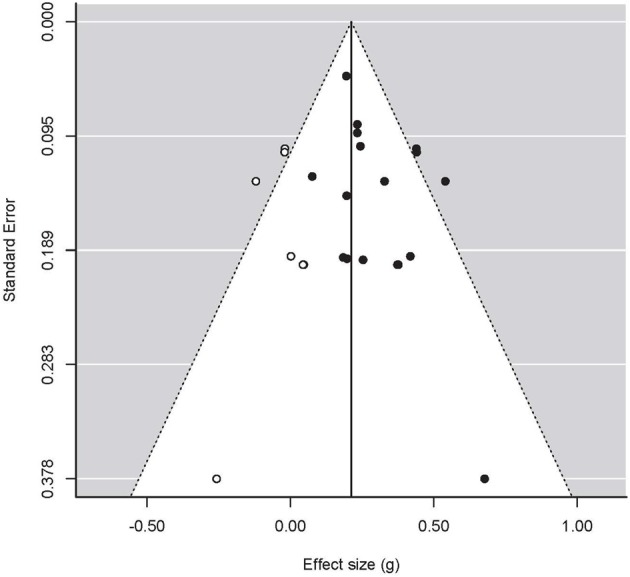
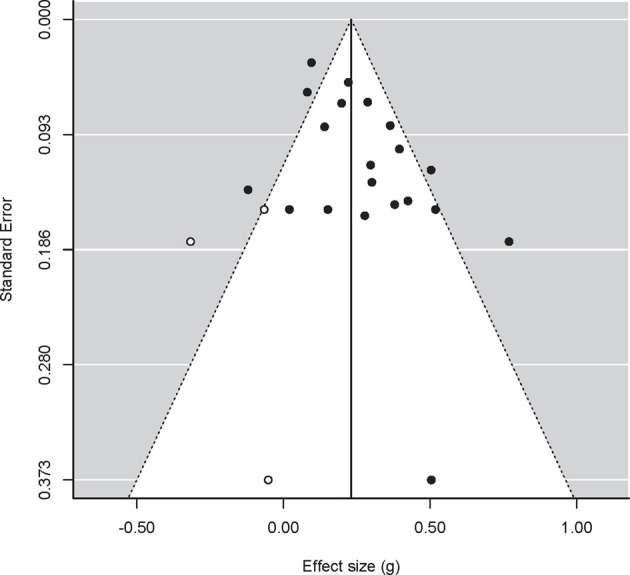
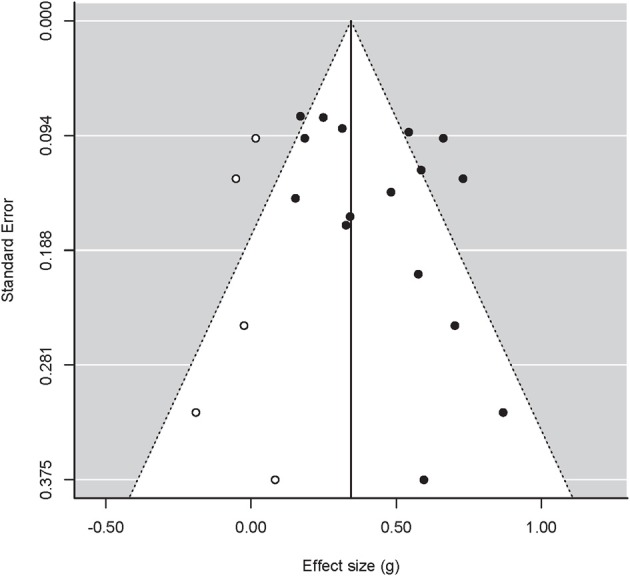
Verification
Claims the paper makes
The claims and statistics of this paper haven’t been checked yet.
Run the check — free, no account needed. It reads the open-access text and checks the sources it cites.
Claims other papers make about this one
Each is checked against this paper’s own text: does it say what the citing paper says it does?
The source backs part of the claim, not all of it — or backs it for a different population, condition or comparison.
In the citing paper
“These explicit instructions were based on meta-analytic findings that explicit instructions in AAT trainings are associated with greater effect sizes than instructions that attempt to conceal the purpose of the training by asking participants to focus on neutral aspects of the stimuli (e.g., push/pull based on the color or shape of the stimuli; Phaf et al., 2014).”
From Evaluating Mechanisms: Mapping Weekly Dynamics between Experiential Avoidance and SAD Symptoms (2021) · cites this paper as Phaf et al., 2014
Experimental — accuracy not yet measured
Self-check
Percentages, sums and reported differences re-computed from the paper’s own numbers.
The self-check needs the paper’s full text.
Citations
Cites
R: A Language and Environment for Statistical Computing
R Core Team (2000) · doi:10.32614/r.manuals · Cited by 355,893
Bias in meta-analysis detected by a simple, graphical test
Egger, M., Smith, G. D., Schneider, M., & Minder, C. (1997) · BMJ · doi:10.1136/bmj.315.7109.629 · Cited by 56,722
Conducting Meta-Analyses in R with the metafor Package
Viechtbauer, W. (2010) · Journal of Statistical Software · doi:10.18637/jss.v036.i03 · Cited by 20,464
Borenstein, M., Hedges, L. V., Higgins, J. P. T., & Rothstein, H. R. (2009) · doi:10.1002/9780470743386 · Cited by 14,225
Duval, S., & Tweedie, R. (2000) · Biometrics · doi:10.1111/j.0006-341x.2000.00455.x · Cited by 14,099
Wasserman, S. S., Hedges, L. V., & Olkin, I. (1988) · Journal of Educational Statistics · doi:10.2307/1164953 · Cited by 10,377
Borenstein, M., Hedges, L. V., Higgins, J. P. T., & Rothstein, H. R. (2021) · doi:10.1002/9781119558378 · Cited by 9,799
Feeling and thinking: Preferences need no inferences.
Zajonc, R. B. (1980) · American Psychologist · doi:10.1037/0003-066x.35.2.151 · Cited by 8,094
Statistical Methods for Meta-Analysis.
Freeman, P. R., Hedges, L. V., & Olkin, I. (1986) · Biometrics · doi:10.2307/2531069 · Cited by 4,840
Fears, phobias, and preparedness: toward an evolved module of fear and fear learning
Öhman, A., & Mineka, S. (2001) · Psychological Review · doi:10.1037/0033-295x.108.3.483 · Cited by 3,147
International Affective Picture System (IAPS) : Technical Manual and Affective Ratings
Lang, P. J. (1995) · Medical Entomology and Zoology · Cited by 2,870
Publication Bias in Meta‐Analysis: Prevention, Assessment and Adjustments
(2005) · doi:10.1002/0470870168 · Cited by 2,368
Emotion, attention, and the startle reflex
Lang, P. J., Bradley, M. M., & Cuthbert, B. N. (1990) · Psychological Review · doi:10.1037/0033-295x.97.3.377 · Cited by 2,205
Anger is an approach-related affect: Evidence and implications.
Carver, C. S., & Harmon‐Jones, E. (2009) · Psychological Bulletin · doi:10.1037/a0013965 · Cited by 1,862
Meta-analysis of experiments with matched groups or repeated measures designs
Dunlap, W. P., Cortina, J. M., Vaslow, J. B., & Burke, M. J. (1996) · Psychological Methods · doi:10.1037/1082-989x.1.2.170 · Cited by 1,693
Chen, M., & Bargh, J. A. (1999) · Personality and Social Psychology Bulletin · doi:10.1177/0146167299025002007 · Cited by 1,473
Wiers, R. W., Eberl, C., Rinck, M., Becker, E. S., & Lindenmeyer, J. (2011) · Psychological Science · doi:10.1177/0956797611400615 · Cited by 912
Cacioppo, J. T., Priester, J. R., & Berntson, G. G. (1993) · Journal of Personality and Social Psychology · doi:10.1037/0022-3514.65.1.5 · Cited by 871
Regression Methods to Detect Publication and Other Bias in Meta‐Analysis
Sterne, J. A. C., & Egger, M. (2005) · Publication Bias in Meta‐Analysis · doi:10.1002/0470870168.ch6 · Cited by 826
The rules of the game called psychological science
Bakker, M., van Dijk, A., & Wicherts, J. M. (2012) · Perspectives on Psychological Science · doi:10.1177/1745691612459060 · Cited by 800
An exploratory test for an excess of significant findings
Ioannidis, J. P., & Trikalinos, T. A. (2007) · Clinical Trials · doi:10.1177/1740774507079441 · Cited by 751
ÖHman, A. (1986) · Psychophysiology · doi:10.1111/j.1469-8986.1986.tb00608.x · Cited by 738
Approach and avoidance in fear of spiders
Rinck, M., & Becker, E. S. (2006) · Journal of Behavior Therapy and Experimental Psychiatry · doi:10.1016/j.jbtep.2006.10.001 · Cited by 706
Differential attentional guidance by unattended faces expressing positive and negative emotion
Eastwood, J. D., Smilek, D., & Merikle, P. M. (2001) · Perception & Psychophysics · doi:10.3758/bf03194519 · Cited by 607
The effects of fear and anger facial expressions on approach- and avoidance-related behaviors
Marsh, A. A., Ambady, N., & Kleck, R. E. (2005) · Emotion · doi:10.1037/1528-3542.5.1.119 · Cited by 588
Solarz, A. K. (1960) · Journal of Experimental Psychology · doi:10.1037/h0047274 · Cited by 425
The Automatic Evaluation of Novel Stimuli
Duckworth, K. L., Bargh, J. A., Garcia, M., & Chaiken, S. (2002) · Psychological Science · doi:10.1111/1467-9280.00490 · Cited by 404
Self-control in action: Implicit dispositions toward goals and away from temptations.
Fishbach, A., & Shah, J. Y. (2006) · Journal of Personality and Social Psychology · doi:10.1037/0022-3514.90.5.820 · Cited by 403
Avoidance of emotional facial expressions in social anxiety: the approach-avoidance task
Heuer, K., Rinck, M., & Becker, E. S. (2007) · Behaviour Research and Therapy · doi:10.1016/j.brat.2007.08.010 · Cited by 380
Constraining Theories of Embodied Cognition
Markman, A. B., & Brendl, C. M. (2005) · Psychological Science · doi:10.1111/j.0956-7976.2005.00772.x · Cited by 367
The (mis)reporting of statistical results in psychology journals
Bakker, M., & Wicherts, J. M. (2011) · Behavior Research Methods · doi:10.3758/s13428-011-0089-5 · Cited by 356
Self-citationEder, A. B., & Rothermund, K. (2008) · Journal of Experimental Psychology General · doi:10.1037/0096-3445.137.2.262 · Cited by 334
The automaticity of emotional Stroop: A meta-analysis
Phaf, R. H., & Kan, K. (2006) · Journal of Behavior Therapy and Experimental Psychiatry · doi:10.1016/j.jbtep.2006.10.008 · Cited by 273
Self-citationThe Psychology of Replication and Replication in Psychology
Francis, G. (2012) · Perspectives on Psychological Science · doi:10.1177/1745691612459520 · Cited by 249
On the generality of the affective Simon effect
Houwer, J. D., Crombez, G., Baeyens, F., & Hermans, D. (2001) · Cognition & Emotion · doi:10.1080/02699930125883 · Cited by 249
Reichardt, R., & Deutsch, R. (2009) · Cognition & Emotion · doi:10.1080/02699930903047298 · Cited by 247
Roelofs, K., van Peer, J., Berretty, E., Jong, P. D., Spinhoven, P., & Elzinga, B. M. (2009) · Biological Psychiatry · doi:10.1016/j.biopsych.2008.08.022 · Cited by 236
On the generality of the affective Simon effect
Houwer, J. D., Crombez, G., Baeyens, F., & Hermans, D. (2001) · Cognition & Emotion · doi:10.1080/0269993004200051 · Cited by 235
Automatic affective evaluation does not automatically predispose for arm flexion and extension
Rotteveel, M., & Phaf, R. H. (2004) · Emotion · doi:10.1037/1528-3542.4.2.156 · Cited by 232
Self-citationThe impact of facial emotional expressions on behavioral tendencies in women and men
Seidel, E.-M., Habel, U., Kirschner, M., Gur, R. C., & Derntl, B. (2010) · Journal of Experimental Psychology: Human Perception and Performance · doi:10.1037/a0018169 · Cited by 197
Endogenous Testosterone Modulates Prefrontal-Amygdala Connectivity during Social Emotional Behavior
Volman, I., Toni, I., Verhagen, L., & Roelofs, K. (2011) · Cerebral Cortex · doi:10.1093/cercor/bhr001 · Cited by 195
Movement direction or change in distance? Self- and object-related approach–avoidance motions
Seibt, B., Neumann, R., Nussinson, R., & Strack, F. (2007) · Journal of Experimental Social Psychology · doi:10.1016/j.jesp.2007.04.013 · Cited by 192
Anterior Prefrontal Cortex Inhibition Impairs Control over Social Emotional Actions
Volman, I., Roelofs, K., Koch, S. B. J., Verhagen, L., & Toni, I. (2011) · Current Biology · doi:10.1016/j.cub.2011.08.050 · Cited by 160
Affect and action: Towards an event-coding account
Lavender, T., & Hommel, B. (2007) · Cognition & Emotion · doi:10.1080/02699930701438152 · Cited by 156
Stins, J. F., Karin Roelofs, A., Villan, J., Kooijman, K., Hagenaars, M. A., & Beek, P. J. (2011) · Experimental Brain Research · doi:10.1007/s00221-011-2767-z · Cited by 152
The origin and function of pleasure
Johnston, V. S. (2003) · Cognition & Emotion · doi:10.1080/02699930302290 · Cited by 147
On the neural control of social emotional behavior
Karin Roelofs, A., Minelli, A., Mars, R. B., van Peer, J. M., & Toni, I. (2008) · Social Cognitive and Affective Neuroscience · doi:10.1093/scan/nsn036 · Cited by 145
The effects of stress-induced cortisol responses on approach–avoidance behavior
Roelofs, K., Elzinga, B. M., & Rotteveel, M. (2005) · Psychoneuroendocrinology · doi:10.1016/j.psyneuen.2005.02.008 · Cited by 130
Self-citationBring it on: Angry facial expressions potentiate approach-motivated motor behavior.
Wilkowski, B. M., & Meier, B. P. (2010) · Journal of Personality and Social Psychology · doi:10.1037/a0017992 · Cited by 125
Approach and avoidance as action effects
van Dantzig, S., Pecher, D., & Zwaan, R. A. (2008) · Quarterly Journal of Experimental Psychology · doi:10.1080/17470210802027987 · Cited by 122
Do Approach-Avoidance Actions Create Attitudes?
Centerbar, D. B., & Clore, G. L. (2005) · Psychological Science · doi:10.1111/j.1467-9280.2005.01660.x · Cited by 120
Stronger suboptimal than optimal affective priming?
Rotteveel, M., de Groot, P., Geutskens, A., & Phaf, R. H. (2001) · Emotion · doi:10.1037/1528-3542.1.4.348 · Cited by 112
Self-citationMaxwell, J. S., & Davidson, R. J. (2007) · Psychological Science · doi:10.1111/j.1467-9280.2007.02033.x · Cited by 102
Implicit and explicit behavioral tendencies in male and female depression
Seidel, E., Habel, U., Finkelmeyer, A. E., Schneider, F. W., Gur, R. C., & Derntl, B. (2010) · Psychiatry Research · doi:10.1016/j.psychres.2010.02.001 · Cited by 96
van Peer, J. M., Roelofs, K., Rotteveel, M., van Dijk, J. G., Spinhoven, P., & Ridderinkhof, K. R. (2007) · Biological Psychology · doi:10.1016/j.biopsycho.2007.07.003 · Cited by 89
Self-citationSocial anxiety and evaluation of social crowds: Explicit and implicit measures
Lange, W., Keijsers, G. P. J., Becker, E. S., & Rinck, M. (2008) · Behaviour Research and Therapy · doi:10.1016/j.brat.2008.04.008 · Cited by 85
Automatic avoidance tendencies in patients with Psychogenic Non Epileptic Seizures
Bakvis, P., Spinhoven, P., Zitman, F. G., & Karin Roelofs, A. (2011) · Seizure · doi:10.1016/j.seizure.2011.06.006 · Cited by 83
Predispositions to approach and avoid are contextually sensitive and goal dependent.
Bamford, S., & Ward, R. D. (2008) · Emotion · doi:10.1037/1528-3542.8.2.174 · Cited by 79
On the Automatic Evaluation of Social Exemplars.
Castelli, L., Zogmaister, C., Smith, E. R., & Arcuri, L. (2004) · Journal of Personality and Social Psychology · doi:10.1037/0022-3514.86.3.373 · Cited by 72
The evaluation-behavior link: Direct and beyond valence
Alexopoulos, T., & Ric, F. (2007) · Journal of Experimental Social Psychology · doi:10.1016/j.jesp.2006.10.017 · Cited by 69
Unconstraining theories of embodied cognition
van Dantzig, S., Zeelenberg, R., & Pecher, D. (2008) · Journal of Experimental Social Psychology · doi:10.1016/j.jesp.2008.11.001 · Cited by 54
Approach Does Not Equal Approach
Reichardt, R., & Deutsch, R. (2013) · Social Psychological and Personality Science · doi:10.1177/1948550612471060 · Cited by 54
Paulus, A., & Wentura, D. (2013) · Cognition & Emotion · doi:10.1080/02699931.2013.849659 · Cited by 53
Najmi, S., Kuckertz, J. M., & Amir, N. (2010) · Behaviour Research and Therapy · doi:10.1016/j.brat.2010.06.007 · Cited by 47
Control of impulsive emotional behaviour through implementation intentions
Eder, A. B. (2010) · Cognition & Emotion · doi:10.1080/02699931.2010.527493 · Cited by 44
Dopamine transporter polymorphisms affect social approach–avoidance tendencies
Enter, D., Colzato, L. S., & Roelofs, K. (2012) · Genes Brain & Behavior · doi:10.1111/j.1601-183x.2012.00791.x · Cited by 43
Önal-Hartmann, C., Pauli, P., Ocklenburg, S., & Güntürkün, O. (2011) · Psychological Research · doi:10.1007/s00426-011-0337-4 · Cited by 35
Affective Monitoring: A Generic Mechanism for Affect Elicitation
Phaf, R. H., & Rotteveel, M. (2012) · Frontiers in Psychology · doi:10.3389/fpsyg.2012.00047 · Cited by 32
Self-citationEder, A. B., Rothermund, K., & Proctor, R. W. (2010) · Emotion · doi:10.1037/a0019009 · Cited by 31
Emotional valence and contextual affordances flexibly shape approach-avoidance movements
Saraiva, A. C., Schüür, F., & Bestmann, S. (2013) · Frontiers in Psychology · doi:10.3389/fpsyg.2013.00933 · Cited by 31
Reinecke, A., Soltau, C., Hoyer, J., Becker, E. S., & Rinck, M. (2011) · Journal of Anxiety Disorders · doi:10.1016/j.janxdis.2011.12.010 · Cited by 28
A Computational Study into the Evolution of Dual-Route Dynamics for Affective Processing
den Dulk, P., Heerebout, B. T., & Phaf, R. H. (2003) · Journal of Cognitive Neuroscience · doi:10.1162/089892903321208132 · Cited by 22
Self-citationZhang, Y., Proctor, R. W., & Wegener, D. T. (2012) · Journal of Experimental Social Psychology · doi:10.1016/j.jesp.2012.01.004 · Cited by 21
Approaching the familiar: On the ability of mere exposure to direct approach and avoidance behavior
Jones, I. F., Young, S. G., & Claypool, H. M. (2011) · Motivation and Emotion · doi:10.1007/s11031-011-9228-7 · Cited by 19
Looking at the bright side: The affective monitoring of direction.
Phaf, R. H., & Rotteveel, M. (2009) · Emotion · doi:10.1037/a0016308 · Cited by 19
Self-citationProctor, R. W., & Zhang, Y. (2009) · Journal of Experimental Social Psychology · doi:10.1016/j.jesp.2009.10.010 · Cited by 17
Heerebout, B. T., & Phaf, R. H. (2010) · Cognitive Affective & Behavioral Neuroscience · doi:10.3758/cabn.10.2.217 · Cited by 14
Self-citationEmergent Oscillations in Evolutionary Simulations: Oscillating Networks Increase Switching Efficacy
Heerebout, B. T., & Phaf, R. H. (2009) · Journal of Cognitive Neuroscience · doi:10.1162/jocn.2009.21205 · Cited by 12
Self-citationClow, K. A., & Olson, J. M. (2010) · Canadian Journal of Behavioural Science/Revue canadienne des sciences du comportement · doi:10.1037/a0020010 · Cited by 9
Heerebout, B. T., Phaf, R. H., Dębiec, J., Heller, M. S., Brożek, B., & Ledoux, J. (2014) · UvA-DARE (University of Amsterdam) · Cited by 2
Self-citationGenes, Brain and Behavior: At the vanguard of behavioral and genomic neuroscience
Holmes, A. J. (2012) · Genes Brain & Behavior · doi:10.1111/j.1601-183x.2011.00760.x · Cited by 1
Research works printed but not linked: 1
- Frijda, 1986, The Emotions
Cited by
Sorted by citations
Affective–Reflective Theory of physical inactivity and exercise
Brand, R., & Panteleimon Ekkekakis, A. (2017) · German Journal of Exercise and Sport Research · doi:10.1007/s12662-017-0477-9 · Cited by 639
The challenge of abstract concepts.
Borghi, A. M., Binkofski, F., Castelfranchi, C., Cimatti, F., Scorolli, C., & Tummolini, L. (2017) · Psychological Bulletin · doi:10.1037/bul0000089 · Cited by 542
Pittig, A., Treanor, M., LeBeau, R. T., & Craske, M. G. (2018) · Neuroscience & Biobehavioral Reviews · doi:10.1016/j.neubiorev.2018.03.015 · Cited by 317
Loijen, A., Vrijsen, J. N., Egger, J. I. M., Becker, E. S., & Rinck, M. (2020) · Clinical Psychology Review · doi:10.1016/j.cpr.2020.101825 · Cited by 135
Pathways towards the proliferation of avoidance in anxiety and implications for treatment
Arnaudova, I., Kindt, M., Fanselow, M. S., & Beckers, T. (2017) · Behaviour Research and Therapy · doi:10.1016/j.brat.2017.04.004 · Cited by 134
Metadata
- Authors
- Phaf, R. H., Mohr, S. E., Rotteveel, M., & Wicherts, J. M.
- Affiliations
- University of Amsterdam (NL)
- Tilburg University (NL)
- Corresponding author
- Phaf, R. Hans
- Venue
- Frontiers in Psychology
- Publisher
- Frontiers Media SA
- Published
- 2014-05-08
- Volume
- 5
- Pages
- 378-378
- ISSN
- 1664-1078 (ISSN-L)
- PMC
- PMC4021119
- OpenAlex
- W2092608429
- Cited by
- 326
- References
- 80
- Citations by year
- 2026: 22 · 2025: 31 · 2024: 22 · 2023: 37 · 2022: 28 · 2021: 40 · 2020: 38 · 2019: 21 · 2018: 28 · 2017: 23 · 2016: 19 · 2015: 14 · 2014: 2
- FWCI
- 1.82
- Type
- journal article
- Language
- en
- Open access
- gold
- doi.org
- Licence
- cc-by
- Locations
- Frontiers in Psychology (publishedVersion, cc-by)
- Europe PMC (PubMed Central) (publishedVersion, cc-by)
- PubMed Central (publishedVersion, cc-by)
- Research portal (Tilburg University) (publishedVersion, other-oa)
- PubMed (publishedVersion)
- UvA-DARE (University of Amsterdam) (submittedVersion, cc-by)
- Data Archiving and Networked Services (DANS) (submittedVersion, other-oa)
- DOAJ (DOAJ: Directory of Open Access Journals) (submittedVersion, cc-by-sa)
- Topics
- Life Sciences › Neuroscience › Cognitive Neuroscience › Neural and Behavioral Psychology Studies
- Social Sciences › Sociology and Political Science › Social and Intergroup Psychology
- Social Sciences › Psychology › Experimental and Cognitive Psychology › Anxiety, Depression, Psychometrics, Treatment, Cognitive Processes
- Keywords
- approach-avoidance tendencies, emotional valence, positive and negative stimuli, manual reaction time, implicit evaluation, explicit evaluation, automaticity, affective priming
About these checks
Registry, retraction, Cites and statistics results are computed, not judged, with one exception: a printed reference that no index lists is read once by a model before it counts as a citation error. Claims are extracted by a model and kept only when their quote appears verbatim in the text; each cited source is then checked, with a model’s help, for whether it says what the claim relies on. Those verdicts can be wrong — read the claim’s quote and the cited source before relying on one.
Statistics and arithmetic are recomputed, not judged.
Confidence bands are shown only for fields calibrated on our annotated test set. None is calibrated yet, so no band is shown.
What counts as a claim ›How we measure confidence ›How we check this ›
Are you an author, or do you see a problem with this page? Request a review
