

Developing the Metacognitive Awareness of Grit Scale for a better understanding of learners of English as a foreign language
Open accessThe DOI matches its Crossref record; 78 of the 80 references it cites were found in a registry or an index.
Abstract
The prominent impact of metacognition on learners’ academic achievement is widely discussed. Learners armed with appropriate metacognitive strategies should witness enhancement in learning performance. Similarly, the concept of grit is also valued as a crucial factor contributing to the improvement of academic achievement. Nevertheless, discussion of the relationship between metacognition and grit or their collective influence on other educational and psychological variables is limited, not to mention that an instrument measuring learners’ metacognitive awareness of grit is a desideratum. Hence, by incorporating the constructs of metacognition and grit, the present research developed a measurement scale to address this need, named the Metacognitive Awareness of Grit Scale (MCAGS). The MCAGS consists of four components and initially included 48 items. It was later distributed to 859 participants for the purpose of scale validation. Confirmatory factor analysis was applied to evaluate the scale’s validity and explore the factor-item relationship. A final model containing 17 items was retained. Implications and future directions were discussed.
Overview
The claims and statistics of this paper haven’t been checked yet.
Free: it reads the open-access text and checks the first 5 claims that cite a source we can check. Create a free account to check every claim.
Integrity signals
Registry
Cites
Statistics
Figures
Verification
Claims the paper makes
The claims and statistics of this paper haven’t been checked yet.
Free: it reads the open-access text and checks the first 5 claims that cite a source we can check. Create a free account to check every claim.
Claims other papers make about this one
Each is checked against this paper’s own text: does it say what the citing paper says it does?
The source backs part of the claim, not all of it — or backs it for a different population, condition or comparison.
In the citing paper
“Despite strong empirical evidence that explicit metacognitive instruction improves writing performance (Teng et al., 2022;Wang et al., 2023), novice EFL learners often struggle to apply these strategies independently.”
From Generative AI, visual scaffolds, and metacognition in EFL writing (2026) · cites this paper as Wang et al., 2023
Experimental — accuracy not yet measured
Self-check
Percentages, sums and reported differences re-computed from the paper’s own numbers.
The self-check needs the paper’s full text.
Citations
Cites
Principles and Practice of Structural Equation Modeling
Tabri, N., & Elliott, C. M. (2012) · Canadian Graduate Journal of Sociology and Criminology · doi:10.15353/cgjsc-rcessc.v1i1.25 · Cited by 38,891
Comparative fit indexes in structural models.
Bentler, P. M. (1990) · Psychological Bulletin · doi:10.1037/0033-2909.107.2.238 · Cited by 25,266 · cited 10×
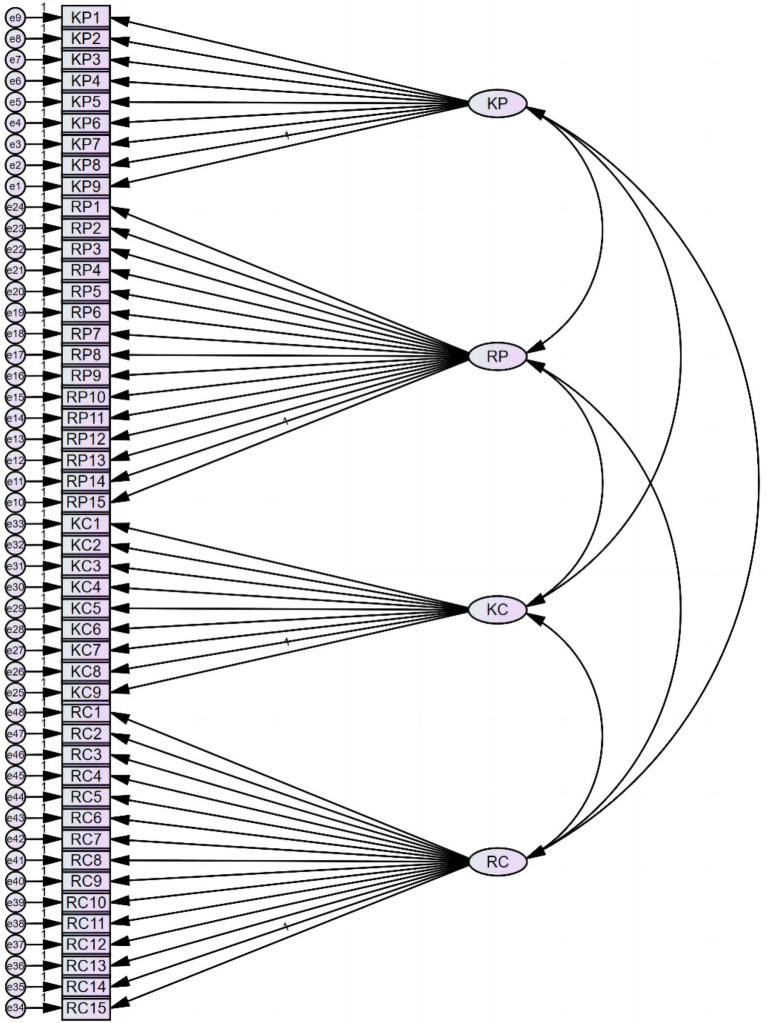
“Indices χ2/df CFI NFI RMSEA SRMR GFI AGFI Model values 4.272 0.885 0.856 0.062* 0.039* 0.791 0.771 Cutoff criteria ≤3.0 ≥0.90 ≥0.90 ≤0.08 ≤0.10 ≥0.90 ≥0.90 *Is a model value that meets the suggested cutoff criteria. χ2 = 4588.619; df = 1,074.”
MethodInfluentialSignificance tests and goodness of fit in the analysis of covariance structures.
Bentler, P. M., & Bonett, D. G. (1980) · Psychological Bulletin · doi:10.1037//0033-2909.88.3.588 · Cited by 19,023
Metacognition and cognitive monitoring: A new area of cognitive–developmental inquiry
Flavell, J. H. (1979) · American Psychologist · doi:10.1037/0003-066x.34.10.906 · Cited by 11,282 · cited 3×
“Working within Flavell’s framework (Flavell, 1979, p. 907), scholars in the EFL learning research realm primarily incorporated metacognition within specific domains or skill areas of EFL learning, for example, reading, writing, listening, speaking, vocabulary, and grammar.”
BackgroundInfluentialGrit: perseverance and passion for long-term goals
Duckworth, A. L., Peterson, C., Matthews, M. D., & Kelly, D. R. (2007) · Journal of Personality and Social Psychology · doi:10.1037/0022-3514.92.6.1087 · Cited by 6,911 · cited 9×
“Nevertheless, the extant empirical research in this domain mostly applied the general metacognitive awareness scales such as the Metacognitive Awareness Inventory (MAI; Schraw and Dennison, 1994) with the Grit-O (Duckworth et al., 2007) or the Grit-S (Duckworth and Quinn, 2009) scale.”
BackgroundInfluentialLanguage Learning Strategies: What Every Teacher Should Know
Horwitz, E. K., & Oxford, R. (1991) · The Modern Language Journal · doi:10.2307/329849 · Cited by 5,941
Development and validation of the short grit scale (grit-s)
Duckworth, A. L., & Quinn, P. D. (2009) · Journal of Personality Assessment · doi:10.1080/00223890802634290 · Cited by 3,376
Assessing Metacognitive Awareness
Schraw, G., & Dennison, R. S. (1994) · Contemporary Educational Psychology · doi:10.1006/ceps.1994.1033 · Cited by 3,199
Handbook of Self-Regulation of Learning and Performance
Schunk, D. H. (2011) · Routledge eBooks · doi:10.4324/9780203839010 · Cited by 2,122
Much ado about grit: A meta-analytic synthesis of the grit literature
Credé, M., Tynan, M. C., & Harms, P. D. (2017) · Journal of Personality and Social Psychology · doi:10.1037/pspp0000102 · Cited by 1,653
Model modifications in covariance structure analysis: The problem of capitalization on chance.
MacCallum, R. C., Roznowski, M., & Necowitz, L. B. (1992) · Psychological Bulletin · doi:10.1037//0033-2909.111.3.490 · Cited by 1,632
Assessing students' metacognitive awareness of reading strategies.
Mokhtari, K., & Reichard, C. A. (2002) · Journal of Educational Psychology · doi:10.1037//0022-0663.94.2.249 · Cited by 1,091
Self-Control and Grit: Related but Separable Determinants of Success
Duckworth, A., & Gross, J. J. (2014) · Current Directions in Psychological Science · doi:10.1177/0963721414541462 · Cited by 1,025 · cited 1×
“Gritty individuals remain committed to their goals and exhibit resistance to the impact of setbacks (Duckworth and Gross, 2014).”
BackgroundPositive Psychology: An Introduction
Seligman, M. E. P., & Csikszentmihalyi, M. (2014) · Flow and the Foundations of Positive Psychology · doi:10.1007/978-94-017-9088-8_18 · Cited by 911
Metacognitive Knowledge and Language Learning1
WENDEN, A. L. (1998) · Applied Linguistics · doi:10.1093/applin/19.4.515 · Cited by 866
Emotions that facilitate language learning: the positive-broadening power of the imagination
MacIntyre, P., & Gregersen, T. (2012) · Studies in Second Language Learning and Teaching · doi:10.14746/ssllt.2012.2.2.4 · Cited by 843 · cited 1×
“Apart from the interplay between metacognition and EFL, scholars have recently drawn inspiration from the research realm of positive psychology and integrated it into the EFL learning research (MacIntyre and Gregersen, 2012; Liu et al., 2022; Zhang et al., 2022).”
BackgroundAccuracy of metacognitive monitoring affects learning of texts.
Thiede, K. W., Anderson, M. C. M., & Therriault, D. (2003) · Journal of Educational Psychology · doi:10.1037//0022-0663.95.1.66 · Cited by 826
Wang, Y., Derakhshan, A., & Zhang, L. J. (2021) · Frontiers in Psychology · doi:10.3389/fpsyg.2021.731721 · Cited by 762 · cited 4×
“TYPE Original Research PUBLISHED 11 April 2023 DOI 10.3389/fpsyg.2023.1141214 Frontiers in Psychology 02 frontiersin.org from the last decade have revealed that positive emotions often play significant and positive roles in EFL learning (e.g., Jiang and Dewaele, 2019; Wang, 2021).”
BackgroundInfluentialSelf-citationGratitude, like other positive emotions, broadens and builds
Fredrickson, B. L. (2004) · The Psychology of Gratitude · doi:10.1093/acprof:oso/9780195150100.003.0008 · Cited by 718
Wolters, C. A., & Hussain, M. (2015) · Metacognition and Learning · doi:10.1007/s11409-014-9128-9 · Cited by 617
How unique is the foreign language classroom enjoyment and anxiety of Chinese EFL learners?
Jiang, Y., & Dewaele, J.-M. (2019) · System · doi:10.1016/j.system.2019.02.017 · Cited by 517
L2 grit: passion and perseverance for second-language learning
Teimouri, Y., Plonsky, L., & Tabandeh, F. (2022) · Language Teaching Research · doi:10.1177/1362168820921895 · Cited by 503
Engaging Language Learners in Contemporary Classrooms
Mercer, S., & Dörnyei, Z. (2020) · doi:10.1017/9781009024563 · Cited by 466
Artz, A. F., & Armour-Thomas, E. (1992) · Cognition and Instruction · doi:10.1207/s1532690xci0902_3 · Cited by 432
Ohtani, K., & Hisasaka, T. (2018) · Metacognition and Learning · doi:10.1007/s11409-018-9183-8 · Cited by 345
Foreign language learning boredom: Conceptualization and measurement
Li, C., Dewaele, J.-M., & Hu, Y. (2023) · Applied Linguistics Review · doi:10.1515/applirev-2020-0124 · Cited by 323
Teng, L. S., & Zhang, L. J. (2020) · Journal of Second Language Writing · doi:10.1016/j.jslw.2019.100701 · Cited by 313
Self-citationAcademic grit scale: psychometric properties and associations with achievement and life satisfaction
Clark, K. N., & Malecki, C. K. (2019) · Journal of School Psychology · doi:10.1016/j.jsp.2018.12.001 · Cited by 290 · cited 1×
“In light of the malleable nature of grit, enhancement through intervention and instruction is possible (Clark and Malecki, 2019).”
BackgroundFostering Metacognition to Support Student Learning and Performance
Stanton, J. D., Sebesta, A. J., & Dunlosky, J. (2021) · CBE—Life Sciences Education · doi:10.1187/cbe.20-12-0289 · Cited by 284 · cited 4×
“Applying metacognitive strategies while learning improves the learning experience and achievements (Stanton et al., 2021).”
BackgroundMethodInfluentialA CLOSER LOOK AT GRIT AND LANGUAGE MINDSET AS PREDICTORS OF FOREIGN LANGUAGE ACHIEVEMENT
Khajavy, G. H., MacIntyre, P. D., & Hariri, J. (2021) · Studies in Second Language Acquisition · doi:10.1017/s0272263120000480 · Cited by 277
A Dynamic Metacognitive Systems Account of Chinese University Students' Knowledge About EFL Reading
ZHANG, L. J. (2010) · TESOL Quarterly · doi:10.5054/tq.2010.223352 · Cited by 200
Self-citationThe impact of metacognitive scaffolding and monitoring on reading comprehension
Dabarera, C., Renandya, W. A., & Zhang, L. J. (2014) · System · doi:10.1016/j.system.2013.12.020 · Cited by 200
Self-citationKhodaei, S., Hasanvand, S., Gholami, M., Mokhayeri, Y., & Amini, M. (2022) · BMC Nursing · doi:10.1186/s12912-022-00804-6 · Cited by 182
Assessing the Size of Model Misfit in Structural Equation Models
Maydeu-Olivares, A. (2017) · Psychometrika · doi:10.1007/s11336-016-9552-7 · Cited by 181
A Study on the Metacognitive Awareness of Secondary School Students
Jaleel, S., & P., P. (2016) · Universal Journal of Educational Research · doi:10.13189/ujer.2016.040121 · Cited by 164
Enhancement of Metacognition Use and Awareness by Means of a Collaborative Intervention
Sandi‐Urena, S., Cooper, M. M., & Stevens, R. H. (2011) · International Journal of Science Education · doi:10.1080/09500690903452922 · Cited by 158
Sudina, E., & Plonsky, L. (2021) · Modern Language Journal · doi:10.1111/modl.12738 · Cited by 158
Metacognition and Self-Regulated Learning (SRL) in Second/Foreign Language Teaching
Zhang, D. “., & Zhang, L. J. (2019) · Springer international handbooks of education · doi:10.1007/978-3-030-02899-2_47 · Cited by 155
Self-citationSchool burnout and psychosocial problems among adolescents: Grit as a resilience factor
Tang, X., Upadyaya, K., & Salmela‐Aro, K. (2020) · Journal of Adolescence · doi:10.1016/j.adolescence.2020.12.002 · Cited by 154
Conceptualisation and measurement of foreign language learning burnout among Chinese EFL students
Li, C., Zhang, L. J., & Jiang, G. (2021) · Journal of Multilingual and Multicultural Development · doi:10.1080/01434632.2021.1931246 · Cited by 141
Self-citationTesting a model of growth mindset, ideal L2 self, boredom, and WTC in an EFL context
Zhang, L. J., Saeedian, A., & Fathi, J. (2024) · Journal of Multilingual and Multicultural Development · doi:10.1080/01434632.2022.2100893 · Cited by 140
Self-citationLiu, E., & Wang, J. (2021) · Frontiers in Psychology · doi:10.3389/fpsyg.2021.666892 · Cited by 125
Teng, (. F. (2020) · Innovation in Language Learning and Teaching · doi:10.1080/17501229.2019.1615493 · Cited by 121
Exploring L2 grit in the Chinese EFL context
Wei, R., Liu, H., & Wang, S. (2020) · System · doi:10.1016/j.system.2020.102295 · Cited by 118
The Role of Students’ Self-Regulated Learning, Grit, and Resilience in Second Language Learning
Wang, L. (2021) · Frontiers in Psychology · doi:10.3389/fpsyg.2021.800488 · Cited by 116
Martin, H. G., Craigwell, R., & Ramjarrie, K. (2021) · European Journal of Engineering Education · doi:10.1080/03043797.2021.2021861 · Cited by 101
Motivation and Grit: Predictors of language learning achievement
Changlek, A., & Palanukulwong, T. (2015) · Cited by 89
Wang, L., & MacIntyre, P. D. (2021) · Studies in Second Language Learning and Teaching · doi:10.14746/ssllt.2021.11.4.2 · Cited by 89
A comparative study of two scales for foreign language classroom enjoyment
Jin, Y., & Zhang, L. J. (2019) · Perceptual and Motor Skills · doi:10.1177/0031512519864471 · Cited by 83
Self-citationAssessing student-writers’ self-efficacy beliefs about text revision in EFL writing
Chen, J., & Zhang, L. J. (2019) · Assessing Writing · doi:10.1016/j.asw.2019.03.002 · Cited by 82
Self-citationRivers, M. L. (2021) · Educational Psychology Review · doi:10.1007/s10648-020-09578-2 · Cited by 81
Kim, T.-Y., & Kim, Y. (2021) · Journal of Psycholinguistic Research · doi:10.1007/s10936-020-09721-8 · Cited by 75 · cited 2×
“…to engage in learning activities (e.g., Jin and Zhang, 2019; Mercer and Dörnyei, 2020), a high capacity to adapt to different or unfavorable circumstances to enhance learning motivation (Kim and Kim, 2021), and constant interest and effort in language learning activities (Khajavy et al., 2021).”
BackgroundTHE PREDICTIVE ROLE OF GRIT ON METACOGNITION IN TURKISH UNIVERSITY STUDENTS
Sakarya University, F. O. E. 5. H., ARSLAN, S., AKIN, A., & ÇİTEMEL, N. (2013) · Studia Psychologica · doi:10.21909/sp.2013.04.645 · Cited by 75
Sun, Q., Zhang, L. J., & Carter, S. (2021) · Frontiers in Psychology · doi:10.3389/fpsyg.2021.744842 · Cited by 68
Self-citationPradhan, S., & Das, P. (2021) · European Journal of Educational Research · doi:10.12973/eu-jer.10.1.381 · Cited by 66
Zhang, W., Zhang, D., & Zhang, L. J. (2021) · Sustainability · doi:10.3390/su13116275 · Cited by 64
Self-citationGutierrez de Blume, A. P. (2022) · Journal of Educational Psychology · doi:10.1037/edu0000674 · Cited by 58
Improving EFL students’ text revision with the Self-Regulated Strategy Development (SRSD) model
Chen, J., Zhang, L. J., & Parr, J. M. (2021) · Metacognition and Learning · doi:10.1007/s11409-021-09280-w · Cited by 55
Self-citationZhang, L. J., & Qin, T. L. (2018) · Metacognition in Language Learning and Teaching · doi:10.4324/9781351049146-9 · Cited by 52
Self-citationMetacognition in TESOL : Theory and Practice
Zhang, L. J., & Zhang, D. (2018) · Wiley eBooks · doi:10.1002/9781118784235.eelt0803 · Cited by 51
Self-citationSong, J., Loyal, S., & Lond, B. J. (2021) · Frontiers in Psychology · doi:10.3389/fpsyg.2020.607577 · Cited by 50
The effect of problem-based learning on the metacognitive awareness of pre-service science teachers
Kuvaç, M., & Koç, İ. (2018) · Educational Studies · doi:10.1080/03055698.2018.1509783 · Cited by 49
Understanding the ecology of foreign language teacher wellbeing
Jin, J., Mercer, S., Babic, S., & Mairitsch, A. (2021) · Second Language Learning and Teaching · doi:10.1007/978-3-030-64444-4_2 · Cited by 41
Sun, Q., & Zhang, L. J. (2023) · Current Psychology · doi:10.1007/s12144-022-03416-0 · Cited by 40 · cited 1×
“It is often defined as one’s awareness and regulation of their own knowledge, experience, and emotions (Zhang and Zhang, 2018, 2019; Rivers, 2021; Sun et al., 2021; Sun and Zhang, 2022).”
BackgroundSelf-citationAllon, M., Gutkin, T. B., & Bruning, R. (1994) · Psychology in the Schools · doi:10.1002/1520-6807(199404)31:2<93::aid-pits2310310202>3.0.co;2-x · Cited by 38
Pasha-Zaidi, N., Afari, E., Sevi, B., Urgancı, B., & Durham, J. (2018) · Learning Environments Research · doi:10.1007/s10984-018-9268-y · Cited by 36
Su, H. (2022) · Journal of Language Teaching and Research · doi:10.17507/jltr.1301.12 · Cited by 34
Zisman, C., & Ganzach, Y. (2020) · Social Psychological and Personality Science · doi:10.1177/1948550620920531 · Cited by 30
Shehzad, M. W., Lashari, T. A., Lashari, S. A., & Hasan, M. K. (2020) · International Journal of Instruction · doi:10.29333/iji.2020.13433a · Cited by 26
Finnish general upper secondary students’ metacognitive awareness in foreign language learning
Mäkipää, T., Kallio, M., & Hotulainen, R. (2021) · Reflective Practice · doi:10.1080/14623943.2021.1913720 · Cited by 23
Listening for Young-adult EFL Learners: Metacognitive Intervention through L1
Bozorgian, H., Fallahpour, S., & Amiri, M. A. (2021) · International Journal of Listening · doi:10.1080/10904018.2021.1923499 · Cited by 20
You, Y.-L., & Joe, S.-G. (2001) · Cited by 19
Editorial: Language teacher psychology: New perspectives in multilingual contexts
Liu, H., Zhang, L. J., & Greenier, V. (2022) · Frontiers in Psychology · doi:10.3389/fpsyg.2022.1109726 · Cited by 17
Self-citationFailure attributions and metacognitive awareness of EFL learners
Güneş, Ö. (2021) · Language Awareness · doi:10.1080/09658416.2021.1960538 · Cited by 14
The predictive power of vocabulary, syntax and metacognitive strategies for L2 reading comprehension
Sarbazi, M., Khany, R., & Shoja, L. (2021) · Southern African Linguistics and Applied Language Studies · doi:10.2989/16073614.2021.1939076 · Cited by 13
The role of metacognition in mindfulness interventions with Japanese EFL university students
Stringer, T., & Looney, K. (2020) · Learning Research and Practice · doi:10.1080/23735082.2020.1818806 · Cited by 11
Bulut, A. S. (2021) · Participatory Educational Research · doi:10.17275/per.21.80.8.4 · Cited by 10
Çakır, N. K., & Güven, G. (2019) · International Journal of Progressive Education · doi:10.29329/ijpe.2019.193.3 · Cited by 6
Research works printed but not linked: 3
- Arnold J. Fonseca C. (2007). “ Affect in teacher talk” in Language acquisition and development. ed. Tomlinson B. (London: Continuum), 107– 121.
- Joreskog K. G. Sorbom D. (1981). LISREL V: Analysis of linear structural relationships by the method of maximum likelihood. Chicago: National Educational Resources.
- Joreskog K. G. Sorbom D. (1984). LISREL VI users guide (3rd). Mooresville, IN: Scientific Software.
Cited by
Teng, M. F., & Mizumoto, A. (2024) · IRAL - International Review of Applied Linguistics in Language Teaching · doi:10.1515/iral-2023-0294 · Cited by 56
The relationship between L2 grit and vocabulary knowledge in first-year Moroccan university students
Hadim, H. E., & Ghaicha, A. (2024) · System · doi:10.1016/j.system.2024.103316 · Cited by 12
Mei, Y., Yan, Y., & Shen, Y. (2024) · SAGE Open · doi:10.1177/21582440241243201 · Cited by 10
Wang, M., & Zhang, L. J. (2026) · Language Teaching Research · doi:10.1177/13621688251405049 · Cited by 9
Self-citationKim, K., Lee, C.-H., & Lim, D. (2025) · Journal of Marine Science and Engineering · doi:10.3390/jmse13122308 · Cited by 6
Metadata
- Authors
- Wang, M., Zhang, L. J., & Hamilton, R.
- Affiliations
- University of Auckland (NZ)
- Corresponding author
- Zhang, Lawrence Jun
- Venue
- Frontiers in Psychology
- Publisher
- Frontiers Media SA
- Published
- 2023-04-11
- Volume
- 14
- Pages
- 1141214-1141214
- ISSN
- 1664-1078 (ISSN-L)
- PMC
- PMC10126521
- OpenAlex
- W4364382081
- Semantic Scholar
- 8427454d4957521e7b47a04dc41d3b7656f45e27
- Cited by
- 12
- References
- 80
- Citations by year
- 2026: 2 · 2025: 4 · 2024: 6
- FWCI
- 3.55
- Type
- journal article
- Language
- en
- Open access
- gold
- doi.org
- Licence
- Locations
- Frontiers in Psychology (publishedVersion, cc-by)
- PubMed Central (publishedVersion, cc-by)
- PubMed (publishedVersion)
- DOAJ (DOAJ: Directory of Open Access Journals) (submittedVersion, cc-by-sa)
- ResearchSpace (University of Auckland) (submittedVersion, cc-by)
- Topics
- Social Sciences › Psychology › Social Psychology › Grit, Self-Efficacy, and Motivation
- Social Sciences › Arts and Humanities › Language and Linguistics › EFL/ESL Teaching and Learning
- Social Sciences › Psychology › Developmental and Educational Psychology › Innovative Teaching and Learning Methods
- Keywords
- metacognition, grit, scale development, EFL learners, academic performance, metacognitive strategies, scale validation
About these checks
Registry, retraction, Cites and statistics results are computed, not judged, with one exception: a printed reference that no index lists is read once by a model before it counts as a citation error. Claims are extracted by a model and kept only when their quote appears verbatim in the text; each cited source is then checked, with a model’s help, for whether it says what the claim relies on. Those verdicts can be wrong — read the claim’s quote and the cited source before relying on one.
Statistics and arithmetic are recomputed, not judged.
Confidence bands are shown only for fields calibrated on our annotated test set. None is calibrated yet, so no band is shown.
What counts as a claim ›How we measure confidence ›How we check this ›
Are you an author, or do you see a problem with this page? Request a review
Data sources
Bibliographic data: Semantic Scholar, OpenAlex, Crossref.
Contains information from the Semantic Scholar Academic Graph Datasets, made available under the ODC Attribution License (ODC-BY 1.0).
Semantic Scholar’s data is described in: Kinney, R., et al. (2023). The Semantic Scholar Open Data Platform. arXiv:2301.10140.
