

A study of the impact of project-based learning on student learning effects: a meta-analysis study
Open accessThe DOI matches its Crossref record; 48 of the 48 references it cites were found in a registry or an index; 2 of the 9 sources its claims cite were checked for support.
Abstract
Introduction: With the educational reform for skills in the 21st century, a large number of scholars have explored project-based learning. However, whether project-based learning can effectively improve the learning effect of students has not yet reached a unified conclusion. Method: This study uses a meta-analysis method to transform 66 experimental or quasi-experimental research papers based on project-based learning over the past 20 years into 190 effect values from the sample size, mean, and standard deviation of experimental data during their experiments, and to conduct in-depth quantitative analysis. Results: The results of the study showed that compared with the traditional teaching model, project-based learning significantly improved students' learning outcomes and positively contributed to academic achievement, affective attitudes, and thinking skills, especially academic achievement. Discussion: The results of the moderating effects test indicated that the effectiveness of project-based learning and teaching was influenced by different moderating variables, including country region, subject area, type of course, academic period, group size, class size, and experimental period : (1) from the perspective of country geography, the effects of project-based learning in Asia, especially in Southeast Asia, were significantly better than those in Western Europe and North America; (2) in terms of curriculum, project-based learning promotes student learning effects more significantly in engineering and technology subjects, and is better applied in laboratory classes than in theory classes; (3) from a pedagogical point of view, project-based learning is more suitable for small group teaching, in which the group size is 4-5 people teaching the best results; (4) in view of the experimental period, 9-18 weeks is more appropriate and has more obvious advantages for application at the high school level.
Overview
CoChat Summary
## TL;DR
This meta-analysis synthesizes 66 experimental or quasi-experimental studies (190 effect sizes) and finds that project-based learning (PBL) significantly improves student learning outcomes versus traditional teaching. The overall effect is moderate, with stronger effects in Asia, engineering/technology, laboratory classes, high school, small classes, and groups of 4–5 students.
## Key findings
- Across 66 empirical studies and 190 effect sizes, the combined effect of PBL on student learning outcomes was SMD = 0.441, p < 0.001, indicating a moderate positive effect.
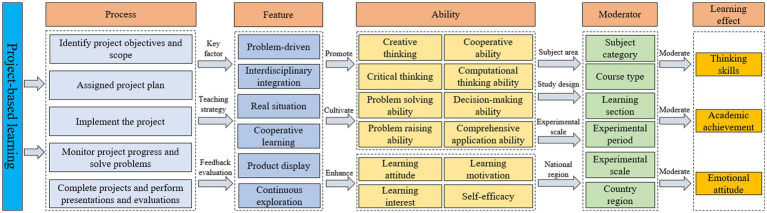
- PBL had significant positive effects on all three outcome types reported: academic achievement (SMD = 0.650), thinking skills (SMD = 0.387, p < 0.001), and affective attitudes (SMD = 0.379, p < 0.001).
- Moderator analyses found stronger effects in Asia, especially Southeast Asia (SMD = 0.684), than in Western Europe and North America; the effect in North America was not significant (SMD = 0.061, p = 0.429).
- The largest subgroup effects were reported for high school (SMD = 0.720), engineering and technology (SMD = 0.619), experimental/laboratory classes (SMD = 0.498), groups of 4–5 students (SMD = 0.909), and 9–18 weeks of intervention (SMD = 0.673).
## Methods
- The study is a meta-analysis of project-based learning interventions compared with traditional teaching.
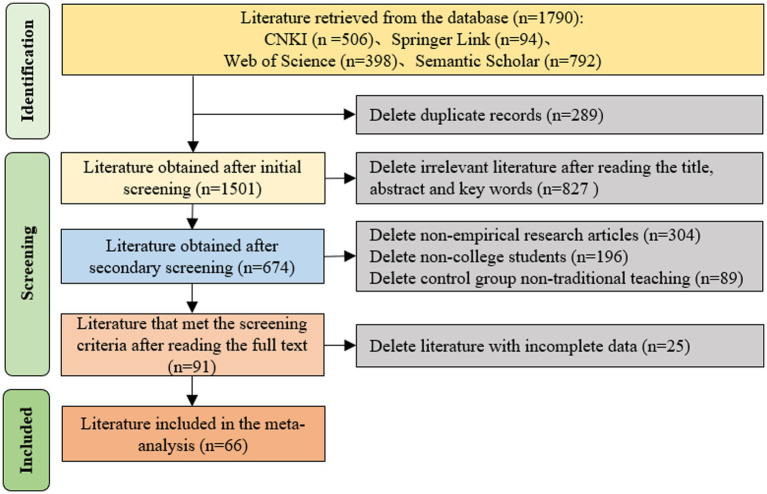
- The sample consisted of 66 experimental or quasi-experimental papers published from 2003 to 2023, yielding 190 effect sizes; the authors extracted sample size, mean, and standard deviation data.
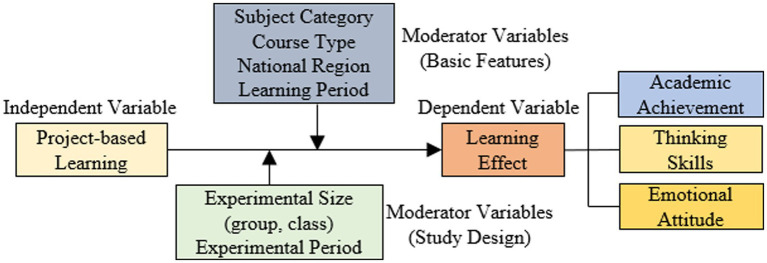
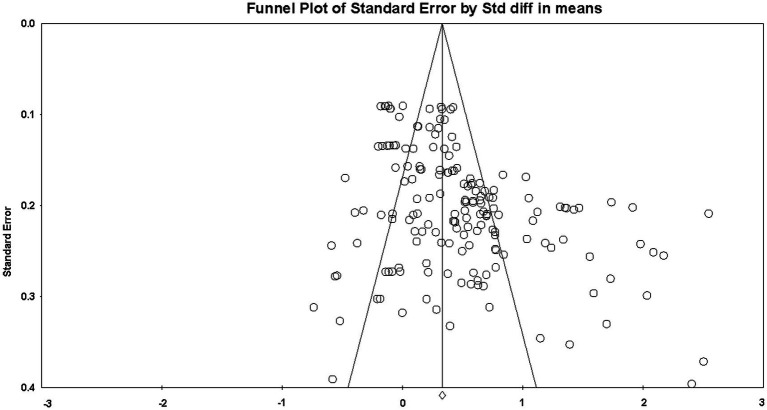
- Analyses were conducted in Comprehensive Meta Analysis 3.0, including publication bias tests (funnel plot, Begg’s test, Trim and Fill, Fail-safe N), heterogeneity tests (Q, I²), effect-size synthesis using standardized mean differences (SMD), and moderator analyses for country region, subject area, course type, academic section, class size, group size, and experiment period.
## Limitations
- The paper states that some PBL studies lacked sufficient statistical information for inclusion, and most studies did not provide a specific classification of learning effectiveness, limiting more detailed analysis.
- The text also makes evident that the meta-analysis had high heterogeneity (I² = 87.4%, Q = 1496.2, p < 0.001); this is not framed as a limitation by the authors but does indicate substantial between-study variability.
- The authors note that the included literature was weighted toward primary and secondary education, with less research on universities and young children; this is stated by the paper as a direction for future research.
Model-written summary. Check it against the paper before relying on it.
Integrity signals
Registry
Cites
Statistics
Figures
Verification
Claims the paper makes
1 Valid · 0 Not valid · 6 Not checked · 57 Own results and interpretations
A result the paper reports from its own data — it cites no other source for it, so there is none to check. The quote shows it is in the paper.
In the paper
“Moderately positive impact (SMD = 0.650), and the total effect values for affective attitudes and thinking skills were 0.389 and 0.386, respectively.”
§ A study of the impact of project-based learning on student learning effects: a meta-analysis study > Results > Results about problem of studies’ fields
plainstates a cause- Asserted: passes — The authors put it forward as true.
- Checkable: passes — It can be checked against evidence.
- Load-bearing: passes — The paper’s conclusions depend on it.
- Based: passes — The paper gives a reason why it holds.
- Rests on 3 assumptions not shown here.
A result the paper reports from its own data — it cites no other source for it, so there is none to check. The quote shows it is in the paper.
In the paper
“and also had moderate positive effects on learning motivation (SMD = 0.401) and learning attitudes (SMD = 0.536)”
§ A study of the impact of project-based learning on student learning effects: a meta-analysis study > Results > Results about problem of studies’ fields
plainstates a cause- Asserted: passes — The authors put it forward as true.
- Checkable: passes — It can be checked against evidence.
- Load-bearing: passes — The paper’s conclusions depend on it.
- Based: passes — The paper gives a reason why it holds.
- Rests on 2 assumptions not shown here.
A result the paper reports from its own data — it cites no other source for it, so there is none to check. The quote shows it is in the paper.
In the paper
“computational thinking skills (SMD = 0.719) had the most significant effect”
§ A study of the impact of project-based learning on student learning effects: a meta-analysis study > Results > Results about problem of studies’ fields
plainstates a cause- Asserted: passes — The authors put it forward as true.
- Checkable: passes — It can be checked against evidence.
- Load-bearing: passes — The paper’s conclusions depend on it.
- Based: passes — The paper gives a reason why it holds.
- Rests on 2 assumptions not shown here.
A result the paper reports from its own data — it cites no other source for it, so there is none to check. The quote shows it is in the paper.
In the paper
“its effect on student learning outcomes was not significant (SMD = 0.061, p = 0.429 > 0.05)”
§ A study of the impact of project-based learning on student learning effects: a meta-analysis study > Results > Results about problem of studies’ fields
plain- Asserted: passes — The authors put it forward as true.
- Checkable: passes — It can be checked against evidence.
- Load-bearing: passes — The paper’s conclusions depend on it.
- Based: passes — The paper gives a reason why it holds.
- Rests on 2 assumptions not shown here.
A result the paper reports from its own data — it cites no other source for it, so there is none to check. The quote shows it is in the paper.
In the paper
“Moderately positive impact (SMD = 0.650), and the total effect values for affective attitudes and thinking skills were 0.389 and 0.386, respectively.”
§ A study of the impact of project-based learning on student learning effects: a meta-analysis study > Results > Results about problem of studies’ fields
plainstates a cause- Asserted: passes — The authors put it forward as true.
- Checkable: passes — It can be checked against evidence.
- Load-bearing: passes — The paper’s conclusions depend on it.
- Based: passes — The paper gives a reason why it holds.
- Rests on 3 assumptions not shown here.
24 more claims
Create a free account to see all 64 claims and every source verdict.
- Probably not a substantial claim. 10
- It may state two separate claims as one. 31
- The quote only partly states this claim. 3
Claims other papers make about this one
Each is checked against this paper’s own text: does it say what the citing paper says it does?
The cited source says what the claim attributes to it.
In the citing paper
“Several meta-analyses and systematic reviews have synthesized the effects of PBL in education, demonstrating positive impacts on academic achievement (Chen and Yang, 2019; Zhang and Hu, 2019; Zhang and Ma, 2023).”
From Can project-based learning improve students’ mathematics learning outcomes: a three-level meta-analysis (2026) · cites this paper as Zhang and Ma, 2023
The cited source says what the claim attributes to it.
In the citing paper
“Conversely, Zhang and Ma (2023) report stronger effects of PBL in Asia, especially Southeast Asia, than in Western Europe and North America.”
From Can project-based learning improve students’ mathematics learning outcomes: a three-level meta-analysis (2026) · cites this paper as Zhang and Ma, 2023
The cited source says what the claim attributes to it.
In the citing paper
“However, some research reports non-significant effects on non-cognitive outcomes (Zhang and Ma, 2023; Chen and Yang, 2019).”
From Can project-based learning improve students’ mathematics learning outcomes: a three-level meta-analysis (2026) · cites this paper as Zhang and Ma, 2023
The cited source says what the claim attributes to it.
In the citing paper
“Zhang and Ma (2023) demonstrated that interventions lasting 9–18 weeks produce the most significant effects, with diminishing returns beyond 18 weeks.”
From Can project-based learning improve students’ mathematics learning outcomes: a three-level meta-analysis (2026) · cites this paper as Zhang and Ma, 2023
The cited source says what the claim attributes to it.
In the citing paper
“Zhang and Ma (2023) confirmed advantages for small classes, senior high schools, and groups of 4–5 students.”
From Can project-based learning improve students’ mathematics learning outcomes: a three-level meta-analysis (2026) · cites this paper as Zhang and Ma, 2023
1 more claim about this paper
Create a free account to see every claim other papers make about this one.
Self-check
Percentages, sums and reported differences re-computed from the paper’s own numbers.
Each contradiction between two passages listed here was confirmed by an independent check.
Rated minor: it would not touch a result — a value no result rests on, a p-value that stays on the same side of the significance level, or a conflict that is clerical, resolved elsewhere in the paper, or outside its own findings.
In the paper
§ A study of the impact of project-based learning on student learning effects: a meta-analysis study > Results > Results about problem of studies’ fields
“This study included 190 experimental data from 66 empirical research papers, and as shown in Table 2, the combined effect value of the impact of project-based learning on student learning outcomes was 0.441, close to 0.5 and p < 0.001, indicating that project-based learning has a large degree of impact on learning outcomes and is an effective teaching approach.”
§ A study of the impact of project-based learning on student learning effects: a meta-analysis study > Results > Results about problem of studies’ fields
“when the ES is less than 0.2, it means that there is a small effect impact, when the ES is between 0.2–0.8 means that there is a moderate effect, when the ES > 0.8 means that there is a significant effect impact.”
Citations
Cites
Preferred Reporting Items for Systematic Reviews and Meta-Analyses: The PRISMA Statement
Moher, D., Liberati, A., Tetzlaff, J., Altman, D. G., & The PRISMA Group (2009) · PLoS Medicine · doi:10.1371/journal.pmed.1000097 · Cited by 64,042 · cited 2×
“To find articles that meet the subject matter requirements, this study used the (Page, 2021) process for literature processing (Vrabel, 2009), the literature search, screening, and inclusion process is shown in Figure 2.”
Preferred reporting items for systematic reviews and meta-analyses: the PRISMA Statement.
(2009) · PubMed Central · Cited by 44,859
Quantifying heterogeneity in a meta‐analysis
Higgins, J. P. T., & Thompson, S. G. (2002) · Statistics in Medicine · doi:10.1002/sim.1186 · Cited by 36,763
Page, M. J., Moher, D., Bossuyt, P. M., Boutron, I., Hoffmann, T. C., Mulrow, C. D., Shamseer, L., Tetzlaff, J. M., Akl, E. A., Brennan, S. E., et al. (2021) · BMJ · doi:10.1136/bmj.n160 · Cited by 13,262 · cited 2×
“To find articles that meet the subject matter requirements, this study used the (Page, 2021) process for literature processing (Vrabel, 2009), the literature search, screening, and inclusion process is shown in Figure 2.”
MethodPrimary, Secondary, and Meta-Analysis of Research
GLASS, G. V. (1976) · Educational Researcher · doi:10.3102/0013189x005010003 · Cited by 4,890 · cited 1×
“To ensure the quality of the study, this study strictly followed the meta-analysis criteria proposed by Glass (1976), which was mainly divided into four assessment procedures: literature collection, literature coding, effect size calculation, and moderating variable analysis, and finally a…”
MethodHung, C., Hwang, G., & Huang, I. (2012) · Educational Technology & Society · Cited by 635
Publication Bias in Meta‐Analysis
Rothstein, H. R., Sutton, A. J., & Borenstein, M. (2005) · Publication Bias in Meta‐Analysis · doi:10.1002/0470870168.ch1 · Cited by 603
Tseng, K.-H., Chang, C.-C., Lou, S.-J., & Chen, W.-P. (2013) · International Journal of Technology and Design Education · doi:10.1007/s10798-011-9160-x · Cited by 554
Kilpatrick, W. H. (1918) · Teachers College Record: The Voice of Scholarship in Education · doi:10.1177/016146811801900404 · Cited by 431
The effect of authentic project‐based learning on attitudes and career aspirations in STEM
Beier, M. E., Kim, M. H., Saterbak, A., Leautaud, V., Bishnoi, S., & Gilberto, J. M. (2019) · Journal of Research in Science Teaching · doi:10.1002/tea.21465 · Cited by 321
Research works printed but not linked: 41
- Changming, 2020, Why do we need project-based learning?, Primary Secondary School Manage, 8, 5
- Chung, 2021, Students’ perception of self-regulated learning in a project-based learning
- Cohen, 1988, Statistical power analysis for behavioral science, Technometrics, 31, 499
- Cong, 2021, Research on the design and implementation of project-based teaching of high school chemistry based on STSE education
- 2020, Research on the impact of project-based learning STEM curriculum on elementary school students’ problem solving ability [Master’s thesis].
- Gao, 2020, Research on the teaching model of high school biology unit based on project-based learning
- Hongxing, 2017, Project-based learning: classroom teaching activities to cultivate students’ core literacy, J. Lanzhou Univ., 6, 165, 10.13885/j.issn.1000-2804.2017.06.021 · doi:10.13885/j.issn.1000-2804.2017.06.021
- Jina, 2022, The application of project-based learning based on problem awareness in primary school mathematics classroom
- Jingfu, 2002, Project-based learning model, Foreign Educ. Res., 11, 18
- Keleşoğlu, 2011, nvestigating the effects of project-based learning on students’ Academic Achievement and Attitudes Towards English Lesson. vol.1
- Lei, 2020, The design and implementation of project-based learning for high school chemistry teaching
- Ling, 2020, Design and practice of teaching activities based on project-based learning to cultivate primary school students’ computational thinking
- Linxiao, 2020, The application of project learning in senior high school biology classroom study
- Lu, 2020, Research on teaching design of junior high school information technology curriculum based on project-based learning
- Luo, 2020, Research on the development of computational thinking skills based on project-based learning
- Ma, 2022, Project learning self-efficacy in elementary programming impact study
- Ma, 2021, Cooperative reasoning learning to promote the development of higher-order thinking, Educ. Dev. Res., 24, 64, 10.14121/j.cnki.1008-3855.2021.24.011 · doi:10.14121/j.cnki.1008-3855.2021.24.011
- Mark, 2022, The effectiveness of PBL classes using multimedia tools: a case study of a university liberal arts English class, Multimedia Lang. Teach., 25, 237
- Mingquan, 2020, Project learning in senior high school geography teaching research and practice
- Rui, 2020, An empirical study on the development of computational thinking skills of high school students based on project-based learning
- Ruiz-Rosa, 2021, Project-Based Learning as a tool to foster entrepreneurial competences (El Aprendizaje Basado en Proyectos como herramienta para potenciar la competencia emprendedora), Cult. Educ., 33, 1, 10.1080/11356405.2021.1904657 · DOI
- ShiXuan, 2017, Research on the design of project-based learning activities based on Moodle
- Wang, Project learning perspective of organic chemistry teaching design and implementation of high school
- Wang, Design and practice of open source hardware project-based learning for primary schools with problem-solving skills development
- Wang, 2022, Research on the design and application of a comprehensive practical activity curriculum for primary schools based on project-based learning
- Wei, 2020, The impact of cooperative learning on students' learning outcomes: A meta-analysis based on 48 experimental or quasi-experimental studies, Shanghai J. Educ. Res., 7, 34, 10.16194/j.cnki.31-1059/g4.2020.07.008 · doi:10.16194/j.cnki.31-1059/g4.2020.07.008
- Weihong, 2019, Promoting Students' high-level thinking development through project-based learning -- design and implementation of "baby market" exploration project, Basic Educ Curric, 6, 20
- Wenlan, 2019, Does project-based learning play a role in learning? -- meta-analysis based on 46 experimental and quasi-experimental studies, Res. Visual Educ., 2, 95, 10.13811/j.cnki.eer.2019.02.012 · doi:10.13811/j.cnki.eer.2019.02.012
- Xiaolei, 2021, Research on the design and practice of high school information technology curriculum based on project-based learning
- Xu, 2022, A practical study of project-based learning for developing core literacy in subjects
- Xuezhi, 2022, Research on the design and practice of project-based learning in junior high school mathematics curriculum
- Yanan, 2020, An experimental study of Jigsaw-based project-based learning in elementary school IT class
- Yang, 2020, Practical research on teaching reform of information technology curriculum in Baochang No. 1 Middle School
- Yating, 2022, Research on the design and practice of teaching elemental compounds in high school based on project-based learning
- Yexin, 2019, The application of robot project learning in middle school teaching research
- Ying, 2022, A study on the influence of project-based teaching on the intrinsic motivation of private university students’ English learning, J. Sci. Educ, 13, 29, 10.16400/j.cnki.kjdk.2022.13.010 · doi:10.16400/j.cnki.kjdk.2022.13.010
- Yuan, 2017, A Study on the Teaching Reform of Information Technology Course in Baochang No.1 Middle School - Taking “Project-based Learning” as an Example
- Yun, 2022, Practical exploration of project-oriented deep ritual education -- take the project-oriented learning of searching for roots Xu Huiyuan in grade 5 as an example, Shanghai J. Educ. Res., 9, 64, 10.16194/j.cnki.31-1059/g4.2022.09.006 · doi:10.16194/j.cnki.31-1059/g4.2022.09.006
- Yuting, 2022, Practical research on project-based learning based on the development of scientific inquiry ability in secondary school biology teaching
- Zhang, 2022, A study on the effect of project-based teaching on the intrinsic motivation of private university students’ English learning, J. Sci. Educ., 13, 29, 10.16400/j.cnki.kjdk.2022.13.010 · doi:10.16400/j.cnki.kjdk.2022.13.010
- Zhang, 2022, Based on the junior high school students information technology subject core. Mesh type teaching mode design and application research
Cited by
Items 101–200 of 428
The Role of Cognitive Abilities in Project-Based Teaching: A Mixed Methods Study
Wang, L., & Zhang, C. (2025) · Behavioral Sciences · doi:10.3390/bs15030299 · Cited by 6
“Compared with the considerable body of literature on project-based learning (Hung et al., 2019; Kokotsaki et al., 2016; Zhang & Ma, 2023), relatively li tt le a tt ention has been paid to project-based teaching.”
Soia, O. M., Леонова, І., Ковтонюк, М. М., Туржанська, О. С., & Косовець, О. П. (2025) · Lecture notes in networks and systems · doi:10.1007/978-3-031-83523-0_37 · Cited by 2
Driving Project-Based Learning and Problem-Based Learning Through Research in Middle Schools
Al-Thani, N. J., & Ahmad, Z. (2025) · Springer briefs in education · doi:10.1007/978-3-031-87544-1_3 · Cited by 18
Qi, C., Zuo, S., & Li, G. (2025) · Current Psychology · doi:10.1007/s12144-025-08319-4 · Cited by 10
“Although numerous studies highlight the motivational benefits of PjBL, most focus on learning interest and do not examine motivation as a formal mediating mechanism link - ing PjBL to academic outcomes (Mettas & Constantinou, 2008; Zhang & Ma, 2023).”
Metodologías activas en el proceso enseñanza aprendizaje en la educación superior
Mayorga, C. A. F., Caiche-Valarezo, K. A., & Vega-Jiménez, A. J. (2025) · MQRInvestigar · doi:10.56048/mqr20225.9.3.2025.e945 · Cited by 4
Madybekova, G., Zabynbekova, T., Shertayeva, N., & Bitursyn, S. (2026) · Chemistry Teacher International · doi:10.1515/cti-2025-0075 · Cited by 8
“Teachers must invest time in preparing project materials, rubrics, and supervision schedules, particularly during the initial course redesign phase.”
InfluentialProject-Based Module Development in the Electrical Circuit Course
Sari, J. D. R., Ambiyar, A., Mukhaiyar, R., & Wulansari, R. E. (2024) · Jurnal Penelitian Pendidikan IPA · doi:10.29303/jppipa.v10i4.7385 · Cited by 4
“Project-based learning positively influences students' learning outcomes in cognitive, psychomotor, and affective domains (Susanti et al., 2019; Zhang & Ma, 2023).”
BackgroundHaghbin, N. (2024) · doi:10.18260/1-2--45780 · Cited by 1
Rteü, & Seyhan, A. (2024) · Sosyal Bilimler ve Değerler Eğitimi Dergisi · doi:10.29329/jsve.2024.1097.3 · Cited by 2
First aid education in schools
Hashil, H. H. A., Hashil, H. S. A., Alhareth, M. N. A., Mansour, H. Y. A., & Hutayla, Y. M. A. (2024) · مجلة العلوم الطبية و الصيدلانية · doi:10.26389/ajsrp.l031124 · Cited by 9
Project-Based Learning Implementation in Distance Learning
Sela, S. T., & Luke, J. Y. (2024) · International Conference on TVET Excellence & Development (ICTeD) · doi:10.1109/icted62334.2024.10844605 · Cited by 1
“The usage of project-based learning was also proven to increase the attitude of students, skills, and academic skills [7].”
Clark, L., Weaver, L., Floersch, E., Remškar, M., Brunsvold, M. E., & Woll, A. (2025) · Journal of surgical education · doi:10.1016/j.jsurg.2025.103481 · Cited by 1
Ansar, M., & George, G. (2025) · Advances in computational intelligence and robotics book series · doi:10.4018/979-8-3693-7332-3.ch009 · Cited by 1
Metodologías Activas en la Educación Superior: Estrategias para el Aprendizaje Significativo
Guillén, S. R. G. R., Solórzano-Cobeña, C. M., Prado-Carpio, E. C., Giler-Sánchez, M. A., & Vega-Rivera, E. E. (2025) · doi:10.70171/yw2j4p08 · Cited by 5
Building a Community Robotics Pipeline
Gustafson, J. R. D. (2025) · IGI Global eBooks · doi:10.4018/979-8-3693-9496-0.ch007 · Cited by 1
The Usage of Artificial Intelligence Applications in Vocational Education Students' Projects
Wong, K. C., & Lai, Y. C. (2024) · Advances in information quality and management · doi:10.4018/978-1-6684-7366-5.ch095 · Cited by 1
Sung, C. C. M. (2025) · Reflective Practice · doi:10.1080/14623943.2025.2504223 · Cited by 2
Learning effectiveness of assorted educational material on terraced landscape for 7th-grade students
Chrysanthaki, C., Klonari, A. I., & Petanidou, T. (2025) · International Research in Geographical and Environmental Education · doi:10.1080/10382046.2025.2512311 · Cited by 2
Nguyen, T. T. (2025) · VNU Journal of Foreign Studies · doi:10.63023/2525-2445/jfs.ulis.5518 · Cited by 2
TRANSFORMATION IN SCIENCE EDUCATION: THE ROLE OF TECHNOLOGY AND EMERGING APPROACHES
Uşak, M. (2025) · Journal of Baltic Science Education · doi:10.33225/jbse/25.24.396 · Cited by 1
Empowering STEM Education: Harnessing MagicSchool AI for Experiential Learning
Ashley, M. S. (2025) · Advances in computational intelligence and robotics book series · doi:10.4018/979-8-3373-1122-7.ch003 · Cited by 1
Yang, H., Fan, X., Cui, K., Liang, Z., & Chen, H. (2025) · International Conference on e-Education, e-Business, e-Management and e-Learning · doi:10.1109/ic4e65071.2025.11075441 · Cited by 1
“Cocco (2006) describes PBL learning as a student-centered form of instruction: learners actively participate in the learning process within specific contexts, achieving their target knowledge and understanding through social interaction and sharing[6].”
Antunes, R., Carneiro, T., Joaquim, L., de Matos, M. G., Alexandre, J., & Filipe, M. G. (2025) · Frontiers in Psychology · doi:10.3389/fpsyg.2025.1554001 · Cited by 8
Chitamba, A., Yearwood, V., Swanepoel, M. J., & Gabriel, M. (2025) · International Journal of Research in Business and Social Science (2147-4478) · doi:10.20525/ijrbs.v14i5.4249 · Cited by 3
Chen, Y., Lei, S., Yang, Q., Zhu, J., & Xiang, Y. (2025) · Sustainability · doi:10.3390/su17177958 · Cited by 4
Liu, L., & Hwang, G.-J. (2025) · PRESENCE Virtual and Augmented Reality · doi:10.1162/pres.a.406 · Cited by 4
Personal strategies for developing adaptive readiness of students and teachers
Grigoryeva, M. V., Sharov, A. A., & Локаткова, О. Н. (2025) · Psychological-Educational Studies · doi:10.17759/psyedu.2025170310 · Cited by 1
Virgilio, F. D., Puccio, A., & Manocchio, M. C. (2025) · Lecture notes in networks and systems · doi:10.1007/978-981-96-7289-9_30 · Cited by 1
Problem structuring in urban science education: Why, what, and how
Lai, Y., & Lavi, R. (2025) · Frontiers of Urban and Rural Planning · doi:10.1007/s44243-025-00064-3 · Cited by 2
“…engage in real-world (simple, simplified, or complex) problems, cases, or questions, carry out discourse with other students and reflect on their own learning, have been shown to help foster students’ HOTS and problem-solving skills (Lavi et al., 2021a; Virtanen & Tynjala, 2019; Zhang & Ma, 2023).”
Han, Z., Zhou, Z., Huang, C., Wang, X., Chen, G., & Huang, Q. (2025) · Interactive Learning Environments · doi:10.1080/10494820.2025.2568908 · Cited by 2
“As Zhang and Ma (2023) observed, current technological tools fall short in helping students visualize collaboration processes, such as real-time co-editing awareness and problem-solving visualizations, leading to suboptimal interaction and outcomes (Saqr & López-Pernas, 2022).”
Castellanos-Reyes, D., & Leppard, T. R. (2025) · International Journal of Educational Technology in Higher Education · doi:10.1186/s41239-025-00560-y · Cited by 3
“Meta-analytic evidence from 66 studies shows that project-based learning instruction has a large impact on students’ outcomes and academic achievement (SMD = 0.65) and a moderate effect on students’ emotional attitudes (SMD = 0.389) and thinking skills (SMD = 0.386) (Zhang & Ma, 2023).”
InfluentialEnhancing physiology learning through group dynamics: outcomes and perceptions of medical students
Tutor, A. S., Avila, M. D. N., Muñoz, Ú., & Sánchez‐Vera, I. (2025) · Frontiers in Physiology · doi:10.3389/fphys.2025.1662624 · Cited by 3
The Role of Artificial Intelligence in Personalizing the Process of Learning the English Language
Aygozel, Y. (2025) · Universal Library of languages and literatures. · doi:10.70315/uloap.ullli.2025.0201005 · Cited by 1
Enhancing statistical literacy: Transformative learning for non-STEM tertiary students
Addison, L. M., Ramdial, P. T., Brito, D. S., et al. (2025) · Research in Statistics · doi:10.1080/27684520.2025.2573373 · Cited by 1
AI robots as learning companions in PBL: Effects on cognitive and self-regulatory outcomes
Na-Songkhla, J., & Shieh, C.-J. (2025) · Contemporary Educational Technology · doi:10.30935/cedtech/17417 · Cited by 2
Using Project-Based Learning to Enhance Student Engagement and Academic Achievement
Morgan, H. (2025) · The Clearing House A Journal of Educational Strategies Issues and Ideas · doi:10.1080/00098655.2025.2597211 · Cited by 1
“This study consisted of a meta-analysis and indicated that affective attitudes were the feelings students have toward learning, motivation, and self-efficacy (Zhang and Ma 2023).”
Canut-Montalva, A., Rizo-Maestre, C., & Sória, I. N. (2025) · Societies · doi:10.3390/soc15120345 · Cited by 8
Developing Students' Artistic Creativity Through Local Wisdom-Based Project Learning
Ifrianti, S., Hasnanto, A. T., & Yuslinda, A. F. (2025) · Tadris Jurnal Keguruan dan Ilmu Tarbiyah · doi:10.24042/tadris.v10i1.20583 · Cited by 1
Uribe, D. F., García-Galán, R., Ortiz‐Marcos, I., & Rodríguez‐Rivero, R. (2025) · Applied Sciences · doi:10.3390/app152312830 · Cited by 2
“Finally, EBL grounds conceptual understanding in concrete engineering tasks, following the experiential learning cycle [58,71].”
Sari, L. D., Sudarti, S., & Siswati, B. H. (2025) · Integrated Science Education Journal · doi:10.37251/isej.v7i1.2454 · Cited by 1
“Experimental-based PBL has also been shown to improve students’ critical thinking, collaboration, and scientific confidence, which are important components of scientific communication skills [25], [26].”
Zhang, Q., & Lin, C. (2026) · Frontiers in Psychology · doi:10.3389/fpsyg.2025.1722170 · Cited by 9
Nasharuddin, Said, M. A., Amal, A., et al. (2025) · Jurnal Penelitian Pendidikan IPA · doi:10.29303/jppipa.v11i12.12691 · Cited by 1
“In parallel, Project-Based Learning (PjBL) has been shown to cultivate 21st-century skills, critical thinking, creativity, and collaboration by engaging students in authentic problem-solving within contextual scenarios (Zhang & Ma, 2023; Juita et al., 2025).”
WIP: Integrating Generative AI into Project-Based Learning for Advanced Power Systems Analysis
Robol, A., Kerestes, R. J., Dukes, A. A., & Besterfield‐Sacre, M. (2025) · IEEE Frontiers in Education Conference (FIE) · doi:10.1109/fie63693.2025.11328632 · Cited by 2
“A meta-analysis of 66 quasi-experimental studies found that PjBL significantly improves student learning outcomes over traditional methods [4].”
Wang, S., Yuan, Y., Zhou, C., et al. (2026) · BMC Medical Education · doi:10.1186/s12909-026-08649-2 · Cited by 1
Setiawan, I. (2026) · Assessment & Evaluation in Higher Education · doi:10.1080/02602938.2026.2620645 · Cited by 1
Promtuang, W. (2025) · The EUrASEANs journal on global socio-economic dynamics · doi:10.35678/2539-5645.0.6(55).2025.288-301 · Cited by 1
Petchamé, J., Novkovic, D., Fox, P. B., Kinnear, L., & Kompen, R. T. (2026) · Sustainability · doi:10.3390/su18041849 · Cited by 2
Gestión del cambio para la sostenibilidad socioeconómica de las naciones
(2025) · Fondo Editorial Universitario Servando Garcés de la Universidad Politécnica Territorial de Falcón Alonso Gamero / Alianza de Investigadores Internacionales S.A.S. eBooks · doi:10.47212/gestiondelcambiosostenibilidad2025 · Cited by 2
Students’ Situational Engagement in a Primary School Science Project
Ervelius, P., Lavonen, J., Juuti, K., Ramsaroop, S., & Loukomies, A. (2026) · International Journal of Science and Mathematics Education · doi:10.1007/s10763-026-10648-0 · Cited by 4
“Research further shows that PBL designs emphasizing feedback and cyclical improvement foster engagement, autonomy, and conceptual growth (Blumenfeld et al., 1991; Zhang & Ma, 2023).”
Rahman, N., Sari, N., & Abas, H. (2026) · Primary Jurnal Pendidikan Guru Sekolah Dasar · doi:10.33578/jpfkip.v15i1.42-57 · Cited by 1
“Additionally, real-world relevance and tangible learning experiences serve to elevate student engagement and motivation, both of which are crucial for sustained academic interest (Thabethe & Mwambakana, 2025; L. Zhang & Ma, 2023).”
Project-based learning in schools: a multi-complementary study of its effectiveness
Doğan, Y., Yener, D., Daşdemir, İ., Ekşi, Z., & Batdı, V. (2026) · Humanities and Social Sciences Communications · doi:10.1057/s41599-026-06684-4 · Cited by 6
Mantilla, R. R. (2026) · International Journal of Interactive Mobile Technologies (iJIM) · doi:10.3991/ijim.v20i06.58489 · Cited by 3
Social pedagogy and civic education: comparing school participatory budgeting and Project Citizen
Bartlett, T., & Schugurensky, D. (2026) · International Journal of Social Pedagogy · doi:10.14324/111.444.ijsp.2026.v15.x.009 · Cited by 3
Park, S., & Song, Y. (2026) · Journal of research in nursing · doi:10.1177/17449871261427312 · Cited by 1
Babeshkova, E. V., & Lavina, T. A. (2026) · Pedagogy Theory & Practice · doi:10.30853/ped20260104 · Cited by 1
Wuwen, Z., Yu, H., Xia, M., Yang, M., & Ja, J. (2026) · Education and Information Technologies · doi:10.1007/s10639-026-14030-z · Cited by 1
“Through further data analysis, we discovered two noteworthy findings behind the overall effects that diverge from mainstream findings in existing AIED intervention literature.”
InfluentialGómez-Freire, F. J., Erazo-Álvarez, M. D. L., Ávila-Flores, I. J., Espinoza-Lovato, A. S., & Pallaroso-Granizo, R. Y. (2026) · Revista Científica Zambos. · doi:10.69484/rcz/v5/n2/183 · Cited by 2
“Zhang y Ma (2023) encontraron efectos positivos del ABP en resultados de aprendizaje, actitudes y habilidades de pensamiento, pero también evidenciaron que dichos efectos varían según el nivel educativo, duración, tamaño del grupo y condiciones de implementación.”
Sardinha, M., & Leite, M. (2026) · Procedia CIRP · doi:10.1016/j.procir.2026.05.331 · Cited by 4
Additive manufacturing of recycled plastics for sustainable STEM education
Ali, L., Rashid, A. A., & Koç, M. (2026) · Discover Sustainability · doi:10.1007/s43621-026-03811-8 · Cited by 1
“8) was developed by synthesizing research on STEM education, including PBL, design thinking, and circular economy pedagogy in AM, as tools for sustainability and engineering education [71–73].”
Diep, N. T. B., Linh, N. Q., Tu, P. T. H., et al. (2026) · Discover Education · doi:10.1007/s44217-026-01636-1 · Cited by 1
“Finally, PBL is considered one of the most effective methods for implementing STEM because it creates a dynamic learning environment that fosters curiosity, creativity, collaboration, and the 21st-century skills that STEM education aims for [7, 35, 45].”
InfluentialGüvendiren, M. (2026) · Education Sciences · doi:10.3390/educsci16070988 · Cited by 3
Tishkus, K., & Streitwieser, B. T. (2026) · International Journal of Development Education and Global Learning · doi:10.14324/ijdegl.18.1.03 · Cited by 1
The Framework of Student-Driven Learning Personalization in Project-Based Learning
Ignatova, N., Augustinienė, A., & Klizienė, I. (2024) · Advances in educational technologies and instructional design book series · doi:10.4018/979-8-3693-0868-4.ch009 · Cited by 1
Faculty Perspectives on Web Learning Apps and Mobile Devices on Student Engagement
Coelhoso, P., & Kalogeras, S. (2024) · Journal of Information Technology Education Innovations in Practice · doi:10.28945/5272 · Cited by 8
Jamaludin, N. L., Nasir, J. S. M., Isa, S. S., et al. (2024) · Environment-Behaviour Proceedings Journal · doi:10.21834/e-bpj.v9isi17.5453 · Cited by 1
Madjid, S., Moelier, D. D., Asri, W. K., et al. (2024) · International Journal of Religion · doi:10.61707/jt9tey10 · Cited by 1
“This approach aligns with problem-based learning and emphasizes active engagement with complex academic content (Zhang & Ma, 2023).”
ADEIKA, B., Ariyibi, A. A., Abiodun, P. O., & Owolabi, O. A. (2024) · ASEE Annual Conference & Exposition · doi:10.18260/1-2--48406 · Cited by 1
Project Management and Education: Improving Learning and Student Success
Even, A. M. (2024) · International Journal of Curriculum Development and Learning Measurement · doi:10.4018/ijcdlm.353926 · Cited by 7
“Completing a project is a rewarding experience, instilling a sense of accomplishment in students that boosts their confidence and self-esteem (Zhang & Ma, 2023).”
InfluentialReaux, C. R., Meche, S., Grider, J. M., Dhanabal, S., Milon, T. I., Chen, F., & Xu, W. (2025) · Frontiers in Education · doi:10.3389/feduc.2024.1455173 · Cited by 1
Online Course Tailoring Design through Project-Based Learning Syntax in Fashion Studies
Rahmasari, A., Situmorang, R., & Kustandi, C. (2024) · Journal of Science and Education (JSE) · doi:10.58905/jse.v5i1.430 · Cited by 2
“Project based learning is a learning approach that has the following characteristics: students make decisions about their framework students have a problem or challenge, design a process for students to identify problems or propose solutions[18].”
Hamid, K. S. (2025) · Inovacije u nastavi · doi:10.5937/inovacije2501135s · Cited by 2
Implementing and Adjusting Project-Based Inquiry in a Secondary English Language Arts Classroom
Nerlino, E. (2025) · IGI Global eBooks · doi:10.4018/979-8-3373-0305-5.ch013 · Cited by 1
Indiwara, R. (2025) · Educational Journal of Learning Technology · doi:10.58230/edutech.v3i1.69 · Cited by 2
Ernisasneli (2023) · Journal of Hypermedia & Technology-Enhanced Learning (J-HyTEL) · doi:10.58536/j-hytel.v1i1.28
SPECIFICITY OF INDEPENDENT WORK AT THE HIGHER MEDICAL SCHOOL
Nikolova, D., & Popova, M. (2023) · International Journal of Advanced Natural Sciences and Engineering Researches · doi:10.59287/as-ijanser.12
Folgueras, X., Abelleira, M. V., Campos, C. P., & González-García, R. J. (2023) · Physical Education Theory and Methodology · doi:10.17309/tmfv.2023.6.09 · Cited by 3
“In contrast to traditional teaching methods, this approach has a moderately advantageous impact on students’ academic achievement, cognitive competence, and emotional dispositions, as found by Zhang and Ma (2023).”
BackgroundResultالردادي, د. ر. ن. ح. (2024) · مجلة الدراسات التربوية والإنسانية · doi:10.21608/jehs.2024.336160
The Unified Learning Cycle: An Educational Technology for Student-Driven Learning Personalization
Ignatova, N., Kubilinskienė, S., Augustinienė, A., Klizienė, I., & Simonaitienė, B. (2024) · Advances in educational technologies and instructional design book series · doi:10.4018/979-8-3693-0868-4.ch006
FORMATION PROJECT MANAGEMENT SKILLS FOR FUTURE COMPUTER SCIENCE TEACHERS
Lutsenko, G. V. (2024) · Academic Notes Series Pedagogical Science · doi:10.36550/2415-7988-2024-1-213-40-46
Sani, A., Dewanto, D., Sapulete, H., et al. (2024) · Edumaspul - Jurnal Pendidikan · doi:10.33487/edumaspul.v8i1.7715
“This type of research is meta-analysis research, Meta-analysis is a research approach that analyzes previous research quantitatively to get a conclusion (Suparman et al., 2021; Wijnia et al., 2024; Ichsan et al., 2022; Tamur et al., 2020; Zhang & Ma, 2023 ).”
MethodIvata, L. C. D. S., Vitorino, E., Martins, J. S., de Oliveira, M. G. C., & da Silva, P. C. D. S. (2024) · Revista Pleiade · doi:10.32915/pleiade.v18i42.943 · Cited by 2
The entrepreneurial revolution in science research and education
Halma, M. T. J. (2024) · Scientific Bulletin of Mukachevo State University Series “Pedagogy and Psychology” · doi:10.52534/msu-pp1.2024.46
Chamisijatin, L., & Zaenab, S. (2024) · Research and Development in Education (RaDEn) · doi:10.22219/raden.v4i1.32558 · Cited by 3
Yunita, W., & Harahap, A. (2024) · Jurnal Inovasi Pengabdian Masyarakat Pendidikan · doi:10.33369/jurnalinovasi.v4i2.31087
Zhai, X., Chen, P., & Luo, Q. (2024) · SSRN Electronic Journal · doi:10.2139/ssrn.4900425
Pohan, M. M., Latif, M., & Rosyadi, K. I. (2024) · Journal Of Education And Teaching Learning (JETL) · doi:10.51178/jetl.v6i2.1991
Wang, X., Gao, Y., Li, X., Yin, H., Meng, K., Ma, Q., & Guo, Y. P. (2024) · Research Square · doi:10.21203/rs.3.rs-4857423/v1
Balseca, C. L. I., Caiza, A. F. M., Coronel, F., Mena, A., Inca, E., & Guerra, J. (2024) · WSEAS TRANSACTIONS ON COMPUTER RESEARCH · doi:10.37394/232018.2024.12.39 · Cited by 1
Kadhi, N. E., & Bunagan, M. M. (2024) · Advances in higher education and professional development book series · doi:10.4018/979-8-3693-3443-0.ch006
Horiuchi, S. (2024) · Qeios · doi:10.32388/m7qclp
Tanyeri, M. (2024) · Biomedical Engineering Education · doi:10.1007/s43683-024-00161-7
Barbaso, L. V., Busico, E. C., Laviste, R. P., & Rama, J. (2024) · International Conference on Digital Technology in Education (ICDTE) · doi:10.1145/3696230.3696245
Vicy, Mustaji, Mariono, A., & Arianto, F. (2024) · Journal of Education Society and Behavioural Science · doi:10.9734/jesbs/2024/v37i61355
Firstanda, H. M., Hidayah, W. N., Firnanda, A., et al. (2024) · Pubmedia Jurnal Penelitian Tindakan Kelas Indonesia · doi:10.47134/ptk.v2i2.1205
Tohiri, D. M., & Rakhmawati, A. (2024) · Research and Development in Education (RaDEn) · doi:10.22219/raden.v4i2.36263 · Cited by 2
“Project-based learning enhances students' literacy, critical thinking skills, and abilities essential for the 21st century (L. Zhang & Ma, 2023), enhancing students' computational thinking skills (W. Zhang et al., 2024) and improving creativity competence (Saad & Zainudin, 2022) .”
Jusniar, J., Syamsidah, S., Auliah, A., & Fadly, D. (2025) · Journal of Ecohumanism · doi:10.62754/joe.v3i8.5668 · Cited by 1
Peng, S. (2024) · JPAIR Multidisciplinary Research · doi:10.7719/jpair.v58i1.912 · Cited by 2
Yolviansyah, F., Amin, N. F. M., Retutas, M. J., et al. (2023) · Journal of Educational Technology and Learning Creativity · doi:10.37251/jetlc.v1i2.1398
“With improved technological literacy and 21st-century skills, teachers are not only able to create more engaging learning but also more relevant to students' needs in the digital era [52]-[54].”
Saputra, I., Purnawan, A., & Angraini, R. (2025) · International Journal of Social Service and Research · doi:10.46799/ijssr.v5i1.1180
“…the efficacy of project-based learning (PjBL) in enhancing students’ English performance, indicating that students developed pertinent reading skills, improved their learning, and acquired a diverse range of academic and non-academic competencies through project-based learning (Zhang & Ma, 2023).”
Metadata
- Authors
- Zhang, L., & Ma, Y.
- Affiliations
- Chongqing Normal University (CN)
- Corresponding author
- Ma, Yan
- Venue
- Frontiers in Psychology
- Publisher
- Frontiers Media SA
- Published
- 2023-07-17
- Volume
- 14
- Pages
- 1202728-1202728
- ISSN
- 1664-1078 (ISSN-L)
- PMC
- PMC10411581
- OpenAlex
- W4384498111
- Semantic Scholar
- 62a083ea55ae0b7bcb659bba3159fada89e8945f
- Cited by
- 455
- References
- 47
- Citations by year
- 2026: 192 · 2025: 168 · 2024: 88 · 2023: 7
- FWCI
- 27.58
- Type
- journal article
- Language
- en
- Open access
- gold
- doi.org
- Licence
- Locations
- Frontiers in Psychology (publishedVersion, cc-by)
- PubMed Central (publishedVersion, cc-by)
- PubMed (publishedVersion)
- DOAJ (DOAJ: Directory of Open Access Journals) (submittedVersion, cc-by-sa)
- Funders
- Chongqing Normal University
- Division of Graduate Education
- Topics
- Social Sciences › Education › Problem and Project Based Learning
- Social Sciences › Psychology › Developmental and Educational Psychology › Innovative Teaching and Learning Methods
- Social Sciences › Education › Innovative Teaching Methods
- Keywords
- project-based learning, learning outcomes, academic performance, affective attitudes, thinking skills, moderating effect, group size, technology and engineering education, laboratory classes, upper secondary school, 21st century skills
About these checks
Registry, retraction, Cites and statistics results are computed, not judged, with one exception: a printed reference that no index lists is read once by a model before it counts as a citation error. Claims are extracted by a model and kept only when their quote appears verbatim in the text; each cited source is then checked, with a model’s help, for whether it says what the claim relies on. Those verdicts can be wrong — read the claim’s quote and the cited source before relying on one.
The claim verdicts this report counts are experimental: their accuracy is not yet measured.
A language model drew the claims from the paper on 2026-10-10, under version 3 of the claim definition (model deepseek-v4.1-flash, prompt extract-v3).
A second model labelled each claim on 2026-10-10 (model jev-1.13-20260917, definition revision gold-guideline-v0.2).
Statistics and arithmetic are recomputed, not judged.
Confidence bands are shown only for fields calibrated on our annotated test set. None is calibrated yet, so no band is shown.
What counts as a claim ›How we measure confidence ›How we check this ›
Are you an author, or do you see a problem with this page? Request a review
Data sources
Bibliographic data: Semantic Scholar, OpenAlex, Crossref.
Contains information from the Semantic Scholar Academic Graph Datasets, made available under the ODC Attribution License (ODC-BY 1.0).
Semantic Scholar’s data is described in: Kinney, R., et al. (2023). The Semantic Scholar Open Data Platform. arXiv:2301.10140.
