

A study of the impact of project-based learning on student learning effects: a meta-analysis study
Open accessThe DOI matches its Crossref record; 48 of the 48 references it cites were found in a registry or an index; 2 of the 9 sources its claims cite were checked for support.
Abstract
Introduction: With the educational reform for skills in the 21st century, a large number of scholars have explored project-based learning. However, whether project-based learning can effectively improve the learning effect of students has not yet reached a unified conclusion. Method: This study uses a meta-analysis method to transform 66 experimental or quasi-experimental research papers based on project-based learning over the past 20 years into 190 effect values from the sample size, mean, and standard deviation of experimental data during their experiments, and to conduct in-depth quantitative analysis. Results: The results of the study showed that compared with the traditional teaching model, project-based learning significantly improved students' learning outcomes and positively contributed to academic achievement, affective attitudes, and thinking skills, especially academic achievement. Discussion: The results of the moderating effects test indicated that the effectiveness of project-based learning and teaching was influenced by different moderating variables, including country region, subject area, type of course, academic period, group size, class size, and experimental period : (1) from the perspective of country geography, the effects of project-based learning in Asia, especially in Southeast Asia, were significantly better than those in Western Europe and North America; (2) in terms of curriculum, project-based learning promotes student learning effects more significantly in engineering and technology subjects, and is better applied in laboratory classes than in theory classes; (3) from a pedagogical point of view, project-based learning is more suitable for small group teaching, in which the group size is 4-5 people teaching the best results; (4) in view of the experimental period, 9-18 weeks is more appropriate and has more obvious advantages for application at the high school level.
Overview
CoChat Summary
## TL;DR
This meta-analysis synthesizes 66 experimental or quasi-experimental studies (190 effect sizes) and finds that project-based learning (PBL) significantly improves student learning outcomes versus traditional teaching. The overall effect is moderate, with stronger effects in Asia, engineering/technology, laboratory classes, high school, small classes, and groups of 4–5 students.
## Key findings
- Across 66 empirical studies and 190 effect sizes, the combined effect of PBL on student learning outcomes was SMD = 0.441, p < 0.001, indicating a moderate positive effect.
- PBL had significant positive effects on all three outcome types reported: academic achievement (SMD = 0.650), thinking skills (SMD = 0.387, p < 0.001), and affective attitudes (SMD = 0.379, p < 0.001).
- Moderator analyses found stronger effects in Asia, especially Southeast Asia (SMD = 0.684), than in Western Europe and North America; the effect in North America was not significant (SMD = 0.061, p = 0.429).
- The largest subgroup effects were reported for high school (SMD = 0.720), engineering and technology (SMD = 0.619), experimental/laboratory classes (SMD = 0.498), groups of 4–5 students (SMD = 0.909), and 9–18 weeks of intervention (SMD = 0.673).
## Methods
- The study is a meta-analysis of project-based learning interventions compared with traditional teaching.
- The sample consisted of 66 experimental or quasi-experimental papers published from 2003 to 2023, yielding 190 effect sizes; the authors extracted sample size, mean, and standard deviation data.
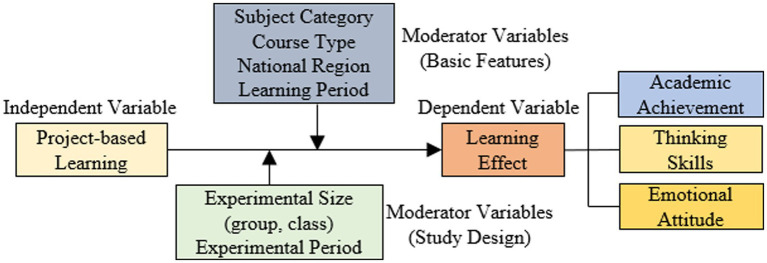
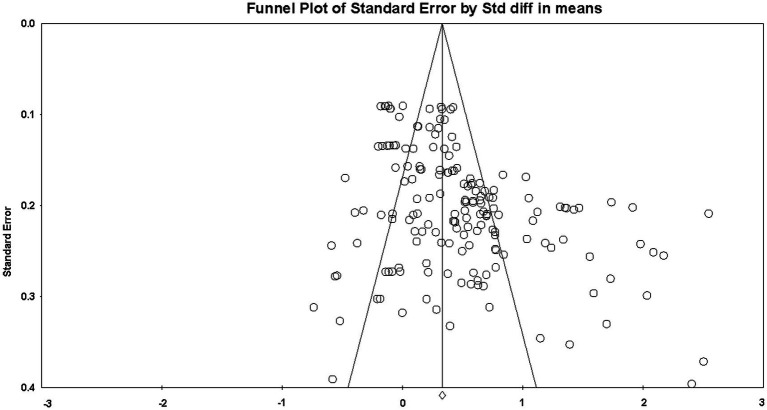
- Analyses were conducted in Comprehensive Meta Analysis 3.0, including publication bias tests (funnel plot, Begg’s test, Trim and Fill, Fail-safe N), heterogeneity tests (Q, I²), effect-size synthesis using standardized mean differences (SMD), and moderator analyses for country region, subject area, course type, academic section, class size, group size, and experiment period.
## Limitations
- The paper states that some PBL studies lacked sufficient statistical information for inclusion, and most studies did not provide a specific classification of learning effectiveness, limiting more detailed analysis.
- The text also makes evident that the meta-analysis had high heterogeneity (I² = 87.4%, Q = 1496.2, p < 0.001); this is not framed as a limitation by the authors but does indicate substantial between-study variability.
- The authors note that the included literature was weighted toward primary and secondary education, with less research on universities and young children; this is stated by the paper as a direction for future research.
Model-written summary. Check it against the paper before relying on it.
Integrity signals
Registry
Cites
Statistics
Figures
Verification
Claims the paper makes
1 Valid · 0 Not valid · 6 Not checked · 57 Own results and interpretations
A result the paper reports from its own data — it cites no other source for it, so there is none to check. The quote shows it is in the paper.
In the paper
“Moderately positive impact (SMD = 0.650), and the total effect values for affective attitudes and thinking skills were 0.389 and 0.386, respectively.”
§ A study of the impact of project-based learning on student learning effects: a meta-analysis study > Results > Results about problem of studies’ fields
plainstates a cause- Asserted: passes — The authors put it forward as true.
- Checkable: passes — It can be checked against evidence.
- Load-bearing: passes — The paper’s conclusions depend on it.
- Based: passes — The paper gives a reason why it holds.
- Rests on 3 assumptions not shown here.
A result the paper reports from its own data — it cites no other source for it, so there is none to check. The quote shows it is in the paper.
In the paper
“and also had moderate positive effects on learning motivation (SMD = 0.401) and learning attitudes (SMD = 0.536)”
§ A study of the impact of project-based learning on student learning effects: a meta-analysis study > Results > Results about problem of studies’ fields
plainstates a cause- Asserted: passes — The authors put it forward as true.
- Checkable: passes — It can be checked against evidence.
- Load-bearing: passes — The paper’s conclusions depend on it.
- Based: passes — The paper gives a reason why it holds.
- Rests on 2 assumptions not shown here.
A result the paper reports from its own data — it cites no other source for it, so there is none to check. The quote shows it is in the paper.
In the paper
“computational thinking skills (SMD = 0.719) had the most significant effect”
§ A study of the impact of project-based learning on student learning effects: a meta-analysis study > Results > Results about problem of studies’ fields
plainstates a cause- Asserted: passes — The authors put it forward as true.
- Checkable: passes — It can be checked against evidence.
- Load-bearing: passes — The paper’s conclusions depend on it.
- Based: passes — The paper gives a reason why it holds.
- Rests on 2 assumptions not shown here.
A result the paper reports from its own data — it cites no other source for it, so there is none to check. The quote shows it is in the paper.
In the paper
“its effect on student learning outcomes was not significant (SMD = 0.061, p = 0.429 > 0.05)”
§ A study of the impact of project-based learning on student learning effects: a meta-analysis study > Results > Results about problem of studies’ fields
plain- Asserted: passes — The authors put it forward as true.
- Checkable: passes — It can be checked against evidence.
- Load-bearing: passes — The paper’s conclusions depend on it.
- Based: passes — The paper gives a reason why it holds.
- Rests on 2 assumptions not shown here.
A result the paper reports from its own data — it cites no other source for it, so there is none to check. The quote shows it is in the paper.
In the paper
“Moderately positive impact (SMD = 0.650), and the total effect values for affective attitudes and thinking skills were 0.389 and 0.386, respectively.”
§ A study of the impact of project-based learning on student learning effects: a meta-analysis study > Results > Results about problem of studies’ fields
plainstates a cause- Asserted: passes — The authors put it forward as true.
- Checkable: passes — It can be checked against evidence.
- Load-bearing: passes — The paper’s conclusions depend on it.
- Based: passes — The paper gives a reason why it holds.
- Rests on 3 assumptions not shown here.
24 more claims
Create a free account to see all 64 claims and every source verdict.
- Probably not a substantial claim. 10
- It may state two separate claims as one. 31
- The quote only partly states this claim. 3
Claims other papers make about this one
Each is checked against this paper’s own text: does it say what the citing paper says it does?
The cited source says what the claim attributes to it.
In the citing paper
“Several meta-analyses and systematic reviews have synthesized the effects of PBL in education, demonstrating positive impacts on academic achievement (Chen and Yang, 2019; Zhang and Hu, 2019; Zhang and Ma, 2023).”
From Can project-based learning improve students’ mathematics learning outcomes: a three-level meta-analysis (2026) · cites this paper as Zhang and Ma, 2023
The cited source says what the claim attributes to it.
In the citing paper
“Conversely, Zhang and Ma (2023) report stronger effects of PBL in Asia, especially Southeast Asia, than in Western Europe and North America.”
From Can project-based learning improve students’ mathematics learning outcomes: a three-level meta-analysis (2026) · cites this paper as Zhang and Ma, 2023
The cited source says what the claim attributes to it.
In the citing paper
“However, some research reports non-significant effects on non-cognitive outcomes (Zhang and Ma, 2023; Chen and Yang, 2019).”
From Can project-based learning improve students’ mathematics learning outcomes: a three-level meta-analysis (2026) · cites this paper as Zhang and Ma, 2023
The cited source says what the claim attributes to it.
In the citing paper
“Zhang and Ma (2023) demonstrated that interventions lasting 9–18 weeks produce the most significant effects, with diminishing returns beyond 18 weeks.”
From Can project-based learning improve students’ mathematics learning outcomes: a three-level meta-analysis (2026) · cites this paper as Zhang and Ma, 2023
The cited source says what the claim attributes to it.
In the citing paper
“Zhang and Ma (2023) confirmed advantages for small classes, senior high schools, and groups of 4–5 students.”
From Can project-based learning improve students’ mathematics learning outcomes: a three-level meta-analysis (2026) · cites this paper as Zhang and Ma, 2023
1 more claim about this paper
Create a free account to see every claim other papers make about this one.
Self-check
Percentages, sums and reported differences re-computed from the paper’s own numbers.
Each contradiction between two passages listed here was confirmed by an independent check.
Rated minor: it would not touch a result — a value no result rests on, a p-value that stays on the same side of the significance level, or a conflict that is clerical, resolved elsewhere in the paper, or outside its own findings.
In the paper
§ A study of the impact of project-based learning on student learning effects: a meta-analysis study > Results > Results about problem of studies’ fields
“This study included 190 experimental data from 66 empirical research papers, and as shown in Table 2, the combined effect value of the impact of project-based learning on student learning outcomes was 0.441, close to 0.5 and p < 0.001, indicating that project-based learning has a large degree of impact on learning outcomes and is an effective teaching approach.”
§ A study of the impact of project-based learning on student learning effects: a meta-analysis study > Results > Results about problem of studies’ fields
“when the ES is less than 0.2, it means that there is a small effect impact, when the ES is between 0.2–0.8 means that there is a moderate effect, when the ES > 0.8 means that there is a significant effect impact.”
Citations
Cites
Preferred Reporting Items for Systematic Reviews and Meta-Analyses: The PRISMA Statement
Moher, D., Liberati, A., Tetzlaff, J., Altman, D. G., & The PRISMA Group (2009) · PLoS Medicine · doi:10.1371/journal.pmed.1000097 · Cited by 64,042 · cited 2×
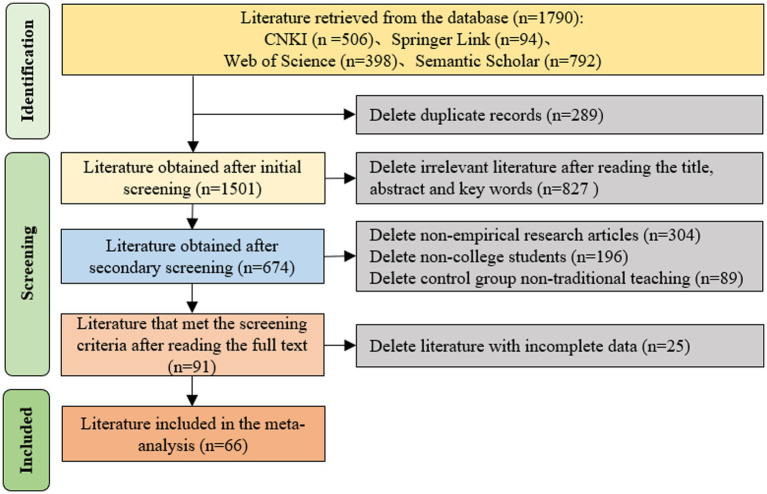
“To find articles that meet the subject matter requirements, this study used the (Page, 2021) process for literature processing (Vrabel, 2009), the literature search, screening, and inclusion process is shown in Figure 2.”
Preferred reporting items for systematic reviews and meta-analyses: the PRISMA Statement.
(2009) · PubMed Central · Cited by 44,859
Quantifying heterogeneity in a meta‐analysis
Higgins, J. P. T., & Thompson, S. G. (2002) · Statistics in Medicine · doi:10.1002/sim.1186 · Cited by 36,763
Page, M. J., Moher, D., Bossuyt, P. M., Boutron, I., Hoffmann, T. C., Mulrow, C. D., Shamseer, L., Tetzlaff, J. M., Akl, E. A., Brennan, S. E., et al. (2021) · BMJ · doi:10.1136/bmj.n160 · Cited by 13,262 · cited 2×
“To find articles that meet the subject matter requirements, this study used the (Page, 2021) process for literature processing (Vrabel, 2009), the literature search, screening, and inclusion process is shown in Figure 2.”
MethodPrimary, Secondary, and Meta-Analysis of Research
GLASS, G. V. (1976) · Educational Researcher · doi:10.3102/0013189x005010003 · Cited by 4,890 · cited 1×
“To ensure the quality of the study, this study strictly followed the meta-analysis criteria proposed by Glass (1976), which was mainly divided into four assessment procedures: literature collection, literature coding, effect size calculation, and moderating variable analysis, and finally a…”
MethodHung, C., Hwang, G., & Huang, I. (2012) · Educational Technology & Society · Cited by 635
Publication Bias in Meta‐Analysis
Rothstein, H. R., Sutton, A. J., & Borenstein, M. (2005) · Publication Bias in Meta‐Analysis · doi:10.1002/0470870168.ch1 · Cited by 603
Tseng, K.-H., Chang, C.-C., Lou, S.-J., & Chen, W.-P. (2013) · International Journal of Technology and Design Education · doi:10.1007/s10798-011-9160-x · Cited by 554
Kilpatrick, W. H. (1918) · Teachers College Record: The Voice of Scholarship in Education · doi:10.1177/016146811801900404 · Cited by 431
The effect of authentic project‐based learning on attitudes and career aspirations in STEM
Beier, M. E., Kim, M. H., Saterbak, A., Leautaud, V., Bishnoi, S., & Gilberto, J. M. (2019) · Journal of Research in Science Teaching · doi:10.1002/tea.21465 · Cited by 321
Research works printed but not linked: 41
- Changming, 2020, Why do we need project-based learning?, Primary Secondary School Manage, 8, 5
- Chung, 2021, Students’ perception of self-regulated learning in a project-based learning
- Cohen, 1988, Statistical power analysis for behavioral science, Technometrics, 31, 499
- Cong, 2021, Research on the design and implementation of project-based teaching of high school chemistry based on STSE education
- 2020, Research on the impact of project-based learning STEM curriculum on elementary school students’ problem solving ability [Master’s thesis].
- Gao, 2020, Research on the teaching model of high school biology unit based on project-based learning
- Hongxing, 2017, Project-based learning: classroom teaching activities to cultivate students’ core literacy, J. Lanzhou Univ., 6, 165, 10.13885/j.issn.1000-2804.2017.06.021 · doi:10.13885/j.issn.1000-2804.2017.06.021
- Jina, 2022, The application of project-based learning based on problem awareness in primary school mathematics classroom
- Jingfu, 2002, Project-based learning model, Foreign Educ. Res., 11, 18
- Keleşoğlu, 2011, nvestigating the effects of project-based learning on students’ Academic Achievement and Attitudes Towards English Lesson. vol.1
- Lei, 2020, The design and implementation of project-based learning for high school chemistry teaching
- Ling, 2020, Design and practice of teaching activities based on project-based learning to cultivate primary school students’ computational thinking
- Linxiao, 2020, The application of project learning in senior high school biology classroom study
- Lu, 2020, Research on teaching design of junior high school information technology curriculum based on project-based learning
- Luo, 2020, Research on the development of computational thinking skills based on project-based learning
- Ma, 2022, Project learning self-efficacy in elementary programming impact study
- Ma, 2021, Cooperative reasoning learning to promote the development of higher-order thinking, Educ. Dev. Res., 24, 64, 10.14121/j.cnki.1008-3855.2021.24.011 · doi:10.14121/j.cnki.1008-3855.2021.24.011
- Mark, 2022, The effectiveness of PBL classes using multimedia tools: a case study of a university liberal arts English class, Multimedia Lang. Teach., 25, 237
- Mingquan, 2020, Project learning in senior high school geography teaching research and practice
- Rui, 2020, An empirical study on the development of computational thinking skills of high school students based on project-based learning
- Ruiz-Rosa, 2021, Project-Based Learning as a tool to foster entrepreneurial competences (El Aprendizaje Basado en Proyectos como herramienta para potenciar la competencia emprendedora), Cult. Educ., 33, 1, 10.1080/11356405.2021.1904657 · DOI
- ShiXuan, 2017, Research on the design of project-based learning activities based on Moodle
- Wang, Project learning perspective of organic chemistry teaching design and implementation of high school
- Wang, Design and practice of open source hardware project-based learning for primary schools with problem-solving skills development
- Wang, 2022, Research on the design and application of a comprehensive practical activity curriculum for primary schools based on project-based learning
- Wei, 2020, The impact of cooperative learning on students' learning outcomes: A meta-analysis based on 48 experimental or quasi-experimental studies, Shanghai J. Educ. Res., 7, 34, 10.16194/j.cnki.31-1059/g4.2020.07.008 · doi:10.16194/j.cnki.31-1059/g4.2020.07.008
- Weihong, 2019, Promoting Students' high-level thinking development through project-based learning -- design and implementation of "baby market" exploration project, Basic Educ Curric, 6, 20
- Wenlan, 2019, Does project-based learning play a role in learning? -- meta-analysis based on 46 experimental and quasi-experimental studies, Res. Visual Educ., 2, 95, 10.13811/j.cnki.eer.2019.02.012 · doi:10.13811/j.cnki.eer.2019.02.012
- Xiaolei, 2021, Research on the design and practice of high school information technology curriculum based on project-based learning
- Xu, 2022, A practical study of project-based learning for developing core literacy in subjects
- Xuezhi, 2022, Research on the design and practice of project-based learning in junior high school mathematics curriculum
- Yanan, 2020, An experimental study of Jigsaw-based project-based learning in elementary school IT class
- Yang, 2020, Practical research on teaching reform of information technology curriculum in Baochang No. 1 Middle School
- Yating, 2022, Research on the design and practice of teaching elemental compounds in high school based on project-based learning
- Yexin, 2019, The application of robot project learning in middle school teaching research
- Ying, 2022, A study on the influence of project-based teaching on the intrinsic motivation of private university students’ English learning, J. Sci. Educ, 13, 29, 10.16400/j.cnki.kjdk.2022.13.010 · doi:10.16400/j.cnki.kjdk.2022.13.010
- Yuan, 2017, A Study on the Teaching Reform of Information Technology Course in Baochang No.1 Middle School - Taking “Project-based Learning” as an Example
- Yun, 2022, Practical exploration of project-oriented deep ritual education -- take the project-oriented learning of searching for roots Xu Huiyuan in grade 5 as an example, Shanghai J. Educ. Res., 9, 64, 10.16194/j.cnki.31-1059/g4.2022.09.006 · doi:10.16194/j.cnki.31-1059/g4.2022.09.006
- Yuting, 2022, Practical research on project-based learning based on the development of scientific inquiry ability in secondary school biology teaching
- Zhang, 2022, A study on the effect of project-based teaching on the intrinsic motivation of private university students’ English learning, J. Sci. Educ., 13, 29, 10.16400/j.cnki.kjdk.2022.13.010 · doi:10.16400/j.cnki.kjdk.2022.13.010
- Zhang, 2022, Based on the junior high school students information technology subject core. Mesh type teaching mode design and application research
Cited by
Items 301–400 of 428
Astuti, D., Retnawati, H., Prahmana, R. C. I., et al. (2026) · STEM Education · doi:10.3934/steme.2026015
Xue, H., Kasuma, S. A. A., & Feng, L. (2026) · Frontiers in Psychology · doi:10.3389/fpsyg.2026.1750394
Luna, C. L. T., Cabrera, S. M. M., & Reyes, E. J. C. (2026) · INNOVA Research Journal · doi:10.33890/innova.v11.n1.especial.2026.2853
Xu, G. (2026) · Frontiers in Psychology · doi:10.3389/fpsyg.2026.1800462
“The effectiveness of PBL has been widely verified in higher education around the world (Shin, 2018; (Zhang and Ma, 2023).”
Young Austrian Engineers Contest - A Competition to Promote Student
Probst, A., Bernsteiner, R. C., & Pachatz, W. (2026) · Lecture notes in networks and systems · doi:10.1007/978-3-032-18885-4_37
Empowering Education and Training with Advanced AI and Affective Facial Analysis
Negrea, A. S., Bogdan, C., Modran, H. A., & Marin, N. A. (2026) · Lecture notes in networks and systems · doi:10.1007/978-3-032-18885-4_8
Murniawaty, I., Farliana, N., Sehabuddin, A., & Solihat, A. N. (2025) · Indonesian Journal Of Educational Research and Review · doi:10.23887/ijerr.v8i3.97029
Does Project-Based Learning Equally Foster Critical and Creative Thinking?
Arfin, A., Wulanningtyas, M. E., Louismono, A. L., & Stepanus, O. (2026) · Riemann Research of Mathematics and Mathematics Education · doi:10.38114/riemann.v8i1.180
PROJECT ACTIVITY IN VOCATIONAL EDUCATION: ESSENCE, FEATURES AND PROSPECTS OF IMPLEMENTATION
ЄСІКОВА, І. (2026) · OPEN EDUCATIONAL E-ENVIRONMENT OF MODERN UNIVERSITY · doi:10.28925/2414-0325.2026.203 · Cited by 1
Kaur, R. (2026) · IGI Global eBooks · doi:10.4018/979-8-3373-7102-3.ch008
Integrating STEAM Education into Project Based Learning by Exploring Ethyl Acetate in Nail Polish
Wan, L., Zhong, H., Hu, J., & Chen, X. (2026) · Journal of Chemical Education · doi:10.1021/acs.jchemed.5c01642 · Cited by 1
Uribe, L. F. P., & Moreno, A. O. V. (2025) · Perspectivas en Inteligencia · doi:10.47961/2145194x.793
Niculau, E. D. S., Carvalho, L. L., Alves, M. D. A., et al. (2026) · Interdisciplinary Journal of Environmental and Science Education · doi:10.29333/ijese/18526
“…the “ Metodologias de ensino por aprendizagem baseada em projetos (ABP) e sequência de ensino por investigação (SEI) [Project-based learning teaching methodologies and investigation learning sequence] ” was prioritized (Astawa et al., 2017; Bell, 2010; Pérez-Sánchez et al., 2018; Zhang & Ma, 2023).”
The impact of project-based learning on employability of Danang University of Economics students
Le, T. T. V., Pham, A. T., Phan, N. D. H., et al. (2026) · Proceedings of International Academia · doi:10.65956/procia.2026.91
“Zhang and Ma (2023) found that PBL leads to moderate to large improvements in academic achievement, motivation, and higher-order thinking skills.”
InfluentialAlisawi, T. A. J., Al-Ani, M. M. T., Sultan, R. R., et al. (2025) · International Conference on Decision Aid Sciences and Applications (DASA) · doi:10.1109/dasa68193.2025.11499092
Xie, X., Chen, Y., Luo, L., & Cui, Y. (2026) · Communications in computer and information science · doi:10.1007/978-981-95-7731-6_30
Phung, V. H., Phung, T. T. L., Nguyen, T. T. H., & Nguyen, T. T. P. (2026) · Journal of Baltic Science Education · doi:10.33225/jbse/26.25.351
Extending the Pedagogical Lens: From Research-Based Learning to Hybrid Innovation Models
Restivo, M. T., Gfrerer, M., & Zvacek, S. M. (2026) · Lecture notes in networks and systems · doi:10.1007/978-3-032-18891-5_30
Feng, C., Liu, X.-C., Meng, Q.-X., et al. (2025) · International Conference on Education and E-Learning (ICEEL) · doi:10.1145/3789859.3789924
“This finding is also well-supported by previous studies [8][9][10].”
Tambis, D. J. E., Peñaflor, C. M. L. R., Buenconsejo, C. M. M., et al. (2026) · International Journal of Research and Review · doi:10.52403/ijrr.20260530
Polishchuk, S., & Horbatiuk, O. (2026) · Scientific Bulletin of the Izmail State University of Humanities Section «Pedagogical sciences» · doi:10.31909/26168812.2026-(74)-20.195-204
The role of stimulus characteristics in visual attention: an eye-tracking study
Berger, E., & Hochhauser, M. (2026) · BMC Psychology · doi:10.1186/s40359-026-04785-y
“A recent meta-analysis further supported this view, demonstrating that incorporating familiar, real-world contexts into learning enhances academic achievement, particularly when new information aligns with students’ prior knowledge [61].”
A Study on a Geography Project-Based Learning Model Aimed at Cultivating Spatial Thinking
Wei, H., & Zhao, Y. (2026) · Journal of Geography · doi:10.1080/00221341.2026.2667278
Canut-Montalva, A., Rizo-Maestre, C., Martínez-López, J., et al. (2026) · Sustainability · doi:10.3390/su18105075
Floril, C. P., Floril, M. D. R. P., García, C. D. R., Sains, M. A. C., Fiallos, J. R. M., & Pomboza, S. A. R. (2026) · Frontiers in Education · doi:10.3389/feduc.2026.1847905 · Cited by 4
Andrini, V. S., Hidayati, U., Etika, E. D., Yusuf, I., & Ulfa, S. U. (2026) · Frontiers in Education · doi:10.3389/feduc.2026.1812582 · Cited by 1
Sembiring, A. K., Dinata, M., Rizky, R., et al. (2026) · JPI (Jurnal Pendidikan Indonesia) · doi:10.23887/jpi-undiksha.v15i1.103315
From Script to Co-Pilot: Human-AI Framework for Reclaiming Teacher Agency in K-8 Curricula
Wang, L., Wang, Y., Lewis, T. D., & Dueñas, G. (2026) · IGI Global eBooks · doi:10.4018/979-8-3373-5027-1.ch006
Saputra, I., Ninsyi, D. S., Aprianty, D. W., & Pratama, N. H. (2026) · Indonesian Journal of Innovation Multidisipliner Research · doi:10.69693/ijim.v4i2.886 · Cited by 2
Moderate Learning Gains Through PjBL Interactive E Modules
Intihana, M., Sumartiningsih, S., Prasetya, A. T., et al. (2026) · Academia Open · doi:10.21070/acopen.11.2026.14251
Tamayo, J. M. J. (2026) · Arandu-UTIC. · doi:10.69639/arandu.v13i2.2230
“Los tamaños del efecto reportados oscilan entre moderados y grandes, con el metaanálisis internacional de mayor alcance (Chen et al., 2023) situando la mejora en SMD = 0,443, y los estudios ecuatorianos reportando diferencias de hasta 27 puntos porcentuales a favor del grupo ABP frente al grupo…”
InfluentialParsons, B. E., & Watson, B. (2026) · Frontiers in Veterinary Science · doi:10.3389/fvets.2026.1828852
Vivek, C. M., Srividhya, P. K., Ramkumar, P., et al. (2026) · International Journal of Mechanical Engineering Education · doi:10.1177/03064190261457741
Using issues of water to CURE your teaching: STEM education is civic education
Smyth, D. (2026) · Journal of Microbiology & Biology Education · doi:10.1128/jmbe.00110-26
Czap, H., Miteza, I., & Czap, N. V. (2026) · Review of Behavioral Economics · doi:10.1108/rbe-09-2025-0083
Karimi, N., & Yahyavi, M. (2026) · Journal of Science Teacher Education · doi:10.1080/1046560x.2026.2642420
Kan, J.-S., Myung-Soon, K., & Lee, Y. E. (2026) · The Journal of Korean Institute of Information Technology · doi:10.14801/jkiit.2026.24.5.57
Muñoz, M. C. Z., Napa, C. M. V., Pontón, M. I. S., López, L. K. Z., López, O. M. Z., & Cabrera, D. M. V. (2026) · Revista Científica Multidisciplinaria OGMA. · doi:10.69516/q0r1gm65
Wardi, M. (2026) · British Journal of Religious Education · doi:10.1080/01416200.2026.2691222
Компетентностно-ролевое моделирование подготовки топ-специалистов в сфере информационных технологий
Алюнов, А. Н., Feklin, V., & Сергеевич, Т. Р. (2026) · Sovremennye informacionnye tehnologii i IT-obrazovanie. · doi:10.25559/sitito.022.202601.183-193
Novitasari, L., Rozzaq, G. A., Komarudin, Dewi, E. S., Rosyada, I. A., Abidin, M. F. Z., Fanny, A. M., & Nugraheni, L. (2026) · Paedagogie · doi:10.31603/wwqc5c96
Developing talented students in robotics, AI, and coding with Work-Integrated Learning
Malakul, S., Sangkawetai, C., Joochim, O., Tirasuntarakul, N., Kaewkamnerd, S., & Sereevoravitgul, T. (2026) · Computer Science Education · doi:10.1080/08993408.2026.2694764
Man, N. Y. T., ELMALI, Ş., Lommatzsch, A., & Tiemann, R. (2026) · Journal of Chemical Education · doi:10.1021/acs.jchemed.5c01713 · Cited by 1
INTERACTIVE FORMS OF LEARNING AS A MEANS OF DEVELOPING SOFT SKILLS FOR FUTURE TEACHERS
Бобро, Л. В., & Tikhonov, A. M. (2026) · Continuing Professional Education Theory and Practice · doi:10.28925/2412-0774.2026.2.7
Murali, R., Dhanalakshmy, D. M., Sunny, S., & Rajagopal, V. (2026) · IEEE Global Engineering Education Conference (EDUCON) · doi:10.1109/educon67543.2026.11574453
“Research highlights that project-based learning (PjBL) boosts academic outcomes by increasing student engagement, knowledge retention, academic performance, and higher order thinking [1], [2], [3].”
Papademas, M., Ziouvelou, X., Karpouzis, K. C., & Karkaletsis, V. (2026) · IEEE Global Engineering Education Conference (EDUCON) · doi:10.1109/educon67543.2026.11574410
Gaponov, I., Collier, O., Charitonidis, A., Tozadore, D. C., & Yan, Y. (2026) · IEEE Global Engineering Education Conference (EDUCON) · doi:10.1109/educon67543.2026.11574344
Implementación del aprendizaje basado en proyectos en la asignatura Taller Integral de Saberes
Aguirre, É. F. H., Guamán, F. V. O., & Guamán, S. V. O. (2026) · Sílex · doi:10.53870/silex.2026161450
Loganathan, S., Chermakani, G., & Venkatesan, S. K. (2026) · Frontiers in Education · doi:10.3389/feduc.2026.1838734
Sahertian, P., & Kurniawati, M. (2026) · Proceeding International Conference on Digital Education and Social Science · doi:10.55506/icdess.v3i1.177
Bermudo, D. M. (2026) · PSIQUEMAG/ Revista Científica Digital de Psicología · doi:10.18050/psiquemag.v15i1.4313
Bui, N. (2026) · Journal of Leadership and Quality in Education · doi:10.65956/leqa.2026.126
“Project-based and active learning can support transferable skills (Guo et al., 2020; Zhang & Ma, 2023), but this study shows a necessary condition.”
Aminoroaya, H., & Najafi, A. (2026) · Research Square · doi:10.21203/rs.3.rs-9805121/v1
Vélez, V. L. A., Bermello, G. L. V., & Carrera, J. M. (2026) · REVISTA CIENCIAS PEDAGÓGICAS E INNOVACIÓN · doi:10.26423/t80tq189
“Esta evidencia se vincula al Aprendizaje Basado en Proyectos y el design thinking , que promueven la resolución de problemas, la ideación y la construcción de soluciones en contextos auténticos (Zhang y Ma, 2023; Alvarado, 2025).”
Ntaganzwa, O., Knobloch, N. A., Wang, H.-H., & Radhakrishna, R. (2026) · Journal of Agricultural Education · doi:10.5032/jae.v67i3.3213
Hayati, R., Niswanto, Rasyid, S., et al. (2026) · Journal of Education Research and Evaluation · doi:10.23887/jere.v10i1.107785
Galuza, A. A., Savchenko, A. A., Lyubchyk, L. M., Akhiiezer, О., & Pogorelov, S. V. (2026) · Industry and Higher Education · doi:10.1177/09504222261469622 · Cited by 1
Affara, F. F. (2026) · Decision Sciences in Human Learning and Development · doi:10.64268/decision.v1i1.11
“Similar findings have been identified in previous educational studies showing that project-oriented learning promotes students’ communication skills and classroom engagement during English language learning activities (Imbaquingo & Cárdenas, 2023; Zhang & Ma, 2023).”
Reyes, J. M., Rivera, P. L. G., Magallanes, H. F. I., & Martínez, C. M. A. (2026) · Frontiers in Education · doi:10.3389/feduc.2026.1911517
Andari, T., Lusiana, R., & Susanti, V. D. (2026) · Journal of Physics Conference Series · doi:10.1088/1742-6596/3276/1/012026
Integrated Teaching Model Based on Project-Based Learning for Physics Education
Aubakir, I., Rēvalde, G., & Murzagaliyeva, A. (2026) · Education Sciences · doi:10.3390/educsci16081189 · Cited by 1
Aprendizaje basado en proyectos para la enseñanza de prácticas agronómicas sostenibles.
Uyaguari, J. L. P., & Herrera-Sánchez, D. J. (2024) · Revista de Investigación y Liderazgo · doi:10.63618/omd/revinvlid/v1/n4/24
“Esta estructura respondió a la evidencia que destacó la autenticidad del problema, la interdisciplinariedad, la evaluación continua y la elaboración de productos como elementos centrales del aprendizaje basado en proyectos (Zhang & Ma, 2023; Sánchez-García & Reyes-de-Cózar, 2025).”
Nugroho, A., Abas, A. N., Purbasari, A., et al. (2026) · Kontribusi Jurnal Penelitian dan Pengabdian Kepada Masyarakat · doi:10.53624/kontribusi.v7i1.959
Yeboah, A. K., Dadson, Y. A., Mohammed, Z., & Hussein, M. (2026) · Artificial Intelligence in Education · doi:10.1108/aiie-07-2025-0184 · Cited by 4
Öztürk, C. (2026) · Research Square · doi:10.21203/rs.3.rs-10331833/v1
SPEAK UP Pedagogy Produces Highest Expressive and Analytical Speaking Scores in Students
Inra, M., Nazurty, N., & Syarif, A. (2026) · Academia Open · doi:10.21070/acopen.11.2026.14870
Witkowska-Tomaszewska, A. (2026) · Forum Oświatowe · doi:10.34862/fo.2026.1.12
Igarza, L. M. Z., Zúñiga, S. D., Fernández-Ochoa, Y., Pérez-Campdesuñer, R., Sánchez-Rodríguez, A., & García-Vidal, G. (2026) · Cogent Education · doi:10.1080/2331186x.2026.2701517
Fitriani, V., Borhan, M. T., & Tawang, A. (2026) · Jurnal Penelitian Pendidikan IPA · doi:10.29303/jppipa.v12i7.15568
Tulebekova, A., Aldungarova, A. K., Ryvkina, N., & Bakirova, D. (2026) · Frontiers in Education · doi:10.3389/feduc.2026.1915493
Vidal, S. L., Curi, H. T., & Ferretti, E. C. (2026) · Revista Ocupación Humana · doi:10.25214/25907816.1978
“A aprendizagem baseada em projetos favorece a conexão entre teoria e prática, incentivando o pensamento crítico, a criatividade e a resolução de problemas centrado na pessoa (Zhang & Ma, 2023).”
Irmayanti, Khoiron, A. M., Suryani, H., et al. (2026) · MATEC Web of Conferences · doi:10.1051/matecconf/202642303003
“This finding is consistent with the results of [14], which showed that PjBL is significantly superior to traditional models in terms of learning achievement.”
Project-based learning as a tool for developing teamwork skills in IT students
SPIRINA, Y., Gorbunova, N., Popova, N., Kopbalina, S. S., Tursyngaliyeva, G., & Samoilova, I. (2026) · Frontiers in Education · doi:10.3389/feduc.2026.1913646
Understanding students' mathematical dispositions through metaphorical representations
Wei, Z., Zuo, H., Wijaya, T. T., & Wang, Y. (2026) · Asian Education and Development Studies · doi:10.1108/aeds-08-2025-0395
Intelligent Evaluation of STEM Project-Based Learning Reports Based on a HITL Multi-Agent System
Yang, H., Zhang, R., & Feng, Y. (2026) · Electronics · doi:10.3390/electronics15163614
Thongpanit, P., Thongpanit, P., & Onkhum, P. (2026) · Eurasia Journal of Mathematics Science and Technology Education · doi:10.29333/ejmste/19139
“Related active-learning approaches show comparable benefits: project-based learning yields medium-to-large gains in achievement (Chen & Yang, 2019; Zhang & Ma, 2023), and problem-based and inquiry-based learning improve critical thinking, including in science (Arifin et al., 2025; Liu & Pásztor,…”
Regional Language Interference in Indonesian Phonology among Elementary School Students
Nahak, K. B., Nahak, M. M. N., Lasi, F., Seran, Y., Lein, A. L., & Verdial, J. D. C. (2026) · Jurnal Penelitian dan Pengembangan Pendidikan · doi:10.23887/jppp.v10i1.102894
84Lernwelt Hochschule im Veränderungsprozess
Schumacher, F., & Seidl, T. (2026) · De Gruyter eBooks · doi:10.1515/9783111237473-006
Mutmainna, M., Istiyono, E., Haryanto, & Febriana, B. W. (2026) · Physical Review Physics Education Research · doi:10.1103/wgcy-66s2 · Cited by 3
A Stirling Example of Incorporating Hands on Analysis of a Model Engine in Thermodynamics
Walls, P. L. L., & Aurand, J. (2026) · ASEE Annual Conference & Exposition · doi:10.18260/1-2--59172
Project-based learning as a pedagogical shift in lab-oriented courses in higher education
Surya, M., Kanna, P. R., & Deepakkumar, R. (2026) · Frontiers in Education · doi:10.3389/feduc.2026.1828214
Maxim, B. R., Ghammam, A., Roy, M., Gandi, S., & Gujarathi, A. (2026) · ASEE Annual Conference & Exposition · doi:10.18260/1-2--60806
Kazemi, M., & Vaseghi, M. (2026) · ASEE Annual Conference & Exposition · doi:10.18260/1-2--60168
Rhomadona, E. Y., Latifah, S., & Suryani, Y. D. (2026) · SAKALIMA Pilar Pemberdayaan Masyarakat Pendidikan · doi:10.70211/sakalima.v3i3.571
“…dampak positif terhadap capaian belajar, motivasi, dan keterampilan belajar mahasiswa, meskipun efektivitasnya sangat bergantung pada kualitas desain pembelajaran, struktur proyek, mekanisme umpan balik, serta keselarasan antara aktivitas pembelajaran dan prosedur penilaian [9], [11], [12].”
Integrating Project-Based Green Education Learning in Environmental Chemistry Courses
Sumanik, N. B., Indrawati, N., Nurhidayah, et al. (2026) · Journal of Pedagogy and Education Science · doi:10.56741/iistr.jpes.001641
“Previous studies [13],[17],[18] have demonstrated that PjBL enhances learning outcomes, critical thinking, and scientific attitudes compared to conventional models.”
The Organizational Experience of Next Gen Learning Through Portrait of a Graduate
Campbell, K. (2026) · Digital Commons - DU (University of Denver) · doi:10.56902/etdcrp.2026.72
Villegas, G. J. F. (2026) · Prometeo Conocimiento Científico · doi:10.55204/pcc.v6i1.e161
Investigating Student Project Activities: The Service-Learning Model in Practice
Soloveva, S. V., & Gayazova, E. B. (2026) · Lecture notes in civil engineering · doi:10.1007/978-3-032-32653-9_58
Arifin, R., Widiastuti, Siregar, N. M., Fauzan, L. A., & Amirudin, A. (2026) · International Journal of Physical Education Fitness and Sports · doi:10.54392/ijpefs2632 · Cited by 1
“…meta-analysis also demonstrated that PjBL positively affects learning outcomes compared with traditional instruction, although its effectiveness may vary according to the field of study, duration of implementation, group size, project design, and quality of lecturer facilitation (Zhang & Ma, 2023).”
Silva, D. L., de Jesus, K. L. M., Catanes, J. G., Nagarit, N. B., Lictaoa, C. S., Leopoldo, M. P., Velasco, J. N., & Abestilla, G. D. (2026) · International Conference on Distance Education and Learning (ICDEL) · doi:10.1109/icdel70250.2026.11663795
“This is achieved by involving students in authentic, problem-centered tasks that incorporate technical, environmental, and socio-economic dimensions relevant to Circular Economy implementation [5,6].”
Jiménez-Gaona, Y., & Vivanco-Galván, O. (2026) · Frontiers in Education · doi:10.3389/feduc.2026.1868066
Pebrianti, L., Giatman, M., Sukardi, S., et al. (2026) · Jurnal Penelitian Pendidikan IPA · doi:10.29303/jppipa.v12i8.15830
“This gap provides a strong rationale for developing a learning intervention that integrates digital technology, authentic projects, and multidimensional competency assessment (Zhang & Ma, 2023).”
Rohmah, R. A., Hasnah Faizah, A. R., Erni, & Sinaga, M. (2026) · Education Sciences · doi:10.3390/educsci16091449
Wang, C., Zhang, W., & Cheng, J. (2026) · Frontiers in Psychology · doi:10.3389/fpsyg.2026.1868415
“For culturally responsive instructional adaptation, educators can first learn about students’ collaborative preferences, communication styles and engagement attitudes toward group work, rather than sub-jectively estimating team efficiency simply based on cultural identities (Zhang and Ma, 2023).”
InfluentialTrà, Đ. H., Thuần, N. T., & Linh, N. Q. (2026) · Multidisciplinary Science Journal · doi:10.31893/multiscience.2027246
“…size in educa tional interventions (Cohen, 1988) and is consistent with the upper range reported in recent meta analyses of project based learning in Asian science education contexts, where pooled effect sizes typically cluster between d = 0.50 and d = 0.80 (Chen & Yang, 2019; Zhang & Ma, 2023).”
InfluentialAlbaiti, A., Lepa, A., Hakimi, M., et al. (2026) · AMPLITUDO Journal of Science & Technology Innovation · doi:10.56566/amplitudo.v5i2.712
Owusu-Ansah, P. P., Steiner, R., Opoku–Asare, N. A., Kquofi, S., & Kankam, T. (2026) · Discover Education · doi:10.1007/s44217-026-01732-2 · Cited by 1
“This integrated concept ensures the CBT manual serves as a definitive bridge that aligns classroom pedagogy with the rigorous demands of the bamboo and rattan industry [11, 41].”
ABDİMANAPOVA, G., Aldeshov, S., Bülbül, H. İ., Zhaidakbayeva, L., & Altynbekov, S. (2026) · Bangladesh Journal of Multidisciplinary Scientific Research · doi:10.46281/bjmsr.v11i4.2942
Metadata
- Authors
- Zhang, L., & Ma, Y.
- Affiliations
- Chongqing Normal University (CN)
- Corresponding author
- Ma, Yan
- Venue
- Frontiers in Psychology
- Publisher
- Frontiers Media SA
- Published
- 2023-07-17
- Volume
- 14
- Pages
- 1202728-1202728
- ISSN
- 1664-1078 (ISSN-L)
- PMC
- PMC10411581
- OpenAlex
- W4384498111
- Semantic Scholar
- 62a083ea55ae0b7bcb659bba3159fada89e8945f
- Cited by
- 455
- References
- 47
- Citations by year
- 2026: 192 · 2025: 168 · 2024: 88 · 2023: 7
- FWCI
- 27.58
- Type
- journal article
- Language
- en
- Open access
- gold
- doi.org
- Licence
- Locations
- Frontiers in Psychology (publishedVersion, cc-by)
- PubMed Central (publishedVersion, cc-by)
- PubMed (publishedVersion)
- DOAJ (DOAJ: Directory of Open Access Journals) (submittedVersion, cc-by-sa)
- Funders
- Chongqing Normal University
- Division of Graduate Education
- Topics
- Social Sciences › Education › Problem and Project Based Learning
- Social Sciences › Psychology › Developmental and Educational Psychology › Innovative Teaching and Learning Methods
- Social Sciences › Education › Innovative Teaching Methods
- Keywords
- project-based learning, learning outcomes, academic performance, affective attitudes, thinking skills, moderating effect, group size, technology and engineering education, laboratory classes, upper secondary school, 21st century skills
About these checks
Registry, retraction, Cites and statistics results are computed, not judged, with one exception: a printed reference that no index lists is read once by a model before it counts as a citation error. Claims are extracted by a model and kept only when their quote appears verbatim in the text; each cited source is then checked, with a model’s help, for whether it says what the claim relies on. Those verdicts can be wrong — read the claim’s quote and the cited source before relying on one.
The claim verdicts this report counts are experimental: their accuracy is not yet measured.
A language model drew the claims from the paper on 2026-10-10, under version 3 of the claim definition (model deepseek-v4.1-flash, prompt extract-v3).
A second model labelled each claim on 2026-10-10 (model jev-1.13-20260917, definition revision gold-guideline-v0.2).
Statistics and arithmetic are recomputed, not judged.
Confidence bands are shown only for fields calibrated on our annotated test set. None is calibrated yet, so no band is shown.
What counts as a claim ›How we measure confidence ›How we check this ›
Are you an author, or do you see a problem with this page? Request a review
Data sources
Bibliographic data: Semantic Scholar, OpenAlex, Crossref.
Contains information from the Semantic Scholar Academic Graph Datasets, made available under the ODC Attribution License (ODC-BY 1.0).
Semantic Scholar’s data is described in: Kinney, R., et al. (2023). The Semantic Scholar Open Data Platform. arXiv:2301.10140.
