

A study of the impact of project-based learning on student learning effects: a meta-analysis study
Open accessThe DOI matches its Crossref record; 48 of the 48 references it cites were found in a registry or an index; 2 of the 9 sources its claims cite were checked for support.
Abstract
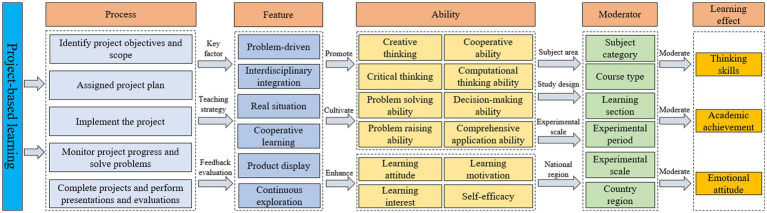
Introduction: With the educational reform for skills in the 21st century, a large number of scholars have explored project-based learning. However, whether project-based learning can effectively improve the learning effect of students has not yet reached a unified conclusion. Method: This study uses a meta-analysis method to transform 66 experimental or quasi-experimental research papers based on project-based learning over the past 20 years into 190 effect values from the sample size, mean, and standard deviation of experimental data during their experiments, and to conduct in-depth quantitative analysis. Results: The results of the study showed that compared with the traditional teaching model, project-based learning significantly improved students' learning outcomes and positively contributed to academic achievement, affective attitudes, and thinking skills, especially academic achievement. Discussion: The results of the moderating effects test indicated that the effectiveness of project-based learning and teaching was influenced by different moderating variables, including country region, subject area, type of course, academic period, group size, class size, and experimental period : (1) from the perspective of country geography, the effects of project-based learning in Asia, especially in Southeast Asia, were significantly better than those in Western Europe and North America; (2) in terms of curriculum, project-based learning promotes student learning effects more significantly in engineering and technology subjects, and is better applied in laboratory classes than in theory classes; (3) from a pedagogical point of view, project-based learning is more suitable for small group teaching, in which the group size is 4-5 people teaching the best results; (4) in view of the experimental period, 9-18 weeks is more appropriate and has more obvious advantages for application at the high school level.
Overview
CoChat Summary
## TL;DR
This meta-analysis synthesizes 66 experimental or quasi-experimental studies (190 effect sizes) and finds that project-based learning (PBL) significantly improves student learning outcomes versus traditional teaching. The overall effect is moderate, with stronger effects in Asia, engineering/technology, laboratory classes, high school, small classes, and groups of 4–5 students.
## Key findings
- Across 66 empirical studies and 190 effect sizes, the combined effect of PBL on student learning outcomes was SMD = 0.441, p < 0.001, indicating a moderate positive effect.
- PBL had significant positive effects on all three outcome types reported: academic achievement (SMD = 0.650), thinking skills (SMD = 0.387, p < 0.001), and affective attitudes (SMD = 0.379, p < 0.001).
- Moderator analyses found stronger effects in Asia, especially Southeast Asia (SMD = 0.684), than in Western Europe and North America; the effect in North America was not significant (SMD = 0.061, p = 0.429).
- The largest subgroup effects were reported for high school (SMD = 0.720), engineering and technology (SMD = 0.619), experimental/laboratory classes (SMD = 0.498), groups of 4–5 students (SMD = 0.909), and 9–18 weeks of intervention (SMD = 0.673).
## Methods
- The study is a meta-analysis of project-based learning interventions compared with traditional teaching.
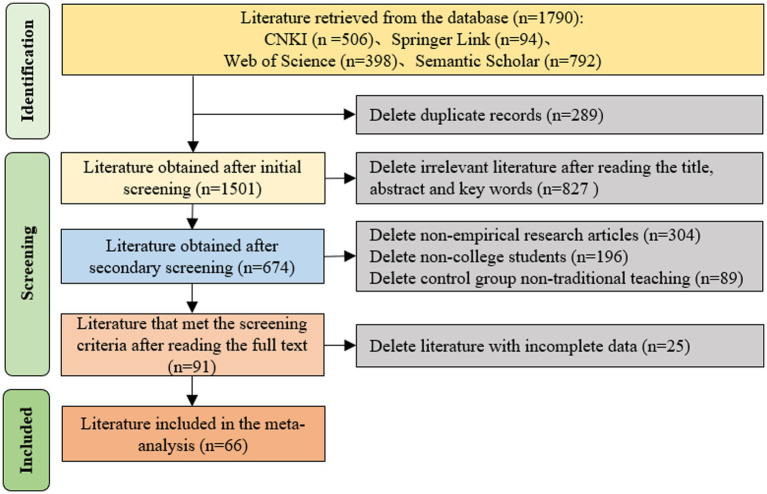
- The sample consisted of 66 experimental or quasi-experimental papers published from 2003 to 2023, yielding 190 effect sizes; the authors extracted sample size, mean, and standard deviation data.
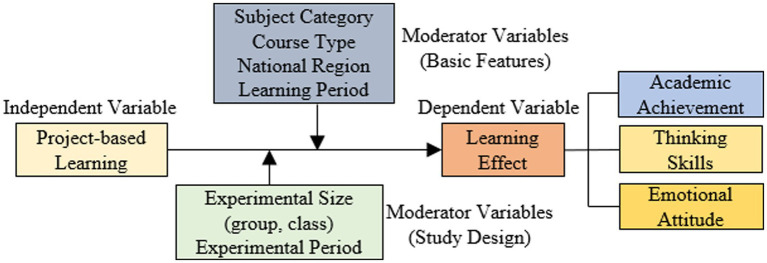
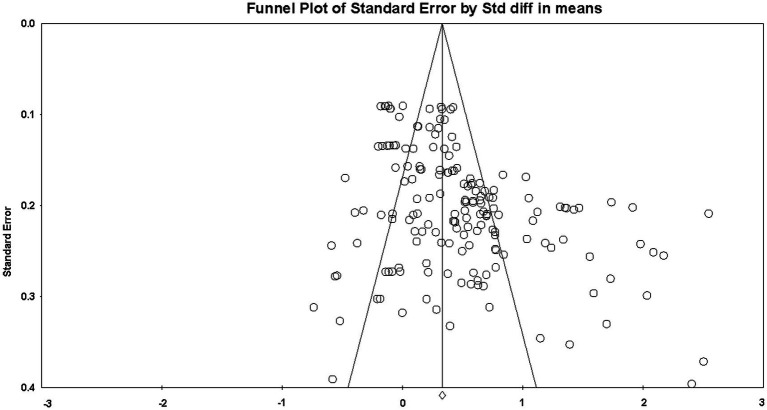
- Analyses were conducted in Comprehensive Meta Analysis 3.0, including publication bias tests (funnel plot, Begg’s test, Trim and Fill, Fail-safe N), heterogeneity tests (Q, I²), effect-size synthesis using standardized mean differences (SMD), and moderator analyses for country region, subject area, course type, academic section, class size, group size, and experiment period.
## Limitations
- The paper states that some PBL studies lacked sufficient statistical information for inclusion, and most studies did not provide a specific classification of learning effectiveness, limiting more detailed analysis.
- The text also makes evident that the meta-analysis had high heterogeneity (I² = 87.4%, Q = 1496.2, p < 0.001); this is not framed as a limitation by the authors but does indicate substantial between-study variability.
- The authors note that the included literature was weighted toward primary and secondary education, with less research on universities and young children; this is stated by the paper as a direction for future research.
Model-written summary. Check it against the paper before relying on it.
Integrity signals
Registry
Cites
Statistics
Figures
Verification
Claims the paper makes
1 Valid · 0 Not valid · 6 Not checked · 57 Own results and interpretations
A result the paper reports from its own data — it cites no other source for it, so there is none to check. The quote shows it is in the paper.
In the paper
“Moderately positive impact (SMD = 0.650), and the total effect values for affective attitudes and thinking skills were 0.389 and 0.386, respectively.”
§ A study of the impact of project-based learning on student learning effects: a meta-analysis study > Results > Results about problem of studies’ fields
plainstates a cause- Asserted: passes — The authors put it forward as true.
- Checkable: passes — It can be checked against evidence.
- Load-bearing: passes — The paper’s conclusions depend on it.
- Based: passes — The paper gives a reason why it holds.
- Rests on 3 assumptions not shown here.
A result the paper reports from its own data — it cites no other source for it, so there is none to check. The quote shows it is in the paper.
In the paper
“and also had moderate positive effects on learning motivation (SMD = 0.401) and learning attitudes (SMD = 0.536)”
§ A study of the impact of project-based learning on student learning effects: a meta-analysis study > Results > Results about problem of studies’ fields
plainstates a cause- Asserted: passes — The authors put it forward as true.
- Checkable: passes — It can be checked against evidence.
- Load-bearing: passes — The paper’s conclusions depend on it.
- Based: passes — The paper gives a reason why it holds.
- Rests on 2 assumptions not shown here.
A result the paper reports from its own data — it cites no other source for it, so there is none to check. The quote shows it is in the paper.
In the paper
“computational thinking skills (SMD = 0.719) had the most significant effect”
§ A study of the impact of project-based learning on student learning effects: a meta-analysis study > Results > Results about problem of studies’ fields
plainstates a cause- Asserted: passes — The authors put it forward as true.
- Checkable: passes — It can be checked against evidence.
- Load-bearing: passes — The paper’s conclusions depend on it.
- Based: passes — The paper gives a reason why it holds.
- Rests on 2 assumptions not shown here.
A result the paper reports from its own data — it cites no other source for it, so there is none to check. The quote shows it is in the paper.
In the paper
“its effect on student learning outcomes was not significant (SMD = 0.061, p = 0.429 > 0.05)”
§ A study of the impact of project-based learning on student learning effects: a meta-analysis study > Results > Results about problem of studies’ fields
plain- Asserted: passes — The authors put it forward as true.
- Checkable: passes — It can be checked against evidence.
- Load-bearing: passes — The paper’s conclusions depend on it.
- Based: passes — The paper gives a reason why it holds.
- Rests on 2 assumptions not shown here.
A result the paper reports from its own data — it cites no other source for it, so there is none to check. The quote shows it is in the paper.
In the paper
“Moderately positive impact (SMD = 0.650), and the total effect values for affective attitudes and thinking skills were 0.389 and 0.386, respectively.”
§ A study of the impact of project-based learning on student learning effects: a meta-analysis study > Results > Results about problem of studies’ fields
plainstates a cause- Asserted: passes — The authors put it forward as true.
- Checkable: passes — It can be checked against evidence.
- Load-bearing: passes — The paper’s conclusions depend on it.
- Based: passes — The paper gives a reason why it holds.
- Rests on 3 assumptions not shown here.
24 more claims
Create a free account to see all 64 claims and every source verdict.
- Probably not a substantial claim. 10
- It may state two separate claims as one. 31
- The quote only partly states this claim. 3
Claims other papers make about this one
Each is checked against this paper’s own text: does it say what the citing paper says it does?
The cited source says what the claim attributes to it.
In the citing paper
“Several meta-analyses and systematic reviews have synthesized the effects of PBL in education, demonstrating positive impacts on academic achievement (Chen and Yang, 2019; Zhang and Hu, 2019; Zhang and Ma, 2023).”
From Can project-based learning improve students’ mathematics learning outcomes: a three-level meta-analysis (2026) · cites this paper as Zhang and Ma, 2023
The cited source says what the claim attributes to it.
In the citing paper
“Conversely, Zhang and Ma (2023) report stronger effects of PBL in Asia, especially Southeast Asia, than in Western Europe and North America.”
From Can project-based learning improve students’ mathematics learning outcomes: a three-level meta-analysis (2026) · cites this paper as Zhang and Ma, 2023
The cited source says what the claim attributes to it.
In the citing paper
“However, some research reports non-significant effects on non-cognitive outcomes (Zhang and Ma, 2023; Chen and Yang, 2019).”
From Can project-based learning improve students’ mathematics learning outcomes: a three-level meta-analysis (2026) · cites this paper as Zhang and Ma, 2023
The cited source says what the claim attributes to it.
In the citing paper
“Zhang and Ma (2023) demonstrated that interventions lasting 9–18 weeks produce the most significant effects, with diminishing returns beyond 18 weeks.”
From Can project-based learning improve students’ mathematics learning outcomes: a three-level meta-analysis (2026) · cites this paper as Zhang and Ma, 2023
The cited source says what the claim attributes to it.
In the citing paper
“Zhang and Ma (2023) confirmed advantages for small classes, senior high schools, and groups of 4–5 students.”
From Can project-based learning improve students’ mathematics learning outcomes: a three-level meta-analysis (2026) · cites this paper as Zhang and Ma, 2023
1 more claim about this paper
Create a free account to see every claim other papers make about this one.
Self-check
Percentages, sums and reported differences re-computed from the paper’s own numbers.
Each contradiction between two passages listed here was confirmed by an independent check.
Rated minor: it would not touch a result — a value no result rests on, a p-value that stays on the same side of the significance level, or a conflict that is clerical, resolved elsewhere in the paper, or outside its own findings.
In the paper
§ A study of the impact of project-based learning on student learning effects: a meta-analysis study > Results > Results about problem of studies’ fields
“This study included 190 experimental data from 66 empirical research papers, and as shown in Table 2, the combined effect value of the impact of project-based learning on student learning outcomes was 0.441, close to 0.5 and p < 0.001, indicating that project-based learning has a large degree of impact on learning outcomes and is an effective teaching approach.”
§ A study of the impact of project-based learning on student learning effects: a meta-analysis study > Results > Results about problem of studies’ fields
“when the ES is less than 0.2, it means that there is a small effect impact, when the ES is between 0.2–0.8 means that there is a moderate effect, when the ES > 0.8 means that there is a significant effect impact.”
Citations
Cites
Preferred Reporting Items for Systematic Reviews and Meta-Analyses: The PRISMA Statement
Moher, D., Liberati, A., Tetzlaff, J., Altman, D. G., & The PRISMA Group (2009) · PLoS Medicine · doi:10.1371/journal.pmed.1000097 · Cited by 64,042 · cited 2×
“To find articles that meet the subject matter requirements, this study used the (Page, 2021) process for literature processing (Vrabel, 2009), the literature search, screening, and inclusion process is shown in Figure 2.”
Preferred reporting items for systematic reviews and meta-analyses: the PRISMA Statement.
(2009) · PubMed Central · Cited by 44,859
Quantifying heterogeneity in a meta‐analysis
Higgins, J. P. T., & Thompson, S. G. (2002) · Statistics in Medicine · doi:10.1002/sim.1186 · Cited by 36,763
Page, M. J., Moher, D., Bossuyt, P. M., Boutron, I., Hoffmann, T. C., Mulrow, C. D., Shamseer, L., Tetzlaff, J. M., Akl, E. A., Brennan, S. E., et al. (2021) · BMJ · doi:10.1136/bmj.n160 · Cited by 13,262 · cited 2×
“To find articles that meet the subject matter requirements, this study used the (Page, 2021) process for literature processing (Vrabel, 2009), the literature search, screening, and inclusion process is shown in Figure 2.”
MethodPrimary, Secondary, and Meta-Analysis of Research
GLASS, G. V. (1976) · Educational Researcher · doi:10.3102/0013189x005010003 · Cited by 4,890 · cited 1×
“To ensure the quality of the study, this study strictly followed the meta-analysis criteria proposed by Glass (1976), which was mainly divided into four assessment procedures: literature collection, literature coding, effect size calculation, and moderating variable analysis, and finally a…”
MethodHung, C., Hwang, G., & Huang, I. (2012) · Educational Technology & Society · Cited by 635
Publication Bias in Meta‐Analysis
Rothstein, H. R., Sutton, A. J., & Borenstein, M. (2005) · Publication Bias in Meta‐Analysis · doi:10.1002/0470870168.ch1 · Cited by 603
Tseng, K.-H., Chang, C.-C., Lou, S.-J., & Chen, W.-P. (2013) · International Journal of Technology and Design Education · doi:10.1007/s10798-011-9160-x · Cited by 554
Kilpatrick, W. H. (1918) · Teachers College Record: The Voice of Scholarship in Education · doi:10.1177/016146811801900404 · Cited by 431
The effect of authentic project‐based learning on attitudes and career aspirations in STEM
Beier, M. E., Kim, M. H., Saterbak, A., Leautaud, V., Bishnoi, S., & Gilberto, J. M. (2019) · Journal of Research in Science Teaching · doi:10.1002/tea.21465 · Cited by 321
Research works printed but not linked: 41
- Changming, 2020, Why do we need project-based learning?, Primary Secondary School Manage, 8, 5
- Chung, 2021, Students’ perception of self-regulated learning in a project-based learning
- Cohen, 1988, Statistical power analysis for behavioral science, Technometrics, 31, 499
- Cong, 2021, Research on the design and implementation of project-based teaching of high school chemistry based on STSE education
- 2020, Research on the impact of project-based learning STEM curriculum on elementary school students’ problem solving ability [Master’s thesis].
- Gao, 2020, Research on the teaching model of high school biology unit based on project-based learning
- Hongxing, 2017, Project-based learning: classroom teaching activities to cultivate students’ core literacy, J. Lanzhou Univ., 6, 165, 10.13885/j.issn.1000-2804.2017.06.021 · doi:10.13885/j.issn.1000-2804.2017.06.021
- Jina, 2022, The application of project-based learning based on problem awareness in primary school mathematics classroom
- Jingfu, 2002, Project-based learning model, Foreign Educ. Res., 11, 18
- Keleşoğlu, 2011, nvestigating the effects of project-based learning on students’ Academic Achievement and Attitudes Towards English Lesson. vol.1
- Lei, 2020, The design and implementation of project-based learning for high school chemistry teaching
- Ling, 2020, Design and practice of teaching activities based on project-based learning to cultivate primary school students’ computational thinking
- Linxiao, 2020, The application of project learning in senior high school biology classroom study
- Lu, 2020, Research on teaching design of junior high school information technology curriculum based on project-based learning
- Luo, 2020, Research on the development of computational thinking skills based on project-based learning
- Ma, 2022, Project learning self-efficacy in elementary programming impact study
- Ma, 2021, Cooperative reasoning learning to promote the development of higher-order thinking, Educ. Dev. Res., 24, 64, 10.14121/j.cnki.1008-3855.2021.24.011 · doi:10.14121/j.cnki.1008-3855.2021.24.011
- Mark, 2022, The effectiveness of PBL classes using multimedia tools: a case study of a university liberal arts English class, Multimedia Lang. Teach., 25, 237
- Mingquan, 2020, Project learning in senior high school geography teaching research and practice
- Rui, 2020, An empirical study on the development of computational thinking skills of high school students based on project-based learning
- Ruiz-Rosa, 2021, Project-Based Learning as a tool to foster entrepreneurial competences (El Aprendizaje Basado en Proyectos como herramienta para potenciar la competencia emprendedora), Cult. Educ., 33, 1, 10.1080/11356405.2021.1904657 · DOI
- ShiXuan, 2017, Research on the design of project-based learning activities based on Moodle
- Wang, Project learning perspective of organic chemistry teaching design and implementation of high school
- Wang, Design and practice of open source hardware project-based learning for primary schools with problem-solving skills development
- Wang, 2022, Research on the design and application of a comprehensive practical activity curriculum for primary schools based on project-based learning
- Wei, 2020, The impact of cooperative learning on students' learning outcomes: A meta-analysis based on 48 experimental or quasi-experimental studies, Shanghai J. Educ. Res., 7, 34, 10.16194/j.cnki.31-1059/g4.2020.07.008 · doi:10.16194/j.cnki.31-1059/g4.2020.07.008
- Weihong, 2019, Promoting Students' high-level thinking development through project-based learning -- design and implementation of "baby market" exploration project, Basic Educ Curric, 6, 20
- Wenlan, 2019, Does project-based learning play a role in learning? -- meta-analysis based on 46 experimental and quasi-experimental studies, Res. Visual Educ., 2, 95, 10.13811/j.cnki.eer.2019.02.012 · doi:10.13811/j.cnki.eer.2019.02.012
- Xiaolei, 2021, Research on the design and practice of high school information technology curriculum based on project-based learning
- Xu, 2022, A practical study of project-based learning for developing core literacy in subjects
- Xuezhi, 2022, Research on the design and practice of project-based learning in junior high school mathematics curriculum
- Yanan, 2020, An experimental study of Jigsaw-based project-based learning in elementary school IT class
- Yang, 2020, Practical research on teaching reform of information technology curriculum in Baochang No. 1 Middle School
- Yating, 2022, Research on the design and practice of teaching elemental compounds in high school based on project-based learning
- Yexin, 2019, The application of robot project learning in middle school teaching research
- Ying, 2022, A study on the influence of project-based teaching on the intrinsic motivation of private university students’ English learning, J. Sci. Educ, 13, 29, 10.16400/j.cnki.kjdk.2022.13.010 · doi:10.16400/j.cnki.kjdk.2022.13.010
- Yuan, 2017, A Study on the Teaching Reform of Information Technology Course in Baochang No.1 Middle School - Taking “Project-based Learning” as an Example
- Yun, 2022, Practical exploration of project-oriented deep ritual education -- take the project-oriented learning of searching for roots Xu Huiyuan in grade 5 as an example, Shanghai J. Educ. Res., 9, 64, 10.16194/j.cnki.31-1059/g4.2022.09.006 · doi:10.16194/j.cnki.31-1059/g4.2022.09.006
- Yuting, 2022, Practical research on project-based learning based on the development of scientific inquiry ability in secondary school biology teaching
- Zhang, 2022, A study on the effect of project-based teaching on the intrinsic motivation of private university students’ English learning, J. Sci. Educ., 13, 29, 10.16400/j.cnki.kjdk.2022.13.010 · doi:10.16400/j.cnki.kjdk.2022.13.010
- Zhang, 2022, Based on the junior high school students information technology subject core. Mesh type teaching mode design and application research
Cited by
Items 201–300 of 428
Implementation of Problem Based Learning Model in 21st Century Learning: Literature Review
Yuliyanah, Y., Gumala, Y., & Yohamintin, Y. (2025) · Journal of Basic Education Research · doi:10.37251/jber.v6i1.1315 · Cited by 2
Nahorniuk, O. (2024) · International Scientific Journal of Universities and Leadership · doi:10.31874/2520-6702-2024-18-78-92
Оразова, К. С., & Абдиманапов, Б. Ш. (2024) · Хабаршысы. Жаратылыстану-география ғылымдары сериясы. · doi:10.51889/3005-6217.2024.82.4.012
Maharani, M., Wuryandani, W., Retnasari, L., & Wibowo, S. E. (2024) · Journal for Lesson and Learning Studies · doi:10.23887/jlls.v7i3.88752 · Cited by 13
“Through digital platforms, students can conduct research, collaborate, and present their work more efficiently (Zhang & Ma, 2023).”
The Synergy of Electric Vehicle Technology, Artificial Intelligence for Educational Innovation
Abid, A. (2025) · Smart innovation, systems and technologies · doi:10.1007/978-981-97-6469-3_29
Vasquez-Monteros, J., Samaniego-Rojas, P., & Celi, C. (2025) · European Public & Social Innovation Review · doi:10.31637/epsir-2025-1924
Higbee, S., Miller, S. J., & Alfrey, K. (2025) · Biomedical Engineering Education · doi:10.1007/s43683-025-00178-6
“Incorporating these applied, biomedically relevant projects offers many of the benefits of Project-based Learning (PBL) [34–37], including building skills in critical thinking, problem solving, and written communication.”
Towards a Multi-competence Based Learning Internship Model: A Problem-Based Approach
Bakar, A., Nkonoki, E., Khatib, M. M., Hamad, M. M., & Rusudi, B. (2025) · Lecture notes in networks and systems · doi:10.1007/978-3-031-83523-0_29 · Cited by 2
A Control-Value Theory Lens on Middle School Students' Emotions in Project-Based Learning
Feyzioğlu, E. Y., & Çelebi, A. B. (2025) · Erzincan Üniversitesi Eğitim Fakültesi Dergisi · doi:10.17556/erziefd.1554609
Efayena, T. (2024) · ETDC Indonesian Journal of Research and Educational Review · doi:10.51574/ijrer.v4i1.2689 · Cited by 2
“This finding backs up earlier studies by Dai et al. (2023); Zhang & Ma (2023); Saavedra & Rapaport (2024), which found that students in project-based learning programs did better in school than those in regular classes.”
Project-Based Virus Enrichment Module Local Issue Context
Handayani, S., Suranto, S., & Fatmawati, U. (2025) · Journal of Education Research and Evaluation · doi:10.23887/jere.v9i1.84501
“…factors (soft skills), acquire knowledge to solve problems, improve high-level thinking, expand the realm of thinking (cognitive, psychomotor, affective), foster critical and creative thinking skills, and encourage student activities (J. D. R. Sari et al., 2024; Yu, 2024; Zhang & Ma, 2023).”
An Innovative Approach to Health Sector Regulatory Compliance Education
Mohamed, S., & Rampersad, A. (2025) · Journal of innovation in polytechnic education. · doi:10.69520/jipe.v7i1.248
Perubahan dan Inovasi Kurikulum Pendidikan di Berbagai Negara
Fangestu, I. W. F., Marfuah, S., Bahrissalim, et al. (2025) · Southeast Asian Journal of Islamic Education Management · doi:10.21154/sajiem.v6i1.357
Wang, X. (2024) · International Conference on Information Education and Artificial Intelligence (ICIEAI) · doi:10.1145/3724504.3724550
Utilization of an E-Knows-Based Learning Management System (LMS) to Enhance Learning Quality
Al-Dosakee, K., Dehaghi, H. K., & Musleh, S. (2025) · Journal of Educational Technology and Learning Creativity · doi:10.37251/jetlc.v3i1.1619
“However, the implementation of E-Knows-based LMS still requires further study regarding its effectiveness in improving the quality of learning [21]-[23].”
Authentic group projects for upper-level economics courses
Picault, J. (2025) · Citizenship Social and Economics Education · doi:10.1177/14788047251343791 · Cited by 1
“In their recent meta-analysis, Zhang and Ma (2023) found that group projects improve students ’ learning outcomes.”
Development of Programmable Logic Controller (PLC) Trainer Learning Media for Industrial Automation
Widinata, F., & Irawan, I. (2025) · Edunesia Jurnal Ilmiah Pendidikan · doi:10.51276/edu.v6i2.1229
Yücel, H., & Çavlık, K. (2025) · Ergoterapi ve Rehabilitasyon Dergisi · doi:10.30720/ered.1505667
Triyani, D., Utami, S. R., & Rohman, S. (2025) · Jurnal Onoma Pendidikan Bahasa dan Sastra · doi:10.30605/onoma.v11i2.5355 · Cited by 4
The H.U.M.A.N Learning Ecosystem: Cultivating Curiosity, Connection, and Cognitive GrowthPreprint
Rashed, A. Q. (2025) · PsyArXiv (OSF Preprints) · doi:10.31234/osf.io/2kgae_v1
Ritonga, A. Z., Ritonga, M. A., Nainggolan, Z., Aminah, W., & Herawati, P. (2025) · 12 Waiheru · doi:10.70872/12waiheru.v11i1.350 · Cited by 2
Generative AI in Project-Based Learning for Sustainable Development
Hernández‐Leo, D., Theophilou, E., & Alkhasawneh, S. N. (2025) · Computer-supported collaborative learning/The Computer-Supported Collaborative Learning Conference · doi:10.22318/cscl2025.592902 · Cited by 1
Exploring the Perceptions of Junior High School Students Towards Historical Texts
Serrano, A., Luminate, G., Yap, L. A., & Serafico-Reyes, N. M. A. (2025) · The Normal Lights · doi:10.56278/tnl.v19i1.3085
TABIIY FANLAR DARSLARIDA LOYIHA ASOSIDA O‘QITISH METODIKASI
MAMANOVA, G., & JURAEV, X. (2024) · UzMU xabarlari · doi:10.69617/nuuz.v1i1.7.1.3354
Nurhayati, S. F. (2025) · Akademika · doi:10.34005/ak.v14i01.4531
Deep Learning and Application in Elementary Schools: an Exploration of Learning Practices
Cahyanto, B. (2025) · GHANCARAN Jurnal Pendidikan Bahasa dan Sastra Indonesia · doi:10.19105/ghancaran.v7i1.18892 · Cited by 23
The efficacy of selected approaches in teaching Earth Science among Grade 11 students
Velasco, J., & Orbillos, D. (2025) · Pantao (International Journal of the Humanities and Social Sciences) · doi:10.69651/pijhss0402261
Tenni, Slamet, S. Y., Adi, F. P., et al. (2025) · International Journal of Elementary Education · doi:10.23887/ijee.v9i2.95052
Global Research Trends on Learning Technology in Psychology: A Bibliometrics Analysis
Jailani, M., Mahanani, S., Moruk, S. V., Giyono, & Suparman, S. (2025) · Journal of Teaching and Learning · doi:10.22329/jtl.v19i3.9370 · Cited by 1
Hidayat, M. W., Chamalah, E., & Kusumadewi, R. F. (2025) · Al-Irsyad Journal of Education Science · doi:10.58917/aijes.v4i2.293
Yulian, R., Yuniarti, Y., Ruhama, U., Fitri, N. N., & Rievaldy, R. (2025) · Jurnal Pendidikan dan Pengajaran · doi:10.23887/jpp.v58i2.93357
Yorat, E., Özbek, N. S., & Sarıbulut, L. (2025) · International Scientific Conference on Information, Communication and Energy Systems and Technologies (ICEST) · doi:10.1109/icest66328.2025.11098432
“In particular of SCP, project-based learning (PBL) cultivates these skills and helps students tackle real-world problems [6-8].”
Gabriel-Wettey, F. K. N., Aweso, D. M., Eshun, V., & Denteh, A. S. (2025) · African Journal of Empirical Research · doi:10.51867/ajernet.6.3.38
Enhancing Student Learning in a Blended Undergraduate Dynamics Course through Hands-on Mini-Projects
Pal, S., Outerbridge, S., Chimehrad, M., et al. (2025) · ASEE Annual Conference & Exposition · doi:10.18260/1-2--56425
Impact of a Mentored Programming Workshop on High School Students’ Skill Development
Korom, S., Marhefka, I., Illés, Z., & Bakonyi, V. (2025) · Lecture notes in electrical engineering · doi:10.1007/978-981-96-6034-6_19
Science and Mathematics Teachers’ Views of STEM Integration in an International School
Ali, M. A. A. (2025) · Open Journal of Applied Sciences · doi:10.4236/ojapps.2025.158167
Ortaokul Öğrencilerinin Proje Yarışması Deneyimleri: Teknofest Örneği
Çavuş, R. (2025) · Disiplinlerarası Eğitim Araştırmaları Dergisi · doi:10.57135/jier.1669387 · Cited by 1
Páez, R. A. P., Méndez, J. K. T., & Álava, J. J. A. (2025) · Prohominum · doi:10.47606/acven/ph0371
Project-Based learning course co-designed with regional enterprises
Guo, Y., Li, Z., Wei, Y., et al. (2025) · IEEE Integrated STEM Education Conference (ISEC) · doi:10.1109/isec64801.2025.11147369
“It immerses students in real-world problem solving and fosters career readiness [1].”
Self-citationTarasova, A. N., & Кульминская, А. В. (2025) · University Management Practice and Analysis · doi:10.15826/umpa.2025.02.016
Hasibuan, H., Sari, S. A., & Sinaga, M. (2025) · Pubmedia Jurnal Penelitian Tindakan Kelas Indonesia · doi:10.47134/ptk.v2i4.2107 · Cited by 1
Martz, U.-M., Colloseus, C., Reinisch, U., et al. (2025) · Lecture notes in networks and systems · doi:10.1007/978-3-031-98883-7_29
Project based learning in urban crisis management
Ravi, R. V., & Dutta, P. K. (2025) · Advances in computers · doi:10.1016/bs.adcom.2025.09.001
Designing an AI-Supported Pedagogical Evaluation Model for Visual and Illustration Design in China
Lin, Y., Liu, G., & Yu, Z. (2025) · Communications in computer and information science · doi:10.1007/978-981-95-2011-4_8
Völlmecke, C., & Dönitz, A. (2025) · IFAC-PapersOnLine · doi:10.1016/j.ifacol.2025.09.556
Kedang, M. K., Yuwana, S., & Hendratno (2025) · Multidisciplinary Reviews · doi:10.31893/multirev.2026110
Nervi, E. M., Zani, G., & di Prisco, M. (2025) · Structural Concrete · doi:10.1002/suco.70366
“9,10 Collaborative workshops involving interdisciplinary and multicultural teams were structured to simulate authentic professional environments and promote transversal skills such as communication, leadership, and ethical reasoning, all essential in conservation-oriented activities.”
Open-Ended Questions: Enhancing Writing and Learning Processes
Fisher, J. (2025) · Journal of Applied Learning in Higher Education · doi:10.57186/jalhe_2025_a7p75-94
Khairunnisa, H. H., Sari, S., & Sukmawardana, Y. (2025) · IJCER (International Journal of Chemistry Education Research) · doi:10.20885/ijcer.vol9.iss2.art1
“…with practice [7] Project-based worksheets systematically enhance students' scientific performance by facilitating comprehensive learning outcomes that encompass academic achievement, critical thinking skills, and scientific attitudes through structured engagement with real-world problems [8].”
Assessing the Impact of Project-Based Learning on Sustainable Knowledge Construction
Alam, S. U., Ashrafuzzaman, M., & Khan, M. R. (2025) · INTI JOURNAL. · doi:10.61453/intij.202539
Research analysis of critical thinking skills in physics learning in higher education
Jatmiko, B., Rahman, N. R., Prahanı, B. K., et al. (2025) · Multidisciplinary Reviews · doi:10.31893/multirev.2026215
Exploring students’ critical thinking skills through STEM-PjBL on Newton’s Laws
Andarini, S. Y., Dewi, N. M., & Lesmono, A. D. (2025) · Physics Education · doi:10.1088/1361-6552/ae19bd
Viareco, H., & Hutagalung, W. L. C. (2025) · Jurnal Teknik Lingkungan · doi:10.5614/j.tl.2025.31.1.1
Nikolidakis, S., & Kosmas, P. (2025) · IGI Global eBooks · doi:10.4018/979-8-3373-4957-2.ch012 · Cited by 3
Digital Citizenship in Primary Education: Project-Based Learning for Developing 21st Century Skills
Pliogou, V., Tromara, S., & Valsamaras, D. (2025) · IGI Global eBooks · doi:10.4018/979-8-3373-4957-2.ch010
Fan, W. (2025) · Scientific Reports · doi:10.1038/s41598-025-26024-x · Cited by 3
Song, H., McNeal, K. S., Beckingham, L. E., Solomon, J. T., & Lazar, K. B. (2025) · Environmental Engineering Science · doi:10.1177/15579018251397072 · Cited by 2
“Similarly, curricular roadmaps from Asia and project-based learning in Europe demonstrate innovative approaches, but rigorous empirical evaluations of their impacts remain limited (Zhang & Ma, 2023).”
Zhang, X., & Tian, H. (2025) · Scientific Reports · doi:10.1038/s41598-025-26990-2 · Cited by 3
“Zhang & Ma 20 examined how project-based learning affects undergraduate information literacy.”
A Practice-Oriented Approach to Teaching Python Programming for University Students
Karymsakova, A., Капбар, Г., Berkimbayev, K., & Bakirova, G. (2025) · Open Education Studies · doi:10.1515/edu-2025-0099 · Cited by 1
Replications as Project‐Based Learning in Geographic Information Science
Kedron, P., Trgovac, A. B., & Holler, J. (2025) · Transactions in GIS · doi:10.1111/tgis.70162 · Cited by 4
Israwaty, I., Ramadhan, A. S., & Krismanto, W. (2025) · doi:10.1109/icet67257.2025.11290931
“Thus, applying constructivist learning principles in the science learning process aims to improve the quality of learning and create a more interactive and meaningful learning atmosphere [23], [24].”
Development of IT Project Management Learning Media Using YOLO and Reinforcement Learning
Fergina, A., Parwati, L. S., LAH, R. A. D., Alamsyah, Z., Rangkuti, M. F. N., Rajandrya, A., & Akbar, M. R. (2025) · Data & Metadata · doi:10.56294/dm20261305
Aktürk, F., & Bahadır, E. (2025) · Uluslararası Sosyal Bilimler Eğitimi Dergisi · doi:10.47615/issej.1756699
Bao, X., Hu, S., & Li, Z. (2025) · Lecture notes in educational technology · doi:10.1007/978-981-95-5234-4_10
CHALLENGES OF STUDENT LEARNING PROBLEMS IN THE DIGITAL ERA: A SCHOOL COUNSELOR'S PERSPECTIVE
Saputra, N. M. A., Muslihati, M., Ramli, M., Sobri, A. Y., Jalil, M. K., & Rafli, M. (2025) · Counsenesia Indonesian Journal Of Guidance and Counseling · doi:10.36728/cijgc.v6i2.5664 · Cited by 2
“Psychologically, students face a heightened risk of developing academic anxiety, learned helplessness, and even depression (Carstens, Mallon, Bataineh, & Al-Bataineh, 2021; Zhang & Ma, 2023).”
Navigating Teamwork Challenges in Project-Based Learning
Prince, B., Baldi, A., Jaiswal, A., & Sapkota, M. (2025) · IEEE Frontiers in Education Conference (FIE) · doi:10.1109/fie63693.2025.11328717
“Prior research highlights its benefits, including the enhancement of students’ critica l thinking and problem-solving skills [2], [3].”
Moratti, T., Das, R. P., Lee, Y., Sign, A., Kraemer, D. J. M., & Morkos, B. W. (2025) · IEEE Frontiers in Education Conference (FIE) · doi:10.1109/fie63693.2025.11328666
“Various strategies such as case-based learning, project-based learning, problem-based learning, and flipped classrooms are widely practiced in engineering education [24], [25], [26], [27].”
Chamorro, J. A., Lagunas, H. A. A., Jara, O. I. A., et al. (2026) · Educational Regent Multidisciplinary Journal · doi:10.63969/0853rz57
“According to Zhang & Ma (2023) the core principles of effective project-based learning include active student engagement, the integration of theoretical knowledge with practical application, the development of higher-order thinking skills, and meaningful learning through authentic, real-world…”
Applying Systems Engineering to the Design of Project-Based Learning Units
Hills, C., Bowtell, L., Maiti, A., et al. (2026) · Lecture notes in networks and systems · doi:10.1007/978-3-032-07316-7_14
Development Skills in Sustainable Fashion Design Projects
Bicho, M., Pereira, M., Barata, T. R., et al. (2026) · Springer eBooks · doi:10.1007/978-3-032-02070-3_7
Bridging Theory and Practice in Machine Learning Education Through Mixed Reality Gamification
Zhang, G., & Lee, B. G. (2025) · IEEE International Conference on Teaching, Assessment, and Learning for Engineering · doi:10.1109/tale66047.2025.11346761
“Project-based learning, gamification, and constructivist methods show considerable promise to improve student engagement and connect theoretical knowledge with practical application [18], [19].”
Integrating Social Realities Into Project-Based Learning: Insights from Indonesian Lecturers
Candra, P. H., Lakonawa, P., & Pandanari, D. S. (2026) · International Conference on Ubiquitous Information Management and Communication (IMCOM) · doi:10.1109/imcom69009.2026.11360959
“It is a learning by doing approach, where students involve in doing the project, applying the theoretical knowledge from the class and solve the real problems throughout the process [7].”
Atia, A., Alsherif, E., Khamis, S., Abdo, M., Elfard, S., & Njaim, S. (2026) · Journal of Education and Health Promotion · doi:10.4103/jehp.jehp_495_25
“[11,12] Understanding students’ perceptions of PBL has broader implications for educational policy and practice.”
From Sensors to Decisions in an Undergraduate e-Logistics Course
Yosephine, V. S., & Hasibuan, I. Z. M. (2025) · International Conference on Intelligent Cybernetics Technology & Applications (ICICyTA) · doi:10.1109/icicyta68677.2025.11362540
“Project-based and experiential designs provide the required authenticity by situating knowledge in use, while modest scaffolds help novice learners manage cognitive load and focus on the meaning of data rather than boilerplate code [11], [12].”
Suaza, D. A. P. (2026) · DIALÓGICA REVISTA MULTIDISCIPLINARIA · doi:10.56219/dialgica.v23i1.4938
Sidik, R. M., Gunawan, I., Haqiqi, I. N., & Harnika, G. N. (2025) · Digital Learning Social Science and Life-course Studies · doi:10.70211/disolife.v1i2.155 · Cited by 10
Implementasi model microteaching biologi berbasis PjBL dan blended learning
Sadikin, A., Siburian, J., Saudagar, F., & Pratama, R. (2026) · Jurnal Penelitian Pendidikan IPA · doi:10.29303/jppipa.v12i1.13069 · Cited by 1
Wang, F., Zhang, C., & Maitreesophon, B. (2026) · The EUrASEANs journal on global socio-economic dynamics · doi:10.35678/2539-5645.11.1.2026.200
KAEDAH PENGAJARAN RASULULLAH SAW: ANALISIS MODUL PENGHAYATAN HADIS 40 IMAM NAWAWI
Kamarudin, M. H., Halim, A. A., Zakaria, N., & Mamat, M. A. (2025) · International Journal of Modern Education · doi:10.35631/ijmoe.728011
Winarni, A. T., & Kisyanto, K. (2025) · Interval Indonesian Journal of Mathematical Education · doi:10.37251/ijome.v3i2.2511
“The data obtained were analyzed to assess the impact of the actions taken on the student learning process and outcomes [47], [48].”
SYSTEMATIC REVIEW (METASYNTHESIS) PENGARUH PJBL TERHADAP KEAKTIFAN SISWA
Siahaan, F. N., & Fadilah, M. (2026) · Jurnal Biogenerasi · doi:10.30605/biogenerasi.v11i1.8175
PhET Simulations Improve Fraction Learning in Primary School Students
Kukuh, K. I. S., Saputro, B. A., Wijayanti, A., & Tandas, M. V. (2025) · Jurnal Ilmiah Sekolah Dasar · doi:10.23887/jisd.v9i3.96419 · Cited by 1
Castro-Vargas, C., & Cabana-Cáceres, M. R. (2026) · ESPACIOS · doi:10.48082/espacios-a26v47n01i14
Колтунов, Е. И., Korobova, S. Y., & Dmitrieva, Y. A. (2026) · Science for Education Today · doi:10.15293/2658-6762.2601.10
Franco, P. M. R., Martínez, A. R. T., Chucino, M. E. D., et al. (2026) · Revista Multidisciplinar Epistemología de las Ciencias · doi:10.71112/h9qtz106
Effectiveness of Project-Based Learning in Developing Critical Thinking Skills
Eshun, I., Koranteng, U., Ajayi, A. B., & Ogar, E. E. (2026) · doi:10.69739/jicte.v1i1.1619 · Cited by 1
The Implementation and Challenges of a Project-Based STEM Programme in Rural Minority China
Yi, X., Chua, K. H., & Fadzil, H. M. (2026) · Canadian Journal of Science Mathematics and Technology Education · doi:10.1007/s42330-026-00454-9
“It has gained significant recognition as an effective teaching strategy, especially in STEM education (Kurniawan, 2024; Zhang & Ma, 2023).”
Cultivating Effective Educators: Experiential Learning in Korean Language Teacher Education
Chung, J. H., Choi, Y., Kim, N., You, M., & Yoo, T. J. (2025) · International Journal of Korean Humanities and Social Sciences · doi:10.14746/kr.2025.11.09
Ranas, A. D., & -, N. C. N. (2026) · European Modern Studies Journal · doi:10.59573/emsj.10(1).2026.7
Project-based Study Program Graduates’ Perceptions of Acquired Competences
Vesikivi, P., Malmi, L., Lakkala, M., Muukkonen, H., & Holvikivi, J. (2026) · ACM Transactions on Computing Education · doi:10.1145/3799249
Тарасенкова, Н., & Акуленко, І. А. (2025) · Problems of Modern Textbook · doi:10.32405/2411-1309-2025-35-193-208
Project-based learning during scientific student exchanges program using Arduino
Pesthy, S. G., Hömöstrei, M., & Jenei, P. (2026) · European Journal of STEM Education · doi:10.20897/ejsteme/18049 · Cited by 2
“A meta analysis, shows that PBL has positive effects not only on academic performance, but on self-emotional attitudes and values and thinking skills too (Zhang & Ma, 2023) H3.”
Anggraeni, N. M. D., Astawan, I. G., & Ilma, A. Z. (2025) · Mimbar Ilmu · doi:10.23887/mi.v30i3.89096
Ramadhani, S. A., Sabara, E., & Supriadi, S. (2026) · ETDC Indonesian Journal of Research and Educational Review · doi:10.51574/ijrer.v5i2.4532
“Meta-analyses show that PjBL has a higher effect size on learning outcomes than conventional methods (Chen & Yang, 2019; Suryani et al., 2024; Wijnia et al., 2024; Zhang & Ma, 2023).”
The Integrated Teaching Reform and Practice of Soil Fertilization Course Based on the OBE Concept
赵, 英. (2026) · Advances in Education · doi:10.12677/ae.2026.163538
Chiro, N. L., & Silva-Castillo, J. (2026) · Revista de Investigación Educativa Niveles. · doi:10.61347/rien.v3i1.88
Mahdy, M. A. A. (2026) · BMC Medical Education · doi:10.1186/s12909-026-08926-0
Imparting System-Development Skills and Project Based Learning to First-Year Engineering Students
Ravikumar, C. P., Kendaganna Swamy, S., Subramanya, K. N., Rajasree, P. M., & Shruthi, P. (2026) · IETE Journal of Education · doi:10.1080/09747338.2026.2649138
Silva, S. D., Carmichael, B. J., Roose, J. L., Hale‐Donze, H., Peterson, C. B., & Wilson-Kennedy, Z. S. (2026) · Journal of Science Education and Technology · doi:10.1007/s10956-026-10307-7
“A small group size was implemented to facilitate even contribution to team project elements and support positive, manageable interactions (Lou et al., 1996; Zhang & Ma, 2023).”
Metadata
- Authors
- Zhang, L., & Ma, Y.
- Affiliations
- Chongqing Normal University (CN)
- Corresponding author
- Ma, Yan
- Venue
- Frontiers in Psychology
- Publisher
- Frontiers Media SA
- Published
- 2023-07-17
- Volume
- 14
- Pages
- 1202728-1202728
- ISSN
- 1664-1078 (ISSN-L)
- PMC
- PMC10411581
- OpenAlex
- W4384498111
- Semantic Scholar
- 62a083ea55ae0b7bcb659bba3159fada89e8945f
- Cited by
- 455
- References
- 47
- Citations by year
- 2026: 192 · 2025: 168 · 2024: 88 · 2023: 7
- FWCI
- 27.58
- Type
- journal article
- Language
- en
- Open access
- gold
- doi.org
- Licence
- Locations
- Frontiers in Psychology (publishedVersion, cc-by)
- PubMed Central (publishedVersion, cc-by)
- PubMed (publishedVersion)
- DOAJ (DOAJ: Directory of Open Access Journals) (submittedVersion, cc-by-sa)
- Funders
- Chongqing Normal University
- Division of Graduate Education
- Topics
- Social Sciences › Education › Problem and Project Based Learning
- Social Sciences › Psychology › Developmental and Educational Psychology › Innovative Teaching and Learning Methods
- Social Sciences › Education › Innovative Teaching Methods
- Keywords
- project-based learning, learning outcomes, academic performance, affective attitudes, thinking skills, moderating effect, group size, technology and engineering education, laboratory classes, upper secondary school, 21st century skills
About these checks
Registry, retraction, Cites and statistics results are computed, not judged, with one exception: a printed reference that no index lists is read once by a model before it counts as a citation error. Claims are extracted by a model and kept only when their quote appears verbatim in the text; each cited source is then checked, with a model’s help, for whether it says what the claim relies on. Those verdicts can be wrong — read the claim’s quote and the cited source before relying on one.
The claim verdicts this report counts are experimental: their accuracy is not yet measured.
A language model drew the claims from the paper on 2026-10-10, under version 3 of the claim definition (model deepseek-v4.1-flash, prompt extract-v3).
A second model labelled each claim on 2026-10-10 (model jev-1.13-20260917, definition revision gold-guideline-v0.2).
Statistics and arithmetic are recomputed, not judged.
Confidence bands are shown only for fields calibrated on our annotated test set. None is calibrated yet, so no band is shown.
What counts as a claim ›How we measure confidence ›How we check this ›
Are you an author, or do you see a problem with this page? Request a review
Data sources
Bibliographic data: Semantic Scholar, OpenAlex, Crossref.
Contains information from the Semantic Scholar Academic Graph Datasets, made available under the ODC Attribution License (ODC-BY 1.0).
Semantic Scholar’s data is described in: Kinney, R., et al. (2023). The Semantic Scholar Open Data Platform. arXiv:2301.10140.
