

The DOI matches its Crossref record; 73 of the 73 references it cites were found in a registry or an index; 1 of the 49 sources its claims cite were checked for support.
Maternal smoking cessation in the first trimester still poses an increased risk of attention-deficit/hyperactivity disorder and learning disability in offspring
Open accessAbstract
Background: Studies have found maternal smoking during pregnancy was linked to attention-deficit/hyperactivity disorder (ADHD) risk. It is unclear if maternal smoking cessation during pregnancy lowers ADHD and learning disability (LD) risk in offspring. This study aimed to explore the associations between maternal smoking cessation during pregnancy and ADHD and LD risk in offspring. Methods: Data from the National Health and Nutrition Examination Survey 1999–2004 (8,068 participants) were used. Logistic regression was used to analyze the associations between maternal smoking and smoking cessation during pregnancy and ADHD and LD risk in offspring. Results: Compared to non-smokers’ offspring, maternal smoking during pregnancy increased the risk of ADHD (odds ratios [OR] = 2.07, 95% confidence interval [CI]: 1.67–2.56) and LD (OR = 1.93, 95% CI: 1.61–2.31) in offspring, even if mothers quit smoking later (OR ADHD = 1.91, 95%CI ADHD: 1.38–2.65, OR LD = 1.65, 95%CI LD: 1.24–2.19). Further analysis of the timing of initiation of smoking cessation during pregnancy revealed that, compared to non-smokers’ offspring, maternal quitting smoking in the first trimester still posed an increased risk of ADHD (OR = 1.72, 95% CI: 1.41–2.61) and LD (OR = 1.52, 95% CI: 1.06–2.17) in offspring. Maternal quitting smoking in the second or third trimester also had a significantly increased risk of ADHD (OR = 2.13, 95% CI: 1.26–3.61) and LD (OR = 1.82, 95% CI: 1.16–2.87) in offspring. Furthermore, maternal smoking but never quitting during pregnancy had the highest risk of ADHD (OR = 2.17, 95% CI: 1.69–2.79) and LD (OR = 2.10, 95% CI: 1.70–2.58) in offspring. Interestingly, a trend toward a gradual increase in the risk-adjusted OR for ADHD and LD risk was observed among the three groups: maternal quitting smoking in the first trimester, maternal quitting smoking in the second or third trimester, and maternal smoking but never quitting. Conclusion: Maternal smoking cessation in the first trimester still poses an increased risk of ADHD and LD in offspring. Furthermore, it seems that the later the mothers quit smoking during pregnancy, the higher the risk of ADHD and LD in their offspring. Therefore, early intervention of maternal smoking in preconception and prenatal care is vital for offspring neurodevelopment.
Overview
AI snapshot
Written from the paper’s full text.
TL;DR
In NHANES 1999–2004, maternal smoking during pregnancy was associated with higher odds of ADHD and learning disability (LD) in offspring, and quitting later in pregnancy did not eliminate the elevated risk. Even quitting in the first trimester was associated with increased odds of ADHD and LD compared with offspring of non-smokers.
Key findings
- Compared with non-smokers’ offspring, maternal smoking during pregnancy increased the risk of ADHD (OR = 2.07, 95% CI: 1.67–2.56) and LD (OR = 1.93, 95% CI: 1.61–2.31).
- Mothers who smoked but quit later still had offspring with increased ADHD (OR = 1.91, 95% CI: 1.38–2.65) and LD (OR = 1.65, 95% CI: 1.24–2.19) risk.
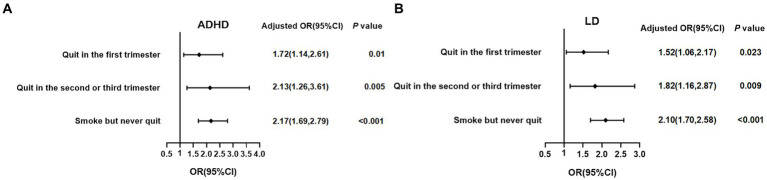
- Quitting in the first trimester was still associated with ADHD (OR = 1.72, 95% CI: 1.41–2.61) and LD (OR = 1.52, 95% CI: 1.06–2.17); quitting in the second or third trimester was associated with ADHD (OR = 2.13, 95% CI: 1.26–3.61) and LD (OR = 1.82, 95% CI: 1.16–2.87).
- Smoking but never quitting had the highest reported risk of ADHD (OR = 2.17, 95% CI: 1.69–2.79) and LD (OR = 2.10, 95% CI: 1.70–2.58), with a trend toward gradually increasing adjusted ORs across first-trimester quitters, second/third-trimester quitters, and never-quitters.
Methods
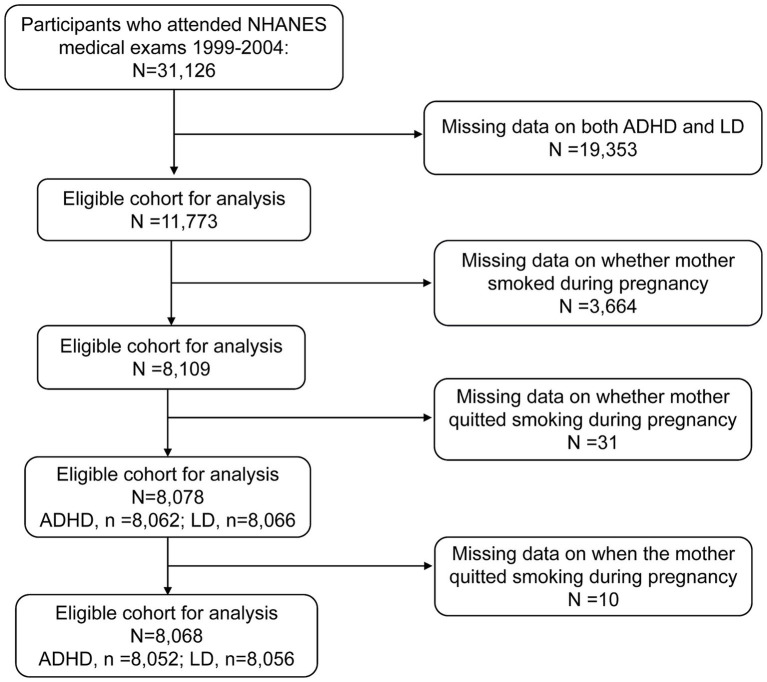
- Used publicly available National Health and Nutrition Examination Survey (NHANES) 1999–2004 data; from 31,126 participants, the final analytic sample was 8,068 children (8,052 with ADHD data; 8,056 with LD data).
- Maternal smoking and cessation timing were based on parental/guardian interview responses; ADHD and LD outcomes were based on parent/guardian reports of doctor or school/health professional diagnosis.
- Logistic regression estimated associations using a crude model and adjusted models; Model II adjusted for age, gender, race, poverty income ratio, birth weight, and NHANES cycle, with sensitivity analysis excluding participants missing PIR data.
Limitations
- Stated: the authors could not adjust for other risk factors such as gene–environment correlations or maternal health problems, so causality could not be established.
- Stated: tobacco exposure was heterogeneous, and NHANES lacked maternal smoking frequency, so heavy smoking may not be fully captured.
- Stated: smoking and cessation variables were self-reported, risking subjective bias; evident from the design, the study is cross-sectional/observational with parent-reported ADHD and LD outcomes and no objective biomarkers, leaving potential residual confounding.
Model-written summary. Check it against the paper before relying on it.
Integrity signals
Registry
Cites
Statistics
Figures
Verification
Claims the paper makes
16 Own result · 14 Not checked yet · 12 No full text of the sources · 10 Own method · 10 Own interpretation · 1 Supported so far · 1 Check pending
The sources with a verdict support this claim; the rest weren’t checked yet, have no full text we could read, or their verdicts aren’t rated yet.
In the paper
“Epidemiological studies indicate that maternal smoking during pregnancy increases the risk of ADHD (22–28) and LD (29, 30) in offspring.”
§ Maternal smoking cessation in the first trimester still poses an increased risk of attention-deficit/hyperactivity disorder and learning disability in offspring > Introduction
What the sources say
- Supportedcites [29] Jorge, 2016, Influence of passive smoking on learning in elementary school, J Pediatr source
The Discussion reports that a review of 24 studies found associations between maternal tobacco use during pregnancy and learning disorders in children. The Introduction also describes a greater probability of learning difficulties among children born to mothers who smoke during pregnancy, although it discusses continued postnatal exposure as well. (LLM, conf=0.87)
- Not checked — no full text of the sourcecites [30] Laura, 2010, Contribution of tobacco smoke exposure to learning disabilities, J Obstet Gynecol Neonatal Nurs source
hedgedstates a cause- Asserted: passes — The authors put it forward as true.
- Checkable: passes — It can be checked against evidence.
- Load-bearing: passes — The paper’s conclusions depend on it.
- Based: passes — The paper gives a reason why it holds.
- Supported
A result the paper reports from its own data — it cites no other source for it, so there is none to check. The quote shows it is in the paper.
In the paper
“Interestingly, a trend toward a gradual increase in the risk-adjusted OR for ADHD and LD risk was observed among the three groups: maternal quitting smoking in the first trimester, maternal quitting smoking in the second or third trimester, and maternal smoking but never quitting.”
- Also stated in: § Associations between the timing of maternal initiation of smoking cessation during pregnancy and the risk of ADHD and LD in offspring · plain
“the risk-adjusted OR for offspring with ADHD and LD showed a gradual increase”
§ Maternal smoking cessation in the first trimester still poses an increased risk of attention-deficit/hyperactivity disorder and learning disability in offspring > Abstract > Results
plainstates an association- Asserted: passes — The authors put it forward as true.
- Checkable: passes — It can be checked against evidence.
- Load-bearing: passes — The paper’s conclusions depend on it.
- Based: passes — The paper gives a reason why it holds.
- Rests on an assumption: Parental or guardian reports of ADHD and LD are valid measures of these outcomes.
- Rests on an assumption: Parental or guardian reports of maternal smoking and smoking cessation timing are accurate.
- Rests on an assumption: The measured covariates (age, gender, race, PIR, birth weight, NHANES cycle) adequately control for confounding of the association between maternal smoking and ADHD/LD.
- Rests on an assumption: The observed associations between maternal smoking/cessation and ADHD/LD are not due to unmeasured genetic or environmental confounding.
- Also stated in: § Associations between the timing of maternal initiation of smoking cessation during pregnancy and the risk of ADHD and LD in offspring · plain
A result the paper reports from its own data — it cites no other source for it, so there is none to check. The quote shows it is in the paper.
In the paper
“maternal quitting smoking in the first trimester still posed an increased risk of ADHD (OR = 1.72, 95% CI: 1.41–2.61) and LD (OR = 1.52, 95% CI: 1.06–2.17) in offspring.”
- Also stated in: § Results · plain
“maternal quitting smoking in the first trimester still posed an increased risk of ADHD (OR = 1.72, 95% CI: 1.41–2.61) and LD (OR = 1.52, 95% CI: 1.06–2.17) in offspring”
§ Maternal smoking cessation in the first trimester still poses an increased risk of attention-deficit/hyperactivity disorder and learning disability in offspring > Abstract > Results
plainstates a cause- Asserted: passes — The authors put it forward as true.
- Checkable: passes — It can be checked against evidence.
- Load-bearing: passes — The paper’s conclusions depend on it.
- Based: passes — The paper gives a reason why it holds.
- Rests on an assumption: Parental or guardian reports of ADHD and LD are valid measures of these outcomes.
- Rests on an assumption: Parental or guardian reports of maternal smoking and smoking cessation timing are accurate.
- Rests on an assumption: The measured covariates (age, gender, race, PIR, birth weight, NHANES cycle) adequately control for confounding of the association between maternal smoking and ADHD/LD.
- Rests on an assumption: The observed associations between maternal smoking/cessation and ADHD/LD are not due to unmeasured genetic or environmental confounding.
- Also stated in: § Results · plain
A result the paper reports from its own data — it cites no other source for it, so there is none to check. The quote shows it is in the paper.
In the paper
“even if mothers quit smoking later (ORADHD = 1.91, 95%CIADHD: 1.38–2.65, ORLD = 1.65, 95%CILD: 1.24–2.19).”
- Also stated in: § Associations between maternal smoking habits during pregnancy and the risk of ADHD and LD in offspring · plain
“maternal smoking during pregnancy but quitting later still increased the risk of ADHD (OR = 1.91, 95% CI: 1.38–2.65) and LD (OR = 1.65, 95% CI: 1.24–2.19) in offspring compared to non-smokers’ offspring.”
§ Maternal smoking cessation in the first trimester still poses an increased risk of attention-deficit/hyperactivity disorder and learning disability in offspring > Abstract > Results
plainstates a cause- Asserted: passes — The authors put it forward as true.
- Checkable: passes — It can be checked against evidence.
- Load-bearing: passes — The paper’s conclusions depend on it.
- Based: passes — The paper gives a reason why it holds.
- Rests on an assumption: Parental or guardian reports of ADHD and LD are valid measures of these outcomes.
- Rests on an assumption: Parental or guardian reports of maternal smoking and smoking cessation timing are accurate.
- Rests on an assumption: The measured covariates (age, gender, race, PIR, birth weight, NHANES cycle) adequately control for confounding of the association between maternal smoking and ADHD/LD.
- Rests on an assumption: The observed associations between maternal smoking/cessation and ADHD/LD are not due to unmeasured genetic or environmental confounding.
- Also stated in: § Associations between maternal smoking habits during pregnancy and the risk of ADHD and LD in offspring · plain
A result the paper reports from its own data — it cites no other source for it, so there is none to check. The quote shows it is in the paper.
In the paper
“maternal smoking during pregnancy increased the risk of ADHD (odds ratios [OR] = 2.07, 95% confidence interval [CI]: 1.67–2.56)”
§ Maternal smoking cessation in the first trimester still poses an increased risk of attention-deficit/hyperactivity disorder and learning disability in offspring > Abstract > Results
plainstates a cause- Asserted: passes — The authors put it forward as true.
- Checkable: passes — It can be checked against evidence.
- Load-bearing: passes — The paper’s conclusions depend on it.
- Based: passes — The paper gives a reason why it holds.
- Rests on an assumption: Parental or guardian reports of ADHD and LD are valid measures of these outcomes.
- Rests on an assumption: Parental or guardian reports of maternal smoking and smoking cessation timing are accurate.
- Rests on an assumption: The measured covariates (age, gender, race, PIR, birth weight, NHANES cycle) adequately control for confounding of the association between maternal smoking and ADHD/LD.
- Rests on an assumption: The observed associations between maternal smoking/cessation and ADHD/LD are not due to unmeasured genetic or environmental confounding.
A result the paper reports from its own data — it cites no other source for it, so there is none to check. The quote shows it is in the paper.
In the paper
“maternal smoking during pregnancy increased the risk of ADHD (odds ratios [OR] = 2.07, 95% confidence interval [CI]: 1.67–2.56) and LD (OR = 1.93, 95% CI: 1.61–2.31) in offspring”
- Also stated in: § Associations between maternal smoking habits during pregnancy and the risk of ADHD and LD in offspring · plain
“maternal smoking during pregnancy increased the risk of ADHD (OR = 2.07, 95% CI: 1.67–2.56) and LD (OR = 1.93, 95% CI: 1.61–2.31) in offspring compared to non-smokers’ offspring.”
§ Maternal smoking cessation in the first trimester still poses an increased risk of attention-deficit/hyperactivity disorder and learning disability in offspring > Abstract > Results
plainstates a cause- Asserted: passes — The authors put it forward as true.
- Checkable: passes — It can be checked against evidence.
- Load-bearing: passes — The paper’s conclusions depend on it.
- Based: passes — The paper gives a reason why it holds.
- Rests on an assumption: Parental or guardian reports of ADHD and LD are valid measures of these outcomes.
- Rests on an assumption: Parental or guardian reports of maternal smoking and smoking cessation timing are accurate.
- Rests on an assumption: The measured covariates (age, gender, race, PIR, birth weight, NHANES cycle) adequately control for confounding of the association between maternal smoking and ADHD/LD.
- Rests on an assumption: The observed associations between maternal smoking/cessation and ADHD/LD are not due to unmeasured genetic or environmental confounding.
- Also stated in: § Associations between maternal smoking habits during pregnancy and the risk of ADHD and LD in offspring · plain
A result the paper reports from its own data — it cites no other source for it, so there is none to check. The quote shows it is in the paper.
In the paper
“maternal smoking but never quitting during pregnancy had the highest risk of ADHD (OR = 2.17, 95% CI: 1.69–2.79) and LD (OR = 2.10, 95% CI: 1.70–2.58) in offspring.”
- Also stated in: § Associations between the timing of maternal initiation of smoking cessation during pregnancy and the risk of ADHD and LD in offspring · plain
“maternal smoking but never quitting during pregnancy had the highest risk of ADHD (OR = 2.17, 95% CI: 1.69–2.79) and LD (OR = 2.10, 95% CI: 1.70–2.58) in offspring.”
§ Maternal smoking cessation in the first trimester still poses an increased risk of attention-deficit/hyperactivity disorder and learning disability in offspring > Abstract > Results
plainstates an association- Asserted: passes — The authors put it forward as true.
- Checkable: passes — It can be checked against evidence.
- Load-bearing: passes — The paper’s conclusions depend on it.
- Based: passes — The paper gives a reason why it holds.
- Rests on an assumption: Parental or guardian reports of ADHD and LD are valid measures of these outcomes.
- Rests on an assumption: Parental or guardian reports of maternal smoking and smoking cessation timing are accurate.
- Rests on an assumption: The measured covariates (age, gender, race, PIR, birth weight, NHANES cycle) adequately control for confounding of the association between maternal smoking and ADHD/LD.
- Rests on an assumption: The observed associations between maternal smoking/cessation and ADHD/LD are not due to unmeasured genetic or environmental confounding.
- Also stated in: § Associations between the timing of maternal initiation of smoking cessation during pregnancy and the risk of ADHD and LD in offspring · plain
A result the paper reports from its own data — it cites no other source for it, so there is none to check. The quote shows it is in the paper.
In the paper
“even if mothers quit smoking later (ORADHD = 1.91, 95%CIADHD: 1.38–2.65, ORLD = 1.65, 95%CILD: 1.24–2.19).”
- Also stated in: § Associations between maternal smoking habits during pregnancy and the risk of ADHD and LD in offspring · plain
“maternal smoking during pregnancy but quitting later still increased the risk of ADHD (OR = 1.91, 95% CI: 1.38–2.65) and LD (OR = 1.65, 95% CI: 1.24–2.19) in offspring compared to non-smokers’ offspring.”
§ Maternal smoking cessation in the first trimester still poses an increased risk of attention-deficit/hyperactivity disorder and learning disability in offspring > Abstract > Results
plainstates a cause- Asserted: passes — The authors put it forward as true.
- Checkable: passes — It can be checked against evidence.
- Load-bearing: passes — The paper’s conclusions depend on it.
- Based: passes — The paper gives a reason why it holds.
- Rests on an assumption: Parental or guardian reports of ADHD and LD are valid measures of these outcomes.
- Rests on an assumption: Parental or guardian reports of maternal smoking and smoking cessation timing are accurate.
- Rests on an assumption: The measured covariates (age, gender, race, PIR, birth weight, NHANES cycle) adequately control for confounding of the association between maternal smoking and ADHD/LD.
- Rests on an assumption: The observed associations between maternal smoking/cessation and ADHD/LD are not due to unmeasured genetic or environmental confounding.
- Also stated in: § Associations between maternal smoking habits during pregnancy and the risk of ADHD and LD in offspring · plain
A result the paper reports from its own data — it cites no other source for it, so there is none to check. The quote shows it is in the paper.
In the paper
“maternal smoking but never quitting during pregnancy had the highest risk of ADHD (OR = 2.17, 95% CI: 1.69–2.79) and LD (OR = 2.10, 95% CI: 1.70–2.58) in offspring.”
- Also stated in: § Associations between the timing of maternal initiation of smoking cessation during pregnancy and the risk of ADHD and LD in offspring · plain
“maternal smoking but never quitting during pregnancy had the highest risk of ADHD (OR = 2.17, 95% CI: 1.69–2.79) and LD (OR = 2.10, 95% CI: 1.70–2.58) in offspring.”
§ Maternal smoking cessation in the first trimester still poses an increased risk of attention-deficit/hyperactivity disorder and learning disability in offspring > Abstract > Results
plainstates an association- Asserted: passes — The authors put it forward as true.
- Checkable: passes — It can be checked against evidence.
- Load-bearing: passes — The paper’s conclusions depend on it.
- Based: passes — The paper gives a reason why it holds.
- Rests on an assumption: Parental or guardian reports of ADHD and LD are valid measures of these outcomes.
- Rests on an assumption: Parental or guardian reports of maternal smoking and smoking cessation timing are accurate.
- Rests on an assumption: The measured covariates (age, gender, race, PIR, birth weight, NHANES cycle) adequately control for confounding of the association between maternal smoking and ADHD/LD.
- Rests on an assumption: The observed associations between maternal smoking/cessation and ADHD/LD are not due to unmeasured genetic or environmental confounding.
- Also stated in: § Associations between the timing of maternal initiation of smoking cessation during pregnancy and the risk of ADHD and LD in offspring · plain
- It may state two separate claims as one. 7
- Probably not a substantial claim. 22
None of the sources cited for this claim have been checked yet.
In the paper
“Animal studies have also found that prolonged nicotine exposure during pregnancy was associated with reduced attention, increased hyperactivity, and learning and memory deficits in offspring (33–35).”
§ Maternal smoking cessation in the first trimester still poses an increased risk of attention-deficit/hyperactivity disorder and learning disability in offspring > Introduction
What the sources say
- Not checked — no full text of the sourcecites [33] Polli, 2020, Cellular and molecular changes in hippocampal glutamate Signaling and alterations in learning, attention, and impulsivity following prenatal nicotine exposure, Mol Neurobiol source
- Not checked — no full text of the sourcecites [34] Al-Sawalha, 2018, Effect of prenatal exposure to waterpipe tobacco smoke on learning and memory of adult offspring rats, Nicot Tob Res source
- Not checked yetcites [35] Hall, 2016, Cognitive and Behavioral impairments evoked by low-level exposure to tobacco smoke components: comparison with nicotine alone, Toxicol Sci source
plainstates an association- Asserted: passes — The authors put it forward as true.
- Checkable: passes — It can be checked against evidence.
- Load-bearing: unclear — It is unclear whether the paper’s conclusions depend on it.
- Based: passes — The paper gives a reason why it holds.
It may state two separate claims as one.
What the paper did — it cites no source for this, so there is none to check. The quote shows it is in the paper.
In the paper
“The NCHS Research Ethics Review Board approved these NHANES cycles. All participants provided written informed consent.”
§ Maternal smoking cessation in the first trimester still poses an increased risk of attention-deficit/hyperactivity disorder and learning disability in offspring > Materials and methods > Study population
plain- Asserted: passes — The authors put it forward as true.
- Checkable: passes — It can be checked against evidence.
- Load-bearing: fails — The paper’s conclusions may not depend on it.
- Based: passes — The paper gives a reason why it holds.
Probably not a substantial claim. The paper’s conclusions may not depend on it. It may state two separate claims as one.
None of the sources cited for this claim have been checked yet.
In the paper
“Piper et al. (48) showed that children whose mothers quit smoking during pregnancy had significantly fewer attention and externalizing problems than those whose mothers continued smoking.”
§ Maternal smoking cessation in the first trimester still poses an increased risk of attention-deficit/hyperactivity disorder and learning disability in offspring > Introduction
What the sources say
- Not checked yetcites [48] Piper, 2012, Maternal smoking cessation and reduced academic and behavioral problems in offspring, Drug Alcohol Depend source
Checked before — its earlier verdict is held back until a new check runs.
plainstates an association- Asserted: passes — The authors put it forward as true.
- Checkable: passes — It can be checked against evidence.
- Load-bearing: fails — The paper’s conclusions may not depend on it.
- Based: passes — The paper gives a reason why it holds.
Probably not a substantial claim. The paper’s conclusions may not depend on it.
- Not checked yet
What the paper did — it cites no source for this, so there is none to check. The quote shows it is in the paper.
In the paper
“Model II: adjusted for all underlying covariates including age, gender, race, PIR, birthweight, and NHANES cycle.”
- Also stated in: § Associations between maternal smoking habits during pregnancy and the risk of ADHD and LD in offspring · plain
“in Model II (adjusted for age, gender, race, PIR, birth weight, and NHANES cycle)”
§ Maternal smoking cessation in the first trimester still poses an increased risk of attention-deficit/hyperactivity disorder and learning disability in offspring > Materials and methods > Statistical analysis
plain- Asserted: passes — The authors put it forward as true.
- Checkable: passes — It can be checked against evidence.
- Load-bearing: passes — The paper’s conclusions depend on it.
- Based: passes — The paper gives a reason why it holds.
Probably not a substantial claim.
- Rests on an assumption: Parental or guardian reports of ADHD and LD are valid measures of these outcomes.
- Rests on an assumption: Parental or guardian reports of maternal smoking and smoking cessation timing are accurate.
- Rests on an assumption: The observed associations between maternal smoking/cessation and ADHD/LD are not due to unmeasured genetic or environmental confounding.
- Also stated in: § Associations between maternal smoking habits during pregnancy and the risk of ADHD and LD in offspring · plain
In the paper
“which can also have long-lasting adverse effects on the behavior and mental health of offspring (66).”
§ Maternal smoking cessation in the first trimester still poses an increased risk of attention-deficit/hyperactivity disorder and learning disability in offspring > Discussion
What the sources say
- Not checked — no full text of the sourcecites [66] Van den Bergh, 2020, Prenatal developmental origins of behavior and mental health: the influence of maternal stress in pregnancy, Neurosci Biobehav Rev source
plainstates a possible cause- Asserted: passes — The authors put it forward as true.
- Checkable: passes — It can be checked against evidence.
- Load-bearing: fails — The paper’s conclusions may not depend on it.
- Based: passes — The paper gives a reason why it holds.
Probably not a substantial claim. The paper’s conclusions may not depend on it.
None of the sources cited for this claim have been checked yet.
In the paper
“However, studies have also shown that maternal smoking during pregnancy is not significantly associated with neuropsychological functioning, intelligence (55), and the risk of ADHD in offspring (38, 56).”
§ Maternal smoking cessation in the first trimester still poses an increased risk of attention-deficit/hyperactivity disorder and learning disability in offspring > Discussion
What the sources say
- Not checked yetcites [55] Roigé-Castellví, 2020, The effect of prenatal smoke exposure on child neuropsychological function: a prospective mother-child cohort study, J Reprod Infant Psychol source
Checked before — its earlier verdict is held back until a new check runs.
- Not checked — no full text of the sourcecites [38] Ball, 2010, Revisiting the association between maternal smoking during pregnancy and ADHD, J Psychiatr Res source
- Not checked yetcites [56] Thapar, 2009, Prenatal smoking might not cause attention-deficit/hyperactivity disorder: evidence from a novel design, Biol Psychiatry source
Checked before — its earlier verdict is held back until a new check runs.
plain- Asserted: fails — The authors may not put it forward as true.
- Checkable: passes — It can be checked against evidence.
- Load-bearing: fails — The paper’s conclusions may not depend on it.
- Based: passes — The paper gives a reason why it holds.
Probably not a substantial claim. The authors may not put it forward as true. The paper’s conclusions may not depend on it. It may state two separate claims as one.
- Not checked yet
None of the sources cited for this claim have been checked yet.
In the paper
“Similarly, Yang et al. (59) found that maternal smoking during each trimester of pregnancy significantly increased the risk of congenital anomalies at birth in offspring.”
§ Maternal smoking cessation in the first trimester still poses an increased risk of attention-deficit/hyperactivity disorder and learning disability in offspring > Discussion
What the sources say
- Not checked yetcites [59] Yang, 2022, Maternal cigarette smoking before or during pregnancy increases the risk of birth congenital anomalies: a population-based retrospective cohort study of 12 million mother-infant pairs, BMC Med source
Checked before — its earlier verdict is held back until a new check runs.
plainstates a cause- Asserted: passes — The authors put it forward as true.
- Checkable: passes — It can be checked against evidence.
- Load-bearing: fails — The paper’s conclusions may not depend on it.
- Based: passes — The paper gives a reason why it holds.
Probably not a substantial claim. The paper’s conclusions may not depend on it.
- Not checked yet
What the paper did — it cites no source for this, so there is none to check. The quote shows it is in the paper.
In the paper
“Written informed consent for participation in this study was provided by the participants’ legal guardians/participants.”
§ Maternal smoking cessation in the first trimester still poses an increased risk of attention-deficit/hyperactivity disorder and learning disability in offspring > Ethics statement
plain- Asserted: passes — The authors put it forward as true.
- Checkable: passes — It can be checked against evidence.
- Load-bearing: fails — The paper’s conclusions may not depend on it.
- Based: passes — The paper gives a reason why it holds.
Probably not a substantial claim. The paper’s conclusions may not depend on it.
What the paper did — it cites no source for this, so there is none to check. The quote shows it is in the paper.
In the paper
“The studies involving humans were reviewed and approved by The NCHS Research Ethics Review Board.”
§ Maternal smoking cessation in the first trimester still poses an increased risk of attention-deficit/hyperactivity disorder and learning disability in offspring > Ethics statement
plain- Asserted: passes — The authors put it forward as true.
- Checkable: passes — It can be checked against evidence.
- Load-bearing: fails — The paper’s conclusions may not depend on it.
- Based: passes — The paper gives a reason why it holds.
Probably not a substantial claim. The paper’s conclusions may not depend on it.
None of the sources cited for this claim have been checked yet.
In the paper
“Azuine et al. (63) showed that children exposed to opioids in utero are diagnosed with behavioral disorders, emotional disorders, or ADHD at approximately twice the rate of children without exposure.”
§ Maternal smoking cessation in the first trimester still poses an increased risk of attention-deficit/hyperactivity disorder and learning disability in offspring > Discussion
What the sources say
- Not checked yetcites [63] Azuine, 2019, Prenatal risk factors and perinatal and postnatal outcomes associated with maternal opioid exposure in an urban, low-income, Multiethnic US Population, JAMA Netw Open source
Checked before — its earlier verdict is held back until a new check runs.
plainstates an association- Asserted: passes — The authors put it forward as true.
- Checkable: passes — It can be checked against evidence.
- Load-bearing: fails — The paper’s conclusions may not depend on it.
- Based: passes — The paper gives a reason why it holds.
Probably not a substantial claim. The paper’s conclusions may not depend on it.
- Not checked yet
A statement the paper makes itself — it cites no source for it, so there is none to check. The quote shows it is in the paper.
In the paper
“However, specific evidence on whether maternal smoking cessation during pregnancy can mitigate ADHD and LD risks in offspring is currently insufficient; furthermore, studies on the effects of smoking cessation timing are lacking.”
§ Maternal smoking cessation in the first trimester still poses an increased risk of attention-deficit/hyperactivity disorder and learning disability in offspring > Introduction
plain- Asserted: passes — The authors put it forward as true.
- Checkable: passes — It can be checked against evidence.
- Load-bearing: passes — The paper’s conclusions depend on it.
- Based: passes — The paper gives a reason why it holds.
Probably not a substantial claim.
In the paper
“Our study also supports the speculation of Zou et al. (74) that exposure to tobacco throughout pregnancy is more associated with brain development than transient exposure in early gestation.”
§ Maternal smoking cessation in the first trimester still poses an increased risk of attention-deficit/hyperactivity disorder and learning disability in offspring > Discussion
What the sources say
- Not checked yetcites [74] Zou, 2022, Association of Maternal Tobacco use during Pregnancy with Preadolescent Brain Morphology among Offspring, JAMA Netw Open source
hedgedstates an association- Asserted: passes — The authors put it forward as true.
- Checkable: passes — It can be checked against evidence.
- Load-bearing: fails — The paper’s conclusions may not depend on it.
- Based: passes — The paper gives a reason why it holds.
Probably not a substantial claim. The paper’s conclusions may not depend on it.
None of the sources cited for this claim have been checked yet.
In the paper
“Notably, smoking-related epigenetic effects could potentially be transmitted across generations (i.e., smoking influences may affect germline cells or escape epigenetic reprogramming during development) (70, 72).”
§ Maternal smoking cessation in the first trimester still poses an increased risk of attention-deficit/hyperactivity disorder and learning disability in offspring > Discussion
What the sources say
- Not checked yetcites [70] Knopik, 2012, The epigenetics of maternal cigarette smoking during pregnancy and effects on child development, Dev Psychopathol source
Checked before — its earlier verdict is held back until a new check runs.
- Not checked yetcites [72] Liu, 2022, Pre-pubertal smoke exposure of fathers and increased risk of offspring asthma: a possible transgenerational effect, Eur Respir J source
Checked before — its earlier verdict is held back until a new check runs.
hedgedstates a possible cause- Asserted: passes — The authors put it forward as true.
- Checkable: passes — It can be checked against evidence.
- Load-bearing: fails — The paper’s conclusions may not depend on it.
- Based: passes — The paper gives a reason why it holds.
Probably not a substantial claim. The paper’s conclusions may not depend on it.
- Not checked yet
In the paper
“Similarly, a study by Räisänen et al. (21) found that infants of mothers who quit smoking in early pregnancy were slightly more likely to be admitted to neonatal care compared to infants of non-smokers.”
§ Maternal smoking cessation in the first trimester still poses an increased risk of attention-deficit/hyperactivity disorder and learning disability in offspring > Discussion
What the sources say
- Not checked — no full text of the sourcecites [21] Räisänen, 2014, Smoking cessation in the first trimester reduces most obstetric risks, but not the risks of major congenital anomalies and admission to neonatal care: a population-based cohort study of 1,164,953 singleton pregnancies in Finland, J Epidemiol Community Health source
plainstates an association- Asserted: passes — The authors put it forward as true.
- Checkable: passes — It can be checked against evidence.
- Load-bearing: fails — The paper’s conclusions may not depend on it.
- Based: passes — The paper gives a reason why it holds.
Probably not a substantial claim. The paper’s conclusions may not depend on it.
What the paper did — it cites no source for this, so there is none to check. The quote shows it is in the paper.
In the paper
“Second, there was heterogeneity in tobacco exposure among mothers who smoked during pregnancy.”
§ Maternal smoking cessation in the first trimester still poses an increased risk of attention-deficit/hyperactivity disorder and learning disability in offspring > Discussion
plain- Asserted: passes — The authors put it forward as true.
- Checkable: passes — It can be checked against evidence.
- Load-bearing: fails — The paper’s conclusions may not depend on it.
- Based: passes — The paper gives a reason why it holds.
Probably not a substantial claim. The paper’s conclusions may not depend on it.
In the paper
“As in the study by Heinonen et al. (49), they found that children whose mothers smoked >10 cigarettes daily and quit before pregnancy had significantly lower cognitive scores than children of never-smokers.”
§ Maternal smoking cessation in the first trimester still poses an increased risk of attention-deficit/hyperactivity disorder and learning disability in offspring > Discussion
What the sources say
- Not checked — no full text of the sourcecites [49] Heinonen, 2011, Longitudinal study of smoking cessation before pregnancy and children's cognitive abilities at 56 months of age, Early Hum Dev source
plainstates an association- Asserted: passes — The authors put it forward as true.
- Checkable: passes — It can be checked against evidence.
- Load-bearing: passes — The paper’s conclusions depend on it.
- Based: passes — The paper gives a reason why it holds.
Probably not a substantial claim.
None of the sources cited for this claim have been checked yet.
In the paper
“Previous studies have found that smoking during pregnancy is associated with adverse outcomes in several areas, such as low birth weight (20), reduced intelligence (50), learning and memory deficits (51), poor academic performance (52), elevated levels of externalizing and internalizing symptoms (53, 54), and hyperactivity/attention difficulties (22).”
§ Maternal smoking cessation in the first trimester still poses an increased risk of attention-deficit/hyperactivity disorder and learning disability in offspring > Discussion
What the sources say
- Not checked yetcites [20] Hamadneh, 2021, Active and passive maternal smoking during pregnancy and birth outcomes: a study from a developing country, Ann Glob Health source
Checked before — its earlier verdict is held back until a new check runs.
- Not checked — no full text of the sourcecites [50] Mortensen, 2005, A dose-response relationship between maternal smoking during late pregnancy and adult intelligence in male offspring, Paediatr Perinat Epidemiol source
- Not checked — no full text of the sourcecites [51] Cornelius, 2001, Prenatal tobacco effects on neuropsychological outcomes among preadolescents, J Dev Behav Pediatr source
plainstates an association- Asserted: passes — The authors put it forward as true.
- Checkable: passes — It can be checked against evidence.
- Load-bearing: passes — The paper’s conclusions depend on it.
- Based: passes — The paper gives a reason why it holds.
Probably not a substantial claim. It may state two separate claims as one.
- Not checked yet
What the paper did — it cites no source for this, so there is none to check. The quote shows it is in the paper.
In the paper
“First, other risk factors (e.g., gene–environment correlations or maternal health problems) may affect the risk of ADHD and LD; however, we could not adjust for these because such data are not included in the NHANES database.”
§ Maternal smoking cessation in the first trimester still poses an increased risk of attention-deficit/hyperactivity disorder and learning disability in offspring > Discussion
hedgedstates a possible cause- Asserted: passes — The authors put it forward as true.
- Checkable: passes — It can be checked against evidence.
- Load-bearing: passes — The paper’s conclusions depend on it.
- Based: passes — The paper gives a reason why it holds.
It may state two separate claims as one.
A statement the paper makes itself — it cites no source for it, so there is none to check. The quote shows it is in the paper.
In the paper
“However, specific evidence on whether maternal smoking cessation during pregnancy can mitigate ADHD and LD risks in offspring is currently insufficient; furthermore, studies on the effects of smoking cessation timing are lacking.”
§ Maternal smoking cessation in the first trimester still poses an increased risk of attention-deficit/hyperactivity disorder and learning disability in offspring > Introduction
plain- Asserted: passes — The authors put it forward as true.
- Checkable: passes — It can be checked against evidence.
- Load-bearing: passes — The paper’s conclusions depend on it.
- Based: passes — The paper gives a reason why it holds.
Probably not a substantial claim.
None of the sources cited for this claim have been checked yet.
In the paper
“These changes may be associated with neurobehavioral and cognitive deficits in the offspring (40–42).”
§ Maternal smoking cessation in the first trimester still poses an increased risk of attention-deficit/hyperactivity disorder and learning disability in offspring > Introduction
What the sources say
- Not checked yetcites [40] Cornelius, 2009, Developmental consequences of prenatal tobacco exposure, Curr Opin Neurol source
- Not checked — no full text of the sourcecites [41] Herrmann, 2008, Prenatal tobacco smoke and postnatal secondhand smoke exposure and child neurodevelopment, Curr Opin Pediatr source
- Not checked — no full text of the sourcecites [42] Pauly, 2008, Maternal tobacco smoking, nicotine replacement and neurobehavioural development, Acta Paediatr source
hedgedstates an association- Asserted: passes — The authors put it forward as true.
- Checkable: passes — It can be checked against evidence.
- Load-bearing: passes — The paper’s conclusions depend on it.
- Based: passes — The paper gives a reason why it holds.
Probably not a substantial claim.
In the paper
“Similarly, a birth cohort study revealed that maternal smoking during pregnancy was associated with a slight decline in offspring academic performance, with the potential effects persisting into adolescence (32).”
§ Maternal smoking cessation in the first trimester still poses an increased risk of attention-deficit/hyperactivity disorder and learning disability in offspring > Introduction
What the sources say
- Not checked — no full text of the sourcecites [32] O'Callaghan, 2010, Is smoking in pregnancy an independent predictor of academic difficulties at 14years of age? A birth cohort study, Early Hum Dev source
plainstates an association- Asserted: passes — The authors put it forward as true.
- Checkable: passes — It can be checked against evidence.
- Load-bearing: fails — The paper’s conclusions may not depend on it.
- Based: passes — The paper gives a reason why it holds.
Probably not a substantial claim. The paper’s conclusions may not depend on it. It may state two separate claims as one.
In the paper
“Biederman et al. (31) showed that maternal smoking during pregnancy was associated with a more severe form of ADHD in children, characterized by more severe clinical and neuropsychological manifestations.”
§ Maternal smoking cessation in the first trimester still poses an increased risk of attention-deficit/hyperactivity disorder and learning disability in offspring > Introduction
What the sources say
- Not checked — no full text of the sourcecites [31] Biederman, 2017, Is maternal smoking during pregnancy a risk factor for cigarette smoking in offspring? A longitudinal controlled study of ADHD children grown up, J Atten Disord source
plainstates an association- Asserted: passes — The authors put it forward as true.
- Checkable: passes — It can be checked against evidence.
- Load-bearing: fails — The paper’s conclusions may not depend on it.
- Based: passes — The paper gives a reason why it holds.
Probably not a substantial claim. The paper’s conclusions may not depend on it.
None of the sources cited for this claim have been checked yet.
In the paper
“both experimental animal and human studies have shown that tobacco smoke contains numerous toxic components, including nicotine and carbon monoxide, which can lead to changes in enzyme and hormone levels, as well as in the expression of genes, microRNAs, and proteins early in a child’s life (39).”
§ Maternal smoking cessation in the first trimester still poses an increased risk of attention-deficit/hyperactivity disorder and learning disability in offspring > Introduction
What the sources say
- Not checked yetcites [39] Braun, 2020, Influence of second-hand smoke and prenatal tobacco smoke exposure on biomarkers, genetics and physiological processes in children-an overview in research insights of the last few years, Int J Environ Res Public Health source
Checked before — its earlier verdict is held back until a new check runs.
plainstates a cause- Asserted: passes — The authors put it forward as true.
- Checkable: passes — It can be checked against evidence.
- Load-bearing: fails — The paper’s conclusions may not depend on it.
- Based: passes — The paper gives a reason why it holds.
Probably not a substantial claim. The paper’s conclusions may not depend on it. It may state two separate claims as one.
- Not checked yet
In the paper
“Another study of 1,019 Finnish children born at term also observed that children of mothers who smoked before and/or during pregnancy performed worse on cognitive tests at 56 months of age than children of non-smokers (49).”
§ Maternal smoking cessation in the first trimester still poses an increased risk of attention-deficit/hyperactivity disorder and learning disability in offspring > Discussion
What the sources say
- Not checked — no full text of the sourcecites [49] Heinonen, 2011, Longitudinal study of smoking cessation before pregnancy and children's cognitive abilities at 56 months of age, Early Hum Dev source
plainstates an associationn = 1,019- Asserted: passes — The authors put it forward as true.
- Checkable: passes — It can be checked against evidence.
- Load-bearing: fails — The paper’s conclusions may not depend on it.
- Based: passes — The paper gives a reason why it holds.
Probably not a substantial claim. The paper’s conclusions may not depend on it.
The paper relies on this without support.
Parental or guardian reports of ADHD and LD are valid measures of these outcomes.
“To assess the neurodevelopmental outcomes, including ADHD and LD, the parents/guardian were asked, “Has a doctor or health professional ever told you/SP that you/s/he/SP had attention deficit disorder?” and “Has a representative from a school or a health professional ever told you/SP that s/he/SP had a learning disability?””
The paper relies on this without support.
Parental or guardian reports of maternal smoking and smoking cessation timing are accurate.
“This information was based on parental or guardian responses to the NHANES interview question.”
The paper relies on this without support.
The measured covariates (age, gender, race, PIR, birth weight, NHANES cycle) adequately control for confounding of the association between maternal smoking and ADHD/LD.
“Some covariables were assessed as potential confounders, including age, gender, race, poverty income ratio (PIR), birth weight, and NHANES cycle.”
“Model II: adjusted for all underlying covariates including age, gender, race, PIR, birthweight, and NHANES cycle.”
The paper relies on this without support.
The observed associations between maternal smoking/cessation and ADHD/LD are not due to unmeasured genetic or environmental confounding.
“Even though some studies suggest that this association is explained by unmeasured genetic or environmental confounding (37, 38)”
The paper relies on this without support.
The critical period of embryo development is early in pregnancy, and this period is particularly sensitive to external factors.
“One possible explanation is that the critical period of embryo development is early in pregnancy, a period that is particularly sensitive to external factors.”
The paper relies on this without support.
Accumulated toxins in the body can pass through the bloodstream into the placenta and affect the embryo’s brain development.
“these can pass through the bloodstream into the placenta, affecting the embryo’s brain development.”
Self-check
Percentages, sums and reported differences re-computed from the paper’s own numbers.
Each contradiction between two passages listed here was confirmed by an independent check.
Rated minor: it would not touch a result — a value no result rests on, a p-value that stays on the same side of the significance level, or a conflict that is clerical, resolved elsewhere in the paper, or outside its own findings.
In the paper
§ Maternal smoking cessation in the first trimester still poses an increased risk of attention-deficit/hyperactivity disorder and learning disability in offspring > Materials and methods > Study population
“Among them, 8,052 participants had available data on ADHD, and 8,056 participants had available data on LD.”
§ Maternal smoking cessation in the first trimester still poses an increased risk of attention-deficit/hyperactivity disorder and learning disability in offspring > Results > Study population characteristics
“| Characteristic | ADHD No (N = 7,540) | ADHD Yes (N = 522) | ADHD Test | ADHD P | LD No (N = 7,223) | LD Yes (N = 843) | LD Test | LD P |”
Citations
Cites
Ben-Shlomo, Y. (2002) · International Journal of Epidemiology · doi:10.1093/ije/31.2.285 · Cited by 3,038
Nicotine Chemistry, Metabolism, Kinetics and Biomarkers
Benowitz, N. L., Hukkanen, J., & Jacob, P. (2009) · Handbook of experimental pharmacology · doi:10.1007/978-3-540-69248-5_2 · Cited by 1,483
ADHD in Children and Young People: Prevalence, Care Pathways, and Service Provision
Sayal, K., Prasad, V., Daley, D., Ford, T., & Coghill, D. (2018) · The Lancet Psychiatry · doi:10.1016/s2215-0366(17)30167-0 · Cited by 1,223
Danielson, M. L., Bitsko, R. H., Ghandour, R. M., Holbrook, J. R., Kogan, M. D., & Blumberg, S. J. (2018) · Journal of Clinical Child & Adolescent Psychology · doi:10.1080/15374416.2017.1417860 · Cited by 1,181
Van den Bergh, B. R. H., van den Heuvel, M. I., Lahti, M., Braeken, M., de Rooij, S. R., Entringer, S., Hoyer, D., Roseboom, T., Räikkönen, K., King, S., et al. (2020) · Neuroscience & Biobehavioral Reviews · doi:10.1016/j.neubiorev.2017.07.003 · Cited by 1,181
Attention deficit hyperactivity disorder
Thapar, A., & Cooper, M. (2015) · The Lancet · doi:10.1016/s0140-6736(15)00238-x · Cited by 1,169
Developmental Origins of Health and Disease
Gillman, M. W. (2005) · New England Journal of Medicine · doi:10.1056/nejme058187 · Cited by 756
Practitioner Review: What have we learnt about the causes of ADHD?
Thapar, A., Cooper, M., Eyre, O., & Langley, K. (2013) · Journal of Child Psychology and Psychiatry · doi:10.1111/j.1469-7610.2012.02611.x · Cited by 701
Environmental risk factors for attention‐deficit hyperactivity disorder
Banerjee, T. D., Middleton, F., & Faraone, S. V. (2007) · Acta Paediatrica · doi:10.1111/j.1651-2227.2007.00430.x · Cited by 575
Lange, S., Probst, C., Rehm, J., & Popova, S. (2018) · The Lancet Global Health · doi:10.1016/s2214-109x(18)30223-7 · Cited by 550
Research works printed but not linked: 1
- Arlington, 2013, American Psychiatric Association: diagnostic and statistical manual of mental disorders
Cited by
Sorted by citations
Mohammadian, M., Khachatryan, L., Vadiyan, F. V., Maleki, M., Fatahian, F., & Mohammadian-Hafshejani, A. (2025) · PLoS ONE · doi:10.1371/journal.pone.0317112 · Cited by 13
RetractedHe, B., Peng, J., Wu, M., Deng, Y., & Zhang, Y. (2025) · Tobacco Induced Diseases · doi:10.18332/tid/207094 · Cited by 3
Memory under siege: the cognitive costs of smoking and vaping
Oliver, B. G. G., Wang, Q., Yarak, R. A., Hikasem, T., Gorrie, C. A., Yi, C., & Chen, H. (2025) · Brain Behavior & Immunity - Health · doi:10.1016/j.bbih.2025.101102 · Cited by 3
(2025) · Wiley eBooks · doi:10.1002/9781118941430.refs
Bi, S., Li, H., Xu, X., & Li, L. (2026) · Journal of Child and Adolescent Psychopharmacology · doi:10.1177/10445463261416680
Metadata
- Authors
- Li, Q., Cai, X., Zhou, H., Ma, D., & Li, N.
- Affiliations
- Sichuan University (CN)
- Corresponding author
- Li, Na
- Venue
- Frontiers in Public Health
- Publisher
- Frontiers Media SA
- Published
- 2024-07-16
- Volume
- 12
- Pages
- 1386137-1386137
- ISSN
- 2296-2565 (ISSN-L)
- PMC
- PMC11286595
- OpenAlex
- W4400696047
- Cited by
- 9
- References
- 73
- Citations by year
- 2026: 5 · 2025: 4
- FWCI
- 4.23
- Type
- journal article
- Language
- en
- Open access
- gold
- doi.org
- Licence
- Locations
- Frontiers in Public Health (publishedVersion, cc-by)
- PubMed Central (publishedVersion, cc-by)
- PubMed (publishedVersion)
- DOAJ (DOAJ: Directory of Open Access Journals) (submittedVersion, cc-by-sa)
- Funders
- Chengdu Science and Technology Bureau
- Health Commission of Sichuan Province
- Topics
- Health Sciences › Medicine › Pediatrics, Perinatology and Child Health › Prenatal Substance Exposure Effects
- Health Sciences › Medicine › Public Health, Environmental and Occupational Health › Smoking Behavior and Cessation
- Health Sciences › Medicine › Psychiatry and Mental health › Attention Deficit Hyperactivity Disorder
- Keywords
- maternal smoking cessation, prenatal tobacco exposure, attention deficit hyperactivity disorder, learning disabilities, offspring neurodevelopment, first trimester, smoking during pregnancy, prenatal care
- MeSH terms
- Adult, Attention Deficit Disorder with Hyperactivity, Child, Female, Humans, Learning Disabilities, Male, Mothers, Nutrition Surveys, Pregnancy, Pregnancy Trimester, First, Prenatal Exposure Delayed Effects, Risk Factors, Smoking, Smoking Cessation
About these checks
Registry, retraction, Cites and statistics results are computed, not judged, with one exception: a printed reference that no index lists is read once by a model before it counts as a citation error. Claims are extracted by a model and kept only when their quote appears verbatim in the text; each cited source is then checked, with a model’s help, for whether it says what the claim relies on. Those verdicts can be wrong — read the claim’s quote and the cited source before relying on one.
A language model drew the claims from the paper on 2026-11-11, under version 3 of the claim definition (model deepseek-v4.1-flash, prompt extract-v3).
A second model labelled each claim on 2026-11-11 (model jev-1.13-20260917, definition revision gold-guideline-v0.2).
Cited sources are checked with a language model’s help (gpt-6-sol).
Statistics and arithmetic are recomputed, not judged.
Confidence bands are shown only for fields calibrated on our annotated test set. None is calibrated yet, so no band is shown.
What counts as a claim ›How we measure confidence ›How we check this ›
Are you an author, or do you see a problem with this page? Request a review
