

The Extended Digital Maturity Model
Open accessThe DOI matches its Crossref record; 51 of the 54 references it cites were found in a registry or an index.
Abstract
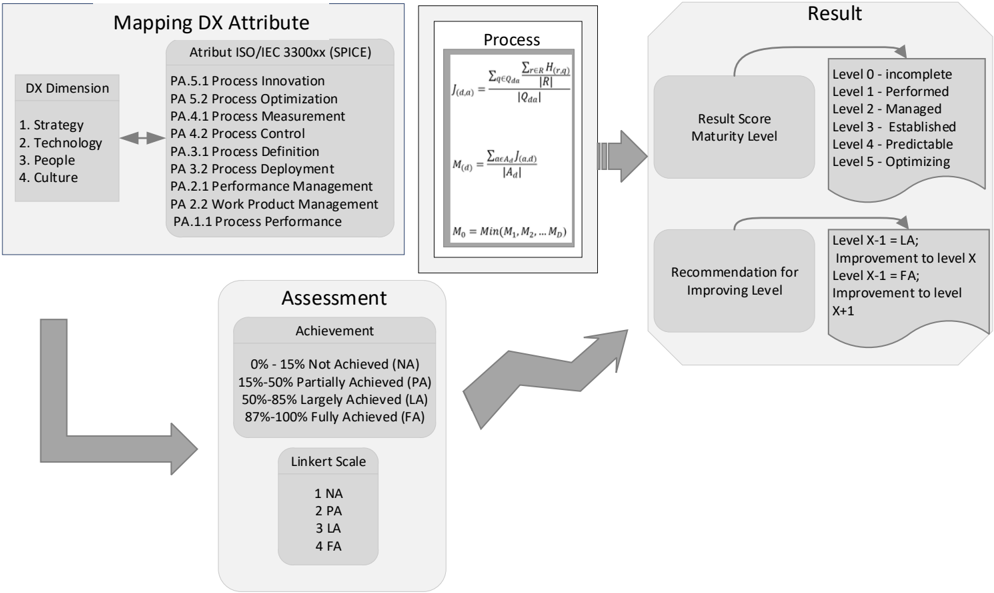
The Digital Transformation (DX) potentially affects productivity and efficiency while offering high risks to organizations. Necessary frameworks and tools to help organizations navigate such radical changes are needed. An extended framework of DMM is presented through a comparative analysis of various digital maturity models and qualitative approaches through expert feedback. The maturity level determination uses the Emprise test of the international standard ISO/IEC Assessment known as SPICE. This research reveals seven interrelated dimensions for supporting the success of DX as a form of development of an existing Maturity Model. The DX–Self Assessment Maturity Model (DX-SAMM) is built to guide organizations by providing a broad roadmap for improving digital maturity. This article presents a digital maturity model from a holistic point of view and meets the criteria for assessment maturity. The case study results show that DX-SAMM can identify DX maturity levels while providing roadmap recommendations for increasing maturity levels in every aspect of its dimensions. It offers practical implications for improving maturity levels and the ease of real-time monitoring and evaluating digital maturity. With the development of maturity measurement, DX-SAMM contributes to the sustainability of the organization by proposing DX strategies in the future based on the current maturity achievements.
Overview
The claims and statistics of this paper haven’t been checked yet.
Free: it reads the open-access text and checks the first 5 claims that cite a source we can check. Create a free account to check every claim.
Integrity signals
Registry
Cites
Statistics
Figures




Verification
Claims the paper makes
The claims and statistics of this paper haven’t been checked yet.
Free: it reads the open-access text and checks the first 5 claims that cite a source we can check. Create a free account to check every claim.
Claims other papers make about this one
Each is checked against this paper’s own text: does it say what the citing paper says it does?
The cited source says what the claim attributes to it.
In the citing paper
“Technology is considered a critical area of digital transformation [17].”
From Digital Maturity Assessment Model for the Organizational and Process Dimensions (2023) · cites this paper as [17]
Self-check
Percentages, sums and reported differences re-computed from the paper’s own numbers.
The self-check needs the paper’s full text.
Citations
Cites
1 retracted
Topornin, N., Pyatkina, D., & Bokov, Y. (2021) · Journal of Information Science · doi:10.1177/01655515211014142 · Cited by 15 · cited 1×
“Skills, social strata, culture [31] and the role of the government [32] have contributed to the success of DT.”
BackgroundRetractedDesign Science in Information Systems Research1
Hevner, A. R., March, S. T., Park, J., & Ram, S. (2004) · MIS Quarterly · doi:10.2307/25148625 · Cited by 10,707 · cited 1×
“Case studies are a design evaluation approach and can be used to validate models [38,58,66].”
BackgroundUnderstanding digital transformation: A review and a research agenda
Vial, G. (2019) · The Journal of Strategic Information Systems · doi:10.1016/j.jsis.2019.01.003 · Cited by 7,337 · cited 1×
“Technology is only part of the DT problem that must be solved for organizations to remain competitive in the digital world [30].”
BackgroundDigital transformation: A multidisciplinary reflection and research agenda
Verhoef, P. C., Broekhuizen, T., Bart, Y., Bhattacharya, A., Qi Dong, J., Fabian, N., & Haenlein, M. (2021) · Journal of Business Research · doi:10.1016/j.jbusres.2019.09.022 · Cited by 5,720 · cited 6×
“Changes in the economic and social structure (workers) are seen in the replacement of human labor in certain areas such as call center services with the help of robots or virtual agents, optimizing logistics flows and reducing supply chain costs through the use of AI and blockchain [6].”
BackgroundInfluentialDetecting influenza epidemics using search engine query data
Ginsberg, J., Mohebbi, M. H., Patel, R. S., Brammer, L., Smolinski, M. S., & Brilliant, L. (2009) · Nature · doi:10.1038/nature07634 · Cited by 4,295 · cited 2×
“The accuracy of the organization in adapting and responding to changes helps the sustainability of the organization, even making it possible to obtain potential opportunities [18–20].”
The Deepening Divide: Inequality in the Information Society
van Dijk, J. (2005) · doi:10.4135/9781452229812 · Cited by 2,243 · cited 1×
“Without technology, the digitization process is challenging to carry out [50,70,71].”
BackgroundA Maturity Model for Assessing Industry 4.0 Readiness and Maturity of Manufacturing Enterprises
Schumacher, A., Erol, S., & Sihn, W. (2016) · Procedia CIRP · doi:10.1016/j.procir.2016.07.040 · Cited by 1,766 · cited 10×
“Other research states that many organizations are still trying to organize and implement a digital agenda [5,21,22].”
BackgroundMethodInfluentialvan Deursen, A. J., & van Dijk, J. A. (2019) · New Media & Society · doi:10.1177/1461444818797082 · Cited by 1,234 · cited 1×
“The technological dimension according to Massimo [16] and van Deursen & van Dijk [17] is the initial stage towards digital transformation.”
MethodOptions for Formulating a Digital Transformation Strategy
Heß, T., Matt, C., Benlian, A., & Wiesböck, F. (n.d.) · RePEc: Research Papers in Economics · doi:10.7892/boris.105447 · Cited by 988
Understanding the Main Phases of Developing a Maturity Assessment Model
de Bruin, T., Freeze, R., Kulkarni, U. R., & Rosemann, M. (2005) · QUT ePrints (Queensland University of Technology) · Cited by 916
Karimi, J., & Walter, Z. (2015) · Journal of Management Information Systems · doi:10.1080/07421222.2015.1029380 · Cited by 877 · cited 1×
“Skills, social strata, culture [31] and the role of the government [32] have contributed to the success of DT.”
BackgroundChange Through Digitization—Value Creation in the Age of Industry 4.0
Kagermann, H. (2015) · Management of Permanent Change · doi:10.1007/978-3-658-05014-6_2 · Cited by 838 · cited 1×
“In addition, digital technologists must create added value for customers, the business itself and other important stakeholders [40] Since it has social, technical, technological and managerial effects on organizations, DX must be managed from a holistic perspective [1,6,33,39,45–47].”
BackgroundDigital transformation of business models-best practice, enablers, and roadmap
SCHALLMO, D., WILLIAMS, C. A., & BOARDMAN, L. (2017) · International Journal of Innovation Management · doi:10.1142/s136391961740014x · Cited by 655 · cited 2×
“In addition, digital technologists must create added value for customers, the business itself and other important stakeholders [40] Since it has social, technical, technological and managerial effects on organizations, DX must be managed from a holistic perspective [1,6,33,39,45–47].”
BackgroundMaturity models in business process management
Röglinger, M., Pöppelbuß, J., & Becker, J. (2012) · Business Process Management Journal · doi:10.1108/14637151211225225 · Cited by 601 · cited 1×
“The reference of these models was the progress rate of ad hoc practices and measurable practices that meet measurable conditions [59].”
BackgroundRide-hailing, travel behaviour and sustainable mobility: an international review
Tirachini, A. (2020) · Transportation · doi:10.1007/s11116-019-10070-2 · Cited by 470
Sjödin, D. R., Parida, V., Leksell, M., & Petrovic, A. (2018) · Research-Technology Management · doi:10.1080/08956308.2018.1471277 · Cited by 413 · cited 1×
“The technological dimension in this study confirms the research of academic studies [1,36,51,67,75] and practitioners [35,52,82,83]—technology is an inseparable part of the digital.”
BackgroundDigital transformation maturity: A systematic review of literature
Teichert, R. (2019) · Acta Universitatis Agriculturae et Silviculturae Mendelianae Brunensis · doi:10.11118/actaun201967061673 · Cited by 380 · cited 7×
“Digital transformation can be seen as a process of the continuous adoption of a significantly changing digital landscape to meet the digital expectations of customers, employees and partners [39].”
BackgroundInfluentialThree stage maturity model in SME’s toward industry 4.0
Ganzarain, J., & Errasti, N. (2016) · Journal of Industrial Engineering and Management · doi:10.3926/jiem.2073 · Cited by 352
Cashless Transactions: A Study on Intention and Adoption of e-Wallets
Yang, M., Mamun, A. A., Mohiuddin, M., Nawi, N. C., & Zainol, N. R. (2021) · Sustainability · doi:10.3390/su13020831 · Cited by 326
Assessing Organizational Capabilities: Reviewing and Guiding the Development of Maturity Grids
Maier, A. M., Moultrie, J., & Clarkson, P. J. (2012) · IEEE Transactions on Engineering Management · doi:10.1109/tem.2010.2077289 · Cited by 318 · cited 6×
“Therefore, it is necessary to measure the digital maturity that accommodates various dimensions of supporting digital transformation as a whole [1,5] and can be easily accessed by users [38].”
BackgroundMethodInfluentialThe Digital Transformation of Business Model Innovation: A Structured Literature Review
Vaska, S., Massaro, M., Bagarotto, E. M., & Dal Mas, F. (2021) · Frontiers in Psychology · doi:10.3389/fpsyg.2020.539363 · Cited by 314
Agag, G. M., & El-Masry, A. A. (2017) · Journal of Travel Research · doi:10.1177/0047287516643185 · Cited by 277 · cited 1×
“In addition, organizations can avoid disruptive impacts and risks due to delays in the adaptation to digital transformation [6,10–12].”
BackgroundSchumacher, A., Nemeth, T., & Sihn, W. (2019) · Procedia CIRP · doi:10.1016/j.procir.2019.02.110 · Cited by 258 · cited 5×
“In this study, the digital maturity model is defined as a method for measuring the current state of an organization in terms of digital transformation, strategy, technology adoption [16,51,52] and business process implementation [53].”
BackgroundMethodResultInfluentialDiscovering digital business models in traditional industries
Remane, G., Hanelt, A., Nickerson, R. C., & Kolbe, L. M. (2017) · Journal of Business Strategy · doi:10.1108/jbs-10-2016-0127 · Cited by 228 · cited 2×
“Organizations create the structure ecosystem to create products and services [69].”
BackgroundA Digital Maturity Model for Telecommunications Service Providers
Valdez-de-Leon, O. (2016) · Technology Innovation Management Review · doi:10.22215/timreview/1008 · Cited by 216
Maturity Models for Information Systems - A State of the Art
Proença, D., & Borbinha, J. (2016) · Procedia Computer Science · doi:10.1016/j.procs.2016.09.279 · Cited by 203 · cited 1×
“It is also useful in developing the basic stage to a more advanced final stage [49].”
BackgroundDigital transformation capability maturity model enabling the assessment of industrial manufacturers
Gökalp, E., & Martinez, V. (2021) · Computers in Industry · doi:10.1016/j.compind.2021.103522 · Cited by 200 · cited 10×
“DX is defined as an achievement of disruptive technologies that brings new business models and operations across all sectors [1].”
BackgroundInfluentialPeter, M. K., Kraft, C., & Lindeque, J. (2020) · Journal of Strategy and Management · doi:10.1108/jsma-05-2019-0070 · Cited by 199
Structuring Digital Transformation: A Framework of Action Fields and its Application at ZEISS
Gimpel, H., Hosseini, S., Huber, R. X. R., Probst, L., Röglinger, M., & Faisst, U. (2018) · ERef Bayreuth (University of Bayreuth) · Cited by 181
Digital Maturity: Definition and Model
Aslanova, I., & Kulichkina, A. I. (2020) · International Scientific and Practical Conference Modern Management Trends and the Digital Economy: from Regional Development to Global Economic Growth (MTDE) · doi:10.2991/aebmr.k.200502.073 · Cited by 175
Digital Business Transformation and Strategy: What Do We Know So Far?
Ismail, M. H., Khater, M., & Zaki, M. (2018) · doi:10.13140/rg.2.2.36492.62086 · Cited by 171
Horlacher, A., & Hess, T. (2016) · 2016 49th Hawaii International Conference on System Sciences (HICSS) · doi:10.1109/hicss.2016.634 · Cited by 167
Project Management Maturity Models – A Critical Review
Backlund, F., Chronéer, D., & Sundqvist, E. (2014) · Procedia - Social and Behavioral Sciences · doi:10.1016/j.sbspro.2014.03.094 · Cited by 160 · cited 1×
“The maturity model framework is essential for assessing organizations [54].”
BackgroundDevelopment of an Industry 4.0 maturity model for the delivery process in supply chains
Asdecker, B., & Felch, V. (2018) · Journal of Modelling in Management · doi:10.1108/jm2-03-2018-0042 · Cited by 139 · cited 2×
“Structure 1.10 3.20 Technology Organizations that adopt technology have not achieved the expected success of Digital Transformation [67,78].”
BackgroundMethodInfluentialExamining actual consumer usage of E-wallet: A case study of big data analytics
Teng, S., & Khong, K. W. (2021) · Computers in Human Behavior · doi:10.1016/j.chb.2021.106778 · Cited by 136 · cited 1×
“The need to transact digitally has developed a new industry in digital wallets [13–15].”
BackgroundEntwicklung von Reifegradmodellen für das IT-Management: Vorgehensmodell und praktische Anwendung
Becker, J., Knackstedt, R., & Pöppelbuß, J. (2009) · WIRTSCHAFTSINFORMATIK · doi:10.1007/s11576-009-0167-9 · Cited by 134 · cited 2×
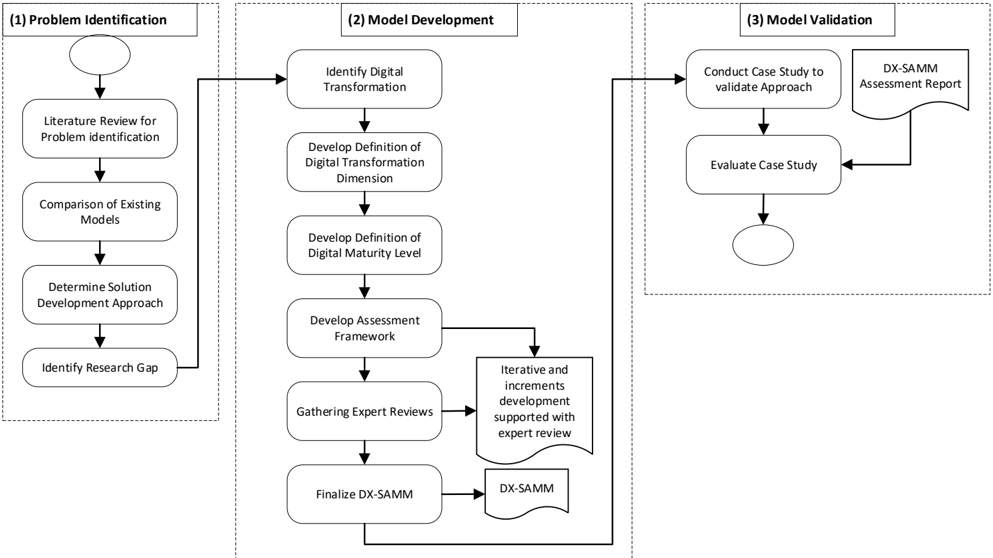
“It was developed using a maturity model creation stage approach [63]. stages of model maturity aims to create a basis for conducting assessments and provide guidance for presenting assessment results with a rating scale.”
MethodDigital transformation challenges
Henriette, E., Feki, M., & Boughzala, I. (2016) · HAL · Cited by 129
(2017) · Routledge eBooks · doi:10.4324/9781315455334 · Cited by 123 · cited 1×
“Without technology, the digitization process is challenging to carry out [50,70,71].”
BackgroundAgarwal, N., & Brem, A. (2015) · International Journal of Technology Management · doi:10.1504/ijtm.2015.068224 · Cited by 115
Developing a maturity model for service systems in heavy equipment manufacturing enterprises
Neff, A. A., Hamel, F., Herz, T. P., Uebernickel, F., Brenner, W., & Brocke, J. V. (2014) · Information & Management · doi:10.1016/j.im.2014.05.001 · Cited by 95 · cited 2×
“Embracing DX requires a comprehensive point of view [33], including heterogeneous and complex processes from the different domains of strategy, human resources, process management, information technology and others [34].”
BackgroundMethodThe best response to digital disruption
Bughin, J., & van Zeebroeck, N. (2017) · Dépôt institutionnel de l'Université libre de Bruxelles (Université Libre de Bruxelles) · Cited by 92
Thinking in Terms of Design Decisions When Developing Maturity Models
Mettler, T. (2010) · International Journal of Strategic Decision Sciences · doi:10.4018/jsds.2010100105 · Cited by 87 · cited 2×
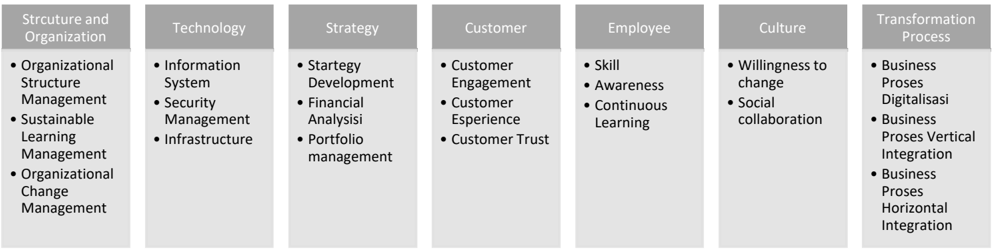
“There is a slight difference from the findings of previous studies indicating that the success of transformation is determined by employees [16,75], customers [36,51], the transformation process [1,74,79,84] and culture [37,67].”
BackgroundResultWilliams, P. A., Lovelock, B., Cabarrus, T., & Harvey, M. (2019) · JMIR Medical Informatics · doi:10.2196/12465 · Cited by 65 · cited 1×
“Data processing and security systems are an inseparable part of technology [35,72].”
BackgroundApplying an organisational agility maturity model
Gunsberg, D., Callow, B., Ryan, B., Suthers, J., Baker, P. A., & Richardson, J. (2018) · Journal of Organizational Change Management · doi:10.1108/jocm-10-2017-0398 · Cited by 61 · cited 1×
“There is a slight difference from the findings of previous studies indicating that the success of transformation is determined by employees [16,75], customers [36,51], the transformation process [1,74,79,84] and culture [37,67].”
ResultOnline travel review rating scales and effects on hotel scoring and competitiveness
Martín-Fuentes, E., Mellinas, J. P., & Parra-López, E. (2020) · Tourism Review · doi:10.1108/tr-01-2019-0024 · Cited by 54 · cited 2×
“Many traditional companies are defeated by the presence of new, more innovative companies [6] The ride-hailing industry is shifting the existence of conventional taxis [7–12].”
BackgroundDesigning a Portfolio Management Maturity Model (Elena)
Nikkhou, S., Taghizadeh, K., & HajiYakhchali, S. (2016) · Procedia - Social and Behavioral Sciences · doi:10.1016/j.sbspro.2016.06.194 · Cited by 51 · cited 1×
“The term maturity refers to being in perfect condition; it is also a testament to achievement and provides guidance to fix or prevent problems [48].”
BackgroundApplication of a software agility assessment model – AgilityMod in the field
Özcan‐Top, Ö., & Demirörs, O. (2018) · Computer Standards & Interfaces · doi:10.1016/j.csi.2018.07.002 · Cited by 24 · cited 6×
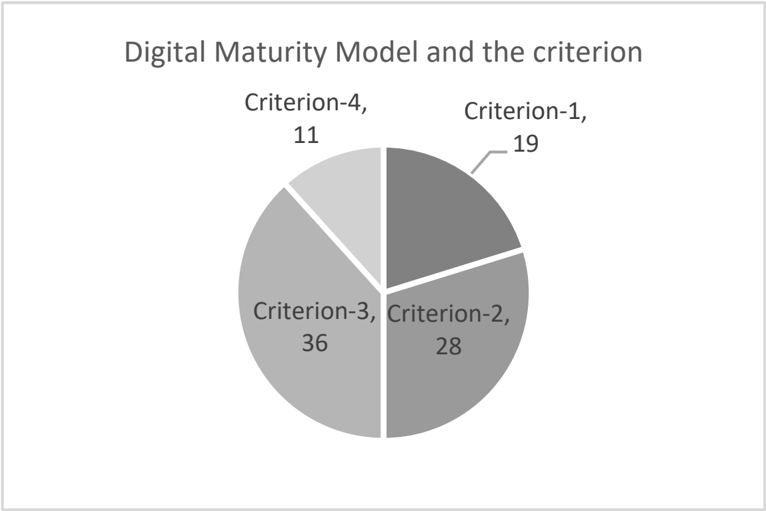
“The specified criteria are mainly related to the study of Maier et al. [38] on the development of the organizational maturity grid, the MM evaluation criteria in Özcan-Top and Demirors [58] and the maturity criteria in the study of Gokalp and Matinez [1].”
BackgroundMethodInfluentialModel based process assessment for public financial and physical resource management processes
Gökalp, E., & Demirörs, O. (2016) · Computer Standards & Interfaces · doi:10.1016/j.csi.2016.11.011 · Cited by 22
Strategic leading of digital transformation in large established companies – a multiple case-study
Hyvönen, J. (2018) · Cited by 13
TOUCHPOINT STRATEGIES IN THE LUXURY INDUSTRY
Haug, L., & Berghaus, B. (2017) · Global Fashion Management Conference · doi:10.15444/gfmc2017.05.05.01 · Cited by 6
Isaac Sacolick: Driving Digital: The Leader’s Guide to Business Transformation Through Technology
Costigan, S. S. (2018) · Publishing Research Quarterly · doi:10.1007/s12109-018-9578-z · Cited by 6 · cited 1×
“Meanwhile, some academic literature partially discusses aspects of Digital Transformation [26–29].”
Background
Research works printed but not linked: 11
- 5. Bumann, J.; Peter, M. Action fields of digital transformation-A review and comparative analysis of digital transformation maturity models and frameworks. Digit. Innov. Im Manag. 2019, 2, 13-40.
- 21. Akdil, K.Y.; Ustundag, A.; Cevikcan, E. Maturity and Readiness Model for Industry 4.0 Strategy. Springer Series in Advanced Manufacturing. 2017, pp. 61-94. Available online: https://link.springer.com/chapter/10.1007%2F978-3-319-57870-5_4 (accessed on 15 November 2022). · DOI · Paper page
- 28. Chowdhury, E.K. Transformation of Business Model through Blockchain Technology. J. Account. 2019, 47, 4-9.
- 41. Wischnevsky, J.D.; Damanpour, F. Organizational transformation and performance: An examination of three perspectives. J. Manag. Issues 2006, 18, 104-128.
- 51. Tabrizi, B.; Lam, E.; Girard, K.; Irvin, V. Digital Transformation Is Not About Technology. Harv. Bus. Rev. 2019, 13, 1-6.
- 57. Automotive, S. Automotive SPICE Process Assessment Model. Final. Release 2010, 4, 46.
- 58. Dorn, C.S.; Knüvener, C.L. Building the Bridge Between Automotive SPICE ® and Agile Development. In Communications in Computer and Information Science; Springer: Berlin/Heidelberg, Germany, 2021; Volume 1442. [CrossRef]
- 63. Sener, U.; Gökalp, E.; Şener, U.; Eren, P.E. Towards a Maturity Model for Industry 4.0: A Systematic Literature Review and a Model Proposal. In Industry 4.0 from the MIS Perspective, 21st ed.; Peterlang: Bern, Switzerland, 2018. Available online: https://www.researchgate.net/publication/335652665 (accessed on 15 November 2022).
- 66. Cresswell, J.W. Research Design: Qualitative, Quantitative, and Mixed Methods Approaches, 4th ed.; Sage Publications: Lincoln, RI, USA, 2014.
- 75. Mittal, S.; Romero, D.; Wuest, T. Towards a smart manufacturing maturity model for SMEs (SM3E). In IFIP Advances in Information and Communication Technology; Springer: Berlin, Germany, 2018.
- 76. Bandara, O.; Vidanagamachchi, K.; Wickramarachchi, R. A model for assessing maturity of industry 4.0 in the banking sector. In Proceedings of the International Conference on Industrial Engineering and Operations Management, Bangkok, Thailand, 5-7 March 2019; Volume 2019.
Cited by
Sustainable Digital Transformation Roadmaps for SMEs: A Systematic Literature Review
Pinto, M. M. A., Kovaleski, J. L., & Chiroli, D. M. D. G. (2024) · Sustainability · doi:10.3390/su16198551 · Cited by 90
Pinto, M. M. A., Kovaleski, J. L., Mick, R. L., & Chiroli, D. M. D. G. (2024) · Sustainability · doi:10.3390/su16208745 · Cited by 96
Utama, D. R., Hamsal, M., Abdinagoro, S. B., & Rahim, R. K. (2024) · Transportation Research Interdisciplinary Perspectives · doi:10.1016/j.trip.2024.101146 · Cited by 80
Digital Maturity Assessment Model for the Organizational and Process Dimensions
Tubis, A. A. (2023) · Sustainability · doi:10.3390/su152015122 · Cited by 49
“…review article published in 2023, including 44 DMMs) developed by Haryanti et al. [17]. of assessment criteria, along with the frequency of their use in DMMs, based on the most up-to-date and extensive literature review (a review article 2023, including 44 DMMs) developed by Haryanti et al. [17].”
InfluentialCarolis, A. D., Sassanelli, C., Acerbi, F., Macchi, M., Terzi, S., & Taisch, M. (2025) · International Journal of Production Research · doi:10.1080/00207543.2025.2455476 · Cited by 57
“Indeed, they do not allow to assess the digital maturity and define a unique and solid improvement roadmap having under control all the company’s operations at the same time and using a single and standard maturity scale (Haryanti, Rakhmawati, and Subriadi 2023).”
Metadata
- Authors
- Haryanti, T., Rakhmawati, N. A., & Subriadi, A. P.
- Affiliations
- Institut Teknologi Sepuluh Nopember (ID)
- Corresponding author
- Haryanti, Tining
- Venue
- Big Data and Cognitive Computing
- Publisher
- MDPI AG
- Published
- 2023-01-17
- Volume
- 7
- Issue
- 1
- Pages
- 17
- ISSN
- 2504-2289 (ISSN-L)
- OpenAlex
- W4316804590
- Cited by
- 84
- References
- 54
- Citations by year
- 2026: 21 · 2025: 28 · 2024: 23 · 2023: 12
- FWCI
- 24.15
- Type
- journal article
- Language
- en
- Open access
- gold
- doi.org
- Licence
- Locations
- Big Data and Cognitive Computing (publishedVersion, cc-by)
- DOAJ (DOAJ: Directory of Open Access Journals) (submittedVersion, cc-by-sa)
- Funders
- Institut Teknologi Sepuluh Nopember Surabaya (ITS) (996/PKS/ITS/2022)
- Topics
- Social Sciences › Business, Management and Accounting › Management Information Systems › Information Technology Governance and Strategy
- Social Sciences › Business, Management and Accounting › Management of Technology and Innovation › Digital Innovation in Industries
- Physical Sciences › Engineering › Industrial and Manufacturing Engineering › Digital Transformation in Industry
- Keywords
- digital maturity model, digital transformation, maturity assessment
About these checks
Registry, retraction, Cites and statistics results are computed, not judged, with one exception: a printed reference that no index lists is read once by a model before it counts as a citation error. Claims are extracted by a model and kept only when their quote appears verbatim in the text; each cited source is then checked, with a model’s help, for whether it says what the claim relies on. Those verdicts can be wrong — read the claim’s quote and the cited source before relying on one.
Statistics and arithmetic are recomputed, not judged.
Confidence bands are shown only for fields calibrated on our annotated test set. None is calibrated yet, so no band is shown.
What counts as a claim ›How we measure confidence ›How we check this ›
Are you an author, or do you see a problem with this page? Request a review
Data sources
Bibliographic data: Semantic Scholar, OpenAlex, Crossref.
Contains information from the Semantic Scholar Academic Graph Datasets, made available under the ODC Attribution License (ODC-BY 1.0).
Semantic Scholar’s data is described in: Kinney, R., et al. (2023). The Semantic Scholar Open Data Platform. arXiv:2301.10140.
