

A Paradoxical Role for Regulatory T Cells in the Tumor Microenvironment of Pancreatic Cancer
Open accessThe DOI matches its Crossref record; 56 of the 56 references it cites were found in a registry or an index.
Abstract
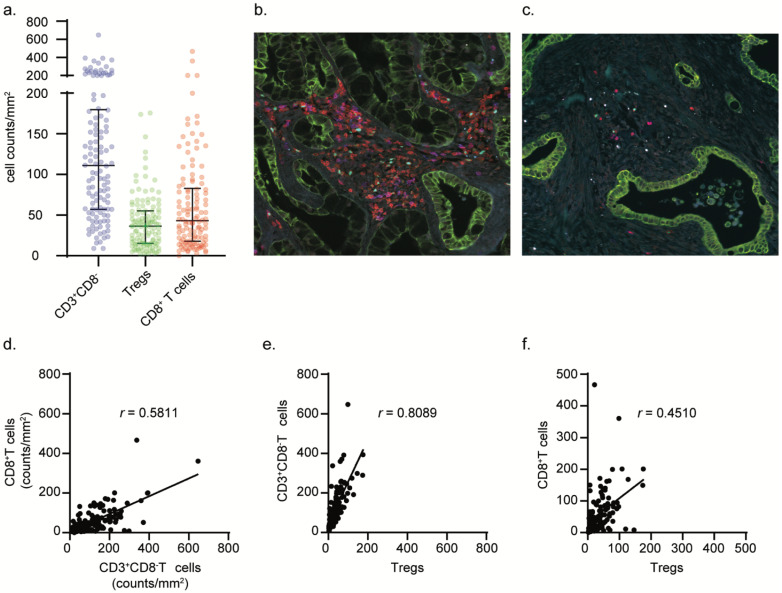
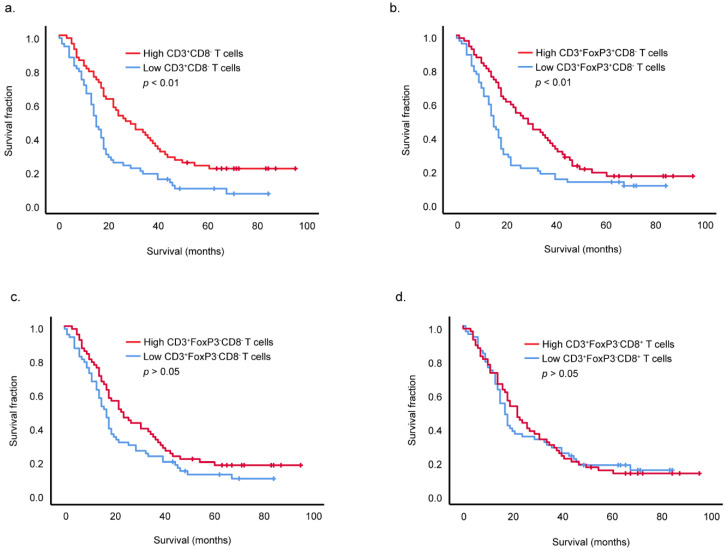
Pancreatic ductal adenocarcinoma (PDAC) is considered to be a poorly immunogenic cancer type that combines a low mutation burden with a strong immunosuppressive tumor microenvironment. Regulatory T cells (Tregs) are major drivers of immune suppression but their prognostic role, particularly in gastrointestinal malignancies, remains controversial. Lymphocytic infiltration in 122 PDAC samples was assessed by multispectral immunofluorescence with anti-Keratin, -CD3, -CD8, -FOXP3 and -CD163 antibodies. Differential infiltration by Tregs was analyzed in the context of transcriptomic profiles that were available for 65 tumors. High infiltration of CD3+CD8− (mainly CD4+) T cells and, especially, of the subset expressing FOXP3 (Tregs) was associated with improved patient survival, whilst cytotoxic CD3+CD8+ T cell infiltration did not have an impact on overall survival. Transcriptomic analysis revealed three signatures in PDAC tumors comprising of epithelial-mesenchymal transition (EMT)/stromal, metabolic, and secretory/pancreatic signature. However, none of these signatures explained differences in Treg infiltration. We show that Tregs associate with improved overall survival in PDAC patients. This effect was independent of cytotoxic T cell infiltration and the transcriptomic profiles of their respective tumors. These findings provide a new layer of complexity in the study of PDAC tumor microenvironment that must be considered when developing immunotherapeutic interventions for this disease.
Overview
The claims and statistics of this paper haven’t been checked yet.
Free: it reads the open-access text and checks the first 5 claims that cite a source we can check. Create a free account to check every claim.
Integrity signals
Registry
Cites
Statistics
Figures
Verification
Claims the paper makes
The claims and statistics of this paper haven’t been checked yet.
Free: it reads the open-access text and checks the first 5 claims that cite a source we can check. Create a free account to check every claim.
Claims other papers make about this one
Each is checked against this paper’s own text: does it say what the citing paper says it does?
The source backs part of the claim, not all of it — or backs it for a different population, condition or comparison.
In the citing paper
“Another study demonstrated that a significant infiltration of Tregs extends survival time in individuals diagnosed with pancreatic cancer [115].”
From Potential anti-tumor effects of regulatory T cells in the tumor microenvironment: a review (2024) · cites this paper as [115]
Experimental — accuracy not yet measured
Self-check
Percentages, sums and reported differences re-computed from the paper’s own numbers.
The self-check needs the paper’s full text.
Citations
Cites
STAR: ultrafast universal RNA-seq aligner
Dobin, A., Davis, C. A., Schlesinger, F., Drenkow, J., Zaleski, C., Jha, S., Batut, P., Chaisson, M., & Gingeras, T. R. (2013) · Bioinformatics · doi:10.1093/bioinformatics/bts635 · Cited by 51,709
PD-1 and PD-L1 Immune Checkpoint Blockade to Treat Breast Cancer
Hartkopf, A. D., Taran, F.-A., Wallwiener, M., Walter, C. B., Krämer, B., Grischke, E.-M., & Brucker, S. Y. (2016) · Breast Care · doi:10.1159/000453569 · Cited by 30,845
HTSeq—a Python framework to work with high-throughput sequencing data
Anders, S., Pyl, P. T., & Huber, W. (2015) · Bioinformatics · doi:10.1093/bioinformatics/btu638 · Cited by 21,464 · cited 1×
“1) [39] using the GENCODE human reference gene set (v30) as reference.”
MethodSiegel, R. L., Miller, K. D., & Jemal, A. (2019) · CA: A Cancer Journal for Clinicians · doi:10.3322/caac.21551 · Cited by 20,160
Adverse Renal Effects of Immune Checkpoint Inhibitors: A Narrative Review
Wanchoo, R., Karam, S., Uppal, N. N., Barta, V. S., Deray, G., Devoe, C., Launay-Vacher, V., Jhaveri, K. D., & on behalf of Cancer and Kidney International Network Workgroup on Immune Checkpoint Inhibitors (2017) · American Journal of Nephrology · doi:10.1159/000455014 · Cited by 15,256
Safety and activity of anti-PD-L1 antibody in patients with advanced cancer
Brahmer, J. R., Tykodi, S. S., Chow, L. Q. M., Hwu, W.-J., Topalian, S. L., Hwu, P., Drake, C. G., Camacho, L. H., Kauh, J., Odunsi, K., et al. (2012) · New England Journal of Medicine · doi:10.1056/nejmoa1200694 · Cited by 7,945
Mutational landscape determines sensitivity to PD-1 blockade in non–small cell lung cancer
Rizvi, N. A., Hellmann, M. D., Snyder, A., Kvistborg, P., Makarov, V., Havel, J. J., Lee, W., Yuan, J., Wong, P., Ho, T. S., et al. (2015) · Science · doi:10.1126/science.aaa1348 · Cited by 7,802
Mismatch repair deficiency predicts response of solid tumors to PD-1 blockade
Le, D. T., Durham, J. N., Smith, K. N., Wang, H., Bartlett, B. R., Aulakh, L. K., Lu, S., Kemberling, H., Wilt, C., Luber, B. S., et al. (2017) · Science · doi:10.1126/science.aan6733 · Cited by 6,645
Neoantigens in cancer immunotherapy
Schumacher, T. N., & Schreiber, R. D. (2015) · Science · doi:10.1126/science.aaa4971 · Cited by 4,783
Chen, W., Jin, W., Hardegen, N., Lei, K.-J., Li, L., Marinos, N., McGrady, G., & Wahl, S. M. (2003) · The Journal of Experimental Medicine · doi:10.1084/jem.20030152 · Cited by 4,699
Genetic Basis for Clinical Response to CTLA-4 Blockade in Melanoma
Snyder, A., Makarov, V., Merghoub, T., Yuan, J., Zaretsky, J. M., Desrichard, A., Walsh, L. A., Postow, M. A., Wong, P., Ho, T. S., et al. (2014) · New England Journal of Medicine · doi:10.1056/nejmoa1406498 · Cited by 4,286
The Role of Tumoral FOXP3 on Cell Proliferation, Migration, and Invasion in Gastric Cancer
Zhang, L., Xu, J., Zhang, X., Zhang, Y., Wang, L., Huang, X., & Xu, Z. (2017) · Cellular Physiology and Biochemistry · doi:10.1159/000479442 · Cited by 4,088
Genomic analyses identify molecular subtypes of pancreatic cancer
Bailey, P., Chang, D. K., Nones, K., Johns, A. L., Patch, A.-M., Gingras, M.-C., Miller, D. K., Christ, A. N., Bruxner, T. J. C., Quinn, M. C., et al. (2016) · Nature · doi:10.1038/nature16965 · Cited by 3,621
Özdemir, B. C., Pentcheva-Hoang, T., Carstens, J. L., Zheng, X., Wu, C.-C., Simpson, T. R., Laklai, H., Sugimoto, H., Kahlert, C., Novitskiy, S. V., et al. (2014) · Cancer Cell · doi:10.1016/j.ccr.2014.04.005 · Cited by 2,681 · cited 3×
“Furthermore, none of these molecular subtypes associated with patient survival and Treg infiltration (Supplemental Figure S6) [43,44,45].”
BackgroundDistinct populations of inflammatory fibroblasts and myofibroblasts in pancreatic cancer
Öhlund, D., Handly-Santana, A., Biffi, G., Elyada, E., Almeida, A. S., Ponz-Sarvise, M., Corbo, V., Oni, T. E., Hearn, S. A., Lee, E. J., et al. (2017) · Journal of Experimental Medicine · doi:10.1084/jem.20162024 · Cited by 2,590
Ryan, D. P., Hong, T. S., & Bardeesy, N. (2014) · New England Journal of Medicine · doi:10.1056/nejmra1404198 · Cited by 2,348
The immune contexture in cancer prognosis and treatment
Fridman, W. H., Zitvogel, L., Sautès–Fridman, C., & Kroemer, G. (2017) · Nature Reviews Clinical Oncology · doi:10.1038/nrclinonc.2017.101 · Cited by 2,263 · cited 2×
“As such, Treg infiltration in tumors has mostly been interpreted as a poor predictor of tumor behavior but conflicting reports have been published on its association with clinical outcomes [1].”
BackgroundResultMoffitt, R. A., Marayati, R., Flate, E. L., Volmar, K. E., Loeza, S. G. H., Hoadley, K. A., Rashid, N. U., Williams, L. A., Eaton, S. C., Chung, A. H., et al. (2015) · Nature Genetics · doi:10.1038/ng.3398 · Cited by 2,194
Schadendorf, D., Hodi, F. S., Robert, C., Weber, J. S., Margolin, K., Hamid, O., Patt, D., Chen, T.-T., Berman, D. M., & Wolchok, J. D. (2015) · Journal of Clinical Oncology · doi:10.1200/jco.2014.56.2736 · Cited by 2,141
Regulatory T cells, tumour immunity and immunotherapy
Zou, W. (2006) · Nature Reviews Immunology · doi:10.1038/nri1806 · Cited by 2,085
Huang, B., Pan, P.-Y., Li, Q., Sato, A. I., Levy, D. E., Bromberg, J., Divino, C. M., & Chen, S.-H. (2006) · Cancer Research · doi:10.1158/0008-5472.can-05-1299 · Cited by 1,435
Biffi, G., Oni, T. E., Spielman, B., Hao, Y., Elyada, E., Park, Y., Preall, J., & Tuveson, D. A. (2019) · Cancer Discovery · doi:10.1158/2159-8290.cd-18-0710 · Cited by 1,360 · cited 3×
“Furthermore, none of these molecular subtypes associated with patient survival and Treg infiltration (Supplemental Figure S6) [43,44,45].”
BackgroundThe Pancreas Cancer Microenvironment
Feig, C., Gopinathan, A., Neesse, A., Chan, D. S., Cook, N., & Tuveson, D. A. (2012) · Clinical Cancer Research · doi:10.1158/1078-0432.ccr-11-3114 · Cited by 1,316
Royal, R. E., Levy, C., Turner, K., Mathur, A., Hughes, M., Kammula, U. S., Sherry, R. M., Topalian, S. L., Yang, J. C., Lowy, I., et al. (2010) · Journal of Immunotherapy · doi:10.1097/cji.0b013e3181eec14c · Cited by 1,257
Foxp3-dependent programme of regulatory T-cell differentiation
Gavin, M. A., Rasmussen, J. P., Fontenot, J. D., Vasta, V., Manganiello, V. C., Beavo, J. A., & Rudensky, A. Y. (2007) · Nature · doi:10.1038/nature05543 · Cited by 1,135
Ruffell, B., Chang-Strachan, D., Chan, V., Rosenbusch, A., Ho, C. M. T., Pryer, N., Daniel, D., Hwang, E. S., Rugo, H. S., & Coussens, L. M. (2014) · Cancer Cell · doi:10.1016/j.ccell.2014.09.006 · Cited by 1,008
Salama, P., Phillips, M., Grieu, F., Morris, M., Zeps, N., Joseph, D., Platell, C., & Iacopetta, B. (2009) · Journal of Clinical Oncology · doi:10.1200/jco.2008.18.7229 · Cited by 991
Shang, B., Liu, Y., Jiang, S.-J., & Liu, Y. (2015) · Scientific Reports · doi:10.1038/srep15179 · Cited by 985
Two FOXP3+CD4+ T cell subpopulations distinctly control the prognosis of colorectal cancers
Saito, T., Nishikawa, H., Wada, H., Nagano, Y., Sugiyama, D., Atarashi, K., Maeda, Y., Hamaguchi, M., Ohkura, N., Sato, E., et al. (2016) · Nature Medicine · doi:10.1038/nm.4086 · Cited by 871 · cited 2×
“Saito and colleagues demonstrated that, in colorectal cancer, two different Treg subsets can be distinguished by different levels of expression of FOXP3 [35].”
BackgroundResultKusmartsev, S., Nefedova, Y., Yoder, D., & Gabrilovich, D. I. (2004) · The Journal of Immunology · doi:10.4049/jimmunol.172.2.989 · Cited by 850
Immune cell infiltration as an indicator of the immune microenvironment of pancreatic cancer
Ino, Y., Yamazaki-Itoh, R., Shimada, K., Iwasaki, M., Kosuge, T., Kanai, Y., & Hiraoka, N. (2013) · British Journal of Cancer · doi:10.1038/bjc.2013.32 · Cited by 849
Hiraoka, N., Onozato, K., Kosuge, T., & Hirohashi, S. (2006) · Clinical Cancer Research · doi:10.1158/1078-0432.ccr-06-0369 · Cited by 831
Patnaik, A., Kang, S. P., Rasco, D., Papadopoulos, K. P., Elassaiss-Schaap, J., Beeram, M., Drengler, R., Chen, C., Smith, L., Espino, G., et al. (2015) · Clinical Cancer Research · doi:10.1158/1078-0432.ccr-14-2607 · Cited by 807
Cancer classification using the Immunoscore: a worldwide task force
Galon, J., Pagès, F., Marincola, F. M., Angell, H. K., Thurin, M., Lugli, A., Zlobec, I., Berger, A., Bifulco, C., Botti, G., et al. (2012) · Journal of Translational Medicine · doi:10.1186/1479-5876-10-205 · Cited by 791
O’Reilly, E. M., Oh, D.-Y., Dhani, N., Renouf, D. J., Lee, M. A., Sun, W., Fisher, G., Hezel, A., Chang, S.-C., Vlahovic, G., et al. (2019) · JAMA Oncology · doi:10.1001/jamaoncol.2019.1588 · Cited by 767
Carstens, J. L., Correa de Sampaio, P., Yang, D., Barua, S., Wang, H., Rao, A., Allison, J. P., LeBleu, V. S., & Kalluri, R. (2017) · Nature Communications · doi:10.1038/ncomms15095 · Cited by 633 · cited 1×
“, performed a similar investigation to the one reported here but did not find a significant association between Treg infiltration and patient prognosis and, instead, reported an association between cytotoxic T cell infiltration and PDAC survival [53].”
ResultSignificance of M2-Polarized Tumor-Associated Macrophage in Pancreatic Cancer
Kurahara, H., Shinchi, H., Mataki, Y., Maemura, K., Noma, H., Kubo, F., Sakoda, M., Ueno, S., Natsugoe, S., & Takao, S. (2011) · Journal of Surgical Research · doi:10.1016/j.jss.2009.05.026 · Cited by 552
Mempel, T. R., Pittet, M. J., Khazaie, K., Weninger, W., Weissleder, R., von Boehmer, H., & von Andrian, U. H. (2006) · Immunity · doi:10.1016/j.immuni.2006.04.015 · Cited by 488
Ohta, A., Kini, R., Ohta, A., Subramanian, M., Madasu, M., & Sitkovsky, M. (2012) · Frontiers in Immunology · doi:10.3389/fimmu.2012.00190 · Cited by 398
Zhang, Y., Lazarus, J., Steele, N. G., Yan, W., Lee, H.-J., Nwosu, Z. C., Halbrook, C. J., Menjivar, R. E., Kemp, S. B., Sirihorachai, V. R., et al. (2020) · Cancer Discovery · doi:10.1158/2159-8290.cd-19-0958 · Cited by 385 · cited 4×
“In line with our findings, Treg depletion was recently reported to accelerate pancreatic carcinogenesis [36].”
BackgroundInfluentialFoxp3 Expression in Pancreatic Carcinoma Cells as a Novel Mechanism of Immune Evasion in Cancer
Hinz, S., Pagerols-Raluy, L., Oberg, H.-H., Ammerpohl, O., Grüssel, S., Sipos, B., Grützmann, R., Pilarsky, C., Ungefroren, H., Saeger, H.-D., et al. (2007) · Cancer Research · doi:10.1158/0008-5472.can-06-3304 · Cited by 352
Antonia, S. J., Borghaei, H., Ramalingam, S. S., Horn, L., De Castro Carpeño, J., Pluzanski, A., Burgio, M. A., Garassino, M., Chow, L. Q. M., Gettinger, S., et al. (2019) · The Lancet Oncology · doi:10.1016/s1470-2045(19)30407-3 · Cited by 351
West, N. R., Kost, S. E., Martin, S. D., Milne, K., deLeeuw, R. J., Nelson, B. H., & Watson, P. H. (2013) · British Journal of Cancer · doi:10.1038/bjc.2012.524 · Cited by 268
Tang, Y., Xu, X., Guo, S., Zhang, C., Tang, Y., Tian, Y., Ni, B., Lu, B., & Wang, H. (2014) · PLoS ONE · doi:10.1371/journal.pone.0091551 · Cited by 228
Inflammatory networks and immune surveillance of pancreatic carcinoma
Vonderheide, R. H., & Bayne, L. J. (2013) · Current Opinion in Immunology · doi:10.1016/j.coi.2013.01.006 · Cited by 200
Knudsen, E. S., Vail, P., Balaji, U., Ngo, H., Botros, I. W., Makarov, V., Riaz, N., Balachandran, V., Leach, S., Thompson, D. M., et al. (2017) · Clinical Cancer Research · doi:10.1158/1078-0432.ccr-17-0162 · Cited by 191
Hu, H., Hang, J.-J., Han, T., Zhuo, M., Jiao, F., & Wang, L.-W. (2016) · Tumor Biology · doi:10.1007/s13277-015-4741-z · Cited by 177
de Vries, N. L., van Unen, V., Ijsselsteijn, M. E., Abdelaal, T., van der Breggen, R., Farina Sarasqueta, A., Mahfouz, A., Peeters, K. C. M. J., Höllt, T., Lelieveldt, B. P. F., et al. (2020) · Gut · doi:10.1136/gutjnl-2019-318672 · Cited by 121
Self-citationvon Pawel, J., Bordoni, R., Satouchi, M., Fehrenbacher, L., Cobo, M., Han, J. Y., Hida, T., Moro-Sibilot, D., Conkling, P., Gandara, D. R., et al. (2019) · European Journal of Cancer · doi:10.1016/j.ejca.2018.11.020 · Cited by 104
Lohneis, P., Sinn, M., Bischoff, S., Jühling, A., Pelzer, U., Wisłocka, L., Bahra, M., Sinn, B. V., Denkert, C., Oettle, H., et al. (2017) · European Journal of Cancer · doi:10.1016/j.ejca.2017.06.016 · Cited by 96
Turning the Tide Against Regulatory T Cells
Han, S., Toker, A., Liu, Z. Q., & Ohashi, P. S. (2019) · Frontiers in Oncology · doi:10.3389/fonc.2019.00279 · Cited by 61
FOXP3+ Lymphocyte Density in Pancreatic Cancer Correlates with Lymph Node Metastasis
Jiang, Y., Du, Z., Yang, F., Di, Y., Li, J., Zhou, Z., Pillarisetty, V. G., & Fu, D. (2014) · PLoS ONE · doi:10.1371/journal.pone.0106741 · Cited by 44
Cancer immunophenotyping by seven‐colour multispectral imaging without tyramide signal amplification
Ijsselsteijn, M. E., Brouwer, T. P., Abdulrahman, Z., Reidy, E., Ramalheiro, A., Heeren, A. M., Vahrmeijer, A., Jordanova, E. S., & de Miranda, N. F. (2019) · The Journal of Pathology: Clinical Research · doi:10.1002/cjp2.113 · Cited by 39
Self-citationKindt, N., Descamps, G., Seminerio, I., Bellier, J., Lechien, J. R., Mat, Q., Pottier, C., Delvenne, P., Journé, F., & Saussez, S. (2017) · Oral Oncology · doi:10.1016/j.oraloncology.2017.02.023 · Cited by 37
Norton, S. E., Ward‐Hartstonge, K. A., McCall, J. L., Leman, J. K. H., Taylor, E. S., Munro, F. M., Black, M. A., Groth, B. F. D. S., McGuire, H. M., & Kemp, R. A. (2019) · The Journal of Immunology · doi:10.4049/jimmunol.1801368 · Cited by 29
Delayre, T., Guilbaud, T., Resseguier, N., Mamessier, É., Rubis, M., Moutardier, V., Fara, R., Berdah, S. V., Garcia, S., & Birnbaum, D. J. (2020) · British journal of surgery · doi:10.1002/bjs.11434 · Cited by 14
Cited by
Potential anti-tumor effects of regulatory T cells in the tumor microenvironment: a review
Li, Y., Zhang, C., Jiang, A., Lin, A., Liu, Z., Cheng, X., Wang, W., Cheng, Q., Zhang, J., Wei, T., et al. (2024) · Journal of Translational Medicine · doi:10.1186/s12967-024-05104-y · Cited by 105
“Depletion of Tregs in pancreatic cancer resulted in an increase in CD4 + T cells and accelerated oncogenesis [115, 116].”
BackgroundOlaoba, O. T., Yang, M. J., Adelusi, T. I., Maidens, T., Kimchi, E. T., Staveley-O’Carroll, K. F., & Li, G. (2024) · Cancers · doi:10.3390/cancers16081470 · Cited by 35
Pothuri, V. S., Hogg, G. D., Conant, L., Borcherding, N. C., James, C. A., Mudd, J. L., Williams, G., Seo, Y. D., Hawkins, W. G., Pillarisetty, V. G., et al. (2024) · OncoImmunology · doi:10.1080/2162402x.2024.2320411 · Cited by 23
Targeting KRASG12V mutations with HLA class II-restricted TCR for the immunotherapy in solid tumors
Ai, Q., Li, F., Zou, S., Zhang, Z., Jin, Y., Jiang, L., Chen, H., Deng, X., Peng, C., Mou, N., et al. (2023) · Frontiers in Immunology · doi:10.3389/fimmu.2023.1161538 · Cited by 21
Lapuente-Santana, Ó., Sturm, G., Kant, J. A., Außerhofer, M., Zackl, C., Zopoglou, M., McGranahan, N., Rieder, D., Trajanoski, Z., de Miranda, N. F. C. C., et al. (2024) · iScience · doi:10.1016/j.isci.2024.110529 · Cited by 20
Self-citation
Metadata
- Authors
- Brouwer, T., Ijsselsteijn, M., Oosting, J., Ruano, D., van der Ploeg, M., Dijk, F., Bonsing, B., Fariña, A., Morreau, H., Vahrmeijer, A., & Miranda, N. D.
- Affiliations
- Leiden University Medical Center (NL)
- Amsterdam University Medical Centers (NL)
- Department of Pathology, Leiden University Medical Center, Albinusdreef 2, 2333 ZA Leiden, The Netherlands
- ORCID
- Venue
- Cancers
- Publisher
- MDPI AG
- Published
- 2022-08-10
- Volume
- 14
- Issue
- 16
- Pages
- 3862
- ISSN
- 2072-6694 (ISSN-L)
- PMC
- PMC9405872
- OpenAlex
- W4293511221
- Semantic Scholar
- e35fe954769de0d3d28d03be0642961c262ef23e
- Cited by
- 24
- References
- 56
- Citations by year
- 2026: 2 · 2025: 7 · 2024: 10 · 2023: 5
- FWCI
- 2.30
- Type
- journal article
- Language
- en
- Open access
- gold
- doi.org
- Licence
- Locations
- Cancers (publishedVersion, cc-by)
- PubMed Central (publishedVersion, cc-by)
- PubMed (publishedVersion)
- Amsterdam UMC (VU Amsterdam) - Institutional Repository (publishedVersion, other-oa)
- Pure Amsterdam UMC (acceptedVersion, cc-by)
- Leiden Repository (Leiden University) (submittedVersion, cc-by)
- Data Archiving and Networked Services (DANS) (submittedVersion, other-oa)
- Data Archiving and Networked Services (DANS) (submittedVersion, cc-by)
- DOAJ (DOAJ: Directory of Open Access Journals) (submittedVersion, cc-by-sa)
- Funders
- European Commission H2020 MSCA-ETN (675743, 852832)
- European Research Council (ERC) (675743, 852832)
- Topics
- Health Sciences › Medicine › Oncology › Pancreatic and Hepatic Oncology Research
- Health Sciences › Medicine › Oncology › Cancer Immunotherapy and Biomarkers
- Life Sciences › Immunology and Microbiology › Immunology › T-cell and B-cell Immunology
- Keywords
- regulatory T cells, pancreatic ductal adenocarcinoma, tumor microenvironment, Foxp3, CD8+ T cells, CD4+ T cells, tumor-infiltrating lymphocytes, overall survival, prognostic factors, epithelial-mesenchymal transition, cancer metabolism, immunosuppression, immunotherapy
About these checks
Registry, retraction, Cites and statistics results are computed, not judged, with one exception: a printed reference that no index lists is read once by a model before it counts as a citation error. Claims are extracted by a model and kept only when their quote appears verbatim in the text; each cited source is then checked, with a model’s help, for whether it says what the claim relies on. Those verdicts can be wrong — read the claim’s quote and the cited source before relying on one.
Statistics and arithmetic are recomputed, not judged.
Confidence bands are shown only for fields calibrated on our annotated test set. None is calibrated yet, so no band is shown.
What counts as a claim ›How we measure confidence ›How we check this ›
Are you an author, or do you see a problem with this page? Request a review
Data sources
Bibliographic data: Semantic Scholar, OpenAlex, Crossref.
Contains information from the Semantic Scholar Academic Graph Datasets, made available under the ODC Attribution License (ODC-BY 1.0).
Semantic Scholar’s data is described in: Kinney, R., et al. (2023). The Semantic Scholar Open Data Platform. arXiv:2301.10140.
