

ADHD Children Take More Time to Inhibit Automatic Responses: A Comparison with Anxiety Disorders Using NEPSY-II
Open accessThe DOI matches its Crossref record; 122 of the 122 references it cites were found in a registry or an index; 18 of the 65 sources its claims cite were checked for support.
Abstract
BACKGROUND/OBJECTIVES: Attention deficit hyperactivity disorder (ADHD) and anxiety disorders (AD) are prevalent in childhood and adolescence, often presenting with overlapping symptoms. This study aimed to assess cognitive and executive functions-specifically attention, inhibition, and working memory-in children with ADHD, AD, and comorbid ADHD + AD. It also sought to identify potential neuropsychological markers that differentiate ADHD from AD and ADHD + AD comorbidity. METHODS: Cognitive and executive functions were assessed in a sample of 48 school-age children and adolescents (aged 8-15 years) using the Wechsler Intelligence Scale for Children-Fourth Edition (WISC-IV) and the NEPSY-II battery. The MASC 2 self-report questionnaire was also used to assess anxiety symptoms. The participants were divided into three groups based on clinical diagnoses: ADHD, AD, and ADHD + AD. RESULTS: No significant group differences emerged in cognitive performance, attention, or working memory. Significant differences emerged in inhibition performance, with children in the AD group demonstrating more efficient inhibition compared to both the ADHD and ADHD + AD groups. Children with ADHD showed longer response times. Better performance on inhibition tasks was associated with more severe anxiety symptoms. CONCLUSIONS: These findings suggest that anxiety may modulate specific aspects of executive functioning during tasks requiring attentional and inhibitory control. However, the complex interaction between ADHD and anxiety requires further investigation. This study underscores the importance of distinguishing ADHD from AD based on cognitive and executive profiles, particularly inhibition. In this context, it supports the routine use of the NEPSY-II in combination with the MASC 2 questionnaire to facilitate differential diagnosis in clinical practice.
Overview
CoChat Summary
TL;DR
In 48 children and adolescents aged 8–15 with ADHD, anxiety disorders (AD), or comorbid ADHD + AD, groups did not differ on WISC-IV cognitive profiles or most NEPSY-II attention/working-memory measures, but inhibition differed. Children with AD showed more efficient inhibition than children with ADHD, and greater anxiety symptoms correlated with better inhibition performance.
Key findings
- No significant group differences emerged in IQ or WISC-IV indexes (VCI, PRI, WMI, PSI), or in most NEPSY-II subtests, including Visual Attention, Auditory Attention, and Inhibition conditions A and C.
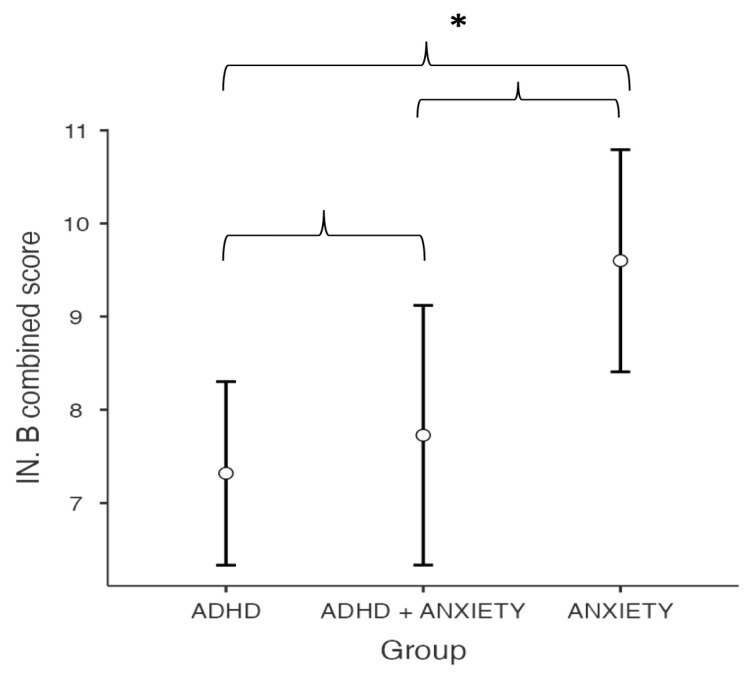
- Diagnosis significantly affected the NEPSY-II IN-B inhibition combined score: F(2,45) = 4.63, p = 0.015, η²p = 0.171. The AD group scored higher than the ADHD group (M_ADHD = 7.32, SE = 0.489 vs. M_AD = 7.73, SE = 0.691; p_tukey = 0.013, d = 0.995, 95% CI [0.28–1.70]); no significant differences were found between ADHD and ADHD + AD (p_tukey = 0.880) or between AD and ADHD + AD (p_tukey = 0.110). A Tukey test also indicated the AD group completed IN-B significantly faster than the ADHD group (p = 0.049).
- A significant positive correlation was found between IN-B combined score and MASC 2 total score, r(48) = 0.349. MASC 2 total scores were higher in the AD group (mean 66.5 ± 14.5) and ADHD + AD group (mean 60.2 ± 5.74) than in the ADHD group (Nemenyi–Damico–Wolfe–Dunn p = 0.0015 and p = 0.00236, respectively).
- Auditory Attention omission errors were negatively correlated with WISC-IV WMI, r(48) = −0.322; IQ was positively correlated with IN-A combined score, r(48) = 0.394, and IN-C combined score, r(48) = 0.321.
Methods
- Retrospective clinical study of children referred to the Neuropsychological Service of the Complex Operative Unit of Child Neuropsychiatry, Policlinico Umberto I, in 2021–2022 for learning difficulties, inattention, and distractibility. The final sample was 48 children and adolescents aged 8–15 years (mean age 10.12 years; SD = 1.59), divided into ADHD, AD, and ADHD + AD groups by DSM-5 diagnosis. Inclusion criteria included IQ ≥ 85 on WISC-IV, Italian as native language, and parent-reported CBCL scores between 65 and 69 or above 70 on at least one DSM-oriented scale; exclusions included depressive symptoms on CDI-2, other comorbidities, and borderline/pathological Affective Problems on CBCL.
- Measures included the WISC-IV (IQ and four composite indexes), selected NEPSY-II attention/executive functioning subtests (Visual Attention, Auditory Attention, Inhibition), and the MASC 2 self-report questionnaire total T-score.
- Analyses used Jamovi version 2.3.28 and Excel; descriptive and inferential analyses included Levene’s test, Tukey or Nemenyi–Damico–Wolfe–Dunn tests, Pearson correlations, independent-samples t-tests, and Bonferroni correction for multiple comparisons.
Limitations
- The paper states that the small sample size limited in-depth analyses, reduced generalizability, and reduced statistical power to detect differences on WISC-IV indexes and other NEPSY-II subtests. Executive functions were assessed only with NEPSY-II, precluding correlations with other testing methods and limiting exploration of other cognitive functions such as planning. More detailed analyses of ADHD subtypes and AD subtypes were not feasible, and future research should include larger samples and consider subtypes and gender effects.
- The text makes evident additional constraints: data were collected retrospectively; participants were a clinically referred sample; none were taking medication for ADHD or anxiety-related disorders at assessment; and the NEPSY-II subtests were not identified a priori but chosen during the analysis phase. The abstract reports a sample of 48, while the methods initially state that 71 children were included before describing the final sample of 48.
Model-written summary. Check it against the paper before relying on it.
Integrity signals
Registry
Cites
Statistics
Figures
Verification
Claims the paper makes
8 Valid · 5 Not valid · 15 Not checked · 41 Own results and interpretations
The sources with a verdict support this claim; the rest weren’t checked yet, have no full text we could read, or their verdicts aren’t rated yet.
In the paper
“However, this result does not provide evidence to support or refute the hypothesis that AD might serve as a protective factor for inhibition deficits in ADHD [100,101].”
§ ADHD Children Take More Time to Inhibit Automatic Responses: A Comparison with Anxiety Disorders Using NEPSY-II > 4. Discussion
What the sources say
- Supportedcites [100] Maric M. Bexkens A. Bögels S.M. Is Clinical Anxiety a Risk or a Protective Factor for Executive Functioning in Youth with ADHD? A Meta-Regression Analysis Clin. Child Fam. Psychol. Rev. 2018 21 340 353 10.1007/s10567-018-0255-8 29484581 source
The Introduction identifies the hypothesis that comorbid anxiety disorders (AD) may protect against inhibition problems in youth with ADHD. The Discussion reports better response inhibition in children with ADHD and AD than in those with ADHD alone. The statement about what “this result” can establish concerns the citing authors’ own result, not a finding attributed to this source. (LLM, conf=0.89)
- Not checked — no full text of the sourcecites [101] Klymkiw D.F. Milligan K. Lackner C. Phillips M. Schmidt L.A. Segalowitz S.J. Does Anxiety Enhance or Hinder Attentional and Impulse Control in Youth With ADHD? An ERP Analysis J. Atten. Disord. 2020 24 1746 1756 10.1177/1087054717707297 28494637 source
plain- Asserted: passes — The authors put it forward as true.
- Checkable: passes — It can be checked against evidence.
- Load-bearing: passes — The paper’s conclusions depend on it.
- Based: passes — The paper gives a reason why it holds.
- Supported
The cited sources support only part of this claim — read each source’s verdict below.
In the paper
“The absence of significant differences in overall cognitive profiles among the three groups is consistent with previous studies.”
§ ADHD Children Take More Time to Inhibit Automatic Responses: A Comparison with Anxiety Disorders Using NEPSY-II > 4. Discussion
What the sources say
- Could not verifycites [83] Ravagnani Salto A.B. Salum G.A. Hoffmann M.S. Santoro M.L. Zugman A. Pan P.M. Belangero S.I. Ito L.T. Doretto V.F. Croci M.S. The Trajectory of Anxiety Symptoms during the Transition from Childhood to Young Adulthood Is Predicted by IQ and Sex, but Not Polygenic Risk Scores JCPP Adv. 2025 5 e12268 10.1002/jcv2.12268 40060001 PMC11889643 sourceExperimental — accuracy not yet measured
The Results (Predicting class membership; page unavailable) compare three anxiety-trajectory classes and find that IQ significantly predicts class membership. They do not compare overall cognitive profiles among the three groups in the citing sentence, whose identities are unspecified. The Methods (Data analysis; page unavailable) report no IQ difference for a different comparison—participants with one versus multiple anxiety assessments—so that finding does not establish the claim. (LLM, conf=0.70)
- Partly supportedcites [84] Agnew-Blais J.C. Polanczyk G.V. Danese A. Wertz J. Moffitt T.E. Arseneault L. Are Changes in ADHD Course Reflected in Differences in IQ and Executive Functioning from Childhood to Young Adulthood? Psychol. Med. 2020 50 2799 2808 10.1017/S0033291719003015 31718730 PMC12981699 sourceExperimental — accuracy not yet measured
The ‘Executive functioning amongst ADHD groups’ section says the three ADHD groups were not distinguished by executive-functioning measures overall, apart from one task. But ‘Differences in IQ amongst groups with different ADHD courses’ reports significant IQ differences between groups, so the broader claim of no significant differences in overall cognitive profiles overstates the findings. (LLM, conf=0.86)
- Not checked — no full text of the sourcecites [85] Hare C. Leslie A.C. Bodell L.P. Kaufman E.A. Morton J.B. Nicolson R. Kelley E. Jones J. Ayub M. Crosbie J. Sex and Intelligence Quotient Differences in Age of Diagnosis among Youth with Attention-deficit Hyperactivity Disorder Br. J. Clin. Psychol. 2024 63 627 645 10.1111/bjc.12485 38923582 source
plain- Asserted: passes — The authors put it forward as true.
- Checkable: passes — It can be checked against evidence.
- Load-bearing: unclear — It is unclear whether the paper’s conclusions depend on it.
- Based: passes — The paper gives a reason why it holds.
- Could not verify
A result the paper reports from its own data — it cites no other source for it, so there is none to check. The quote shows it is in the paper.
In the paper
“Significant differences emerged in inhibition performance, with children in the AD group demonstrating more efficient inhibition compared to both the ADHD and ADHD + AD groups.”
§ ADHD Children Take More Time to Inhibit Automatic Responses: A Comparison with Anxiety Disorders Using NEPSY-II > Abstract
boosted- Asserted: passes — The authors put it forward as true.
- Checkable: passes — It can be checked against evidence.
- Load-bearing: passes — The paper’s conclusions depend on it.
- Based: passes — The paper gives a reason why it holds.
A result the paper reports from its own data — it cites no other source for it, so there is none to check. The quote shows it is in the paper.
In the paper
“No significant group differences emerged in cognitive performance, attention, or working memory.”
§ ADHD Children Take More Time to Inhibit Automatic Responses: A Comparison with Anxiety Disorders Using NEPSY-II > Abstract
plain- Asserted: passes — The authors put it forward as true.
- Checkable: passes — It can be checked against evidence.
- Load-bearing: passes — The paper’s conclusions depend on it.
- Based: passes — The paper gives a reason why it holds.
A result the paper reports from its own data — it cites no other source for it, so there is none to check. The quote shows it is in the paper.
In the paper
“Children with ADHD showed longer response times.”
§ ADHD Children Take More Time to Inhibit Automatic Responses: A Comparison with Anxiety Disorders Using NEPSY-II > Abstract
plain- Asserted: passes — The authors put it forward as true.
- Checkable: passes — It can be checked against evidence.
- Load-bearing: passes — The paper’s conclusions depend on it.
- Based: passes — The paper gives a reason why it holds.
24 more claims
Create a free account to see all 69 claims and every source verdict.
- It may state two separate claims as one. 24
- Probably not a substantial claim. 31
Statistics recomputed
Every reported test result, recomputed from its test statistic and degrees of freedom. A result shows as not adding up only once an independent check has confirmed it.
- ConsistentF(2, 45) = 4.63reported p = .015 · recomputed p = .015
“F(2,45) = 4.63, p = .015”
Self-check
Percentages, sums and reported differences re-computed from the paper’s own numbers.
Each contradiction between two passages listed here was confirmed by an independent check.
Rated major: it would touch a result — a value a result rests on, reported and recomputed p-values on opposite sides of the significance level, two passages that conflict with no sign which is right, or a cited work retracted before this paper was published.
In the paper
§ ADHD Children Take More Time to Inhibit Automatic Responses: A Comparison with Anxiety Disorders Using NEPSY-II > 4. Discussion
“Second, significant group differences in inhibition performance (IN-B subtest) were found, with better performance in the AD group compared to the ADHD group and the ADHD + AD group.”
§ ADHD Children Take More Time to Inhibit Automatic Responses: A Comparison with Anxiety Disorders Using NEPSY-II > 3. Results
“No statistically significant differences were found in the inhibition task between the ADHD group and the ADHD + AD group (ptukey = 0.880, d = 0.178, 95% CI [0.56, 0.92]) or between the AD group and the ADHD + AD group (ptukey = 0.110, d = 0.817, 95% CI [0.00, 1.63])”
Citations
Cites
Diagnostic and Statistical Manual of Mental Disorders
American Psychiatric Association (2013) · doi:10.1176/appi.books.9780890425596 · Cited by 116,369
Miyake, A., Friedman, N. P., Emerson, M. J., Witzki, A. H., Howerter, A., & Wager, T. D. (2000) · Cognitive Psychology · doi:10.1006/cogp.1999.0734 · Cited by 15,798
Diamond, A. (2013) · Annual Review of Psychology · doi:10.1146/annurev-psych-113011-143750 · Cited by 13,268
Anxiety and cognitive performance: Attentional control theory
Eysenck, M. W., Derakshan, N., Santos, R., & Calvo, M. G. (2007) · Emotion · doi:10.1037/1528-3542.7.2.336 · Cited by 5,289
Working Memory: Theories, Models, and Controversies
Baddeley, A. (2012) · Annual Review of Psychology · doi:10.1146/annurev-psych-120710-100422 · Cited by 4,271
FARAONE, S. V., BIEDERMAN, J., & MICK, E. (2006) · Psychological Medicine · doi:10.1017/s003329170500471x · Cited by 2,267
ADHD in Children and Young People: Prevalence, Care Pathways, and Service Provision
Sayal, K., Prasad, V., Daley, D., Ford, T., & Coghill, D. (2018) · The Lancet Psychiatry · doi:10.1016/s2215-0366(17)30167-0 · Cited by 1,223
Executive Attention, Working Memory Capacity, and a Two-Factor Theory of Cognitive Control
Engle, R. W., & Kane, M. J. (2003) · Psychology of Learning and Motivation · doi:10.1016/s0079-7421(03)44005-x · Cited by 1,104
ADHD Comorbidity Findings From the MTA Study: Comparing Comorbid Subgroups
JENSEN, P. S., HINSHAW, S. P., KRAEMER, H. C., LENORA, N., NEWCORN, J. H., ABIKOFF, H. B., MARCH, J. S., ARNOLD, L. E., CANTWELL, D. P., CONNERS, C. K., et al. (2001) · Journal of the American Academy of Child & Adolescent Psychiatry · doi:10.1097/00004583-200102000-00009 · Cited by 974
BIEDERMAN, J., MONUTEAUX, M. C., MICK, E., SPENCER, T., WILENS, T. E., SILVA, J. M., SNYDER, L. E., & FARAONE, S. V. (2006) · Psychological Medicine · doi:10.1017/s0033291705006410 · Cited by 850
New Perspectives in Attentional Control Theory
Eysenck, M. W., & Derakshan, N. (2011) · Personality and Individual Differences · doi:10.1016/j.paid.2010.08.019 · Cited by 826
Evidence-Based Assessment of Attention Deficit Hyperactivity Disorder in Children and Adolescents
Pelham, Jr., Fabiano, G. A., & Massetti, G. M. (2005) · Journal of Clinical Child & Adolescent Psychology · doi:10.1207/s15374424jccp3403_5 · Cited by 803
Frazier, T. W., Demaree, H. A., & Youngstrom, E. A. (2004) · Neuropsychology · doi:10.1037/0894-4105.18.3.543 · Cited by 792
Anxiety and working memory capacity: A meta-analysis and narrative review.
Moran, T. P. (2016) · Psychological Bulletin · doi:10.1037/bul0000051 · Cited by 776
Derakshan, N., & Eysenck, M. W. (2009) · European Psychologist · doi:10.1027/1016-9040.14.2.168 · Cited by 710
Live fast, die young? A review on the developmental trajectories of ADHD across the lifespan
Franke, B., Michelini, G., Asherson, P., Banaschewski, T., Bilbow, A., Buitelaar, J. K., Cormand, B., Faraone, S. V., Ginsberg, Y., Haavik, J., et al. (2018) · European Neuropsychopharmacology · doi:10.1016/j.euroneuro.2018.08.001 · Cited by 643
Hart, E. L., Lahey, B. B., Loeber, R., Applegate, B., & Frick, P. J. (1995) · Journal of Abnormal Child Psychology · doi:10.1007/bf01447474 · Cited by 590
Barkley, R. A. (1997) · Psychological Bulletin · doi:10.1037//0033-2909.121.1.65 · Cited by 580
The Child Behavior Checklist and related instruments.
Achenbach, T. M. (1999) · Cited by 565
Relations Between Continuous Performance Test Performance Measures and ADHD Behaviors
Epstein, J. N., Erkanli, A., Conners, C. K., Klaric, J., Costello, J. E., & Angold, A. (2003) · Journal of Abnormal Child Psychology · doi:10.1023/a:1025405216339 · Cited by 520
Halperin, J. M., & Schulz, K. P. (2006) · Psychological Bulletin · doi:10.1037/0033-2909.132.4.560 · Cited by 446
Toplak, M. E., Bucciarelli, S. M., Jain, U., & Tannock, R. (2008) · Child Neuropsychology · doi:10.1080/09297040802070929 · Cited by 444
Lara, C., Fayyad, J., de Graaf, R., Kessler, R. C., Aguilar-Gaxiola, S., Angermeyer, M., Demytteneare, K., de Girolamo, G., Haro, J. M., Jin, R., et al. (2009) · Biological Psychiatry · doi:10.1016/j.biopsych.2008.10.005 · Cited by 420
The Encyclopedia of Clinical Psychology
(2015) · Wiley eBooks · doi:10.1002/9781118625392 · Cited by 417
ADHD With Comorbid Anxiety: A Review of the Current Literature
Schatz, D. B., & Rostain, A. L. (2006) · Journal of Attention Disorders · doi:10.1177/1087054706286698 · Cited by 407
Attentional control deficits in trait anxiety: Why you see them and why you don't
Berggren, N., & Derakshan, N. (2013) · Biological Psychology · doi:10.1016/j.biopsycho.2012.03.007 · Cited by 403
Literacy difficulties and psychiatric disorders: evidence for comorbidity
Carroll, J. M., Maughan, B., Goodman, R., & Meltzer, H. (2005) · Journal of Child Psychology and Psychiatry · doi:10.1111/j.1469-7610.2004.00366.x · Cited by 401
A cognitive model of pathological worry
Hirsch, C. R., & Mathews, A. (2012) · Behaviour Research and Therapy · doi:10.1016/j.brat.2012.06.007 · Cited by 400
Nigg, J. T., Goldsmith, H. H., & Sachek, J. (2004) · Journal of Clinical Child & Adolescent Psychology · doi:10.1207/s15374424jccp3301_5 · Cited by 383
Predictors of persistent ADHD: An 11-year follow-up study
Biederman, J., Petty, C. R., Clarke, A., Lomedico, A., & Faraone, S. V. (2011) · Journal of Psychiatric Research · doi:10.1016/j.jpsychires.2010.06.009 · Cited by 382
Response inhibition and psychopathology: A meta-analysis of go/no-go task performance
Wright, L., Lipszyc, J., Dupuis, A., Thayapararajah, S. W., & Schachar, R. (2014) · Journal of Abnormal Psychology · doi:10.1037/a0036295 · Cited by 360
Carlson, C. L., & Mann, M. (2002) · Journal of Clinical Child & Adolescent Psychology · doi:10.1207/s15374424jccp3101_14 · Cited by 342
Working Memory and Executive Attention: A Revisit
Engle, R. W. (2018) · Perspectives on Psychological Science · doi:10.1177/1745691617720478 · Cited by 339
Kessler, R. C., Green, J. G., Adler, L. A., Barkley, R. A., Chatterji, S., Faraone, S. V., Finkelman, M., Greenhill, L. L., Gruber, M. J., Jewell, M., et al. (2010) · Archives of General Psychiatry · doi:10.1001/archgenpsychiatry.2010.146 · Cited by 317
Jarrett, M. A., & Ollendick, T. H. (2008) · Clinical Psychology Review · doi:10.1016/j.cpr.2008.05.004 · Cited by 311
Wechsler Intelligence Scale for Children – Fourth UK Edition (WISC-IV UK)
Wechsler, D. (2004) · doi:10.53841/bpstest.2004.wisc4 · Cited by 306
NEPSY-II: A Developmental Neuropsychological Assessment, Second Edition
Brooks, B. L., Sherman, E. M. S., & Strauss, E. (2009) · Child Neuropsychology · doi:10.1080/09297040903146966 · Cited by 298
Attention deficit hyperactivity disorder and comorbidity: a review of literature
Gnanavel, S., Sharma, P., Kaushal, P., & Hussain, S. (2019) · World Journal of Clinical Cases · doi:10.12998/wjcc.v7.i17.2420 · Cited by 296
Effect of Anxiety on Cognition, Behavior, and Stimulant Response in ADHD
PLISZKA, S. R. (1989) · Journal of the American Academy of Child & Adolescent Psychiatry · doi:10.1097/00004583-198911000-00012 · Cited by 293
Patterns of Psychiatric Comorbidity with Attention-Deficit/Hyperactivity Disorder
Pliszka, S. R. (2000) · Child and Adolescent Psychiatric Clinics of North America · doi:10.1016/s1056-4993(18)30105-6 · Cited by 257
BALDWIN, J. S., & DADDS, M. R. (2007) · Journal of the American Academy of Child & Adolescent Psychiatry · doi:10.1097/01.chi.0000246065.93200.a1 · Cited by 252
Conners' Parent Rating Scale--Revised
Conners, C. K., Sitarenios, G., Parker, J. D. A., & Epstein, J. N. (2021) · PsycTESTS Dataset · doi:10.1037/t81067-000 · Cited by 240
ADHD subtypes: do they differ in their executive functioning profile?
GEURTS, H., VERTE, S., OOSTERLAAN, J., ROEYERS, H., & SERGEANT, J. (2005) · Archives of Clinical Neuropsychology · doi:10.1016/j.acn.2004.11.001 · Cited by 239
Response inhibition and ADHD traits: Correlates and heritability in a community sample
Crosbie, J., Arnold, P., Paterson, A., Swanson, J., Dupuis, A., Li, X., Shan, J., Goodale, T., Tam, C., Strug, L. J., et al. (2013) · Journal of Abnormal Child Psychology · doi:10.1007/s10802-012-9693-9 · Cited by 218
KLORMAN, R., HAZEL-FERNANDEZ, L. A., SHAYWITZ, S. E., FLETCHER, J. M., MARCHIONE, K. E., HOLAHAN, J. M., STUEBING, K. K., & SHAYWITZ, B. A. (1999) · Journal of the American Academy of Child & Adolescent Psychiatry · doi:10.1097/00004583-199909000-00020 · Cited by 215
The Multidimensional Anxiety Scale for Children (MASC)
March, J. S., & Parker, J. D. A. (2014) · The Use of Psychological Testing for Treatment Planning and Outcomes Assessment · doi:10.4324/9781410610621-2 · Cited by 215
Comer, J. S., Blanco, C., Hasin, D. S., Liu, S.-M., Grant, B. F., Turner, J. B., & Olfson, M. (2011) · The Journal of Clinical Psychiatry · doi:10.4088/jcp.09m05094blu · Cited by 214
Working memory, psychiatric symptoms, and academic performance at school
Aronen, E. T., Vuontela, V., Steenari, M.-R., Salmi, J., & Carlson, S. (2005) · Neurobiology of Learning and Memory · doi:10.1016/j.nlm.2004.06.010 · Cited by 212
Genetic Contributions to the Development of ADHD Subtypes From Childhood to Adolescence
LARSSON, H., LICHTENSTEIN, P., & LARSSON, J.-O. (2006) · Journal of the American Academy of Child & Adolescent Psychiatry · doi:10.1097/01.chi.0000222787.57100.d8 · Cited by 203
Rapport, M. D., Chung, K.-M., Shore, G., & Isaacs, P. (2001) · Journal of Clinical Child & Adolescent Psychology · doi:10.1207/s15374424jccp3001_6 · Cited by 198
Attention and executive functions profile in drug naive ADHD subtypes
Pasini, A., Paloscia, C., Alessandrelli, R., Porfirio, M. C., & Curatolo, P. (2007) · Brain and Development · doi:10.1016/j.braindev.2006.11.010 · Cited by 182
Chapter 10 The prefrontal cortex and its relation to behavior
Fuster, J. M. (1991) · Progress in Brain Research · doi:10.1016/s0079-6123(08)63053-8 · Cited by 180
Research Review: Pediatric Anxiety Disorders—What Have We Learnt in the Last 10 Years?
Strawn, J. R., Lu, L., Peris, T. S., Levine, A., & Walkup, J. T. (2021) · Journal of Child Psychology and Psychiatry · doi:10.1111/jcpp.13262 · Cited by 168
Frigerio, A., Cattaneo, C., Cataldo, M., Schiatti, A., Molteni, M., & Battaglia, M. (2004) · European Journal of Psychological Assessment · doi:10.1027/1015-5759.20.2.124 · Cited by 168
Comorbidity between ADHD and Anxiety Disorders across the Lifespan
D’Agati, E., Curatolo, P., & Mazzone, L. (2019) · International Journal of Psychiatry in Clinical Practice · doi:10.1080/13651501.2019.1628277 · Cited by 165
Test Review: Wechsler Intelligence Scale for Children, Fourth Edition (WISC-IV)
Kaufman, A. S., Flanagan, D. P., Alfonso, V. C., & Mascolo, J. T. (2006) · Journal of Psychoeducational Assessment · doi:10.1177/0734282906288389 · Cited by 164
SCHACHAR, R., & TANNOCK, R. (1995) · Journal of the American Academy of Child & Adolescent Psychiatry · doi:10.1097/00004583-199505000-00016 · Cited by 161
Children's Depression Inventory ( CDI and CDI 2)
Kovacs, M. (2015) · The Encyclopedia of Clinical Psychology · doi:10.1002/9781118625392.wbecp419 · Cited by 139
Korkman, M., & Pesonen, A.-E. (1994) · Journal of Learning Disabilities · doi:10.1177/002221949402700605 · Cited by 137
Kawabata, Y., Tseng, W., & Gau, S. S. (2011) · Research on Child and Adolescent Psychopathology · doi:10.1007/s10802-011-9556-9 · Cited by 134
Bridgett, D. J., & Walker, M. E. (2006) · Psychological Assessment · doi:10.1037/1040-3590.18.1.1 · Cited by 134
Does neurocognitive functioning predict future or persistence of ADHD? A systematic review
van Lieshout, M., Luman, M., Buitelaar, J., Rommelse, N. N. J., & Oosterlaan, J. (2013) · Clinical Psychology Review · doi:10.1016/j.cpr.2013.02.003 · Cited by 133
Childhood predictors of adolescent and young adult outcome in ADHD
Cheung, C. H. M., Rijdijk, F., McLoughlin, G., Faraone, S. V., Asherson, P., & Kuntsi, J. (2015) · Journal of Psychiatric Research · doi:10.1016/j.jpsychires.2015.01.011 · Cited by 131
SEIDMAN, L. J., BIEDERMAN, J., FARAONE, S. V., MILBERGER, S., NORMAN, D., SEIVERD, K., BENEDICT, K., GUITE, J., MICK, E., & KIELY, K. (1995) · Journal of the American Academy of Child & Adolescent Psychiatry · doi:10.1097/00004583-199508000-00011 · Cited by 128
Current research on cognitive aspects of anxiety disorders
Ferreri, F., Lapp, L. K., & Peretti, C.-S. (2011) · Current Opinion in Psychiatry · doi:10.1097/yco.0b013e32833f5585 · Cited by 125
Working memory and organizational skills problems in ADHD
Kofler, M. J., Sarver, D. E., Harmon, S. L., Moltisanti, A., Aduen, P. A., Soto, E. F., & Ferretti, N. (2018) · Journal of Child Psychology and Psychiatry · doi:10.1111/jcpp.12773 · Cited by 125
Mayes, S. D., Calhoun, S. L., Chase, G. A., Mink, D. M., & Stagg, R. E. (2009) · Journal of Attention Disorders · doi:10.1177/1087054708320402 · Cited by 120
Antshel, K. M., Faraone, S. V., Stallone, K., Nave, A., Kaufmann, F. A., Doyle, A., Fried, R., Seidman, L., & Biederman, J. (2007) · Journal of Child Psychology and Psychiatry · doi:10.1111/j.1469-7610.2007.01735.x · Cited by 117
Test Review: Children’s Depression Inventory 2 (CDI 2)
Bae, Y. (2012) · Journal of Psychoeducational Assessment · doi:10.1177/0734282911426407 · Cited by 113
Watkins, M. W. (2010) · Psychological Assessment · doi:10.1037/a0020043 · Cited by 99
Ghirardi, L., Pettersson, E., Taylor, M. J., Freitag, C. M., Franke, B., Asherson, P., Larsson, H., & Kuja-Halkola, R. (2019) · Psychological Medicine · doi:10.1017/s003329171800243x · Cited by 99
Korkman, M., Kirk, U., & Kemp, S. (2012) · PsycTESTS Dataset · doi:10.1037/t15125-000 · Cited by 98
Clarifying Inhibitory Control: Diversity and Development of Attentional Inhibition
Howard, S. J., Johnson, J., & Pascual-Leone, J. (2014) · Cognitive Development · doi:10.1016/j.cogdev.2014.03.001 · Cited by 96
Souza, I., Pinheiro, M. A., Denardin, D., Mattos, P., & Rohde, L. A. (2004) · European Child & Adolescent Psychiatry · doi:10.1007/s00787-004-0402-2 · Cited by 92
Canivez, G. L. (2014) · School Psychology Quarterly · doi:10.1037/spq0000032 · Cited by 87
Milioni, A. L. V., Chaim, T. M., Cavallet, M., de Oliveira, N. M., Annes, M., dos Santos, B., Louzã, M., da Silva, M. A., Miguel, C. S., Serpa, M. H., et al. (2017) · Journal of Attention Disorders · doi:10.1177/1087054714554933 · Cited by 77
Tucha, O. M., Walitza, S., Mecklinger, L., Sontag, T. A., Kübber, S., Linder, M., & Lange, K. W. (2006) · Journal of Neural Transmission · doi:10.1007/s00702-006-0496-4 · Cited by 77
Manassis (2007) · Behavioral and Brain Functions · doi:10.1186/1744-9081-3-4 · Cited by 72
Trait and state anxiety: Relations to executive functioning in an at-risk sample
Ursache, A., & Raver, C. C. (2014) · Cognition and Emotion · doi:10.1080/02699931.2013.855173 · Cited by 72
Ghanizadeh, A. (2008) · International Journal of Dermatology · doi:10.1111/j.1365-4632.2008.03743.x · Cited by 70
Trait anxiety and adolescent's academic achievement: The role of executive function
Alfonso, S. V., & Lonigan, C. J. (2020) · Learning and Individual Differences · doi:10.1016/j.lindif.2020.101941 · Cited by 66
Dickerson Mayes, S., Calhoun, S. L., & Crowell, E. W. (1998) · Journal of Attention Disorders · doi:10.1177/108705479800200402 · Cited by 65
Racz, S. J., Putnick, D. L., Suwalsky, J. T. D., Hendricks, C., & Bornstein, M. H. (2016) · Journal of Youth and Adolescence · doi:10.1007/s10964-016-0602-3 · Cited by 63
Roth, R. M., Wishart, H. A., Flashman, L. A., Riordan, H. J., Huey, L., & Saykin, A. J. (2004) · Neuropsychology · doi:10.1037/0894-4105.18.1.78 · Cited by 53
Trait Anxiety Attenuates Response Inhibition: Evidence From an ERP Study Using the Go/NoGo Task
Xia, L., Mo, L., Wang, J., Zhang, W., & Zhang, D. (2020) · Frontiers in Behavioral Neuroscience · doi:10.3389/fnbeh.2020.00028 · Cited by 51
Self-Regulation and Inhibition in Comorbid ADHD Children: An Evaluation of Executive Functions
Sarkis, S. M., Sarkis, E. H., Marshall, D., & Archer, J. (2005) · Journal of Attention Disorders · doi:10.1177/1087054705277265 · Cited by 51
Braaten, E. B., Beiderman, J., Monuteaux, M. C., Mick, E., Calhoun, E., Cattan, G., & Faraone, S. V. (2003) · Biological Psychiatry · doi:10.1016/s0006-3223(02)01434-8 · Cited by 49
Cornoldi, C., Orsini, A., Cianci, L., Giofrè, D., & Pezzuti, L. (2013) · Learning and Individual Differences · doi:10.1016/j.lindif.2013.04.005 · Cited by 47
Co-Occurrence of ADHD and Anxiety in Preschool Children
Øvergaard, K. R., Aase, H., Torgersen, S. O., & Zeiner, P. (2012) · Journal of Attention Disorders · doi:10.1177/1087054712463063 · Cited by 47
Memory deficits in children with and at risk for anxiety disorders
Vasa, R. A., Roberson-Nay, R., Klein, R. G., Mannuzza, S., Moulton, Guardino, M., Merikangas, A., Carlino, A. R., & Pine, D. S. (2007) · Depression and Anxiety · doi:10.1002/da.20193 · Cited by 44
Clinical practice guidelines for attention-deficit/hyperactivity disorder: recent updates
Eom, T. H., & Kim, Y.-H. (2023) · Korean Journal of Pediatrics · doi:10.3345/cep.2021.01466 · Cited by 44
Maric, M., Bexkens, A., & Bögels, S. M. (2018) · Clinical Child and Family Psychology Review · doi:10.1007/s10567-018-0255-8 · Cited by 42
Semrud-Clikeman, M., Pliszka, S. R., Bledsoe, J., & Lancaster, J. (2014) · Journal of Attention Disorders · doi:10.1177/1087054712443158 · Cited by 40
Neurostructural Correlates of Two Subtypes of Specific Phobia: A Voxel-Based Morphometry Study
Hilbert, K., Evens, R., Isabel Maslowski, N., Wittchen, H.-U., & Lueken, U. (2015) · Psychiatry Research: Neuroimaging · doi:10.1016/j.pscychresns.2014.12.003 · Cited by 40
Anxiety Disorders in Children with High Intellectual Potential
Kermarrec, S., Attinger, L., Guignard, J.-H., & Tordjman, S. (2020) · BJPsych Open · doi:10.1192/bjo.2019.104 · Cited by 36
Prediction of ADHD to Anxiety Disorders: An 11-Year National Insurance Data Analysis in Taiwan
Tai, Y.-M., Gau, C.-S., Gau, S. S.-F., & Chiu, H.-W. (2013) · Journal of Attention Disorders · doi:10.1177/1087054712437581 · Cited by 36
Agnew-Blais, J. C., Polanczyk, G. V., Danese, A., Wertz, J., Moffitt, T. E., & Arseneault, L. (2020) · Psychological Medicine · doi:10.1017/s0033291719003015 · Cited by 36
van der Meer, D., Hoekstra, P. J., van Rooij, D., Winkler, A. M., van Ewijk, H., Heslenfeld, D. J., Oosterlaan, J., Faraone, S. V., Franke, B., Buitelaar, J. K., et al. (2017) · The World Journal of Biological Psychiatry · doi:10.1080/15622975.2017.1287952 · Cited by 33
Vance, A., Ferrin, M., Winther, J., & Gomez, R. (2013) · Journal of Abnormal Child Psychology · doi:10.1007/s10802-013-9721-4 · Cited by 33
Test Review: Multidimensional Anxiety Scale for Children by J. S. March
Fraccaro, R. L., Stelnicki, A. M., & Nordstokke, D. (2015) · Canadian Journal of School Psychology · doi:10.1177/0829573514542924 · Cited by 32
ADHD in Adults: Characterization, Diagnosis, and Treatment
Buitelaar, J. K., Kan, C. C., & Asherson, P. J. (2011) · Cambridge University Press eBooks · doi:10.1017/cbo9780511780752 · Cited by 28
Melby, L., Indredavik, M. S., Løhaugen, G., Brubakk, A. M., Skranes, J., & Vik, T. (2020) · BMC Psychology · doi:10.1186/s40359-020-0372-2 · Cited by 28
Duff, C. T., & Sulla, E. M. (2015) · Applied Neuropsychology: Child · doi:10.1080/21622965.2013.848329 · Cited by 28
An Investigation of Executive Functioning in Pediatric Anxiety
Murphy, Y. E., Luke, A., Brennan, E., Francazio, S., Christopher, I., & Flessner, C. A. (2018) · Behavior Modification · doi:10.1177/0145445517749448 · Cited by 26
The Influence of Generalized Anxiety Disorder on Executive Functions in Children with ADHD
Menghini, D., Armando, M., Calcagni, M., Napolitano, C., Pasqualetti, P., Sergeant, J. A., Pani, P., & Vicari, S. (2018) · European Archives of Psychiatry and Clinical Neuroscience · doi:10.1007/s00406-017-0831-9 · Cited by 23
Kofler, M. J., Sarver, D. E., & Wells, E. L. (2020) · Journal of Attention Disorders · doi:10.1177/1087054715608439 · Cited by 20
Poznyak, E., & Debbané, M. (2025) · Child and Adolescent Psychiatry and Mental Health · doi:10.1186/s13034-025-00898-1 · Cited by 19
Psychological Treatments for Hyperactivity and Impulsivity in Children with ADHD: A Narrative Review
Sadr-Salek, S., Costa, A. P., & Steffgen, G. (2023) · Children · doi:10.3390/children10101613 · Cited by 19
Does Anxiety Enhance or Hinder Attentional and Impulse Control in Youth With ADHD? An ERP Analysis
Klymkiw, D. F., Milligan, K., Lackner, C., Phillips, M., Schmidt, L. A., & Segalowitz, S. J. (2020) · Journal of Attention Disorders · doi:10.1177/1087054717707297 · Cited by 18
Memory and language impairments are associated with anxiety disorder severity in childhood
Sbicigo, J. B., Toazza, R., Becker, N., Ecker, K., Manfro, G. G., & de Salles, J. F. (2020) · Trends in Psychiatry and Psychotherapy · doi:10.1590/2237-6089-2019-0051 · Cited by 16
IQ Modulates Coupling Between Diverse Dimensions of Psychopathology in Children and Adolescents
Mahony, B. W., Tu, D., Rau, S., Liu, S., Lalonde, F. M., Alexander-Bloch, A. F., Satterthwaite, T. D., Shinohara, R. T., Bassett, D. S., Milham, M. P., et al. (2023) · Journal of the American Academy of Child & Adolescent Psychiatry · doi:10.1016/j.jaac.2022.06.015 · Cited by 15
Koyuncu, A., İnce, E., Ertekin, E., Çelebi, F., & Tükel, R. (2019) · ADHD Attention Deficit and Hyperactivity Disorders · doi:10.1007/s12402-018-00283-3 · Cited by 10
Plourde, V., Boivin, M., Brendgen, M. R., Vitaro, F., & Dionne, G. (2016) · Development and Psychopathology · doi:10.1017/s0954579416001255 · Cited by 10
Brown, T. E. (2011) · Cambridge University Press eBooks · doi:10.1017/cbo9780511780752.011 · Cited by 9
Marsh, C. L., Harmon, S. L., Cho, S., Chan, E. S. M., Gaye, F., DeGeorge, L., Black, K. E., Irwin, L. N., & Kofler, M. J. (2023) · Research on Child and Adolescent Psychopathology · doi:10.1007/s10802-023-01152-y · Cited by 8
You, Y., Oginni, O. A., Rijsdijk, F. V., Lim, K. X., Zavos, H. M. S., & McAdams, T. A. (2024) · Psychological Medicine · doi:10.1017/s0033291724002514 · Cited by 8
Uno studio di validazione del CBCL/6-18 e del TRF/6-18 nella tarda infanzia
(2010) · Cited by 7
Hare, C., Leslie, A. C., Bodell, L. P., Kaufman, E. A., Morton, J. B., Nicolson, R., Kelley, E., Jones, J., Ayub, M., Crosbie, J., et al. (2024) · British Journal of Clinical Psychology · doi:10.1111/bjc.12485 · Cited by 5
Clinician’s Guide to ADHD Comorbidities in Children and Adolescents: Case Studies
Sadek, J. (2019) · doi:10.1007/978-3-319-45635-5 · Cited by 4
Ravagnani Salto, A. B., Salum, G. A., Hoffmann, M. S., Santoro, M. L., Zugman, A., Pan, P. M., Belangero, S. I., Ito, L. T., Doretto, V. F., Croci, M. S., et al. (2025) · JCPP Advances · doi:10.1002/jcv2.12268 · Cited by 3
Research works printed but not linked: 2
- Conners C.K. Conners 3rd Edition: Manual Multi-Health Systems Toronto, ON, Canada 2008
- Melchiori F. Paloscia C. Giangregorio A. Guerini R. Manual of Multidimensional Anxiety Scale Fo Children Second Edition 2—Italian Version Hogrefe Florence, Italy 2017
Cited by
Wang, C.-H., Huang, Y., Lee, Y.-T., Wang, H.-W., Liu, Y., & Chen, H.-J. (2026) · Diagnostics · doi:10.3390/diagnostics16193104
Adak, İ., Varan, E. O., Eyupoglu, N., Alpman, A., Durmus, Z. B., Karakuş, O. B., Gamlı, İ. S., & Ekıncı, O. (2026) · Diagnostics · doi:10.3390/diagnostics16050808
Metadata
- Authors
- Panvino, F., Zaccaria, V., Pica, M., Amitrano, N., Pisani, F., & Di Brina, C.
- Affiliations
- Sapienza University of Rome (IT)
- Unit of Child and Adolescent Neuropsychiatry, Department of Human Neuroscience, Sapienza University of Rome, Via dei Sabelli 108, 00185 Rome, Italy
- Corresponding author
- Panvino, Fabiola
- Venue
- Children
- Publisher
- MDPI AG
- Published
- 2025-06-18
- Volume
- 12
- Issue
- 6
- Pages
- 798
- ISSN
- 2227-9067 (ISSN-L)
- PMC
- PMC12191324
- OpenAlex
- W4411452927
- Cited by
- 2
- References
- 119
- Citations by year
- 2026: 2
- FWCI
- 1.35
- Type
- journal article
- Language
- en
- Open access
- gold
- doi.org
- Licence
- Locations
- Children (publishedVersion, cc-by)
- PubMed Central (publishedVersion, cc-by)
- PubMed (publishedVersion)
- DOAJ (DOAJ: Directory of Open Access Journals) (submittedVersion, cc-by-sa)
- IRIS Research product catalog (Sapienza University of Rome) (submittedVersion, cc-by)
- Topics
- Health Sciences › Medicine › Psychiatry and Mental health › Attention Deficit Hyperactivity Disorder
- Social Sciences › Psychology › Neuropsychology and Physiological Psychology › Developmental and Educational Neuropsychology
- Social Sciences › Psychology › Clinical Psychology › Child and Adolescent Psychosocial and Emotional Development
- Keywords
- attention deficit hyperactivity disorder, childhood anxiety disorders, inhibition, executive function, working memory, attention, neuropsychological markers, differential diagnosis, NEPSY-II, anxiety symptoms, reaction time (psychology)
About these checks
Registry, retraction, Cites and statistics results are computed, not judged, with one exception: a printed reference that no index lists is read once by a model before it counts as a citation error. Claims are extracted by a model and kept only when their quote appears verbatim in the text; each cited source is then checked, with a model’s help, for whether it says what the claim relies on. Those verdicts can be wrong — read the claim’s quote and the cited source before relying on one.
The claim verdicts this report counts are experimental: their accuracy is not yet measured.
A language model drew the claims from the paper on 2026-09-29, under version 3 of the claim definition (model deepseek-v4.1-flash, prompt extract-v3).
A second model labelled each claim on 2026-09-29 (model jev-1.13-20260917, definition revision gold-guideline-v0.2).
Cited sources are checked with a language model’s help (gpt-6-sol).
Statistics and arithmetic are recomputed, not judged.
Confidence bands are shown only for fields calibrated on our annotated test set. None is calibrated yet, so no band is shown.
What counts as a claim ›How we measure confidence ›How we check this ›
Are you an author, or do you see a problem with this page? Request a review
Data sources
Bibliographic data: Semantic Scholar, OpenAlex, Crossref.
Contains information from the Semantic Scholar Academic Graph Datasets, made available under the ODC Attribution License (ODC-BY 1.0).
Semantic Scholar’s data is described in: Kinney, R., et al. (2023). The Semantic Scholar Open Data Platform. arXiv:2301.10140.
