

Analysis of the Clinical Impact of the BioFire FilmArray Meningitis Encephalitis Panel on Antimicrobial Use and Duration of Therapy at an Academic Medical Center
Open accessThe DOI matches its Crossref record; 18 of the 18 references it cites were found in a registry or an index; 15 of the 29 sources its claims cite were checked for support.
Abstract
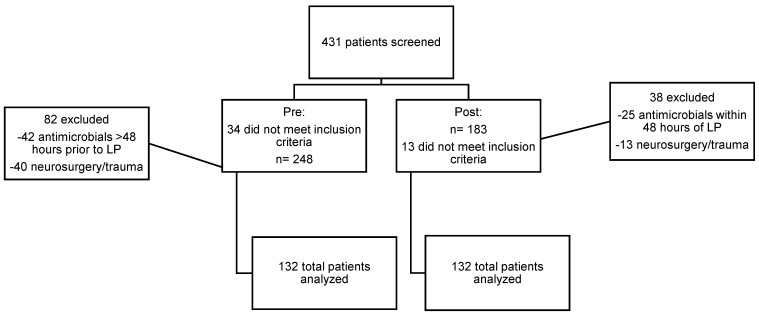
The purpose of this study was to assess the clinical impact of the BioFire FilmArray Meningitis/Encephalitis (ME) panel on antimicrobial use and clinical outcomes. This retrospective, quasi-experiment evaluated adult and pediatric patients with suspected ME, evidenced by cerebrospinal fluid (CSF) culture. Hospital-acquired meningitis patients and patients who received antimicrobials >48 h prior to lumbar puncture were excluded. The primary endpoint was days of antimicrobial therapy pre- and post-implementation of the ME panel. Secondary endpoints included total length of stay, 30-day readmission, and individual days of antimicrobial therapy. Two hundred and sixty-four total adult and pediatric patients were included. Antimicrobial days of therapy had a median of 3 days (IQR 0−5) in the pre vs. post group with a median of 2 days (2−5) (p = 0.099). Days of therapy for acyclovir were significantly decreased in the post group (median 2 days [IQR 1−3] vs. 3 days [IQR 2.5−4.5], p = 0.0002). There were no significant differences in the secondary endpoints. Overall, implementation of the ME panel impacted the duration of antimicrobials, particularly acyclovir; however, opportunities for further education regarding antimicrobial de-escalation and utilization of the panel were identified. Antimicrobial stewardship program intervention is critical to maximize benefit of this rapid diagnostic test.
Overview
CoChat Summary
TL;DR
In this retrospective pre-post study at a 722-bed academic medical center, implementation of the BioFire FilmArray ME panel did not significantly change overall antimicrobial days of therapy or clinical outcomes, but it did significantly reduce acyclovir duration. The authors conclude that the panel’s benefit likely depends on pairing it with antimicrobial stewardship or clinical guidance.
Key findings
- A total of 264 patients were analyzed, 132 pre-implementation and 132 post-implementation.
- Overall antimicrobial days of therapy were median 3 days [IQR 0–5] pre vs 2 days [IQR 2–5] post, which was not statistically significant (p = 0.099).
- Acyclovir days of therapy were significantly shorter after implementation: median 3 days [IQR 2.5–4.5] pre vs 2 days [IQR 1–3] post (p = 0.0002).
- Secondary outcomes were similar between groups: length of stay, 30-day readmission, and mortality showed no significant differences.
- The ME panel detected a pathogen in 18/132 post-group patients (13.6%); detection was 2/132 (3.7%) in adults and 16/132 (20.5%) in pediatrics.
Methods
- Design: Retrospective pre-post quasi-experiment with a 1-year washout period around ME panel implementation.
- Sample/data: Patients with CSF culture results at UMMC, comparing 1 Aug 2013–1 Aug 2016 vs 1 Aug 2017–1 Aug 2020; excluded patients with antimicrobials >48 h before LP, polymicrobial CSF infection, healthcare-associated meningitis, and post-implementation patients without ME panel testing.
- Analysis: Descriptive statistics plus Mann–Whitney U, Fisher’s exact, and chi-squared tests; primary endpoint was antimicrobial days of therapy (DOT).
Limitations
- The paper states that 25% of patients received no antimicrobial therapy despite CSF diagnostic testing, and many were being evaluated for ocular or neurological diseases such as multiple sclerosis; this suggests possible overuse/inappropriate ordering of the panel.
- The authors state the study was from a single center and that a larger, geographically broader sample would improve generalizability.
- The authors also state interpretation is limited by the overall low positivity rate, especially in adults.
Model-written summary. Check it against the paper before relying on it.
Integrity signals
Registry
Cites
Statistics
Figures
Verification
Claims the paper makes
13 Valid · 0 Not valid · 5 Not checked · 27 Own results and interpretations
The sources with a verdict support this claim; the rest weren’t checked yet, have no full text we could read, or their verdicts aren’t rated yet.
In the paper
“Implementation of the ME Panel into clinical practice has yielded mixed results.”
§ Analysis of the Clinical Impact of the BioFire FilmArray Meningitis Encephalitis Panel on Antimicrobial Use and Duration of Therapy at an Academic Medical Center > 1. Introduction
What the sources say
- Supportedcites [11] Didiodato G. Bradbury N. Cerebrospinal fluid analysis with the biofire filmarray meningitis/encephalitis molecular panel reduces length of hospital stay in patients with suspected central nervous system infections Open Forum Infect. Dis. 2019 6 ofz119 10.1093/ofid/ofz119 31041338 PMC6483125 source
The results passage (indexed under Abstract; page not provided) reports mixed effects after ME Panel implementation: hospital stay fell by about 1.5 days, but total hours of antimicrobial therapy did not differ between groups. This supports the broad characterization of mixed results, though the study concerns one hospital rather than clinical practice generally. (LLM, conf=0.86)
- Not checked — no full text of the sourcecites [12] Nabower A.M. Miller S. Biewen B. Lyden E. Goodrich N. Miller A. Snowden J. Association of the filmarray meningitis/encephalitis panel with clinical management Hosp. Pediatr. 2019 9 763 769 10.1542/hpeds.2019-0064 31511395 source
plain- Asserted: passes — The authors put it forward as true.
- Checkable: passes — It can be checked against evidence.
- Load-bearing: unclear — It is unclear whether the paper’s conclusions depend on it.
- Based: passes — The paper gives a reason why it holds.
- Supported
The sources with a verdict support this claim; the rest weren’t checked yet, have no full text we could read, or their verdicts aren’t rated yet.
In the paper
“Implementation of the ME Panel has also been shown to reduce acyclovir days of therapy in several clinical pre-post analyses [12,13,14,15].”
§ Analysis of the Clinical Impact of the BioFire FilmArray Meningitis Encephalitis Panel on Antimicrobial Use and Duration of Therapy at an Academic Medical Center > 1. Introduction
What the sources say
- Not checked — no full text of the sourcecites [12] Nabower A.M. Miller S. Biewen B. Lyden E. Goodrich N. Miller A. Snowden J. Association of the filmarray meningitis/encephalitis panel with clinical management Hosp. Pediatr. 2019 9 763 769 10.1542/hpeds.2019-0064 31511395 source
- Not checked — no full text of the sourcecites [13] Broadhurst M.J. Dujari S. Budvytiene I. Pinsky B.A. Gold C.A. Banaei N. Utilization, yield, and accuracy of the filmarray meningitis/encephalitis panel with diagnostic stewardship and testing algorithm J. Clin. Microbiol. 2020 58 e00311-20 10.1128/JCM.00311-20 32493787 PMC7448656 source
- Supportedcites [14] Messacar K. Gaensbauer J.T. Birkholz M. Palmer C. Todd J.K. Tyler K.L. Dominguez S.R. Impact of filmarray meningitis encephalitis panel on HSV testing and empiric acyclovir use in children beyond the neonatal period Diagn. Microbiol. Infect. Dis. 2020 97 115085 10.1016/j.diagmicrobio.2020.115085 32559588 PMC7384938 source
The Methods describe a retrospective comparison before and after ME Panel implementation in children older than 60 days. The Results report earlier acyclovir discontinuation among children started on treatment, and the Discussion explicitly states that implementation decreased empiric acyclovir duration. This paper supports one of the pre-post analyses cited in the sentence, rather than the number of analyses collectively. (LLM, conf=0.91)
- Supportedcites [15] Hagen A. Eichinger A. Meyer-Buehn M. Schober T. Huebner J. Comparison of antibiotic and acyclovir usage before and after the implementation of an on-site filmarray meningitis/encephalitis panel in an academic tertiary pediatric hospital: A retrospective observational study BMC Pediatr. 2020 20 56 10.1186/s12887-020-1944-2 32020860 PMC7001287 source
The Results (Antibiotic and acyclovir usage) report that empiric acyclovir therapy was significantly shorter after implementation of the ME Panel: a median of 1 day versus 3 days in the historical control group. This retrospective before-and-after study supports the cited sentence as one of the analyses reporting reduced acyclovir therapy, though the authors describe the finding as an association. (LLM, conf=0.91)
plainstates a cause- Asserted: passes — The authors put it forward as true.
- Checkable: passes — It can be checked against evidence.
- Load-bearing: passes — The paper’s conclusions depend on it.
- Based: passes — The paper gives a reason why it holds.
Every source the paper cites for this claim was checked and supports it.
In the paper
“In one of the largest studies evaluating accuracy of the ME panel, sensitivity/positive percentage of agreement (PPA) and specificity/negative percentage of agreement (NPA) of the ME panel for S. pneumoniae were 100% and 99.2%, respectively [8].”
§ Analysis of the Clinical Impact of the BioFire FilmArray Meningitis Encephalitis Panel on Antimicrobial Use and Duration of Therapy at an Academic Medical Center > 4. Discussion
What the sources say
- Supportedcites [8] Leber A.L. Everhart K. Balada-Llasat J.M. Cullison J. Daly J. Holt S. Bourzac K.M. Multicenter evaluation of biofire filmarray meningitis/encephalitis panel for detection of bacteria, viruses, and yeast in cerebrospinal fluid specimens J. Clin. Microbiol. 2016 54 2251 2261 10.1128/JCM.00730-16 27335149 PMC5005480 source
Table 3 (Results) reports S. pneumoniae sensitivity of 100% (4/4) and specificity of 99.2% (1,544/1,556), using CSF culture as the comparator. Although the study tested 1,560 specimens, the sensitivity estimate rests on four culture-positive specimens. (LLM, conf=0.94)
plainn = 16- Asserted: passes — The authors put it forward as true.
- Checkable: passes — It can be checked against evidence.
- Load-bearing: passes — The paper’s conclusions depend on it.
- Based: passes — The paper gives a reason why it holds.
- Supported
A result the paper reports from its own data — it cites no other source for it, so there is none to check. The quote shows it is in the paper.
In the paper
“Days of therapy for acyclovir were significantly decreased in the post group (median 2 days [IQR 1–3] vs. 3 days [IQR 2.5–4.5], p = 0.0002).”
- Also stated in: § 3.4. Primary and Secondary Endpoints · plain
“duration of acyclovir was significantly shorter in the post-intervention group (p = 0.0002).”
- Also stated in: § 5. Conclusions · plain
“Implementation of the BioFire® FilmArray® ME Panel at a tertiary academic medical center led to a statistically significant decrease in acyclovir days of therapy, which was consistent with previous literature.”
§ Analysis of the Clinical Impact of the BioFire FilmArray Meningitis Encephalitis Panel on Antimicrobial Use and Duration of Therapy at an Academic Medical Center > Abstract
plain- Asserted: passes — The authors put it forward as true.
- Checkable: passes — It can be checked against evidence.
- Load-bearing: passes — The paper’s conclusions depend on it.
- Based: passes — The paper gives a reason why it holds.
- Also stated in: § 3.4. Primary and Secondary Endpoints · plain
A result the paper reports from its own data — it cites no other source for it, so there is none to check. The quote shows it is in the paper.
In the paper
“There were no significant differences in the secondary endpoints.”
- Also stated in: § 3.4. Primary and Secondary Endpoints · plain
“Clinical secondary endpoints of hospital length of stay, 30-day readmission, and mortality were similar between groups.”
- Also stated in: § 4. Discussion · plain
“clinical outcomes including length of stay, 30-day readmission, and all-cause mortality duFring index admission were not found to be statistically different between groups.”
§ Analysis of the Clinical Impact of the BioFire FilmArray Meningitis Encephalitis Panel on Antimicrobial Use and Duration of Therapy at an Academic Medical Center > Abstract
plainn = 4- Asserted: passes — The authors put it forward as true.
- Checkable: passes — It can be checked against evidence.
- Load-bearing: passes — The paper’s conclusions depend on it.
- Based: passes — The paper gives a reason why it holds.
- Also stated in: § 3.4. Primary and Secondary Endpoints · plain
9 more claims
Create a free account to see all 45 claims and to verify the 2 references still open.
- Probably not a substantial claim. 22
- It may state two separate claims as one. 13
Citations
Cites
Harris, P. A., Taylor, R., Thielke, R., Payne, J., Gonzalez, N., & Conde, J. G. (2009) · Journal of Biomedical Informatics · doi:10.1016/j.jbi.2008.08.010 · Cited by 51,384
Practice Guidelines for the Management of Bacterial Meningitis
Tunkel, A. R., Hartman, B. J., Kaplan, S. L., Kaufman, B. A., Roos, K. L., Scheld, W. M., & Whitley, R. J. (2004) · Clinical Infectious Diseases · doi:10.1086/425368 · Cited by 2,308
Tunkel, A. R., Glaser, C. A., Bloch, K. C., Sejvar, J. J., Marra, C. M., Roos, K. L., Hartman, B. J., Kaplan, S. L., Scheld, W. M., & Whitley, R. J. (2008) · Clinical Infectious Diseases · doi:10.1086/589747 · Cited by 1,193
Bacterial Meningitis in the United States, 1998–2007
Thigpen, M. C., Whitney, C. G., Messonnier, N. E., Zell, E. R., Lynfield, R., Hadler, J. L., Harrison, L. H., Farley, M. M., Reingold, A., Bennett, N. M., et al. (2011) · New England Journal of Medicine · doi:10.1056/nejmoa1005384 · Cited by 953
Leber, A. L., Everhart, K., Balada-Llasat, J.-M., Cullison, J., Daly, J., Holt, S., Lephart, P., Salimnia, H., Schreckenberger, P. C., DesJarlais, S., et al. (2016) · Journal of Clinical Microbiology · doi:10.1128/jcm.00730-16 · Cited by 609
Banerjee, R., Teng, C. B., Cunningham, S. A., Ihde, S. M., Steckelberg, J. M., Moriarty, J. P., Shah, N. D., Mandrekar, J. N., & Patel, R. (2015) · Clinical Infectious Diseases · doi:10.1093/cid/civ447 · Cited by 570
Nosocomial Bacterial Meningitis
van de Beek, D., Drake, J. M., & Tunkel, A. R. (2010) · New England Journal of Medicine · doi:10.1056/nejmra0804573 · Cited by 433
Tansarli, G. S., & Chapin, K. C. (2020) · Clinical Microbiology and Infection · doi:10.1016/j.cmi.2019.11.016 · Cited by 263
Epidemiology of meningitis and encephalitis in the United States, 2011–2014
Hasbun, R., Rosenthal, N., Balada-Llasat, J. M., Chung, J., Duff, S., Bozzette, S., Zimmer, L., & Ginocchio, C. C. (2017) · Clinical Infectious Diseases · doi:10.1093/cid/cix319 · Cited by 171
MacVane, S. H., & Nolte, F. S. (2016) · Journal of Clinical Microbiology · doi:10.1128/jcm.00996-16 · Cited by 167
Cited by
Gavina, K., Franco, L. C., Khan, H., Lavik, J., & Relich, R. F. (2023) · Journal of Clinical Virology · doi:10.1016/j.jcv.2023.105613 · Cited by 92
López, N., Cuesta, G., Rodríguez-Vega, S., Rosas, E., Chumbita, M., Casals-Pascual, C., Morata, L., Vergara, A., Bodro, M., Bosch, J., et al. (2024) · Infection · doi:10.1007/s15010-023-02076-x · Cited by 21
“In such a context, FA could still be useful due to its high NPV [18, 19], but confirmation of positive results (with routine methods, radiology, etc.) is imperative.”
BackgroundAn Assessment of a New Rapid Multiplex PCR Assay for the Diagnosis of Meningoencephalitis
Cuesta, G., Puerta-Alcalde, P., Vergara, A., Roses, E., Bosch, J., Casals-Pascual, C., Soriano, A., Marcos, M. Á., Sanz, S., & Vila, J. (2024) · Diagnostics · doi:10.3390/diagnostics14080802 · Cited by 17
Erba, A., Franzeck, F. C., Hinic, V., Egli, A., & Osthoff, M. (2024) · Frontiers in Medicine · doi:10.3389/fmed.2024.1351903 · Cited by 15
Rafiei, N., Subedi, S., Harris, P. N., & Paterson, D. L. (2025) · Diagnostic Microbiology and Infectious Disease · doi:10.1016/j.diagmicrobio.2025.116823 · Cited by 13
Myint, T., Soria, J., Gao, Y., Conejo Castillo, M. R., Arora, V., & Ribes, J. A. (2025) · Microbiology Spectrum · doi:10.1128/spectrum.00014-24 · Cited by 12
Molecular diagnostic methods for rapid diagnosis of central nervous system infections
Mallikarjuna, P. V., Upadhya, D., Yegneswaran, P. P., Varghese, A., Pahadasingh, S., Prabhu, A., Saravu, K., & Shettigar, K. S. (2025) · Frontiers in Medical Technology · doi:10.3389/fmedt.2025.1497512 · Cited by 10
Wang, H., Tomatis‐Souverbielle, C., Everhart, K., Oyeniran, S. J., & Leber, A. L. (2023) · Diagnostic Microbiology and Infectious Disease · doi:10.1016/j.diagmicrobio.2023.116029 · Cited by 7
Ghoweba, Y., Safizadeh Shabestari, S. A., & Malik, Z. A. (2024) · Cureus · doi:10.7759/cureus.51906 · Cited by 5
Lu, J., Flores-Vazquez, J., Lee, J., Posch, L. C., Costales, C., & Bard, J. D. (2025) · Journal of Clinical Virology · doi:10.1016/j.jcv.2025.105856 · Cited by 4
From guesswork to guidelines: advancing diagnostic stewardship in immunocompromised hosts
Kinsella, P. M., Thursky, K., Slavin, M. A., & Reynolds, G. K. (2025) · Expert Review of Anti-infective Therapy · doi:10.1080/14787210.2025.2545504 · Cited by 2
“In an unstewarded implementation of a multiplex PCR array on CSF which included immunocompromised patients, there was a significant reduction in the amount of acyclovir (3 vs. 2 days) in the pre and post-implementation period [63].”
Antiviral Stewardship in Transplantation
Bonda, S., Trinh, S. A., & Hand, J. M. (2024) · Viruses · doi:10.3390/v16121884 · Cited by 3
“Studies including transplant and immunocompromised patients have reported decreases in ACV utilization after implementation of meningitis encephalitis panels, which may support AVS [82,83].”
Ibrahim, N. H., Kinsella, P. M., Chan, E., Cronin, K. M., & Bond, K. A. (2026) · Internal Medicine Journal · doi:10.1111/imj.70391 · Cited by 3
McMillen, T. A., Powell, E. A., Jani, K., Scipione, M. R., Seo, S. K., & Babady, N. E. (2025) · Journal of Clinical Virology Plus · doi:10.1016/j.jcvp.2025.100221 · Cited by 1
“Prior studies have evaluated the impact of the M/E panel on clinical management in a variety of patient populations including pediatric patients [15–17], intensive care unit patients [18] and general wards [19,20] with various impact reported on clinical outcomes.”
Enhancing meningitis diagnosis: a diagnostic stewardship workflow in a resource-limited setting
Chiappe-Gonzalez, A., de la Torre, J. C. G., Montenegro-Idrogo, J. J., Mori, N., Cari, E. V., Martínez-Dionisio, L., Cucho-Espinoza, C., Alvarado, L., Newby, R., Zunt, J. R., et al. (2026) · Microbiology Spectrum · doi:10.1128/spectrum.04173-25 · Cited by 1
Subedi, S., Harris, P. N. A., Hall, L., & Paterson, L. D. (2026) · Open Forum Infectious Diseases · doi:10.1093/ofid/ofag240
Khatod, Y., Bohra, G. K., Kumar, D., Ramankutty, N. T., Gadepalli, R., Panda, S., Kaur, N., & kanagiri, T. (2026) · Infectious Diseases in Clinical Practice · doi:10.1097/ipc.0000000000001545
Meningitis diagnosis, treatment, and outcomes in rural, northern Uganda: 2015–2024
Link, A., Okwir, M., Nabongo, B., Okello, F., Alal, J., Meya, D. B., & Bohjanen, P. R. (2026) · PLOS Global Public Health · doi:10.1371/journal.pgph.0005800
A Pilot Study Using Microbial Glycolipid Signatures to Diagnose Nosocomial Ventriculitis
O’Keefe, I. P., Putnam, N., Ernst, R. K., & Doub, J. B. (2025) · Rapid Communications in Mass Spectrometry · doi:10.1002/rcm.10138
Lu, J., Flores-Vazquez, J., Lee, J., et al. (2025) · SSRN Electronic Journal · doi:10.2139/ssrn.5251365
Pae, R., Millest, A., Tirion, A., Dryden, M., Lee, J. E., Wight, N., Fraser, G., Toplass, J., & Weston, D. (2024) · medRxiv · doi:10.1101/2024.11.05.24316772 · Cited by 1
Metadata
- Authors
- Markovich, K., Wingler, M. J. B., Stover, K. R., Barber, K. E., Wagner, J. L., & Cretella, D. A.
- Affiliations
- Steward Healthcare, Fall River, MA 02721, USA
- University of Mississippi Medical Center (US)
- University of Mississippi (US)
- Corresponding author
- Stover, Kayla R.
- Venue
- Diseases
- Publisher
- MDPI AG
- Published
- 2022-11-20
- Volume
- 10
- Issue
- 4
- Pages
- 110
- ISSN
- 2079-9721 (ISSN-L)
- PMC
- PMC9680255
- OpenAlex
- W4309656609
- Semantic Scholar
- 2557d2d3c64a0e1577b011ca9d2c5886d6f8a764
- Cited by
- 22
- References
- 18
- Citations by year
- 2026: 5 · 2025: 7 · 2024: 7 · 2023: 3
- FWCI
- 2.14
- Type
- journal article
- Language
- en
- Open access
- gold
- doi.org
- Licence
- Locations
- Diseases (publishedVersion, cc-by)
- PubMed (publishedVersion)
- PubMed Central (submittedVersion, cc-by)
- DOAJ (DOAJ: Directory of Open Access Journals) (submittedVersion, cc-by-sa)
- Topics
- Life Sciences › Immunology and Microbiology › Microbiology › Bacterial Infections and Vaccines
- Health Sciences › Medicine › Epidemiology › Pneumonia and Respiratory Infections
- Health Sciences › Medicine › Infectious Diseases › Streptococcal Infections and Treatments
- Keywords
- meningitis, encephalitis, antimicrobial stewardship, antibiotic de-escalation, acyclovir, antimicrobial duration, rapid diagnostic tests, cerebrospinal fluid culture
About these checks
Registry, retraction, Cites and statistics results are computed, not judged, with one exception: a printed reference that no index lists is read once by a model before it counts as a citation error. Claims are extracted by a model and kept only when their quote appears verbatim in the text; each cited source is then checked, with a model’s help, for whether it says what the claim relies on. Those verdicts can be wrong — read the claim’s quote and the cited source before relying on one.
The claim verdicts this report counts are experimental: their accuracy is not yet measured.
A language model drew the claims from the paper on 2026-10-11, under version 3 of the claim definition (model deepseek-v4.1-flash, prompt extract-v3).
A second model labelled each claim on 2026-10-11 (model jev-1.13-20260917, definition revision gold-guideline-v0.2).
Cited sources are checked with a language model’s help (gpt-6-sol).
Statistics and arithmetic are recomputed, not judged.
Confidence bands are shown only for fields calibrated on our annotated test set. None is calibrated yet, so no band is shown.
What counts as a claim ›How we measure confidence ›How we check this ›
Are you an author, or do you see a problem with this page? Request a review
Data sources
Bibliographic data: Semantic Scholar, OpenAlex, Crossref.
Contains information from the Semantic Scholar Academic Graph Datasets, made available under the ODC Attribution License (ODC-BY 1.0).
Semantic Scholar’s data is described in: Kinney, R., et al. (2023). The Semantic Scholar Open Data Platform. arXiv:2301.10140.
