

Extraction of Carotenoids from Pumpkin Peel and Pulp: Comparison between Innovative Green Extraction Technologies (Ultrasonic and Microwave-Assisted Extractions Using Corn Oil)
Open accessThe DOI matches its Crossref record; 41 of the 41 references it cites were found in a registry or an index.
Abstract
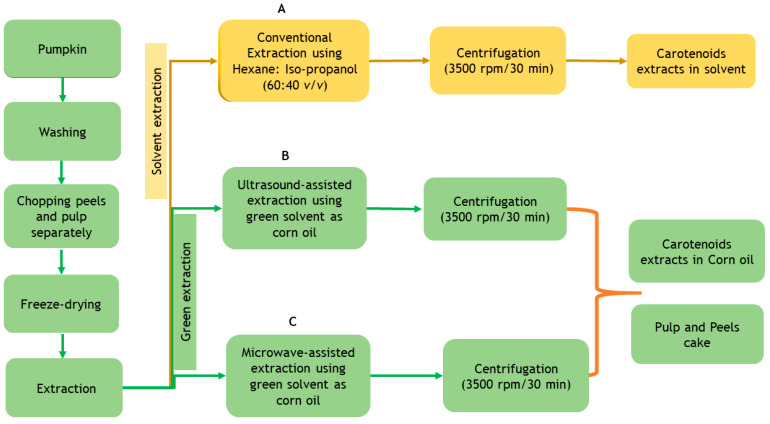
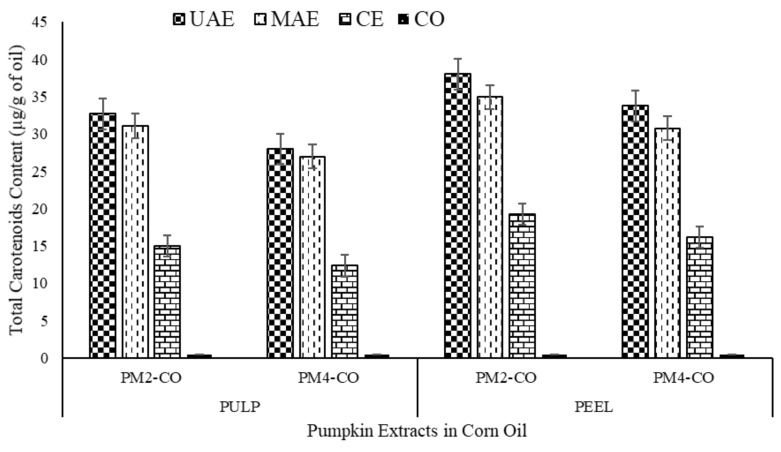
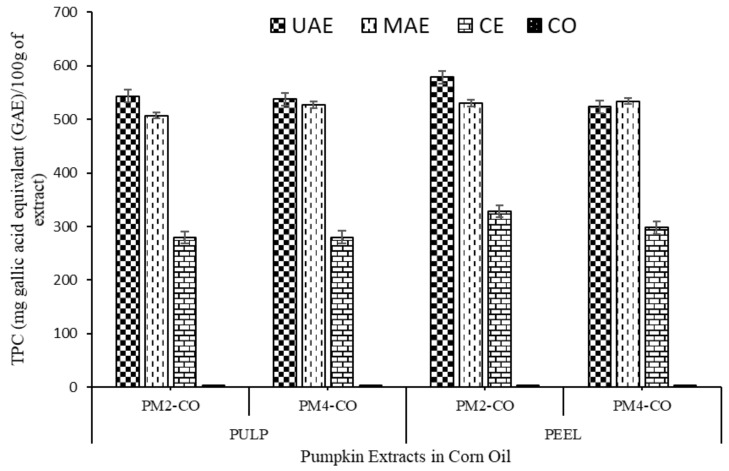
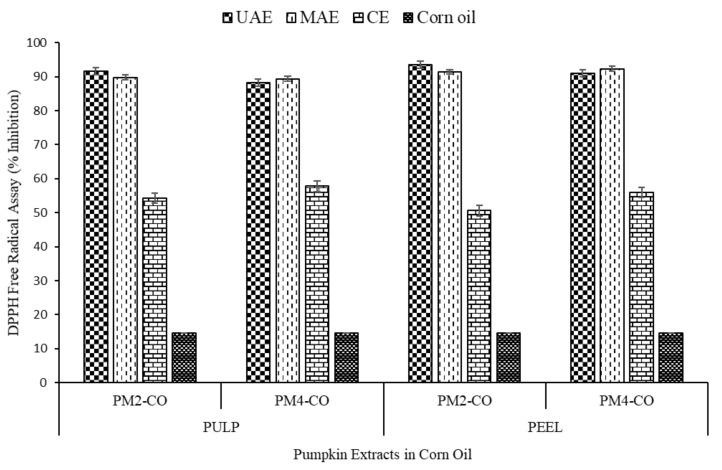
Natural pigments improve aesthetic value as well as antioxidant potential of a food product. This study was designed to determine the effects of green extraction techniques on carotenoids, polyphenols and antioxidant activities of pulp and peel of two varieties of pumpkin (Cucurbita maxima). Innovative green extractions (IGE; Ultrasound and Microwave-Assisted Extractions) synergised with corn oil (used as green solvent) were compared with conventional extraction (CE; hexane/isopropyl alcohol; 60:40, v/v). Results showed total carotenoids to be almost double on employing IGE (PM2-UAE-peel = 38.03 ± 4.21; PM4-UAE-peel = 33.78 ± 1.76 µg/g) when compared to conventional extraction (PM2-CE-peel = 19.21 ± 4.39; PM4-CE-peel = 16.21 ± 2.52 µg/g). Polyphenolic contents ranged between 510.69 ± 5.50 and 588.68 ± 7.26 mg GAE/100 g of extract in IGE, compared with conventional extracts (269.50 ± 2.17 to 318.46 ± 6.60 mg GAE/100 g) and percent inhibition of 2,2-Diphenyl-1-picrylhydrazyl (DPPH) ranging between 88.32 ± 1.51 and 93.53 ± 0.30% in IGE when compared with conventional extraction (50.61 ± 1.44 to 57.79 ± 2.09%). Further, oxidative stability of carotenoids extracts from IGE (protection factor = 1.59 ± 0.01 to 1.81 ± 0.05) were found to be significantly higher (p < 0.05) than conventional extracts. Based on results, this study supports the use of innovative green extraction techniques to obtain bioactive pigments like carotenoids. It is anticipated that results generated will find potential applications in food, pharmaceutical and cosmetic industries.
Overview
The claims and statistics of this paper haven’t been checked yet.
Free: it reads the open-access text and checks the first 5 claims that cite a source we can check. Create a free account to check every claim.
Integrity signals
Registry
Cites
Statistics
Figures
Verification
Claims the paper makes
The claims and statistics of this paper haven’t been checked yet.
Free: it reads the open-access text and checks the first 5 claims that cite a source we can check. Create a free account to check every claim.
Claims other papers make about this one
Each is checked against this paper’s own text: does it say what the citing paper says it does?
The source backs part of the claim, not all of it — or backs it for a different population, condition or comparison.
In the citing paper
“The carotenoid concentration in the samples obtained by UAE was higher compared to the samples obtained through MAE and CE using organic solvents (hexane and isopropyl alcohol).”
From Pumpkin and Pumpkin By-Products: A Comprehensive Overview of Phytochemicals, Extraction, Health Benefits, and Food Applications (2024) · cites this paper as [97]
Experimental — accuracy not yet measuredThe source backs part of the claim, not all of it — or backs it for a different population, condition or comparison.
In the citing paper
“In comparison to traditional extraction (19.21 ± 4.39; 16.21 ± 2.52 µg/g), the results showed that total carotenoids were almost two times higher when using ultrasound (38.03 ± 4.21; 33.78 ± 1.76 µg/g).”
From Pumpkin and Pumpkin By-Products: A Comprehensive Overview of Phytochemicals, Extraction, Health Benefits, and Food Applications (2024) · cites this paper as [97]
Experimental — accuracy not yet measuredThe cited source says what the claim attributes to it.
In the citing paper
“Additionally, it was discovered that the amount of carotenoids varied based on the plant portion, with the peel powder having a higher amount than the pulp powder.”
From Pumpkin and Pumpkin By-Products: A Comprehensive Overview of Phytochemicals, Extraction, Health Benefits, and Food Applications (2024) · cites this paper as [97]
Self-check
Percentages, sums and reported differences re-computed from the paper’s own numbers.
The self-check needs the paper’s full text.
Citations
Cites
Colorimetry of Total Phenolics with Phosphomolybdic-Phosphotungstic Acid Reagents
Singleton, V. L., & Rossi, J. A. (1965) · American Journal of Enology and Viticulture · doi:10.5344/ajev.1965.16.3.144 · Cited by 24,852 · cited 4×
“The method used for the extraction of total phenols (from oil samples) was based on the procedure given by Fuentes et al. [21] and the TPC of the pumpkin extracts was analysed by utilising the Folin-Ciocalteu reagent method suggested by Singleton and Rossi [22].”
MethodInfluentialDudonné, S., Vitrac, X., Coutière, P., Woillez, M., & Mérillon, J.-M. (2009) · Journal of Agricultural and Food Chemistry · doi:10.1021/jf803011r · Cited by 1,849 · cited 1×
“[23] after little modifications using gallic acid as standard.”
MethodPotential Role of Carotenoids as Antioxidants in Human Health and Disease
Fiedor, J., & Burda, K. (2014) · Nutrients · doi:10.3390/nu6020466 · Cited by 1,420 · cited 1×
“A plethora of epidemiological studies reported that high intake of carotenoids in diet are related with lower risks of chronic diseases such as cardio-vascular diseases (CVDs), cancer, neurological disorder or eye-related diseases [10].”
BackgroundGreen extraction of natural products. Origins, current status, and future challenges
Chemat, F., Abert-Vian, M., Fabiano-Tixier, A. S., Strube, J., Uhlenbrock, L., Gunjevic, V., & Cravotto, G. (2019) · TrAC Trends in Analytical Chemistry · doi:10.1016/j.trac.2019.05.037 · Cited by 644 · cited 1×
“In the 21st century, researchers are more concerned about consumers’ health and environment, and in the meantime are aiming towards enhancing competition of academia and industries to make them more ecologic, economic and innovative [13].”
BackgroundNatural Colorants: Food Colorants from Natural Sources
Sigurdson, G. T., Tang, P., & Giusti, M. M. (2017) · Annual Review of Food Science and Technology · doi:10.1146/annurev-food-030216-025923 · Cited by 635 · cited 1×
“Consumers’ demand for use of natural pigments with potential health benefits, coupled with consumer’s consciousness to acquire safe food, has rendered efforts to swap on the use of synthetic pigments with naturally derived bioactive pigments from plant sources [4].”
BackgroundNatural food additives: Quo vadis?
Carocho, M., Morales, P., & Ferreira, I. C. F. R. (2015) · Trends in Food Science & Technology · doi:10.1016/j.tifs.2015.06.007 · Cited by 585 · cited 1×
“Majority of the petroleum based or synthetic pigments are reported for their ill-effects on human health, which can directly induce hyperactivity and allergenicity in children and other sensitive people [1,2].”
BackgroundGreen ultrasound-assisted extraction of carotenoids from pomegranate wastes using vegetable oils
Goula, A. M., Ververi, M., Adamopoulou, A., & Kaderides, K. (2017) · Ultrasonics Sonochemistry · doi:10.1016/j.ultsonch.2016.07.022 · Cited by 362
de Carvalho, L. M. J., Gomes, P. B., Godoy, R. L. D. O., Pacheco, S., do Monte, P. H. F., de Carvalho, J. L. V., Nutti, M. R., Neves, A. C. L., Vieira, A. C. R. A., & Ramos, S. R. R. (2012) · Food Research International · doi:10.1016/j.foodres.2011.07.040 · Cited by 313 · cited 1×
“[33], who observed the TCC of landrace variety of pumpkin sample “A” to be 404.”
BackgroundValorization of fruits and vegetable wastes and by-products to produce natural pigments
Sharma, M., Usmani, Z., Gupta, V. K., & Bhat, R. (2021) · Critical Reviews in Biotechnology · doi:10.1080/07388551.2021.1873240 · Cited by 275 · cited 2×
“Modern day health-conscious consumers are demanding for the plant derived natural pigments, especially in food applications, which has led researches to exploit the vegetal wastes to isolate bioactive natural pigments [3].”
BackgroundSelf-citationLi, Y., Fabiano-Tixier, A. S., Tomao, V., Cravotto, G., & Chemat, F. (2013) · Ultrasonics Sonochemistry · doi:10.1016/j.ultsonch.2012.07.005 · Cited by 259
Research works printed but not linked: 2
- Azizah A.H. Wee K.C. Azizah O. Azizah M. Effect of boiling and stir frying on total phenolics, carotenoids and radical scavenging activity of pumpkin (Cucurbita moschata) Int. Food Res. J. 2009 16 45 51
- Mala K.S. Kurian A.E. Nutritional composition and antioxidant activity of pumpkin wastes Int. J. Pharm. Chem. Biol. Sci. 2016 6 336 344
Cited by
Exploring the potential of antioxidants from fruits and vegetables and strategies for their recovery
Arias, A., Feijoo, G., & Moreira, M. T. (2022) · Innovative Food Science & Emerging Technologies · doi:10.1016/j.ifset.2022.102974 · Cited by 215
Quercetin for managing type 2 diabetes and its complications, an insight into multitarget therapy
Dhanya, R. (2022) · Biomedicine & Pharmacotherapy · doi:10.1016/j.biopha.2021.112560 · Cited by 179
Ultrasound-Assisted Extraction of Natural Pigments From Food Processing By-Products: A Review
Linares, G., & Rojas, M. L. (2022) · Frontiers in Nutrition · doi:10.3389/fnut.2022.891462 · Cited by 164
Hussain, A., Kausar, T., Sehar, S., Sarwar, A., Ashraf, A. H., Jamil, M. A., Noreen, S., Rafique, A., Iftikhar, K., Quddoos, M. Y., et al. (2022) · Food Chemistry Advances · doi:10.1016/j.focha.2022.100067 · Cited by 200
Nonglait, D. L., & Gokhale, J. S. (2023) · Food and Bioprocess Technology · doi:10.1007/s11947-023-03192-0 · Cited by 132
“Likewise, corn oil was also used as a green solvent in MAE of carotenoids from pumpkin peel and pulp (Sharma & Bhat, 2021).”
Sharma, M., Hussain, S., Jarg, T., Aav, R., & Bhat, R. (2021) · Industrial Crops and Products · doi:10.1016/j.indcrop.2021.114257 · Cited by 122
Self-citationCarotenoid Content and Profiles of Pumpkin Products and By-Products
Grassino, A. N., Brnčić, S. R., Sabolović, M. B., Žlabur, J. Š., Marović, R., & Brnčić, M. (2023) · Molecules · doi:10.3390/molecules28020858 · Cited by 133
“Sharma and Bhat [37] used corn oil as a green solvent and three different extraction techniques (ultrasound-assisted extraction, microwave-assisted extraction and conventional extraction) for carotenoid extraction from the pulp and peel of two pumpkin (C. maxima) cultivars.”
BackgroundUmair, M., Jabbar, S., Nasiru, M. M., Lu, Z., Zhang, J., Abid, M., Murtaza, M. A., Kieliszek, M., & Zhao, L. (2021) · Molecules · doi:10.3390/molecules26226763 · Cited by 109
“, flavonoids [15–17], carotenoids [18], polysaccharides [19], proteins [20] and lipids [21].”
BackgroundSupercritical fluid extraction of bioactives from fruit waste and its therapeutic potential
Ray, A., Dubey, K. K., Marathe, S. J., & Singhal, R. S. (2023) · Food Bioscience · doi:10.1016/j.fbio.2023.102418 · Cited by 113
Gavril (Rațu), R. N., Stoica, F., Lipșa, F. D., Constantin, O. E., Stănciuc, N., Aprodu, I., & Râpeanu, G. (2024) · Foods · doi:10.3390/foods13172694 · Cited by 97
“The authors explained that this is caused by the decrease in solvent polarity that occurs in subcritical conditions, which encourages the solubilization of a variety of phenolic compounds.”
BackgroundHussain, A., Kausar, T., Sehar, S., Sarwar, A., Ashraf, A. H., Jamil, M. A., Noreen, S., Rafique, A., Iftikhar, K., Aslam, J., et al. (2022) · Applied Food Research · doi:10.1016/j.afres.2022.100241 · Cited by 106
Green Solvents: Emerging Alternatives for Carotenoid Extraction from Fruit and Vegetable By-Products
Viñas-Ospino, A., López-Malo, D., Esteve, M. J., Frígola, A., & Blesa, J. (2023) · Foods · doi:10.3390/foods12040863 · Cited by 96
“Sharma and Bhat [45] compared the extraction of carotenoids in pumpkin peels using corn oil with that using hexane/isopropyl alcohol as a traditional solvent.”
BackgroundMethodInfluentialViñas-Ospino, A., Panić, M., Redovniković, I. R., Blesa, J., & Esteve, M. J. (2023) · Food Bioscience · doi:10.1016/j.fbio.2023.102570 · Cited by 94
Bhat, I. U. H., & Bhat, R. (2021) · Biology · doi:10.3390/biology10070586 · Cited by 98
Self-citationDas, P., Nayak, P. K., & Kesavan, R. K. (2022) · Food Chemistry Advances · doi:10.1016/j.focha.2022.100144 · Cited by 80
Cassani, L., Marcovich, N. E., & Gómez‐Zavaglia, A. (2021) · Food Research International · doi:10.1016/j.foodres.2021.110924 · Cited by 75
Application of ultrasound technology for the effective management of waste from fruit and vegetable
Nabi, B. G., Mukhtar, K., Ansar, S., Hassan, S. A., Hafeez, M. A., Bhat, Z. F., Khaneghah, A. M., Haq, A. U., & Aadil, R. M. (2023) · Ultrasonics Sonochemistry · doi:10.1016/j.ultsonch.2023.106744 · Cited by 66
“The DDPH inhibition percentage in US and MW-treated samples was 92.49 ± 1.84 and 94.16 ± 1.06 %, respectively, while in the conventional method was 58.57 ± 2.34 % [146].”
MethodInfluentialKumar, G., Upadhyay, S., Yadav, D. K., Malakar, S., Dhurve, P., & Suri, S. (2022) · Journal of Food Process Engineering · doi:10.1111/jfpe.14238 · Cited by 59
Pereira, J. A. M., Berenguer, C. V., Andrade, C. F. P., & Câmara, J. S. (2022) · Applied Sciences · doi:10.3390/app12052747 · Cited by 63
“Pumpkin flesh: dietary fiber, carotenoids, phenolic acids, flavonols, minerals, vitamins − peel and rind: dietary fiber (pectins), carotenoids, phenolic acids, flavonols, minerals, vitamins − edible after cooking − natural food additive − softened before ingestion (cooking) − washed to eliminate pesticides and other c…”
BackgroundSharma, M., Sridhar, K., Gupta, V. K., & Dikkala, P. K. (2022) · Current Research in Green and Sustainable Chemistry · doi:10.1016/j.crgsc.2022.100340 · Cited by 48
Self-citationSarangi, P. K., Vivekanand, V., Mohanakrishna, G., Pattnaik, B., Muddapur, U. M., & Aminabhavi, T. M. (2023) · Journal of Cleaner Production · doi:10.1016/j.jclepro.2023.137460 · Cited by 48
Valisakkagari, H., Chaturvedi, C., & Rupasinghe, H. P. V. (2024) · Processes · doi:10.3390/pr12040742 · Cited by 49
Hussain, S., Sharma, M., & Bhat, R. (2021) · Foods · doi:10.3390/foods10061330 · Cited by 36
Self-citationShajan, A. E., Dash, K. K., Hamid, Bashir, O., & Shams, R. (2024) · Future Foods · doi:10.1016/j.fufo.2024.100312 · Cited by 39
Tzanova, M. T., Yaneva, Z. L., Ivanova, D., Toneva, M., Grozeva, N., & Memdueva, N. (2024) · Foods · doi:10.3390/foods13040605 · Cited by 50
Valorization of dragon fruit waste to value-added bioproducts and formulations: A review
Tripathi, M., Diwan, D., Shukla, A. C., Gaffey, J., Pathak, N., Dashora, K., Pandey, A., Sharma, M., Guleria, S., Varjani, S., et al. (2023) · Critical Reviews in Biotechnology · doi:10.1080/07388551.2023.2254930 · Cited by 62
“…for their diverse application in the food–energy–pharma–agri sectors by val-orizing different types of agri-food wastes, such as pumpkin peel waste [1], corn husk [2], coconut waste [3], hemp-based lignocellulosic biomass [4], seabuck-thorn pomace [5,6], pineapple waste [7,8], crustacean waste…”
Self-citationNatural pigments from food wastes: New approaches for the extraction and encapsulation
Cazón, P., & Sanches-Silva, A. T. (2024) · Current Opinion in Green and Sustainable Chemistry · doi:10.1016/j.cogsc.2024.100929 · Cited by 50
Kurek, M. A., Aktaş, H., Pokorski, P., Pogorzelska-Nowicka, E., & Custodio-Mendoza, J. A. (2025) · Applied Sciences · doi:10.3390/app15073506 · Cited by 32
da Silva, E. S., Nunes, A. O., & Hoskin, R. T. (2023) · Chemical Engineering and Processing - Process Intensification · doi:10.1016/j.cep.2023.109443 · Cited by 33
Matić, M., Stupar, A., Pezo, L. L., Ilić, N. Đ., Mišan, A. Č., Teslić, N., Pojić, M. M., & Mandić, A. (2024) · Food Chemistry X · doi:10.1016/j.fochx.2024.101290 · Cited by 27
“Besides being powerful antioxidants, these natural colorants can improve the aesthetic appeal of food products and at the same time replace the artificial coloring compounds in the food industry (Sharma & Bhat, 2021).”
BackgroundJoudi-Sarighayeh, F., Abbaspour‐Gilandeh, Y., Kaveh, M., Szymanek, M., & Kulig, R. (2023) · Foods · doi:10.3390/foods12051114 · Cited by 28
“Additionally, due to its bioactive properties, carotenoids, and vitamins, pumpkin has beneficial effects on human health, including: reducing the risk of neurological, heart, and cancer diseases [4], the prevention of osteoporosis [5], and high blood pressure [6].”
BackgroundPinna, N., Ianni, F., Selvaggini, R., Urbani, S., Codini, M., Grispoldi, L., Cenci-Goga, B. T., Cossignani, L., & Blasi, F. (2023) · Foods · doi:10.3390/foods12214035 · Cited by 26
“The TCC values of extracts from two varieties of C. maxima ranged from 16.21 µ g/g of oil extracts of a conventional extraction method to 34.94 µ g/g of oil extract of MAE, up to 38.03 µ g/g of oil extract for UAE using corn oil [11].”
BackgroundMethodInfluentialResearch progress on extraction technology and biomedical function of natural sugar substitutes
Lei, P., Chen, H., Ma, J., Fang, Y., Qu, L., Yang, Q., Peng, B., Zhang, X., Jin, L., & Sun, D. (2022) · Frontiers in Nutrition · doi:10.3389/fnut.2022.952147 · Cited by 27
Gaweł‐Bęben, K., Czech, K., Strzępek-Gomółka, M., Czop, M., Szczepanik, M., Lichtarska, A. M., & Kukuła‐Koch, W. (2022) · Molecules · doi:10.3390/molecules27217618 · Cited by 24
“UAE was shown as the most efficient method [14].”
MethodSebdani, M. M., & Abbasi, H. (2023) · Microchemical Journal · doi:10.1016/j.microc.2023.109092 · Cited by 22
Rațu, R. N., Constantin, O. E., Enachi, E., Stoica, F., Lipșa, F. D., Stănciuc, N., Aprodu, I., & Râpeanu, G. (2024) · Plants · doi:10.3390/plants13111447 · Cited by 23
“Because carotenoids are strong antioxidants, they are frequently utilized as natural coloring agents in food applications such as butter, salad dressings, frozen desserts, roasted foods like popcorn, and various beverages [24,25].”
BackgroundBiobased materials as a sustainable potential for edible packaging
Trajkovska Petkoska, A., Daniloski, D., Kumar, N., Pratibha, & Broach, A. T. (2021) · Environmental Footprints and Eco-design of Products and Processes · doi:10.1007/978-981-16-4609-6_5 · Cited by 14
García-Ortíz, J. D., Ascacio‐Valdés, J. A., Nery‐Flores, S. D., Galindo, A. S., Flores‐Gallegos, A. C., & Rodríguez-Herrera, R. (2023) · Applied Food Research · doi:10.1016/j.afres.2023.100350 · Cited by 22
Plaza, M., & Marina, M. L. (2024) · Microchemical Journal · doi:10.1016/j.microc.2024.112421 · Cited by 22
Güngör, K. K., & Torun, M. (2022) · Waste and Biomass Valorization · doi:10.1007/s12649-022-01866-y · Cited by 22
“1 3 However, there are very few reports [25, 46, 47] on the potential of vegetable oil to extract carotenoid from pumpkin or pumpkin wastes.”
BackgroundDutta, D., Nayak, A., & Dutta, D. (2022) · Food and Bioprocess Technology · doi:10.1007/s11947-022-02888-z · Cited by 22
“…5.49 ppm 3.93 ppm Zucchini 1.16 ppm 0.64 ppm Squash 0.053 ppm 0.040 ppm Pumpkin peel (PM2) UAE with corn oil 38.03 µg/g Conventional (solvent) extraction 19.21 µg/g Sharma & Bhat, 2021 MAE with corn oil 34.94 µg/g Pumpkin peel (PM4) UAE with corn oil 33.78 µg/g 16.21 µg/g MAE with corn oil…”
InfluentialExtraction and Emulsification of Carotenoids from Carrot Pomaces Using Oleic Acid
Vo, T. P., Tran, H. K. L., Ta, T. M. N., Nguyen, H. T. V., Phan, T. H., Nguyen, T. H. P., Nguyen, V. K., Dang, T. C. T., Nguyen, L. G. K., Chung, T. Q., et al. (2023) · ACS Omega · doi:10.1021/acsomega.3c05301 · Cited by 18
Yu, X., Wang, H., Xiang, X., Fu, J., Wang, X., Zhou, Y., & Wang, X. (2024) · Current Issues in Molecular Biology · doi:10.3390/cimb46090633 · Cited by 21
“Furthermore, the use of corn oil as a green solvent for ultrasound-assisted extraction, in regard to antioxidants with color development results showed UAE > Microwave-Assisted Extraction, MAE > CE compared to MAE and conventional extraction, where UAE had higher TCC, DPPH, and TPC values [38].”
ResultPinna, N., Ianni, F., Blasi, F., Stefani, A., Codini, M., Sabatini, S., Schoubben, A., & Cossignani, L. (2022) · Molecules · doi:10.3390/molecules27238240 · Cited by 18
“The extraction procedure was carried out following the conditions of previous papers [16,17] with slight modifications.”
BackgroundMethodResultInfluentialPumpkin Pomace Powder as a Bioactive Powder Ingredient for Whey Cheese Production
Lipșa, F. D., Ulea, E., Gafencu, A.-M., Florea, A.-M., Rațu, R. N., Stoica, F., Motrescu, I., & Râpeanu, G. (2024) · Applied Sciences · doi:10.3390/app14219624 · Cited by 16
“Sharma and Bhat [26] established DPPH (1,1-diphenyl-2-picrylhydrazyl) % inhibition values ranging from 55.95% to 93.53% for two pumpkin varieties of the C. maxima species using an ultrasound assisted-extraction method.”
InfluentialEffect of betanin synthesis on photosynthesis and tyrosine metabolism in transgenic carrot
Wang, B., Wang, Y.-H., Deng, Y., Yao, Q., & Xiong, A. (2023) · BMC Plant Biology · doi:10.1186/s12870-023-04383-9 · Cited by 14
Sharma, S., Dedha, A., Gupta, M. M., Singh, N., Gautam, A., & Kumari, A. (2024) · Preparative Biochemistry & Biotechnology · doi:10.1080/10826068.2024.2402905 · Cited by 17
Karlović, S., Dujmić, F., Brnčić, S. R., Sabolović, M. B., Grassino, A. N., Škegro, M., Šimić, M. A., & Brnčić, M. (2023) · Processes · doi:10.3390/pr11020469 · Cited by 14
“Thus, pumpkin has beneficial effects on human health [8], reduces the risk of neurodegenerative, cardiovascular, and cancer diseases [10] and prevents osteoporosis and hypertension [11,12].”
BackgroundHosen, M., Rafii, M. Y., Mazlan, N., Jusoh, M., Chowdhury, M. F. N., Oladosu, Y. A., Ridzuan, R., Karim, K. M. R., Halidu, J., & Ikbal, M. F. (2022) · Horticulturae · doi:10.3390/horticulturae8100863 · Cited by 12
Ishikiriyama, N. M. D. F., da Silveira, I. P., Silva, J. V., de Freitas, B. P., Kunigami, C. N., Jung, E. P., & Ribeiro, L. D. O. (2024) · Resources · doi:10.3390/resources13020020 · Cited by 11
Insights into potential value and sustainable utilisation of pumpkin peel: A review
Zhang, G., & Liu, L. (2025) · Future Foods · doi:10.1016/j.fufo.2025.100575 · Cited by 12
Deotale, S. M., Reddy, N. B. P., Vivek, K., Rajam, R., Gururaj, P. N., & Thivya, P. (2025) · Food and Humanity · doi:10.1016/j.foohum.2025.100651 · Cited by 12
Pan-utai, W., Phomkaivon, N., & Settachaimongkon, S. (2025) · Foods · doi:10.3390/foods14213637 · Cited by 12
Extraction and Application of Pumpkin Peel Colorants for Natural Textile Dyeing
Che, J., Teng, X., & Ji, J. (2023) · AATCC Journal of Research · doi:10.1177/24723444221147980 · Cited by 10
“Innovative green extractions (ultrasound and microwave-assisted extractions) synergized with corn oil were compared with conventional extraction.(8) The results proved to be advantageous in terms of improving extraction efficiency; reducing extraction cost, time, and energy; and enhancing the yield.”
BackgroundMethodAlsobh, A., Zin, M. M., Marđokić, A., Vatai, G. N., & Bánvölgyi, S. (2024) · Progress in Agricultural Engineering Sciences · doi:10.1556/446.2024.00103 · Cited by 12
Bio-Based Formulations for Sustainable Applications in Agri-Food-Pharma
Sharma, M., Bhat, R., Usmani, Z., McClements, D. J., Shukla, P., Raghavendra, V. B., & Gupta, V. K. (2021) · Biomolecules · doi:10.3390/biom11050768 · Cited by 10
“these compounds obtained from natural resources is a vital criterion that needs to be considered [2].”
BackgroundSelf-citationInnovative approaches to transform pumpkin peel-based biowaste into value-added products
Tran, G. T., & Nguyen, D. T. C. (2024) · Biomass Conversion and Biorefinery · doi:10.1007/s13399-024-06302-w · Cited by 10
“Sharma et al. observed a nearly double increase in the total carotenoids extracted from pumpkin wastes (peel and pulp) using innovative green extractions (UAE and MAE) compared with conventional extraction using hexane and isopropyl alcohol [26].”
Hussain, S., Sharma, M., Jarg, T., Aav, R., & Bhat, R. (2023) · Current Research in Food Science · doi:10.1016/j.crfs.2023.100629 · Cited by 14
Self-citationValisakkagari, H., & Rupasinghe, H. P. V. (2025) · Nutraceuticals · doi:10.3390/nutraceuticals5010002 · Cited by 9
Golshany, H., Ni, Y., Yu, Q., & Fan, L. (2025) · Food Reviews International · doi:10.1080/87559129.2025.2466446 · Cited by 8
“[105,106] When optimized, UAE can effectively extract carotenoids under specific conditions, with parameters such as temperature, sonication time, and solvent ratio playing crucial roles in the extraction efficiency.”
Ziemlewska, A., Nizioł‐Łukaszewska, Z., Zagórska-Dziok, M., Mokrzyńska, A., Krupski, W., Wójciak, M., & Sowa, I. (2025) · Molecules · doi:10.3390/molecules30204082 · Cited by 10
“This condition disrupts collagen metabolism, promotes lipid peroxidation, and stimulates the release of pro-inflammatory cytokines, ultimately leading to deterioration of the skin structure and acceleration of the aging process [1,6–9].”
Mpalanzi, V. T., Zhang, M., Sundarsingh, A., MUJUMDAR, A. S., & Li, R. (2025) · Critical Reviews in Food Science and Nutrition · doi:10.1080/10408398.2025.2604196 · Cited by 12
“…corn oil has been applied as a green solvent and found to be effective in the recovery of carotenoids from pumpkin peel and pulp through MAE (Sharma and Bhat 2021), while combining MAE and UAE with natural oils such as corn and olive oil enhanced carotenoid recovery from sea buck-thorn…”
Lauria, V. B. M., & Silva, L. P. (2024) · Foods · doi:10.3390/foods13060962 · Cited by 12
“In the study conducted by Sharma and Bhat [26], ultrasound-assisted and microwave-assisted extractions were performed to obtain carotenoids.”
MethodGREEN extraction of antioxidant carotenoids from fresh ORANGE PEEL USING CO₂-expanded ethanol
Plaza, M., & Marina, M. L. (2026) · Separation and Purification Technology · doi:10.1016/j.seppur.2026.136808 · Cited by 9
Golubkina, N., Skrypnik, L. N., Logvinenko, L. A., Zayachkovsky, V., Smirnova, A. M., Кривенков, Л. В., Романов, В. С., Kharchenko, V. A., Poluboyarinov, P. A., Sękara, A., et al. (2023) · Diversity · doi:10.3390/d15010123 · Cited by 8
Pinna, N., Ianni, F., Conte, C., Codini, M., di Vito, R., Urbani, S., Selvaggini, R., Cossignani, L., & Blasi, F. (2024) · Nutrients · doi:10.3390/nu16173043 · Cited by 6
“Furthermore, as there is a growing interest in extracting novel bioactives from foods and agri-food waste by applying innovative procedures (i.e., ultrasound-and microwave-assisted extraction -UAE and MAE-), pumpkin and its waste are valuable for their carotenoids [4,5].”
BackgroundKrishnakripa, P., & Thoppil, J. E. (2025) · Vegetos · doi:10.1007/s42535-025-01166-5 · Cited by 7
Bousselma, A., Abdessemed, D., Tahraoui, H., Zedame, F., & Amrane, A. (2023) · Kemija u industriji · doi:10.15255/kui.2022.045 · Cited by 6
Development of Value-Added Chicken Burgers by Adding Pumpkin Peel Powder as a Sustainable Ingredient
Pinna, N., Ianni, F., Codini, M., Cenci-Goga, B. T., Misuraca, M., Costanzi, E., Cossignani, L., & Blasi, F. (2025) · Antioxidants · doi:10.3390/antiox14060648 · Cited by 5
“A wide range of values of color parameters has been reported for pumpkin peel [20,26].”
Santiago, B., Sillero, L., Moreira, M. T., Feijóo, G., & González‐García, S. (2023) · Royal Society of Chemistry eBooks · doi:10.1039/bk9781837670093-00001 · Cited by 5
Ge, H., Yang, L., Yao, Q., Gu, Y., Zhang, C., Liu, X., Huang, F., & Zhang, Y. (2025) · ACS Food Science & Technology · doi:10.1021/acsfoodscitech.4c00964 · Cited by 6
Stinco, C. M., Benítez-González, A. M., Escudero-Gilete, M. L., & Vicario, I. M. (2025) · Sustainable Chemistry and Pharmacy · doi:10.1016/j.scp.2025.102085 · Cited by 4
Slamet, A., Kanetro, B., & Purwaningsih, H. (2026) · Food Research · doi:10.26656/fr.2017.10(1).047 · Cited by 4
Alsulami, R. S., Babiker, E. E., Ahmed, I. A. M., Alsulami, T. S., & Al‐Juhaimi, F. Y. (2025) · LWT · doi:10.1016/j.lwt.2025.118655 · Cited by 3
Therapeutic Effects of Carotenoids: Trends and Advances
Martins, I. R., Bezerra, F. W. F., Silva, J. D. M. E., de Oliveira, J. A. R., & Martins, L. H. D. S. (2024) · Springer eBooks · doi:10.1007/978-3-031-75322-0_11 · Cited by 3
Garg, M., Yadav, R., Chopra, R., Pani, B., & Sablania, V. (2023) · Journal of Food Science and Technology · doi:10.1007/s13197-023-05749-5 · Cited by 3
“Significant change in taste and flavor of the baked balls with increasing pumpkin peel powder could be due to the higher percentage of phenolic content in peels (Sharma and Bhat 2021).”
BackgroundDas, J. N., Basak, S., Sablania, V., Negi, R., Yadav, N., Rustagi, S., Singh, S., Kumar, A., Shreaz, S., & Yadav, A. N. (2024) · Journal of Applied Biology & Biotechnology · doi:10.7324/jabb.2024.162743 · Cited by 4
“The total carotenoid content was determined by spectrophotometer at 470 nm [126].”
MethodTurcov, D., Paraschiv, M., Blaga, A. C., Tucaliuc, A., Caşcaval, D., & Galaction, A. (2025) · Biomolecules · doi:10.3390/biom15101371 · Cited by 2
“For example, corn oil has been successfully used in ultrasound-and microwave-assisted extraction of carotenoids, demonstrating the feasibility of edible oil-based systems as alternatives to toxic organic solvents [29].”
Jans, H. M., Wijerathna, M. C., Fernando, G. S. N., & Hafiz, M. S. (2025) · Foods · doi:10.3390/foods14223947 · Cited by 2
“Such behavior has been reported for oil-based extraction of carotenoids from carrot, pumpkin, and mango matrices, where a plateau occurs once solubilization equilibrium is reached [20,31].”
Voccia, D., Wachongkum, S., Suciu, N., Monaco, E., Trevisan, M., & Lamastra, L. (2026) · Applied Sciences · doi:10.3390/app16031299 · Cited by 2
Potentiality of Banana and Pumpkin Fruits Residues as a Cheap Source of Valuable Nutrients
Mahmud, M., Hossain, M., Shuvo, S., Reza, M., & Abedin, M. Z. (2022) · Journal of Environmental Science and Natural Resources · doi:10.3329/jesnr.v13i1-2.60695 · Cited by 2
“Whereas the value of 57.79±2.09% total antioxidant activity was obtained by Sharma and Bhat (2021) in pumpkin peel flour.”
BackgroundInfluentialValorisation of Fruit and Vegetable Waste
Tomer, V., Kumar, A., Chhikara, N., & Panghal, A. (2024) · Wiley eBooks · doi:10.1002/9781119803980.ch1 · Cited by 2
Extraction, characterization, and isolation of natural colorants and pigments
Kaur, N., & Kaur, G. (2024) · Elsevier eBooks · doi:10.1016/b978-0-443-13842-3.00009-5 · Cited by 2
Sharma, M., Sharma, M., Dikkala, P. K., Sridhar, K., Usmani, Z., Moreau, B., Gupta, V. K., Singh, N. P., & Jahnavi, K. V. S. (2023) · Elsevier eBooks · doi:10.1016/b978-0-12-822887-6.00010-3 · Cited by 2
Self-citationA Review: Microwave Assisted Extraction
Trilokchandran, B. (2024) · INTERANTIONAL JOURNAL OF SCIENTIFIC RESEARCH IN ENGINEERING AND MANAGEMENT · doi:10.55041/ijsrem28772 · Cited by 2
Phytochemicals from Pumpkin (Cucurbita maxima) By-Products
Pellicorio, V., Barberis, M., Colombo, R., Milanese, C., & Papetti, A. (2025) · Springer eBooks · doi:10.1007/978-3-031-77399-0_11 · Cited by 3
Therapeutic Role of Natural Pigments in Functional Food Applications
Dikkala, P. K., Ibrahim, M. N. G., Sridhar, K., Gupta, V. K., & Sharma, M. (2025) · Royal Society of Chemistry eBooks · doi:10.1039/9781837673292-00293 · Cited by 1
Self-citationSilva, J. F., Guedes, C. T., Alves, E. S., dos Santos, S. S., Madrona, G. S., Rossoni, D. F., & Scapim, M. R. D. S. (2025) · Ciência e Agrotecnologia · doi:10.1590/1413-7054202549006825 · Cited by 1
Tawil, S., Roschat, W., Phewphong, S., Srisai, A., Yathongchai, W., Hanchai, P., Wiangpati, R., Pongcomsing, B., & Leelatam, T. (2025) · ASEAN Journal of Scientific and Technological Reports · doi:10.55164/ajstr.v28i6.260061 · Cited by 1
“Overall, the extraction efficiency depends on the solvent properties, particularly viscosity, which affects the dissolution of bioactive compounds and the cavitation process in UAE [7, 17].”
Lutein: Extraction, Therapeutic Value, Stability and Food Value Addition
Sharma, S., & Siddiqui, S. (2025) · World sustainability series · doi:10.1007/978-3-031-98200-2_22 · Cited by 2
Overview of Recent Trends on Non-conventional Approaches to Extract Carotenoids
Salazar, M. D. L. A. R., Silva, J. V. M., Ferreira, R. S. B., & Chisté, R. C. (2024) · Springer eBooks · doi:10.1007/978-3-031-75322-0_5 · Cited by 1
Pumpkin By-products: Exploring Creative By-product Uses
Hussain, A., Siddique, F., Bakhtawar, F., ALI, M. Q., Asif, A., Zia, M., Gorsi, F. I., Bilal, M. S., Raza, M. S., & Ain, H. B. U. (2026) · Springer eBooks · doi:10.1007/978-3-032-03503-5_7 · Cited by 2
Gomes, C. M., Alves, L. R. P., da Silva, W. G., & Martins, G. A. D. S. (2026) · Food Hydrocolloids · doi:10.1016/j.foodhyd.2026.113011 · Cited by 1
ULTRASONIC EXTRACTION OF PIGMENTS FROM VEGETABLE RAW MATERIALS. REVIEW
Pogorelov, A. G., Ipatova, L., Погорелова, В. Н., Panait, A. I., Stankevich, A. A., & Suvorov, O. A. (2025) · chemistry of plant raw material · doi:10.14258/jcprm.20250114798 · Cited by 1
Bhat, R. (2023) · Current Nutrition & Food Science · doi:10.2174/157340131904230117121732
Self-citationEffectiveness of various organic peels in facial rejuvenation and treatment of sensitive skin
Dogiparthi, S. N., Mohan, S., Bala, A., & Jenson, J. J. (2023) · Journal of Medical and Scientific Research · doi:10.17727/jmsr.2023/11-57
Adouane, M., Kadri, N., Benzitoune, N., Abbou, A., Kerdouche, K., Berkani, F., Adel, K., Mameri, A., Remini, H., Dahmoune, F., et al. (2024) · Current Bioactive Compounds · doi:10.2174/0115734072308822240529101221
PIGMENTOS NATURALES EN LAPRODUCCIÓN AVÍCOLA
Jácome-Gómez, J. R., Chicaiza, M. D. L. C., Valencia-Enríquez, X., Espinoza-Zambrano, J., & Rosado, V. M. (2024) · doi:10.70171/487rr081
Green Synthesis of Bio-additives for Food Processing
Bhattu, M., Soni, H., Acevedo, R., Verma, M., Singh, J., & Mubarak, N. M. (2024) · Springer eBooks · doi:10.1007/978-3-031-71131-2_2
Metadata
- Authors
- Sharma, M., & Bhat, R.
- Affiliations
- Estonian University of Life Sciences (EE)
- Corresponding author
- Sharma, Minaxi
- Venue
- Foods
- Publisher
- MDPI AG
- Published
- 2021-04-06
- Volume
- 10
- Issue
- 4
- Pages
- 787
- ISSN
- 2304-8158 (ISSN-L)
- PMC
- PMC8067522
- OpenAlex
- W3139628361
- Semantic Scholar
- 19e9316930b96e18eb24c5df4cfe787335e05f4f
- Cited by
- 108
- References
- 41
- Citations by year
- 2026: 12 · 2025: 21 · 2024: 25 · 2023: 26 · 2022: 16 · 2021: 8
- FWCI
- 10.21
- Type
- journal article
- Language
- en
- Open access
- gold
- doi.org
- Licence
- Locations
- Foods (publishedVersion, cc-by)
- PubMed Central (publishedVersion, cc-by)
- PubMed (publishedVersion)
- DOAJ (DOAJ: Directory of Open Access Journals) (submittedVersion, cc-by-sa)
- EMU DSpace (submittedVersion, cc-by)
- Funders
- This work is supported by VALORTECH project, which has received funding from the European Union’s Horizon 2020 research and innovation program (grant agreement No 810630.)
- Topics
- Health Sciences › Medicine › Biochemistry (medical) › Phytochemicals and Antioxidant Activities
- Life Sciences › Agricultural and Biological Sciences › Food Science › Agricultural and Biological Research
- Physical Sciences › Chemistry › Organic Chemistry › Edible Oils Quality and Analysis
- Keywords
- carotenoids, pumpkin, Cucurbita maxima, pumpkin peel, pumpkin pulp, ultrasound-assisted extraction, microwave-assisted extraction, corn oil, green extraction, polyphenols, antioxidant activity, DPPH radical scavenging, natural pigments
About these checks
Registry, retraction, Cites and statistics results are computed, not judged, with one exception: a printed reference that no index lists is read once by a model before it counts as a citation error. Claims are extracted by a model and kept only when their quote appears verbatim in the text; each cited source is then checked, with a model’s help, for whether it says what the claim relies on. Those verdicts can be wrong — read the claim’s quote and the cited source before relying on one.
Statistics and arithmetic are recomputed, not judged.
Confidence bands are shown only for fields calibrated on our annotated test set. None is calibrated yet, so no band is shown.
What counts as a claim ›How we measure confidence ›How we check this ›
Are you an author, or do you see a problem with this page? Request a review
Data sources
Bibliographic data: Semantic Scholar, OpenAlex, Crossref.
Contains information from the Semantic Scholar Academic Graph Datasets, made available under the ODC Attribution License (ODC-BY 1.0).
Semantic Scholar’s data is described in: Kinney, R., et al. (2023). The Semantic Scholar Open Data Platform. arXiv:2301.10140.
