

Extraction of Carotenoids from Pumpkin Peel and Pulp: Comparison between Innovative Green Extraction Technologies (Ultrasonic and Microwave-Assisted Extractions Using Corn Oil)
Open accessThe DOI matches its Crossref record; 41 of the 41 references it cites were found in a registry or an index.
Abstract
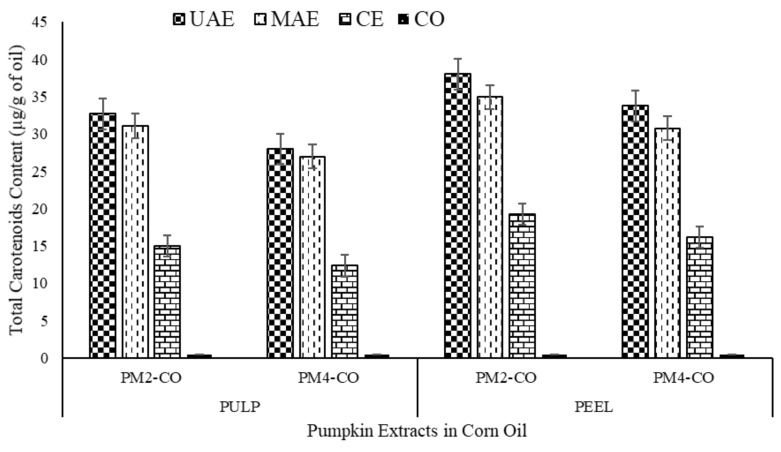
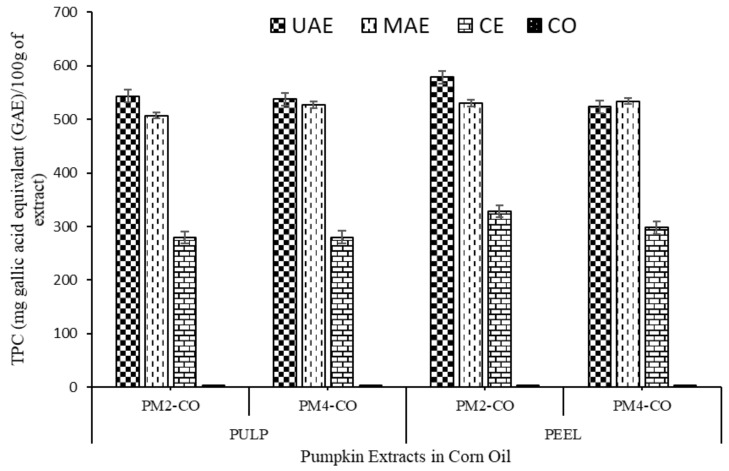
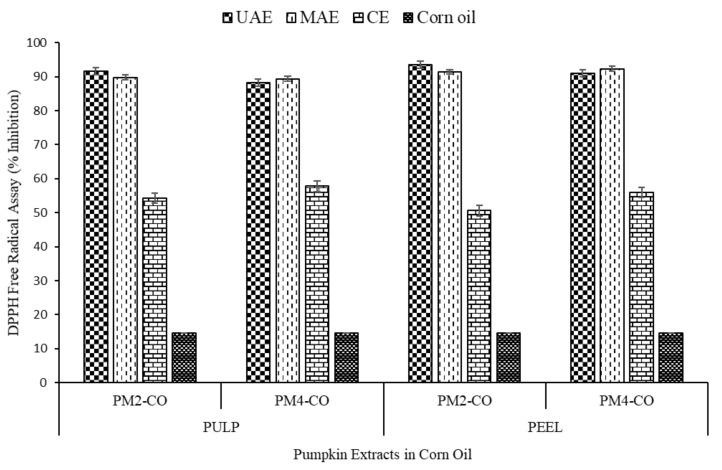
Natural pigments improve aesthetic value as well as antioxidant potential of a food product. This study was designed to determine the effects of green extraction techniques on carotenoids, polyphenols and antioxidant activities of pulp and peel of two varieties of pumpkin (Cucurbita maxima). Innovative green extractions (IGE; Ultrasound and Microwave-Assisted Extractions) synergised with corn oil (used as green solvent) were compared with conventional extraction (CE; hexane/isopropyl alcohol; 60:40, v/v). Results showed total carotenoids to be almost double on employing IGE (PM2-UAE-peel = 38.03 ± 4.21; PM4-UAE-peel = 33.78 ± 1.76 µg/g) when compared to conventional extraction (PM2-CE-peel = 19.21 ± 4.39; PM4-CE-peel = 16.21 ± 2.52 µg/g). Polyphenolic contents ranged between 510.69 ± 5.50 and 588.68 ± 7.26 mg GAE/100 g of extract in IGE, compared with conventional extracts (269.50 ± 2.17 to 318.46 ± 6.60 mg GAE/100 g) and percent inhibition of 2,2-Diphenyl-1-picrylhydrazyl (DPPH) ranging between 88.32 ± 1.51 and 93.53 ± 0.30% in IGE when compared with conventional extraction (50.61 ± 1.44 to 57.79 ± 2.09%). Further, oxidative stability of carotenoids extracts from IGE (protection factor = 1.59 ± 0.01 to 1.81 ± 0.05) were found to be significantly higher (p < 0.05) than conventional extracts. Based on results, this study supports the use of innovative green extraction techniques to obtain bioactive pigments like carotenoids. It is anticipated that results generated will find potential applications in food, pharmaceutical and cosmetic industries.
Overview
The claims and statistics of this paper haven’t been checked yet.
Free: it reads the open-access text and checks the first 5 claims that cite a source we can check. Create a free account to check every claim.
Integrity signals
Registry
Cites
Statistics
Figures
Verification
Claims the paper makes
The claims and statistics of this paper haven’t been checked yet.
Free: it reads the open-access text and checks the first 5 claims that cite a source we can check. Create a free account to check every claim.
Claims other papers make about this one
Each is checked against this paper’s own text: does it say what the citing paper says it does?
The source backs part of the claim, not all of it — or backs it for a different population, condition or comparison.
In the citing paper
“The carotenoid concentration in the samples obtained by UAE was higher compared to the samples obtained through MAE and CE using organic solvents (hexane and isopropyl alcohol).”
From Pumpkin and Pumpkin By-Products: A Comprehensive Overview of Phytochemicals, Extraction, Health Benefits, and Food Applications (2024) · cites this paper as [97]
Experimental — accuracy not yet measuredThe source backs part of the claim, not all of it — or backs it for a different population, condition or comparison.
In the citing paper
“In comparison to traditional extraction (19.21 ± 4.39; 16.21 ± 2.52 µg/g), the results showed that total carotenoids were almost two times higher when using ultrasound (38.03 ± 4.21; 33.78 ± 1.76 µg/g).”
From Pumpkin and Pumpkin By-Products: A Comprehensive Overview of Phytochemicals, Extraction, Health Benefits, and Food Applications (2024) · cites this paper as [97]
Experimental — accuracy not yet measuredThe cited source says what the claim attributes to it.
In the citing paper
“Additionally, it was discovered that the amount of carotenoids varied based on the plant portion, with the peel powder having a higher amount than the pulp powder.”
From Pumpkin and Pumpkin By-Products: A Comprehensive Overview of Phytochemicals, Extraction, Health Benefits, and Food Applications (2024) · cites this paper as [97]
Self-check
Percentages, sums and reported differences re-computed from the paper’s own numbers.
The self-check needs the paper’s full text.
Citations
Cites
Colorimetry of Total Phenolics with Phosphomolybdic-Phosphotungstic Acid Reagents
Singleton, V. L., & Rossi, J. A. (1965) · American Journal of Enology and Viticulture · doi:10.5344/ajev.1965.16.3.144 · Cited by 24,852 · cited 4×
“The method used for the extraction of total phenols (from oil samples) was based on the procedure given by Fuentes et al. [21] and the TPC of the pumpkin extracts was analysed by utilising the Folin-Ciocalteu reagent method suggested by Singleton and Rossi [22].”
MethodInfluentialDudonné, S., Vitrac, X., Coutière, P., Woillez, M., & Mérillon, J.-M. (2009) · Journal of Agricultural and Food Chemistry · doi:10.1021/jf803011r · Cited by 1,849 · cited 1×
“[23] after little modifications using gallic acid as standard.”
MethodPotential Role of Carotenoids as Antioxidants in Human Health and Disease
Fiedor, J., & Burda, K. (2014) · Nutrients · doi:10.3390/nu6020466 · Cited by 1,420 · cited 1×
“A plethora of epidemiological studies reported that high intake of carotenoids in diet are related with lower risks of chronic diseases such as cardio-vascular diseases (CVDs), cancer, neurological disorder or eye-related diseases [10].”
BackgroundGreen extraction of natural products. Origins, current status, and future challenges
Chemat, F., Abert-Vian, M., Fabiano-Tixier, A. S., Strube, J., Uhlenbrock, L., Gunjevic, V., & Cravotto, G. (2019) · TrAC Trends in Analytical Chemistry · doi:10.1016/j.trac.2019.05.037 · Cited by 644 · cited 1×
“In the 21st century, researchers are more concerned about consumers’ health and environment, and in the meantime are aiming towards enhancing competition of academia and industries to make them more ecologic, economic and innovative [13].”
BackgroundNatural Colorants: Food Colorants from Natural Sources
Sigurdson, G. T., Tang, P., & Giusti, M. M. (2017) · Annual Review of Food Science and Technology · doi:10.1146/annurev-food-030216-025923 · Cited by 635 · cited 1×
“Consumers’ demand for use of natural pigments with potential health benefits, coupled with consumer’s consciousness to acquire safe food, has rendered efforts to swap on the use of synthetic pigments with naturally derived bioactive pigments from plant sources [4].”
BackgroundNatural food additives: Quo vadis?
Carocho, M., Morales, P., & Ferreira, I. C. F. R. (2015) · Trends in Food Science & Technology · doi:10.1016/j.tifs.2015.06.007 · Cited by 585 · cited 1×
“Majority of the petroleum based or synthetic pigments are reported for their ill-effects on human health, which can directly induce hyperactivity and allergenicity in children and other sensitive people [1,2].”
BackgroundGreen ultrasound-assisted extraction of carotenoids from pomegranate wastes using vegetable oils
Goula, A. M., Ververi, M., Adamopoulou, A., & Kaderides, K. (2017) · Ultrasonics Sonochemistry · doi:10.1016/j.ultsonch.2016.07.022 · Cited by 362
de Carvalho, L. M. J., Gomes, P. B., Godoy, R. L. D. O., Pacheco, S., do Monte, P. H. F., de Carvalho, J. L. V., Nutti, M. R., Neves, A. C. L., Vieira, A. C. R. A., & Ramos, S. R. R. (2012) · Food Research International · doi:10.1016/j.foodres.2011.07.040 · Cited by 313 · cited 1×
“[33], who observed the TCC of landrace variety of pumpkin sample “A” to be 404.”
BackgroundValorization of fruits and vegetable wastes and by-products to produce natural pigments
Sharma, M., Usmani, Z., Gupta, V. K., & Bhat, R. (2021) · Critical Reviews in Biotechnology · doi:10.1080/07388551.2021.1873240 · Cited by 275 · cited 2×
“Modern day health-conscious consumers are demanding for the plant derived natural pigments, especially in food applications, which has led researches to exploit the vegetal wastes to isolate bioactive natural pigments [3].”
BackgroundSelf-citationLi, Y., Fabiano-Tixier, A. S., Tomao, V., Cravotto, G., & Chemat, F. (2013) · Ultrasonics Sonochemistry · doi:10.1016/j.ultsonch.2012.07.005 · Cited by 259
Research works printed but not linked: 2
- Azizah A.H. Wee K.C. Azizah O. Azizah M. Effect of boiling and stir frying on total phenolics, carotenoids and radical scavenging activity of pumpkin (Cucurbita moschata) Int. Food Res. J. 2009 16 45 51
- Mala K.S. Kurian A.E. Nutritional composition and antioxidant activity of pumpkin wastes Int. J. Pharm. Chem. Biol. Sci. 2016 6 336 344
Cited by
Items 101–115 of 115
Alsobh, A. (2024) · doi:10.54598/004740 · Cited by 1
Extraction and Quantification of Plant-Based Carotenoids
Gat, Y., Negi, B., Kotak, K., & Kadam, A. (2025) · Methods and protocols in food science · doi:10.1007/978-1-0716-4840-7_2
Silva, S. D. V. B. R. D. (2022) · Portuguese National Funding Agency for Science, Research and Technology (RCAAP Project by FCT) · doi:10.34626/h20p-p017
Wang, B., Wang, Y.-H., Deng, Y.-J., Yao, Q.-H., & 熊爱生 (2023) · Figshare · doi:10.6084/m9.figshare.24030927
Sustainable Recovery of Carotenoids from Pumpkin By-Products via Green Extraction Technologies
Portillo‐López, R., Arguijo-Lozano, G. I., Morales‐Castro, J., Ochoa‐Martínez, L. A., Heredia, J. B., Muy‐Rangel, M. D., & Rosas, M. I. G. (2026) · Waste and Biomass Valorization · doi:10.1007/s12649-026-03509-y
“…from shrimp by-products using olive oil required 210 min of sonication to reach the maximum yield of 235 µg/g [44], while in the extraction of carotenoids from pumpkin ( Cucurbita maxima ) pulp and peel powder required 30 min for the highest yields (326.9 and 380.3 µg/g, respectively) [13].”
InfluentialMeehnian, H., Randhawa, J. S., Rustagi, S., & Anjali (2026) · Journal of Food Measurement & Characterization · doi:10.1007/s11694-026-04702-2
“Similarly, Sharma et al. (2021) showed that the amount of carotenoids extracted from pumpkin using UAE and corn oil was 38.03 µg/g, which is almost twice as much as the quantity recovered using hexane–isopropyl alcohol (19.21 µg/g) [ 53].”
InfluentialAnarak, N. Z., Moghimi, M., Mohammadi-Moghaddam, T., Fierro, D., Bakhshabadi, H., Morshedi, A., & Gharekhani, M. (2026) · Journal of Food Processing and Preservation · doi:10.1155/jfpp/9240328
Muaga, G. J., Romero, D. A. C., Abreu, S. M., Mattos, H. F., Rombaldi, C. V., Dias, Á. R. G., & Zavareze, E. D. R. (2026) · Separation and Purification Technology · doi:10.1016/j.seppur.2026.139410
Alhemaid, W. A., Babiker, E. E., Ahmed, I. A. M., Juhaimi, F. A., & Al-Quh, H. (2026) · Ultrasonics Sonochemistry · doi:10.1016/j.ultsonch.2026.108042
“The findings indicate potential uses of pumpkin in the culinary, cosmetic, and medicinal sectors [10].”
Joseph, L. P., Bhardwaj, N., Dulta, K., Iqbal, H., Singh, A., Aman, J., Yadav, P., Onyeaka, H. N., & Ghosh, S. B. (2026) · Journal of Food Processing and Preservation · doi:10.1155/jfpp/7679052
In vitro αξιολόγηση αντιοξειδωτικών της cucurbita moschata
Κοντογιάννης, Κ. Σ. (2024) · Institutional Repository Hellanicus
Hidayat, U. (2023) · Indonesian Journal of Nutrition Science and Food
Urs, M. J., & Semeniuc, C. A. (2026) · Applied Sciences · doi:10.3390/app16199875
Bioactive Compounds from Cucurbita spp. and Their Processing By-Products: A Critical Review
Kolarš, B., Minaković, I., Bosanac, M., Gvozdenovi, N., Milak, J., Petrović, N., & Mijatović, V. (2026) · Metabolites · doi:10.3390/metabo16100754
“CO 2 ), enzyme-assisted aqueous extraction (EAAE), deep eutectic solvents (DES), ultrasound, microwaves, pulsed electric fields (PEFs), and high-pressure homogenization (HPH)—may reduce treatment time, modify selectivity, or limit the use of volatile petrochemical solvents [13].”
Quijije, K., Baño, S. M., Pincay, C. A., & Galarza, L. (2026) · Frontiers in Food Science and Technology · doi:10.3389/frfst.2026.1963126
Metadata
- Authors
- Sharma, M., & Bhat, R.
- Affiliations
- Estonian University of Life Sciences (EE)
- Corresponding author
- Sharma, Minaxi
- Venue
- Foods
- Publisher
- MDPI AG
- Published
- 2021-04-06
- Volume
- 10
- Issue
- 4
- Pages
- 787
- ISSN
- 2304-8158 (ISSN-L)
- PMC
- PMC8067522
- OpenAlex
- W3139628361
- Semantic Scholar
- 19e9316930b96e18eb24c5df4cfe787335e05f4f
- Cited by
- 108
- References
- 41
- Citations by year
- 2026: 12 · 2025: 21 · 2024: 25 · 2023: 26 · 2022: 16 · 2021: 8
- FWCI
- 10.21
- Type
- journal article
- Language
- en
- Open access
- gold
- doi.org
- Licence
- Locations
- Foods (publishedVersion, cc-by)
- PubMed Central (publishedVersion, cc-by)
- PubMed (publishedVersion)
- DOAJ (DOAJ: Directory of Open Access Journals) (submittedVersion, cc-by-sa)
- EMU DSpace (submittedVersion, cc-by)
- Funders
- This work is supported by VALORTECH project, which has received funding from the European Union’s Horizon 2020 research and innovation program (grant agreement No 810630.)
- Topics
- Health Sciences › Medicine › Biochemistry (medical) › Phytochemicals and Antioxidant Activities
- Life Sciences › Agricultural and Biological Sciences › Food Science › Agricultural and Biological Research
- Physical Sciences › Chemistry › Organic Chemistry › Edible Oils Quality and Analysis
- Keywords
- carotenoids, pumpkin, Cucurbita maxima, pumpkin peel, pumpkin pulp, ultrasound-assisted extraction, microwave-assisted extraction, corn oil, green extraction, polyphenols, antioxidant activity, DPPH radical scavenging, natural pigments
About these checks
Registry, retraction, Cites and statistics results are computed, not judged, with one exception: a printed reference that no index lists is read once by a model before it counts as a citation error. Claims are extracted by a model and kept only when their quote appears verbatim in the text; each cited source is then checked, with a model’s help, for whether it says what the claim relies on. Those verdicts can be wrong — read the claim’s quote and the cited source before relying on one.
Statistics and arithmetic are recomputed, not judged.
Confidence bands are shown only for fields calibrated on our annotated test set. None is calibrated yet, so no band is shown.
What counts as a claim ›How we measure confidence ›How we check this ›
Are you an author, or do you see a problem with this page? Request a review
Data sources
Bibliographic data: Semantic Scholar, OpenAlex, Crossref.
Contains information from the Semantic Scholar Academic Graph Datasets, made available under the ODC Attribution License (ODC-BY 1.0).
Semantic Scholar’s data is described in: Kinney, R., et al. (2023). The Semantic Scholar Open Data Platform. arXiv:2301.10140.
