

Plant Proteins for Future Foods: A Roadmap
Open accessThe DOI matches its Crossref record; 267 of the 269 references it cites were found in a registry or an index.
Abstract
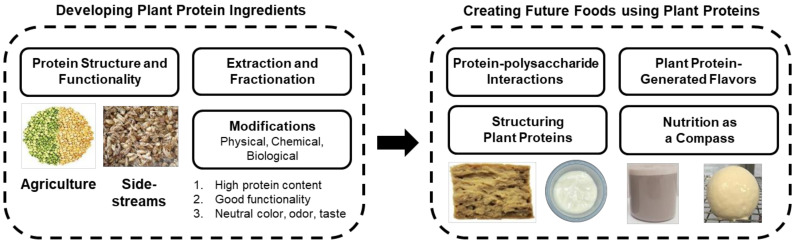
Protein calories consumed by people all over the world approximate 15–20% of their energy intake. This makes protein a major nutritional imperative. Today, we are facing an unprecedented challenge to produce and distribute adequate protein to feed over nine billion people by 2050, in an environmentally sustainable and affordable way. Plant-based proteins present a promising solution to our nutritional needs due to their long history of crop use and cultivation, lower cost of production, and easy access in many parts of the world. However, plant proteins have comparatively poor functionality, defined as poor solubility, foaming, emulsifying, and gelling properties, limiting their use in food products. Relative to animal proteins, including dairy products, plant protein technology is still in its infancy. To bridge this gap, advances in plant protein ingredient development and the knowledge to construct plant-based foods are sorely needed. This review focuses on some salient features in the science and technology of plant proteins, providing the current state of the art and highlighting new research directions. It focuses on how manipulating plant protein structures during protein extraction, fractionation, and modification can considerably enhance protein functionality. To create novel plant-based foods, important considerations such as protein–polysaccharide interactions, the inclusion of plant protein-generated flavors, and some novel techniques to structure plant proteins are discussed. Finally, the attention to nutrition as a compass to navigate the plant protein roadmap is also considered.
Overview
The claims and statistics of this paper haven’t been checked yet.
Free: it reads the open-access text and checks the first 5 claims that cite a source we can check. Create a free account to check every claim.
Integrity signals
Registry
Cites
Statistics
Figures
Verification
Claims the paper makes
The claims and statistics of this paper haven’t been checked yet.
Free: it reads the open-access text and checks the first 5 claims that cite a source we can check. Create a free account to check every claim.
Claims other papers make about this one
Each is checked against this paper’s own text: does it say what the citing paper says it does?
The source backs part of the claim, not all of it — or backs it for a different population, condition or comparison.
In the citing paper
“The review highlights that native pea protein structure dictates both its limitations and the engineering strategies needed to overcome them, progressing from isolation technologies through modification approaches to advanced food applications, with emphasis on structure-guided engineering approaches and biorefinery perspectives [2,6,8].”
From Pea Protein Isolates: From Extraction to Functionality. (2025) · cites this paper as [8]
Experimental — accuracy not yet measuredThe source backs part of the claim, not all of it — or backs it for a different population, condition or comparison.
In the citing paper
“Off-flavor attributes, notably characteristic pea-like bitterness, can detract from consumer acceptance and limit broader utilization in sensory-sensitive food products [2,8].”
From Pea Protein Isolates: From Extraction to Functionality. (2025) · cites this paper as [8]
Experimental — accuracy not yet measured
Self-check
Percentages, sums and reported differences re-computed from the paper’s own numbers.
The self-check needs the paper’s full text.
Citations
Cites
Food in the Anthropocene: the EAT–Lancet Commission on healthy diets from sustainable food systems
Willett, W., Rockström, J., Loken, B., Springmann, M., Lang, T., Vermeulen, S., Garnett, T., Tilman, D., DeClerck, F., Wood, A., et al. (2019) · The Lancet · doi:10.1016/s0140-6736(18)31788-4 · Cited by 10,880 · cited 1×
“Plant proteins are also more environmentally sustainable [3].”
BackgroundPhillips, G. O., & Williams, P. A. (2009) · Woodhead Publishing Limited eBooks · doi:10.1533/9781845695873 · Cited by 2,105
Food Polysaccharides and Their Applications
(2016) · CRC Press eBooks · doi:10.1201/9781420015164 · Cited by 1,650 · cited 1×
“Polysaccharides are sugar polymers linked by glycosidic bonds and include a vast family such as starch, cellulose, pectins, agars, carrageenans, alginates and gums [168].”
BackgroundBoye, J., Zare, F., & Pletch, A. (2010) · Food Research International · doi:10.1016/j.foodres.2009.09.003 · Cited by 1,579 · cited 2×
“Albumin and globulins are predominately present in all pulses (>50%) [17] and some pseudocereals (quinoa, and amaranth), whereas prolamins (wheat, maize, barley and rye) and glutelins (wheat) make up 85% of total protein in the cereal [18] and pseudocereal family [16,19].”
BackgroundSlow and fast dietary proteins differently modulate postprandial protein accretion
Boirie, Y., Dangin, M., Gachon, P., Vasson, M.-P., Maubois, J.-L., & Beaufrère, B. (1997) · Proceedings of the National Academy of Sciences · doi:10.1073/pnas.94.26.14930 · Cited by 1,453 · cited 2×
“Whey proteins are digested more quickly and absorbed in the body than native micellar casein because caseins coagulate with digestives enzymes resulting in slower digestion and subsequent absorption [260].”
BackgroundA review on protein–phenolic interactions and associated changes
Ozdal, T., Capanoglu, E., & Altay, F. (2013) · Food Research International · doi:10.1016/j.foodres.2013.02.009 · Cited by 1,355 · cited 1×
“form complexes with plant proteins, affecting the functional and nutritional properties of the proteins [52].”
BackgroundTang, J. E., Moore, D. R., Kujbida, G. W., Tarnopolsky, M. A., & Phillips, S. M. (2009) · Journal of Applied Physiology · doi:10.1152/japplphysiol.00076.2009 · Cited by 998
Pea protein isolates: Structure, extraction, and functionality
Lam, A. C. Y., Can Karaca, A., Tyler, R. T., & Nickerson, M. T. (2018) · Food Reviews International · doi:10.1080/87559129.2016.1242135 · Cited by 902 · cited 2×
“Even most legume protein isolates rich in globulin contain various globulin subfractions, such as legumin, vicilin and convicilin in pea [65].”
BackgroundMethodFood proteins: A review on their emulsifying properties using a structure–function approach
Lam, R. S. H., & Nickerson, M. T. (2013) · Food Chemistry · doi:10.1016/j.foodchem.2013.04.038 · Cited by 895 · cited 1×
“The need for a more sustainable food production system comprising the inclusion of more highly functional plant-based components has increased the requirement for an economically effective manufacturing technique [129].”
BackgroundPlant protein-based alternatives of reconstructed meat: Science, technology, and challenges
Sha, L., & Xiong, Y. L. (2020) · Trends in Food Science & Technology · doi:10.1016/j.tifs.2020.05.022 · Cited by 856 · cited 2×
“Although most plant proteins (soy, pea, potato, mung bean, and rice proteins) are globular [40], they differ from animal globular proteins in terms of molecular characteristics and functional properties.”
Background
Research works printed but not linked: 3
- Tornberg E. Andersson K. Andersson A. Josell A. The texture of comminuted meat products Food Aust. 2000 52 519 524
- Flory P.J. Principles of Polymer Chemistry Cornell University Press Ithaca, NY, USA 1953
- Rossen J.L. Miller R.C. Food extrusion Food Technol. 1973 27 46 53
Cited by
The Current Situation of Pea Protein and Its Application in the Food Industry
Shanthakumar, P., Klepacka, J., Bains, A., Chawla, P., Dhull, S. B., & Najda, A. (2022) · Molecules · doi:10.3390/molecules27165354 · Cited by 381
“This process is also used as a pre-treatment for other protein modification methods such as hydrolysis and glycation by making the amino acids folded in the inner layer of the proteins [94].”
MethodDeep Eutectic Solvent as Green Solvent in Extraction of Biological Macromolecules: A Review
Ling, J. K. U., & Hadinoto, K. (2022) · International Journal of Molecular Sciences · doi:10.3390/ijms23063381 · Cited by 337
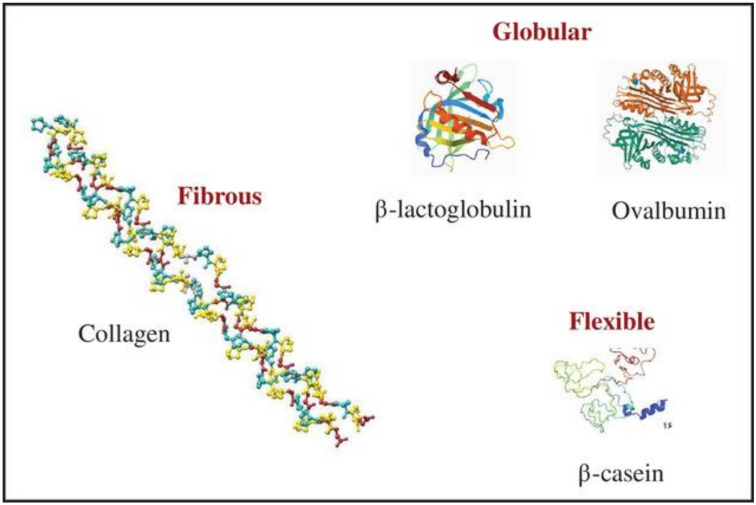
“Proteins can be classified as globular (albumin), fibrous (collagen and keratin), or flexible (casein), depending on their structure and sequence on the polymer chain [86].”
BackgroundFermentation of plant‐based dairy alternatives by lactic acid bacteria
Harper, A. R., Dobson, R. C. J., Morris, V. K., & Moggré, G. (2022) · Microbial Biotechnology · doi:10.1111/1751-7915.14008 · Cited by 240
“This is due to the disulphide bonds, hydrophobic effects, electrostatic forces, hydrogen bonding and van der Waals forces present (Sim et al., 2021).”
BackgroundInfluentialCurrent challenges of alternative proteins as future foods
Malila, Y., Owolabi, I. O., Chotanaphuti, T., Sakdibhornssup, N., Elliott, C. T., Visessanguan, W., Karoonuthaisiri, N., & Petchkongkaew, A. (2024) · npj Science of Food · doi:10.1038/s41538-024-00291-w · Cited by 210
“Most plant proteins are globular and stored as preserved nutrients in storage organs (e.g., seeds and tubes) 35 , hence why protein extraction is required (Fig.”
BackgroundHassoun, A., Cropotova, J., Trif, M., Alexandru Vasile, R. U. S. U., Bobiş, O., Nayik, G. A., Jagdale, Y. D., Saeed, F., Afzaal, M., Mostashari, P., et al. (2022) · Frontiers in Nutrition · doi:10.3389/fnut.2022.972154 · Cited by 175
Metadata
- Authors
- Sim, S. Y. J., SRV, A., Chiang, J. H., & Henry, C. J.
- Affiliations
- Agency for Science, Technology and Research (SG)
- Clinical Nutrition Research Centre (CNRC), Singapore Institute of Food and Biotechnology Innovation (SIFBI), Agency for Science, Technology and Research (A*STAR), Singapore 117599, Singapore
- Corresponding author
- Sim, Shaun Yong Jie
- Venue
- Foods
- Publisher
- MDPI AG
- Published
- 2021-08-23
- Volume
- 10
- Issue
- 8
- Pages
- 1967
- ISSN
- 2304-8158 (ISSN-L)
- PMC
- PMC8391319
- OpenAlex
- W3193926126
- Semantic Scholar
- 0bc64bbf0df91f9d920b8b8074c1734bc7bbbe63
- Cited by
- 352
- References
- 269
- Citations by year
- 2026: 57 · 2025: 100 · 2024: 92 · 2023: 60 · 2022: 40 · 2021: 3
- FWCI
- 4.43
- Type
- journal article
- Language
- en
- Open access
- gold
- doi.org
- Licence
- Locations
- Foods (publishedVersion, cc-by)
- PubMed Central (publishedVersion, cc-by)
- PubMed (publishedVersion)
- National University of Singapore (submittedVersion, cc-by)
- DOAJ (DOAJ: Directory of Open Access Journals) (submittedVersion, cc-by-sa)
- Funders
- Agency for Science, Technology and Research (W20W2D0006, H17/01/a0/A11)
- Topics
- Life Sciences › Agricultural and Biological Sciences › Food Science › Proteins in Food Systems
- Life Sciences › Agricultural and Biological Sciences › Food Science › Food Nutrient Composition and Product Development
- Life Sciences › Agricultural and Biological Sciences › Food Science › Protein Hydrolysis and Bioactive Peptides
- Keywords
- plant proteins, plant-based foods, protein functional properties, protein solubility, foaming and emulsifying properties, gelling properties, protein extraction, protein fractionation, protein modification, protein-polysaccharide interactions, global food security, sustainable food production
About these checks
Registry, retraction, Cites and statistics results are computed, not judged, with one exception: a printed reference that no index lists is read once by a model before it counts as a citation error. Claims are extracted by a model and kept only when their quote appears verbatim in the text; each cited source is then checked, with a model’s help, for whether it says what the claim relies on. Those verdicts can be wrong — read the claim’s quote and the cited source before relying on one.
Statistics and arithmetic are recomputed, not judged.
Confidence bands are shown only for fields calibrated on our annotated test set. None is calibrated yet, so no band is shown.
What counts as a claim ›How we measure confidence ›How we check this ›
Are you an author, or do you see a problem with this page? Request a review
Data sources
Bibliographic data: Semantic Scholar, OpenAlex, Crossref.
Contains information from the Semantic Scholar Academic Graph Datasets, made available under the ODC Attribution License (ODC-BY 1.0).
Semantic Scholar’s data is described in: Kinney, R., et al. (2023). The Semantic Scholar Open Data Platform. arXiv:2301.10140.
