

Understanding Food Loss and Waste—Why Are We Losing and Wasting Food?
Open accessThe DOI matches its Crossref record; 78 of the 82 references it cites were found in a registry or an index, and 1 are not checked yet; 10 of the 74 sources its claims cite were checked for support.
Abstract
The Food and Agricultural Organization (FAO) reported that approximately one-third of all produced foods (1.3 billion tons of edible food) for human consumption is lost and wasted every year across the entire supply chain. Significant impacts of food loss and waste (FLW) have increased interest in establishing prevention programs around the world. This paper aims to provide an overview of FLW occurrence and prevention. Economic, political, cultural, and socio-demographic drivers of FLW are described, highlighting the global variation. This approach might be particularly helpful for scientists, governors, and policy makers to identify the global variation and to focus on future implications. The main focus here was to identify the cause of the FLW occurrence throughout the food supply chain. We have created a framework for FLW occurrence at each stage of the food supply chain. Several feasible solutions are provided based on the framework.
Verified 2026-11-25 · 1 reference not checked yet
Overview
CoChat Summary
## TL;DR
This paper is a systematic review of food loss and waste (FLW) that maps where losses occur along the food supply chain, why they happen, and what kinds of policies and practices can reduce them. It argues that FLW is driven by different factors at production, storage, distribution, and consumption stages, and that prevention requires stage-specific, coordinated action.
## Key findings
- The paper states that about one-third of all produced food is lost and wasted every year, equal to 1.3 billion tons of edible food; its monetary value is estimated at about USD $936 billion.
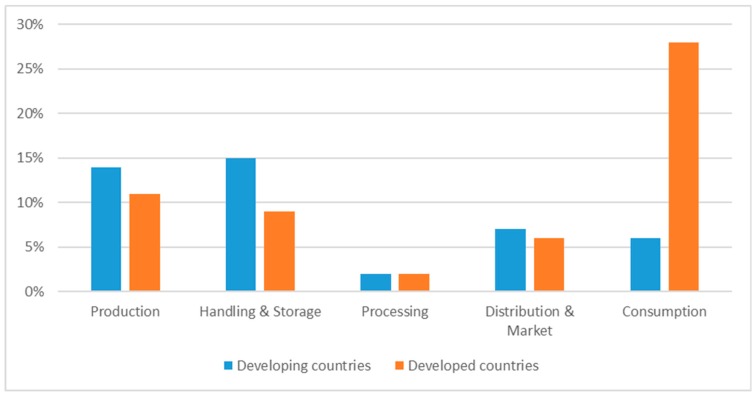
- It reports that in less-developed countries, FLW occurs mainly in the post-harvest and processing stages, which account for approximately 44% of global FLW, while in developed countries 40% of FLW occurs at the consumption stage.
- The review cites specific consumption-side figures: 15.8 million U.S. households were considered food insecure, and reducing FLW by 15% would feed all insecure U.S. households; reducing FLW by 50% could feed an additional one billion people.
- The paper highlights one intervention result: the UK “Love Food, Hate Waste” campaign was associated with a 15% reduction in household food waste and a 21% reduction in avoidable waste from 2007 to 2012; France’s 2015 supermarket law is also described as contributing to France reaching first rank in the 2017 Food Sustainability Index.
## Methods
- The study is a systematic review structured according to PRISMA.
- It reviewed literature from 2001–2018 using Scopus, Science Direct, Jstor, and Google Scholar, plus government and international organization websites; the initial database search returned 82,730 articles.
- After screening, 264 articles remained after title/abstract review, 145 technical-only articles were excluded, and 119 articles were included in the final review.
## Limitations
- The paper states that no commonly agreed-upon definition of FLW exists, which makes FLW difficult to measure, compare, and use for policy design.
- It states that quantification methods are heterogeneous and have weaknesses, and that estimates are difficult to compare across countries and studies because different criteria are used.
- Evident from the text: this is a narrative/systematic review of prior studies rather than original empirical data collection, so its conclusions depend on the quality and comparability of the included literature.
Model-written summary. Check it against the paper before relying on it.
Integrity signals
Registry
Cites
Statistics
Figures
Verification
Claims the paper makes
8 Valid · 1 Not valid · 45 Not checked · 8 Own results and interpretations
The cited sources support only part of this claim — read each source’s verdict below.
In the paper
“However, perishing of the fresh-cut products is accelerated by poor temperature and packaging management [66,84].”
§ Understanding Food Loss and Waste—Why Are We Losing and Wasting Food? > 3. FLW in the Supply Chain > 3.4. FW on Distribution and Marketing Stage
What the sources say
- Partly supportedcites [66] Papargyropoulou E. Lozano R. Steinberger J.K. Wright N. bin Ujang Z. The food waste hierarchy as a framework for the management of food surplus and food waste J. Clean. Prod. 2014 76 106 115 10.1016/j.jclepro.2014.04.020 sourceExperimental — accuracy not yet measured
The table of food losses (Accepted Manuscript, p. 10) lists inappropriate packaging as damaging produce and lack of cooling or cold storage as causing losses. It does not specifically address fresh-cut products or establish that poor management accelerates their perishing. (LLM, conf=0.86)
- Could not verifycites [84] Plazzotta S. Manzocco L. Nicoli M.C. Fruit and vegetable waste management and the challenge of fresh-cut salad Trends Food Sci. Technol. 2017 63 51 59 10.1016/j.tifs.2017.02.013 sourceExperimental — accuracy not yet measured
The discussion of fresh-cut salad (p. 10) says cutting damages tissue and increases the rate of quality depletion during storage. It does not attribute accelerated perishing to poor temperature or packaging management; searches for those terms found no passage making that connection. (LLM, conf=0.76)
plainstates a cause- Asserted: passes — The authors put it forward as true.
- Checkable: passes — It can be checked against evidence.
- Load-bearing: unclear — It is unclear whether the paper’s conclusions depend on it.
- Based: passes — The paper gives a reason why it holds.
- Partly supported
The cited sources support only part of this claim — read each source’s verdict below.
In the paper
“The contamination in a processing line that occurs due to improperly cleaned processing units not sanitized from previous processes is also one of main causes of FL occurrence, especially for animal products [43,66].”
§ Understanding Food Loss and Waste—Why Are We Losing and Wasting Food? > 3. FLW in the Supply Chain > 3.3. Processing and Packaging Stage FL
What the sources say
- Not checked — no full text of the sourcecites [43] Beretta C. Stoessel F. Baier U. Hellweg S. Quantifying food losses and the potential for reduction in Switzerland Waste Manag. 2013 33 764 773 10.1016/j.wasman.2012.11.007 23270687 source
- Partly supportedcites [66] Papargyropoulou E. Lozano R. Steinberger J.K. Wright N. bin Ujang Z. The food waste hierarchy as a framework for the management of food surplus and food waste J. Clean. Prod. 2014 76 106 115 10.1016/j.jclepro.2014.04.020 sourceExperimental — accuracy not yet measured
Table 1 (accepted manuscript, pp. 9–10; also p. 32) lists contamination during processing as causing loss of quality. It does not identify improperly cleaned or unsanitized equipment as the cause, describe contamination as a main cause of food loss, or single out animal products. (LLM, conf=0.86)
plainstates a cause- Asserted: passes — The authors put it forward as true.
- Checkable: passes — It can be checked against evidence.
- Load-bearing: unclear — It is unclear whether the paper’s conclusions depend on it.
- Based: passes — The paper gives a reason why it holds.
The cited sources support only part of this claim — read each source’s verdict below.
In the paper
“Commercial pressure in the marketing stage is also a major cause of food waste [66,85].”
§ Understanding Food Loss and Waste—Why Are We Losing and Wasting Food? > 3. FLW in the Supply Chain > 3.4. FW on Distribution and Marketing Stage
What the sources say
- Partly supportedcites [66] Papargyropoulou E. Lozano R. Steinberger J.K. Wright N. bin Ujang Z. The food waste hierarchy as a framework for the management of food surplus and food waste J. Clean. Prod. 2014 76 106 115 10.1016/j.jclepro.2014.04.020 sourceExperimental — accuracy not yet measured
The food-supply-chain table (Accepted Manuscript, p. 10) identifies losses at the marketing stage, including transport spoilage, poor handling and inadequate cooling. It does not identify commercial pressure as a cause or say it is a major cause of food waste. (LLM, conf=0.79)
- Not checked — no full text of the sourcecites [85] Godfray H.C.J. Beddington J.R. Crute I.R. Haddad L. Lawrence D. Muir J.F. Pretty J. Robinson S. Thomas S.M. Toulmin C. Food security: The challenge of feeding 9 billion people Science 2010 327 812 818 10.1126/science.1185383 20110467 source
plainstates a cause- Asserted: passes — The authors put it forward as true.
- Checkable: passes — It can be checked against evidence.
- Load-bearing: unclear — It is unclear whether the paper’s conclusions depend on it.
- Based: passes — The paper gives a reason why it holds.
- Partly supported
Every source the paper cites for this claim was checked and supports it.
In the paper
“The impact of attitudes and behaviors of individuals on FLW prevention could be limited, as attitudes are not entirely consistent with the actual behaviors (i.e., the attitude–behavior gap, [97]).”
§ Understanding Food Loss and Waste—Why Are We Losing and Wasting Food? > 3. FLW in the Supply Chain > 3.5. Consumption Stage FW
What the sources say
- Supportedcites [97] Schanes K. Dobernig K. Gӧzet B. Food Waste Matters—A Systematic review of household food waste practices and their policy implications J. Clean. Prod. 2018 182 978 991 10.1016/j.jclepro.2018.02.030 source
Section 3.1 (page not provided) explicitly describes an attitude–behaviour gap: intentions to reduce food waste often do not translate into action, and attitudes are not always good indicators of less food being wasted. This supports the citing sentence’s hedged point about the limits of relying on individual attitudes for prevention. (LLM, conf=0.90)
hedged- Asserted: passes — The authors put it forward as true.
- Checkable: passes — It can be checked against evidence.
- Load-bearing: unclear — It is unclear whether the paper’s conclusions depend on it.
- Based: passes — The paper gives a reason why it holds.
- Supported
Every source the paper cites for this claim was checked and supports it.
In the paper
“Jörissen et al. [87] also reported that single-person households generate the most FW per capita.”
§ Understanding Food Loss and Waste—Why Are We Losing and Wasting Food? > 3. FLW in the Supply Chain > 3.5. Consumption Stage FW
What the sources say
- Supportedcites [87] Jörissen J. Priefer C. Bräutigam K.R. Food waste generation at household level: Results of a survey among employees of two European research centers in Italy and Germany Sustainability 2015 7 2695 2715 10.3390/su7032695 source
The Results (section 4.3, p. 8) report that one-person households wasted the most food per capita in both surveyed locations. The Discussion (p. 13) repeats the finding for single-person households. (LLM, conf=0.95)
plainstates an association- Asserted: passes — The authors put it forward as true.
- Checkable: passes — It can be checked against evidence.
- Load-bearing: unclear — It is unclear whether the paper’s conclusions depend on it.
- Based: passes — The paper gives a reason why it holds.
- Supported
34 more claims · 1 with their cited sources checked
Create a free account to see all 62 claims and to verify the 7 references still open.
- It may state two separate claims as one. 15
- Probably not a substantial claim. 9
Claims other papers make about this one
Each is checked against this paper’s own text: does it say what the citing paper says it does?
In the citing paper
“In industrialized countries, food waste, which accounts for approximately 56% of global food waste, is obtained via the latter stages of the supply chain, particularly during processing and consumption [12].”
From From Industrial Food Waste to Bioactive Ingredients: A Review on the Sustainable Management and Transformation of Plant-Derived Food Waste (2023) · cites this paper as [12]
Citations
Cites
Preferred Reporting Items for Systematic Reviews and Meta-Analyses: the PRISMA statement
Moher, D., Liberati, A., Tetzlaff, J., Altman, D. G., & for the PRISMA Group (2009) · BMJ · doi:10.1136/bmj.b2535 · Cited by 83,823
Preferred Reporting Items for Systematic Reviews and Meta-Analyses: The PRISMA Statement
Moher, D., Liberati, A., Tetzlaff, J., Altman, D. G., & The PRISMA Group (2009) · PLoS Medicine · doi:10.1371/journal.pmed.1000097 · Cited by 64,042
Wang, G., Ma, R., Qiao, G., Wada, K., Aizawa, Y., & Satoh, T. (2015) · Integrative Medicine International · doi:10.1159/000368408 · Cited by 18,657
Food Security: The Challenge of Feeding 9 Billion People
Godfray, H. C. J., Beddington, J. R., Crute, I. R., Haddad, L., Lawrence, D., Muir, J. F., Pretty, J., Robinson, S., Thomas, S. M., & Toulmin, C. (2010) · Science · doi:10.1126/science.1185383 · Cited by 11,943
Food waste within food supply chains: quantification and potential for change to 2050
Parfitt, J., Barthel, M., & Macnaughton, S. (2010) · Philosophical Transactions of the Royal Society B: Biological Sciences · doi:10.1098/rstb.2010.0126 · Cited by 3,197 · cited 4×
“However, the absence of an exact quantification method leads to a data problem [24].”
BackgroundInfluentialThe Omnivore's Dilemma: A Natural History of Four Meals
Pollán, M. (2006) · Cited by 2,015
The food waste hierarchy as a framework for the management of food surplus and food waste
Papargyropoulou, E., Lozano, R., K. Steinberger, J., Wright, N., & Ujang, Z. B. (2014) · Journal of Cleaner Production · doi:10.1016/j.jclepro.2014.04.020 · Cited by 1,711 · cited 8×
“Processing and Packaging Stage - Unavoidable losses [2,43,66] - Technical inefficiencies and malfunctions [21,43,78,79] - Methods and changes in processing lines [43] - Contamination in processing lines [21,43,66] - Legislation restrictions [2,66,72,80] - Packaging system [2,65,78,81] - Overproduction [63,82]”
BackgroundInfluentialSchanes, K., Dobernig, K., & Gözet, B. (2018) · Journal of Cleaner Production · doi:10.1016/j.jclepro.2018.02.030 · Cited by 1,365
By-products of plant food processing as a source of functional compounds—Recent developments
Schieber, A., Stintzing, F. C., & Carle, R. (2001) · Trends in Food Science & Technology · doi:10.1016/s0924-2244(02)00012-2 · Cited by 1,334 · cited 2×
“Processing and Packaging Stage - Unavoidable losses [2,43,66] - Technical inefficiencies and malfunctions [21,43,78,79] - Methods and changes in processing lines [43] - Contamination in processing lines [21,43,66] - Legislation restrictions [2,66,72,80] - Packaging system [2,65,78,81] - Overproduction [63,82]”
BackgroundKummu, M., de Moel, H., Porkka, M., Siebert, S., Varis, O., & Ward, P. J. (2012) · Science of The Total Environment · doi:10.1016/j.scitotenv.2012.08.092 · Cited by 1,300 · cited 2×
“The waste of resources caused by global FLW has been estimated to account for 24% of the total usage of freshwater resources and 23% of the global fertilizer use [27].”
Background
Research works printed but not linked: 5
- Bond M. Meacham T. Bhunnoo R. Benton T. Food Waste within Global Food Systems Global Food Security Elsevier Amsterdam, The Netherlands 2013
- Parry M. Parry M.L. Canziani O. Palutikof J. Van der Linden P. Hanson C. Climate Change 2007-Impacts, Adaptation and Vulnerability: Working Group II Contribution to the Fourth Assessment Report of the IPCC Cambridge University Press Cambridge, UK 2007 Volume 4
- Pärn A. Designing a Solution for Food Waste Reduction Master’s Thesis MSc Integrated Food Studies, Aalborg University Aalborg, Denmark 2016
- Farag D. Aflatoxins: Awareness and control Proceedings of the Third Dubai International Food Safety Conference, Organized by Dubai Municipality Dubai, UAE 23–27 February 2008
- Rathje W.L. Murphy C. Rubbish! The Archaeology of Garbage University of Arizona Press Tucson, AZ, USA 2001
Cited by
Items 301–400 of 582
Ince, V., Bader-El-Den, M., Esmeli, R., & Sari, O. F. (2026) · Food and Bioprocess Technology · doi:10.1007/s11947-026-04222-3 · Cited by 10
Gıda Kayıp ve İsrafının Azaltılmasında Gıda Bankacılığı
Aday, M. S., & Aday, S. (2021) · IBAD Sosyal Bilimler Dergisi · doi:10.21733/ibad.844971 · Cited by 12
Progress in Environmental Nutrition Research
黄, 金. (2025) · Hans Journal of Food and Nutrition Science · doi:10.12677/hjfns.2025.141014 · Cited by 5
Melting Behavior of Compression Molded Poly(ester amide) from 2,5-Furandicarboxylic Acid
Bianchi, E., Soccio, M., Gazzano, M., Papadopoulos, L., Robert, T., Bikiaris, D. Ν., & Lotti, N. (2024) · Polymers · doi:10.3390/polym16243459 · Cited by 5
Li, J., Li, T., Wu, C., Fan, G., Zhou, D.-D., Li, X., & Zhu, Y. (2025) · Trends in Food Science & Technology · doi:10.1016/j.tifs.2025.105470 · Cited by 5
Universiti Teknologi, M. A. R. A., ZAMRI, N. Z. M., AYOB, S. N. F., Universiti Teknologi, M. A. R. A., AHMAD, N. A., Perlis, U. M., NOOR, M. A. M., Universiti Teknologi, M. A. R. A., Shafie, F. A., & Universiti Teknologi, M. A. R. A. (2022) · Journal of Sustainability Science and Management · doi:10.46754/jssm.2022.12.007 · Cited by 4
Quezada-Figueroa, G., Lagos, A. B., Araneda‐Flores, J., Riquelme-Riquelme, S., Navarro-Cruz, A. R., Moresco, P. O., Lobos-Fernández, L., Vera-Cabalín, M., & Segura-Badilla, O. (2023) · Revista chilena de nutrición · doi:10.4067/s0717-75182023000600643 · Cited by 8
Moreno, J. A. J., Barroso, T. L. C. T., Castro, L. E. N., Colpini, L. M. S., Bragagnolo, F. S., Rostagno, M. A., & Forster‐Carneiro, T. (2025) · Resources · doi:10.3390/resources14070109 · Cited by 4
Leveraging Household Food Waste Consumer Behaviour to Optimise Logistics
Ntai, S., Kontopanou, M., & Anastasiadis, F. (2025) · Logistics · doi:10.3390/logistics9030126 · Cited by 5
Debnath, A., & Das, A. (2024) · Access Microbiology · doi:10.1099/acmi.0.000660.v4 · Cited by 6
Thanigaivel, S., Kamalesh, R., Kadirvel, V., Yaashikaa, P. R., Saravanan, A., & Vickram, A. S. (2026) · Waste Disposal & Sustainable Energy · doi:10.1007/s42768-026-00287-0 · Cited by 5
Cu-based nanoparticles as pesticides: Applications and mechanism of management of insect pests
Gacem, M. A., & Chaibi, R. (2022) · Elsevier eBooks · doi:10.1016/b978-0-12-823833-2.00023-4 · Cited by 7
Gleaner-Farmer Relationships: A Study of Recruitment and Relationship Development
Lott, S., Irwin, E. D., & Heiss, S. N. (2020) · Journal of Agriculture Food Systems and Community Development · doi:10.5304/jafscd.2020.093.007 · Cited by 6
Sustainable Solutions: Navigating Agrifood Waste with Eco-smart Approaches for a Greener Environment
Singh, M. P., Kumar, P., Pal, P., Kumari, B., Prakash, O., Singh, A. K., Sarangi, P. K., Pandey, B., & Prakash, A. (2024) · Springer eBooks · doi:10.1007/978-3-031-58441-1_5 · Cited by 6
Knowledge-Based Recommendation System for Plate Waste Reduction in Latvian Schools
Kodors, S., Lonska, J., Zarembo, I., Zvaigzne, A., Apeināns, I., & Dekšne, J. (2024) · Sustainability · doi:10.3390/su16198446 · Cited by 6
Valorizations of food wastes in infrastructural development and construction industries
Kumar, V., Kutty, S. R. M., Shafiq, N., Adebanjo, A. U., Razak, S. N. A., Shams, M. A., & Lohana, S. (2024) · Elsevier eBooks · doi:10.1016/b978-0-443-15958-9.00013-7 · Cited by 6
Reynolds, C. J. (2022) · Routledge eBooks · doi:10.4324/9781003226932-5 · Cited by 7
Agosti, A., Saadoun, J. H., Fontechiari, L., Nazeer, S., Leto, L., Dhenge, R. V., Paterna, A., Levante, A., Rinaldi, M., Lazzi, C., et al. (2025) · Plant Science · doi:10.1016/j.plantsci.2025.112865 · Cited by 5
Identifying solutions to minimize meal tray waste: A mixed-method approach
Fuleihan, K., Stillman, K., Hakimian, J. K., Sarkar, K., Ballesteros, J., Almario, C. V., & Shirazipour, C. H. (2024) · Clinical Nutrition ESPEN · doi:10.1016/j.clnesp.2024.05.002 · Cited by 4
Kolawole, I. D., Sanni-manuel, B. A., Kolawole, G. O., Idowu, D. E., Kolawole, S. K., Ewansiha, J. U., Oni, K. O., Kolawole, V. A., & Kolawole, F. O. (2024) · Food and Humanity · doi:10.1016/j.foohum.2024.100385 · Cited by 9
Yu, P., Hamid, R. B. A., Osman, L. H., Liao, J., & Ni, C. (2026) · Agriculture · doi:10.3390/agriculture16050587 · Cited by 8
Food Wastes and By‐Products as Valuable Ingredients for Processed Foods
Kumaraguruparaswami, M., Subramani, D., & R, P. S. (2025) · Journal of Food Process Engineering · doi:10.1111/jfpe.70199 · Cited by 4
Jayabal, R., & Prabhakar, P. (2025) · Journal of the Science of Food and Agriculture · doi:10.1002/jsfa.70311 · Cited by 14
African Journal of Commercial Studies
Musonda, L. (2023) · African Journal of Commercial Studies · doi:10.59413/ajocs/v4.i2.3 · Cited by 3
Analysis of factors affecting zero-waste food consumption in schools
Dekšne, J., Litavniece, L., Zvaigzne, A., Lonska, J., & Kodors, S. (2022) · Research for Rural Development/Research for Rural Development (Online) · doi:10.22616/rrd.28.2022.022 · Cited by 5
Liquid smoke-infused edible coatings: Antimicrobial agents for preserving cherry tomatoes
Faisal, M., Mansur, D., Desvita, H., & Heriansyah, M. B. (2024) · Case Studies in Chemical and Environmental Engineering · doi:10.1016/j.cscee.2024.101091 · Cited by 6
A Prioritization Method for Sustainable Food Waste Reduction Practices
Moraes, N. V., Fernandes, S. D. C., Gularte, A. C., da Rocha, C. G., & Echeveste, M. E. S. (2025) · Sustainable Development · doi:10.1002/sd.3342 · Cited by 5
Integrated Approach to Climate Adaptation and Mitigation: Processed Potato and Tomato
Gustafson, D., Asseng, S., Kruse, J., Thoma, G., Guan, K., Hoogenboom, G., Matlock, M., Mclean, M., Parajuli, R., Rajagopalan, K., et al. (2020) · doi:10.21203/rs.3.rs-89936/v1 · Cited by 2
A call for perfectly imperfect fruit and vegetables: food loss in public procurement
Clausen, A., Kristensen, N. H., & Hansen, S. R. (2025) · Food and Foodways · doi:10.1080/07409710.2025.2440973 · Cited by 3
Kerr, C., Burritt, D. J., & Burdon, J. N. (2025) · Antioxidants · doi:10.3390/antiox15010030 · Cited by 4
Intelligent packaging—indicators
Marques, C. S., Silva, R. R. A., Arruda, T. R., de Oliveira, T. V., & Soares, N. D. F. F. (2024) · Elsevier eBooks · doi:10.1016/b978-0-443-15388-4.00004-3 · Cited by 4
Lataste, C., Sandoval, S., Maturana, D., Delgado, C., Gajardo, S., & Cáceres, P. (2020) · Archivos Latinoamericanos de Nutrición · doi:10.37527/2020.70.1.002 · Cited by 7
Mukama, M., & Abaasa, P. (2024) · International Journal of Refrigeration · doi:10.1016/j.ijrefrig.2024.05.030 · Cited by 4
The Impact of Economic Drivers on Food Loss Management
(2022) · doi:10.61801/ouaess.2022.1.101 · Cited by 3
From markets to clicks: The impact of purchasing channel migration on household food waste
Tian, Q., Lin, Y., Gao, W., Yu, Y., & Li, C. (2025) · Waste Management · doi:10.1016/j.wasman.2025.114908 · Cited by 3
Decoding food losses in pulses trade: proposing sustainable solutions from an Indian perspective
Chaudhary, A., & Singh, R. (2024) · International Journal of Logistics Research and Applications · doi:10.1080/13675567.2024.2428159 · Cited by 6
Tracking on food and agriculture-related SDG indicators in the Mediterranean region
Miglietta, P. P., Coluccia, B., Pacifico, A. M., & Malorgio, G. (2023) · New Medit · doi:10.30682/nm2304d · Cited by 4
Perilaku Food Loss and Waste pada Ekonomi-Gizi Rumah Tangga Saat Pandemi Covid 19
Swamilaksita, P. D., Vanka, J., Nadiyah, N., & Harna, H. (2022) · Indonesian Journal of Human Nutrition · doi:10.21776/ub.ijhn.2022.009.01.2 · Cited by 8
Green Catalysis: The Role of Medicinal Plants as Food Waste Decomposition Enhancers/Accelerators
Mugivhisa, L. L., & Manganyi, M. C. (2025) · Life · doi:10.3390/life15040552 · Cited by 6
A review: application of freeze-drying in meat processing
(2023) · doi:10.22616/rrd.29.2023.011 · Cited by 3
Extending freshness: The efficacy of ozonation in sterilizing fresh cut Malus domestica
Zia, R., Tahir, A., Arshad, M., & Akhtar, N. (2025) · Food and Humanity · doi:10.1016/j.foohum.2024.100486 · Cited by 3
Leveraging LSTM and ensemble classifiers for enhanced food waste classification
Alsalem, K. O. (2025) · Discover Sustainability · doi:10.1007/s43621-025-01330-6 · Cited by 3
Haines, A., & Frumkin, H. (2021) · Cambridge University Press eBooks · doi:10.1017/9781108698054.010 · Cited by 2
The battle for biomass : Tackling tensions and tradeoffs at the science-policy interface
Muscat, A. (2021) · doi:10.18174/541657 · Cited by 2
Towards a sustainable Agri-Food supply chain
(2021) · doi:10.31705/bprm.v2.2021.12 · Cited by 2
Reinesch, A. C., Fausak, L. K., Joseph, A., Kylstra, S., & Lavkulich, L. M. (2022) · Agricultural Sciences · doi:10.4236/as.2022.135042 · Cited by 2
Electronic nose technology for food quality monitoring
Sun, J., Fu, Q., Kot-Cheung, S. K., Qi, D., & Zhang, H. (2026) · Food Control · doi:10.1016/j.foodcont.2026.112495 · Cited by 2
Ibtiyah, A. K., Romadlon, F., & Nurisusilawati, I. (2023) · HABITAT · doi:10.21776/ub.habitat.2023.034.3.27 · Cited by 4
Molecular and Microbial Identification of Microbiota of Processed Chicken Products: Mini ReviewPreprint
Al-Maaqar, S. M. (2023) · Qeios · doi:10.32388/wu2l4f · Cited by 1
The role of cold chain logistics in reducing postharvest losses
Edo, G. I., Ali, A. B. M., Owheruo, J. O., Iwanegbe, I., Orogu, J. O., Yousif, E., Igbuku, U. A., Oghroro, E. E. A., Opiti, R. A., Essaghah, A. E. A., et al. (2026) · Next Energy · doi:10.1016/j.nxener.2026.100697 · Cited by 11
Liu, H., Zhou, G., Wang, Z., & Li, X. (2026) · Journal of Nanobiotechnology · doi:10.1186/s12951-026-04340-2 · Cited by 5
Modeling the Food Wastes from Hospital Food Service Operations Using the System Dynamics Approach
Cua, K. A., Bernardo, E., & Li, R. C. (2024) · IEEE International Conference on Industrial Engineering and Engineering Management (IEEM) · doi:10.1109/ieem62345.2024.10857243 · Cited by 3
Revolutionizing Post-Harvest Packaging: Energy-Efficient Approach for Fresh Produce Preservation
Kundu, S., Sharma, C., Pathak, P., Saxena, J., & Gautam, S. (2025) · Advances in environmental engineering and green technologies book series · doi:10.4018/979-8-3693-8342-1.ch009 · Cited by 2
Evaluation of Behavior of Consumers with Respect to Expired FoodPreprint
Córdova‐Ramos, J. S., García, D., Montenegro, L. O., Ruiz, A., Mendez, A., Huaman, T. G., & Ruiz, J. M. (2023) · Preprints.org · doi:10.20944/preprints202308.1290.v1 · Cited by 3
Matei, E., Cosma, L., Râpă, M., Calotă, A.-S., Predescu, A. M., Stoica, A., & Coman, G. (2026) · Foods · doi:10.3390/foods15081432 · Cited by 3
Waste of fruits and vegetables in retail: cause, destination and reduction strategies
da Silva, T. P., Castro, B. P. S., Cordeiro, N. G., Andrade, A. C. D. S., Lopes, A. C. S., & Costa, B. V. D. L. (2025) · Journal of Material Cycles and Waste Management · doi:10.1007/s10163-025-02205-8 · Cited by 2
Miyangaskary, M. K., Keivanpour, S., Kordlar, A. E., Safari, H., & Lamghari, A. (2025) · International Journal of Systems Science Operations & Logistics · doi:10.1080/23302674.2025.2450608 · Cited by 4
Sarkar, N., Ganguly, A., & Chatterjee, P. K. (2021) · Elsevier eBooks · doi:10.1016/b978-0-12-822121-1.00008-4 · Cited by 4
Garrido‐Miranda, K. A., González, M. E., Hernández‐Montelongo, J., Jaramillo, A. F., Oñate, Á., Burgos‐Díaz, C., & Manso‐Silván, M. (2025) · Polymers · doi:10.3390/polym17091157 · Cited by 2
Singh, S., & Pandey, A. (2025) · Journal of International Food & Agribusiness Marketing · doi:10.1080/08974438.2025.2582775 · Cited by 2
Dukundane, B., Uyisenga, J., Rugwiro, P., Tuyishimire, A., Mubashankwaya, I., Munyandamutsa, F., Abijuru, J. C., & Nyabinwa, P. (2022) · European Journal of Animal Health · doi:10.47672/ejah.903 · Cited by 3
Oliveira, L., & Lucas, M. R. (2026) · Food and Humanity · doi:10.1016/j.foohum.2026.101337 · Cited by 4
Applications of biotechnology for enhancing the shelf life of horticultural crops
Mihrete, T. B., Alemayehu, M., & Assefa, F. (2024) · Journal of Sustainable Agriculture and Environment · doi:10.1002/sae2.12121 · Cited by 4
Arslan, K. (2023) · Erzincan Üniversitesi Fen Bilimleri Enstitüsü Dergisi · doi:10.18185/erzifbed.1279953 · Cited by 5
Intellectual Property Rights in Agriculture: Plant Variety Protection and Food Security
Sugeng, S., Aidy, W. R., & Cardenas, A. (2024) · Audito Comparative Law Journal (ACLJ) · doi:10.22219/aclj.v5i2.33097 · Cited by 5
Optimization of the food distribution process using the goal programming technique
Godoi, L. F., Aranha, F. Q., Coral, M. C., & Cantane, D. R. (2025) · OPSEARCH · doi:10.1007/s12597-025-00923-z · Cited by 2
The impact of light heterogeneity in controlled environment agriculture on biomass of microgreens
Claydon, W., Sutton, P., Redmond, E. J., Vong, G. Y. W., Kluczkovski, A., Thomas, A., Denby, K., & Ezer, D. (2025) · Quantitative Plant Biology · doi:10.1017/qpb.2025.10003 · Cited by 3
Beyond Barriers: Active Packaging Strategies for Sustainable Food Protection
Maffioli, E., Ruggeri, M., Tommasino, C., Vigani, B., Rossi, S., & Sandri, G. (2026) · Polymers · doi:10.3390/polym18111399 · Cited by 6
Miwornunyuie, N., Hunter, J., Kang, D., & Chavis, C. (2025) · Biomass and Bioenergy · doi:10.1016/j.biombioe.2025.108815 · Cited by 2
Chandran, N., & Babu, N. R. (2026) · Journal of Environmental Management · doi:10.1016/j.jenvman.2026.129331 · Cited by 2
Wang, Y., Pan, W., Yang, X., Song, E., Zhang, H., Liu, Y., Wang, K., Wu, H., & Liu, Q. (2025) · Ultrasonics Sonochemistry · doi:10.1016/j.ultsonch.2025.107721 · Cited by 7
Merino, L., Teijeiro, M., Castagnini, J. M., Sebastià, A., Martí-Quijal, F. J., & Bucci, P. (2026) · Foods · doi:10.3390/foods15122116 · Cited by 8
Direct Discrimination and Growth Estimation of Foodborne Bacteria in Raw Meat Using Electronic Nose
Gonçalves, W. B., Teixeira, W. S. R., Sampaio, A. N. D. C. E., Martins, O. A., Cervantes, E. P., Mioni, M. D. S. R., Gruber, J., & Pereira, J. G. (2024) · Microorganisms · doi:10.3390/microorganisms12112250 · Cited by 2
The Role of Composting in the Sustainable Development Goals
Rizzo, P. F., Pintér, M., Greco, S., & Uliarte, E. M. (2025) · Royal Society of Chemistry eBooks · doi:10.1039/9781837673650-00409 · Cited by 3
Retrieval of Polyphenols Using Aqueous Two-Phase Systems Based on Ethyl Lactate and Organic Salts
Perestrelo, G., Velho, P., & Macedo, E. A. (2025) · Molecules · doi:10.3390/molecules30071532 · Cited by 2
Minimisation of fresh produce loss in the fresh food supply chain
Alsbua, R. A. S. (2023) · Queensland University of Technology · doi:10.5204/thesis.eprints.239734 · Cited by 2
Identification of Antioxidant Additives in Food Products Sold in Dakar Markets
Kane, A., Diakhaté, P. A., Ndao, S., Dieng, M., Cissé, M., & Diop, A. (2024) · Open Journal of Applied Sciences · doi:10.4236/ojapps.2024.141004 · Cited by 3
Kokthi, E., & Guri, F. (2025) · Frontiers in Sustainability · doi:10.3389/frsus.2025.1717100 · Cited by 2
Sarna, K. K., Das, D., & Singh, R. K. (2026) · Benchmarking An International Journal · doi:10.1108/bij-10-2024-0900 · Cited by 3
Giordano, F. S., Reynolds, A., Burgess, C. M., Foley, L., & Frías, J. M. (2024) · Current Research in Food Science · doi:10.1016/j.crfs.2024.100881 · Cited by 3
Żukiewicz, K., Słowik, T., Dudziak, A., Łusiak, P., & Mazur, J. (2024) · Agricultural Engineering/Inżynieria Rolnicza · doi:10.2478/agriceng-2024-0013 · Cited by 2
Jimenez-Champi, D., Romero-Orejon, F. L., Muñoz, A. M., Cuchuyrumi-Nina, W., & Ramos-Escudero, F. (2024) · Potato Research · doi:10.1007/s11540-024-09808-y · Cited by 2
Metadata
- Authors
- Ishangulyyev, R., Kim, S., & Lee, S.
- Affiliations
- Department of Information, Turkmen Agricultural Institute, Dashoguz 746300, Turkmenistan
- Korea Rural Economic Institute (KR)
- Kangwon National University (KR)
- Corresponding author
- Lee, Sang
- Venue
- Foods
- Publisher
- MDPI AG
- Published
- 2019-07-29
- Volume
- 8
- Issue
- 8
- Pages
- 297
- ISSN
- 2304-8158 (ISSN-L)
- PMC
- PMC6723314
- OpenAlex
- W2965917027
- Semantic Scholar
- 3e99fc9fdc50d5317aa7ccfd8f3fd4bf3f96c91f
- Cited by
- 586
- References
- 82
- Citations by year
- 2026: 75 · 2025: 109 · 2024: 139 · 2023: 105 · 2022: 71 · 2021: 61 · 2020: 25 · 2019: 1
- FWCI
- 3.55
- Type
- journal article
- Language
- en
- Open access
- gold
- dx.doi.org
- Licence
- Locations
- Foods (publishedVersion, cc-by)
- Europe PMC (PubMed Central) (publishedVersion, cc-by)
- PubMed Central (publishedVersion, cc-by)
- PubMed (publishedVersion)
- DOAJ (DOAJ: Directory of Open Access Journals) (submittedVersion)
- Funders
- U.S. Environmental Protection Agency
- Kangwon National University
- Topics
- Life Sciences › Agricultural and Biological Sciences › Food Science › Food Waste Reduction and Sustainability
- Physical Sciences › Environmental Science › Ecology › Agriculture Sustainability and Environmental Impact
- Life Sciences › Agricultural and Biological Sciences › General Agricultural and Biological Sciences › Food Security and Socioeconomic Dynamics
- Keywords
- food loss, food waste, food supply chain, food waste prevention, sociodemographic factors, political and economic factors, cultural factors, global variation
About these checks
Registry, retraction, Cites and statistics results are computed, not judged, with one exception: a printed reference that no index lists is read once by a model before it counts as a citation error. Claims are extracted by a model and kept only when their quote appears verbatim in the text; each cited source is then checked, with a model’s help, for whether it says what the claim relies on. Those verdicts can be wrong — read the claim’s quote and the cited source before relying on one.
The claim verdicts this report counts are experimental: their accuracy is not yet measured.
A language model drew the claims from the paper on 2026-10-10, under version 3 of the claim definition (model deepseek-v4.1-flash, prompt extract-v3).
A second model labelled each claim on 2026-10-10 (model jev-1.13-20260917, definition revision gold-guideline-v0.2).
Cited sources are checked with a language model’s help (gpt-6-sol).
Statistics and arithmetic are recomputed, not judged.
Confidence bands are shown only for fields calibrated on our annotated test set. None is calibrated yet, so no band is shown.
What counts as a claim ›How we measure confidence ›How we check this ›
Are you an author, or do you see a problem with this page? Request a review
Data sources
Bibliographic data: Semantic Scholar, OpenAlex, Crossref.
Contains information from the Semantic Scholar Academic Graph Datasets, made available under the ODC Attribution License (ODC-BY 1.0).
Semantic Scholar’s data is described in: Kinney, R., et al. (2023). The Semantic Scholar Open Data Platform. arXiv:2301.10140.
