

Understanding Food Loss and Waste—Why Are We Losing and Wasting Food?
Open accessThe DOI matches its Crossref record; 78 of the 82 references it cites were found in a registry or an index, and 1 are not checked yet; 10 of the 74 sources its claims cite were checked for support.
Abstract
The Food and Agricultural Organization (FAO) reported that approximately one-third of all produced foods (1.3 billion tons of edible food) for human consumption is lost and wasted every year across the entire supply chain. Significant impacts of food loss and waste (FLW) have increased interest in establishing prevention programs around the world. This paper aims to provide an overview of FLW occurrence and prevention. Economic, political, cultural, and socio-demographic drivers of FLW are described, highlighting the global variation. This approach might be particularly helpful for scientists, governors, and policy makers to identify the global variation and to focus on future implications. The main focus here was to identify the cause of the FLW occurrence throughout the food supply chain. We have created a framework for FLW occurrence at each stage of the food supply chain. Several feasible solutions are provided based on the framework.
Verified 2026-11-25 · 1 reference not checked yet
Overview
CoChat Summary
## TL;DR
This paper is a systematic review of food loss and waste (FLW) that maps where losses occur along the food supply chain, why they happen, and what kinds of policies and practices can reduce them. It argues that FLW is driven by different factors at production, storage, distribution, and consumption stages, and that prevention requires stage-specific, coordinated action.
## Key findings
- The paper states that about one-third of all produced food is lost and wasted every year, equal to 1.3 billion tons of edible food; its monetary value is estimated at about USD $936 billion.
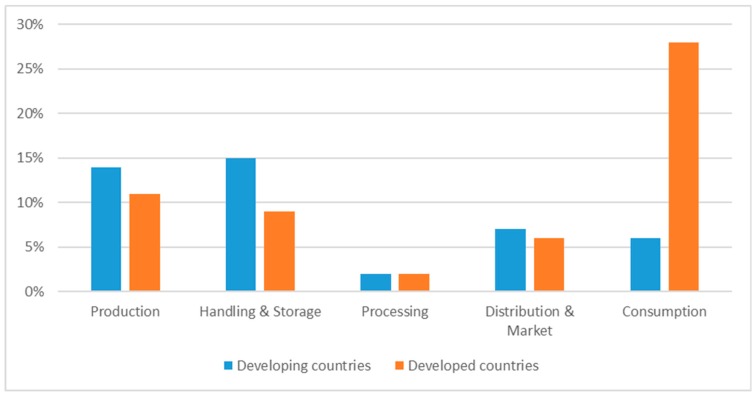
- It reports that in less-developed countries, FLW occurs mainly in the post-harvest and processing stages, which account for approximately 44% of global FLW, while in developed countries 40% of FLW occurs at the consumption stage.
- The review cites specific consumption-side figures: 15.8 million U.S. households were considered food insecure, and reducing FLW by 15% would feed all insecure U.S. households; reducing FLW by 50% could feed an additional one billion people.
- The paper highlights one intervention result: the UK “Love Food, Hate Waste” campaign was associated with a 15% reduction in household food waste and a 21% reduction in avoidable waste from 2007 to 2012; France’s 2015 supermarket law is also described as contributing to France reaching first rank in the 2017 Food Sustainability Index.
## Methods
- The study is a systematic review structured according to PRISMA.
- It reviewed literature from 2001–2018 using Scopus, Science Direct, Jstor, and Google Scholar, plus government and international organization websites; the initial database search returned 82,730 articles.
- After screening, 264 articles remained after title/abstract review, 145 technical-only articles were excluded, and 119 articles were included in the final review.
## Limitations
- The paper states that no commonly agreed-upon definition of FLW exists, which makes FLW difficult to measure, compare, and use for policy design.
- It states that quantification methods are heterogeneous and have weaknesses, and that estimates are difficult to compare across countries and studies because different criteria are used.
- Evident from the text: this is a narrative/systematic review of prior studies rather than original empirical data collection, so its conclusions depend on the quality and comparability of the included literature.
Model-written summary. Check it against the paper before relying on it.
Integrity signals
Registry
Cites
Statistics
Figures
Verification
Claims the paper makes
8 Valid · 1 Not valid · 45 Not checked · 8 Own results and interpretations
The cited sources support only part of this claim — read each source’s verdict below.
In the paper
“However, perishing of the fresh-cut products is accelerated by poor temperature and packaging management [66,84].”
§ Understanding Food Loss and Waste—Why Are We Losing and Wasting Food? > 3. FLW in the Supply Chain > 3.4. FW on Distribution and Marketing Stage
What the sources say
- Partly supportedcites [66] Papargyropoulou E. Lozano R. Steinberger J.K. Wright N. bin Ujang Z. The food waste hierarchy as a framework for the management of food surplus and food waste J. Clean. Prod. 2014 76 106 115 10.1016/j.jclepro.2014.04.020 sourceExperimental — accuracy not yet measured
The table of food losses (Accepted Manuscript, p. 10) lists inappropriate packaging as damaging produce and lack of cooling or cold storage as causing losses. It does not specifically address fresh-cut products or establish that poor management accelerates their perishing. (LLM, conf=0.86)
- Could not verifycites [84] Plazzotta S. Manzocco L. Nicoli M.C. Fruit and vegetable waste management and the challenge of fresh-cut salad Trends Food Sci. Technol. 2017 63 51 59 10.1016/j.tifs.2017.02.013 sourceExperimental — accuracy not yet measured
The discussion of fresh-cut salad (p. 10) says cutting damages tissue and increases the rate of quality depletion during storage. It does not attribute accelerated perishing to poor temperature or packaging management; searches for those terms found no passage making that connection. (LLM, conf=0.76)
plainstates a cause- Asserted: passes — The authors put it forward as true.
- Checkable: passes — It can be checked against evidence.
- Load-bearing: unclear — It is unclear whether the paper’s conclusions depend on it.
- Based: passes — The paper gives a reason why it holds.
- Partly supported
The cited sources support only part of this claim — read each source’s verdict below.
In the paper
“The contamination in a processing line that occurs due to improperly cleaned processing units not sanitized from previous processes is also one of main causes of FL occurrence, especially for animal products [43,66].”
§ Understanding Food Loss and Waste—Why Are We Losing and Wasting Food? > 3. FLW in the Supply Chain > 3.3. Processing and Packaging Stage FL
What the sources say
- Not checked — no full text of the sourcecites [43] Beretta C. Stoessel F. Baier U. Hellweg S. Quantifying food losses and the potential for reduction in Switzerland Waste Manag. 2013 33 764 773 10.1016/j.wasman.2012.11.007 23270687 source
- Partly supportedcites [66] Papargyropoulou E. Lozano R. Steinberger J.K. Wright N. bin Ujang Z. The food waste hierarchy as a framework for the management of food surplus and food waste J. Clean. Prod. 2014 76 106 115 10.1016/j.jclepro.2014.04.020 sourceExperimental — accuracy not yet measured
Table 1 (accepted manuscript, pp. 9–10; also p. 32) lists contamination during processing as causing loss of quality. It does not identify improperly cleaned or unsanitized equipment as the cause, describe contamination as a main cause of food loss, or single out animal products. (LLM, conf=0.86)
plainstates a cause- Asserted: passes — The authors put it forward as true.
- Checkable: passes — It can be checked against evidence.
- Load-bearing: unclear — It is unclear whether the paper’s conclusions depend on it.
- Based: passes — The paper gives a reason why it holds.
The cited sources support only part of this claim — read each source’s verdict below.
In the paper
“Commercial pressure in the marketing stage is also a major cause of food waste [66,85].”
§ Understanding Food Loss and Waste—Why Are We Losing and Wasting Food? > 3. FLW in the Supply Chain > 3.4. FW on Distribution and Marketing Stage
What the sources say
- Partly supportedcites [66] Papargyropoulou E. Lozano R. Steinberger J.K. Wright N. bin Ujang Z. The food waste hierarchy as a framework for the management of food surplus and food waste J. Clean. Prod. 2014 76 106 115 10.1016/j.jclepro.2014.04.020 sourceExperimental — accuracy not yet measured
The food-supply-chain table (Accepted Manuscript, p. 10) identifies losses at the marketing stage, including transport spoilage, poor handling and inadequate cooling. It does not identify commercial pressure as a cause or say it is a major cause of food waste. (LLM, conf=0.79)
- Not checked — no full text of the sourcecites [85] Godfray H.C.J. Beddington J.R. Crute I.R. Haddad L. Lawrence D. Muir J.F. Pretty J. Robinson S. Thomas S.M. Toulmin C. Food security: The challenge of feeding 9 billion people Science 2010 327 812 818 10.1126/science.1185383 20110467 source
plainstates a cause- Asserted: passes — The authors put it forward as true.
- Checkable: passes — It can be checked against evidence.
- Load-bearing: unclear — It is unclear whether the paper’s conclusions depend on it.
- Based: passes — The paper gives a reason why it holds.
- Partly supported
Every source the paper cites for this claim was checked and supports it.
In the paper
“The impact of attitudes and behaviors of individuals on FLW prevention could be limited, as attitudes are not entirely consistent with the actual behaviors (i.e., the attitude–behavior gap, [97]).”
§ Understanding Food Loss and Waste—Why Are We Losing and Wasting Food? > 3. FLW in the Supply Chain > 3.5. Consumption Stage FW
What the sources say
- Supportedcites [97] Schanes K. Dobernig K. Gӧzet B. Food Waste Matters—A Systematic review of household food waste practices and their policy implications J. Clean. Prod. 2018 182 978 991 10.1016/j.jclepro.2018.02.030 source
Section 3.1 (page not provided) explicitly describes an attitude–behaviour gap: intentions to reduce food waste often do not translate into action, and attitudes are not always good indicators of less food being wasted. This supports the citing sentence’s hedged point about the limits of relying on individual attitudes for prevention. (LLM, conf=0.90)
hedged- Asserted: passes — The authors put it forward as true.
- Checkable: passes — It can be checked against evidence.
- Load-bearing: unclear — It is unclear whether the paper’s conclusions depend on it.
- Based: passes — The paper gives a reason why it holds.
- Supported
Every source the paper cites for this claim was checked and supports it.
In the paper
“Jörissen et al. [87] also reported that single-person households generate the most FW per capita.”
§ Understanding Food Loss and Waste—Why Are We Losing and Wasting Food? > 3. FLW in the Supply Chain > 3.5. Consumption Stage FW
What the sources say
- Supportedcites [87] Jörissen J. Priefer C. Bräutigam K.R. Food waste generation at household level: Results of a survey among employees of two European research centers in Italy and Germany Sustainability 2015 7 2695 2715 10.3390/su7032695 source
The Results (section 4.3, p. 8) report that one-person households wasted the most food per capita in both surveyed locations. The Discussion (p. 13) repeats the finding for single-person households. (LLM, conf=0.95)
plainstates an association- Asserted: passes — The authors put it forward as true.
- Checkable: passes — It can be checked against evidence.
- Load-bearing: unclear — It is unclear whether the paper’s conclusions depend on it.
- Based: passes — The paper gives a reason why it holds.
- Supported
34 more claims · 1 with their cited sources checked
Create a free account to see all 62 claims and to verify the 7 references still open.
- It may state two separate claims as one. 15
- Probably not a substantial claim. 9
Claims other papers make about this one
Each is checked against this paper’s own text: does it say what the citing paper says it does?
In the citing paper
“In industrialized countries, food waste, which accounts for approximately 56% of global food waste, is obtained via the latter stages of the supply chain, particularly during processing and consumption [12].”
From From Industrial Food Waste to Bioactive Ingredients: A Review on the Sustainable Management and Transformation of Plant-Derived Food Waste (2023) · cites this paper as [12]
Citations
Cites
Preferred Reporting Items for Systematic Reviews and Meta-Analyses: the PRISMA statement
Moher, D., Liberati, A., Tetzlaff, J., Altman, D. G., & for the PRISMA Group (2009) · BMJ · doi:10.1136/bmj.b2535 · Cited by 83,823
Preferred Reporting Items for Systematic Reviews and Meta-Analyses: The PRISMA Statement
Moher, D., Liberati, A., Tetzlaff, J., Altman, D. G., & The PRISMA Group (2009) · PLoS Medicine · doi:10.1371/journal.pmed.1000097 · Cited by 64,042
Wang, G., Ma, R., Qiao, G., Wada, K., Aizawa, Y., & Satoh, T. (2015) · Integrative Medicine International · doi:10.1159/000368408 · Cited by 18,657
Food Security: The Challenge of Feeding 9 Billion People
Godfray, H. C. J., Beddington, J. R., Crute, I. R., Haddad, L., Lawrence, D., Muir, J. F., Pretty, J., Robinson, S., Thomas, S. M., & Toulmin, C. (2010) · Science · doi:10.1126/science.1185383 · Cited by 11,943
Food waste within food supply chains: quantification and potential for change to 2050
Parfitt, J., Barthel, M., & Macnaughton, S. (2010) · Philosophical Transactions of the Royal Society B: Biological Sciences · doi:10.1098/rstb.2010.0126 · Cited by 3,197 · cited 4×
“However, the absence of an exact quantification method leads to a data problem [24].”
BackgroundInfluentialThe Omnivore's Dilemma: A Natural History of Four Meals
Pollán, M. (2006) · Cited by 2,015
The food waste hierarchy as a framework for the management of food surplus and food waste
Papargyropoulou, E., Lozano, R., K. Steinberger, J., Wright, N., & Ujang, Z. B. (2014) · Journal of Cleaner Production · doi:10.1016/j.jclepro.2014.04.020 · Cited by 1,711 · cited 8×
“Processing and Packaging Stage - Unavoidable losses [2,43,66] - Technical inefficiencies and malfunctions [21,43,78,79] - Methods and changes in processing lines [43] - Contamination in processing lines [21,43,66] - Legislation restrictions [2,66,72,80] - Packaging system [2,65,78,81] - Overproduction [63,82]”
BackgroundInfluentialSchanes, K., Dobernig, K., & Gözet, B. (2018) · Journal of Cleaner Production · doi:10.1016/j.jclepro.2018.02.030 · Cited by 1,365
By-products of plant food processing as a source of functional compounds—Recent developments
Schieber, A., Stintzing, F. C., & Carle, R. (2001) · Trends in Food Science & Technology · doi:10.1016/s0924-2244(02)00012-2 · Cited by 1,334 · cited 2×
“Processing and Packaging Stage - Unavoidable losses [2,43,66] - Technical inefficiencies and malfunctions [21,43,78,79] - Methods and changes in processing lines [43] - Contamination in processing lines [21,43,66] - Legislation restrictions [2,66,72,80] - Packaging system [2,65,78,81] - Overproduction [63,82]”
BackgroundKummu, M., de Moel, H., Porkka, M., Siebert, S., Varis, O., & Ward, P. J. (2012) · Science of The Total Environment · doi:10.1016/j.scitotenv.2012.08.092 · Cited by 1,300 · cited 2×
“The waste of resources caused by global FLW has been estimated to account for 24% of the total usage of freshwater resources and 23% of the global fertilizer use [27].”
Background
Research works printed but not linked: 5
- Bond M. Meacham T. Bhunnoo R. Benton T. Food Waste within Global Food Systems Global Food Security Elsevier Amsterdam, The Netherlands 2013
- Parry M. Parry M.L. Canziani O. Palutikof J. Van der Linden P. Hanson C. Climate Change 2007-Impacts, Adaptation and Vulnerability: Working Group II Contribution to the Fourth Assessment Report of the IPCC Cambridge University Press Cambridge, UK 2007 Volume 4
- Pärn A. Designing a Solution for Food Waste Reduction Master’s Thesis MSc Integrated Food Studies, Aalborg University Aalborg, Denmark 2016
- Farag D. Aflatoxins: Awareness and control Proceedings of the Third Dubai International Food Safety Conference, Organized by Dubai Municipality Dubai, UAE 23–27 February 2008
- Rathje W.L. Murphy C. Rubbish! The Archaeology of Garbage University of Arizona Press Tucson, AZ, USA 2001
Cited by
Items 401–500 of 582
Behavioral Drivers of Food Waste Reduction in Urban Vietnam
Nguyen, T. T. G., & Nguyen, G. H. (2025) · The Journal of Behavioral Science · doi:10.69523/tjbs.2025.278953 · Cited by 3
Pandey, A., Tozer, P. R., & Reid, J. I. (2026) · Cleaner Food Systems · doi:10.1016/j.clfs.2026.100030 · Cited by 2
Smart Detection and Scientific Disinfestation Technologies for Food Grain Protection
Guru, P. N., Sharma, M., Zalpouri, R., Urhe, S. B., Dubey, A., Balakrishnan, R., & Maharana, S. A. (2024) · doi:10.54083/978-81-947739-1-7-4 · Cited by 1
Sventzouri, E., Μάνθος, Γ., Τσίγκου, Κ., Mastropetros, S. G., Pispas, K., Zagklis, D. P., Ali, S. S., & Kornaros, M. E. (2024) · Elsevier eBooks · doi:10.1016/b978-0-443-21801-9.00007-0 · Cited by 1
Omomowo, I. O., Adedayo, A. A., Omomowo, O. I., Majolagbe, O. N., & Ogundola, A. F. (2021) · Journal of Experimental Biology and Agricultural Sciences · doi:10.18006/2021.9(5).663.671 · Cited by 1
Shindano, J., Hachibamba, T., Zgambo, L., Kumwenda, C., Mukuma, M., Nyau, V., Chirwa, M., Sadoki, A., & Moonga, H. B. (2025) · Food Security · doi:10.1007/s12571-025-01567-z · Cited by 3
A quantitative analysis of avoidable food waste in Mexico City households
Vite-Cortez, Z. A., Islas-Maya, A., Álvarez‐Zeferino, J. C., Cruz‐Salas, A. A., Velasco-Pérez, M., Valdemar, R. M. E., Jiménez-Escamilla, I. R., Turpin-Marion, S. J., González-Cardoso, G., Sotelo-Navarro, P. X., et al. (2025) · Waste Management & Research The Journal for a Sustainable Circular Economy · doi:10.1177/0734242x251376874 · Cited by 1
Beldek, C., Sarıyıldız, E., & Alıcı, G. (2025) · Agriculture · doi:10.3390/agriculture15202170 · Cited by 2
Alhumaidan, O. A., & Alsaif, M. A. (2025) · Discover Sustainability · doi:10.1007/s43621-025-02040-9 · Cited by 3
Celton, C., Caton, S., Akoetey, W., Nicol, R., & Hosseinian, F. S. (2023) · Sustainable Agriculture Research · doi:10.5539/sar.v12n2p45 · Cited by 2
Packaging supporting food sustainability
Tichoniuk, M., & Wiszumirska, K. (2024) · doi:10.18559/978-83-8211-209-2/4 · Cited by 1
Development of Bioplastic and Biodegradable Plastics
Giri, N. C., Verma, V., & Patro, B. P. (2022) · Advances in human services and public health (AHSPH) book series · doi:10.4018/978-1-7998-9723-1.ch011 · Cited by 4
An insight into food waste generations: Status, source, and global impact
Rao, S., & Nagendra, A. (2025) · Elsevier eBooks · doi:10.1016/b978-0-443-36302-3.00004-2 · Cited by 4
Multivariate analysis of food sufficiency and its determinants: global and European context
Poláková, Z., Matejková, E., Palkovič, J., Soóki, M., & Májek, M. (2024) · Slovenská poľnohospodárska univerzita v Nitre eBooks · doi:10.15414/2024.9788055227375 · Cited by 1
Andersen, M. S. B., & Säterö, R. (2020) · Cited by 1
Digital Twins for Food Supply Chain Sustainability: Rapid Literature Review and Conceptual Model
Bouraya, S., & Korchi, A. E. (2025) · International Conference on Industrial Engineering and Operations Management (IEOM) · doi:10.46254/af6.20250148 · Cited by 2
Zoubi, A., Taha, A., Mayad, E. H., Hallouti, A., Boulli, A., & Abbas, Y. (2025) · International journal on food system dynamics · doi:10.18461/ijfsd.v16i1o3 · Cited by 1
A study of potential food loss and food waste of agricultural commodities in Indonesia
Taufiqi, H., Bagastyo, A. Y., Titah, H. S., & Radita, D. R. (2025) · IOP Conference Series Earth and Environmental Science · doi:10.1088/1755-1315/1556/1/012040 · Cited by 6
Valorization of Waste from Bell Pepper: Chemical Composition and Bioactive Potential
Baessa, J., Liberal, Â., Finimundy, T. C., Stojković, D. S., Mišić, D. M., Pires, T. C. S. P., Barros, L., & Fernandes, Â. S. F. (2025) · Waste and Biomass Valorization · doi:10.1007/s12649-025-03395-w · Cited by 2
Biological and pharmaceutical activities of polysaccharides
Bourais, I., Elmarrkechy, S., Machich, O., Nassif, A., Taha, D., & Bouyahya, A. (2023) · Elsevier eBooks · doi:10.1016/b978-0-323-90780-4.00025-5 · Cited by 3
Samuel, C. E., Jumbo, R. B., & Abbey, S. J. (2026) · Agroecology and Sustainable Food Systems · doi:10.1080/21683565.2026.2683512 · Cited by 1
De, B., & Das, R. C. (2025) · Quality & Quantity · doi:10.1007/s11135-025-02129-3 · Cited by 2
Yazdanpanah, S., Sepe, F., Romano, S., Valentino, A., Petillo, O., Peluso, G., Conte, R., & Calarco, A. (2026) · Current Issues in Molecular Biology · doi:10.3390/cimb48050459 · Cited by 1
Khairunisa, K., Setiawati, S., & Wulan, S. (2023) · Jurnal Penelitian Pendidikan IPA · doi:10.29303/jppipa.v9i10.4415 · Cited by 2
Extraction of Bio-Solvent from Fruit and Vegetable Processing Wastes
Ojha, A., Kumar, A., Kumar, S., & Bandyopadhyay, T. K. (2025) · Methods and protocols in food science · doi:10.1007/978-1-0716-4763-9_9 · Cited by 1
Andrade, J. (2021) · RiuNet (Universitat Politècnica de València) · doi:10.4995/thesis/10251/175566 · Cited by 2
Bell, V., Ferrão, J., Guina, J. A., & Fernandes, T. H. (2026) · Agriculture & Food Security · doi:10.1186/s40066-025-00576-7 · Cited by 2
Sustainable food processing waste management for environmental protection
Ogwu, M. C., Malikia, C. N., Stansfield, A., Gonzalez-Torres, A. D., & Izah, S. C. (2024) · Elsevier eBooks · doi:10.1016/b978-0-443-15291-7.00010-9 · Cited by 2
Reducing Food Loss and Waste in the Hospitality and Food Service Sector: A Design Thinking Approach
Ezeanaka, C., & Tran, T. H. (2024) · Highlights of Sustainability · doi:10.54175/hsustain3040021 · Cited by 4
Kumar, M. A., Moradeeya, P. G., Bharath, K. M., Mary, P. J. D., & Giridharan, K. S. (2024) · Energy, environment, and sustainability · doi:10.1007/978-981-97-2523-6_11 · Cited by 2
From waste to wealth: Innovating with food by-products
Sinha, S., Ratan, R., Halder, R., Chandrakar, N., Banerjee, M., & Bhowmick, G. D. (2026) · Food and Humanity · doi:10.1016/j.foohum.2026.101054 · Cited by 7
Food applications of pomegranate peel bioactive compounds
Kantureyeva, G. O. (2025) · Elsevier eBooks · doi:10.1016/b978-0-443-22390-7.00001-6 · Cited by 2
Hindayani, A., Mulyana, M. R., Budiman, H., Darmayanti, N. T. E., & Zuas, O. (2020) · PERIÓDICO TCHÊ QUÍMICA · doi:10.52571/ptq.v17.n36.2020.689_periodico36_pgs_674_687.pdf · Cited by 1
Applying Circular Economy Thinking to Food Systems in the Hospitality Industry in Nigeria
Okupe, A. (2023) · Sustainable development goals series · doi:10.1007/978-981-99-3083-8_12 · Cited by 1
UTILIZING BLOCKCHAIN TECHNOLOGY TO TACKLE FOOD WASTE IN SMART CITIES
Plakas, G., Ponis, S. T., Tzanetou, D., & Kitsantas, E. A. A. A. (2023) · IADIS International Conferences on ICT, Society and Human Beings, e-Health, Connected Smart Cities and Big Data Analytics, Data Mining and Computational Intelligence (ICT/EH/CSC/BigDaCI) · doi:10.33965/mccsis2023_202305c012 · Cited by 1
Metabolomics application for food quality improvement and reduction of food loss
Yunindanova, M. B., & Putri, S. P. (2024) · AIP conference proceedings · doi:10.1063/5.0195076 · Cited by 1
Strategies to Curb Food Waste on University Campuses: A Scoping Review
Dyrbye-Wright, O., Stull, V. J., Grabow, M. L., & Patz, J. (2025) · Journal of Sustainability Research · doi:10.20900/jsr20250034 · Cited by 5
TWIZERIMANA, T., & Safari, E. (2023) · Journal of Hospitality and Tourism Management · doi:10.53819/81018102t5258 · Cited by 1
Nethra, J., Deepa, S., & Adeyeye, S. A. O. (2026) · Journal of Food Process Engineering · doi:10.1111/jfpe.70647 · Cited by 3
The impact of molecular hydrogen in food, health and agriculture: An updated review
Akpoghelie, P. O., Edo, G. I., Ali, A. B. M., lwanegbe, L., Yousif, E., Owheruo, J. O., Oghroro, E. E. A., Igbuku, U. A., Essaghah, A. E. A., Unuofin, J. O., et al. (2025) · Sustainable Chemistry One World · doi:10.1016/j.scowo.2025.100153 · Cited by 1
Phosphate fertilization to improve yield and chemical composition of banana ‘BRS SCS Belluna’ fruit
Cândido, H. T., Leonel, M., Leonel, S., de Jesus, P. R. R., dos Ouros, L. F., Molha, N. Z., & Domiciano, V. M. (2024) · Journal of Plant Nutrition · doi:10.1080/01904167.2024.2387806 · Cited by 1
A modern cloud based recycling system for smart cities
Baras, N., Ziouzios, D., Dasygenis, M., & Tsanaktsidis, C. G. (2021) · International Conference on Modern Circuits and Systems Technologies · doi:10.1109/mocast52088.2021.9493420 · Cited by 2
From ethical consumers to collective action: advancing healthy and sustainable food systems
Freeman, C., Smith, K., & Cullerton, K. B. (2025) · Health Sociology Review · doi:10.1080/14461242.2025.2594616 · Cited by 1
Relative Benefits of a Multi-Agent System Framework for Waste Reduction in Precision Agriculture
Naveen, M. V., & Ramesh, T. R. (2026) · doi:10.1109/ic-aida68291.2026.11564402 · Cited by 1
Parameshwar, S., Verma, D., Nangan, S., Jain, S., Varshney, D., & Singh, S. (2025) · Journal of Nanotechnology · doi:10.1155/jnt/2060809 · Cited by 1
MEYER, S. E. (2022) · Carleton University's Institutional Repository (MacOdrum Library, Carleton University) · doi:10.22215/etd/2022-14853 · Cited by 1
Mapping Food Losses in International Supply Chains: A Case Study of India’s Marine and Meat Exports
Singh, S., & Singh, R. (2023) · Journal of International Food & Agribusiness Marketing · doi:10.1080/08974438.2023.2288091 · Cited by 1
Composition, structure and comprehensive utilization of abalone shell: A review
Li, M.-Y., Wu, Y., Huang, L., Gong, P.-X., & Li, H. (2024) · Sustainable Chemistry and Pharmacy · doi:10.1016/j.scp.2024.101892 · Cited by 3
Global city goes local? State ambitions and societal undercurrents of food localisation in Singapore
Soh, E. (2025) · Geoforum · doi:10.1016/j.geoforum.2025.104484 · Cited by 1
Food loss and waste reduction – a new challenge for all stakeholders in food supply chain
Vaško, Ž., & Jalić, N. (2024) · Edicija Održivi razvoj i upravljanje prirodnim resursima Republike Srpske. · doi:10.7251/eoru2410553v
Kumar, N., Neeraj, N. A., Aditya, A., & Pratibha, N. A. (2026) · Food and Feed Research · doi:10.5937/ffr0-62055
Khan, M. M. H., & Katajajuuri, J. (2025) · Springer eBooks · doi:10.1007/978-3-031-87492-5_5
Food Waste Management Practices: The Case of Invercargill’s Food and Beverages Sector in New Zealand
Santamaria, Y., & Omisakin, O. M. (2025) · Journal of Sustainability Research · doi:10.20900/jsr20250019
Functional and sustainable savory snack formulation through olive and brewing industry by-products
Bonucci, A., Veneziani, G., Dottori, I., Bravi, E., Dicorato, M., Francesco, G. D., Esposto, S., & Marconi, O. (2026) · Future Foods · doi:10.1016/j.fufo.2026.100947
Suresh, M., Meyyazhagan, A., Bhotla, H. K., Pappuswamy, M., & Balasubramanian, B. (2026) · Food Chemistry International · doi:10.1002/fci2.70090
Recent Advances in Biogas Production from Food Waste
Pandit, G. K., Tiwari, R. K., Shanvi, Singh, V., & Singh, M. (2022) · Clean Energy Production Technologies · doi:10.1007/978-981-19-0813-2_5
Maja, A., Mojapelo, N. A., September, L. A., Seroka, N. S., & Khotseng, L. E. (2026) · Next Materials · doi:10.1016/j.nxmate.2026.103367
Teenagers’ Intention on Sustainable Development- A Food Delivery App – Based Analysis
Mathur, P., & Mathur, V. K. (2023) · SDMIMD Journal of Management · doi:10.18311/sdmimd/2023/32470
Nanomaterial for Postharvest Management
Durr-e-Nayab, Bangash, N., Arshad, N., Hayat, M. T., & Akhtar, S. (2024) · Nanotechnology in the life sciences · doi:10.1007/978-3-031-76000-6_12 · Cited by 1
Processing and flavoring meat analogues
Snel, S. J. E. (2023) · doi:10.18174/633616
Consumer food waste as household technical inefficiency across countries and time
Vieira, D., Barrera, E. L., & Ferreira, M. D. P. (2026) · American Journal of Agricultural Economics · doi:10.1002/ajae.70040
Beyond the menu: assessing the environmental and social impact of institutional meals
Pérez, A. T. E., Melo, I. C., & Alves, P. N. (2026) · International Journal of Sustainability in Higher Education · doi:10.1108/ijshe-05-2025-0413
van Berkum, S., & Berkhout, E. (2022) · doi:10.18174/567258
Balaguer, L., García‐Gonzalo, D., Pagán, R., Berdejo, D., Espina, L., & Merino, N. (2026) · Methods and protocols in food science · doi:10.1007/978-1-0716-5064-6_10
Chandra, C., & Arnakim, L. Y. (2025) · Discover Sustainability · doi:10.1007/s43621-025-01218-5 · Cited by 2
Redefining sustainability in travel and hospitality to achieve net-zero tourism
Olawade, D. B., Wada, O. Z., Ijiwade, J. O., & Adeniji, Y. J. (2026) · Elsevier eBooks · doi:10.1016/b978-0-443-44454-8.00017-0
Acceptance of Food Products Containing Upcycled Ingredients
Doran, J. M., Fox, S., & Dermiki, M. (2026) · Lecture notes on multidisciplinary industrial engineering · doi:10.1007/978-3-032-19652-1_3
Smart Kitchenmate AI: An Intelligent Assistant for Cooking
K, D. V., Abisha, K., & Akshaya, G. (2026) · International Conference on Augmented Intelligence and Sustainable Systems (ICAISS) · doi:10.1109/icaiss68683.2026.11525886
Sustainable Food Systems: Case Studies of Successful Insect-Based Enterprises
Abajue, M. C., & Wogu, M. N. (2025) · Springer eBooks · doi:10.1007/978-3-031-90087-7_12
Yumna, A. H., Ulfa, M., Razalli, N. H., Rajikan, R., Akca, N., & Saygılı, M. (2025) · Jurnal Kesehatan Lingkungan Indonesia · doi:10.14710/jkli.71214
Bagheri, M., Pröpper, A., & Klein, G. (2025) · Energy Efficiency · doi:10.1007/s12053-025-10343-z
Magwedere, K. (2026) · Research Square · doi:10.21203/rs.3.rs-8944048/v1
From Waste to Harvest: Organic Fertilizers from Food Waste for Achieving Zero Hunger
Gupta, S., Mishra, S., Gupta, G. S., Mishra, A. K., Madheshiya, P., & Tiwari, S. (2026) · Springer eBooks · doi:10.1007/978-3-032-22472-9_12
Wasting Food Practice on Tiktok: Micro-Fame, Profit, and Trendiness
Syahriyani, A., Nurazizah, I. A., Sakinata, A., & Putri, A. S. (2023) · LONTAR Jurnal Ilmu Komunikasi · doi:10.30656/lontar.v11i2.7576
Alviana, D., Romadlon, F., Zulherman, D., & Ahmad, W. N. K. W. (2026) · 2026 ASU International Conference in Emerging Technologies for Sustainability and Intelligent Systems (ICETSIS) · doi:10.1109/icetsis68266.2026.11549296
Food waste in traditional cultural foods: evidence from the mooncake industry in China
Zhang, P., Liu, L., Zhu, X., Sun, F., & Lin, J. (2026) · Frontiers in Sustainable Food Systems · doi:10.3389/fsufs.2026.1910791
Variation in Nutrient Availability for Aquatic Phototrophs and Its Ecological Consequences
MABERLY, S. C. (2024) · Cambridge University Press eBooks · doi:10.1017/9781139049979.021
Functional potential of fruits and vegetables: From peels to pits
Siddiqui, H., & Sajid, M. (2026) · Elsevier eBooks · doi:10.1016/b978-0-443-34071-0.00003-8
The Evolution of Feeding Concepts and Technologies: Past, Present, and Future
Ammar, E. E., Sallam, A. S., Ekramy, S., EL-Shershaby, N. A., & Zou, X. (2025) · Emerald Group Publishing Limited eBooks · doi:10.1108/978-1-83608-388-720251005
Factors Affecting the Waste of Selected Agricultural Products with an Emphasis on the Marketing Mix
mahmoudi, M., Mohammadi, H., Saghaian, S., & Karbasi, A. R. (2024) · Agriculture · doi:10.3390/agriculture14060857 · Cited by 3
Biohydrogen Production from Potato Waste Using Dark Fermentation
Shahab, N. (2023) · Sheffield Hallam University · doi:10.7190/shu-thesis-00553 · Cited by 1
Postharvest waste management and circular bioeconomy: innovations, gaps, and opportunities
Mohanty, A., Mankoti, M., & Meena, S. S. (2023) · Elsevier eBooks · doi:10.1016/b978-0-323-91132-0.00014-9 · Cited by 3
Role of IOT in Food Processing Industries- A Comprehensive Review
Ul, I. Z., Asif, M. S., & Ahmad, A. (2025) · Current Functional Foods · doi:10.2174/0126668629372253250317043939
Metadata
- Authors
- Ishangulyyev, R., Kim, S., & Lee, S.
- Affiliations
- Department of Information, Turkmen Agricultural Institute, Dashoguz 746300, Turkmenistan
- Korea Rural Economic Institute (KR)
- Kangwon National University (KR)
- Corresponding author
- Lee, Sang
- Venue
- Foods
- Publisher
- MDPI AG
- Published
- 2019-07-29
- Volume
- 8
- Issue
- 8
- Pages
- 297
- ISSN
- 2304-8158 (ISSN-L)
- PMC
- PMC6723314
- OpenAlex
- W2965917027
- Semantic Scholar
- 3e99fc9fdc50d5317aa7ccfd8f3fd4bf3f96c91f
- Cited by
- 586
- References
- 82
- Citations by year
- 2026: 75 · 2025: 109 · 2024: 139 · 2023: 105 · 2022: 71 · 2021: 61 · 2020: 25 · 2019: 1
- FWCI
- 3.55
- Type
- journal article
- Language
- en
- Open access
- gold
- dx.doi.org
- Licence
- Locations
- Foods (publishedVersion, cc-by)
- Europe PMC (PubMed Central) (publishedVersion, cc-by)
- PubMed Central (publishedVersion, cc-by)
- PubMed (publishedVersion)
- DOAJ (DOAJ: Directory of Open Access Journals) (submittedVersion)
- Funders
- U.S. Environmental Protection Agency
- Kangwon National University
- Topics
- Life Sciences › Agricultural and Biological Sciences › Food Science › Food Waste Reduction and Sustainability
- Physical Sciences › Environmental Science › Ecology › Agriculture Sustainability and Environmental Impact
- Life Sciences › Agricultural and Biological Sciences › General Agricultural and Biological Sciences › Food Security and Socioeconomic Dynamics
- Keywords
- food loss, food waste, food supply chain, food waste prevention, sociodemographic factors, political and economic factors, cultural factors, global variation
About these checks
Registry, retraction, Cites and statistics results are computed, not judged, with one exception: a printed reference that no index lists is read once by a model before it counts as a citation error. Claims are extracted by a model and kept only when their quote appears verbatim in the text; each cited source is then checked, with a model’s help, for whether it says what the claim relies on. Those verdicts can be wrong — read the claim’s quote and the cited source before relying on one.
The claim verdicts this report counts are experimental: their accuracy is not yet measured.
A language model drew the claims from the paper on 2026-10-10, under version 3 of the claim definition (model deepseek-v4.1-flash, prompt extract-v3).
A second model labelled each claim on 2026-10-10 (model jev-1.13-20260917, definition revision gold-guideline-v0.2).
Cited sources are checked with a language model’s help (gpt-6-sol).
Statistics and arithmetic are recomputed, not judged.
Confidence bands are shown only for fields calibrated on our annotated test set. None is calibrated yet, so no band is shown.
What counts as a claim ›How we measure confidence ›How we check this ›
Are you an author, or do you see a problem with this page? Request a review
Data sources
Bibliographic data: Semantic Scholar, OpenAlex, Crossref.
Contains information from the Semantic Scholar Academic Graph Datasets, made available under the ODC Attribution License (ODC-BY 1.0).
Semantic Scholar’s data is described in: Kinney, R., et al. (2023). The Semantic Scholar Open Data Platform. arXiv:2301.10140.
