

Understanding Food Loss and Waste—Why Are We Losing and Wasting Food?
Open accessThe DOI matches its Crossref record; 78 of the 82 references it cites were found in a registry or an index, and 1 are not checked yet; 10 of the 74 sources its claims cite were checked for support.
Abstract
The Food and Agricultural Organization (FAO) reported that approximately one-third of all produced foods (1.3 billion tons of edible food) for human consumption is lost and wasted every year across the entire supply chain. Significant impacts of food loss and waste (FLW) have increased interest in establishing prevention programs around the world. This paper aims to provide an overview of FLW occurrence and prevention. Economic, political, cultural, and socio-demographic drivers of FLW are described, highlighting the global variation. This approach might be particularly helpful for scientists, governors, and policy makers to identify the global variation and to focus on future implications. The main focus here was to identify the cause of the FLW occurrence throughout the food supply chain. We have created a framework for FLW occurrence at each stage of the food supply chain. Several feasible solutions are provided based on the framework.
Verified 2026-11-25 · 1 reference not checked yet
Overview
CoChat Summary
## TL;DR
This paper is a systematic review of food loss and waste (FLW) that maps where losses occur along the food supply chain, why they happen, and what kinds of policies and practices can reduce them. It argues that FLW is driven by different factors at production, storage, distribution, and consumption stages, and that prevention requires stage-specific, coordinated action.
## Key findings
- The paper states that about one-third of all produced food is lost and wasted every year, equal to 1.3 billion tons of edible food; its monetary value is estimated at about USD $936 billion.
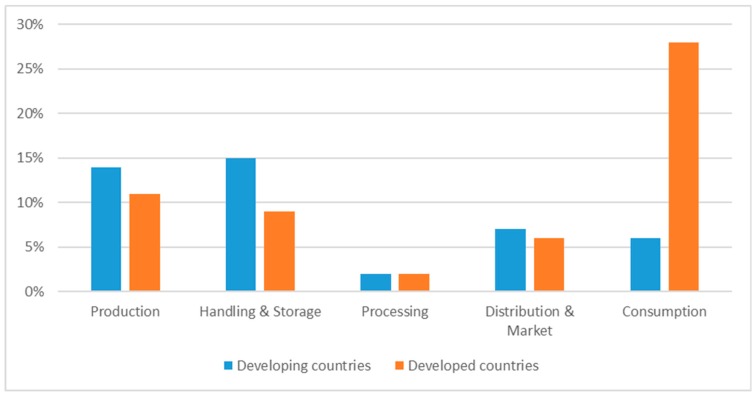
- It reports that in less-developed countries, FLW occurs mainly in the post-harvest and processing stages, which account for approximately 44% of global FLW, while in developed countries 40% of FLW occurs at the consumption stage.
- The review cites specific consumption-side figures: 15.8 million U.S. households were considered food insecure, and reducing FLW by 15% would feed all insecure U.S. households; reducing FLW by 50% could feed an additional one billion people.
- The paper highlights one intervention result: the UK “Love Food, Hate Waste” campaign was associated with a 15% reduction in household food waste and a 21% reduction in avoidable waste from 2007 to 2012; France’s 2015 supermarket law is also described as contributing to France reaching first rank in the 2017 Food Sustainability Index.
## Methods
- The study is a systematic review structured according to PRISMA.
- It reviewed literature from 2001–2018 using Scopus, Science Direct, Jstor, and Google Scholar, plus government and international organization websites; the initial database search returned 82,730 articles.
- After screening, 264 articles remained after title/abstract review, 145 technical-only articles were excluded, and 119 articles were included in the final review.
## Limitations
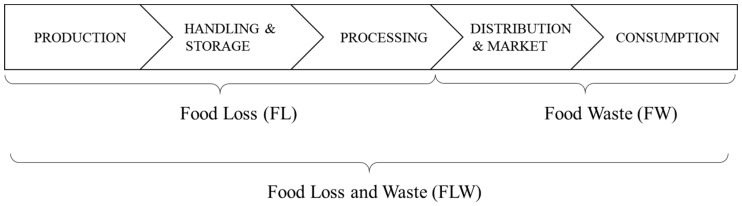
- The paper states that no commonly agreed-upon definition of FLW exists, which makes FLW difficult to measure, compare, and use for policy design.
- It states that quantification methods are heterogeneous and have weaknesses, and that estimates are difficult to compare across countries and studies because different criteria are used.
- Evident from the text: this is a narrative/systematic review of prior studies rather than original empirical data collection, so its conclusions depend on the quality and comparability of the included literature.
Model-written summary. Check it against the paper before relying on it.
Integrity signals
Registry
Cites
Statistics
Figures
Verification
Claims the paper makes
8 Valid · 1 Not valid · 45 Not checked · 8 Own results and interpretations
The cited sources support only part of this claim — read each source’s verdict below.
In the paper
“However, perishing of the fresh-cut products is accelerated by poor temperature and packaging management [66,84].”
§ Understanding Food Loss and Waste—Why Are We Losing and Wasting Food? > 3. FLW in the Supply Chain > 3.4. FW on Distribution and Marketing Stage
What the sources say
- Partly supportedcites [66] Papargyropoulou E. Lozano R. Steinberger J.K. Wright N. bin Ujang Z. The food waste hierarchy as a framework for the management of food surplus and food waste J. Clean. Prod. 2014 76 106 115 10.1016/j.jclepro.2014.04.020 sourceExperimental — accuracy not yet measured
The table of food losses (Accepted Manuscript, p. 10) lists inappropriate packaging as damaging produce and lack of cooling or cold storage as causing losses. It does not specifically address fresh-cut products or establish that poor management accelerates their perishing. (LLM, conf=0.86)
- Could not verifycites [84] Plazzotta S. Manzocco L. Nicoli M.C. Fruit and vegetable waste management and the challenge of fresh-cut salad Trends Food Sci. Technol. 2017 63 51 59 10.1016/j.tifs.2017.02.013 sourceExperimental — accuracy not yet measured
The discussion of fresh-cut salad (p. 10) says cutting damages tissue and increases the rate of quality depletion during storage. It does not attribute accelerated perishing to poor temperature or packaging management; searches for those terms found no passage making that connection. (LLM, conf=0.76)
plainstates a cause- Asserted: passes — The authors put it forward as true.
- Checkable: passes — It can be checked against evidence.
- Load-bearing: unclear — It is unclear whether the paper’s conclusions depend on it.
- Based: passes — The paper gives a reason why it holds.
- Partly supported
The cited sources support only part of this claim — read each source’s verdict below.
In the paper
“The contamination in a processing line that occurs due to improperly cleaned processing units not sanitized from previous processes is also one of main causes of FL occurrence, especially for animal products [43,66].”
§ Understanding Food Loss and Waste—Why Are We Losing and Wasting Food? > 3. FLW in the Supply Chain > 3.3. Processing and Packaging Stage FL
What the sources say
- Not checked — no full text of the sourcecites [43] Beretta C. Stoessel F. Baier U. Hellweg S. Quantifying food losses and the potential for reduction in Switzerland Waste Manag. 2013 33 764 773 10.1016/j.wasman.2012.11.007 23270687 source
- Partly supportedcites [66] Papargyropoulou E. Lozano R. Steinberger J.K. Wright N. bin Ujang Z. The food waste hierarchy as a framework for the management of food surplus and food waste J. Clean. Prod. 2014 76 106 115 10.1016/j.jclepro.2014.04.020 sourceExperimental — accuracy not yet measured
Table 1 (accepted manuscript, pp. 9–10; also p. 32) lists contamination during processing as causing loss of quality. It does not identify improperly cleaned or unsanitized equipment as the cause, describe contamination as a main cause of food loss, or single out animal products. (LLM, conf=0.86)
plainstates a cause- Asserted: passes — The authors put it forward as true.
- Checkable: passes — It can be checked against evidence.
- Load-bearing: unclear — It is unclear whether the paper’s conclusions depend on it.
- Based: passes — The paper gives a reason why it holds.
The cited sources support only part of this claim — read each source’s verdict below.
In the paper
“Commercial pressure in the marketing stage is also a major cause of food waste [66,85].”
§ Understanding Food Loss and Waste—Why Are We Losing and Wasting Food? > 3. FLW in the Supply Chain > 3.4. FW on Distribution and Marketing Stage
What the sources say
- Partly supportedcites [66] Papargyropoulou E. Lozano R. Steinberger J.K. Wright N. bin Ujang Z. The food waste hierarchy as a framework for the management of food surplus and food waste J. Clean. Prod. 2014 76 106 115 10.1016/j.jclepro.2014.04.020 sourceExperimental — accuracy not yet measured
The food-supply-chain table (Accepted Manuscript, p. 10) identifies losses at the marketing stage, including transport spoilage, poor handling and inadequate cooling. It does not identify commercial pressure as a cause or say it is a major cause of food waste. (LLM, conf=0.79)
- Not checked — no full text of the sourcecites [85] Godfray H.C.J. Beddington J.R. Crute I.R. Haddad L. Lawrence D. Muir J.F. Pretty J. Robinson S. Thomas S.M. Toulmin C. Food security: The challenge of feeding 9 billion people Science 2010 327 812 818 10.1126/science.1185383 20110467 source
plainstates a cause- Asserted: passes — The authors put it forward as true.
- Checkable: passes — It can be checked against evidence.
- Load-bearing: unclear — It is unclear whether the paper’s conclusions depend on it.
- Based: passes — The paper gives a reason why it holds.
- Partly supported
Every source the paper cites for this claim was checked and supports it.
In the paper
“The impact of attitudes and behaviors of individuals on FLW prevention could be limited, as attitudes are not entirely consistent with the actual behaviors (i.e., the attitude–behavior gap, [97]).”
§ Understanding Food Loss and Waste—Why Are We Losing and Wasting Food? > 3. FLW in the Supply Chain > 3.5. Consumption Stage FW
What the sources say
- Supportedcites [97] Schanes K. Dobernig K. Gӧzet B. Food Waste Matters—A Systematic review of household food waste practices and their policy implications J. Clean. Prod. 2018 182 978 991 10.1016/j.jclepro.2018.02.030 source
Section 3.1 (page not provided) explicitly describes an attitude–behaviour gap: intentions to reduce food waste often do not translate into action, and attitudes are not always good indicators of less food being wasted. This supports the citing sentence’s hedged point about the limits of relying on individual attitudes for prevention. (LLM, conf=0.90)
hedged- Asserted: passes — The authors put it forward as true.
- Checkable: passes — It can be checked against evidence.
- Load-bearing: unclear — It is unclear whether the paper’s conclusions depend on it.
- Based: passes — The paper gives a reason why it holds.
- Supported
Every source the paper cites for this claim was checked and supports it.
In the paper
“Jörissen et al. [87] also reported that single-person households generate the most FW per capita.”
§ Understanding Food Loss and Waste—Why Are We Losing and Wasting Food? > 3. FLW in the Supply Chain > 3.5. Consumption Stage FW
What the sources say
- Supportedcites [87] Jörissen J. Priefer C. Bräutigam K.R. Food waste generation at household level: Results of a survey among employees of two European research centers in Italy and Germany Sustainability 2015 7 2695 2715 10.3390/su7032695 source
The Results (section 4.3, p. 8) report that one-person households wasted the most food per capita in both surveyed locations. The Discussion (p. 13) repeats the finding for single-person households. (LLM, conf=0.95)
plainstates an association- Asserted: passes — The authors put it forward as true.
- Checkable: passes — It can be checked against evidence.
- Load-bearing: unclear — It is unclear whether the paper’s conclusions depend on it.
- Based: passes — The paper gives a reason why it holds.
- Supported
34 more claims · 1 with their cited sources checked
Create a free account to see all 62 claims and to verify the 7 references still open.
- It may state two separate claims as one. 15
- Probably not a substantial claim. 9
Claims other papers make about this one
Each is checked against this paper’s own text: does it say what the citing paper says it does?
In the citing paper
“In industrialized countries, food waste, which accounts for approximately 56% of global food waste, is obtained via the latter stages of the supply chain, particularly during processing and consumption [12].”
From From Industrial Food Waste to Bioactive Ingredients: A Review on the Sustainable Management and Transformation of Plant-Derived Food Waste (2023) · cites this paper as [12]
Citations
Cites
Preferred Reporting Items for Systematic Reviews and Meta-Analyses: the PRISMA statement
Moher, D., Liberati, A., Tetzlaff, J., Altman, D. G., & for the PRISMA Group (2009) · BMJ · doi:10.1136/bmj.b2535 · Cited by 83,823
Preferred Reporting Items for Systematic Reviews and Meta-Analyses: The PRISMA Statement
Moher, D., Liberati, A., Tetzlaff, J., Altman, D. G., & The PRISMA Group (2009) · PLoS Medicine · doi:10.1371/journal.pmed.1000097 · Cited by 64,042
Wang, G., Ma, R., Qiao, G., Wada, K., Aizawa, Y., & Satoh, T. (2015) · Integrative Medicine International · doi:10.1159/000368408 · Cited by 18,657
Food Security: The Challenge of Feeding 9 Billion People
Godfray, H. C. J., Beddington, J. R., Crute, I. R., Haddad, L., Lawrence, D., Muir, J. F., Pretty, J., Robinson, S., Thomas, S. M., & Toulmin, C. (2010) · Science · doi:10.1126/science.1185383 · Cited by 11,943
Food waste within food supply chains: quantification and potential for change to 2050
Parfitt, J., Barthel, M., & Macnaughton, S. (2010) · Philosophical Transactions of the Royal Society B: Biological Sciences · doi:10.1098/rstb.2010.0126 · Cited by 3,197 · cited 4×
“However, the absence of an exact quantification method leads to a data problem [24].”
BackgroundInfluentialThe Omnivore's Dilemma: A Natural History of Four Meals
Pollán, M. (2006) · Cited by 2,015
The food waste hierarchy as a framework for the management of food surplus and food waste
Papargyropoulou, E., Lozano, R., K. Steinberger, J., Wright, N., & Ujang, Z. B. (2014) · Journal of Cleaner Production · doi:10.1016/j.jclepro.2014.04.020 · Cited by 1,711 · cited 8×
“Processing and Packaging Stage - Unavoidable losses [2,43,66] - Technical inefficiencies and malfunctions [21,43,78,79] - Methods and changes in processing lines [43] - Contamination in processing lines [21,43,66] - Legislation restrictions [2,66,72,80] - Packaging system [2,65,78,81] - Overproduction [63,82]”
BackgroundInfluentialSchanes, K., Dobernig, K., & Gözet, B. (2018) · Journal of Cleaner Production · doi:10.1016/j.jclepro.2018.02.030 · Cited by 1,365
By-products of plant food processing as a source of functional compounds—Recent developments
Schieber, A., Stintzing, F. C., & Carle, R. (2001) · Trends in Food Science & Technology · doi:10.1016/s0924-2244(02)00012-2 · Cited by 1,334 · cited 2×
“Processing and Packaging Stage - Unavoidable losses [2,43,66] - Technical inefficiencies and malfunctions [21,43,78,79] - Methods and changes in processing lines [43] - Contamination in processing lines [21,43,66] - Legislation restrictions [2,66,72,80] - Packaging system [2,65,78,81] - Overproduction [63,82]”
BackgroundKummu, M., de Moel, H., Porkka, M., Siebert, S., Varis, O., & Ward, P. J. (2012) · Science of The Total Environment · doi:10.1016/j.scitotenv.2012.08.092 · Cited by 1,300 · cited 2×
“The waste of resources caused by global FLW has been estimated to account for 24% of the total usage of freshwater resources and 23% of the global fertilizer use [27].”
Background
Research works printed but not linked: 5
- Bond M. Meacham T. Bhunnoo R. Benton T. Food Waste within Global Food Systems Global Food Security Elsevier Amsterdam, The Netherlands 2013
- Parry M. Parry M.L. Canziani O. Palutikof J. Van der Linden P. Hanson C. Climate Change 2007-Impacts, Adaptation and Vulnerability: Working Group II Contribution to the Fourth Assessment Report of the IPCC Cambridge University Press Cambridge, UK 2007 Volume 4
- Pärn A. Designing a Solution for Food Waste Reduction Master’s Thesis MSc Integrated Food Studies, Aalborg University Aalborg, Denmark 2016
- Farag D. Aflatoxins: Awareness and control Proceedings of the Third Dubai International Food Safety Conference, Organized by Dubai Municipality Dubai, UAE 23–27 February 2008
- Rathje W.L. Murphy C. Rubbish! The Archaeology of Garbage University of Arizona Press Tucson, AZ, USA 2001
Cited by
Biodegradable Plastics: Standards, Policies, and Impacts
Filiciotto, L., & Rothenberg, G. (2021) · ChemSusChem · doi:10.1002/cssc.202002044 · Cited by 495
Microbial spoilage of vegetables, fruits and cereals
Alegbeleye, O., Odeyemi, O. A., Strateva, M., & Stratev, D. (2022) · Applied Food Research · doi:10.1016/j.afres.2022.100122 · Cited by 389
Biodegradable Antimicrobial Food Packaging: Trends and Perspectives
Motelica, L., Ficai, D., Ficai, A., Oprea, O. C., Kaya, D. A., & Andronescu, E. (2020) · Foods · doi:10.3390/foods9101438 · Cited by 389
Roy, P., Mohanty, A. K., Dick, P., & Misra, M. (2023) · ACS Environmental Au · doi:10.1021/acsenvironau.2c00050 · Cited by 376
An overview of fermentation in the food industry - looking back from a new perspective
Siddiqui, S. A., Erol, Z., Rugji, J., Taşçı, F., Kahraman, H. A., Toppi, V., Musa, L., Di Giacinto, G., Bahmid, N. A., Mehdizadeh, M., et al. (2023) · Bioresources and Bioprocessing · doi:10.1186/s40643-023-00702-y · Cited by 311
“A high proportion of nutrients are found in plant-based food processing waste, including pulp, peels, and silage, but these materials are typically disposed of in landfills or washed into water bodies, causing the fast depletion of dissolved oxygen (Ishangulyyev et al. 2019).”
BackgroundLosses in the Grain Supply Chain: Causes and Solutions
Mesterházy, Á., Oláh, J., & Popp, J. (2020) · Sustainability · doi:10.3390/su12062342 · Cited by 309
Li, K., Lee, J.-Y., & Gharehgozli, A. (2023) · International Journal of Production Research · doi:10.1080/00207543.2021.1970849 · Cited by 294
“The Food and Agricultural Organization (FAO) also reported that approximately one-third of food produced for human consumption (i.e. 1.3 billion tons of edible food) is lost and wasted every year across the entire supply chain due to food recalls and food spoilage (Ishangulyyev, Kim, and Lee 2019).”
BackgroundInfluentialGlobal Vegetable Intake and Supply Compared to Recommendations: A Systematic Review
Kalmpourtzidou, A., Eilander, A., & Talsma, E. F. (2020) · Nutrients · doi:10.3390/nu12061558 · Cited by 233
Mafe, A. N., Edo, G. I., Makia, R. S., Joshua, O. A., Akpoghelie, P. O., Gaaz, T. S., Jikah, A. N., Yousif, E., Isoje, E. F., Igbuku, U. A., et al. (2024) · Food Chemistry Advances · doi:10.1016/j.focha.2024.100852 · Cited by 235
Utilization of text mining as a big data analysis tool for food science and nutrition
Tao, D., Yang, P., & Feng, H. (2020) · Comprehensive Reviews in Food Science and Food Safety · doi:10.1111/1541-4337.12540 · Cited by 228
A review on smart active packaging systems for food preservation: Applications and future trends
Du, H., Sun, X., Chong, X., Yang, M., Zhu, Z., & Wen, Y. (2023) · Trends in Food Science & Technology · doi:10.1016/j.tifs.2023.104200 · Cited by 238
Recent advances in thermoplastic starches for food packaging: A review
Bangar, S. P., Whiteside, W. S., Ashogbon, A. O., & Kumar, M. (2021) · Food Packaging and Shelf Life · doi:10.1016/j.fpsl.2021.100743 · Cited by 226
Fruit Quality Monitoring with Smart Packaging
Alam, A. U., Rathi, P., Beshai, H., Sarabha, G. K., & Deen, M. J. (2021) · Sensors · doi:10.3390/s21041509 · Cited by 220
Insect Farming for Feed and Food Production from a Circular Business Model Perspective
Madau, F. A., Arru, B., Furesi, R., & Pulina, P. (2020) · Sustainability · doi:10.3390/su12135418 · Cited by 201
“Fears about global food security have arisen from food loss and waste across the entire supply chain, which accounts for about one-third of all food produced for human consumption (1.3 billion tons of edible food), having significant negative economic and environmental impacts [3].”
BackgroundInfluentialShell Waste Management and Utilization: Mitigating Organic Pollution and Enhancing Sustainability
Topić Popović, N., Lorencin, V., Strunjak-Perović, I., & Čož-Rakovac, R. (2023) · Applied Sciences · doi:10.3390/app13010623 · Cited by 194
“Furthermore, for any potential green roof layer, various shell types must undergo water-saturated weight tests to establish their actual feasibility on buildings [5].”
BackgroundHamed, I., Jakobsen, A. N., & Lerfall, J. (2022) · Comprehensive Reviews in Food Science and Food Safety · doi:10.1111/1541-4337.12870 · Cited by 195
Lemes, A. C., Egea, M. B., Oliveira Filho, J. G. D., Gautério, G. V., Ribeiro, B. D., & Coelho, M. A. Z. (2022) · Frontiers in Bioengineering and Biotechnology · doi:10.3389/fbioe.2021.802543 · Cited by 176
Food Loss and Waste Prevention Strategies from Farm to Fork
Nicastro, R., & Carillo, P. (2021) · Sustainability · doi:10.3390/su13105443 · Cited by 165
da Costa, T. P., Gillespie, J., Cama-Moncunill, X., Ward, S., Condell, J., Ramanathan, R., & Murphy, F. (2022) · Sustainability · doi:10.3390/su15010614 · Cited by 166
Nath, P. C., Ojha, A., Debnath, S., Sharma, M., Nayak, P. K., Sridhar, K., & Inbaraj, B. S. (2023) · Animals · doi:10.3390/ani13081366 · Cited by 219
An Artificial Intelligence Approach Toward Food Spoilage Detection and Analysis
Sonwani, E., Bansal, U., Alroobaea, R., Baqasah, A. M., & Hedabou, M. (2022) · Frontiers in Public Health · doi:10.3389/fpubh.2021.816226 · Cited by 172
“3 billion tons, and it is projected to rise even more in the upcoming year, which is a concerning problem (17).”
BackgroundNyhan, L., Sahin, A. W., Schmitz, H. H., Siegel, J. B., & Arendt, E. K. (2023) · Journal of Agricultural and Food Chemistry · doi:10.1021/acs.jafc.3c02489 · Cited by 153
Sustainable Use of Apple Pomace (AP) in Different Industrial Sectors
Gołębiewska, E., Kalinowska, M., & Yıldız, G. (2022) · Materials · doi:10.3390/ma15051788 · Cited by 145
Rabbi, M. F., & Amin, M. B. (2024) · Cleaner and Responsible Consumption · doi:10.1016/j.clrc.2024.100206 · Cited by 190
Renovation of Agro-Waste for Sustainable Food Packaging: A Review
Varghese, S. A., Pulikkalparambil, H., Promhuad, K., Srisa, A., Laorenza, Y., Jarupan, L., Nampitch, T., Chonhenchob, V., & Harnkarnsujarit, N. (2023) · Polymers · doi:10.3390/polym15030648 · Cited by 150
Advanced technologies in biodegradable packaging using intelligent sensing to fight food waste
Jafarzadeh, S., Yildiz, Z., Yıldız, P., Strachowski, P., Forough, M., Esmaeili, Y., Naebe, M., & Abdollahi, M. (2024) · International Journal of Biological Macromolecules · doi:10.1016/j.ijbiomac.2024.129647 · Cited by 134
Kataya, G., Cornu, D., Bechelany, M., Hijazi, A., & Issa, M. (2023) · Agronomy · doi:10.3390/agronomy13112833 · Cited by 141
Smart packaging − A pragmatic solution to approach sustainable food waste management
Ganeson, K., Mouriya, G. K., Bhubalan, K., Razali, R. M., Jasmine, R., Sowmiya, S., Amirul, A.-A. A., Vigneswari, S., & Ramakrishna, S. (2023) · Food Packaging and Shelf Life · doi:10.1016/j.fpsl.2023.101044 · Cited by 125
Investigating logistics-related food loss drivers: A study on fresh fruit and vegetable supply chain
Surucu-Balci, E., & Tuna, O. (2021) · Journal of Cleaner Production · doi:10.1016/j.jclepro.2021.128561 · Cited by 131
Summa, D., Lanzoni, M., Castaldelli, G., Fano, E. A., & Tamburini, E. (2022) · Resources · doi:10.3390/resources11050048 · Cited by 125
High-Pressure Processing for Sustainable Food Supply
Nabi, B. G., Mukhtar, K., Arshad, R. N., Radicetti, E., Tedeschi, P., Shahbaz, M., Walayat, N., Nawaz, A., Inam‐Ur‐Raheem, M., & Aadil, R. M. (2021) · Sustainability · doi:10.3390/su132413908 · Cited by 120
Remodeling agro-industrial and food wastes into value-added bioactives and biopolymers
Arun, K. B., Madhavan, A., Sindhu, R., Binod, P., Pandey, A., Rajasekharan, R., & Sirohi, R. (2020) · Industrial Crops and Products · doi:10.1016/j.indcrop.2020.112621 · Cited by 107
İçer, M. A., Sarıkaya, B., Koçyiğit, E., Atabılen, B., Çelik, M. N., Capasso, R., Ağagündüz, D., & Budán, F. (2024) · Foods · doi:10.3390/foods13152437 · Cited by 117
“The short shelf life foods adds to this problem [1].”
BackgroundIqbal, B., Alabbosh, K. F., Jalal, A., Suboktagin, S., & Elboughdiri, N. A. (2024) · Food Science and Biotechnology · doi:10.1007/s10068-024-01712-y · Cited by 139
“According to the Food and Agriculture Organization (FAO), approximately one-third of all food produced for human consumption is lost or wasted globally, amounting to about 1.3 billion metric tons annually (Ishangulyyev et al., 2019).”
InfluentialExploring the green waste management problem in food supply chains: A circular economy context
Kharola, S., Ram, M., Mangla, S. K., Goyal, N., Nautiyal, O. P., Pant, D., & Kazançoğlu, Y. (2022) · Journal of Cleaner Production · doi:10.1016/j.jclepro.2022.131355 · Cited by 101
Jaouhari, Y., Travaglia, F., Giovannelli, L., Picco, A., Oz, E., Oz, F., & Bordiga, M. (2023) · Foods · doi:10.3390/foods12112183 · Cited by 89
Liu, F., Li, M., Wang, Q., Yan, J., Han, S., Ma, C., Ma, P., Liu, X., & McClements, D. J. (2022) · Critical Reviews in Food Science and Nutrition · doi:10.1080/10408398.2022.2033683 · Cited by 101
“It has been estimated that around one-third of the food produced globally is currently lost, which means that all of the resources used to produce it are also wasted (Ishangulyyev, Kim, and Lee 2019).”
BackgroundA comprehensive review of current approaches on food waste reduction strategies
Urugo, M. M., Teka, T. A., Gemede, H. F., Mersha, S., Tessema, A., Woldemariam, H. W., & Admassu, H. (2024) · Comprehensive Reviews in Food Science and Food Safety · doi:10.1111/1541-4337.70011 · Cited by 138
Role of water-energy-food nexus in environmental management and climate action
Lalawmpuii, L., & Rai, P. K. (2023) · Energy Nexus · doi:10.1016/j.nexus.2023.100230 · Cited by 108
“In post COVID phase, issues related with in-equitability of food sectors can be addressed by effective governance, emphasising sustainable food production and consumption, and employment to local agricultural workers to help achieve food security and SDGs (e.g., SDG 1 and SDG 2) [84,85].”
BackgroundInfluentialAgricultural Waste: Challenges and Solutions, a Review
Lackner, M. K., & Besharati, M. (2025) · Waste · doi:10.3390/waste3020018 · Cited by 143
Collart, A. J., & Canales, E. (2021) · Applied Economic Perspectives and Policy · doi:10.1002/aepp.13134 · Cited by 112
Elmassry, M. M., Zayed, A., & Farag, M. A. (2020) · Critical Reviews in Food Science and Nutrition · doi:10.1080/10408398.2020.1828263 · Cited by 90
“These demands are expected to reach 150–170% by 2050 (Bodirsky et al. 2015; Ishangulyyev, Kim, and Lee 2019).”
BackgroundNisa, M., Dar, R. A., Fomda, B. A., & Nazir, R. (2023) · Food Control · doi:10.1016/j.foodcont.2023.109710 · Cited by 88
The dark side of convenience: how to reduce food waste induced by food delivery apps
Talwar, S., Kaur, P., Ahmed, U., Bilgihan, A., & Dhir, A. (2022) · British Food Journal · doi:10.1108/bfj-02-2021-0204 · Cited by 85
“Evidence from past studies acknowledges that despite variations in the amount of and reasons for food waste across countries, a common denominator exists in terms of consumers ’ attitudes, behaviour and values (Ishangulyyev et al. , 2019).”
Rastogi, Y. R., Thakur, R., Thakur, P., Mittal, A., Chakrabarti, S., Siwal, S. S., Thakur, V. K., Saini, R. V., & Saini, A. K. (2022) · International Journal of Food Microbiology · doi:10.1016/j.ijfoodmicro.2022.109666 · Cited by 95
Romero-Perdomo, F., & González‐Curbelo, M. Á. (2023) · Sustainability · doi:10.3390/su15065026 · Cited by 95
Waste biorefinery to produce renewable energy: Bioconversion process and circular bioeconomy
Ahmed, S. F., Kabir, M., Mehjabin, A., Zuhara, F. T., Ahmed, S., Mannan, S., Mofijur, M., AlMomani, F. A., Badruddin, I. A., & Kamangar, S. (2023) · Energy Reports · doi:10.1016/j.egyr.2023.09.137 · Cited by 90
Guo, X., Broeze, J., Groot, J. J., Axmann, H., & Vollebregt, M. (2020) · Sustainability · doi:10.3390/su12187488 · Cited by 74
The status of the global food waste mitigation policies: experience and inspiration for China
Shen, G., Li, Z., Hong, T., Ru, X., Wang, K., Gu, Y., Han, J., & Guo, Y. (2023) · Environment Development and Sustainability · doi:10.1007/s10668-023-03132-0 · Cited by 84
“Therefore, developing an appropriate strategy for reducing FLW is one of the important issues related to sustainable development (Ishangulyyev et al., 2019).”
Wu, Y., Li, B.-H., Chen, M., & Liu, B. (2024) · Food Hydrocolloids · doi:10.1016/j.foodhyd.2024.110160 · Cited by 77
Salins, M., & Aithal, P. S. (2023) · International Journal of Management Technology and Social Sciences · doi:10.47992/ijmts.2581.6012.0279 · Cited by 64
Kumar, L., Tyagi, P., Lucia, L. A., & Pal, L. (2025) · Comprehensive Reviews in Food Science and Food Safety · doi:10.1111/1541-4337.70217 · Cited by 110
IoT-Enabled Electronic Nose System for Beef Quality Monitoring and Spoilage Detection
Damdam, A. N., Ozay, L. O., Ozcan, C. K., Alzahrani, A., Helabi, R., & Salama, K. N. (2023) · Foods · doi:10.3390/foods12112227 · Cited by 84
Upcycling of food waste and food loss-A sustainable approach in the food sector
Rakesh, B., & Mahendran, R. (2024) · Trends in Food Science & Technology · doi:10.1016/j.tifs.2023.104274 · Cited by 69
Tomić, A., Šovljanski, O., & Erceg, T. (2023) · Antibiotics · doi:10.3390/antibiotics12091473 · Cited by 83
“It is estimated that the amount of wasted food per year can feed one-eighth of the world’s population and answer the global challenge of meeting the increased need for food [5].”
BackgroundTechnologies for disinfection of food grains: Advances and way forward
Sirohi, R., Tarafdar, A., Gaur, V. K., Singh, S., Sindhu, R., Rajasekharan, R., Madhavan, A., Binod, P., Kumar, S., & Pandey, A. (2021) · Food Research International · doi:10.1016/j.foodres.2021.110396 · Cited by 78
Potential and Restrictions of Food-Waste Valorization through Fermentation Processes
Ortiz‐Sanchez, M., Inocencio-García, P.-J., Alzate-Ramírez, A. F., & Álzate, C. A. C. (2023) · Fermentation · doi:10.3390/fermentation9030274 · Cited by 72
Muscat, A., de Olde, E. M., Kovacic, Z., de Boer, I. J. M., & Ripoll‐Bosch, R. (2021) · Environmental Science & Policy · doi:10.1016/j.envsci.2021.05.001 · Cited by 73
Expectations for household food security in the coming decades: A global scenario
Rahut, D. B., Aryal, J. P., Manchanda, N. K., & Sonobe, T. (2022) · Elsevier eBooks · doi:10.1016/b978-0-323-91001-9.00002-5 · Cited by 110
Peng, B., Qin, J., Li, Y., Wu, K., Kuang, Y., & Jiang, F. (2024) · Food Control · doi:10.1016/j.foodcont.2024.110542 · Cited by 65
Dourou, D., Spyrelli, E. D., Doulgeraki, A. I., Argyri, A. A., Γρούντα, Α., Nychas, G. E., Chorianopoulos, N., & Tassou, C. C. (2021) · Foods · doi:10.3390/foods10040765 · Cited by 67
A novel paper-based and pH-sensitive intelligent detector in meat and seafood packaging
Alamdari, N. E., Aksoy, B., Yildirim‐Aksoy, M., Beck, B. H., & Jiang, Z. (2020) · Talanta · doi:10.1016/j.talanta.2020.121913 · Cited by 57
Value Addition Employing Waste Bio-Materials in Environmental Remedies and Food Sector
Taneja, A., Sharma, R., Khetrapal, S., Sharma, A. K., Nagraik, R., Venkidasamy, B., Ghate, M. N., Azizov, S., Sharma, S., & Kumar, D. (2023) · Metabolites · doi:10.3390/metabo13050624 · Cited by 68
Drivers and reduction solutions of food waste in the Chinese food service business
Gao, S., Bao, J., Li, R., Liu, X., & Wu, C. (2020) · Sustainable Production and Consumption · doi:10.1016/j.spc.2020.09.013 · Cited by 69
Antioxidants in Oak (Quercus sp.): Potential Application to Reduce Oxidative Rancidity in Foods
Othón-Díaz, E. D., Fimbres-García, J. O., Flores-Sauceda, M., Silva‐Espinoza, B. A., López-Martínez, L. X., Bernal-Mercado, A. T., & Ayala-Zavala, J. F. (2023) · Antioxidants · doi:10.3390/antiox12040861 · Cited by 64
Capsicum Waste as a Sustainable Source of Capsaicinoids for Metabolic Diseases
Yasin, M., Li, L., Mak, M., Chen, Z., & Panchal, S. K. (2023) · Foods · doi:10.3390/foods12040907 · Cited by 65
Singh, A. K., Itkor, P., & Lee, Y. S. (2023) · Gels · doi:10.3390/gels9060433 · Cited by 62
Intelligent and active biodegradable biopolymeric films containing carotenoids
Filho, J. G. D. O., Bertolo, M. R. V., Fernandes, S. S., Lemes, A. C., Silva, G. D. C., Bogusz, S., de Azeredo, H. M. C., Mattoso, L. H. C., & Egea, M. B. (2023) · Food Chemistry · doi:10.1016/j.foodchem.2023.137454 · Cited by 59
Segmentation of Polish Households Taking into Account Food Waste
Bilska, B., Tomaszewska, M., Kołożyn‐Krajewska, D., & Piecek, M. (2020) · Foods · doi:10.3390/foods9040379 · Cited by 63
Tushar, S. R., Alam, M. F. B., Zaman, S. M., Garza‐Reyes, J. A., Bari, A. B. M. M., & Karmaker, C. L. (2023) · Sustainable Operations and Computers · doi:10.1016/j.susoc.2023.04.003 · Cited by 73
The concept of food waste and food loss prevention and measuring tools
Economou, F., Chatziparaskeva, G., Papamichael, I., Loizia, P., Voukkali, I., Navarro-Pedreño, J., Klontza, E. E., Lekkas, D., Naddeo, V., & Zorpas, A. A. (2024) · Waste Management & Research The Journal for a Sustainable Circular Economy · doi:10.1177/0734242x241237187 · Cited by 75
“According to Bellemare et al. (2017) and as depicted in Table 1, the definitions for FW and FL differ, resulting in differing estimations and approaches in solving the issue of FL/FW accumulation (Ishangulyyev et al., 2019; Koester and Galaktioniva, 2020).”
InfluentialZhang, G., Li, G., & Peng, J. (2020) · Sustainability · doi:10.3390/su12187569 · Cited by 67
Pacifico, D., Lanzanova, C., Pagnotta, E., Bassolino, L., Mastrangelo, A. M., Marone, D., Matteo, R., Scalzo, R. L., & Balconi, C. (2021) · Molecules · doi:10.3390/molecules26082174 · Cited by 56
Economic Impact of Temperature Control during Food Transportation—A COVID-19 Perspective
Skawińska, E., & Zalewski, R. I. (2022) · Foods · doi:10.3390/foods11030467 · Cited by 63
“Ishangulyyev et al. (2019) [6] wrote that monetary value of FLW was estimated at about 936 billion USD.”
BackgroundPomoni, D. I., Koukou, M. K., Vrachopoulos, M. G., & Vasiliadis, L. (2024) · Water-Energy Nexus · doi:10.1016/j.wen.2023.12.003 · Cited by 50
Shahbazi, F., Shahbazi, S., Nadimi, M., & Paliwal, J. (2025) · Journal of Stored Products Research · doi:10.1016/j.jspr.2025.102547 · Cited by 58
Novel extraction methods and potential applications of polyphenols in fruit waste: a review
Cai, H., You, S., Xu, Z., Li, Z., Guo, J., Ren, Z., & Fu, C. (2021) · Journal of Food Measurement & Characterization · doi:10.1007/s11694-021-00901-1 · Cited by 52
Managing soils of environmental significance: A critical review
Niu, A., & Lin, C. (2021) · Journal of Hazardous Materials · doi:10.1016/j.jhazmat.2021.125990 · Cited by 49
Transitional Pathways towards Achieving a Circular Economy in the Water, Energy, and Food Sectors
Naidoo, D., Nhamo, L., Lottering, S., Mpandeli, S., Liphadzi, S., Modi, A. T., Trois, C., & Mabhaudhi, T. (2021) · Sustainability · doi:10.3390/su13179978 · Cited by 58
Olmo, R., Wetzels, S. U., Armanhi, J. S. L., Arruda, P., Berg, G., Cernava, T., Cotter, P. D., Araujo, S. C., de Souza, R. S. C., Ferrocino, I., et al. (2022) · Frontiers in Microbiology · doi:10.3389/fmicb.2022.834622 · Cited by 53
Schrank, J., Hanchai, A., Thongsalab, S., Sawaddee, N., Chanrattanagorn, K., & Ketkaew, C. (2023) · Resources · doi:10.3390/resources12080093 · Cited by 65
Shawky, E. M., Gibbons, S., & Selim, D. A. (2025) · Bioresource Technology · doi:10.1016/j.biortech.2025.132640 · Cited by 59
Rosenthal, A., Guedes, A. M. M., dos Santos, K. M. O., & Deliza, R. (2021) · Current Opinion in Food Science · doi:10.1016/j.cofs.2021.07.002 · Cited by 52
Islam, M. Z., & Zheng, L. (2024) · Sustainable Development · doi:10.1002/sd.3135 · Cited by 67
Losses in Agricultural Produce: Causes and Effects on Food Security
Shahbazi, F., Shahbazi, S., & Zare, D. (2025) · Food and Energy Security · doi:10.1002/fes3.70086 · Cited by 74
Dejene, B. K., Birlie, A. A., Yizengaw, M. A., & Getahun, S. A. (2024) · International Journal of Biological Macromolecules · doi:10.1016/j.ijbiomac.2024.137099 · Cited by 49
The Clean Your Plate Campaign: Resisting Table Food Waste in an Unstable World
Wang, L., Yang, Y., & Wang, G. (2022) · Sustainability · doi:10.3390/su14084699 · Cited by 52
Integrated sustainable waste management in densely populated cities: The case of Hong Kong
Wong, M. H. (2022) · Sustainable Horizons · doi:10.1016/j.horiz.2022.100014 · Cited by 51
Turning Food Waste into Value-Added Resources: Current Status and Regulatory Promotion in Taiwan
Tsai, W. (2020) · Resources · doi:10.3390/resources9050053 · Cited by 52
Microbial spoilage mechanisms of vacuum-packed lamb meat: A review
Toomik, E., Rood, L., Bowman, J. P., & Kocharunchitt, C. (2022) · International Journal of Food Microbiology · doi:10.1016/j.ijfoodmicro.2022.110056 · Cited by 44
Akram, H. W., Akhtar, S., Ahmad, A., Anwar, I., & Sulaiman, M. A. B. A. (2023) · Sustainability · doi:10.3390/su15064907 · Cited by 60
“About a trillion dollars’ worth of food is lost or wasted every year around the world [6].”
Background(2022) · doi:10.1007/s10924-022-02596-x · Cited by 41
“According to the United States and French Natural Resources Defense Council around 52% of fresh food, spoils are due to loss of moisture and excess penetration of oxygen molecules [1].”
BackgroundFood Waste and Social Practices in Australian Households
Keegan, E., & Breadsell, J. K. (2021) · Sustainability · doi:10.3390/su13063377 · Cited by 56
Marimuthu, S., Saikumar, A., & Badwaik, L. S. (2024) · Waste Disposal & Sustainable Energy · doi:10.1007/s42768-024-00200-7 · Cited by 52
“According to the Food and Agricultural Organization (FAO) of the United Nations, approximately one-third of the food produced for human consumption worldwide is lost or wasted annually [1].”
Wibisono, D. A. S., Saw, C.-Y., Wu, T.-Y., & Chau, C. (2025) · Processes · doi:10.3390/pr13010084 · Cited by 52
“The European Commission considers food waste as any food (or inedible parts) removed from the supply chain for disposal, recovery (e.g., composting, and animal feed), or non-food purposes (e.g., bioenergy) at any supply chain stage [3].”
InfluentialCorallo, A., Latino, M. E., Menegoli, M., & Signore, F. (2024) · IEEE Transactions on Engineering Management · doi:10.1109/tem.2024.3403251 · Cited by 51
“In theadvancedeconomies(especiallyinEurope,NorthAmerica, Oceania,Japan,andChina)about40%offoodwastageoccurs intheconsumptionstagewhichislinkedtothevariabilityin consumer behaviors, values, and attitudes [11].”
BackgroundMateus, A. R. S., Pena, A., & Sanches-Silva, A. T. (2024) · Current Opinion in Green and Sustainable Chemistry · doi:10.1016/j.cogsc.2024.100938 · Cited by 59
Metadata
- Authors
- Ishangulyyev, R., Kim, S., & Lee, S.
- Affiliations
- Department of Information, Turkmen Agricultural Institute, Dashoguz 746300, Turkmenistan
- Korea Rural Economic Institute (KR)
- Kangwon National University (KR)
- Corresponding author
- Lee, Sang
- Venue
- Foods
- Publisher
- MDPI AG
- Published
- 2019-07-29
- Volume
- 8
- Issue
- 8
- Pages
- 297
- ISSN
- 2304-8158 (ISSN-L)
- PMC
- PMC6723314
- OpenAlex
- W2965917027
- Semantic Scholar
- 3e99fc9fdc50d5317aa7ccfd8f3fd4bf3f96c91f
- Cited by
- 586
- References
- 82
- Citations by year
- 2026: 75 · 2025: 109 · 2024: 139 · 2023: 105 · 2022: 71 · 2021: 61 · 2020: 25 · 2019: 1
- FWCI
- 3.55
- Type
- journal article
- Language
- en
- Open access
- gold
- dx.doi.org
- Licence
- Locations
- Foods (publishedVersion, cc-by)
- Europe PMC (PubMed Central) (publishedVersion, cc-by)
- PubMed Central (publishedVersion, cc-by)
- PubMed (publishedVersion)
- DOAJ (DOAJ: Directory of Open Access Journals) (submittedVersion)
- Funders
- U.S. Environmental Protection Agency
- Kangwon National University
- Topics
- Life Sciences › Agricultural and Biological Sciences › Food Science › Food Waste Reduction and Sustainability
- Physical Sciences › Environmental Science › Ecology › Agriculture Sustainability and Environmental Impact
- Life Sciences › Agricultural and Biological Sciences › General Agricultural and Biological Sciences › Food Security and Socioeconomic Dynamics
- Keywords
- food loss, food waste, food supply chain, food waste prevention, sociodemographic factors, political and economic factors, cultural factors, global variation
About these checks
Registry, retraction, Cites and statistics results are computed, not judged, with one exception: a printed reference that no index lists is read once by a model before it counts as a citation error. Claims are extracted by a model and kept only when their quote appears verbatim in the text; each cited source is then checked, with a model’s help, for whether it says what the claim relies on. Those verdicts can be wrong — read the claim’s quote and the cited source before relying on one.
The claim verdicts this report counts are experimental: their accuracy is not yet measured.
A language model drew the claims from the paper on 2026-10-10, under version 3 of the claim definition (model deepseek-v4.1-flash, prompt extract-v3).
A second model labelled each claim on 2026-10-10 (model jev-1.13-20260917, definition revision gold-guideline-v0.2).
Cited sources are checked with a language model’s help (gpt-6-sol).
Statistics and arithmetic are recomputed, not judged.
Confidence bands are shown only for fields calibrated on our annotated test set. None is calibrated yet, so no band is shown.
What counts as a claim ›How we measure confidence ›How we check this ›
Are you an author, or do you see a problem with this page? Request a review
Data sources
Bibliographic data: Semantic Scholar, OpenAlex, Crossref.
Contains information from the Semantic Scholar Academic Graph Datasets, made available under the ODC Attribution License (ODC-BY 1.0).
Semantic Scholar’s data is described in: Kinney, R., et al. (2023). The Semantic Scholar Open Data Platform. arXiv:2301.10140.
