

The DOI matches its Crossref record; 74 of the 77 references it cites were found in a registry or an index, and 3 are not checked yet; none of the 169 sources its claims cite is checked for support yet.
Effects of Aging on Determinants of Endurance Performance in Women Masters Athletes: A Scoping Review
Open accessAbstract
Background/Objectives: Masters athletes are adults aged ≥40 who compete in sport, exhibiting superior physical function and healthier aging than their sedentary peers. However, even highly trained masters athletes experience age-related performance declines. Women masters athletes represent a growing yet understudied population who may face unique physiological challenges. This scoping review synthesizes literature from 1984 to 2024, examining the impact of age and menopause on determinants of endurance performance in women masters athletes. Methods: Following JBI scoping review methodology, six databases were searched (Medline, Embase, Central, CINAHL, SPORTdiscus, Scopus). Studies were evaluated for population characteristics, methodological approaches, and physiological determinants of performance (i.e., aerobic capacity, lactate kinetics, and exercise economy). Results: Twenty-nine studies were included. Most (n = 28) assessed aerobic capacity, reporting declines between 0.36 and 0.84 mL·kg−1·min−1·year−1 (0.5–2.4%·year−1). These reductions were primarily associated with decreased cardiac output followed by changes in body composition. Training volume emerged as a predictor of aerobic capacity, but the effects of menopause were unclear. Findings on lactate kinetics and exercise economy were mixed but preliminary research indicated that lactate threshold relative to VO2max generally increased, peak lactate remained stable and energy cost increased with age. Fitness and health characteristics among women athletes differed from sedentary populations, emphasizing the need for athlete-specific data to support training and health decisions. Conclusions: Aging is associated with decreased aerobic capacity and variable changes in lactate kinetics and exercise economy. While training volume may attenuate performance decrements, the impact of menopause remains uncertain, underscoring the need for longitudinal research to better support this growing segment of the population.
Checked 2026-11-14 · 3 references not checked yet
Overview
CoChat Summary
TL;DR
This scoping review synthesizes 29 studies (1984–2022) on how aging and menopause affect the determinants of endurance performance—aerobic capacity, lactate kinetics, and exercise economy—in women masters athletes. Aerobic capacity declines consistently with age, while evidence on lactate kinetics and exercise economy remains mixed and preliminary, and the influence of menopause is largely unclear.
Key findings
- Aerobic capacity was assessed in 28 of 29 studies, declining by 0.36–0.84 mL·kg⁻¹·min⁻¹·year⁻¹ (0.5–2.4%·year⁻¹), with younger athletes declining more slowly and older athletes faster.
- The decline was primarily associated with decreased cardiac output, followed by changes in body composition; maximal heart rate consistently decreased with age, while stroke volume findings were mixed and arteriovenous O₂ difference contributed little.
- Training volume was the most significant modifiable predictor: Eskurza et al. reported that trained women who reduced training volume declined at 1.04 mL·kg⁻¹·min⁻¹·year⁻¹ versus 0.52 mL·kg⁻¹·min⁻¹·year⁻¹ in those who maintained it.
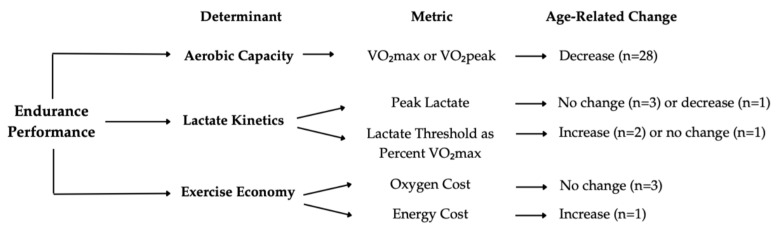
- Peak lactate generally remained stable with age, while lactate threshold relative to VO₂max increased (~0.3%·year⁻¹); preliminary evidence suggested energy cost of running increased with age in females but not males.
- Women masters athletes had higher absolute aerobic capacity than sedentary peers but similar relative (%·year⁻¹) rates of decline.
Methods
- Scoping review following JBI methodology and reported per PRISMA-ScR, with an a priori protocol registered with OSF (18 December 2024).
- Six databases (Medline, Embase, Central, CINAHL, SPORTdiscus, Scopus) were searched in September 2024 with no date or language restrictions; inclusion required women/female endurance athletes (runners, cyclists, swimmers, triathletes) aged 40–65, Tier 2 or above per the Participant Classification Framework, with at least one determinant of endurance performance reported over time.
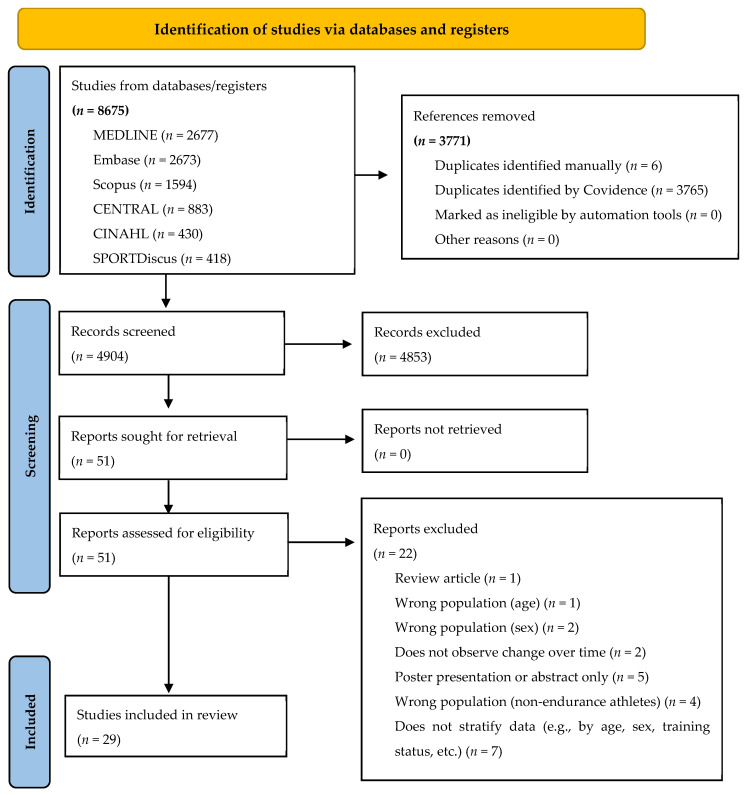
- From 8675 records and 3771 duplicates removed, 4904 were screened, 51 full texts reviewed, and 29 studies included (25 cross-sectional, 4 longitudinal); data extraction was verified by a second reviewer.
Limitations
- Stated: many studies were over 25 years old and used outdated methods (hydrostatic weighing, Douglas bags); menopause status and athlete competitive level were often poorly defined, limiting cross-study comparability; most designs were cross-sectional with small samples, especially in older age groups; inconsistent terminology (e.g., blanket "estrogens," conflation of sex and gender terms) impeded nuanced discussion.
- Stated: inability to classify participants using the STRAW+10 framework because few studies described how menopause status was identified.
- Evident in the text: only 12 of 29 studies discussed menopause at all, few controlled for or examined menopause hormone therapy, and no studies considered the impact of menopause symptoms on exercise performance; exercise economy analysis in depth was limited to a single study.
Model-written summary. Check it against the paper before relying on it.
Integrity signals
Registry
Cites
Statistics
Figures
Verification
Claims the paper makes
0 Valid · 1 Not valid · 74 Not checked · 36 Own results and interpretations
None of the sources cited for this claim have been checked yet.
In the paper
“The contribution of ∆a-vO2 to age-related reduction in aerobic capacity appeared to be limited [50,71].”
§ Effects of Aging on Determinants of Endurance Performance in Women Masters Athletes: A Scoping Review > 4. Discussion > 4.1. Aerobic Capacity
What the sources say
hedged- Asserted: passes — The authors put it forward as true.
- Checkable: passes — It can be checked against evidence.
- Load-bearing: passes — The paper’s conclusions depend on it.
- Based: passes — The paper gives a reason why it holds.
In the paper
“Proctor and Joyner [62] demonstrated that decreases in aerobic capacity normalized to muscle mass were predominately attributed to diminished cardiac output—and consequently reduced oxygen delivery—rather than to impaired ∆a-vO2.”
§ Effects of Aging on Determinants of Endurance Performance in Women Masters Athletes: A Scoping Review > 4. Discussion > 4.1. Aerobic Capacity
What the sources say
- Not checked yetcites [62] Proctor, 1997, Skeletal Muscle Mass and the Reduction of VO2max in Trained Older Subjects, J. Appl. Physiol. source
boostedstates a cause- Asserted: passes — The authors put it forward as true.
- Checkable: passes — It can be checked against evidence.
- Load-bearing: passes — The paper’s conclusions depend on it.
- Based: passes — The paper gives a reason why it holds.
None of the sources cited for this claim have been checked yet.
In the paper
“Maximal heart rate consistently decreased with age regardless of fitness status [34,57,60,61,64], likely due to changes in intrinsic cardiac pacemaker function [70].”
§ Effects of Aging on Determinants of Endurance Performance in Women Masters Athletes: A Scoping Review > 4. Discussion > 4.1. Aerobic Capacity
What the sources say
- Not checked yetcites [34] Hawkins, 2001, A Longitudinal Assessment of Change in VO2max and Maximal Heart Rate in Master Athletes, Med. Sci. Sports Exerc. source
- Not checked yetcites [57] Eskurza, 2002, Changes in Maximal Aerobic Capacity with Age in Endurance-Trained Women: 7-Yr Follow-Up, J. Appl. Physiol. source
- Not checked yetcites [60] Petek, 2023, Characterization of Ventilatory Efficiency during Cardiopulmonary Exercise Testing in Healthy Athletes, Eur. J. Prev. Cardiol. source
- Not checked yetcites [61] Proctor, 1998, Influence of Age and Gender on Cardiac Output-VO2 Relationships during Submaximal Cycle Ergometry, J. Appl. Physiol. source
- Not checked yetcites [64] Tanaka, 1997, Greater Rate of Decline in Maximal Aerobic Capacity with Age in Physically Active vs. Sedentary Healthy Women, J. Appl. Physiol. source
plainstates a cause- Asserted: passes — The authors put it forward as true.
- Checkable: passes — It can be checked against evidence.
- Load-bearing: passes — The paper’s conclusions depend on it.
- Based: passes — The paper gives a reason why it holds.
None of the sources cited for this claim have been checked yet.
In the paper
“Longitudinal studies, which capture within-person changes, reported higher rates of decline compared to cross-sectional designs [34,35,43,57].”
§ Effects of Aging on Determinants of Endurance Performance in Women Masters Athletes: A Scoping Review > 4. Discussion > 4.1. Aerobic Capacity
What the sources say
- Not checked yetcites [34] Hawkins, 2001, A Longitudinal Assessment of Change in VO2max and Maximal Heart Rate in Master Athletes, Med. Sci. Sports Exerc. source
- Not checked yetcites [35] Marcell, 2003, Longitudinal Analysis of Lactate Threshold in Male and Female Master Athletes, Med. Sci. Sports Exerc. source
- Not checked yetcites [43] Hawkins, 2003, Five-Year Maintenance of Bone Mineral Density in Women Master Runners, Med. Sci. Sports Exerc. source
- Not checked yetcites [57] Eskurza, 2002, Changes in Maximal Aerobic Capacity with Age in Endurance-Trained Women: 7-Yr Follow-Up, J. Appl. Physiol. source
plainstates an association- Asserted: passes — The authors put it forward as true.
- Checkable: passes — It can be checked against evidence.
- Load-bearing: unclear — It is unclear whether the paper’s conclusions depend on it.
- Based: passes — The paper gives a reason why it holds.
In the paper
“While stroke volume decreased with age in sedentary women [45], findings among women masters athletes were less consistent.”
§ Effects of Aging on Determinants of Endurance Performance in Women Masters Athletes: A Scoping Review > 4. Discussion > 4.1. Aerobic Capacity
What the sources say
- Not checked yetcites [45] Hunt, 1997, Systemic Hemodynamic Determinants of Blood Pressure in Women: Age, Physical Activity, and Hormone Replacement, Am. J. Physiol. source
plainstates a cause- Asserted: passes — The authors put it forward as true.
- Checkable: passes — It can be checked against evidence.
- Load-bearing: unclear — It is unclear whether the paper’s conclusions depend on it.
- Based: passes — The paper gives a reason why it holds.
54 more claims
Create a free account to see all 111 claims and to verify the 169 references still open.
- Probably not a substantial claim. 21
- It may state two separate claims as one. 38
- The quote only partly states this claim. 1
Self-check
Percentages, sums and reported differences re-computed from the paper’s own numbers.
Each contradiction between two passages listed here was confirmed by an independent check.
Rated minor: it would not touch a result — a value no result rests on, a p-value that stays on the same side of the significance level, or a conflict that is clerical, resolved elsewhere in the paper, or outside its own findings.
In the paper
§ Effects of Aging on Determinants of Endurance Performance in Women Masters Athletes: A Scoping Review > 2. Materials and Methods
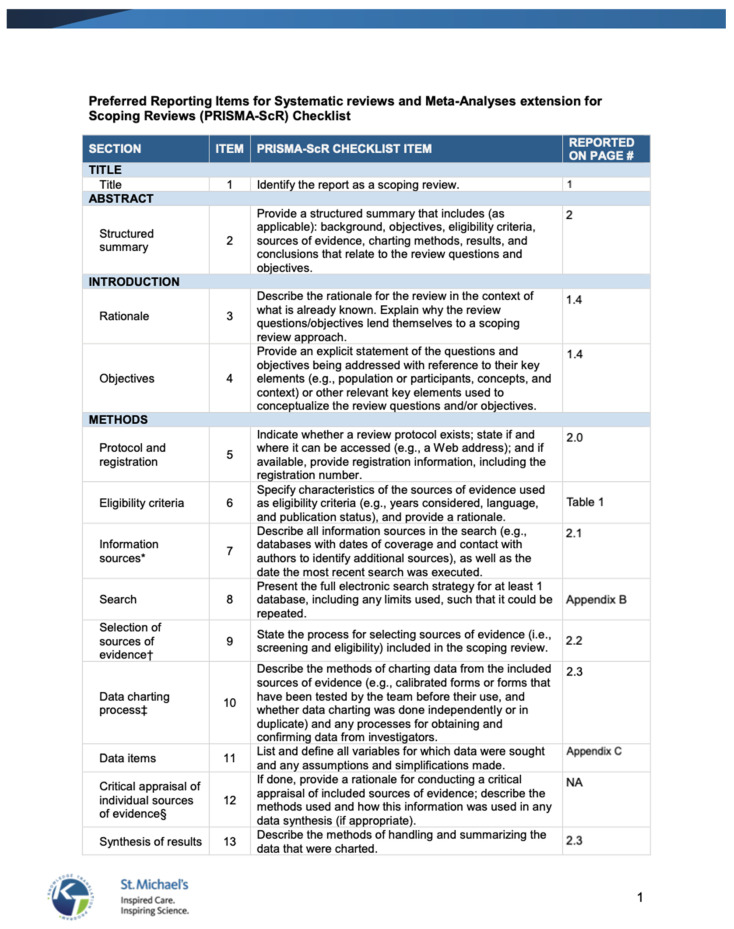
“we reported the process according to the Preferred Reporting Items for Systematic Reviews and Meta-Analysis extension for Scoping Reviews (PRISMA-ScR) (Appendix A) [29].”
§ Effects of Aging on Determinants of Endurance Performance in Women Masters Athletes: A Scoping Review > References
“29. Page M.J. McKenzie J.E. Bossuyt P.M. Boutron I. Hoffman T.C. Mulrow C.D. Shamseer L. Tetzlaff J.M. Akl E.A. Brennan S.E. The PRISMA 2020 Statement: An Updated Guideline for Reporting Systematic Reviews Br. Med. J. 2021 372 n71 10.1136/bmj.n71 33782057 PMC8005924”
Rated minor: it would not touch a result — a value no result rests on, a p-value that stays on the same side of the significance level, or a conflict that is clerical, resolved elsewhere in the paper, or outside its own findings.
In the paper
§ Effects of Aging on Determinants of Endurance Performance in Women Masters Athletes: A Scoping Review > 4. Discussion > 4.2. Lactate Kinetics
“whereas one study observed a decrease [31] (Figure 2).”
§ Effects of Aging on Determinants of Endurance Performance in Women Masters Athletes: A Scoping Review > 3. Results
“Seven articles presented measures of lactate [34,35,52,53,54,55,56]”
Rated minor: it would not touch a result — a value no result rests on, a p-value that stays on the same side of the significance level, or a conflict that is clerical, resolved elsewhere in the paper, or outside its own findings.
In the paper
§ Effects of Aging on Determinants of Endurance Performance in Women Masters Athletes: A Scoping Review > 4. Discussion > 4.2. Lactate Kinetics
“Most evidence indicated stable peak lactate concentrations with age in women masters athletes [34,52,54,64]”
§ Effects of Aging on Determinants of Endurance Performance in Women Masters Athletes: A Scoping Review > 3. Results
“| Tanaka (1997) [64] | 84 | 20–75 † | X | – | – | Rate of VO2max decline between trained and sedentary women. | Absolute rate of VO2max decline was greater in trained compared to sedentary women, but relative rate VO2max was similar between groups. |”
Citations
Cites
The PRISMA 2020 statement: An updated guideline for reporting systematic reviews
Page, M. J., McKenzie, J. E., Bossuyt, P. M., Boutron, I., Hoffmann, T. C., Mulrow, C. D., Shamseer, L., Tetzlaff, J. M., Akl, E. A., Brennan, S. E., et al. (2021) · BMJ · doi:10.1136/bmj.n71 · Cited by 108,283
PRISMA Extension for Scoping Reviews (PRISMA-ScR): Checklist and Explanation
Tricco, A. C., Lillie, E., Zarin, W., O'Brien, K. K., Colquhoun, H., Levac, D., Moher, D., Peters, M. D. J., Horsley, T., Weeks, L., et al. (2018) · Annals of Internal Medicine · doi:10.7326/m18-0850 · Cited by 43,565
Munn, Z., Peters, M. D. J., Stern, C., Tufanaru, C., McArthur, A., & Aromataris, E. (2018) · BMC Medical Research Methodology · doi:10.1186/s12874-018-0611-x · Cited by 11,385 · cited 1×
“Given the relative lack of sport science research on women masters athletes, a scoping review was chosen to broadly map and characterize the state of the literature [25,28].”
Updated methodological guidance for the conduct of scoping reviews
Peters, M. D. J., Marnie, C., Tricco, A. C., Pollock, D., Munn, Z., Alexander, L., McInerney, P., Godfrey, C. M., & Khalil, H. (2020) · JBI Evidence Synthesis · doi:10.11124/jbies-20-00167 · Cited by 9,046
Age-predicted maximal heart rate revisited
Tanaka, H., Monahan, K. D., & Seals, D. R. (2001) · Journal of the American College of Cardiology · doi:10.1016/s0735-1097(00)01054-8 · Cited by 3,775 · cited 1×
“Maximal heart rate consistently decreased with age regardless of fitness status [34,57,60,61,64], likely due to changes in intrinsic cardiac pacemaker function [70].”
Defining Training and Performance Caliber: A Participant Classification Framework
McKay, A. K. A., Stellingwerff, T., Smith, E. S., Martin, D. T., Mujika, I., Goosey-Tolfrey, V. L., Sheppard, J., & Burke, L. M. (2022) · International Journal of Sports Physiology and Performance · doi:10.1123/ijspp.2021-0451 · Cited by 3,093
Harlow, S. D., Gass, M., Hall, J. E., Lobo, R., Maki, P., Rebar, R. W., Sherman, S., Sluss, P. M., & de Villiers, T. J. (2012) · Menopause · doi:10.1097/gme.0b013e31824d8f40 · Cited by 1,705
Endurance exercise performance: the physiology of champions
Joyner, M. J., & Coyle, E. F. (2008) · The Journal of Physiology · doi:10.1113/jphysiol.2007.143834 · Cited by 1,307
Cunningham, C., O' Sullivan, R., Caserotti, P., & Tully, M. A. (2020) · Scandinavian Journal of Medicine & Science in Sports · doi:10.1111/sms.13616 · Cited by 1,154
Peters, M. D., Godfrey, C., McInerney, P., Munn, Z., Tricco, A. C., & Khalil, H. (2024) · JBI Manual for Evidence Synthesis · doi:10.46658/jbimes-24-09 · Cited by 1,044
Ross, R., Chaput, J.-P., Giangregorio, L. M., Janssen, I., Saunders, T. J., Kho, M. E., Poitras, V. J., Tomasone, J. R., El-Kotob, R., McLaughlin, E. C., et al. (2020) · Applied Physiology, Nutrition, and Metabolism · doi:10.1139/apnm-2020-0467 · Cited by 941
Effects of aging, sex, and physical training on cardiovascular responses to exercise.
Ogawa, T., Spina, R. J., Martin, W. H., Kohrt, W. M., Schechtman, K. B., Holloszy, J. O., & Ehsani, A. A. (1992) · Circulation · doi:10.1161/01.cir.86.2.494 · Cited by 701
El Khoudary, S. R., Greendale, G., Crawford, S. L., Avis, N. E., Brooks, M. M., Thurston, R. C., Karvonen-Gutierrez, C., Waetjen, L. E., & Matthews, K. (2019) · Menopause · doi:10.1097/gme.0000000000001424 · Cited by 562
Tanaka, H., & Seals, D. R. (2008) · The Journal of Physiology · doi:10.1113/jphysiol.2007.141879 · Cited by 554
Sedentary behaviour and health in adults: an overview of systematic reviews
Saunders, T. J., McIsaac, T., Douillette, K., Gaulton, N., Hunter, S., Rhodes, R. E., Prince, S. A., Carson, V., Chaput, J.-P., Chastin, S., et al. (2020) · Applied Physiology, Nutrition, and Metabolism · doi:10.1139/apnm-2020-0272 · Cited by 469
“Invisible sportswomen”: The sex data gap in sport and exercise science research
Cowley, E. S., Olenick, A. A., McNulty, K. L., & Ross, E. Z. (2021) · Women in Sport and Physical Activity Journal · doi:10.1123/wspaj.2021-0028 · Cited by 449
Fitzgerald, M. D., Tanaka, H., Tran, Z. V., & Seals, D. R. (1997) · Journal of Applied Physiology · doi:10.1152/jappl.1997.83.1.160 · Cited by 308
Beltz, N. M., Gibson, A. L., Janot, J. M., Kravitz, L., Mermier, C. M., & Dalleck, L. C. (2016) · Journal of Sports Medicine · doi:10.1155/2016/3968393 · Cited by 306
Economy of running: beyond the measurement of oxygen uptake
Fletcher, J. R., Esau, S. P., & MacIntosh, B. R. (2009) · Journal of Applied Physiology · doi:10.1152/japplphysiol.00307.2009 · Cited by 299
Oxidative capacity of human muscle fiber types: effects of age and training status
Proctor, D. N., Sinning, W. E., Walro, J. M., Sieck, G. C., & Lemon, P. W. (1995) · Journal of Applied Physiology · doi:10.1152/jappl.1995.78.6.2033 · Cited by 283
Donato, A. J., Tench, K., Glueck, D. H., Seals, D. R., Eskurza, I., & Tanaka, H. (2003) · Journal of Applied Physiology · doi:10.1152/japplphysiol.00438.2002 · Cited by 218
Tanaka, H., Desouza, C. A., Jones, P. P., Stevenson, E. T., Davy, K. P., & Seals, D. R. (1997) · Journal of Applied Physiology · doi:10.1152/jappl.1997.83.6.1947 · Cited by 216
Friedenreich, C. M., Woolcott, C. G., McTiernan, A., Ballard-Barbash, R., Brant, R. F., Stanczyk, F. Z., Terry, T., Boyd, N. F., Yaffe, M. J., Irwin, M. L., et al. (2010) · Journal of Clinical Oncology · doi:10.1200/jco.2009.24.9557 · Cited by 184
Skeletal muscle mass and the reduction ofV˙ o 2 max in trained older subjects
Proctor, D. N., & Joyner, M. J. (1997) · Journal of Applied Physiology · doi:10.1152/jappl.1997.82.5.1411 · Cited by 155
Sex Differences in Human Performance
Hunter, S. K., & Senefeld, J. W. (2024) · The Journal of Physiology · doi:10.1113/jp284198 · Cited by 153
Influence of age and gender on cardiac output-V˙o2relationships during submaximal cycle ergometry
Proctor, D. N., Beck, K. C., Shen, P. H., Eickhoff, T. J., Halliwill, J. R., & Joyner, M. J. (1998) · Journal of Applied Physiology · doi:10.1152/jappl.1998.84.2.599 · Cited by 135
Mølmen, K. S., Almquist, N. W., & Skattebo, Ø. (2025) · Sports Medicine · doi:10.1007/s40279-024-02120-2 · Cited by 123
Lactate Threshold and Distance-Running Performance in Young and Older Endurance Athletes
Allen, W. K., Seals, D. R., Hurley, B. F., Ehsani, A. A., & Hagberg, J. M. (1985) · Journal of Applied Physiology · doi:10.1152/jappl.1985.58.4.1281 · Cited by 119
Declining performance of master athletes: silhouettes of the trajectory of healthy human ageing?
Lazarus, N. R., & Harridge, S. D. R. (2017) · The Journal of Physiology · doi:10.1113/jp272443 · Cited by 116
Master Athletes Are Extending the Limits of Human Endurance
Lepers, R., & Stapley, P. J. (2016) · Frontiers in Physiology · doi:10.3389/fphys.2016.00613 · Cited by 112
Muscle morphology and performance in master athletes: A systematic review and meta-analyses
Mckendry, J., Breen, L., Shad, B. J., & Greig, C. A. (2018) · Ageing Research Reviews · doi:10.1016/j.arr.2018.04.007 · Cited by 111
Baker, A. B., & Tang, Y. Q. (2010) · Experimental Aging Research · doi:10.1080/0361073x.2010.507433 · Cited by 101
Trends in Triathlon Performance: Effects of Sex and Age
Lepers, R., Knechtle, B., & Stapley, P. J. (2013) · Sports Medicine · doi:10.1007/s40279-013-0067-4 · Cited by 98
Regular Exercise and the Age-Related Decline in Resting Metabolic Rate in Women
Pelt, R. E. V., Jones, P. P., Davy, K. P., DeSouza, C. A., Tanaka, H., Davy, B. M., & Seals, D. R. (1997) · The Journal of Clinical Endocrinology & Metabolism · doi:10.1210/jcem.82.10.4268 · Cited by 88
Relationship between Physiological Loss, Performance Decrement, and Age in Master Athletes
Wiswell, R. A., Hawkins, S. A., Jaque, S. V., Hyslop, D., Constantino, N., Tarpenning, K., Marcell, T., & Schroeder, E. T. (2001) · The Journals of Gerontology Series A: Biological Sciences and Medical Sciences · doi:10.1093/gerona/56.10.m618 · Cited by 86
Haynes, E. M. K., Neubauer, N. A., Cornett, K. M. D., O’Connor, B. P., Jones, G. R., & Jakobi, J. M. (2020) · Applied Physiology, Nutrition, and Metabolism · doi:10.1139/apnm-2020-0081 · Cited by 83
Changes in Maximal Aerobic Capacity with Age in Endurance-Trained Women: 7-Yr Follow-Up
Eskurza, I., Donato, A. J., Moreau, K. L., Seals, D. R., & Tanaka, H. (2002) · Journal of Applied Physiology · doi:10.1152/japplphysiol.01124.2001 · Cited by 78
A longitudinal assessment of change in &OV0312;O2max and maximal heart rate in master athletes
HAWKINS, S. A., MARCELL, T. J., VICTORIA JAQUE, S., & WISWELL, R. A. (2001) · Medicine & Science in Sports & Exercise · doi:10.1097/00005768-200110000-00020 · Cited by 76
Age-Associated Power Decline from Running, Jumping, and Throwing Male Masters World Records
Gava, P., Kern, H., & Carraro, U. (2015) · Experimental Aging Research · doi:10.1080/0361073x.2015.1001648 · Cited by 64
Carrick-Ranson, G., Hastings, J. L., Bhella, P. S., Shibata, S., Fujimoto, N., Palmer, D., Boyd, K., & Levine, B. D. (2013) · The Journals of Gerontology Series A: Biological Sciences and Medical Sciences · doi:10.1093/gerona/gls220 · Cited by 64
Leyk, D., Erley, O., Gorges, W., Ridder, D., Rüther, T., Wunderlich, M., Sievert, A., Essfeld, D., Piekarski, C., & Erren, T. (2009) · International Journal of Sports Medicine · doi:10.1055/s-0028-1105935 · Cited by 62
Maximal Aerobic Power, Lactate Threshold, and Running Performance in Master Athletes
WISWELL, R. A., JAQUE, S. V., MARCELL, T. J., HAWKINS, S. A., TARPENNING, K. M., CONSTANTINO, N., & HYSLOP, D. M. (2000) · Medicine & Science in Sports & Exercise · doi:10.1097/00005768-200006000-00021 · Cited by 57
Regular Exercise and the Age-Related Decline in Resting Metabolic Rate in Women
Pelt, R. E. V. (1997) · The Journal of Clinical Endocrinology & Metabolism · doi:10.1210/jc.82.10.3208 · Cited by 57
Pelt, R. E. V., Davy, K. P., Stevenson, E., Wilson, T. M., Jones, P. P., DeSouza, C. A., & Seals, D. R. (1998) · American Journal of Physiology-Endocrinology and Metabolism · doi:10.1152/ajpendo.1998.275.4.e626 · Cited by 56
An Analysis of Participation and Performance of 2067 100-km Ultra-Marathons Worldwide
Stöhr, A., Nikolaidis, P. Τ., Villiger, E., Sousa, C. V., Scheer, V., Hill, L., & Knechtle, B. (2021) · International Journal of Environmental Research and Public Health · doi:10.3390/ijerph18020362 · Cited by 48
Exercise Cardiac Function in Young through Elderly Endurance Trained Women
WIEBE, C. G., GLEDHILL, N., JAMNIK, V. K., & FERGUSON, S. (1999) · Medicine & Science in Sports & Exercise · doi:10.1097/00005768-199905000-00010 · Cited by 44
Petek, B. J., Tso, J., Churchill, T. W., Guseh, J. S., Loomer, G., DiCarli, M., Lewis, G. D., Weiner, R. B., Kim, J. H., Wasfy, M. M., et al. (2021) · European Journal of Preventive Cardiology · doi:10.1093/eurjpc/zwab150 · Cited by 43
Age and Sex Differences in Blood Lactate Response to Sprint Running in Elite Master Athletes
Korhonen, M. T., Suominen, H., & Mero, A. (2005) · Canadian Journal of Applied Physiology · doi:10.1139/h05-146 · Cited by 42
Nichols, J. F., Phares, L., & Buono, M. J. (1997) · International Journal of Sports Medicine · doi:10.1055/s-2007-972664 · Cited by 40
The Impact of Training on the Loss of Cardiorespiratory Fitness in Aging Masters Endurance Athletes
Burtscher, J., Strasser, B., Burtscher, M., & Millet, G. P. (2022) · International Journal of Environmental Research and Public Health · doi:10.3390/ijerph191711050 · Cited by 36
Bagley, L., McPhee, J. S., Ganse, B., Müller, K., Korhonen, M. T., Rittweger, J., & Degens, H. (2019) · Scandinavian Journal of Medicine & Science in Sports · doi:10.1111/sms.13404 · Cited by 35
Superior endurance performance in aging mountain runners
Burtscher, M., Förster, H., & Burtscher, J. (2008) · Gerontology · doi:10.1159/000148649 · Cited by 33
Central Cardiovascular System Limits to Aerobic Capacity
Joyner, M. J., & Dominelli, P. B. (2021) · Experimental Physiology · doi:10.1113/ep088187 · Cited by 32
Current Insights in the Age-Related Decline in Sports Performance of the Older Athlete
Ganse, B., & Degens, H. (2021) · International Journal of Sports Medicine · doi:10.1055/a-1480-7730 · Cited by 26
Longitudinal Analysis of Lactate Threshold in Male and Female Master Athletes
MARCELL, T. J., HAWKINS, S. A., TARPENNING, K. M., HYSLOP, D. M., & WISWELL, R. A. (2003) · Medicine & Science in Sports & Exercise · doi:10.1249/01.mss.0000065002.69572.6f · Cited by 23
Effect of Age and Menopausal Status on Cardiorespiratory Fitness in Masters Women Runners
WELLS, C. L., BOORMAN, M. A., & RIGGS, D. M. (1992) · Medicine & Science in sports & Exercise · doi:10.1249/00005768-199210000-00013 · Cited by 23
Hagstrom, A. D., Parsons, J. L., Nimphius, S., Jordan, M. J., Coen, S. E., & Norton, R. (2025) · British Journal of Sports Medicine · doi:10.1136/bjsports-2024-109342 · Cited by 23
Benelli, P., Ditroilo, M., Forte, R., De Vito, G., & Stocchi, V. (2007) · European Journal of Applied Physiology · doi:10.1007/s00421-006-0334-2 · Cited by 22
The Aging Athlete: Paradigm of Healthy Aging
Gries, K. J., & Trappe, S. W. (2022) · International Journal of Sports Medicine · doi:10.1055/a-1761-8481 · Cited by 22
Petek, B. J., Churchill, T. W., Gustus, S. K., Schoenike, M. W., Nayor, M., Moulson, N., Guseh, J. S., VanAtta, C., Blodgett, J. B., Contursi, M., et al. (2023) · European Journal of Preventive Cardiology · doi:10.1093/eurjpc/zwac255 · Cited by 19
McNulty, K., Olenick, A., Moore, S., & Cowley, E. (2024) · British Journal of Sports Medicine · doi:10.1136/bjsports-2023-107165 · Cited by 19
The Effects of Menopause and Training on Serum Lipids
Rainville, S., & Vaccaro, P. (1984) · International Journal of Sports Medicine · doi:10.1055/s-2008-1025895 · Cited by 17
Five-Year Maintenance of Bone Mineral Density in Women Master Runners
HAWKINS, S. A., TODD SCHROEDER, E., DREYER, H. C., UNDERWOOD, S., & WISWELL, R. A. (2003) · Medicine & Science in Sports & Exercise · doi:10.1097/00005768-200301000-00021 · Cited by 16
Physiological Predictors of Maximal Incremental Running Performance
Lanferdini, F. J., Silva, E. S., Machado, E., Fischer, G., & Peyré-Tartaruga, L. A. (2020) · Frontiers in Physiology · doi:10.3389/fphys.2020.00979 · Cited by 16
Age-related decline in endurance running performance – an example of a multiple World records holder
Lepers, R., & Cattagni, T. (2017) · Applied Physiology, Nutrition, and Metabolism · doi:10.1139/apnm-2017-0298 · Cited by 11
Endocrine Response to an Ultra-Marathon in Pre- and Post-Menopausal Women
Copeland, J., & Verzosa, M. L. S. (2014) · Biology of Sport · doi:10.5604/20831862.1097480 · Cited by 9
Body Composition and Physiological Responses of Masters Female Swimmers 20 to 70 Years of Age
Vaccaro, P., Ostrove, S. M., VanderVelden, L., Goldfarb, A. H., Clarke, D. H., & Dummer, G. M. (1984) · Research Quarterly for Exercise and Sport · doi:10.1080/02701367.1984.10609365 · Cited by 9
A cross-sectional study on body composition and energy expenditure in women athletes during aging
Ryan, A. S., Nicklas, B. J., & Elahi, D. (1996) · American Journal of Physiology-Endocrinology and Metabolism · doi:10.1152/ajpendo.1996.271.5.e916 · Cited by 9
Plasma Lipid and Lipoprotein Profiles in Pre- and Post-menopausal Middle-aged Runners
Higuchi, M., Iwaoka, K., Ishii, K., Matsuo, S., Kobayashi, S., Tamai, T., Takai, H., & Nakai, T. (1990) · Clinical Physiology · doi:10.1111/j.1475-097x.1990.tb00084.x · Cited by 7
The Future of Physiological Research: A Greater Understanding of Female Master Athletes and Aging?
Daly, L. S. (2024) · Physiological Reports · doi:10.14814/phy2.70109 · Cited by 6
Hamilton, H. M., Yarish, N. M., & Heron, K. E. (2025) · PLOS One · doi:10.1371/journal.pone.0335738 · Cited by 6
Price, M. J., Smith, P. M., Bottoms, L. M., & Hill, M. W. (2024) · Experimental Gerontology · doi:10.1016/j.exger.2024.112427 · Cited by 5
Female trail running: a systematic scoping review
Espasa-Labrador, J., Sandbakk, Ø. B., Cebrián‐Ponce, Á., Irurtia, A., Carrasco‐Marginet, M., & Osborne, J. O. (2026) · Frontiers in Sports and Active Living · doi:10.3389/fspor.2025.1694925 · Cited by 4
Age-Associated Blood Glucose Levels during Exercise in Female Swimmers
Goldfarb, A. H., Vaccaro, P., Buckenmeyer, P. J., Dummer, G. M., & VanderVelden, L. (1986) · European Journal of Applied Physiology and Occupational Physiology · doi:10.1007/bf00422746 · Cited by 3
Hunt, B. E., Davy, K. P., Jones, P. P., DeSouza, C. A., Van Pelt, R. E., Tanaka, H., & Seals, D. R. (1997) · American Journal of Physiology-Heart and Circulatory Physiology · doi:10.1152/ajpheart.1997.273.2.h777 · Cited by 3
The Relationships between Age and Running Performance Variables in Master Runners
Lee, E. J., Snyder, E. M., & Lundstrom, C. J. (2019) · Sport Sciences for Health · doi:10.1007/s11332-019-00543-3 · Cited by 3
NUTRITIONAL PROFILES IN MIDDLE-AGED FEMALE RUNNERS
ITOH, A., ISHII, K., OISHI, K., HIGUCHI, M., & KOBAYASHI, S. (1992) · Japanese Journal of Physical Fitness and Sports Medicine · doi:10.7600/jspfsm1949.41.190
Research works printed but not linked: 4
- (2024). Veritas Health Innovation Covidence Systematic Review Software, Covidence. Available online: www.covidence.org.
- Rael, 2022, Cardiorespiratory Response to High Intensity Interval Exercise in Endurance-Trained Postmenopausal Women, Eur. J. Appl. Physiol., 39, 19
- Koda, 1994, Aerobic Work Capacity of Japanese Masters Swimmers, Coach. Sport Sci. J., 1, 16
- Brown, 2007, Age-Associated Changes In VO2 and Power Output—A Cross-Sectional Study of Endurance Trained New Zealand Cyclists, J. Sports Sci. Med., 6, 477
Cited by
Still being checked.
Metadata
- Authors
- Vangsgaard, D., Noumi, M., Hayden, K. A., & Doyle-Baker, P. K.
- Affiliations
- University of Calgary (CA)
- Libraries and Cultural Resources, University of Calgary, Calgary, AB T2N 1N4, Canada
- Human Performance Laboratory, Faculty of Kinesiology, University of Calgary, Calgary, AB T2N 1N4, Canada
- Venue
- Healthcare
- Publisher
- MDPI AG
- Published
- 2026-04-17
- Volume
- 14
- Issue
- 8
- Pages
- 1080
- ISSN
- 2227-9032 (ISSN-L)
- PMC
- PMC13116005
- OpenAlex
- W7154954110
- Semantic Scholar
- 3f5a0344eb007fd5c25e5baeb144996184359fb6
- Cited by
- 0
- References
- 74
- FWCI
- 0.00
- Type
- journal article
- Language
- en
- Open access
- gold
- doi.org
- Licence
- Locations
- Healthcare (publishedVersion, cc-by)
- PubMed (publishedVersion)
- PubMed Central (publishedVersion, cc-by)
- Funders
- Joan Snyder Fund for Excellence in Kinesiology Research
- Topics
- Health Sciences › Medicine › Physiology (medical) › Cardiovascular and exercise physiology
- Health Sciences › Medicine › Orthopedics and Sports Medicine › Sports Performance and Training
- Health Sciences › Medicine › Public Health, Environmental and Occupational Health › Physical Activity and Health
- Keywords
- masters athletes, female athletes, aging, endurance performance, menopause, cardiorespiratory fitness, lactate kinetics, exercise economy, training volume, cardiac output, body composition, age-related performance decline
About these checks
Registry, retraction, Cites and statistics results are computed, not judged, with one exception: a printed reference that no index lists is read once by a model before it counts as a citation error. Claims are extracted by a model and kept only when their quote appears verbatim in the text; each cited source is then checked, with a model’s help, for whether it says what the claim relies on. Those verdicts can be wrong — read the claim’s quote and the cited source before relying on one.
A language model drew the claims from the paper on 2026-11-14, under version 3 of the claim definition (model deepseek-v4.1-flash, prompt extract-v3).
A second model labelled each claim on 2026-11-14 (model jev-1.13-20260917, definition revision gold-guideline-v0.2).
Statistics and arithmetic are recomputed, not judged.
Confidence bands are shown only for fields calibrated on our annotated test set. None is calibrated yet, so no band is shown.
What counts as a claim ›How we measure confidence ›How we check this ›
Are you an author, or do you see a problem with this page? Request a review
Data sources
Bibliographic data: Semantic Scholar, OpenAlex, Crossref.
Contains information from the Semantic Scholar Academic Graph Datasets, made available under the ODC Attribution License (ODC-BY 1.0).
Semantic Scholar’s data is described in: Kinney, R., et al. (2023). The Semantic Scholar Open Data Platform. arXiv:2301.10140.
