

The Impact of Adolescent Internet Addiction on Sexual Online Victimization: The Mediating Effects of Sexting and Body Self-Esteem
Open accessThe DOI matches its Crossref record; 48 of the 48 references it cites were found in a registry or an index.
Abstract
Adolescents’ problematic use of the internet and the risk of sexual online victimization are an increasing concern among families, researchers, professionals and society. This study aimed to analyze the interplay between adolescents’ addiction to social networks and internet, body self-esteem and sexual–erotic risk behavior online: sexting, sextortion and grooming. While sexting refers to the voluntary engagement in texting sexual–erotic messages, sextortion and grooming are means of sexual–erotic victimization through the use of the internet. Participants were 1763 adolescents (51% girls), aged 12 to 16 years (M = 14.56; SD = 1.16), from public (n = 1068; 60.60%) and private (n = 695; 39.40%) high schools in the Basque Country (Spain). We carried out structural equation modeling (SEM) using Mplus to assess the mediating effects of body self-esteem in the relationship between addiction to social media and internet and sexual–erotic risk behavior. The results showed that internet addiction predicts online sexual victimization; specifically, the best predictors of sexting, sextortion and grooming victimization were symptoms of internet addiction and geek behavior. Body self-esteem and sexting mediated the relationship between internet addiction and sexual online victimization in adolescents. These results highlight the importance of attending to adolescents’ mental health regarding their online behavior, considering the risk and protective factors involved, due to its close association with online sexual victimization.
Overview
The claims and statistics of this paper haven’t been checked yet.
Free: it reads the open-access text and checks the first 5 claims that cite a source we can check. Create a free account to check every claim.
Integrity signals
Registry
Cites
Statistics
Figures
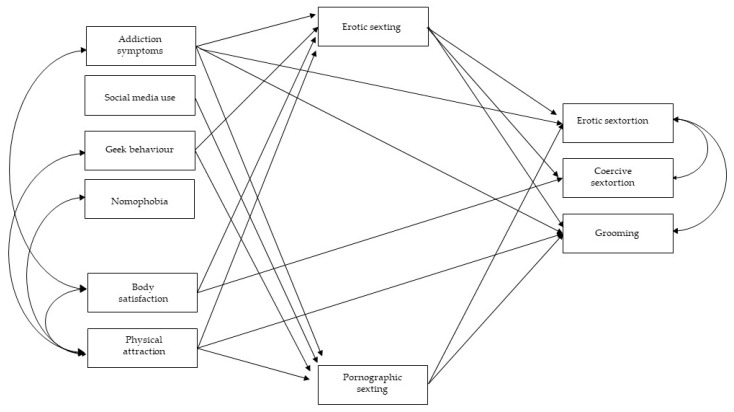
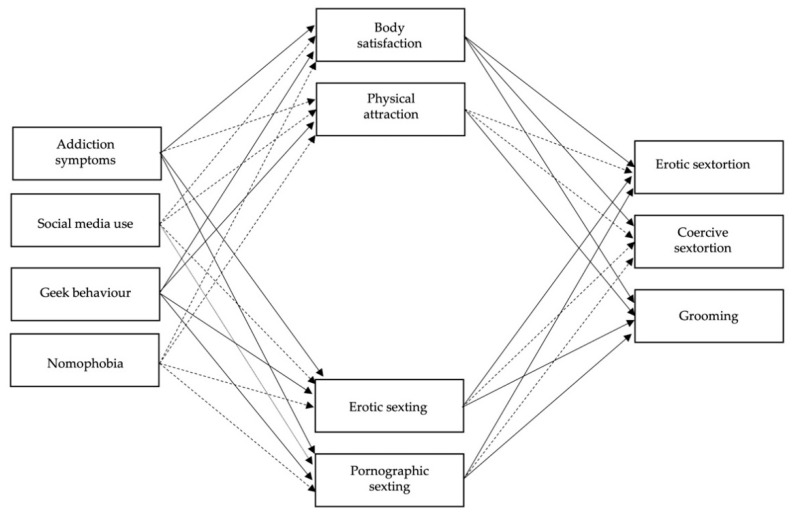
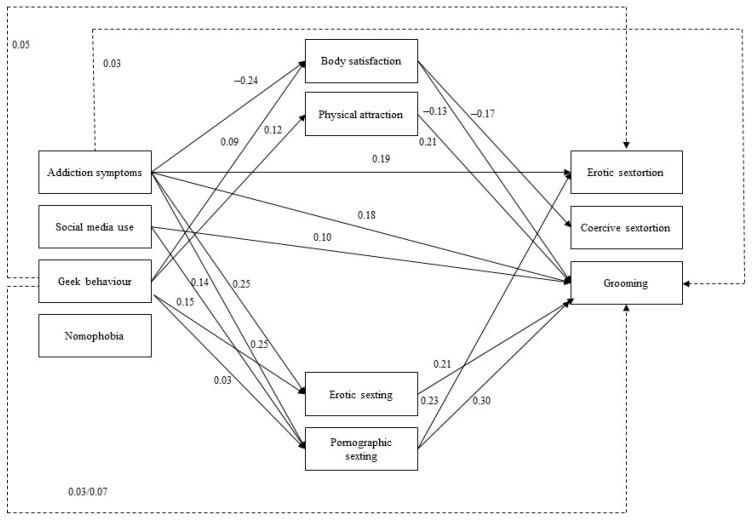
Verification
Claims the paper makes
The claims and statistics of this paper haven’t been checked yet.
Free: it reads the open-access text and checks the first 5 claims that cite a source we can check. Create a free account to check every claim.
Claims other papers make about this one
Each is checked against this paper’s own text: does it say what the citing paper says it does?
The source backs part of the claim, not all of it — or backs it for a different population, condition or comparison.
In the citing paper
“Another study found positive correlations between cybergrooming victimization and facets of Internet addiction, namely addiction symptoms, social media use, geek behavior, and nomophobia, i.e., the fear of staying disconnected from the Internet (Tamarit et al., 2021).”
From Cybergrooming Victimization Among Young People: A Systematic Review of Prevalence Rates, Risk Factors, and Outcomes (2025) · cites this paper as Tamarit et al., 2021
Experimental — accuracy not yet measuredThe cited source says what the claim attributes to it.
In the citing paper
“Four studies investigated the relationship between cybergrooming victimization and problematic Internet use and consistently found a positive association (Calvete et al., 2021b; Machimbarrena et al., 2018; Tamarit et al., 2021; Wachs et al., 2015, 2018).”
From Cybergrooming Victimization Among Young People: A Systematic Review of Prevalence Rates, Risk Factors, and Outcomes (2025) · cites this paper as Tamarit et al., 2021
The cited source says what the claim attributes to it.
In the citing paper
“Furthermore, associations with other victimization experiences were found, which, however, can be conceptualized as a proximal outcome of the cybergrooming process, namely sextortion (Almeida & Barreiros, 2024; Alonso-Ruido et al., 2024; Tamarit et al., 2021), and sexual coercion, sexual pressure, and unwanted exposure to sexual content (Longobardi et al., 2021).”
From Cybergrooming Victimization Among Young People: A Systematic Review of Prevalence Rates, Risk Factors, and Outcomes (2025) · cites this paper as Tamarit et al., 2021
The cited source says what the claim attributes to it.
In the citing paper
“In both cases, the independent variables positively predicted both types of sexting, which in turn directly (Tamarit et al., 2021) or indirectly over sexual advancement strategies (Schoeps et al., 2020), positively predicted cybergrooming victimization.”
From Cybergrooming Victimization Among Young People: A Systematic Review of Prevalence Rates, Risk Factors, and Outcomes (2025) · cites this paper as Tamarit et al., 2021
Self-check
Percentages, sums and reported differences re-computed from the paper’s own numbers.
The self-check needs the paper’s full text.
Citations
Cites
Cook, R. J., Dickens, B. M., & Fathalla, M. F. (2003) · Reproductive Health and Human Rights · doi:10.1093/acprof:oso/9780199241323.003.0025 · Cited by 10,769
Social networking sites and addiction: Ten lessons learned
Kuss, D., & Griffiths, M. (2017) · International Journal of Environmental Research and Public Health · doi:10.3390/ijerph14030311 · Cited by 1,603
Low and decreasing self-esteem during adolescence predict adult depression two decades later.
Steiger, A. E., Allemand, M., Robins, R. W., & Fend, H. A. (2014) · Journal of Personality and Social Psychology · doi:10.1037/a0035133 · Cited by 348 · cited 1×
“Physical attractiveness is derived from the concept of body self-esteem, and means to what extent one perceives their own body as attractive or aesthetically pleasing [36].”
BackgroundChang, F.-C., Chiu, C.-H., Miao, N.-F., Chen, P.-H., Lee, C.-M., Chiang, J.-T., & Pan, Y.-C. (2015) · Comprehensive Psychiatry · doi:10.1016/j.comppsych.2014.11.013 · Cited by 339 · cited 3×
“This phenomenon is associated with emotional distress and has been identified as a risk factor in adolescence, since it is another sign of internet addiction [12,15].”
BackgroundResultInfluentialWartberg, L., Kriston, L., & Thomasius, R. (2020) · Computers in Human Behavior · doi:10.1016/j.chb.2019.09.014 · Cited by 276 · cited 1×
“This behavior is common in adolescents under 16 years, due to the highly addictive nature of social media, which shares psychopathologic signs with other types of addiction [11].”
BackgroundBody image 2.0: Associations between social grooming on Facebook and body image concerns
Kim, J. W., & Chock, T. M. (2015) · Computers in Human Behavior · doi:10.1016/j.chb.2015.01.009 · Cited by 272 · cited 3×
“Our findings are in line with previous studies, which suggest that extensive social engagement on social media sites negatively influences young people’s satisfaction with their bodies and appearance [40].”
BackgroundResultThe Prevalence of Sexting Behaviors Among Emerging Adults: A Meta-Analysis
Mori, C., Cooke, J. E., Temple, J. R., Ly, A., Lu, Y., Anderson, N., Rash, C., & Madigan, S. (2020) · Archives of Sexual Behavior · doi:10.1007/s10508-020-01656-4 · Cited by 249 · cited 2×
“or unwanted, may be seen as harassment [17,22].”
BackgroundWalker, K., & Sleath, E. (2017) · Aggression and Violent Behavior · doi:10.1016/j.avb.2017.06.010 · Cited by 227 · cited 1×
“The term sexting —a combination of “sex” and “texting”—is used in scientific literature as in everyday language and refers to the dissemination and expression of sexual content through digital media, for example, sending erotic pictures, engaging in sexual conversations or sharing audiovisual material through the inte…”
BackgroundVeldhuis, J., Alleva, J. M., Bij de Vaate, A. J. D. (., Keijer, M., & Konijn, E. A. (2020) · Psychology of Popular Media · doi:10.1037/ppm0000206 · Cited by 176 · cited 2×
“[35] revealed that body image (but not body satisfaction) and social networking site use seem to mutually affect and reinforce one other in teenage girls.”
BackgroundSexting and Psychological Distress: The Role of Unwanted and Coerced Sexts
Klettke, B., Hallford, D. J., Clancy, E., Mellor, D. J., & Toumbourou, J. W. (2019) · Cyberpsychology, Behavior, and Social Networking · doi:10.1089/cyber.2018.0291 · Cited by 160 · cited 2×
“It refers to a specific kind of blackmail, using explicit sexual content as a means of manipulating the victim or forcing them to act in a way that would benefit the perpetrator [22].”
BackgroundSexting among Spanish adolescents: Prevalence and personality profiles
Gámez-Guadix, M., de Santisteban, P., & Resett, S. (2017) · Psicothema · doi:10.7334/psicothema2016.222 · Cited by 148
Sexting among adolescents: A nuanced and gendered online challenge for young people
Burén, J., & Lunde, C. (2018) · Computers in Human Behavior · doi:10.1016/j.chb.2018.02.003 · Cited by 144 · cited 1×
“Sexting can play a protective and risk role depending on the way adolescents engage in it [21].”
BackgroundInternet Addiction Symptoms, Disordered Eating, and Body Image Avoidance
Rodgers, R. F., Melioli, T., Laconi, S., Bui, E., & Chabrol, H. (2013) · Cyberpsychology, Behavior, and Social Networking · doi:10.1089/cyber.2012.1570 · Cited by 143 · cited 1×
“Furthermore, internet addiction has been identified as a significant predictor of disordered eating, due to its association with body image problems [42], and negative feelings caused by internet addiction are predictive of lower overall self-esteem [43].”
BackgroundPsychological Risk Factors that Predict Social Networking and Internet Addiction in Adolescents
Peris, M., de la Barrera, U., Schoeps, K., & Montoya-Castilla, I. (2020) · International Journal of Environmental Research and Public Health · doi:10.3390/ijerph17124598 · Cited by 136
Self-citationSexting, Mental Health, and Victimization Among Adolescents: A Literature Review
Gassó, A. M., Klettke, B., Agustina, J. R., & Montiel, I. (2019) · International Journal of Environmental Research and Public Health · doi:10.3390/ijerph16132364 · Cited by 134
Multiple online victimization of Spanish adolescents: Results from a community sample
Montiel, I., Carbonell, E., & Pereda, N. (2016) · Child Abuse & Neglect · doi:10.1016/j.chiabu.2015.12.005 · Cited by 125 · cited 1×
“Traditionally, grooming has been studied as a process intended for sexual abuse and aggression, and it is a type of sexual victimization that can be applied to online interactions [29].”
BackgroundCruz-Sáez, S., Pascual, A., Wlodarczyk, A., & Echeburúa, E. (2020) · Journal of Health Psychology · doi:10.1177/1359105317748734 · Cited by 110 · cited 1×
“The impact of body self-esteem on adolescents’ well-being is relative, because adolescents can rate very specific areas of their body as attractive, while showing dissatisfaction with others—this has been observed to function as a protective mechanism towards external judgement [37,38].”
Backgroundde la Barrera, U., Schoeps, K., Gil‐Gómez, J., & Montoya‐Castilla, I. (2019) · International Journal of Environmental Research and Public Health · doi:10.3390/ijerph16234650 · Cited by 99 · cited 2×
“Self-esteem is often considered as a mediator in the study of adolescents’ well-being [8], and it has been observed to mediate the relationship between body mass index and internet addiction [41].”
BackgroundSelf-citationCasaló, L. V., & Escario, J. (2018) · Computers in Human Behavior · doi:10.1016/j.chb.2018.11.042 · Cited by 91 · cited 1×
“39%, which in Spain is equivalent to more than 94,000 adolescents with problematic online behaviors [9].”
Background“Sex Pics?”: Longitudinal Predictors of Sexting Among Adolescents
Gámez-Guadix, M., & de Santisteban, P. (2018) · Journal of Adolescent Health · doi:10.1016/j.jadohealth.2018.05.032 · Cited by 87 · cited 2×
“Research shows that adolescents undergo a particularly vulnerable period, where they are more likely to engage in risky behaviors to ensure their social adaptation—this kind of coping could lead them to use the internet in problematic ways, facilitating internet addiction and a higher prevalence of sexting among peers…”
BackgroundResultBublatzky, F., Riemer, M., & Guerra, P. (2019) · Frontiers in Psychology · doi:10.3389/fpsyg.2019.02091 · Cited by 87
Varchetta, M., Fraschetti, A., Mari, E., & Giannini, A. M. (2020) · Revista Digital de Investigación en Docencia Universitaria · doi:10.19083/ridu.2020.1187 · Cited by 84 · cited 2×
“These factors are also related to nomophobia; the extreme attention dedicated to the use of technological devices increases adolescents’ vulnerability in online settings [32].”
BackgroundResultTeenagers' perception of risk behaviors regarding digital technologies
Arcos, A. L., de Goñi, J. I. M. D. M., Urdín, J. A., & Perurena, N. A. (2016) · Computers in Human Behavior · doi:10.1016/j.chb.2016.12.004 · Cited by 82 · cited 1×
“The internet and social networks are not only tools of communication and information exchange, but the way adolescents interact with each other over the internet has changed the primary risks to their psychological well-being, unprecedented before the digital era [7].”
BackgroundScreening of Problematic Internet Use Among Spanish Adolescents: Prevalence and Related Variables
Gómez, P., Rial, A., Braña, T., Golpe, S., & Varela, J. (2017) · Cyberpsychology, Behavior, and Social Networking · doi:10.1089/cyber.2016.0262 · Cited by 78 · cited 1×
“The use of the internet and social media has been a research area of increasing interest regarding youths’ emotional and social development, due to the intensive use of ICTs and omnipresence in adolescents’ interactions with their environment [6].”
BackgroundGámez‐Guadix, M., Almendros, C., Calvete, E., & De Santisteban, P. (2018) · Journal of Adolescence · doi:10.1016/j.adolescence.2017.12.002 · Cited by 76 · cited 1×
“Adult cyber-groomers “prepare” their victims, generally minors, by befriending them, earning their trust as a way of seducing them and luring them into an intimate space that facilitates sexual abuse and increases the child or adolescent’s vulnerability [27,30].”
BackgroundHernández, M. P., Schoeps, K., Maganto, C., & Montoya-Castilla, I. (2021) · Computers in Human Behavior · doi:10.1016/j.chb.2020.106569 · Cited by 66 · cited 7×
“Thus, it is associated with a problematic use of the internet and social media, functioning as a risk factor and posing a threat to adolescents’ well-being [3,17].”
BackgroundMethodInfluentialSelf-citationSexting Among Adolescents: The Emotional Impact and Influence of the Need for Popularity
Del Rey, R., Ojeda, M., Casas, J. A., Mora-Merchán, J. A., & Elipe, P. (2019) · Frontiers in Psychology · doi:10.3389/fpsyg.2019.01828 · Cited by 65 · cited 2×
“This phenomenon, in recent years, has evolved as new technologies advanced, becoming highly prevalent in adolescents [19].”
BackgroundPeris, M., Maganto, C., & Garaigordobil, M. (2018) · Revista de psicología Clínica con Niños y Adolescentes · doi:10.21134/rpcna.2018.05.2.4 · Cited by 65 · cited 5×
“[10] have identified four dimensions that comprise this kind of behavioral addiction: addiction symptoms, social media use, geek behavior and nomophobia.”
BackgroundMethodInfluentialSelf-citationRelationship Between Internet Addiction and Self-Esteem: Cross-Cultural Study in Portugal and Brazil
Seabra, L. S., Loureiro, M. J., Pereira, H., Monteiro, S., Afonso, R. M., & Esgalhado, G. (2017) · Interacting with Computers · doi:10.1093/iwc/iwx011 · Cited by 49
Risk factors for being a victim of online grooming in adolescents
Schoeps, K., Montoya-Castilla, I., Garaigordobil, M., & Peris Hernández, M. (2020) · Psicothema · doi:10.7334/psicothema2019.179 · Cited by 43 · cited 7×
“[18] indicated that adolescents with a physically attractive body image are more likely to send erotic pictures over the internet, which makes them more vulnerable to capture by groomers.”
BackgroundResultInfluentialSelf-citationLongobardi, C., Fabris, M. A., Prino, L. E., & Settanni, M. (2021) · Journal of Child & Adolescent Trauma · doi:10.1007/s40653-020-00301-5 · Cited by 41 · cited 3×
“These unexpected results are, however, consistent with certain existing research, which suggests that adolescents, particularly female teenagers, with body image concerns are at greater risk of online sexual victimization [39].”
BackgroundResultMinors and problematic Internet use: Evidence for better prevention
Rial, A., Golpe, S., Isorna, M., Braña, T., & Gómez, P. (2018) · Computers in Human Behavior · doi:10.1016/j.chb.2018.05.030 · Cited by 39 · cited 5×
“It has been associated with gambling and gaming-related issues, usage of erotic websites and compulsive use of online communities, which is associated with psychological problems in minors [1,13].”
BackgroundInfluentialReal ideal: Investigating how ideal and hyper-ideal video game bodies affect men and women
Matthews, N. L., Lynch, T., & Martins, N. (2016) · Computers in Human Behavior · doi:10.1016/j.chb.2016.01.026 · Cited by 34 · cited 2×
“[38] found that male and female gamers improved their feelings about their bodies after playing a video game featuring hyper-idealized characters, which may prevent social comparison.”
BackgroundExploring predictors of online gambling in a nationally representative sample of Spanish adolescents
Escario, J., & Wilkinson, A. V. (2019) · Computers in Human Behavior · doi:10.1016/j.chb.2019.09.002 · Cited by 33 · cited 1×
“It has been associated with gambling and gaming-related issues, usage of erotic websites and compulsive use of online communities, which is associated with psychological problems in minors [1,13].”
BackgroundMotivational Determinants of Sexting: Towards a Model Integrating the Research
Sesar, K., Dodaj, A., & Šimić, N. (2019) · Psihologijske teme · doi:10.31820/pt.28.3.1 · Cited by 32
The role of personality psychopathology in social network site behaviors
Boland, J. K., & Anderson, J. L. (2019) · Personality and Individual Differences · doi:10.1016/j.paid.2019.109517 · Cited by 27 · cited 1×
“Social interactions online evolve into a different paradigm, where ICT users enjoy its many advantages while encountering new threats, unknown to analogic relationships [2].”
BackgroundGuilera, G., Gómez‐Benito, J., Vieta, E., Rojo, E., Barrios, M., & Pino, Ó. (2020) · Psicothema · doi:10.7334/psicothema2019.186 · Cited by 24
Gentile, A., Servidio, R. C., Caci, B., & Boca, S. (2018) · Current Psychology · doi:10.1007/s12144-018-0054-x · Cited by 19 · cited 1×
“Self-esteem is often considered as a mediator in the study of adolescents’ well-being [8], and it has been observed to mediate the relationship between body mass index and internet addiction [41].”
BackgroundUse and abuse of social media by adolescents: a study in Mexico
Valencia Ortiz, R., & Castaño Garrido, C. (2019) · Pixel-Bit, Revista de Medios y Educación · doi:10.12795/pixelbit.2019.i54.01 · Cited by 19 · cited 1×
“Internet addiction entails the extensive use of online websites and social media, which becomes problematic for adolescents since it interferes with their everyday life, entailing serious risks for their well-being and social relationships [31].”
BackgroundBody Self-Esteem, Virtual Image in Social Networks And Sexuality in Adolescent
Peris, M., Maganto, C., & Cortabarría, L. (2013) · European Journal of Investigation in Health Psychology and Education · doi:10.1989/ejihpe.v3i2.34 · Cited by 17
Percepción de riesgo online en jóvenes y su efecto en el comportamiento digital
Soler, I. R., López-Sánchez, C., & Lacave, T. T. (2018) · Repositorio Institucional de la Universidad de Huelva (Universidad de Huelva) · doi:10.3916/c56-2018-07 · Cited by 13 · cited 1×
“possibility of using online profiles and long-distance audiovisual communication, which have become the core of adolescent’s lives and play an essential role in their psychological and social development [4].”
BackgroundSexting among University Students: Links to Internet Addiction and Psychological Variables
Gmez-Garca, G., Romero-Rodrguez, J.-M., Rodrguez-Jimnez, C., & Navas-Parejo, M. R. (2020) · Institutional Repository of the University of Granada (University of Granada) · doi:10.4303/jdar/236105 · Cited by 10
Sexting entre adolescentes españoles: prevalencia y asociación con variables de personalidad
Gámez‐Guadix, M., de Santisteban, P., & Resett, S. A. (2017) · Psicothema · Cited by 6
La sexualidad en la Era Digital
Estefenon, S., & Eisenstein, E. (2015) · Adolescencia e Saude · Cited by 6
Escala de Autoestima Corporal: Datos psicométricos de fiabilidad y validez
Peris, M., Maganto, C., & Garaigordobil, M. (2016) · Dialnet (Universidad de la Rioja) · Cited by 5
Sexting among Adolescent Urban Males
MacDonald, K. R., Imburgia, T. M., Auerswald, C. L., & Ott, M. A. (2018) · Journal of Adolescent Health · doi:10.1016/j.jadohealth.2017.11.257 · Cited by 4 · cited 1×
“While sexting can be considered a normative form of sexual communication, it has been linked to internet addiction signs, namely addiction symptoms, social media use and online gambling (a characteristic of problematic geek behavior), threatening mental health through maladaptive online behavior [23,24].”
BackgroundBody Self-Esteem, Virtual Image in Social Networks And Sexuality in Adolescent
Peris, M., Maganto, C., & Kortabarria, L. (2013) · European Journal of Investigation in Health Psychology and Education · doi:10.3390/ejihpe3020015 · Cited by 3
Cited by
The outcomes of sexting for children and adolescents: A systematic review of the literature
Doyle, C., Douglas, E., & O'Reilly, G. (2021) · Journal of Adolescence · doi:10.1016/j.adolescence.2021.08.009 · Cited by 101
Ray, A., & Henry, N. (2025) · Trauma, Violence, & Abuse · doi:10.1177/15248380241277271 · Cited by 76
“…images or sexting (Gámez-Guadix, Mateos-Pérez et al., 2022; Gámez-Guadix & Incera, 2021; Powell & Henry, 2019; Tamarit et al., 2021), digital dating abuse (Wolak et al., 2018), body dissatisfaction (Tamarit et al., 2021), and harassment, stalking, and imper-sonation (Patchin & Hinduja, 2020).”
Cyberbullying and mental health: past, present and future
Bansal, S., Garg, N., Singh, J., & van der Walt, F. (2024) · Frontiers in Psychology · doi:10.3389/fpsyg.2023.1279234 · Cited by 129
The Association Between Internet Addiction and Adolescents’ Mental Health: A Meta-Analytic Review
Soriano-Molina, E., Gras, R. M. L., Patró-Hernández, R. M., & Rubio‐Aparicio, M. (2025) · Behavioral Sciences · doi:10.3390/bs15020116 · Cited by 114
“…2019; Cao et al., 2021; Wang et al., 2022; Huang et al., 2023; Khasmohammadi et al., 2020; Yang & Zhu, 2023; Pontes & Macur, 2021; Boer et al., 2020; Mathew & Krishnan, 2020; Tamarit et al., 2021; Kuang et al., 2020; M. Liu et al., 2023; Peng et al., 2021a; Peng et al., 2021b; Hamdan et al., 2022).”
Sciacca, B., Mazzone, A., Loftsson, M., Norman, J. O., & Foody, M. (2023) · Journal of Interpersonal Violence · doi:10.1177/08862605231165777 · Cited by 43
“In this respect, research studies looking at specific components of body self-esteem found a negative association between online sexual victimization (sextortion) and body satisfaction (Tamarit et al., 2021).”
Background
Metadata
- Authors
- Tamarit, A., Schoeps, K., Peris-Hernández, M., & Montoya-Castilla, I.
- Affiliations
- Universitat de València (ES)
- Department of Personality, Evaluation and Psychological Treatments of the University of the Basque Country, 48940 Leioa, Spain
- Department of Personality, Assessment and Psychological Treatment, Faculty of Psychology, University of Valencia, 46022 Valencia, Spain
- Venue
- International Journal of Environmental Research and Public Health
- Publisher
- MDPI AG
- Published
- 2021-04-16
- Volume
- 18
- Issue
- 8
- Pages
- 4226
- ISSN
- 1660-4601 (ISSN-L)
- PMC
- PMC8072783
- OpenAlex
- W3155094718
- Semantic Scholar
- bb859f8cae4cffacdd87815e5fd09b75834b623c
- Cited by
- 65
- References
- 48
- Citations by year
- 2026: 18 · 2025: 11 · 2024: 18 · 2023: 10 · 2022: 6 · 2021: 2
- FWCI
- 12.47
- Type
- journal article
- Language
- en
- Open access
- gold
- doi.org
- Licence
- Locations
- International Journal of Environmental Research and Public Health (publishedVersion, cc-by)
- PubMed Central (publishedVersion, cc-by)
- PubMed (publishedVersion)
- RePEc: Research Papers in Economics (submittedVersion)
- Communities in ADDI (Universidad del Pais Vasco) (submittedVersion, cc-by)
- DOAJ (DOAJ: Directory of Open Access Journals) (submittedVersion)
- Hispana (submittedVersion, cc-by)
- Repository of Digital Objects for Teaching Research and Culture (University of Valencia) (submittedVersion, other-oa)
- Funders
- Eusko Jaurlaritza (BFI-2012-40)
- Topics
- Social Sciences › Sociology and Political Science › Impact of Technology on Adolescents
- Social Sciences › Psychology › Clinical Psychology › Sexuality, Behavior, and Technology
- Health Sciences › Medicine › Public Health, Environmental and Occupational Health › Adolescent Sexual and Reproductive Health
- Keywords
- adolescent internet addiction, sexting, sextortion, online grooming, physical self-esteem, social media addiction, mediation
- MeSH terms
- Cyberbullying, Internet Addiction Disorder, Adolescent, Adolescent Behavior, Animals, Child, Female, Humans, Sexual Behavior, Spain, Crime Victims, Internet
About these checks
Registry, retraction, Cites and statistics results are computed, not judged, with one exception: a printed reference that no index lists is read once by a model before it counts as a citation error. Claims are extracted by a model and kept only when their quote appears verbatim in the text; each cited source is then checked, with a model’s help, for whether it says what the claim relies on. Those verdicts can be wrong — read the claim’s quote and the cited source before relying on one.
Statistics and arithmetic are recomputed, not judged.
Confidence bands are shown only for fields calibrated on our annotated test set. None is calibrated yet, so no band is shown.
What counts as a claim ›How we measure confidence ›How we check this ›
Are you an author, or do you see a problem with this page? Request a review
Data sources
Bibliographic data: Semantic Scholar, OpenAlex, Crossref.
Contains information from the Semantic Scholar Academic Graph Datasets, made available under the ODC Attribution License (ODC-BY 1.0).
Semantic Scholar’s data is described in: Kinney, R., et al. (2023). The Semantic Scholar Open Data Platform. arXiv:2301.10140.
