

Lean Healthcare Tools for Processes Evaluation: An Integrative Review.
Open accessThe DOI matches its Crossref record; 61 of the 66 references it cites were found in a registry or an index; 8 of the 86 sources its claims cite were checked for support.
Abstract
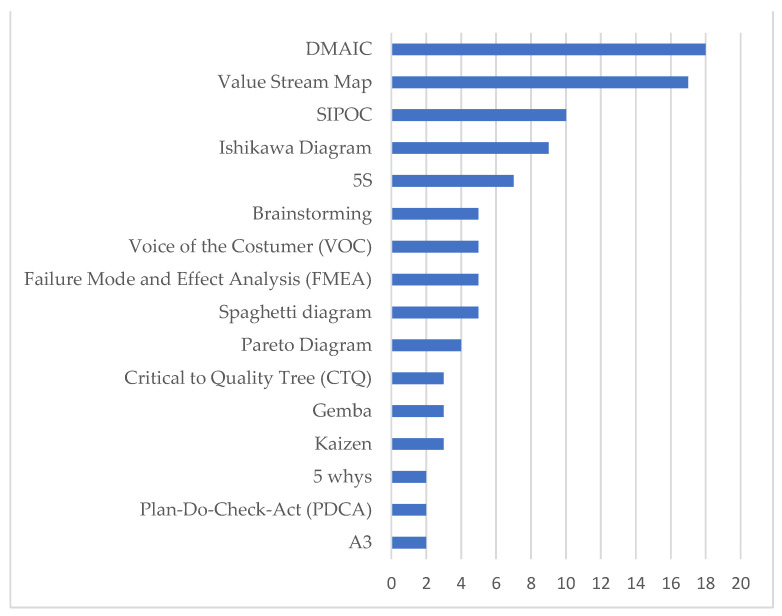
A total of 33 complete articles were selected for analysis. The most recurrent tools were DMAIC, VSM, SIPOC, Ishikawa Diagram and 5S.
Overview
CoChat Summary
TL;DR
This integrative review synthesized 33 articles on lean healthcare tools used to evaluate and improve health-service processes, finding that DMAIC, VSM, SIPOC, Ishikawa, and 5S were the most recurrent. Across studies, the main reported gains were reductions in processing, waiting, cycle, permanence, and total times, along with lower costs and workload and more consultations.
Key findings
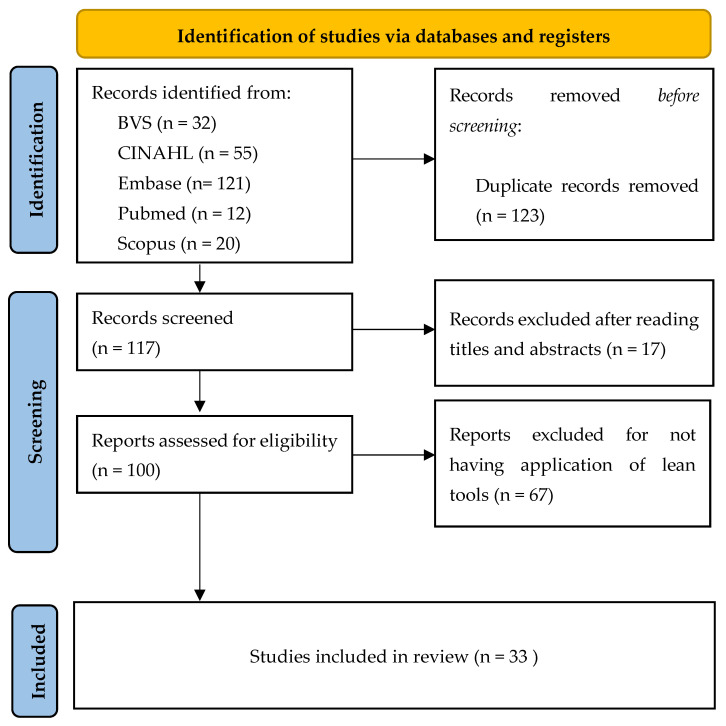
- The review included 33 complete articles from five databases; 67 articles were excluded because they mentioned lean tools but did not describe practical applications.
- The most used tools were DMAIC (18 studies; 54.5%), VSM (17 studies; 48.4%), SIPOC (10 studies; 30.3%), Ishikawa diagram (9 studies; 24.2%), and 5S (7 studies; 21.2%).
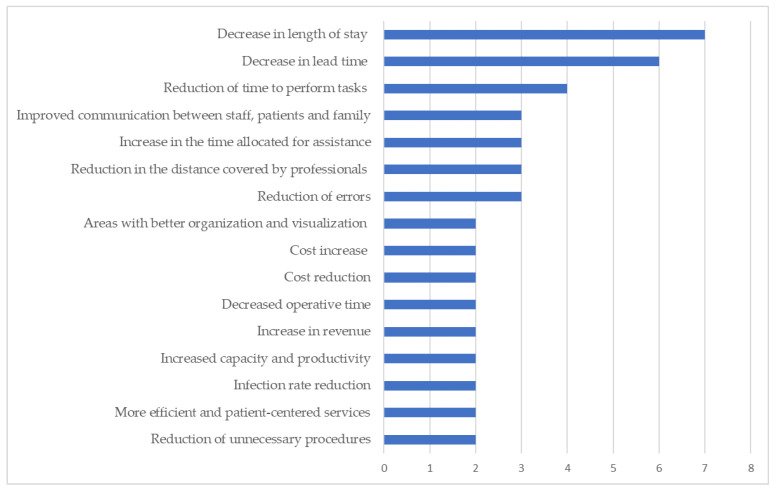
- Reported outcomes most often involved reduced processing, waiting, cycle, permanence, and total times; the abstract also reports reduction in costs and workload and increase in the number of calls/consultations.
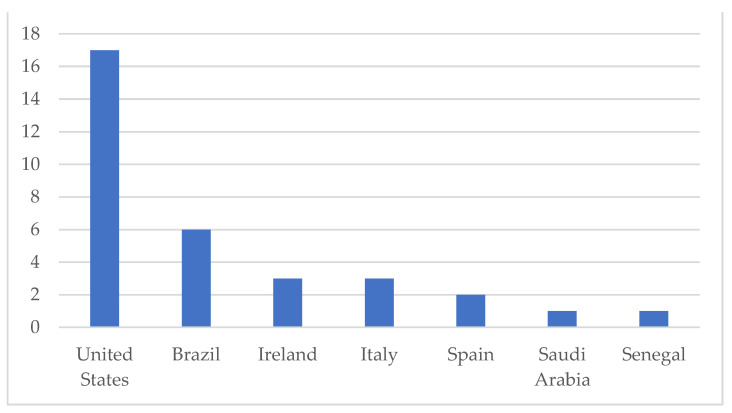
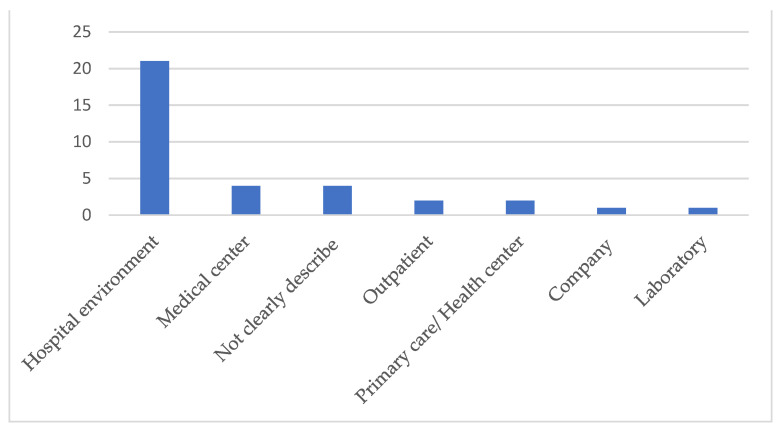
- Of the 33 studies, 21 (63.3%) were conducted in hospitals; 32 (96.9%) were in English; 17 (51.5%) were from the United States.
Methods
- Design: Integrative literature review, following six steps and PRISMA recommendations for identification, selection, eligibility, and inclusion.
- Data/sample: Searches in VHL, PubMed, Scopus, CINAHL, and Embase; included complete articles in English, Portuguese, or Spanish published between 2015 and 2019 that applied lean tools in healthcare services.
- Analysis: Articles were screened and then categorized using a validated Data Collection Instrument covering variables such as study design, sample, interventions, tools, results, and level of evidence; the review also counted tool frequency and reported outcomes.
Limitations
- The paper states there is no controlled descriptor for “lean healthcare” and related tools, which led the authors to build search strategies from common publication terms; they say this may have impaired data recovery.
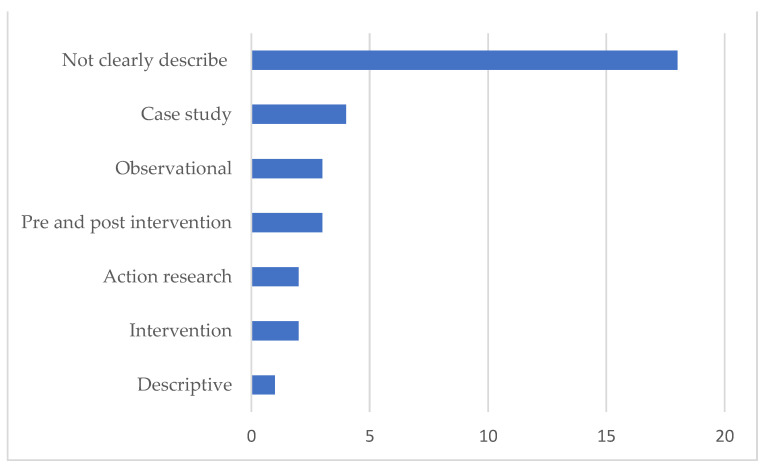
- The authors intended to classify the level of evidence for all articles, but because of an absence of clear descriptions of study designs, this was only partially performed.
- Evident from the text: most included studies did not clearly describe study design (18/33; 54.5%), and about nine studies did not describe sample selection methods, limiting replicability.
Model-written summary. Check it against the paper before relying on it.
Integrity signals
Registry
Cites
Statistics
Figures
Verification
Claims the paper makes
7 Valid · 1 Not valid · 30 Not checked · 53 Own results and interpretations
The sources with a verdict support this claim; the rest weren’t checked yet, have no full text we could read, or their verdicts aren’t rated yet.
In the paper
“review of work processes [38,46,47,48,49]”
§ Lean Healthcare Tools for Processes Evaluation: An Integrative Review > 4. Discussion
What the sources say
- Supportedcites [38] Improta G. Balato G. Romano M. Ponsiglione A.M. Raiola E. Russo M.A. Cuccaro P. Santillo L.C. Cesarelli M. Improving performances of the knee replacement surgery process by applying DMAIC principles J. Eval. Clin. Pract. 2017 23 1401 1407 10.1111/jep.12810 28948662 PMC6585639 source
The Methods (Analyse and Improve; page not specified in our copy) describe evaluating the surgery process with a Value Stream Map and brainstorming, then changing procedures identified as inefficient. This supports describing the intervention as a review of work processes. (LLM, conf=0.91)
- Not checked — no full text of the sourcecites [46] Agarwal S. Gallo J.J. Parashar A. Agarwal K.K. Ellis S.G. Khot U.N. Spooner R. Murat Tuzcu E. Kapadia S.R. Impact of lean six sigma process improvement methodology on cardiac catheterization laboratory efficiency Cardiovasc. Revascularization Med. 2016 17 95 101 10.1016/j.carrev.2015.12.011 26905051 source
- Not checked — no full text of the sourcecites [47] Rico F. Yalcin A. Eikman E.A. Technology Integration Performance Assessment Using Lean Principles in Health Care Am. J. Med. Qual. 2015 30 374 381 10.1177/1062860614536767 24878516 source
- Not checked — no full text of the sourcecites [48] Hultman C.S. Kim S. Lee C.N. Wu C. Dodge B. Hultman C.E. Tanner Roach S. Halvorson E.G. Implementation and analysis of a lean six sigma program in microsurgery to improve operative throughput in perforator flap breast reconstruction Ann. Plast. Surg. 2016 76 352 356 10.1097/SAP.0000000000000786 27187255 source
- Not checked yetcites [49] Gavriloff C. Ostrowski-Delahanty S. Oldfield K. The impact of lean six sigma methodology on patient scheduling Nurs. Econ. 2017 35 189 193
plain- Asserted: passes — The authors put it forward as true.
- Checkable: passes — It can be checked against evidence.
- Load-bearing: unclear — It is unclear whether the paper’s conclusions depend on it.
- Based: passes — The paper gives a reason why it holds.
- Supported
The cited sources support only part of this claim — read each source’s verdict below.
In the paper
“Organizational and cultural changes result in direct impacts on clinical aspect of patients. For this matter, we can highlight, for instance, effects such as “infections rate reduction” and “shorter treatment time” [31,55,63].”
§ Lean Healthcare Tools for Processes Evaluation: An Integrative Review > 4. Discussion
What the sources say
- Not checked — no full text of the sourcecites [31] Henrique D.B. Rentes A.F. Filho M.G. Esposto K.F. A new value stream mapping approach for healthcare environments Prod. Plan. Control 2016 27 24 48 10.1080/09537287.2015.1051159 source
- Not checked — no full text of the sourcecites [55] Montella E. Di Cicco M.V. Ferraro A. Centobelli P. Raiola E. Triassi M. Improta G. The application of Lean Six Sigma methodology to reduce the risk of healthcare–associated infections in surgery departments J. Eval. Clin. Pract. 2017 23 530 539 10.1111/jep.12662 27860065 source
- Partly supportedcites [63] Improta G. Cesarelli M. Montuori P. Santillo L.C. Triassi M. Reducing the risk of healthcare-associated infections through Lean Six Sigma: The case of the medicine areas at the Federico II University Hospital in Naples (Italy) J. Eval. Clin. Pract. 2018 24 338 346 10.1111/jep.12844 29098756 PMC5900966 sourceExperimental — accuracy not yet measured
The Results report that, after process improvements, the percentage of patients colonized by sentinel bacteria and their duration of hospitalization decreased. The Methods identify colonization as a measure of infection risk, not the infection rate itself; the paper reports shorter hospital stays, not shorter treatment time. Page numbers are unavailable in our copy. (LLM, conf=0.86)
plainstates a cause- Asserted: passes — The authors put it forward as true.
- Checkable: passes — It can be checked against evidence.
- Load-bearing: unclear — It is unclear whether the paper’s conclusions depend on it.
- Based: passes — The paper gives a reason why it holds.
The sources with a verdict support this claim; the rest weren’t checked yet, have no full text we could read, or their verdicts aren’t rated yet.
In the paper
“development and standardization of documents [29,50,51,52,53]”
§ Lean Healthcare Tools for Processes Evaluation: An Integrative Review > 4. Discussion
What the sources say
- Not checked — no full text of the sourcecites [29] Lot L.T. Sarantopoulos A. Min L.L. Perales S.R. de Boin I.F.S.F. de Ataide E.C. Using Lean tools to reduce patient waiting time Leadersh. Health Serv. 2018 31 343 351 10.1108/LHS-03-2018-0016 30016918 source
- Could not verifycites [50] Yuri N.E. Silveira A.T.-J. Comparative study: TQ and Lean Production ownership models in health services Rev. Lat. Am. Enfermagem 2015 23 846 854 10.1590/0104-1169.0151.2605 26487134 PMC4660406 sourceExperimental — accuracy not yet measured
The Lean Production Model section describes standardized work and an A3 paper sheet used in a standard format; the Results describe using the A3 tool. Neither passage says the interventions included developing and standardizing documents. Searches for documents, forms, and protocols did not establish that point. (LLM, conf=0.72)
- Not checked — no full text of the sourcecites [51] Dowell J.D. Makary M.S. Brocone M. Sarbinoff J.G. Vargas I.G. Gadkari M. Lean Six Sigma Approach to Improving Interventional Radiology Scheduling J. Am. Coll. Radiol. 2017 1316 1321 10.1016/j.jacr.2017.02.017 28461170 source
- Supportedcites [52] Molla M. Warren D.S. Stewart S.L. Stocking J. Johl H. Sinigayan V. A Lean Six Sigma Quality Improvement Project Improves Timeliness of Discharge from the Hospital Jt. Comm. J. Qual. Patient Saf. 2018 1 12 10.1016/j.jcjq.2018.02.006 30008352 source
The Improve (June 1-15, 2015) section lists the intervention bundle components and describes documents that were built for it: a multidisciplinary huddle checklist (Sidebar 1), formal sign-in sheets to monitor attendance, and a discharge-order-release-time/DBN dashboard 'created' by the Px Department; the Define (May 1-7, 2015) section likewise refers to the computerized 'current state' process-map document produced by the group. The Discussion frames the checklist and 'a standardized forum for communication such as a multidisciplinary huddle' plus 'use of checklists' as central elements of these successful interventions, so development and standardization of documents is an accurate paraphrase of this source's intervention, though the paper never uses that exact phrase. (LLM, conf=0.80)
- Not checked — no full text of the sourcecites [53] Kovach J.V. Borikar S. Enhancing Financial Performance: An Application of Lean Six Sigma to Reduce Insurance Claim Denials Qual. Manag. Health Care 2018 27 165 171 10.1097/QMH.0000000000000175 29944629 source
plain- Asserted: passes — The authors put it forward as true.
- Checkable: passes — It can be checked against evidence.
- Load-bearing: unclear — It is unclear whether the paper’s conclusions depend on it.
- Based: passes — The paper gives a reason why it holds.
The cited sources support only part of this claim — read each source’s verdict below.
In the paper
“some authors used more than one design to characterize this variable [29,35,36].”
§ Lean Healthcare Tools for Processes Evaluation: An Integrative Review > 4. Discussion
What the sources say
- Not checked — no full text of the sourcecites [29] Lot L.T. Sarantopoulos A. Min L.L. Perales S.R. de Boin I.F.S.F. de Ataide E.C. Using Lean tools to reduce patient waiting time Leadersh. Health Serv. 2018 31 343 351 10.1108/LHS-03-2018-0016 30016918 source
- Not matchedcites [35] Polit D.F. Beck C.T. Essentials of Nursing Research Seventh Edition Appraising Evidence for Nursing Practice Lippincott Williams & Wilkins Philadelphia, PA, USA 2010 9788578110796
We searched by its title and found no matching paper.
- Partly supportedcites [36] Rodrigues F.W.A. Ramos A.B.B. Metodologia científica: Análise e reflexão sobre a percepção dos graduandos Int. J. Educ. Teach. 2019 2 47 60 10.31692/2595-2498.v2i1.90 sourceExperimental — accuracy not yet measured
Our copy of Rodrigues & Medeiros (2019) holds mainly the journal metadata, the Resumo and the reference list; the only substantive passage is the abstract, which characterizes the study with more than one label — inductive methods via a qualitative research ('pesquisa qualitativa') and a study developed in two stages, one of them a field study ('estudo de campo'). That partly fits the claim that the authors used more than one design to characterize the study-design variable. However, no passage in our copy presents an explicit design classification (four searches — design/classification terms, 'quanto aos fins e quanto aos meios', 'delineamento', objectives/procedures — returned only reference-list and metadata blocks), so the abstract's mention of two procedural stages does not establish a deliberate multiple-design characterization. The unsupported part is the claim's specific assertion about how the authors classified the study design. (LLM, conf=0.65)
plain- Asserted: passes — The authors put it forward as true.
- Checkable: passes — It can be checked against evidence.
- Load-bearing: unclear — It is unclear whether the paper’s conclusions depend on it.
- Based: passes — The paper gives a reason why it holds.
A result the paper reports from its own data — it cites no other source for it, so there is none to check. The quote shows it is in the paper.
In the paper
“DMAIC was used in 54.5% of the studies”
§ Lean Healthcare Tools for Processes Evaluation: An Integrative Review > 4. Discussion
plain- Asserted: passes — The authors put it forward as true.
- Checkable: passes — It can be checked against evidence.
- Load-bearing: passes — The paper’s conclusions depend on it.
- Based: passes — The paper gives a reason why it holds.
47 more claims
Create a free account to see all 91 claims and to verify the 15 references still open.
- It may state two separate claims as one. 14
- Probably not a substantial claim. 25
- The quote only partly states this claim. 1
Self-check
Percentages, sums and reported differences re-computed from the paper’s own numbers.
Rated minor: it would not touch a result — a value no result rests on, a p-value that stays on the same side of the significance level, or a conflict that is clerical, resolved elsewhere in the paper, or outside its own findings.
In the paper
“Followed by DMAIC, VSM was chosen by 48.4% of the authors”
§ Lean Healthcare Tools for Processes Evaluation: An Integrative Review > 4. Discussion
Reported 48.4 · recomputed 51.515152
Citations
Cites
The PRISMA 2020 statement: An updated guideline for reporting systematic reviews
Page, M. J., McKenzie, J. E., Bossuyt, P. M., Boutron, I., Hoffmann, T. C., Mulrow, C. D., Shamseer, L., Tetzlaff, J. M., Akl, E. A., Brennan, S. E., et al. (2021) · BMJ · doi:10.1136/bmj.n71 · Cited by 108,283
The PRISMA 2020 statement: an updated guideline for reporting systematic reviews
Page, M. J., McKenzie, J., Bossuyt, P., Boutron, I., Hoffmann, T., mulrow, C., Shamseer, L., Tetzlaff, J., Akl, E., Brennan, S. E., et al. (2020) · doi:10.31222/osf.io/v7gm2_v1 · Cited by 8,090
The PRISMA 2020 statement: an updated guideline for reporting systematic reviews
Page, M. J., McKenzie, J., Bossuyt, P., Boutron, I., Hoffmann, T., mulrow, C., Shamseer, L., Tetzlaff, J., Akl, E., Brennan, S. E., et al. (2020) · doi:10.31222/osf.io/v7gm2 · Cited by 5,177
Revisão integrativa: Método de pesquisa para a incorporação de evidências na saúde e na enfermagem
Mendes, K. D. S., Silveira, R. C. D. C. P., & Galvão, C. M. (2008) · Texto & Contexto - Enfermagem · doi:10.1590/s0104-07072008000400018 · Cited by 4,375 · cited 2×
“For this review, six steps were followed: (1) establishment of the research question, (2) sampling or searching the literature, (3) categorization of studies, (4) evaluation of studies that were included in the integrative review, (5) interpretation of results and (6) presentation of the review [13].”
MethodThe PICO strategy for the research question construction and evidence search
Santos, C. M. D. C., Pimenta, C. A. D. M., & Nobre, M. R. C. (2007) · Revista Latino-Americana de Enfermagem · doi:10.1590/s0104-11692007000300023 · Cited by 2,342 · cited 2×
“In step one, to elaborate the research question, the “Population, Intervention, Comparison and Outcome”—PICO [15] strategy was used and the following question was elaborated: Which tools of the lean healthcare philosophy are being used most for the review of work processes and what are the results that are being achie…”
MethodPrincipais itens para relatar Revisões sistemáticas e Meta-análises: A recomendação PRISMA
(2015) · Epidemiologia e Serviços de Saúde · doi:10.5123/s1679-49742015000200017 · Cited by 1,238 · cited 1×
“For the conduction of the second stage, the identification, selection, eligibility and inclusion of the articles was carried out following the Preferred Reporting Items for Systematic review and Meta-Analysis Protocols—PRISMA [16] recommendation.”
MethodLean in healthcare: The unfilled promise?
Radnor, Z. J., Holweg, M., & Waring, J. (2012) · Social Science & Medicine · doi:10.1016/j.socscimed.2011.02.011 · Cited by 737 · cited 1×
“The LH is a healthcare adaptation of the lean philosophy created by Eiji Toyoda, founder of Toyota Motor Company, a Japanese car company [3].”
Background"Prevenção de lesões de pele no perioperatório: revisão integrativa da literatura"
Ursi, E. S., & Gavão, C. M. (2005) · Americanae (AECID Library) · Cited by 524
Prevenção de lesões de pele no perioperatório: revisão integrativa da literatura
Ursi, E. S., & Gavão, C. M. (2006) · Revista Latino-Americana de Enfermagem · doi:10.1590/s0104-11692006000100017 · Cited by 443 · cited 1×
“In step three, to manage the included studies and decide which information would be selected, a validated “Data Collection Instrument” was used, which includes the following variables: base/portal, title, journal, authors’ names, country research, language, year of publication, institution hosting the study, study des…”
MethodThe Promise of Lean in Health Care
Toussaint, J. S., & Berry, L. L. (2013) · Mayo Clinic Proceedings · doi:10.1016/j.mayocp.2012.07.025 · Cited by 421 · cited 2×
“Institutions must also strive for perfection through continuous improvement [8,26].”
Background
Research works printed but not linked: 3
- Polit D.F. Beck C.T. Essentials of Nursing Research Seventh Edition Appraising Evidence for Nursing Practice Lippincott Williams & Wilkins Philadelphia, PA, USA 2010 9788578110796
- Gavriloff C. Ostrowski-Delahanty S. Oldfield K. The impact of lean six sigma methodology on patient scheduling Nurs. Econ. 2017 35 189 193
- Melnyk B.M. Fineout-Overholt E. Evidence-Based Practice in Nursing & Healthcare: A Guide to Best Practice 2nd ed. Lippincott Williams & Wilkins Philadelphia, PA, USA 2010 1605477788
Cited by
Thakur, V., Akerele, O. A., & Randell, E. W. (2022) · Critical Reviews in Clinical Laboratory Sciences · doi:10.1080/10408363.2022.2106544 · Cited by 71
A case study of lean digital transformation through robotic process automation in healthcare
Huang, W.-L., Liao, S., Huang, H.-L., Su, Y.-X., Jerng, J., Lu, C.-Y., Ho, W., & Xu, J. (2024) · Scientific Reports · doi:10.1038/s41598-024-65715-9 · Cited by 73
“The Lean Six Sigma (LSS) methodology has been widely adopted and has demonstrated several positive results, such as increased time for direct patient care, reduced unnecessary procedures, and lower rates of nosocomial infection 23 .”
Shahin, M., Maghanaki, M., Hosseinzadeh, A., & Chen, F. F. (2024) · The International Journal of Advanced Manufacturing Technology · doi:10.1007/s00170-024-13874-4 · Cited by 76
Implementing Lean Six Sigma in health care: a review of case studies
Samanta, A. K., Varaprasad, G., & Gurumurthy, A. (2022) · International Journal of Lean Six Sigma · doi:10.1108/ijlss-08-2021-0133 · Cited by 46
Sarmiento, L. H. T., Escobar-Rodríguez, L. Y., Gomez-Avila, F. L., & Sánchez, D. T. P. (2024) · Cogent Engineering · doi:10.1080/23311916.2024.2411857 · Cited by 46
“…McDermott et al., 2022b; Raja Sreedharan et al., 2015; Rathi et al., 2022; Singh & Rathi, 2019), Quality Value Stream Mapping (Akmal et al., 2020; de Barros et al., 2021; Kelendar et al., 2020; Marin-Garcia et al., 2021; Standiford et al., 2020), The Plan-Do-Study-Act (PDSA) method (Curatolo et…”
Metadata
- Authors
- de Barros, L. B., Bassi, L. D. C., Caldas, L. P., Sarantopoulos, A., Zeferino, E. B. B., Minatogawa, V., & Gasparino, R. C.
- Affiliations
- School of Nursing, University of Campinas, Campinas 13083-887, Brazil
- Universidade Estadual de Campinas (UNICAMP) (BR)
- Faculdade de Ciências Médicas, Universidade Estadual de Campinas, Campinas 13083-887, Brazil
- Pontificia Universidad Católica de Valparaíso (CL)
- ORCID
- Venue
- International Journal of Environmental Research and Public Health
- Publisher
- MDPI AG
- Published
- 2021-07-10
- Volume
- 18
- Issue
- 14
- Pages
- 7389
- ISSN
- 1660-4601 (ISSN-L)
- PMC
- PMC8304063
- OpenAlex
- W3177775552
- Cited by
- 90
- References
- 66
- Citations by year
- 2026: 22 · 2025: 21 · 2024: 22 · 2023: 15 · 2022: 8 · 2021: 2
- FWCI
- 2.07
- Type
- journal article
- Language
- en
- Open access
- gold
- doi.org
- Licence
- Locations
- International Journal of Environmental Research and Public Health (publishedVersion, cc-by)
- PubMed Central (publishedVersion, cc-by)
- PubMed (publishedVersion)
- RePEc: Research Papers in Economics (submittedVersion)
- DOAJ (DOAJ: Directory of Open Access Journals) (submittedVersion)
- Funders
- CNPQ (Conselho Nacional de Desenvolvimento Científico e Tecnológico) (121294/2019-6)
- Topics
- Health Sciences › Medicine › Public Health, Environmental and Occupational Health › Healthcare Quality and Management
- Social Sciences › Decision Sciences › Management Science and Operations Research › Healthcare Operations and Scheduling Optimization
- Social Sciences › Business, Management and Accounting › Management Information Systems › Quality and Supply Management
- Keywords
- lean healthcare, lean tools, process evaluation, continuous improvement, DMAIC, value stream mapping, SIPOC, fishbone diagram, 5S, waste reduction, Lean Six Sigma, healthcare quality improvement, hospital operations
- MeSH terms
- Delivery of Health Care, Humans, Quality of Health Care, Efficiency, Organizational, Total Quality Management, Quality Improvement
About these checks
Registry, retraction, Cites and statistics results are computed, not judged, with one exception: a printed reference that no index lists is read once by a model before it counts as a citation error. Claims are extracted by a model and kept only when their quote appears verbatim in the text; each cited source is then checked, with a model’s help, for whether it says what the claim relies on. Those verdicts can be wrong — read the claim’s quote and the cited source before relying on one.
The claim verdicts this report counts are experimental: their accuracy is not yet measured.
A language model drew the claims from the paper on 2026-10-10, under version 3 of the claim definition (model deepseek-v4.1-flash, prompt extract-v3).
A second model labelled each claim on 2026-10-10 (model jev-1.13-20260917, definition revision gold-guideline-v0.2).
Cited sources are checked with a language model’s help (gpt-6-sol and qwen3.8-omni-flash).
Statistics and arithmetic are recomputed, not judged.
Confidence bands are shown only for fields calibrated on our annotated test set. None is calibrated yet, so no band is shown.
What counts as a claim ›How we measure confidence ›How we check this ›
Are you an author, or do you see a problem with this page? Request a review
Data sources
Bibliographic data: Semantic Scholar, OpenAlex, Crossref.
Contains information from the Semantic Scholar Academic Graph Datasets, made available under the ODC Attribution License (ODC-BY 1.0).
Semantic Scholar’s data is described in: Kinney, R., et al. (2023). The Semantic Scholar Open Data Platform. arXiv:2301.10140.
