Cited by 20

The DOI matches its Crossref record.

Up-Regulation of microRNA* Strands by Their Target Transcripts

Kang, Sung-Min, Choi, Ji-Woong, Hong, Su-Hyung, Lee, Heon-Jin·2013·International Journal of Molecular Sciences

Abstract

During microRNA (miRNA) biogenesis, one strand of a 21–23 nucleotide RNA duplex is preferentially selected for entry into an RNA-induced silencing complex (RISC). The other strand, known as the miRNA* species, is typically thought to be degraded. Previous studies have provided miRNA* selection models, but it remains unclear how the dominance of one arm arises during the biogenesis of miRNA. Using miRNA sponge-like methods, we cloned four tandem target sequences (artificial target) of miR-7b* and then measured miR-7b* expression levels after transfection of the artificial target. miR-7b* levels were found to significantly increase after transfection of the artificial target. We postulate that the abundance of target transcripts drives miRNA arm selection.

Overview

The claims and statistics of this paper haven’t been checked yet.

Run the check — free, no account needed. It reads the open-access text and checks the sources it cites.

A few free checks a day · papers already verified open instantly · results are public

Integrity signals

Registry

Crossref · 10.3390/ijms140713231

Cites

Statistics

Figures

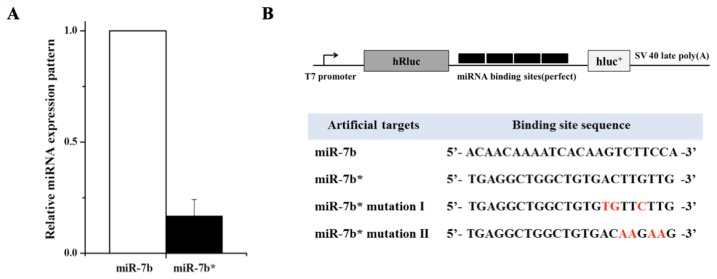
Figure 1 The expression patterns of miR-7b and miR-7b*. (A) Basal levels of miR-7b and miR-7b* expression in AtT-20 cells were analyzed by qRT-PCR; (B) Design of miRNA artificial targets. Renilla (hRluc) containing miRNA artificial targets were constructed by inserting multiple miRNA binding sites into the 3′ UTR of a hRluc reporter gene driven by a T7 promoter. The figure shows the nucleotide sequence of the miRNA artificial targets: the red letters are a mutated sequence; (C) Luciferase assay using the miRNA artificial target reporter constructs. COS-7 cells were co-transfected with the miR-7b* mimic oligonucleiotide and miRNA artificial target (1. miR-7b, 2. miR-7b*, 3. miR-7b* mutation I, 4. miR-7b* mutation II, 5. miR-338-3p). Renilla luciferase activity was normalized against firefly luciferase activity and fold changes are compared to miR-338-3p. The results shown are the means of three independent transfections (error bars indicate standard deviations).
Figure 1 The expression patterns of miR-7b and miR-7b*. (A) Basal levels of miR-7b and miR-7b* expression in AtT-20 cells were analyzed by qRT-PCR; (B) Design of miRNA artificial targets. Renilla (hRluc) containing miRNA artificial targets were constructed by inserting multiple miRNA binding sites into the 3′ UTR of a hRluc reporter gene driven by a T7 promoter. The figure shows the nucleotide sequence of the miRNA artificial targets: the red letters are a mutated sequence; (C) Luciferase assay using the miRNA artificial target reporter constructs. COS-7 cells were co-transfected with the miR-7b* mimic oligonucleiotide and miRNA artificial target (1. miR-7b, 2. miR-7b*, 3. miR-7b* mutation I, 4. miR-7b* mutation II, 5. miR-338-3p). Renilla luciferase activity was normalized against firefly luciferase activity and fold changes are compared to miR-338-3p. The results shown are the means of three independent transfections (error bars indicate standard deviations).CC BY · PubMed Central
Figure 2 Changed expression levels of miR-7b and miR-7b* after transfection with multi-transcript artificial targets. (A) 24 h after transfection of miRNA artificial targets (1 and 1′. null, 2 and 2′. empty vector, 3 and 3′. miR-7b*, 4 and 4′. miR-7b* mutation I, 5 and 5′. miR-7b* mutation II), AtT-20 total RNA was extracted and analyzed by northern blotting using probes specific for miR-7b and miR-7b*, respectively. Lane 3′ shows that miR-7b* expression was significantly increased following transfection of the miR-7b* artificial target. In contrast, miR-7b expression was similar in non-transfected and miR-7b* artificial targets transfected samples; (B) Twenty-four hours after various artificial targets (1 and 1′. null, 2 and 2′. empty vector, 3 and 3′. miR-7b, 4 and 4′. miR-7b*, 5 and 5′. miR-7b* mutation I, 6 and 6′. miR-7b* mutation II) were transfected, miR-7b (left) and miR-7b* (right) expression levels were analyzed by qRT-PCR. miRNA expression levels were normalize to U6. Fold changes are expressed versus empty target of each (2 or 2′); (C) Twenty-four hours after various artificial targets (1 and 1′. empty vector, 2 and 2′. miR-7b*, 3 and 3′. miR-7b* mutation I, 4 and 4′. miR-7b* mutation II) were transfected, AtT-20 lysates were immunoprecipitated (IP) using anti-Ago2 antibody. IPs were analyzed by immunoblotting with the same anti-Ago2 antibody (upper panel). Co-immunoprecipitated RNA was extracted and analyzed by qRT-PCR (lower panel). Fold changes are expressed versus the empty target for each (1 or 1′). Error bars in graphs indicate standard deviations; p-values are also indicated.
Figure 2 Changed expression levels of miR-7b and miR-7b* after transfection with multi-transcript artificial targets. (A) 24 h after transfection of miRNA artificial targets (1 and 1′. null, 2 and 2′. empty vector, 3 and 3′. miR-7b*, 4 and 4′. miR-7b* mutation I, 5 and 5′. miR-7b* mutation II), AtT-20 total RNA was extracted and analyzed by northern blotting using probes specific for miR-7b and miR-7b*, respectively. Lane 3′ shows that miR-7b* expression was significantly increased following transfection of the miR-7b* artificial target. In contrast, miR-7b expression was similar in non-transfected and miR-7b* artificial targets transfected samples; (B) Twenty-four hours after various artificial targets (1 and 1′. null, 2 and 2′. empty vector, 3 and 3′. miR-7b, 4 and 4′. miR-7b*, 5 and 5′. miR-7b* mutation I, 6 and 6′. miR-7b* mutation II) were transfected, miR-7b (left) and miR-7b* (right) expression levels were analyzed by qRT-PCR. miRNA expression levels were normalize to U6. Fold changes are expressed versus empty target of each (2 or 2′); (C) Twenty-four hours after various artificial targets (1 and 1′. empty vector, 2 and 2′. miR-7b*, 3 and 3′. miR-7b* mutation I, 4 and 4′. miR-7b* mutation II) were transfected, AtT-20 lysates were immunoprecipitated (IP) using anti-Ago2 antibody. IPs were analyzed by immunoblotting with the same anti-Ago2 antibody (upper panel). Co-immunoprecipitated RNA was extracted and analyzed by qRT-PCR (lower panel). Fold changes are expressed versus the empty target for each (1 or 1′). Error bars in graphs indicate standard deviations; p-values are also indicated.CC BY · PubMed Central
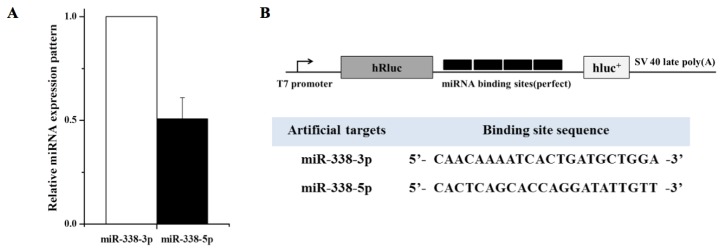
Figure 3 miR-338-3p and miR-338-5p expressions. (A) miR-338-3p and miR-338-5p expression were analyzed by qRT-PCR of the total RNA extracted from AtT-20 cells. miR-338-3p levels were about twice as high as miR-338-5p levels in AtT-20 cells; (B) Schematic representation of miRNA artificial targets. Construct map of the miR-338-3p and miR-338-5p artificial targets with miR-338-3p and miR-338-5p artificial target sequences below; (C) Both miR-338-3p and miR-338-5p expression was up-regulated by each of artificial targets. However, the change of miR-338-3p was not as great as miR-338-5p (miR-338*) by their artificial target. The expression levels of miR-338-5p were significantly elevated by miR-338-5p artificial target transfection but not by transfection of the miR-338-3p artificial target or empty vector (1 and 1′. null, 2 and 2′. empty vector, 3 and 3′. miR-338-3p, 4 and 4′. miR-338-5p). Fold changes are expressed versus the empty target for each (2 or 2′). Error bars in graphs indicate standard deviations; p-values are also indicated.
Figure 3 miR-338-3p and miR-338-5p expressions. (A) miR-338-3p and miR-338-5p expression were analyzed by qRT-PCR of the total RNA extracted from AtT-20 cells. miR-338-3p levels were about twice as high as miR-338-5p levels in AtT-20 cells; (B) Schematic representation of miRNA artificial targets. Construct map of the miR-338-3p and miR-338-5p artificial targets with miR-338-3p and miR-338-5p artificial target sequences below; (C) Both miR-338-3p and miR-338-5p expression was up-regulated by each of artificial targets. However, the change of miR-338-3p was not as great as miR-338-5p (miR-338*) by their artificial target. The expression levels of miR-338-5p were significantly elevated by miR-338-5p artificial target transfection but not by transfection of the miR-338-3p artificial target or empty vector (1 and 1′. null, 2 and 2′. empty vector, 3 and 3′. miR-338-3p, 4 and 4′. miR-338-5p). Fold changes are expressed versus the empty target for each (2 or 2′). Error bars in graphs indicate standard deviations; p-values are also indicated.CC BY · PubMed Central
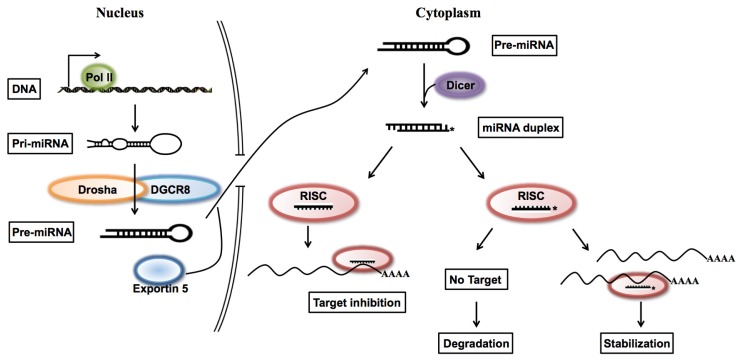
Figure 4 Schematic diagram of miRNA arm selection. Pri-miRNA is transcribed by RNA polymerase II and processed into pre-miRNA by Drosha/DGCR8 in the nucleus. Then pre-miRNA is processed into a duplex form of mRNA that is unwound during RISC assembly in the cytoplasm. Selection of the miRNA* sequence is determined by target transcript abundances. When miRNA* target transcripts are sufficiently abundant the miRNA* sequence is stabilized and acts on target transcripts in the same manner as miRNA.
Figure 4 Schematic diagram of miRNA arm selection. Pri-miRNA is transcribed by RNA polymerase II and processed into pre-miRNA by Drosha/DGCR8 in the nucleus. Then pre-miRNA is processed into a duplex form of mRNA that is unwound during RISC assembly in the cytoplasm. Selection of the miRNA* sequence is determined by target transcript abundances. When miRNA* target transcripts are sufficiently abundant the miRNA* sequence is stabilized and acts on target transcripts in the same manner as miRNA.CC BY · PubMed Central

Verification

Claims the paper makes

The claims and statistics of this paper haven’t been checked yet.

Run the check — free, no account needed. It reads the open-access text and checks the sources it cites.

A few free checks a day · papers already verified open instantly · results are public

Claims other papers make about this one

Each is checked against this paper’s own text: does it say what the citing paper says it does?

Self-check

Percentages, sums and reported differences re-computed from the paper’s own numbers.

The self-check needs the paper’s full text.

Citations

Cites

No references could be resolved yet.

Research works printed but not linked: 26

  1. Bartel, 2004, MicroRNAs: Genomics, biogenesis, mechanism, and function, Cell, 116, 281, 10.1016/S0092-8674(04)00045-5 · DOI
  2. Kim, 2010, Modifications of small RNAs and their associated proteins, Cell, 143, 703, 10.1016/j.cell.2010.11.018 · DOI
  3. Lewis, 2005, Conserved seed pairing, often flanked by adenosines, indicates that thousands of human genes are microRNA targets, Cell, 120, 15, 10.1016/j.cell.2004.12.035 · DOI · Paper page
  4. Bushati, 2007, microRNA Functions, Annu. Rev. Cell Dev. Biol, 23, 175, 10.1146/annurev.cellbio.23.090506.123406 · DOI · Paper page
  5. Lee, 2002, MicroRNA maturation: Stepwise processing and subcellular localization, EMBO J, 21, 4663, 10.1093/emboj/cdf476 · DOI
  6. Rand, 2005, Argonaute2 cleaves the anti-guide strand of siRNA during RISC activation, Cell, 123, 621, 10.1016/j.cell.2005.10.020 · DOI
  7. Matranga, 2005, Passenger-strand cleavage facilitates assembly of siRNA into Ago2-containing RNAi enzyme complexes, Cell, 123, 607, 10.1016/j.cell.2005.08.044 · DOI · Paper page
  8. Wang, 2009, Structural insights into RNA processing by the human RISC-loading complex, Nat. Struct. Mol. Biol, 16, 1148, 10.1038/nsmb.1673 · DOI
  9. Leuschner, 2006, Cleavage of the siRNA passenger strand during RISC assembly in human cells, EMBO Rep, 7, 314, 10.1038/sj.embor.7400637 · DOI
  10. Iwasaki, 2009, Drosophila argonaute1 and argonaute2 employ distinct mechanisms for translational repression, Mol. Cell, 34, 58, 10.1016/j.molcel.2009.02.010 · DOI
  11. Diederichs, 2007, Dual role for argonautes in microRNA processing and posttranscriptional regulation of microRNA expression, Cell, 131, 1097, 10.1016/j.cell.2007.10.032 · DOI
  12. Bhayani, 2012, Functional relevance of miRNA sequences in human disease, Mutat. Res, 731, 14, 10.1016/j.mrfmmm.2011.10.014 · DOI
  13. Khvorova, 2003, Functional siRNAs and miRNAs exhibit strand bias, Cell, 115, 209, 10.1016/S0092-8674(03)00801-8 · DOI · Paper page
  14. Schwarz, 2003, Asymmetry in the assembly of the RNAi enzyme complex, Cell, 115, 199, 10.1016/S0092-8674(03)00759-1 · DOI · Paper page
  15. Hui, 2011, MicroRNA evolution by arm switching, EMBO Rep, 12, 172, 10.1038/embor.2010.191 · DOI · Paper page
  16. Li, 2012, miRNA arm selection and isomiR distribution in gastric cancer, BMC Genomics Electron. Resour, 13, S13, 10.1186/1471-2164-13-S1-S13 · DOI · Paper page
  17. Okamura, 2008, The regulatory activity of microRNA* species has substantial influence on microRNA and 3′ UTR evolution, Nat. Struct. Mol. Biol, 15, 354, 10.1038/nsmb.1409 · DOI · Paper page
  18. Arvey, 2010, Target mRNA abundance dilutes microRNA and siRNA activity, Mol. Syst. Biol, 6, 363, 10.1038/msb.2010.24 · DOI
  19. Larsson, 2010, mRNA turnover rate limits siRNA and microRNA efficacy, Mol. Syst. Biol, 6, 433, 10.1038/msb.2010.89 · DOI
  20. Chatterjee, 2011, Target-mediated protection of endogenous microRNAs in C. elegans, Dev. Cell, 20, 388, 10.1016/j.devcel.2011.02.008 · DOI · Paper page
  21. Ebert, 2007, MicroRNA sponges: Competitive inhibitors of small RNAs in mammalian cells, Nat. Methods, 4, 721, 10.1038/nmeth1079 · DOI · Paper page
  22. Lee, 2006, miR-7b, a microRNA up-regulated in the hypothalamus after chronic hyperosmolar stimulation, inhibits Fos translation, Proc. Natl. Acad. Sci. USA, 103, 15669, 10.1073/pnas.0605781103 · DOI
  23. Hutvagner, 2008, Argonaute proteins: Key players in RNA silencing, Nat. Rev. Mol. Cell Biol, 9, 22, 10.1038/nrm2321 · DOI
  24. Meister, 2004, Human Argonaute2 mediates RNA cleavage targeted by miRNAs and siRNAs, Mol. Cell, 15, 185, 10.1016/j.molcel.2004.07.007 · DOI · Paper page
  25. Liu, 2004, Argonaute2 is the catalytic engine of mammalian RNAi, Science, 305, 1437, 10.1126/science.1102513 · DOI · Paper page
  26. Kwak, 2012, The N domain of Argonaute drives duplex unwinding during RISC assembly, Nat. Struct. Mol. Biol, 19, 145, 10.1038/nsmb.2232 · DOI

Cited by

Sorted by citations

Metadata

Authors
Kang, S.-M., Choi, J.-W., Hong, S.-H., & Lee, H.-J.
Affiliations
Department of Oral Microbiology, School of Dentistry, Kyungpook National University, Daegu 700-412, Korea
Venue
International Journal of Molecular Sciences
Publisher
MDPI AG
Published
2013-06-26
Volume
14
Issue
7
Pages
13231-13240
ISSN
1422-0067
Cited by
20
References
0
Language
en

About these checks

Registry, retraction, Cites and statistics results are computed, not judged, with one exception: a printed reference that no index lists is read once by a model before it counts as a citation error. Claims are extracted by a model and kept only when their quote appears verbatim in the text; each cited source is then checked, with a model’s help, for whether it says what the claim relies on. Those verdicts can be wrong — read the claim’s quote and the cited source before relying on one.

Statistics and arithmetic are recomputed, not judged.

Confidence bands are shown only for fields calibrated on our annotated test set. None is calibrated yet, so no band is shown.

What counts as a claim ›How we measure confidence ›How we check this ›

Are you an author, or do you see a problem with this page? Request a review