

The DOI matches its Crossref record; 48 of the 48 references it cites were found in a registry or an index.
Anti-Inflammatory Effect of Titrated Extract of Centella asiatica in Phthalic Anhydride-Induced Allergic Dermatitis Animal Model
Open accessAbstract
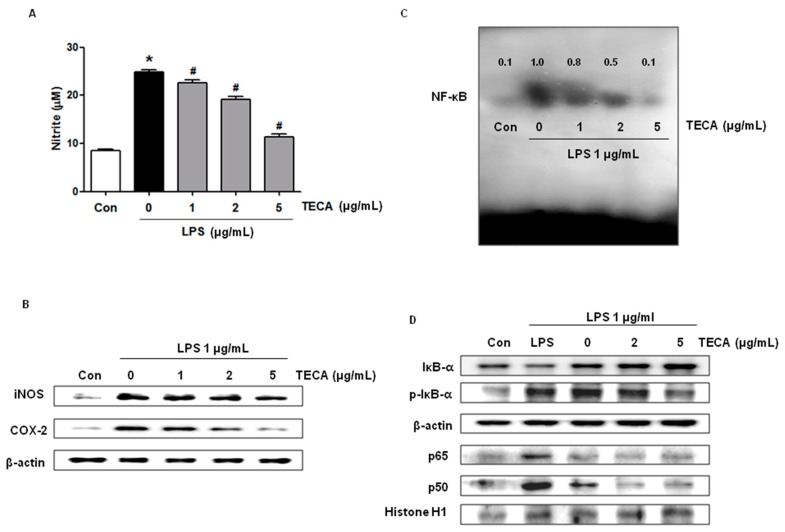
has potent antioxidant and anti-inflammatory properties. However, its anti-dermatitic effect has not yet been reported. In this study, we investigated the anti-dermatitic effects of titrated extract of Centella asiatica (TECA) in a phthalic anhydride (PA)-induced atopic dermatitis (AD) animal model as well as in vitro model. An AD-like lesion was induced by the topical application of five percent PA to the dorsal skin or ear of Hos:HR-1 mouse. After AD induction, 100 μL of 0.2% and 0.4% of TECA (40 μg or 80 μg/cm²) was spread on the dorsum of the ear or back skin three times a week for four weeks. We evaluated dermatitis severity, histopathological changes and changes in protein expression by Western blotting for inducible nitric oxide synthase (iNOS), cyclooxygenase-2 (COX-2), and NF-κB activity, which were determined by electromobility shift assay (EMSA). We also measured TNF-α, IL-1β, IL-6, and IgE concentration in the blood of AD mice by enzyme-linked immunosorbent assay (ELISA). TECA treatment attenuated the development of PA-induced atopic dermatitis. Histological analysis showed that TECA inhibited hyperkeratosis, mast cells and infiltration of inflammatory cells. TECA treatment inhibited expression of iNOS and COX-2, and NF-κB activity as well as the release of TNF-α, IL-1β, IL-6, and IgE. In addition, TECA (1, 2, 5 μg/mL) potently inhibited Lipopolysaccharide (LPS) (1 μg/mL)-induced NO production, expression of iNOS and COX-2, and NF-κB DNA binding activities in RAW264.7 macrophage cells. Our data demonstrated that TECA could be a promising agent for AD by inhibition of NF-κB signaling.
Overview
The claims and statistics of this paper haven’t been checked yet.
Run the check — free, no account needed. It reads the open-access text and checks the sources it cites.
Integrity signals
Registry
Cites
Statistics
Figures
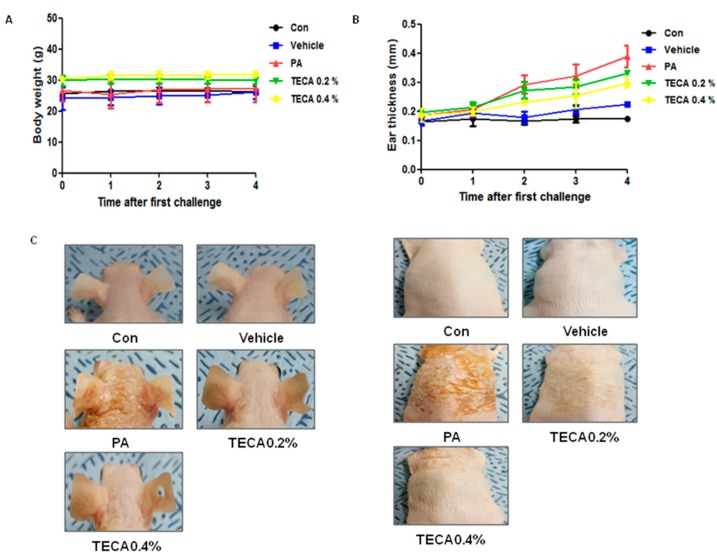
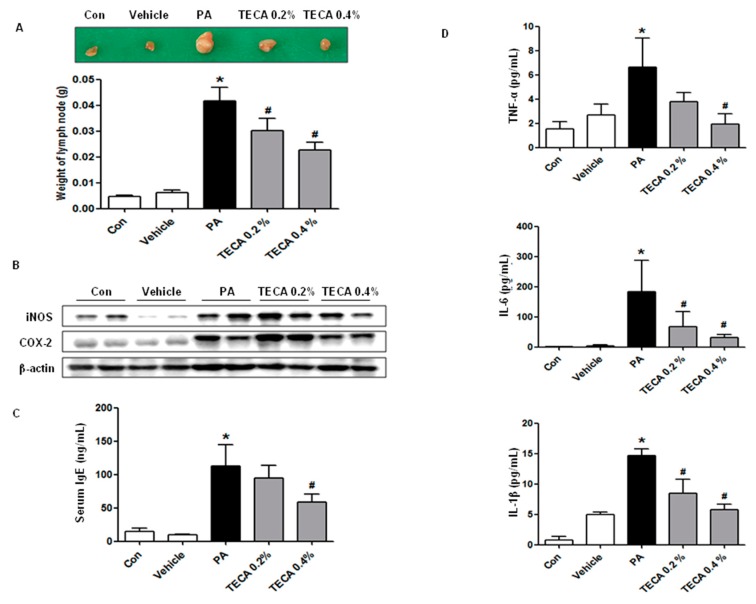
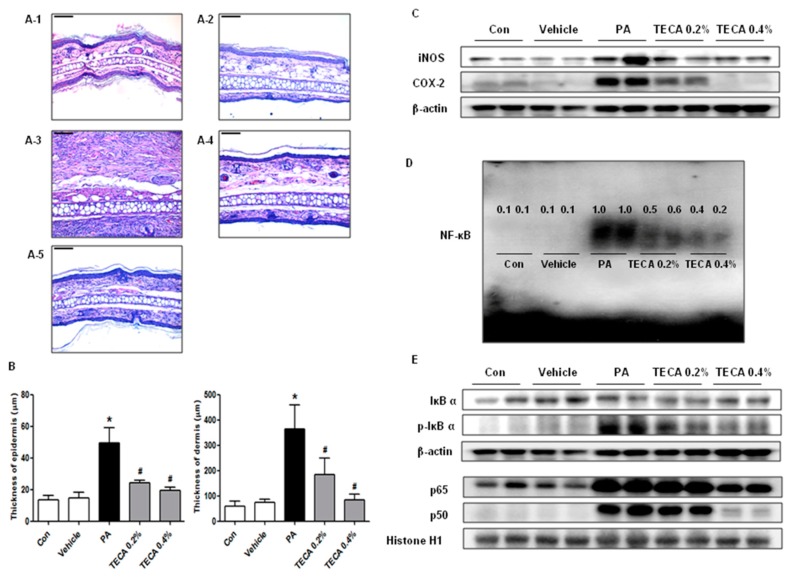
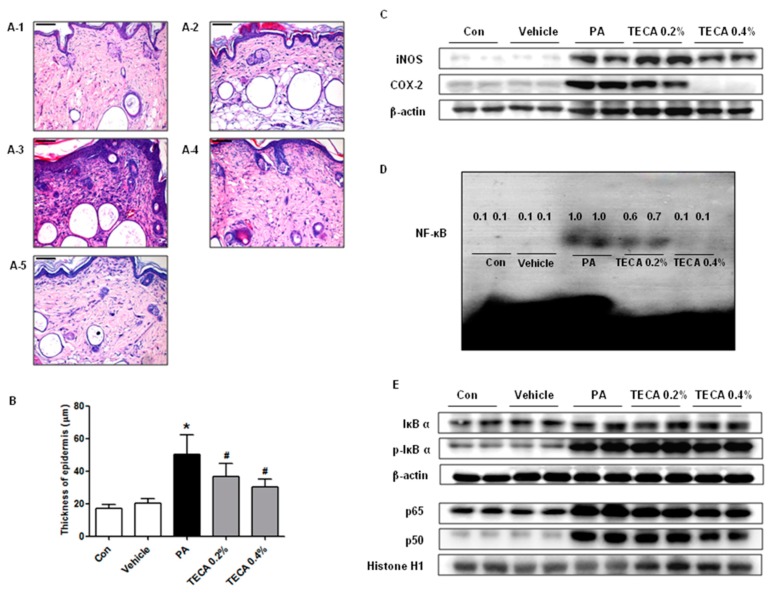
Verification
Claims the paper makes
The claims and statistics of this paper haven’t been checked yet.
Run the check — free, no account needed. It reads the open-access text and checks the sources it cites.
Claims other papers make about this one
Each is checked against this paper’s own text: does it say what the citing paper says it does?
The source backs part of the claim, not all of it — or backs it for a different population, condition or comparison.
In the citing paper
“Studies utilizing phytosomal formulations of C. asiatica (0.2–0.4%) in models of atopic dermatitis have shown substantial decreases in inflammatory markers such as immunoglobulin E (IgE), cyclooxygenase-2 (COX-2), inducible nitric oxide synthase (iNOS), tumor necrosis factor alpha (TNF-α), and mast cell counts through modulation of the NF-κB signaling pathway (Park et al. 2017).”
From Centella asiatica (L.) Urb. in skin health and cosmeceuticals: mechanisms, clinical evidence, and advanced delivery systems (2025) · cites this paper as Park et al. 2017
Experimental — accuracy not yet measuredThe source backs part of the claim, not all of it — or backs it for a different population, condition or comparison.
In the citing paper
“as demonstrated by the inhibition of NF-κB, COX-2, iNOS, and IgE in dermatitis models (Park et al. 2017).”
From Centella asiatica (L.) Urb. in skin health and cosmeceuticals: mechanisms, clinical evidence, and advanced delivery systems (2025) · cites this paper as Park et al. 2017
Experimental — accuracy not yet measuredThe source backs part of the claim, not all of it — or backs it for a different population, condition or comparison.
In the citing paper
“Phytosome complexes showed added anti-inflammatory effects in atopic and contact dermatitis models, emphasizing the importance of delivery vehicle–bioactive interactions.”
From Centella asiatica (L.) Urb. in skin health and cosmeceuticals: mechanisms, clinical evidence, and advanced delivery systems (2025) · cites this paper as Park et al. 2017
Experimental — accuracy not yet measuredThe check wasn’t confident either way, so it gives no verdict — never disputed.
In the citing paper
“Phytosomes, complexing polar bioactives such as madecassoside with phospholipids, offer enhanced anti-inflammatory action and better skin permeation”
From Centella asiatica (L.) Urb. in skin health and cosmeceuticals: mechanisms, clinical evidence, and advanced delivery systems (2025) · cites this paper as Park et al. 2017
Experimental — accuracy not yet measured
Self-check
Percentages, sums and reported differences re-computed from the paper’s own numbers.
The self-check needs the paper’s full text.
Citations
Cites
Nuclear Factor-κB — A Pivotal Transcription Factor in Chronic Inflammatory Diseases
Barnes, P. J., & Karin, M. (1997) · New England Journal of Medicine · doi:10.1056/nejm199704103361506 · Cited by 4,622
Atopic dermatitis: New insights and opportunities for therapeutic intervention
Leung, D. Y. M. (2000) · Journal of Allergy and Clinical Immunology · doi:10.1067/mai.2000.106484 · Cited by 717
Cytokines and chemokines orchestrate atopic skin inflammation
Homey, B., Steinhoff, M. S., Ruzicka, T., & Leung, D. Y. M. (2006) · Journal of Allergy and Clinical Immunology · doi:10.1016/j.jaci.2006.03.047 · Cited by 584
NF-κB in the regulation of epithelial homeostasis and inflammation
Wullaert, A., Bonnet, M., & Pasparakis, M. (2010) · Cell Research · doi:10.1038/cr.2010.175 · Cited by 538
Barnes, P. J. (1997) · The International Journal of Biochemistry & Cell Biology · doi:10.1016/s1357-2725(96)00159-8 · Cited by 498
IgE, Mast Cells, and Eosinophils in Atopic Dermatitis
Liu, F., Goodarzi, H., & Chen, H. (2011) · Clinical Reviews in Allergy & Immunology · doi:10.1007/s12016-011-8252-4 · Cited by 474
Triterpene Composition and Bioactivities of Centella asiatica
Hashim, P., Sidek, H., Helan, M. H. M., Sabery, A., Palanisamy, U. D., & Ilham, M. (2011) · Molecules · doi:10.3390/molecules16021310 · Cited by 266
Centella asiatica in Dermatology: An Overview
Bylka, W., Znajdek-Awiżeń, P., Studzińska-Sroka, E., Dańczak‐Pazdrowska, A., & Brzezińska, M. (2014) · Phytotherapy Research · doi:10.1002/ptr.5110 · Cited by 231
Centella asiatica in cosmetology
Bylka, W., Znajdek-Awiżeń, P., Studzińska-Sroka, E., & Brzezińska, M. (2013) · Advances in Dermatology and Allergology · doi:10.5114/pdia.2013.33378 · Cited by 229
(1999) · PubMed · Cited by 171
Influence of Asiatic Acid, Madecassic Acid, and Asiaticoside on Human Collagen I Synthesis
Bonte, F., Dumas, M., Chaudagne, C., & Meybeck, A. (1994) · Planta Medica · doi:10.1055/s-2006-959434 · Cited by 166 · cited 1×
“The influence of asiatic acid, madecassic acid, and asiaticoside on human skin fibroblast type I collagen synthesis was also found [33].”
Tanaka, A. (2004) · Blood · doi:10.1182/blood-2004-08-3247 · Cited by 162
Atopic dermatitis: a review of topical treatment options
Simpson, E. L. (2010) · Current Medical Research and Opinion · doi:10.1185/03007990903512156 · Cited by 161
Tang, B., Zhu, B., Liang, Y., Bi, L., Hu, Z., Chen, B., Zhang, K., & Zhu, J. (2011) · Archives of Dermatological Research · doi:10.1007/s00403-010-1114-8 · Cited by 154
Cytokine pattern of Langerhans cells isolated from murine epidermal cell cultures
Schreiber, S. C., Kilgus, O., Payer, E., Kutil, R., Elbe, A., Mueller, C., & Stingl, G. (1992) · The Journal of Immunology · doi:10.4049/jimmunol.149.11.3525 · Cited by 130
Facilitating action of asiaticoside at low doses on burn wound repair and its mechanism
Kimura, Y., Sumiyoshi, M., Samukawa, K.-I., Satake, N., & Sakanaka, M. (2008) · European Journal of Pharmacology · doi:10.1016/j.ejphar.2008.02.036 · Cited by 126
Nakamura, H., Aoki, M., Tamai, K., Oishi, M., Ogihara, T., Kaneda, Y., & Morishita, R. (2002) · Gene Therapy · doi:10.1038/sj.gt.3301724 · Cited by 123
Emerging role of Centella asiatica in improving age-related neurological antioxidant status
Subathra, M., Samuel, S., Devi, M. A., & Panneerselvam, C. (2005) · Experimental Gerontology · doi:10.1016/j.exger.2005.06.001 · Cited by 121
Won, J., Shin, J., Park, H.-J., Jung, H., Koh, D.-J., Jo, B.-G., Lee, J.-Y., Yun, K., & Lee, K. (2009) · Planta Medica · doi:10.1055/s-0029-1186142 · Cited by 106
Topical Application with a New NF-κB Inhibitor Improves Atopic Dermatitis in NC/NgaTnd Mice
Tanaka, A., Muto, S., Jung, K., Itai, A., & Matsuda, H. (2006) · Journal of Investigative Dermatology · doi:10.1038/sj.jid.5700603 · Cited by 100
Murakami, Y., Shoji, M., Hirata, A., Tanaka, S., Yokoe, I., & Fujisawa, S. (2004) · Archives of Biochemistry and Biophysics · doi:10.1016/j.abb.2004.11.013 · Cited by 92
Inhibitory effect of galangin on atopic dermatitis-like skin lesions
Choi, J. K., & Kim, S. (2014) · Food and Chemical Toxicology · doi:10.1016/j.fct.2014.03.021 · Cited by 77
Self-citationBurn wound healing properties of asiaticoside and madecassoside
Hou, Q., Li, M., Lu, Y., Liu, D., & Li, C.-C. (2016) · Experimental and Therapeutic Medicine · doi:10.3892/etm.2016.3459 · Cited by 73
Nhiệm, N. X., Tài, B. H., Quang, T. H., Kiệm, P. V., Minh, C. V., Nam, N. H., Kim, J., Im, L.-R., Lee, Y., & Kim, Y. H. (2011) · Bioorganic & Medicinal Chemistry Letters · doi:10.1016/j.bmcl.2011.01.066 · Cited by 70
Park, J., Kim, M.-S., Jeong, G., & Yoon, J. (2015) · Journal of Ethnopharmacology · doi:10.1016/j.jep.2015.05.039 · Cited by 58
Self-citationPerioperative Steroids for Peritumoral Intracranial Edema
Bebawy, J. F. (2012) · Journal of Neurosurgical Anesthesiology · doi:10.1097/ana.0b013e3182578bb5 · Cited by 58
Qiu, J., Yu, L., Zhang, X., Wu, Q., Wang, D., Wang, X., Xia, C., & Feng, H. (2015) · International Immunopharmacology · doi:10.1016/j.intimp.2015.03.022 · Cited by 55
Nowwarote, N., Osathanon, T., Jitjaturunt, P., Manopattanasoontorn, S., & Pavasant, P. (2012) · Phytotherapy Research · doi:10.1002/ptr.4742 · Cited by 50
Contact sensitisation and allergic contact dermatitis: Immunobiological mechanisms
FRIEDMANN, P. (2005) · Toxicology Letters · doi:10.1016/j.toxlet.2005.10.008 · Cited by 45
Kim, H., Lee, E. H., Lim, T. K., Jung, J., & Lyu, Y.-S. (1998) · International Journal of Immunopharmacology · doi:10.1016/s0192-0561(98)00022-8 · Cited by 43
Kim, G., Lee, S. E., Park, Y. S., Shin, D.-H., Park, G. G., & Park, C. (2014) · Food and Chemical Toxicology · doi:10.1016/j.fct.2014.01.057 · Cited by 37
Improvement of atopic dermatitis with topical application of Spirodela polyrhiza
Lee, H. J., Kim, M. H., Choi, Y. Y., Kim, E., Hong, J., Kim, K., & Yang, W. M. (2016) · Journal of Ethnopharmacology · doi:10.1016/j.jep.2016.01.010 · Cited by 34
Self-citationChong, N. J., & Aziz, Z. (2013) · Evidence-based Complementary and Alternative Medicine · doi:10.1155/2013/627182 · Cited by 34
Increased Th2 activity and diminished skin barrier function cooperate in allergic skin inflammation
Sehra, S., Krishnamurthy, P., Koh, B., Zhou, H., Seymour, L., Akhtar, N., Travers, J. B., Turner, M. J., & Kaplan, M. H. (2016) · European Journal of Immunology · doi:10.1002/eji.201646421 · Cited by 32
Harada, D., TAKADA, C., Tsukumo, Y., Takaba, K., & Manabe, H. (2005) · Journal of Dermatological Science · doi:10.1016/j.jdermsci.2004.11.007 · Cited by 32
Effects of Catalpa ovata stem bark on atopic dermatitis-like skin lesions in NC/Nga mice
Yang, G., Choi, C.-H., Lee, K., Lee, M., Ham, I., & Choi, H. (2012) · Journal of Ethnopharmacology · doi:10.1016/j.jep.2012.10.015 · Cited by 31
A rare variant in CYP 27A1 and its association with atopic dermatitis with high serum total IgE
Suzuki, H., Makino, Y., Nagata, M., Furuta, J., Enomoto, H., Hirota, T., Tamari, M., & Noguchi, E. (2016) · Allergy · doi:10.1111/all.12950 · Cited by 29
Gonzales, F., Ramdane, N., Delebarre-Sauvage, C., Modiano, P., Duhamel, A., & Lasek, A. (2016) · Journal of the European Academy of Dermatology and Venereology · doi:10.1111/jdv.13961 · Cited by 29
Klewicka, E., Cukrowská, B., Libudzisz, Z., Śliżewska, K., & Motyl, I. (2011) · Polish Journal of Microbiology · doi:10.33073/pjm-2011-047 · Cited by 27
INCANDELA, L., Cesarone, M. R., DeSanctis, M. T., Belcaro, G., Dugall, M., & Acerbi, G. (2002) · Journal of Cardiovascular Pharmacology and Therapeutics · doi:10.1177/107424840200700104 · Cited by 26
Zhang, Y., Wang, A., Xu, L., Shen, N., Zhu, J., & Tu, C. (2016) · European Journal of Dermatology · doi:10.1684/ejd.2015.2709 · Cited by 26
Kwak, M. H., Kim, J. E., Hwang, I. S., Lee, Y. J., An, B. S., Hong, J. T., Lee, S. H., & Hwang, D. Y. (2013) · Journal of Ethnopharmacology · doi:10.1016/j.jep.2013.05.036 · Cited by 25
Self-citationSung, J.-E., Lee, H. A., Kim, J.-E., Go, J., Seo, E.-J., Yun, W.-B., Kim, D.-S., Son, H.-J., Lee, C.-Y., Lee, H., et al. (2016) · Laboratory Animal Research · doi:10.5625/lar.2016.32.1.34 · Cited by 17
Effect of Eriodictyol on the Development of Atopic Dermatitis-Like Lesions in ICR Mice
Park, S., Lee, Y.-H., Lee, K. H., & Kim, T. (2013) · Biological and Pharmaceutical Bulletin · doi:10.1248/bpb.b13-00296 · Cited by 17
Assessing the New and Emerging Treatments for Atopic Dermatitis
Eichenfield, L. F., Friedlander, S. F., Simpson, E. L., & Irvine, A. D. (2016) · Seminars in Cutaneous Medicine and Surgery · doi:10.12788/j.sder.2016.043 · Cited by 14
Atopic dermatitis-like skin lesions with IgE hyperproduction and pruritus in KFRS4/Kyo rats
Kuramoto, T., Yokoe, M., Tanaka, D., Yuri, A., Nishitani, A., Higuchi, Y., Yoshimi, K., Tanaka, M., Kuwamura, M., Hiai, H., et al. (2015) · Journal of Dermatological Science · doi:10.1016/j.jdermsci.2015.09.005 · Cited by 14
Park, H., Jang, Y. J., Yim, J., Lee, H. K., & Pyo, S. (2016) · Phytotherapy Research · doi:10.1002/ptr.5703 · Cited by 14
Takahashi, N., Jones, M., Fujisawa, S., & Hama, R. (2015) · Drug Healthcare and Patient Safety · doi:10.2147/dhps.s78016 · Cited by 12
Cited by
Sorted by citations
Therapeutic Potential of Centella asiatica and Its Triterpenes: A Review
Sun, B., Wu, L., Wu, Y., Zhang, C., Qin, L., Hayashi, M., Kudo, M., Gao, M., & Liu, T. (2020) · Frontiers in Pharmacology · doi:10.3389/fphar.2020.568032 · Cited by 353
Centella asiatica and Its Metabolite Asiatic Acid: Wound Healing Effects and Therapeutic Potential
Diniz, L. R. L., Calado, L. L., Duarte, A. B. S., & de Sousa, D. P. (2023) · Metabolites · doi:10.3390/metabo13020276 · Cited by 160
Lee, Y., Choi, H. K., N’deh, K. P. U., Choi, Y.-J., Fan, M., Kim, E.-K., Chung, K.-H., & An, J. H. (2020) · Nutrients · doi:10.3390/nu12020411 · Cited by 115
Namviriyachote, N., Lipipun, V., Akkhawattanangkul, Y., Charoonrut, P., & Ritthidej, G. C. (2018) · Asian Journal of Pharmaceutical Sciences · doi:10.1016/j.ajps.2018.09.001 · Cited by 115
Buranasudja, V., Rani, D., Malla, A., Kobtrakul, K., & Vimolmangkang, S. (2021) · Scientific Reports · doi:10.1038/s41598-021-92958-7 · Cited by 112
Metadata
- Authors
- Park, J., Choi, J., Son, D., Park, E., Song, M., Hellström, M., & Hong, J.
- Affiliations
- Chungbuk National University (KR)
- The Catholic University of Korea Daejeon St. Mary's Hospital (KR)
- University of Gothenburg (SE)
- Corresponding author
- Hong, Jin
- Venue
- International Journal of Molecular Sciences
- Publisher
- MDPI AG
- Published
- 2017-03-30
- Volume
- 18
- Issue
- 4
- Pages
- 738
- ISSN
- 1422-0067 (ISSN-L)
- PMC
- PMC5412323
- OpenAlex
- W2600159981
- Cited by
- 97
- References
- 48
- Citations by year
- 2026: 9 · 2025: 10 · 2024: 14 · 2023: 10 · 2022: 11 · 2021: 16 · 2020: 13 · 2019: 7 · 2018: 5 · 2017: 2
- FWCI
- 8.41
- Type
- journal article
- Language
- en
- Open access
- gold
- doi.org
- Licence
- Locations
- International Journal of Molecular Sciences (publishedVersion, cc-by)
- Europe PMC (PubMed Central) (publishedVersion, cc-by)
- PubMed Central (publishedVersion, cc-by)
- PubMed (publishedVersion)
- Funders
- National Research Foundation
- Ministry of Trade, Industry and Energy (1415139249, MOTIE, 1415139249)
- Ministry of Science, ICT and Future Planning (MRC.2008-0062275, 2008-0062275)
- National Research Foundation of Korea (MRC 2008‐0062275, 2008‐0062275)
- Medical Research Council (2008-0062275)
- Topics
- Health Sciences › Medicine › Dermatology › Dermatology and Skin Diseases
- Health Sciences › Medicine › Complementary and alternative medicine › Medicinal Plants and Neuroprotection
- Health Sciences › Medicine › Dermatology › Contact Dermatitis and Allergies
- Keywords
- Centella asiatica, atopic dermatitis, anti-inflammatory activity, NF-κB signaling, inducible nitric oxide synthase, cyclooxygenase-2, mast cells, hyperkeratosis, cytokines, IgE, lipopolysaccharide-induced nitric oxide, macrophages, topical herbal extract
- MeSH terms
- Animals, Anti-Inflammatory Agents, Cell Line, Interleukins, Macrophages, Phthalic Anhydrides, Plant Extracts, Skin, Triterpenes, Tumor Necrosis Factor-alpha, NF-kappa B, Dermatitis, Allergic Contact, Centella, Mice, Cyclooxygenase 2, Nitric Oxide Synthase Type II
About these checks
Registry, retraction, Cites and statistics results are computed, not judged, with one exception: a printed reference that no index lists is read once by a model before it counts as a citation error. Claims are extracted by a model and kept only when their quote appears verbatim in the text; each cited source is then checked, with a model’s help, for whether it says what the claim relies on. Those verdicts can be wrong — read the claim’s quote and the cited source before relying on one.
Statistics and arithmetic are recomputed, not judged.
Confidence bands are shown only for fields calibrated on our annotated test set. None is calibrated yet, so no band is shown.
What counts as a claim ›How we measure confidence ›How we check this ›
Are you an author, or do you see a problem with this page? Request a review
