

Conserved and Divergent Functions of the cAMP/PKA Signaling Pathway in Candida albicans and Candida tropicalis
Open accessThe DOI matches its Crossref record; 98 of the 99 references it cites were found in a registry or an index.
Abstract
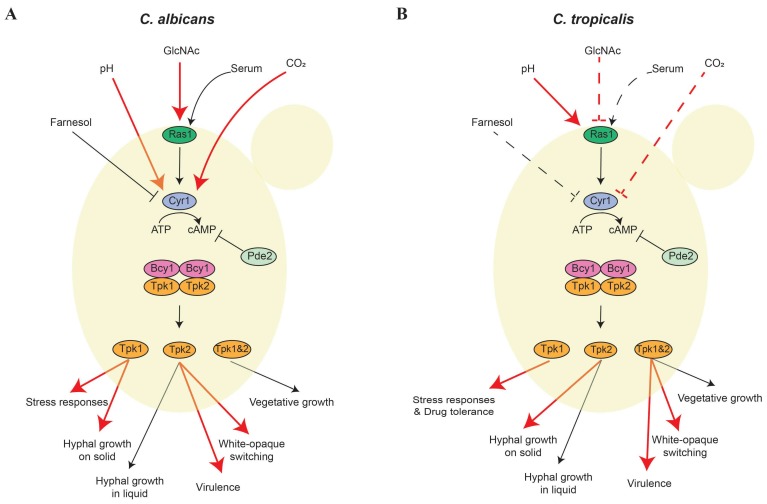
Fungal species undergo many morphological transitions to adapt to changing environments, an important quality especially in fungal pathogens. For decades, Candida albicans has been one of the most prevalent human fungal pathogens, and recently, the prevalence of Candida tropicalis as a causative agent of candidiasis has increased. In C. albicans, the ability to switch between yeast and hyphal forms is thought to be a key virulence factor and is regulated by multiple signaling cascades—including the cyclic adenosine monophosphate/protein kinase A (cAMP/PKA), calcineurin, high-osmolarity glycerol (HOG), and mitogen-activated protein kinases (MAPK) signaling pathways—upon receiving environmental cues. The cAMP/PKA signaling pathway also triggers white-opaque switching in C. albicans. However, studies on C. tropicalis morphogenesis are limited. In this minireview, we discuss the regulation of the yeast-hypha transition, virulence, and white-opaque switching through the cAMP/PKA pathway in the closely related species C. albicans and C. tropicalis.
Overview
The claims and statistics of this paper haven’t been checked yet.
Free: it reads the open-access text and checks the first 5 claims that cite a source we can check. Create a free account to check every claim.
Integrity signals
Registry
Cites
Statistics
Figures
Verification
Claims the paper makes
The claims and statistics of this paper haven’t been checked yet.
Free: it reads the open-access text and checks the first 5 claims that cite a source we can check. Create a free account to check every claim.
Claims other papers make about this one
Each is checked against this paper’s own text: does it say what the citing paper says it does?
The cited source says what the claim attributes to it.
In the citing paper
“The cAMP/PKA signalling pathway plays a core role in regulating the filamentation of C. albicans [30]”
From The F 1 F o -ATP synthase α subunit of Candida albicans induces inflammatory responses by controlling amino acid catabolism (2023) · cites this paper as [30]
The cited source says what the claim attributes to it.
In the citing paper
“This pathway is controlled by many signalling molecules [30] and one of them is pH [31].”
From The F 1 F o -ATP synthase α subunit of Candida albicans induces inflammatory responses by controlling amino acid catabolism (2023) · cites this paper as [30]
The cited source says what the claim attributes to it.
In the citing paper
“The cAMP/PKA pathway is the core signalling pathway regulating filamentation [30].”
From The F 1 F o -ATP synthase α subunit of Candida albicans induces inflammatory responses by controlling amino acid catabolism (2023) · cites this paper as [30]
Self-check
Percentages, sums and reported differences re-computed from the paper’s own numbers.
The self-check needs the paper’s full text.
Citations
Cites
Hidden Killers: Human Fungal Infections
Brown, G. D., Denning, D. W., Gow, N. A. R., Levitz, S. M., Netea, M. G., & White, T. C. (2012) · Science Translational Medicine · doi:10.1126/scitranslmed.3004404 · Cited by 4,284 · cited 1×
“Candida species are common causative agents of superficial and invasive fungal infections worldwide [1,2].”
BackgroundEpidemiology of Invasive Candidiasis: a Persistent Public Health Problem
Pfaller, M. A., & Diekema, D. J. (2007) · Clinical Microbiology Reviews · doi:10.1128/cmr.00029-06 · Cited by 4,174 · cited 1×
“parapsilosis—in patients with candidiasis or candidemia has increased [4,5].”
BackgroundCandida albicans pathogenicity mechanisms
Mayer, F. L., Wilson, D., & Hube, B. (2013) · Virulence · doi:10.4161/viru.22913 · Cited by 1,848
Nonfilamentous C. albicans Mutants Are Avirulent
Lo, H.-J., Köhler, J. R., DiDomenico, B., Loebenberg, D., Cacciapuoti, A., & Fink, G. R. (1997) · Cell · doi:10.1016/s0092-8674(00)80358-x · Cited by 1,809
Evolution of pathogenicity and sexual reproduction in eight Candida genomes
Butler, G., Rasmussen, M. D., Lin, M. F., Santos, M. A. S., Sakthikumar, S., Munro, C. A., Rheinbay, E., Grabherr, M., Forche, A., Reedy, J. L., et al. (2009) · Nature · doi:10.1038/nature08064 · Cited by 1,065
Quorum Sensing in the Dimorphic Fungus Candida albicans Is Mediated by Farnesol
Hornby, J. M., Jensen, E. C., Lisec, A. D., Tasto, J. J., Jahnke, B., Shoemaker, R., Dussault, P., & Nickerson, K. W. (2001) · Applied and Environmental Microbiology · doi:10.1128/aem.67.7.2982-2992.2001 · Cited by 983
Silva, S., Negri, M., Henriques, M., Oliveira, R., Williams, D. W., & Azeredo, J. (2012) · FEMS Microbiology Reviews · doi:10.1111/j.1574-6976.2011.00278.x · Cited by 969
Candida albicans morphogenesis and host defence: discriminating invasion from colonization
Gow, N. A. R., van de Veerdonk, F. L., Brown, A. J. P., & Netea, M. G. (2012) · Nature Reviews Microbiology · doi:10.1038/nrmicro2711 · Cited by 888
Andes, D. R., Safdar, N., Baddley, J. W., Playford, G., Reboli, A. C., Rex, J. H., Sobel, J. D., Pappas, P. G., Kullberg, B. J., & for the Mycoses Study Group (2012) · Clinical Infectious Diseases · doi:10.1093/cid/cis021 · Cited by 793 · cited 1×
“parapsilosis—in patients with candidiasis or candidemia has increased [4,5].”
BackgroundGlobal trends in the distribution of Candida species causing candidemia
Guinea, J. (2014) · Clinical Microbiology and Infection · doi:10.1111/1469-0691.12539 · Cited by 680 · cited 1×
“albicans is the most prevalent and has been responsible for >60% of candidemia cases worldwide for decades [3].”
Background
Cited by
Candida albicans—The Virulence Factors and Clinical Manifestations of Infection
Talapko, J., Juzbašić, M., Matijević, T., Pustijanac, E., Bekić, S., Kotris, I., & Škrlec, I. (2021) · Journal of Fungi · doi:10.3390/jof7020079 · Cited by 794
“The most important is cAMP-dependent protein kinase A (cyclic adenosine monophosphate PKA) [3,26].”
BackgroundThe regulation of hyphae growth in Candida albicans
Chen, H., Zhou, X., Ren, B., & Cheng, L. (2020) · Virulence · doi:10.1080/21505594.2020.1748930 · Cited by 277
Mechanism of Candida pathogenesis: Revisiting the vital drivers
Mba, I. E., & Nweze, E. I. (2020) · European Journal of Clinical Microbiology & Infectious Diseases · doi:10.1007/s10096-020-03912-w · Cited by 143
The role of Candida albicans stress response pathways in antifungal tolerance and resistance
Iyer, K. R., Robbins, N., & Cowen, L. E. (2022) · iScience · doi:10.1016/j.isci.2022.103953 · Cited by 88
“Moreover, studies have specifically highlighted a role for Tpk2 and Cyr1 in regulating drug tolerance at least in part through the regulation of efflux pump expression (Jain et al., 2003; Lin and Chen, 2018).”
BackgroundKim, J.-S., Lee, K.-T., Lee, M. H., Cheong, E., & Bahn, Y.-S. (2021) · mBio · doi:10.1128/mbio.02729-21 · Cited by 53
“In Candida albicans, the cAMP/PKA pathway modulates stress response, vegetative and hyphal growth, virulence, and biofilm formation (15).”
Metadata
- Authors
- Lin, C.-J., & Chen, Y.-L.
- Affiliations
- National Taiwan University (TW)
- Corresponding author
- Chen, Ying-Lien
- Venue
- Journal of Fungi
- Publisher
- MDPI AG
- Published
- 2018-06-08
- Volume
- 4
- Issue
- 2
- Pages
- 68
- ISSN
- 2309-608X (ISSN-L)
- PMC
- PMC6023519
- OpenAlex
- W2805402060
- Cited by
- 55
- References
- 99
- Citations by year
- 2026: 5 · 2025: 6 · 2024: 7 · 2023: 11 · 2022: 4 · 2021: 10 · 2020: 6 · 2019: 5 · 2018: 1
- FWCI
- 0.54
- Type
- journal article
- Language
- en
- Open access
- gold
- dx.doi.org
- Licence
- Locations
- Journal of Fungi (publishedVersion, cc-by)
- Europe PMC (PubMed Central) (publishedVersion, other-oa)
- PubMed Central (publishedVersion, cc-by)
- PubMed (publishedVersion)
- DOAJ (DOAJ: Directory of Open Access Journals) (submittedVersion, cc-by-sa)
- Funders
- Ministry of Science and Technology, Taiwan (104-2320-B-002-063-MY3, 106-2923-B-002-001-MY3)
- Topics
- Life Sciences › Biochemistry, Genetics and Molecular Biology › Molecular Biology › Fungal and yeast genetics research
- Health Sciences › Medicine › Infectious Diseases › Antifungal resistance and susceptibility
- Health Sciences › Medicine › Infectious Diseases › Fungal Infections and Studies
- Keywords
- cAMP/PKA signaling, Candida albicans, Candida tropicalis, yeast-to-hypha transition, morphogenesis, white-opaque switching, fungal virulence, calcineurin signaling, MAPK signaling, candidiasis, fungal pathogens
About these checks
Registry, retraction, Cites and statistics results are computed, not judged, with one exception: a printed reference that no index lists is read once by a model before it counts as a citation error. Claims are extracted by a model and kept only when their quote appears verbatim in the text; each cited source is then checked, with a model’s help, for whether it says what the claim relies on. Those verdicts can be wrong — read the claim’s quote and the cited source before relying on one.
Statistics and arithmetic are recomputed, not judged.
Confidence bands are shown only for fields calibrated on our annotated test set. None is calibrated yet, so no band is shown.
What counts as a claim ›How we measure confidence ›How we check this ›
Are you an author, or do you see a problem with this page? Request a review
How to cite
Cite CoChat for the checks on this page, and the paper for its own findings.
- This page
- CoChat. (2026). Citation check: Conserved and Divergent Functions of the cAMP/PKA Signaling Pathway in Candida albicans and Candida tropicalis. https://app.cochat.ai/papers/10.3390/jof4020068
- The paper
- Lin, C.-J., & Chen, Y.-L. (2018). Conserved and Divergent Functions of the cAMP/PKA Signaling Pathway in Candida albicans and Candida tropicalis. Journal of Fungi. https://doi.org/10.3390/jof4020068
Data sources
Bibliographic data: Semantic Scholar, OpenAlex, Crossref.
Contains information from the Semantic Scholar Academic Graph Datasets, made available under the ODC Attribution License (ODC-BY 1.0).
Semantic Scholar’s data is described in: Kinney, R., et al. (2023). The Semantic Scholar Open Data Platform. arXiv:2301.10140.
