

Fintech and Financial Health in Vietnam during the COVID-19 Pandemic: In-Depth Descriptive Analysis
Open accessThe DOI matches its Crossref record; 51 of the 51 references it cites were found in a registry or an index.
Abstract
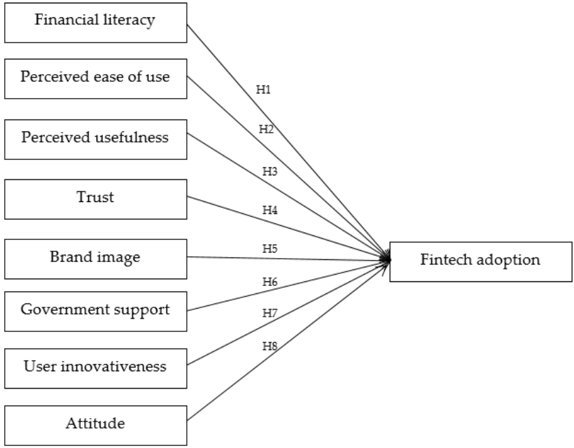
The growing popularity of smartphones and the proliferation of technology have accelerated the development of the digital payment industry. Fintech enables customers to access financial services more efficiently and faster than traditional business, especially during the COVID-19 pandemic due to health protocols, including restrictions on physical contact. This study investigates financial literacy, fintech adoption, and the impact of the COVID-19 crisis on the financial health of consumers in Vietnam. The relatively higher level of the unbanked population in Vietnam and the lower level of adult financial literacy compared with the ASEAN region motivated this study. Based on judgment sampling, participants were approached using the mall intercept technique, and those familiar with fintech were selected for the research interview. Thirty participants were interviewed and were given a survey form to be filled online using their mobile phones. Data analysis was conducted using IBM SPSS software version 23. Perceived ease of use, perceived usefulness, trust, brand image, government support, user innovativeness, and attitude are found to be significantly correlated with fintech adoption in Vietnam, while financial literacy was found to be not significantly correlated with fintech adoption. Furthermore, further analysis using multiple linear regression revealed user innovativeness and attitude have a positive impact towards fintech adoption, and in contrast, financial literacy showed significant negative impact on fintech. This inverse relationship could indicate that in Vietnam, fintech may play a role of bringing financial inclusion where people with lower financial literacy are able to use technology for financial transactions, which was previously inaccessible to them. This could also mean that Vietnamese with higher financial literacy do not see fintech as an important tool for their financial transactions, as they may already have strong access to traditional financial facilities. This research contributes to knowledge in the field of Fintech adoption in Vietnam at the time of the COVID-19 outbreak. To foster greater financial inclusivity and access for the Vietnamese consumers, policy makers could promote the development of fintech business infrastructure and regulatory sandboxes to foster fintech startups.
Overview
The claims and statistics of this paper haven’t been checked yet.
Free: it reads the open-access text and checks the first 5 claims that cite a source we can check. Create a free account to check every claim.
Integrity signals
Registry
Cites
Statistics
Figures
Verification
Claims the paper makes
The claims and statistics of this paper haven’t been checked yet.
Free: it reads the open-access text and checks the first 5 claims that cite a source we can check. Create a free account to check every claim.
Claims other papers make about this one
Each is checked against this paper’s own text: does it say what the citing paper says it does?
The source backs part of the claim, not all of it — or backs it for a different population, condition or comparison.
In the citing paper
“The previous study has revealed that PEU has a positive impact on Fintech adoption [25-27].”
From Fintech Adoption Drivers for Innovation for SMEs in Indonesia (2022) · cites this paper as [25]
Experimental — accuracy not yet measured
Self-check
Percentages, sums and reported differences re-computed from the paper’s own numbers.
The self-check needs the paper’s full text.
Citations
Cites
Perceived usefulness, perceived ease of use, and user acceptance of information technology
Davis, F. D. (1989) · MIS Quarterly · doi:10.2307/249008 · Cited by 68,483 · cited 10×
“The EY report (EY 2019) states that 87 out of 100 residents in China and India have adopted fintech, followed by Russia and South Africa at 82%. The development of fintech is also driven by the convenience provided by fintech compared with traditional financial services. First, registration can be performed online and…”
BackgroundInfluentialLu, J., Yao, J. E., & Yu, C.-S. (2005) · The Journal of Strategic Information Systems · doi:10.1016/j.jsis.2005.07.003 · Cited by 1,457 · cited 1×
“Lu et al. (2005) depict User Innovativeness (UI) as the extent to which someone is willing to experiment with new technology.”
BackgroundThe Evolution of Fintech: A New Post-Crisis Paradigm?
Arner, D. W., Barberis, J. N., & Buckley, R. P. (2015) · SSRN Electronic Journal · doi:10.2139/ssrn.2676553 · Cited by 1,412 · cited 1×
“Arner et al. (2015) define fintech as a combination of financial services and information technology.”
BackgroundDeterminants of user acceptance of Internet banking: an empirical study
Wang, Y.-S., Wang, Y.-M., Lin, H.-H., & Tang, T.-I. (2003) · International Journal of Service Industry Management · doi:10.1108/09564230310500192 · Cited by 1,358 · cited 1×
“Previous studies integrated PEU with fintech adoption by Cheng et al. (2006), Wang et al. (2003), and Hu et al. (2019).”
Financial literacy and the need for financial education: evidence and implications
Lusardi, A. (2019) · Swiss Journal of Economics and Statistics · doi:10.1186/s41937-019-0027-5 · Cited by 1,135 · cited 3×
“Fin ncial litera y is a basic knowledge of finance that covers several aspects of finance such as numeracy, compound interest, inflation, and risk diversification (Lusardi 2019).”
BackgroundInitial trust and online buyer behaviour
Chen, Y.-H., & Barnes, S. (2007) · Industrial Management & Data Systems · doi:10.1108/02635570710719034 · Cited by 841
Adoption of internet banking: An empirical study in Hong Kong
Cheng, T. C. E., Lam, D. Y. C., & Yeung, A. C. L. (2006) · Decision Support Systems · doi:10.1016/j.dss.2006.01.002 · Cited by 806 · cited 5×
“Previous studies integrated PEU with fintech adoption by Cheng et al. (2006), Wang et al. (2003), and Hu et al. (2019). The results of these studies explain that PEU has a significant relationship with technology adoption. The manifestation of trust in technology adoption is described by Kim and Prabhakar (2002) as a…”
MethodResultInfluentialHa, H.-Y., & Perks, H. (2005) · Journal of Consumer Behaviour · doi:10.1002/cb.29 · Cited by 750 · cited 1×
“The studies by Ha and Perks (2005), Ruparelia et al. (2010), and Hu et al. (2019) explain that brand image has a significant relationship to fintech adoption.”
BackgroundThe Real Impact of Improved Access to Finance: Evidence from Mexico
BRUHN, M., & LOVE, I. (2014) · The Journal of Finance · doi:10.1111/jofi.12091 · Cited by 728 · cited 2×
“Bruhn and Love (2014) explain that public access o the formal fi ancial sector has a positive correlatio fi creation, economic growth, and reducing poverty levels.”
BackgroundA solution to minimum sample size for regressions
Jenkins, D. G., & Quintana-Ascencio, P. F. (2020) · PLOS ONE · doi:10.1371/journal.pone.0229345 · Cited by 665 · cited 1×
“Warner (2008) suggests a minimum sample size of 20 and Jenkins and Quintana-Ascencio (2020) posit that a sample size of 25 is sufficient for regression.”
BackgroundHu, Z., Ding, S., Li, S., Chen, L., & Yang, S. (2019) · Symmetry · doi:10.3390/sym11030340 · Cited by 573 · cited 9×
“Hu et al. (2019) integrate moral intention and external variables such as government support and brand image, while Troudi and Bouyoucef (2019) adopt fintech and customer behavior toward green cosmetic products.”
BackgroundResultInfluentialSavings by and for the Poor: A Research Review and Agenda
Karlan, D., Ratan, A. L., & Zinman, J. (2014) · Review of Income and Wealth · doi:10.1111/roiw.12101 · Cited by 548
Financial literacy and its consequences: Evidence from Russia during the financial crisis
Klapper, L., Lusardi, A., & Panos, G. A. (2013) · Journal of Banking & Finance · doi:10.1016/j.jbankfin.2013.07.014 · Cited by 523
The Psychological Causes of Panic Buying Following a Health Crisis
Yuen, K. F., Wang, X., Ma, F., & Li, K. X. (2020) · International Journal of Environmental Research and Public Health · doi:10.3390/ijerph17103513 · Cited by 514
What drives FinTech adoption? A multi-method evaluation using an adapted technology acceptance model
Singh, S., Sahni, M. M., & Kovid, R. K. (2020) · Management Decision · doi:10.1108/md-09-2019-1318 · Cited by 433
Banking goes digital: The adoption of FinTech services by German households
Jünger, M., & Mietzner, M. (2020) · Finance Research Letters · doi:10.1016/j.frl.2019.08.008 · Cited by 371
Online banking adoption: an empirical analysis
Yee‐Loong Chong, A., Ooi, K., Lin, B., & Tan, B. (2010) · International Journal of Bank Marketing · doi:10.1108/02652321011054963 · Cited by 343 · cited 10×
“Previous research investigating the relationship between trust and technology adoption was conducted by Nathan (2009), Chong et al. (2010), and Sanchez-Torres et al. (2018). Previous research on brand image and technology adoption was conducted by looking at various aspects, i.e., brand image associated with quality (…”
BackgroundMethodInfluentialInternet banking adoption strategies for a developing country: the case of Thailand
Jaruwachirathanakul, B., & Fink, D. (2005) · Internet Research · doi:10.1108/10662240510602708 · Cited by 339 · cited 1×
“Previous studies carried out by Jaruwachirathanakul and Fink (2005), Marakarkandy et al. (2017), and Hu et al. (2019) describe that government support has a positive correlation with technology adoption.”
ResultAdoption of artificial intelligence in banking services: an empirical analysis
Rahman, M., Ming, T. H., Baigh, T. A., & Sarker, M. (2023) · International Journal of Emerging Markets · doi:10.1108/ijoem-06-2020-0724 · Cited by 325 · cited 1×
“Recent studies by Rahman et al. (2021) and Setiawan et al. (2021) agree similarly that user attitude impacts financial technology adoption positively.”
BackgroundConsumer acceptance of internet banking: The influence of internet trust
Grabner‐Kräuter, S., & Faullant, R. (2008) · International Journal of Bank Marketing · doi:10.1108/02652320810913855 · Cited by 316
User Innovativeness and Fintech Adoption in Indonesia
Setiawan, B., Nugraha, D. P., Irawan, A., Nathan, R. J., & Zoltan, Z. (2021) · Journal of Open Innovation: Technology, Market, and Complexity · doi:10.3390/joitmc7030188 · Cited by 267 · cited 2×
“Recent studies by Rahman et al. (2021) and Setiawan et al. (2021) agree similarly that user attitude impacts financial technology adoption positively.”
BackgroundSelf-citationBanking “on-the-go”: examining consumers’ adoption of mobile banking services
Zhang, T., Lu, C., & Kizildag, M. (2018) · International Journal of Quality and Service Sciences · doi:10.1108/ijqss-07-2017-0067 · Cited by 239
Initial trust, perceived risk, and the adoption of internet banking
Kim, K., & Prabhakar, B. (2000) · Journal of the Association for Information Systems · doi:10.5555/359640.359809 · Cited by 235
Marakarkandy, B., Yajnik, N., & Dasgupta, C. (2017) · Journal of Enterprise Information Management · doi:10.1108/jeim-10-2015-0094 · Cited by 212 · cited 5×
“Government support The government supports and improves the use of fintech services The government has introduced favorable legislation and regulations for fintech services The government is active in setting up all kinds of infrastructure such as telecom networks which have a positive role in promoting fintech servic…”
BackgroundMethodResultInfluentialRyu, H.-S. (2018) · Proceedings of the Annual Hawaii International Conference on System Sciences · doi:10.24251/hicss.2018.486 · Cited by 176
Development and initial psychometric properties of a panic buying scale during COVID-19 pandemic
Lins, S., & Aquino, S. (2020) · Heliyon · doi:10.1016/j.heliyon.2020.e04746 · Cited by 167
FinTech: Harnessing Innovation for Financial Inclusion
Salampasis, D., & Mention, A. (2017) · Elsevier eBooks · doi:10.1016/b978-0-12-812282-2.00018-8 · Cited by 158
Lahreche, A., Ogawa, S., Beaton, K., Khera, P., Bazarbash, M., von Allmen, U., & Sahay, R. (2020) · Departmental Papers · doi:10.5089/9781513512242.087 · Cited by 158
Bongomin, G. O. C., & Ntayi, J. M. (2020) · Digital Policy Regulation and Governance · doi:10.1108/dprg-01-2019-0005 · Cited by 157
COVID-19 Fear, Mental Health, and Substance Use Among Israeli University Students
Zolotov, Y., Reznik, A., Bender, S., & Isralowitz, R. (2020) · International Journal of Mental Health and Addiction · doi:10.1007/s11469-020-00351-8 · Cited by 157
Twum, K. K., Ofori, D., Keney, G., & Korang-Yeboah, B. (2022) · Journal of Science and Technology Policy Management · doi:10.1108/jstpm-12-2020-0168 · Cited by 151 · cited 1×
“In the context of fintech adoption during the COVID-19 pandemic, Vasenska et al. (2021) revealed that there has been a shift in respondent attitudes as a result of COVID-19, with persons who utilize fintech using technology more frequently during the COVID-19 pandemic than before the crisis.”
BackgroundJeong, J.-H., Kim, J., Son, H., & Nam, D. (2020) · Sustainability · doi:10.3390/su12083447 · Cited by 149 · cited 1×
“The study conducted by Jeong et al. (2020) on 363 companies explained that startups that received investment from VC at the initial stage had a better and more sustainable performance.”
BackgroundGoo, J. J., & Heo, J.-Y. (2020) · Journal of Open Innovation: Technology, Market, and Complexity · doi:10.3390/joitmc6020043 · Cited by 148 · cited 2×
“The study conducted by Goo and Heo (2020) explained that the government’s active role had a positive impact on the development of fintech by reducing uncertainty.”
BackgroundAdoption of internet banking services in China: is it all about trust?
Lifen Zhao, A., Koenig‐Lewis, N., Hanmer‐Lloyd, S., & Ward, P. (2010) · International Journal of Bank Marketing · doi:10.1108/02652321011013562 · Cited by 143
Financial Inclusion in the Digital Age
Patwardhan, A. (2017) · Elsevier eBooks · doi:10.1016/b978-0-12-810441-5.00004-x · Cited by 133
Financial Literacy and Attitudes to CryptocurrenciesPreprint
Panos, G. A., Kärkkäinen, T., & Atkinson, A. (2019) · SSRN Electronic Journal · doi:10.2139/ssrn.3482083 · Cited by 111
Predicting purchasing behavior of green food in Algerian context
Troudi, H., & Bouyoucef, D. (2020) · EuroMed Journal of Business · doi:10.1108/emjb-03-2019-0046 · Cited by 110 · cited 1×
“Hu et al. (2019) integrate moral intention and external variables such as government support and brand image, while Troudi and Bouyoucef (2019) adopt fintech and customer behavior toward green cosmetic products.”
BackgroundE-banking in Colombia: factors favouring its acceptance, online trust and government support
Sánchez-Torres, J. A., Canada, F.-J. A., Sandoval, A. V., & Alzate, J.-A. S. (2018) · International Journal of Bank Marketing · doi:10.1108/ijbm-10-2016-0145 · Cited by 109 · cited 1×
“Previous research investigating the relationship between trust and technology adoption was conducted by Nathan (2009), Chong et al. (2010), and Sanchez-Torres et al. (2018).”
MethodShapiro, S. L., Reams, L., & So, K. K. F. (2019) · Sport Management Review · doi:10.1016/j.smr.2018.03.002 · Cited by 95
Drivers of brand trust in internet retailing
Ruparelia, N., White, L., & Hughes, K. (2010) · Journal of Product & Brand Management · doi:10.1108/10610421011059577 · Cited by 83 · cited 1×
“Brand image I prefer to accept the fintech services provided by familiar brands I can recognize fintech services in Vietnam Fintech overall has a good reputation Ruparelia et al. (2010)”
BackgroundBisht, S. S., & Mishra, V. (2016) · Behaviour and Information Technology · doi:10.1080/0144929x.2016.1183711 · Cited by 67
Financial Transactions Using FINTECH during the Covid-19 Crisis in Bulgaria
Vasenska, I., Dimitrov, P., Koyundzhiyska-Davidkova, B., Krastev, V., Durana, P., & Poulaki, I. (2021) · Risks · doi:10.3390/risks9030048 · Cited by 65 · cited 1×
“In the context of fintech adoption during the COVID-19 pandemic, Vasenska et al. (2021) revealed that there has been a shift in respondent attitudes as a result of COVID-19, with persons who utilize fintech using technology more frequently during the COVID-19 pandemic than before the crisis.”
BackgroundFintech and Financial Inclusion: Opportunities and Pitfalls
Beck, T. (2020) · Econstor (Econstor) · Cited by 56
Morosan, C., & DeFranco, A. (2014) · International Journal of Hospitality Management · doi:10.1016/j.ijhm.2014.06.009 · Cited by 55 · cited 1×
“Previous research has explained that user innovativeness has a significant relationship with technology adoption (Morosan and DeFranco 2014; Zhang et al. 2018; Hu et al. 2019).”
BackgroundAttitude theory and the attitude-behavior relation
Ajzen, I. (2014) · Zenodo (CERN European Organization for Nuclear Research) · doi:10.5281/zenodo.5819214 · Cited by 50
Financial Literacy and Fintech Adoption in Japan
Yoshino, N., Morgan, P., & Long, T. Q. (2020) · Econstor (Econstor) · Cited by 47
Fintech and Financial Literacy in Viet Nam
Morgan, P., & Trinh, L. Q. (2020) · Econstor (Econstor) · Cited by 43
Investment in Startups and Small Business Financing
David, D., Gopalan, S., & Ramachandran, S. (n.d.) · RePEc: Research Papers in Economics · doi:10.1142/9789811235825_0007 · Cited by 41 · cited 2×
“Government incentive and seed funding from venture capital (VC) and private equity (PE) play a significant role in encouraging the activities of fintech companies in the early stage because banks are less willing to provide funds due to high risk (David et al. 2020).”
BackgroundThe demand for life insurance in a developing country and the mediating role of persuasion
Low, D., Nathan, R. J., Görgényi-Hegyes, É., & Fekete‐Farkas, M. (2021) · JOURNAL OF INTERNATIONAL STUDIES · doi:10.14254/2071-8330.2021/14-3/9 · Cited by 29 · cited 1×
“Variable Indicators Source Financial literary I have knowledge of compounding interest I have knowledge of inflation I have knowledge of risk diversification Lusardi (2019), Low et al. (2021).”
BackgroundSelf-citationElectronic Commerce Adoption in the Arab Countries - An Empirical Study.
Nathan, R. J. (2009) · Int. Arab. J. e Technol. · Cited by 17
Self-citationAnand, S., Mishra, K., Verma, V., & Taruna, T. (2021) · Emerald Open Research · doi:10.1108/eor-04-2023-0006 · Cited by 13
Research works printed but not linked: 6
- 4. Avornyo, Philip, Jiaming Fang, Ransford Okoe Odai, and Joshua Ben Vondee. 2019. Factors Affecting Continuous Intention of Mobile Banking in Tema and Kumasi. International Journal of Business and Science 10: 3. [CrossRef
- 5. Barefoot, Jo Ann. 2020. Digitizing Finance: Fintech as a Solution for Consumer Financial Health and Inclusion. M-RCBG Associate Working Paper Series No. 149. Cambridge, UK: Harvard Kennedy School.
- 15. Chuang, Li-Min, Chun-Chu Liu, and Hsiao-Kuang Kao. 2015. The Adoption of Fintech Service: TAM Perspective. International Journal of Management and Administrative Sciences 3: 1-15.
- 43. Korynski, Piotr. 2019. The Contribution of the Fintech Sector to Financial Inclusion and Health: A Review of Opportunities and Challenges. Microfinance Centre. Available online: https://mfc.org.pl/the-contribution-of-the-fintech-sector-to-financial- inclusion-and-health-a-review-of-opportunities-and-challenges/ (accessed on 18 January 2022).
- 51. Maurer, Bill. 2011. Mobile Money: Communication, Consumption and Change in the Payment Space. Journal of Development Studies 4: 589-604.
- 61. Riyadh, Al Nahian, Deborah Bunker, and Fethi Rabhi. 2010. Barriers to E-finance Adoption in Small Medium Sized Enterprises (SMES) in Bangladesh. Paper presented at 5th Conference on Qualitative Research in IT, Brisbane, Australia, November 29-30.
Cited by
Danladi, S., Prasad, M. S. V., Modibbo, U. M., Ahmadi, S. A., & Ghasemi, P. (2023) · Sustainability · doi:10.3390/su151713039 · Cited by 179
Fintech Adoption Drivers for Innovation for SMEs in Indonesia
Nugraha, D. P., Setiawan, B., Nathan, R. J., & Fekete-Farkas, M. (2022) · Journal of Open Innovation: Technology, Market, and Complexity · doi:10.3390/joitmc8040208 · Cited by 188
“The previous study has revealed that PEU has a positive impact on Fintech adoption [25–27].”
Self-citationPattnaik, D., Ray, S., & Raman, R. (2023) · Heliyon · doi:10.1016/j.heliyon.2023.e23492 · Cited by 270
Alkhwaldi, A. F., Alharasis, E. E., Shehadeh, M., Abu-AlSondos, I. A., Oudat, M. S., & Bani Atta, A. A. (2022) · Sustainability · doi:10.3390/su141912616 · Cited by 142
Digital Financial Literacy and Its Impact on Financial Decision-Making of Women: Evidence from India
Mishra, D., Agarwal, N., Sharahiley, S. M., & Kandpal, V. (2024) · Journal of risk and financial management · doi:10.3390/jrfm17100468 · Cited by 246
Metadata
- Authors
- Nathan, R. J., Setiawan, B., & Quynh, M. N.
- Affiliations
- Multimedia University (MY)
- Magyar Agrár- és Élettudományi Egyetem (HU)
- Department of Planning and General Affairs, Vietnam Chamber of Commerce and Industry, Hanoi 10000, Vietnam
- Corresponding author
- Nathan, Robert Jeyakumar
- Setiawan, Budi
- Venue
- Journal of Risk and Financial Management
- Publisher
- MDPI AG
- Published
- 2022-03-06
- Volume
- 15
- Issue
- 3
- Pages
- 125
- ISSN
- 1911-8066 (ISSN-L)
- 1911-8074
- OpenAlex
- W4221044666
- Cited by
- 103
- References
- 51
- Citations by year
- 2026: 19 · 2025: 16 · 2024: 31 · 2023: 26 · 2022: 11
- FWCI
- 20.19
- Type
- journal article
- Language
- en
- Open access
- hybrid
- doi.org
- Licence
- Locations
- Journal of risk and financial management (publishedVersion, cc-by)
- Siti Hasmah Digital Library-MMU Institutiona Repository (Multimedia University) (acceptedVersion)
- RePEc: Research Papers in Economics (submittedVersion)
- Econstor (Econstor) (submittedVersion, cc-by)
- Funders
- Multimedia University
- Ministry of Higher Education, Malaysia (FRGS/1/)
- Topics
- Social Sciences › Business, Management and Accounting › Management Information Systems › FinTech, Crowdfunding, Digital Finance
- Social Sciences › Decision Sciences › Information Systems and Management › Technology Adoption and User Behaviour
- Social Sciences › Business, Management and Accounting › Accounting › Financial Literacy and Behavior
- Keywords
- fintech adoption, financial literacy, financial well-being, COVID-19 pandemic, financial inclusion, digital payments, unbanked populations, perceived ease of use, perceived usefulness, trust in fintech, user innovativeness, consumer attitudes, Vietnam
About these checks
Registry, retraction, Cites and statistics results are computed, not judged, with one exception: a printed reference that no index lists is read once by a model before it counts as a citation error. Claims are extracted by a model and kept only when their quote appears verbatim in the text; each cited source is then checked, with a model’s help, for whether it says what the claim relies on. Those verdicts can be wrong — read the claim’s quote and the cited source before relying on one.
Statistics and arithmetic are recomputed, not judged.
Confidence bands are shown only for fields calibrated on our annotated test set. None is calibrated yet, so no band is shown.
What counts as a claim ›How we measure confidence ›How we check this ›
Are you an author, or do you see a problem with this page? Request a review
Data sources
Bibliographic data: Semantic Scholar, OpenAlex, Crossref.
Contains information from the Semantic Scholar Academic Graph Datasets, made available under the ODC Attribution License (ODC-BY 1.0).
Semantic Scholar’s data is described in: Kinney, R., et al. (2023). The Semantic Scholar Open Data Platform. arXiv:2301.10140.
