

The DOI matches its Crossref record; 13 of the 13 references it cites were found in a registry or an index.
Understanding the Adoption Dynamics of ChatGPT among Generation Z: Insights from a Modified UTAUT2 Model
Abstract
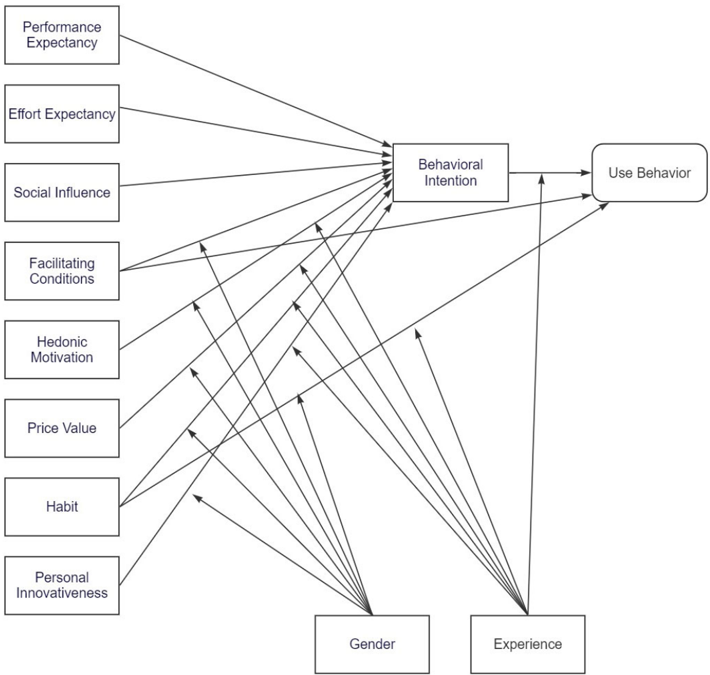
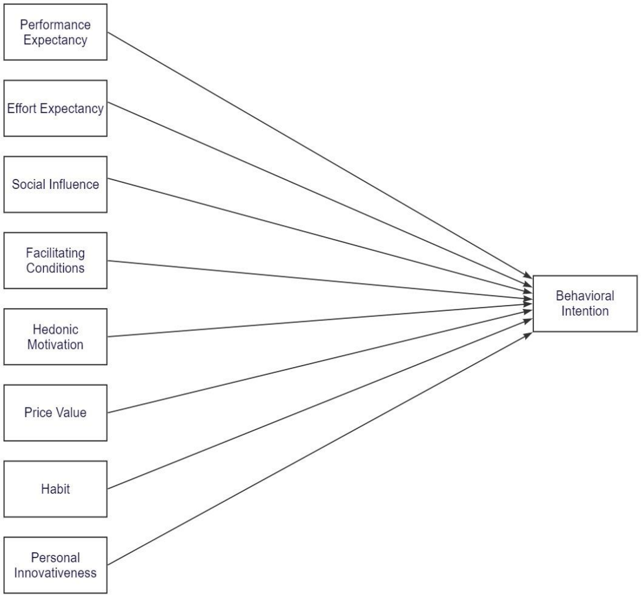
This research delves into the factors influencing the adoption of ChatGPT, a sophisticated AI-based chatbot, among Generation Z members in Croatia. Employing an extended UTAUT2 model, the impact of various factors on the behavioral intention to use ChatGPT is explored. The study included 694 Generation Z participants, and data were collected through an online survey featuring self-reporting questions. The analysis utilized statistical software packages for performing both confirmatory and exploratory factor analyses, in addition to hierarchical linear regression. Key findings reveal that performance expectancy, social influence, hedonic motivation, habit, and personal innovativeness significantly influence the behavioral intention to use ChatGPT. However, effort expectancy, facilitating conditions, and price value do not exhibit a significant impact. Notably, the study excludes the use behavior factor due to multicollinearity issues with behavioral intention. While the research does not focus on moderating factors, it reports that the adapted UTAUT2 model explains 65% of the variance in the adoption of ChatGPT by Generation Z users.
Overview
The claims and statistics of this paper haven’t been checked yet.
Run the check — free, no account needed. It reads the open-access text and checks the sources it cites.
Integrity signals
Registry
Cites
Statistics
Figures
Verification
Claims the paper makes
The claims and statistics of this paper haven’t been checked yet.
Run the check — free, no account needed. It reads the open-access text and checks the sources it cites.
Claims other papers make about this one
Each is checked against this paper’s own text: does it say what the citing paper says it does?
In the citing paper
“Social influence can reduce uncertainty by signalling that relevant others consider the technology acceptable and reliable (Krell et al., 2016); (Biloš & Budimir, 2024).”
From From search results to generative answers: A mixed-methods study of credibility assessment and trust formation in AI Overviews (2027) · cites this paper as Biloš & Budimir, 2024
In the citing paper
“Social influence is associated with trust rather than with intention to use because peer validation may reduce uncertainty before users form an independent assessment of the system's reliability (Krell et al., 2016); (Biloš & Budimir, 2024).”
From From search results to generative answers: A mixed-methods study of credibility assessment and trust formation in AI Overviews (2027) · cites this paper as Biloš & Budimir, 2024
In the citing paper
“Social influence was also associated with trust”
From From search results to generative answers: A mixed-methods study of credibility assessment and trust formation in AI Overviews (2027) · cites this paper as Biloš & Budimir, 2024
Self-check
Percentages, sums and reported differences re-computed from the paper’s own numbers.
The self-check needs the paper’s full text.
Citations
Cites
Perceived usefulness, perceived ease of use, and user acceptance of information technology
Davis, F. D. (1989) · MIS Quarterly · doi:10.2307/249008 · Cited by 68,483
Technology Acceptance Model 3 and a Research Agenda on Interventions
Venkatesh, V., & Bala, H. (2008) · Decision Sciences · doi:10.1111/j.1540-5915.2008.00192.x · Cited by 8,159
Task-Technology Fit and Individual Performance
Goodhue, D. L., & Thompson, R. L. (1995) · MIS Quarterly · doi:10.2307/249689 · Cited by 6,006
Agarwal, R., & Prasad, J. (1998) · Information Systems Research · doi:10.1287/isre.9.2.204 · Cited by 3,575
Ray, P. P. (2023) · Internet of Things and Cyber-Physical Systems · doi:10.1016/j.iotcps.2023.04.003 · Cited by 2,463
Artificial Intelligence and the Public Sector—Applications and Challenges
Wirtz, B. W., Weyerer, J. C., & Geyer, C. (2019) · International Journal of Public Administration · doi:10.1080/01900692.2018.1498103 · Cited by 1,341
Strzelecki, A. (2024) · Interactive Learning Environments · doi:10.1080/10494820.2023.2209881 · Cited by 807
Sohn, K., & Kwon, O. (2020) · Telematics and Informatics · doi:10.1016/j.tele.2019.101324 · Cited by 646
Mariani, M. M., Perez‐Vega, R., & Wirtz, J. (2022) · Psychology & Marketing · doi:10.1002/mar.21619 · Cited by 631
ChatGPT and the future of medical writing
Biswas, S. (2023) · Radiology · doi:10.1148/radiol.223312 · Cited by 571
Research works printed but not linked: 55
- Paul, 2023, ChatGPT and consumers: Benefits, pitfalls and future research agenda, Int. J. Consum. Stud., 47, 1213, 10.1111/ijcs.12928 · DOI · Paper page
- Vaswani, A., Shazzer, N., Parmar, N., Uszkoreit, J., Jones, L., Gomez, A.N., and Polosukhin, I. (2017, January 4–9). Attention is all you need. Proceedings of the Advances in Neural Information Processing Systems, Long Beach, CA, USA.
- Aljanabi, 2023, ChatGpt: Open Possibilities, Iraqi J. Comput. Sci. Math., 4, 62
- Abdullah, M., Madain, A., and Jararweh, Y. (December, January 29). ChatGPT: Fundamentals, applications and social impacts. Proceedings of the 2022 Ninth International Conference on Social Networks Analysis, Management and Security (SNAMS), Milan, Italy. · DOI · Paper page
- Mich, 2023, ChatGPT for e-Tourism: A technological perspective, Inf. Technol. Tour., 25, 1, 10.1007/s40558-023-00248-x · DOI
- Peres, 2023, On ChatGPT and beyond: How generative artificial intelligence may affect research, teaching, and practice, Int. J. Res. Mark., 40, 269, 10.1016/j.ijresmar.2023.03.001 · DOI · Paper page
- Kotler, P., Kartajaya, H., and Setiawan, I. (2021). Marketing 5.0: Technology for Humanity, John Wiley & Sons, Inc.
- 2010, Digitalni domoroci i digitalni imigranti, Dijete Društvo Časopis Promic. Prava Djeteta, 12, 83
- Venkatesh, 1996, A model of the antecedents of perceived ease of use: Development and test, Decis. Sci., 27, 451, 10.1111/j.1540-5915.1996.tb01822.x · DOI · Paper page
- Venkatesh, 2000, A theoretical extension of the technology acceptance model: Four longitudinal field studies, Manag. Sci., 46, 186, 10.1287/mnsc.46.2.186.11926 · DOI · Paper page
- Venkatesh, 2003, User acceptance of information technology: Toward a unified view, MIS Q., 27, 425, 10.2307/30036540 · DOI · Paper page
- Lai, 2017, The literature review of technology adoption models and theories for the novelty technology, JISTEM-J. Inf. Syst. Technol. Manag., 14, 21
- Raeisi, 2016, Factors influencing to m-commerce adoption in China, Int. J. Bus. Manag., 4, 372
- Venkatesh, 2012, Consumer acceptance and use of information technology: Extending the unified theory of acceptance and use of technology, MIS Q., 36, 157, 10.2307/41410412 · DOI · Paper page
- Frank, 2018, Evaluation of electronic programme guide adoption using UTAUT2 based model, Teh. Vjesn., 25, 884
- Gansser, 2021, A new acceptance model for artificial intelligence with extensions to UTAUT2: An empirical study in three segments of application, Technol. Soc., 65, 101535, 10.1016/j.techsoc.2021.101535 · DOI
- Sharma, 2024, Why do retail customers adopt artificial intelligence (ai) based autonomous decision-making systems?, IEEE Trans. Eng. Manag., 71, 1846, 10.1109/TEM.2022.3157976 · DOI
- Venkatesh, 2021, Adoption and use of AI tools: A research agenda grounded in UTAUT, Ann. Oper. Res., 308, 641, 10.1007/s10479-020-03918-9 · DOI
- Ghazi, K.M., Kattara, H., Salem, I.E., and Shaaban, M.N. (2023). Benefit-triggered or trust-guided? investigation of customers’ perceptions towards AI-adopting hotels amid and post COVID-19 pandemic. Tour. Hosp. Res., 14673584231184161. · DOI
- Rahim, N.I.M., Iahad, N.A., Yusof, A.F., and Al-Sharafi, M.A. (2022). AI-Based chatbots adoption model for higher-education institutions: A hybrid PLS-SEM-Neural network modelling approach. Sustainability, 14. · DOI
- Tran, 2021, Determinants of intention to use artificial intelligence-based diagnosis support system among prospective physicians, Front. Public Health, 9, 755644, 10.3389/fpubh.2021.755644 · DOI · Paper page
- Das, 2024, Application of UTAUT2 on adopting artificial intelligence powered lead management system (AI-LMS) in passenger car sales, Technol. Forecast. Soc. Chang., 201, 123241, 10.1016/j.techfore.2024.123241 · DOI
- Ding, 2023, Investigating behavioural intention toward adopting artificial intelligence service robots technology in hospitality in china, Environ.-Behav. Proc. J., 8, 389, 10.21834/e-bpj.v8i26.4990 · DOI
- Vinerean, S., Budac, C., Baltador, L., and Dabija, D. (2022). Assessing the effects of the COVID-19 pandemic on M-commerce adoption: An adapted UTAUT2 approach. Electronics, 11. · DOI
- Behl, 2021, The role of organizational culture and voluntariness in the adoption of artificial intelligence for disaster relief operations, Int. J. Manpow., 43, 569, 10.1108/IJM-03-2021-0178 · DOI
- 2021, Determinants of the adoption of AI wearables—Practical implications for marketing, Hum. Technol., 17, 294, 10.14254/1795-6889.2021.17-3.6 · DOI
- Wang, 2023, What may impact trustworthiness of ai in digital healthcare: Discussion from patients’ viewpoint, Proc. Int. Symp. Hum. Factors Ergon. Health Care, 12, 5, 10.1177/2327857923121001 · DOI
- Thakkar, 2023, Medical specialists’ perception about adoption of artificial intelligence in the healthcare sector, Cardiometry, 25, 426, 10.18137/cardiometry.2022.25.426434 · DOI
- Schmitz, 2022, Modifying UTAUT2 for a cross-country comparison of telemedicine adoption, Comput. Hum. Behav., 130, 107183, 10.1016/j.chb.2022.107183 · DOI
- Antonovica, 2022, Application and extension of the UTAUT2 model for determining behavioral intention factors in use of the artificial intelligence virtual assistants, Front. Psychol., 13, 993935, 10.3389/fpsyg.2022.993935 · DOI
- Nikolopoulou, 2020, Acceptance of mobile phone by university students for their studies: An investigation applying UTAUT2 model, Educ. Inf. Technol., 25, 4139, 10.1007/s10639-020-10157-9 · DOI · Paper page
- Venkatesh, 2016, Unified Theory of Acceptance and Use of Technology: A Synthesis and the Road Ahead, J. Assoc. Inf. Syst., 17, 328
- Venkatesh, 2010, Unified theory of acceptance and use of technology: US vs, China. J. Glob. Inf. Technol. Manag., 13, 5
- Shaikh, 2021, Identifying relevant segments of AI applications adopters–Expanding the UTAUT2’s variables, Telemat. Inform., 58, 101529, 10.1016/j.tele.2020.101529 · DOI · Paper page
- Xian, 2021, Psychological Factors in Consumer Acceptance of Artificial Intelligence in Leisure Economy: A Structural Equation Model, J. Internet Technol., 22, 697
- Sugumar, 2021, Do I desire chatbots to be like humans? Exploring factors for adoption of chatbots for financial services, J. Int. Technol. Inf. Manag., 30, 38
- McLean, 2019, Hey Alexa… examine the variables influencing the use of artificial intelligent in-home voice assistants, Comput. Hum. Behav., 99, 28, 10.1016/j.chb.2019.05.009 · DOI · Paper page
- Fridin, 2014, Acceptance of socially assistive humanoid robot by preschool and elementary school teachers, Comput. Hum. Behav., 33, 23, 10.1016/j.chb.2013.12.016 · DOI
- Alalwan, 2017, Factors influencing adoption of mobile banking by Jordanian bank customers: Extending UTAUT2 with trust, Int. J. Inf. Manag., 37, 99, 10.1016/j.ijinfomgt.2017.01.002 · DOI
- Canziani, 2021, Consumer acceptance of voice-activated smart home devices for product information seeking and online ordering, Comput. Hum. Behav., 119, 106714, 10.1016/j.chb.2021.106714 · DOI
- Crabbe, 2009, An adoption model for mobile banking in Ghana, Int. J. Mob. Commun., 7, 515, 10.1504/IJMC.2009.024391 · DOI
- Hew, 2015, What catalyses mobile apps usage intention: An empirical analysis, Ind. Manag. Data Syst., 115, 1269, 10.1108/IMDS-01-2015-0028 · DOI · Paper page
- Tamilmani, 2019, The battle of Brain vs. Heart: A literature review and meta-analysis of “hedonic motivation” use in UTAUT2, Int. J. Inf. Manag., 46, 222, 10.1016/j.ijinfomgt.2019.01.008 · DOI
- Shaw, 2019, The non-monetary benefits of mobile commerce: Extending UTAUT2 with perceived value, Int. J. Inf. Manag., 45, 44, 10.1016/j.ijinfomgt.2018.10.024 · DOI
- Cintrón, J.J.V. (2022). Factors Influencing IT Managers’ Acceptance of Artificial Intelligence (AI) in Digital Transformation. [Ph.D. Thesis, Capella University].
- Limayem, 2007, How habit limits the predictive power of intention: The case of information systems continuance, MIS Q., 31, 705, 10.2307/25148817 · DOI
- 2019, Analysing the acceptation of online games in mobile devices: An application of UTAUT2, J. Retail. Consum. Serv., 50, 85, 10.1016/j.jretconser.2019.04.018 · DOI
- Merhi, 2019, A cross-cultural study of the intention to use mobile banking between Lebanese and British consumers: Extending UTAUT2 with security, privacy and trust, Technol. Soc., 59, 101151, 10.1016/j.techsoc.2019.101151 · DOI · Paper page
- Imani, 2020, Factors Influencing Customers Acceptance of Using the QR Code Feature in Offline Merchants for Generation Z in Bandung (Extended UTAUT2), KnE Soc. Sci., 2020, 1174
- Bosson, 1999, Self-liking, self-competence, and the quest for self-verification, Personal. Soc. Psychol. Bull., 25, 1230, 10.1177/0146167299258005 · DOI
- Kessler, S.K., and Martin, M. (2017). How Do Potential Users Perceive the Adoption of New Technologies within the Field of Artificial Intelligence and Internet-of-Things?—A Revision of the UTAUT 2 Model Using Voice Assistants. [Master’s Thesis, Lund University].
- Tantra, T., and Ariyanti, M. (2017, January 22–23). The Use of Modified Unified Theory of Acceptance and Use of Technology 2 (UTAUT2) to predict Student Behavioral Intention in the use of Integrated Academic Information System (iGracias) Mobile Application at Telkom University. Proceedings of the 3rd International Conference on Transformation in Communications 2017 (IcoTiC 2017), Bandung, Indonesia.
- Baudier, 2020, Smart home: Highly-educated students’ acceptance, Technol. Forecast. Soc. Chang., 153, 119355, 10.1016/j.techfore.2018.06.043 · DOI
- Chu, 2022, Developing an Extended Theory of UTAUT 2 Model to Explore Factors Influencing Taiwanese Consumer Adoption of Intelligent Elevators, Sage Open, 12, 21582440221142209, 10.1177/21582440221142209 · DOI
- Meet, 2022, Exploring factors affecting the adoption of MOOC in Generation Z using extended UTAUT2 model, Educ. Inf. Technol., 27, 10261, 10.1007/s10639-022-11052-1 · DOI
Cited by
Sorted by citations
Faraon, M., Rönkkö, K., Milrad, M., & Tsui, E. (2025) · Education and Information Technologies · doi:10.1007/s10639-025-13492-x · Cited by 50
Casermeiro-Corpas, Y., Rejón-Guardia, F., Vallespín, M., & Molinillo, S. (2027) · Information Processing & Management · doi:10.1016/j.ipm.2026.105211
Metadata
- Authors
- Biloš, A., & Budimir, B.
- Affiliations
- Faculty of Economics and Business in Osijek, Josip Juraj Strossmayer University of Osijek, 31000 Osijek, Croatia
- Venue
- Journal of Theoretical and Applied Electronic Commerce Research
- Publisher
- MDPI AG
- Published
- 2024-04-13
- Volume
- 19
- Issue
- 2
- Pages
- 863-879
- ISSN
- 0718-1876
- Cited by
- 84
- References
- 13
- Language
- en
About these checks
Registry, retraction, Cites and statistics results are computed, not judged, with one exception: a printed reference that no index lists is read once by a model before it counts as a citation error. Claims are extracted by a model and kept only when their quote appears verbatim in the text; each cited source is then checked, with a model’s help, for whether it says what the claim relies on. Those verdicts can be wrong — read the claim’s quote and the cited source before relying on one.
Statistics and arithmetic are recomputed, not judged.
Confidence bands are shown only for fields calibrated on our annotated test set. None is calibrated yet, so no band is shown.
What counts as a claim ›How we measure confidence ›How we check this ›
Are you an author, or do you see a problem with this page? Request a review
