

Soft, Formstable (Co)Polyester Blend Elastomers
Open accessThe DOI matches its Crossref record; 61 of the 61 references it cites were found in a registry or an index.
Abstract
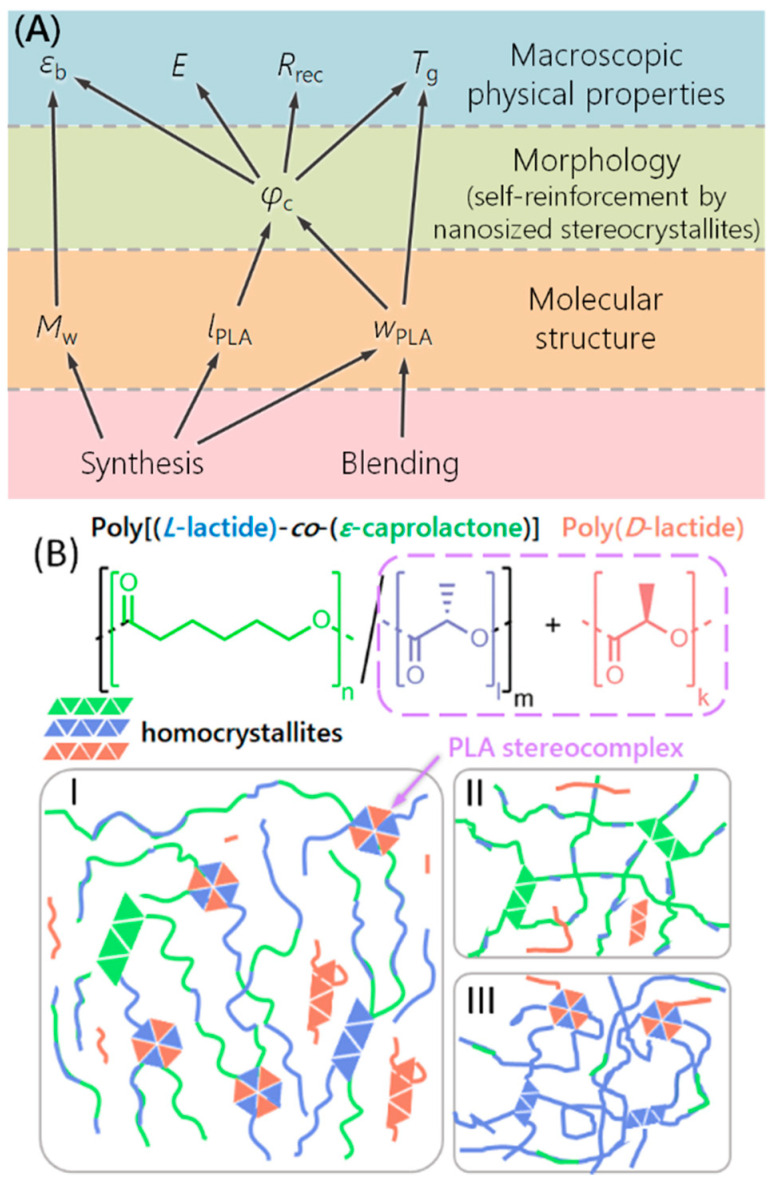
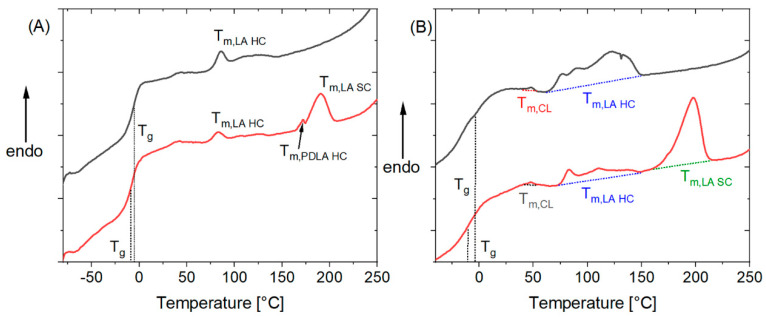
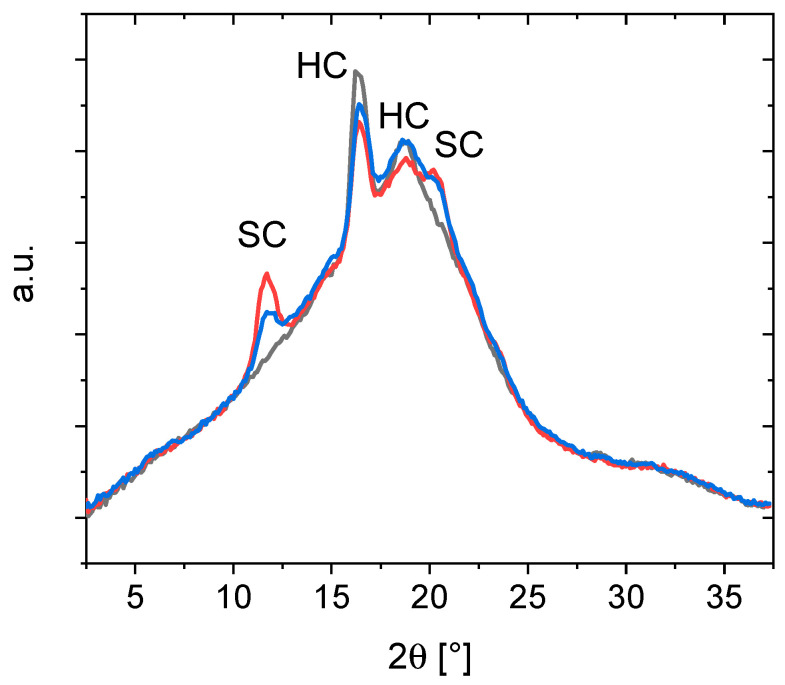
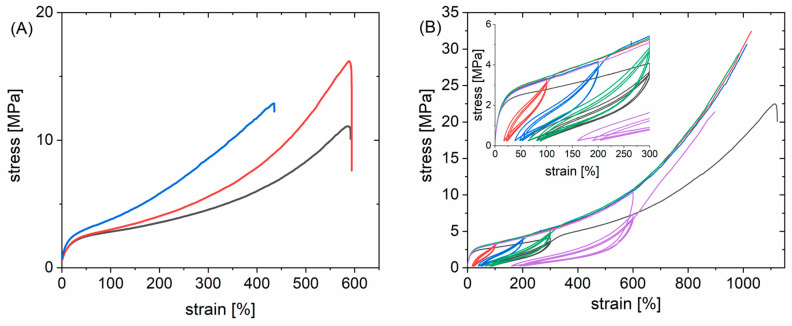
High crystallization rate and thermomechanical stability make polylactide stereocomplexes effective nanosized physical netpoints. Here, we address the need for soft, form-stable degradable elastomers for medical applications by designing such blends from (co)polyesters, whose mechanical properties are ruled by their nanodimensional architecture and which are applied as single components in implants. By careful controlling of the copolymer composition and sequence structure of poly[(L-lactide)-co-(ε-caprolactone)], it is possible to prepare hyperelastic polymer blends formed through stereocomplexation by adding poly(D-lactide) (PDLA). Low glass transition temperature Tg ≤ 0 °C of the mixed amorphous phase contributes to the low Young’s modulus E. The formation of stereocomplexes is shown in DSC by melting transitions Tm > 190 °C and in WAXS by distinct scattering maxima at 2θ = 12° and 21°. Tensile testing demonstrated that the blends are soft (E = 12–80 MPa) and show an excellent hyperelastic recovery Rrec = 66–85% while having high elongation at break εb up to >1000%. These properties of the blends are attained only when the copolymer has 56–62 wt% lactide content, a weight average molar mass >140 kg·mol−1, and number average lactide sequence length ≥4.8, while the blend is formed with a content of 5–10 wt% of PDLA. The devised strategy to identify a suitable copolymer for stereocomplexation and blend formation is transferable to further polymer systems and will support the development of thermoplastic elastomers suitable for medical applications.
Overview
The claims and statistics of this paper haven’t been checked yet.
Free: it reads the open-access text and checks the first 5 claims that cite a source we can check. Create a free account to check every claim.
Integrity signals
Registry
Cites
Statistics
Figures
Verification
Claims the paper makes
The claims and statistics of this paper haven’t been checked yet.
Free: it reads the open-access text and checks the first 5 claims that cite a source we can check. Create a free account to check every claim.
Claims other papers make about this one
Each is checked against this paper’s own text: does it say what the citing paper says it does?
The source backs part of the claim, not all of it — or backs it for a different population, condition or comparison.
In the citing paper
“To assess molar mass based on the obtained 1 H-NMR data, an estimated error of 12% was accounted for, considering factors such as saturation effects, intensity losses from isotropic sidebands, sample non-uniformity in the magnetic field, and line shape contributing to peak overlapping.34”
From Correlative characterization of stereocomplex formation in blends of aliphatic polyester P(PCL m - b -PLLA n ) multiblock-copolymers and PDLA (2026) · cites this paper as [34]
Experimental — accuracy not yet measuredThe source backs part of the claim, not all of it — or backs it for a different population, condition or comparison.
In the citing paper
“Sn(Oct)2 and other catalysts that allow rapid transesterifications between polyester chains can provide more randomized structures at long reaction times, but mostly with higher dispersities.64”
From Iron( ii ) carboxylates and simple carboxamides: an inexpensive and modular catalyst system for the synthesis of PLLA and PLLA-PCL block copolymers (2023) · cites this paper as [64]
Experimental — accuracy not yet measuredThe source backs part of the claim, not all of it — or backs it for a different population, condition or comparison.
In the citing paper
“Alternative catalysts, such as Sn(Oct)2, produce much higher randomized structures than the Fe(OAc)2/DEAA catalyst via transesterification.64”
From Iron( ii ) carboxylates and simple carboxamides: an inexpensive and modular catalyst system for the synthesis of PLLA and PLLA-PCL block copolymers (2023) · cites this paper as [64]
Experimental — accuracy not yet measured
Self-check
Percentages, sums and reported differences re-computed from the paper’s own numbers.
The self-check needs the paper’s full text.
Citations
Cites
A Literature Review of Poly(Lactic Acid)
Garlotta, D. (2001) · Journal of Polymers and the Environment · doi:10.1023/a:1020200822435 · Cited by 3,707 · cited 1×
“A Tg of the copolymer ≤ 0 ◦C is theoretically reached at a weight fraction of ≤65 wt% of LA (Tg,PLA = 50 ◦C) [34] and ≥35 wt% of CL (Tg,PCL = −60 ◦C) [35].”
BackgroundSynthesis of polycaprolactone: A review
Labet, M., & Thielemans, W. (2009) · Chemical Society Reviews · doi:10.1039/b820162p · Cited by 1,673
Poly(lactide) Stereocomplexes: Formation, Structure, Properties, Degradation, and Applications
Tsuji, H. (2005) · Macromolecular Bioscience · doi:10.1002/mabi.200500062 · Cited by 1,366
Poly(lactide) Stereocomplexes: Formation, Structure, Properties, Degradation, and Applications
Tsuji, H. (2007) · Macromolecular Bioscience · doi:10.1002/mabi.200700275 · Cited by 1,021
Biodegradable polymer matrix nanocomposites for tissue engineering: A review
Armentano, I., Dottori, M., Fortunati, E., Mattioli, S., & Kenny, J. M. (2010) · Polymer Degradation and Stability · doi:10.1016/j.polymdegradstab.2010.06.007 · Cited by 999
Molecular model of drawing polyethylene and polypropylene
Peterlin, A. (1971) · Journal of Materials Science · doi:10.1007/bf00550305 · Cited by 987 · cited 1×
“Plastic deformation of the materials is likely to be observed at high applied strains ε, while the increase of the overall crystallinity φc decreases the ε threshold value, at which irreversible restructuring of crystallites starts [27].”
BackgroundPCL and PCL-based materials in biomedical applications
Malikmammadov, E., Tanir, T. E., Kiziltay, A., Hasirci, V., & Hasirci, N. (2018) · Journal of Biomaterials Science, Polymer Edition · doi:10.1080/09205063.2017.1394711 · Cited by 894
Mohr, R., Kratz, K., Weigel, T., Lucka-Gabor, M., Moneke, M., & Lendlein, A. (2006) · Proceedings of the National Academy of Sciences · doi:10.1073/pnas.0600079103 · Cited by 819 · cited 1×
“This is a bit higher than typically observed in physical networks such as multiblock copolymers (Rrec = 55–85%) [55], thermoplastic polyurethanes (Rrec ~ 70%) [56]; (Rrec = 47–80%) [57], poly(butylene 1,4-cyclohexanedicarboxylate) (Rrec = 11–64%) [58], or poly(butylene terephthalate)/ethylene rubber blends (Rrec ~ 60%…”
BackgroundSelf-citationPoly(lactic acid) stereocomplexes: A decade of progress
Tsuji, H. (2016) · Advanced Drug Delivery Reviews · doi:10.1016/j.addr.2016.04.017 · Cited by 535
Thermoplastic elastomers: fundamentals and applications
Spontak, R. J., & Patel, N. P. (2000) · Current Opinion in Colloid & Interface Science · doi:10.1016/s1359-0294(00)00070-4 · Cited by 408
Cited by
Alkhamis, H., Saretia, S., Schwanz, S., Machatschek, R., Neffe, A. T., & Polak-Kraśna, K. (2025) · Polymer Degradation and Stability · doi:10.1016/j.polymdegradstab.2025.111267 · Cited by 12
Self-citationKirchhecker, S., Nguyen, N., Reichert, S., Lützow, K., Eselem Bungu, P. S., Jacobi von Wangelin, A., Sandl, S., & Neffe, A. T. (2023) · RSC Advances · doi:10.1039/d3ra03112h · Cited by 6
Self-citationMandlule, A., Liu, Y., Schwanz, S., Pieper, Y., Scharf, H., Iskhakova, K., Conceição, A. L. C., Wieland, D. C. F., Zeller-Plumhoff, B., Toma, F. M., et al. (2026) · Materials Advances · doi:10.1039/d5ma00886g · Cited by 6
Self-citationChen, C.-M., Chang, H.-L., & Lee, C. (2022) · Polymers · doi:10.3390/polym14163319 · Cited by 5
Synthesis of Bio-Based Polyester from Microbial Lipidic Residue Intended for Biomedical Application
Capêto, A. P., Azevedo‐Silva, J., Sousa, S. C., Pintado, M., Guimarães, A. S., & Oliveira, A. L. S. (2023) · International Journal of Molecular Sciences · doi:10.3390/ijms24054419 · Cited by 4
Metadata
- Authors
- Neffe, A., Izraylit, V., Hommes-Schattmann, P., & Lendlein, A.
- Affiliations
- Helmholtz-Zentrum Hereon (DE)
- University of Potsdam (DE)
- Institute of Active Polymers, Helmholtz-Zentrum Hereon, 14513 Teltow, Germany
- Corresponding author
- Lendlein, Andreas
- Venue
- Nanomaterials
- Publisher
- MDPI AG
- Published
- 2021-06-01
- Volume
- 11
- Issue
- 6
- Pages
- 1472
- ISSN
- 2079-4991 (ISSN-L)
- PMC
- PMC8230036
- OpenAlex
- W3172778829
- Cited by
- 9
- References
- 61
- Citations by year
- 2026: 2 · 2025: 4 · 2023: 2 · 2022: 1
- FWCI
- 0.20
- Type
- journal article
- Language
- en
- Open access
- gold
- doi.org
- Licence
- Locations
- Nanomaterials (publishedVersion, cc-by)
- PubMed Central (publishedVersion, cc-by)
- PubMed (publishedVersion)
- DOAJ (DOAJ: Directory of Open Access Journals) (submittedVersion, cc-by-sa)
- publish.UP (University of Potsdam) (submittedVersion, cc-by)
- Funders
- Helmholtz-Gemeinschaft (programme-oriented funding)
- Seventh Framework Programme (604049)
- Topics
- Physical Sciences › Materials Science › Biomaterials › biodegradable polymer synthesis and properties
- Physical Sciences › Materials Science › Polymers and Plastics › Polymer crystallization and properties
- Physical Sciences › Materials Science › Polymers and Plastics › Polymer composites and self-healing
- Keywords
- polyester blends, stereocomplexation, poly(L-lactide-co-ε-caprolactone), poly(D-lactide), degradable polymers, biomedical implants, crystallization, sequence structure, glass transition temperature, Young's modulus, thermoplastic elastomers
About these checks
Registry, retraction, Cites and statistics results are computed, not judged, with one exception: a printed reference that no index lists is read once by a model before it counts as a citation error. Claims are extracted by a model and kept only when their quote appears verbatim in the text; each cited source is then checked, with a model’s help, for whether it says what the claim relies on. Those verdicts can be wrong — read the claim’s quote and the cited source before relying on one.
Statistics and arithmetic are recomputed, not judged.
Confidence bands are shown only for fields calibrated on our annotated test set. None is calibrated yet, so no band is shown.
What counts as a claim ›How we measure confidence ›How we check this ›
Are you an author, or do you see a problem with this page? Request a review
How to cite
Cite CoChat for the checks on this page, and the paper for its own findings.
- This page
- CoChat. (2026). Citation check: Soft, Formstable (Co)Polyester Blend Elastomers. https://app.cochat.ai/papers/10.3390/nano11061472
- The paper
- Neffe, A., Izraylit, V., Hommes-Schattmann, P., & Lendlein, A. (2021). Soft, Formstable (Co)Polyester Blend Elastomers. Nanomaterials. https://doi.org/10.3390/nano11061472
Data sources
Bibliographic data: Semantic Scholar, OpenAlex, Crossref.
Contains information from the Semantic Scholar Academic Graph Datasets, made available under the ODC Attribution License (ODC-BY 1.0).
Semantic Scholar’s data is described in: Kinney, R., et al. (2023). The Semantic Scholar Open Data Platform. arXiv:2301.10140.
