

The DOI matches its Crossref record; 46 of the 46 references it cites were found in a registry or an index; none of the 38 sources its claims cite is checked for support yet.
Anti-Osteoporotic Potential of Water Extract of Anethum graveolens L. Seeds
Open accessAbstract
Anethum graveolens L., known as European dill, is a versatile herb widely used in both traditional medicine and culinary practices. Despite its long-standing history, the potential impact of the water extract of A. graveolens seeds (WEAG) on bone health remains unexplored. In this study, we investigated the influence of WEAG on osteoclast differentiation and assessed its potential as an anti-osteoporotic agent. WEAG hindered osteoclast differentiation through the suppression of receptor activator of nuclear factor-κB ligand (RANKL) expression in osteoclast-supporting cells and by directly targeting osteoclast precursor cells. WEAG significantly reduced the expression of key osteoclastogenic transcription factors, namely c-Fos and NFATc1, typically induced by RANKL in osteoclast precursors. This reduction was attributed to the suppression of both MAPKs and NF-κB pathways in response to RANKL. In vivo experiments further revealed that WEAG administration effectively reduces trabecular bone loss and weight gain triggered by ovariectomy, mimicking postmenopausal osteoporosis. Furthermore, our comprehensive phytochemical analysis of WEAG identified a range of phytochemical constituents, associated with bone health and weight regulation. Notably, we discovered a specific compound, isorhamnetin-3-O-glucuronide, within WEAG that exhibits anti-osteoclastogenic potential. Overall, this research elucidated the beneficial effects and mechanistic basis of WEAG on osteoclast differentiation and bone loss, indicating its potential as a viable alternative to address bone loss in conditions like postmenopause.
Overview
CoChat Summary
TL;DR
Water extract of *Anethum graveolens* L. seeds (WEAG) inhibits RANKL-induced osteoclast differentiation in vitro and reduces ovariectomy-induced trabecular bone loss and body-weight gain in mice. Phytochemical profiling identified isorhamnetin-3-O-glucuronide as an anti-osteoclastogenic constituent.
Key findings
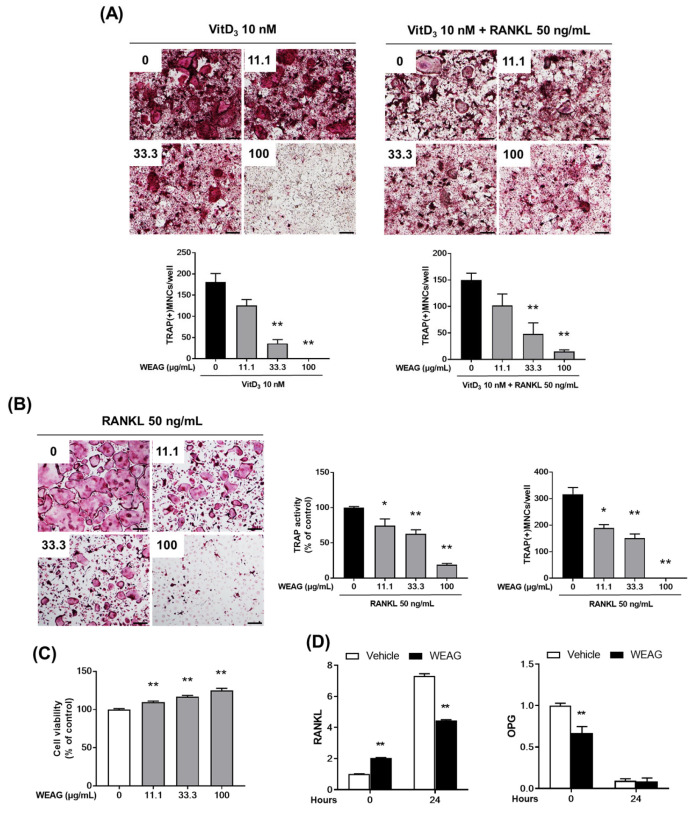
- WEAG dose-dependently inhibited osteoclast formation in MLO-Y4/BMM co-cultures and in RANKL-treated BMMs without cytotoxicity; it suppressed VitD3-stimulated RANKL mRNA in MLO-Y4 cells but did not affect OPG mRNA.
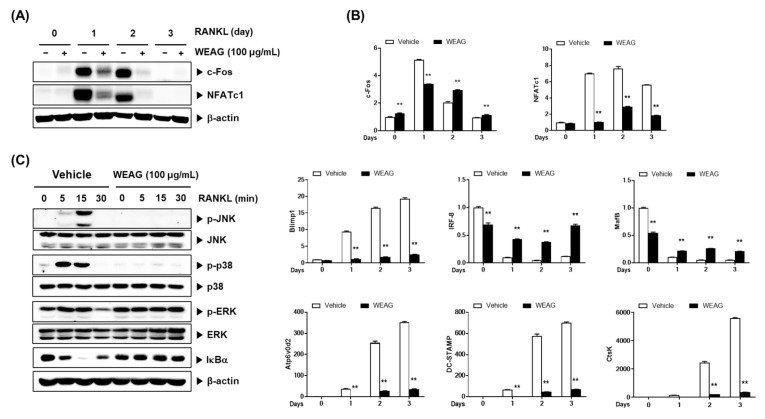
- WEAG reduced RANKL-induced c-Fos and NFATc1 mRNA/protein and osteoclast-specific genes *Atp6v0d2*, *DC-STAMP*, and *Ctsk*; it inhibited JNK and p38 phosphorylation and IκBα degradation, with no effect on ERK phosphorylation.
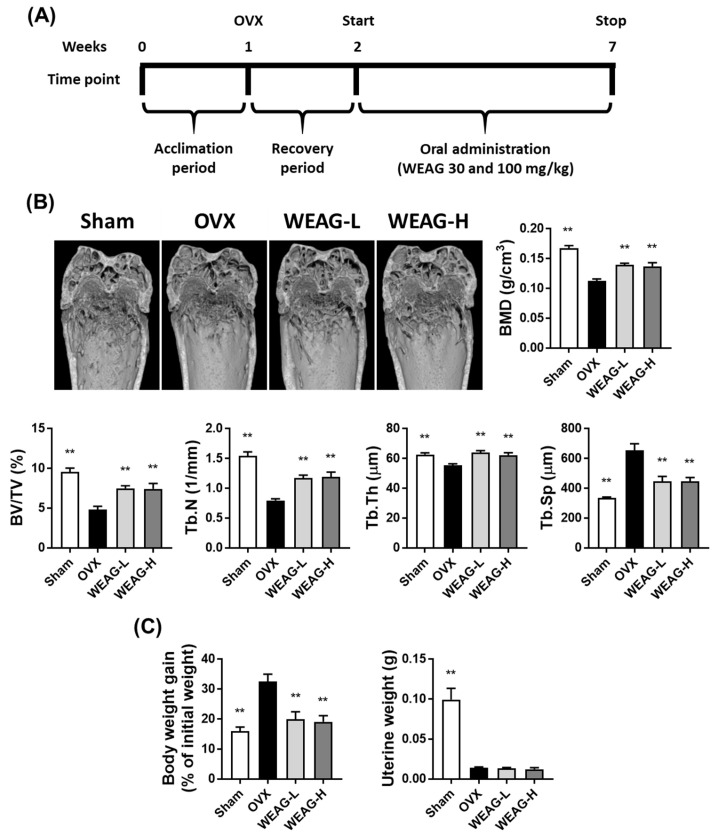
- In OVX mice, WEAG at 30 mg/kg/day (WEAG-L) and 100 mg/kg/day (WEAG-H) increased BMD, BV/TV, Tb.N, and Tb.Th and decreased Tb.Sp versus OVX; it also restored OVX-induced body-weight gain but did not reverse uterine atrophy.
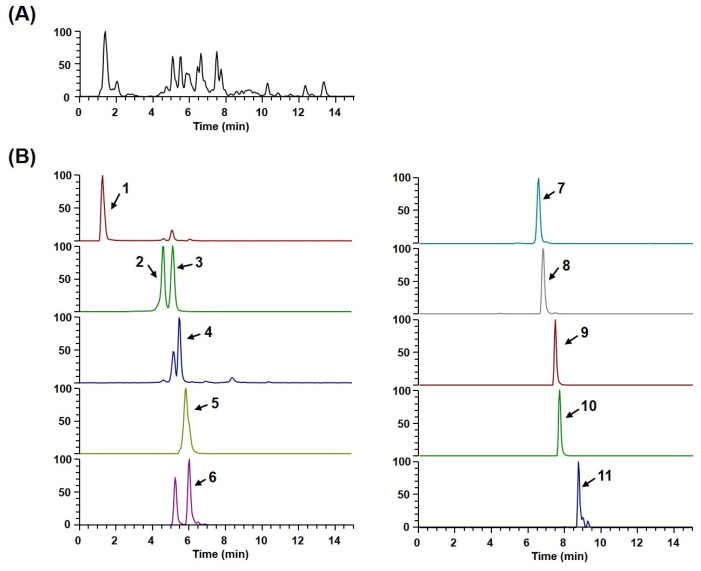
- UHPLC-MS/MS identified six phenolics and five flavonoids in WEAG; isorhamnetin-3-O-glucuronide potently suppressed RANKL-induced osteoclast differentiation without cytotoxicity.
Methods
- In vitro: BMMs and MLO-Y4 osteocyte-like cells were cultured with WEAG, VitD3, RANKL, and/or M-CSF; osteoclast differentiation was assessed by TRAP activity/staining, Western blot, and quantitative real-time PCR.
- In vivo: 6-week-old female C57BL/6J mice underwent bilateral OVX; groups (n = 6 each) were sham, OVX, OVX + WEAG 30 mg/kg/day, and OVX + WEAG 100 mg/kg/day, with daily oral gavage for 5 weeks; distal femoral trabecular bone was analyzed by μ-CT.
- Phytochemical profiling used UHPLC-MS/MS; statistical analysis used one-way ANOVA with Dunnett’s post hoc test or two-way ANOVA with Sidak’s post hoc test.
Limitations
- The paper states that further investigation is warranted, including an in-depth exploration of WEAG’s influence on osteoclasts and osteoblasts in vivo, to fully uncover the mechanisms behind its beneficial effects in OVX mice.
- Evident from the text: the in vivo study does not directly establish cellular mechanisms for bone protection, and the OVX model is limited to female mice with two WEAG doses and n = 6 per group.
Model-written summary. Check it against the paper before relying on it.
Integrity signals
Registry
Cites
Statistics
Figures
Verification
Claims the paper makes
19 Own result · 14 Check pending · 6 Own interpretation · 5 No full text of the sources · 5 Not checked yet
In the paper
“Consistent with previous reports [23], VitD3 stimulated osteoclast formation in the co-culture, as evidenced by the presence of TRAP-positive multinucleated cells containing more than three nuclei.”
§ Anti-Osteoporotic Potential of Water Extract of Anethum graveolens L. Seeds > 3. Results and Discussion > 3.1. WEAG Inhibits Osteoclastogenesis In Vitro
What the sources say
- Check pendingcites [23] Jang, S.A., Hwang, Y.H., Yang, H., Ryuk, J.A., Gu, D.R., and Ha, H. (2022). Ethanolic extract of Pyrrosia lingua (Thunb.) Farw. ameliorates OVX-induced bone loss and RANKL-induced osteoclastogenesis. Biomed. Pharmacother., 147. source
plainstates a cause- Asserted: passes — The authors put it forward as true.
- Checkable: passes — It can be checked against evidence.
- Load-bearing: unclear — It is unclear whether the paper’s conclusions depend on it.
- Based: passes — The paper gives a reason why it holds.
A result the paper reports from its own data — it cites no other source for it, so there is none to check. The quote shows it is in the paper.
In the paper
“In line with this, our study identified a substantial increase in body weight in the OVX group compared to the sham group.”
§ Anti-Osteoporotic Potential of Water Extract of Anethum graveolens L. Seeds > 3. Results and Discussion > 3.3. WEAG Inhibits Bone Loss
plainstates a cause- Asserted: passes — The authors put it forward as true.
- Checkable: passes — It can be checked against evidence.
- Load-bearing: unclear — It is unclear whether the paper’s conclusions depend on it.
- Based: passes — The paper gives a reason why it holds.
A result the paper reports from its own data — it cites no other source for it, so there is none to check. The quote shows it is in the paper.
In the paper
“Subsequently, WEAG also effectively dampened the mRNA expression of osteoclast-specific genes, including Atp6v0d2, DC-STAMP, and CtsK (Figure 2B).”
§ Anti-Osteoporotic Potential of Water Extract of Anethum graveolens L. Seeds > 3. Results and Discussion > 3.2. WEAG Inhibits RANKL-Mediated Signaling Pathways
plainstates a cause- Asserted: passes — The authors put it forward as true.
- Checkable: passes — It can be checked against evidence.
- Load-bearing: passes — The paper’s conclusions depend on it.
- Based: passes — The paper gives a reason why it holds.
A result the paper reports from its own data — it cites no other source for it, so there is none to check. The quote shows it is in the paper.
In the paper
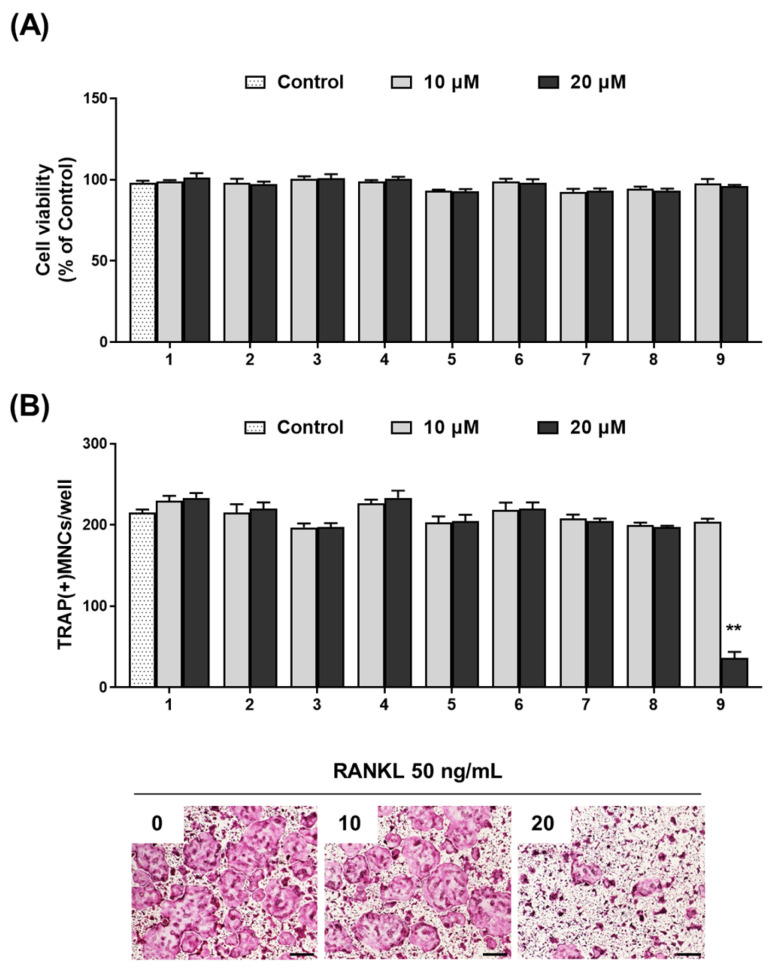
“Supporting these findings, we additionally validated that WEAG exhibited a dose-dependent reduction in RANKL-induced osteoclast differentiation in isolated BMMs (Figure 1B).”
§ Anti-Osteoporotic Potential of Water Extract of Anethum graveolens L. Seeds > 3. Results and Discussion > 3.1. WEAG Inhibits Osteoclastogenesis In Vitro
plainstates a cause- Asserted: passes — The authors put it forward as true.
- Checkable: passes — It can be checked against evidence.
- Load-bearing: passes — The paper’s conclusions depend on it.
- Based: passes — The paper gives a reason why it holds.
A result the paper reports from its own data — it cites no other source for it, so there is none to check. The quote shows it is in the paper.
In the paper
“The inhibitory effect of WEAG on osteoclast formation was observed in a dose-dependent manner (Figure 1A).”
§ Anti-Osteoporotic Potential of Water Extract of Anethum graveolens L. Seeds > 3. Results and Discussion > 3.1. WEAG Inhibits Osteoclastogenesis In Vitro
plainstates a cause- Asserted: passes — The authors put it forward as true.
- Checkable: passes — It can be checked against evidence.
- Load-bearing: passes — The paper’s conclusions depend on it.
- Based: passes — The paper gives a reason why it holds.
13 more claims
Create a free account to see all 49 claims and to verify the 25 references still open.
- It may state two separate claims as one. 21
- Probably not a substantial claim. 16
Self-check
Percentages, sums and reported differences re-computed from the paper’s own numbers.
Each contradiction between two passages listed here was confirmed by an independent check.
Rated minor: it would not touch a result — a value no result rests on, a p-value that stays on the same side of the significance level, or a conflict that is clerical, resolved elsewhere in the paper, or outside its own findings.
In the paper
§ Anti-Osteoporotic Potential of Water Extract of Anethum graveolens L. Seeds > 3. Results and Discussion > 3.2. WEAG Inhibits RANKL-Mediated Signaling Pathways
“WEAG hindered the reduction in the expression of IRF-8 and MafB”
§ Anti-Osteoporotic Potential of Water Extract of Anethum graveolens L. Seeds > 3. Results and Discussion > 3.2. WEAG Inhibits RANKL-Mediated Signaling Pathways
“WEAG’s anti-osteoclastogenic effect can be attributed to its ability to negatively regulate the induction of NFATc1 and the repressors IRF-8 and MafB”
Rated minor: it would not touch a result — a value no result rests on, a p-value that stays on the same side of the significance level, or a conflict that is clerical, resolved elsewhere in the paper, or outside its own findings.
In the paper
§ Anti-Osteoporotic Potential of Water Extract of Anethum graveolens L. Seeds > 3. Results and Discussion > 3.2. WEAG Inhibits RANKL-Mediated Signaling Pathways
“Furthermore, it suppressed RANKL-induced NF-κB activation, as evidenced by the degradation of IκBα (Figure 2C).”
§ Anti-Osteoporotic Potential of Water Extract of Anethum graveolens L. Seeds > 3. Results and Discussion > 3.2. WEAG Inhibits RANKL-Mediated Signaling Pathways
“Upon stimulation by RANKL, IKK triggers the phosphorylation and subsequent degradation of IκBα, releasing NF-κB for nuclear translocation [33].”
Citations
Cites
Analysis of Relative Gene Expression Data Using Real-Time Quantitative PCR and the 2−ΔΔCT Method
Livak, K. J., & Schmittgen, T. D. (2001) · Methods · doi:10.1006/meth.2001.1262 · Cited by 180,860
NF-κB signaling in inflammation
Liu, T., Zhang, L., Joo, D., & Sun, S.-C. (2017) · Signal Transduction and Targeted Therapy · doi:10.1038/sigtrans.2017.23 · Cited by 8,791
Osteoclast differentiation and activation
Boyle, W. J., Simonet, W. S., & Lacey, D. L. (2003) · Nature · doi:10.1038/nature01658 · Cited by 6,670
Osteoporosis Prevention, Diagnosis, and Therapy
NIH Consensus Development Panel on Osteoporosis Prevention, D. (2001) · JAMA: The Journal of the American Medical Association · doi:10.1001/jama.285.6.785 · Cited by 5,529
Mutation of the mouse klotho gene leads to a syndrome resembling ageing
Kuro-o, M., Matsumura, Y., Aizawa, H., Kawaguchi, H., Suga, T., Utsugi, T., Ohyama, Y., Kurabayashi, M., Kaname, T., Kume, E., et al. (1997) · Nature · doi:10.1038/36285 · Cited by 3,837
Pathogenesis of osteoporosis: concepts, conflicts, and prospects
Raisz, L. G. (2005) · Journal of Clinical Investigation · doi:10.1172/jci27071 · Cited by 1,779 · cited 1×
“One of the most common bone disorders, postmenopausal osteoporosis, arises from an increase in the formation and activity of osteoclasts due to the decrease in estrogen levels [2,3].”
BackgroundEvidence for osteocyte regulation of bone homeostasis through RANKL expression
Nakashima, T., Hayashi, M., Fukunaga, T., Kurata, K., Oh-hora, M., Feng, J. Q., Bonewald, L. F., Kodama, T., Wutz, A., Wagner, E. F., et al. (2011) · Nature Medicine · doi:10.1038/nm.2452 · Cited by 1,778
Cancer to bone: a fatal attraction
Weilbaecher, K. N., Guise, T. A., & McCauley, L. K. (2011) · Nature reviews. Cancer · doi:10.1038/nrc3055 · Cited by 1,325
Matrix-embedded cells control osteoclast formation
Xiong, J., Onal, M., Jilka, R. L., Weinstein, R. S., Manolagas, S. C., & O'Brien, C. A. (2011) · Nature Medicine · doi:10.1038/nm.2448 · Cited by 1,304
Bone erosion in rheumatoid arthritis: mechanisms, diagnosis and treatment
Schett, G., & Gravallese, E. (2012) · Nature Reviews Rheumatology · doi:10.1038/nrrheum.2012.153 · Cited by 947
Current Understanding of RANK Signaling in Osteoclast Differentiation and Maturation
Park, J. H., Lee, N. K., & Lee, S. Y. (2017) · Molecules and Cells · doi:10.14348/molcells.2017.0225 · Cited by 645
Self-citationNuclear factor of activated T-cells (NFAT) rescues osteoclastogenesis in precursors lacking c-Fos
Matsuo, K., Galson, D. L., Zhao, C., Peng, L., Laplace, C., Wang, K. Z. Q., Bachler, M. A., Amano, H., Aburatani, H., Ishikawa, H., et al. (2004) · Journal of Biological Chemistry · doi:10.1074/jbc.m313973200 · Cited by 501
Establishment of an osteocyte-like cell line, MLO-Y4
Kato, Y., Windle, J. J., Koop, B. A., Mundy, G. R., & Bonewald, L. F. (1997) · Journal of Bone and Mineral Research · doi:10.1359/jbmr.1997.12.12.2014 · Cited by 500
Matsumoto, M., Kogawa, M., Wada, S., Takayanagi, H., Tsujimoto, M., Katayama, S., Hisatake, K., & Nogi, Y. (2004) · Journal of Biological Chemistry · doi:10.1074/jbc.m408795200 · Cited by 436
Kim, K., Lee, S.-H., Ha Kim, J., Choi, Y., & Kim, N. (2008) · Molecular Endocrinology · doi:10.1210/me.2007-0237 · Cited by 421
Self-citationIkeda, F., Nishimura, R., Matsubara, T., Tanaka, S., Inoue, J.-I., Reddy, S. V., Hata, K., Yamashita, K., Hiraga, T., Watanabe, T., et al. (2004) · Journal of Clinical Investigation · doi:10.1172/jci200419657 · Cited by 417
Xiong, J., Piemontese, M., Onal, M., Campbell, J., Goellner, J. J., Dusevich, V., Bonewald, L., Manolagas, S. C., & O’Brien, C. A. (2015) · PLOS ONE · doi:10.1371/journal.pone.0138189 · Cited by 323
MLO-Y4 Osteocyte-Like Cells Support Osteoclast Formation and Activation
Zhao, S., Kato, Y., Zhang, Y., Harris, S., Ahuja, S. S., & Bonewald, L. F. (2002) · Journal of Bone and Mineral Research · doi:10.1359/jbmr.2002.17.11.2068 · Cited by 322
Khosla, S., Melton, L. J., & Riggs, B. L. (2011) · Journal of Bone and Mineral Research · doi:10.1002/jbmr.262 · Cited by 305
NF-κB-Mediated Regulation of Osteoclastogenesis
Boyce, B. F., Xiu, Y., Li, J., Xing, L., & Yao, Z. (2015) · Endocrinology and Metabolism · doi:10.3803/enm.2015.30.1.35 · Cited by 299
Interferon regulatory factor-8 regulates bone metabolism by suppressing osteoclastogenesis
Zhao, B., Takami, M., Yamada, A., Wang, X., Koga, T., Hu, X., Tamura, T., Ozato, K., Choi, Y., Ivashkiv, L. B., et al. (2009) · Nature Medicine · doi:10.1038/nm.2007 · Cited by 292
Anethum graveolens: An Indian traditional medicinal herb and spice
Shekhawat, G., & Jana, S. (2010) · Pharmacognosy Reviews · doi:10.4103/0973-7847.70915 · Cited by 269
MafB negatively regulates RANKL-mediated osteoclast differentiation
Kim, K., Kim, J. H., Lee, J., Jin, H. M., Kook, H., Kim, K. K., Lee, S. Y., & Kim, N. (2007) · Blood · doi:10.1182/blood-2006-09-048249 · Cited by 238
Self-citationHuang, H., Chang, E.-J., Ryu, J., Lee, Z. H., Lee, Y., & Kim, H.-H. (2006) · Biochemical and Biophysical Research Communications · doi:10.1016/j.bbrc.2006.10.011 · Cited by 154
Lee, J.-H., Jin, H., Shim, H.-E., Kim, H.-N., Ha, H., & Lee, Z. H. (2010) · Molecular Pharmacology · doi:10.1124/mol.109.057877 · Cited by 132
Self-citationHuang, K., Liang, X., Zhong, Y., He, W., & Wang, Z. (2015) · Journal of the Science of Food and Agriculture · doi:10.1002/jsfa.6896 · Cited by 114
Mu, H.-N., Zhou, Q., Yang, R.-Y., Tang, W.-Q., Li, H.-X., Wang, S.-M., Li, J., Chen, W.-X., & Dong, J. (2021) · Food Research International · doi:10.1016/j.foodres.2021.110240 · Cited by 111
Effects of Caffeic Acid and Its Derivatives on Bone: A Systematic Review
Ekeuku, S. O., Pang, K.-L., & Chin, K.-Y. (2021) · Drug Design, Development and Therapy · doi:10.2147/dddt.s287280 · Cited by 77
The Role of Anethum graveolens L. (Dill) in the Management of Diabetes
Goodarzi, M. T., Khodadadi, I., Tavilani, H., & Abbasi Oshaghi, E. (2016) · Journal of Tropical Medicine · doi:10.1155/2016/1098916 · Cited by 68
Effects of Anethum graveolens L. seed extracts on experimental gastric irritation models in mice
Hosseinzadeh, H., Karimi, G., & Ameri, M. (2002) · BMC Pharmacology · doi:10.1186/1471-2210-2-21 · Cited by 58
Zhou, F., Mei, J., Yuan, K., Han, X., Qiao, H., & Tang, T. (2019) · Journal of Cellular and Molecular Medicine · doi:10.1111/jcmm.14333 · Cited by 57
THE PHARMACOLOGICAL IMPORTANCE OF ANETHUM GRAVEOLENS.A REVIEW
Al‐Snafi, A. E. (2014) · Cited by 52
Suppression Effect of Astaxanthin on Osteoclast Formation In Vitro and Bone Loss In Vivo
Hwang, Y.-H., Kim, K.-J., Kim, S.-J., Mun, S.-K., Hong, S.-G., Son, Y.-J., & Yee, S.-T. (2018) · International Journal of Molecular Sciences · doi:10.3390/ijms19030912 · Cited by 48
Self-citationWasli, H., Jelali, N., Silva, A. M. S., Ksouri, R., & Cardoso, S. M. (2018) · Industrial Crops and Products · doi:10.1016/j.indcrop.2018.10.007 · Cited by 38
Dong, J., Zheng, H., Zeng, Q., Zhang, X., Du, L., & Bais, S. (2022) · Human & Experimental Toxicology · doi:10.1177/09603271221119804 · Cited by 34
Deng, Y., Ma, J., Weng, X., Wang, Y., Li, M., Yang, T., Dou, Z., Yin, Z., & Shang, J. (2021) · Life · doi:10.3390/life11050445 · Cited by 33
Forsythia suspensa Protects against Bone Loss in Ovariectomized Mice
Hwang, Y., Jang, S., Kim, T. S., & Ha, H. (2019) · Nutrients · doi:10.3390/nu11081831 · Cited by 25
Self-citationPark, J., Kim, S., Lee, H. J., Kim, S., Kwon, Y., & Chun, W. (2016) · Drug Development Research · doi:10.1002/ddr.21301 · Cited by 22
Choi, E.-B., Agidigbi, T. S., Kang, I.-S., & Kim, C. (2022) · International Journal of Molecular Sciences · doi:10.3390/ijms232113512 · Cited by 22
Song, L., Bi, Y.-N., Zhang, P.-Y., Yuan, X.-M., Liu, Y., Zhang, Y., Huang, J.-Y., & Zhou, K. (2017) · BioMed Research International · doi:10.1155/2017/8417814 · Cited by 21
Syed, M., Khan, M. N., Khadim, A., Shadab, H., Perveen, A., El-Seedi, H. R., & Musharraf, S. G. (2021) · Journal of King Saud University - Science · doi:10.1016/j.jksus.2021.101461 · Cited by 17
Gu, D. R., Yang, H. J., Kim, S. C., Hwang, Y., & Ha, H. (2022) · Nutrients · doi:10.3390/nu14173667 · Cited by 14
Self-citation[Osteoporosis: prevention, diagnosis and therapy].
Hennemann, A. (2002) · PubMed · Cited by 12
Jang, S.-A., Hwang, Y.-H., Yang, H., Ryuk, J. A., Gu, D. R., & Ha, H. (2022) · Biomedicine & Pharmacotherapy · doi:10.1016/j.biopha.2022.112640 · Cited by 4
Self-citation(1991) · PubMed
(2008) · PubMed
Cited by
Liu, T., Li, J., Duan, M., Wang, Y., Jiang, Z., Gan, C., Xiang, Z., Sheng, J., Wang, X., & Xu, H. (2024) · Journal of Cellular and Molecular Medicine · doi:10.1111/jcmm.70256 · Cited by 5
Fareed, R., Anwar, M., Wani, K. R., & Khan, F. (2022) · Journal of Research in Unani Medicine · doi:10.4103/jrum.jrum_17_24
Metadata
- Authors
- Jang, S.-A., Lee, S.-J., Hwang, Y.-H., & Ha, H.
- Affiliations
- KT&G (South Korea) (KR)
- Korea Institute of Oriental Medicine (KR)
- Corresponding author
- Ha, Hyunil
- Venue
- Nutrients
- Publisher
- MDPI AG
- Published
- 2023-10-09
- Volume
- 15
- Issue
- 19
- Pages
- 4302
- ISSN
- 2072-6643 (ISSN-L)
- PMC
- PMC10574365
- OpenAlex
- W4387451985
- Cited by
- 2
- References
- 46
- Citations by year
- 2024: 1
- FWCI
- 0.08
- Type
- journal article
- Language
- en
- Open access
- gold
- doi.org
- Licence
- Locations
- Nutrients (publishedVersion, cc-by)
- PubMed Central (publishedVersion, cc-by)
- PubMed (publishedVersion)
- Funders
- Korea Institute of Oriental Medicine, Ministry of Science and ICT, Republic of Korea (KSN2022332)
- Topics
- Life Sciences › Biochemistry, Genetics and Molecular Biology › Molecular Biology › Bone Metabolism and Diseases
- Life Sciences › Pharmacology, Toxicology and Pharmaceutics › Pharmacology › Medicinal Plant Pharmacodynamics Research
- Health Sciences › Medicine › Orthopedics and Sports Medicine › Bone health and osteoporosis research
- Keywords
- dill, dill seeds, anti-osteoporotic activity, osteoclastogenesis, RANKL, c-fos, NFATc1, MAPK signaling, NF-κB signaling, postmenopausal osteoporosis, ovariectomy-induced bone loss, phytochemicals, bone health, weight gain
- MeSH terms
- Bone Resorption, Cell Differentiation, Female, Humans, Osteoclasts, Osteogenesis, Ovariectomy, NF-kappa B, Anethum graveolens, NFATC Transcription Factors, RANK Ligand, Phytochemicals
About these checks
Registry, retraction, Cites and statistics results are computed, not judged, with one exception: a printed reference that no index lists is read once by a model before it counts as a citation error. Claims are extracted by a model and kept only when their quote appears verbatim in the text; each cited source is then checked, with a model’s help, for whether it says what the claim relies on. Those verdicts can be wrong — read the claim’s quote and the cited source before relying on one.
A language model drew the claims from the paper on 2026-11-12, under version 3 of the claim definition (model deepseek-v4.1-flash, prompt extract-v3).
A second model labelled each claim on 2026-11-12 (model jev-1.13-20260917, definition revision gold-guideline-v0.2).
Statistics and arithmetic are recomputed, not judged.
Confidence bands are shown only for fields calibrated on our annotated test set. None is calibrated yet, so no band is shown.
What counts as a claim ›How we measure confidence ›How we check this ›
Are you an author, or do you see a problem with this page? Request a review
Data sources
Bibliographic data: Semantic Scholar, OpenAlex, Crossref.
Contains information from the Semantic Scholar Academic Graph Datasets, made available under the ODC Attribution License (ODC-BY 1.0).
Semantic Scholar’s data is described in: Kinney, R., et al. (2023). The Semantic Scholar Open Data Platform. arXiv:2301.10140.
