

The DOI matches its Crossref record; 239 of the 253 references it cites were found in a registry or an index; 1 of the 139 sources its claims cite were checked for support.
Impact of Climate Change on Crops Adaptation and Strategies to Tackle Its Outcome: A Review
Open accessAbstract
Agriculture and climate change are internally correlated with each other in various aspects, as climate change is the main cause of biotic and abiotic stresses, which have adverse effects on the agriculture of a region. The land and its agriculture are being affected by climate changes in different ways, e.g., variations in annual rainfall, average temperature, heat waves, modifications in weeds, pests or microbes, global change of atmospheric CO2 or ozone level, and fluctuations in sea level. The threat of varying global climate has greatly driven the attention of scientists, as these variations are imparting negative impact on global crop production and compromising food security worldwide. According to some predicted reports, agriculture is considered the most endangered activity adversely affected by climate changes. To date, food security and ecosystem resilience are the most concerning subjects worldwide. Climate-smart agriculture is the only way to lower the negative impact of climate variations on crop adaptation, before it might affect global crop production drastically. In this review paper, we summarize the causes of climate change, stresses produced due to climate change, impacts on crops, modern breeding technologies, and biotechnological strategies to cope with climate change, in order to develop climate resilient crops. Revolutions in genetic engineering techniques can also aid in overcoming food security issues against extreme environmental conditions, by producing transgenic plants.
Overview
AI snapshot
Written from the paper’s full text.
TL;DR
This review synthesizes literature on how climate change drives abiotic and biotic stresses and reduces crop yields, and surveys adaptation strategies from cultural practices to genomics and genetic engineering. It concludes that climate-smart, stress-tolerant crops developed via breeding, GWAS/GS, transgenic transcription factors, and CRISPR/Cas9 are needed to protect food security.
Key findings
- Climate change is linked to rising atmospheric CO2 (from 280 to 400 µmol−1, predicted up to 800 µmol−1 by century’s end) and an expected 2–4.5 °C increase in Earth’s average temperature in the 21st century; key stresses include drought, heat, salinity, flooding, and cold.
- Yield impacts cited include climate changes reducing crop yield up to 70% since 1982 (Boyer); Zhao et al. (2017) reported reductions of 6% in wheat, 3.2% in rice, 3.1% in soybean, and 7.4% in maize. The review also cites wheat yield declining 6% per °C rise, maize 8.3% per °C, rice 2.6% per °C, and sorghum 7.8% per °C.
- Food-security figures cited include around 815 million people affected by malnutrition, a population expected to reach about 9 billion by 2050 with food requirements rising about 85%, and a projected 25.7% reduction in agricultural production by 2080, with maize the most affected crop in Mexico.
- Adaptation strategies reviewed include cultural methods (sowing time, crop rotation, irrigation), conventional breeding, MAS/QTL mapping, GWAS, genomic selection, and genetic engineering of DREB, ERF, MYB, WRKY, and NAC transcription factors; CRISPR/Cas9 examples include rice seed size increased by 30% via TGW6/GW5/GW2 mutation, low-gluten wheat, SlMAPK3 tomato drought studies, and OsAnn3 rice cold-tolerance work.
Methods
- Narrative review; no primary data collection, systematic search strategy, or meta-analysis is described. It synthesizes cited literature on climate change causes, plant stresses, crop impacts, and adaptation/biotechnological strategies.
- Main analysis is qualitative: it describes mechanisms such as ROS production, Rubisco disruption, and hormone signaling (ABA, salicylic acid, ethylene), and reviews breeding, genomic, transgenic, and CRISPR examples from other studies.
- Figures and tables are referenced but not reproduced in the text; the review reports no sample size or statistical model of its own.
Limitations
- Stated: the paper says how to tackle the problem and which strategies to apply are “still ambiguous,” and future food-security studies need to integrate climate change, crop productivity, water supply, and population.
- Evident: as a narrative review, it lacks systematic inclusion criteria, quantitative synthesis, and primary experimental validation; many yield and climate projections are cited from secondary sources and are not independently assessed.
- Evident: no own data or statistical analysis is presented; conclusions rely on cited literature and selected examples.
Model-written summary. Check it against the paper before relying on it.
Integrity signals
Registry
Cites
Statistics
Figures
Verification
Claims the paper makes
120 Not checked yet · 6 No basis given · 5 Own interpretation · 1 Partly supported · accuracy not yet measured
The cited sources support only part of this claim — read each source’s verdict below.
In the paper
“At the end of this century global production of crops is likely to decrease as climatic severity increases from 2.6 to 4 °C.”
§ Impact of Climate Change on Crops Adaptation and Strategies to Tackle Its Outcome: A Review > 1. Introduction
What the sources say
- Partly supportedcites [17] Rogelj, 2016, Paris Agreement climate proposals need a boost to keep warming well below 2 °C, Nature sourceExperimental — accuracy not yet measured
The Post-2030 implications of INDCs section (p. 4) projects warming of 2.6–3.1 °C under unconditional pledges and more than 4 °C under a no-policy baseline by 2100. It does not project a decline in global crop production as temperatures rise. Its discussion of food production (p. 6) concerns competition for land and water from bioenergy, not climate-driven crop losses. (LLM, conf=0.84)
hedgedconditional- Asserted: passes — The authors put it forward as true.
- Checkable: passes — It can be checked against evidence.
- Load-bearing: passes — The paper’s conclusions depend on it.
- Based: passes — The paper gives a reason why it holds.
- Partly supported
In the paper
“Water availability, air pollution, and soil fertility have a large impact on agriculture productivity [2].”
§ Impact of Climate Change on Crops Adaptation and Strategies to Tackle Its Outcome: A Review > 1. Introduction
What the sources say
- Not checked yetcites [2] Noya, 2018, Environmental impacts of the cultivation-phase associated with agricultural crops for feed production, J. Clean. Prod. source
plaindirect- Asserted: passes — The authors put it forward as true.
- Checkable: passes — It can be checked against evidence.
- Load-bearing: unclear — It is unclear whether the paper’s conclusions depend on it.
- Based: passes — The paper gives a reason why it holds.
In the paper
“Based on national crop yields and questionnaire surveys, large differences in vulnerabilities to current climate changes were detected across Europe.”
§ Impact of Climate Change on Crops Adaptation and Strategies to Tackle Its Outcome: A Review > 2. Plant Yield and Climate Change
What the sources say
- Not checked yetcites [30] Olesen, 2011, Impacts and adaptation of European crop production systems to climate change, Eur. J. Agron. source
plaincorrelational- Asserted: passes — The authors put it forward as true.
- Checkable: passes — It can be checked against evidence.
- Load-bearing: unclear — It is unclear whether the paper’s conclusions depend on it.
- Based: passes — The paper gives a reason why it holds.
In the paper
“Environmental extremes and climate variability enhanced the chances of numerous stresses on plants [23].”
§ Impact of Climate Change on Crops Adaptation and Strategies to Tackle Its Outcome: A Review > 2. Plant Yield and Climate Change
What the sources say
- Not checked yetcites [23] Thornton, 2014, Climate variability and vulnerability to climate change: A review, Glob. Chang. Biol. source
plaindirect- Asserted: passes — The authors put it forward as true.
- Checkable: passes — It can be checked against evidence.
- Load-bearing: unclear — It is unclear whether the paper’s conclusions depend on it.
- Based: passes — The paper gives a reason why it holds.
None of the sources cited for this claim have been checked yet.
In the paper
“In future, the productivity of the major crops is estimated to drop in many countries of the world due to global warming, water shortage, and other environmental impacts [28,29].”
§ Impact of Climate Change on Crops Adaptation and Strategies to Tackle Its Outcome: A Review > 2. Plant Yield and Climate Change
What the sources say
hedgeddirect- Asserted: passes — The authors put it forward as true.
- Checkable: passes — It can be checked against evidence.
- Load-bearing: passes — The paper’s conclusions depend on it.
- Based: passes — The paper gives a reason why it holds.
In the paper
“In developing countries, agricultural yield is predominantly suffered due to adverse environmental conditions, therefore high temperature and excess of CO2 accumulation forced scientists to devise new strategies to cope with less predictable challenges [5].”
§ Impact of Climate Change on Crops Adaptation and Strategies to Tackle Its Outcome: A Review > 1. Introduction
What the sources say
- Not checked yetcites [5] Rosenzweig, 2014, Assessing agricultural risks of climate change in the 21st century in a global gridded crop model intercomparison, Proc. Natl. Acad. Sci. USA source
plaindirect- Asserted: passes — The authors put it forward as true.
- Checkable: passes — It can be checked against evidence.
- Load-bearing: passes — The paper’s conclusions depend on it.
- Based: passes — The paper gives a reason why it holds.
None of the sources cited for this claim have been checked yet.
In the paper
“Plant growth and yield are greatly influenced by abiotic stresses.”
§ Impact of Climate Change on Crops Adaptation and Strategies to Tackle Its Outcome: A Review > 1. Introduction
What the sources say
- Not checked yetcites [7] Ashraf, M.A., Akbar, A., Askari, S.H., Iqbal, M., Rasheed, R., and Hussain, I. (2018). Recent Advances in Abiotic Stress Tolerance of Plants Through Chemical Priming: An Overview. Advances in Seed Priming, Springer. source
- Not checked yetcites [8] Benevenuto, R.F., Agapito-Tenfen, S.Z., Vilperte, V., Wikmark, O.-G., Van Rensburg, P.J., and Nodari, R.O. (2017). Molecular responses of genetically modified maize to abiotic stresses as determined through proteomic and metabolomic analyses. PLoS ONE, 12. source
boosteddirect- Asserted: passes — The authors put it forward as true.
- Checkable: passes — It can be checked against evidence.
- Load-bearing: unclear — It is unclear whether the paper’s conclusions depend on it.
- Based: passes — The paper gives a reason why it holds.
In the paper
“With elevation in temperature, the production of major crops has been reduced evidently around the world [16].”
§ Impact of Climate Change on Crops Adaptation and Strategies to Tackle Its Outcome: A Review > 1. Introduction
What the sources say
- Not checked yetcites [16] Ito, 2018, Global climate change increases risk of crop yield losses and food insecurity in the tropical Andes, Glob. Chang. Biol.
boosteddirect- Asserted: passes — The authors put it forward as true.
- Checkable: passes — It can be checked against evidence.
- Load-bearing: passes — The paper’s conclusions depend on it.
- Based: passes — The paper gives a reason why it holds.
In the paper
“Reduction in the productivity of these crops signifies the main threat to food security, particularly in the speedy increase in the world’s population [17].”
§ Impact of Climate Change on Crops Adaptation and Strategies to Tackle Its Outcome: A Review > 1. Introduction
What the sources say
- Not checked yetcites [17] Rogelj, 2016, Paris Agreement climate proposals need a boost to keep warming well below 2 °C, Nature source
plaindirect- Asserted: passes — The authors put it forward as true.
- Checkable: passes — It can be checked against evidence.
- Load-bearing: passes — The paper’s conclusions depend on it.
- Based: passes — The paper gives a reason why it holds.
In the paper
“Plant physiology has been greatly influenced by climate variability by several means.”
§ Impact of Climate Change on Crops Adaptation and Strategies to Tackle Its Outcome: A Review > 2. Plant Yield and Climate Change
What the sources say
- Not checked yetcites [23] Thornton, 2014, Climate variability and vulnerability to climate change: A review, Glob. Chang. Biol. source
boosteddirect- Asserted: passes — The authors put it forward as true.
- Checkable: passes — It can be checked against evidence.
- Load-bearing: unclear — It is unclear whether the paper’s conclusions depend on it.
- Based: passes — The paper gives a reason why it holds.
- It may state two separate claims as one. 49
- Probably not a substantial claim. 26
- The quote only partly states this claim. 2
In the paper
“According to the study of FAO 2007 (http://www.fao.org/home/en/), all cultivated areas in the world are affected by climatic changes and only 3.5% of areas are safe from environmental limitations (for detail look table 3.7 in http://www.fao.org/docrep/010/a1075e/a1075e00.htm) [27].”
§ Impact of Climate Change on Crops Adaptation and Strategies to Tackle Its Outcome: A Review > 2. Plant Yield and Climate Change
What the sources say
- Not checked yetcites [27] Van Velthuizen, H. (2007). Mapping Biophysical Factors That Influence Agricultural Production and Rural Vulnerability, Food & Agriculture Organization.
plaindirect- Asserted: passes — The authors put it forward as true.
- Checkable: passes — It can be checked against evidence.
- Load-bearing: unclear — It is unclear whether the paper’s conclusions depend on it.
- Based: passes — The paper gives a reason why it holds.
It may state two separate claims as one.
In the paper
“Due to extreme weather events the frequency of global warming is expected to rise, which will ultimately disturb the ecosystem globally [12].”
§ Impact of Climate Change on Crops Adaptation and Strategies to Tackle Its Outcome: A Review > 1. Introduction
What the sources say
- Not checked yetcites [12] Kanojia, A., and Dijkwel, P.P. (2018). Abiotic Stress Responses are Governed by Reactive Oxygen Species and Age. Annu. Plant Rev., 1–32. source
hedgeddirect- Asserted: passes — The authors put it forward as true.
- Checkable: passes — It can be checked against evidence.
- Load-bearing: fails — The paper’s conclusions may not depend on it.
- Based: passes — The paper gives a reason why it holds.
Probably not a substantial claim. The paper’s conclusions may not depend on it. It may state two separate claims as one.
In the paper
“Natural systems, human health, and agricultural production have been badly affected by devastating environmental changes [1].”
§ Impact of Climate Change on Crops Adaptation and Strategies to Tackle Its Outcome: A Review > 1. Introduction
What the sources say
- Not checked yetcites [1] Arunanondchai, P., Fei, C., Fisher, A., McCarl, B.A., Wang, W., and Yang, Y. (2018). How does climate change affect agriculture. The Routledge Handbook of Agricultural Economics, Routledge. source
plaindirect- Asserted: passes — The authors put it forward as true.
- Checkable: passes — It can be checked against evidence.
- Load-bearing: passes — The paper’s conclusions depend on it.
- Based: passes — The paper gives a reason why it holds.
It may state two separate claims as one.
None of the sources cited for this claim have been checked yet.
In the paper
“Recent studies reported that the developed countries have more vulnerability towards climatic changes (8–11%) than developing states [13,14].”
§ Impact of Climate Change on Crops Adaptation and Strategies to Tackle Its Outcome: A Review > 1. Introduction
What the sources say
plaincorrelational- Asserted: passes — The authors put it forward as true.
- Checkable: passes — It can be checked against evidence.
- Load-bearing: fails — The paper’s conclusions may not depend on it.
- Based: passes — The paper gives a reason why it holds.
Probably not a substantial claim. The paper’s conclusions may not depend on it.
In the paper
“Crop adaptability has suffered not only as a result of temperature variations, but also because of rainfall [21].”
§ Impact of Climate Change on Crops Adaptation and Strategies to Tackle Its Outcome: A Review > 1. Introduction
What the sources say
- Not checked yetcites [21] Kang, 2009, Climate change impacts on crop yield, crop water productivity and food security—A review, Prog. Nat. Sci. source
plaindirect- Asserted: passes — The authors put it forward as true.
- Checkable: passes — It can be checked against evidence.
- Load-bearing: unclear — It is unclear whether the paper’s conclusions depend on it.
- Based: passes — The paper gives a reason why it holds.
It may state two separate claims as one.
In the paper
“The population is supposed to grow to about 9 billion in 2050 and food requirement are expected to escalate by about 85% [18].”
§ Impact of Climate Change on Crops Adaptation and Strategies to Tackle Its Outcome: A Review > 1. Introduction
What the sources say
- Not checked yetcites [18] (2017, August 02). FAOSTAT. Available online: http://www.fao.org/faostat/en/#data.
hedged- Asserted: passes — The authors put it forward as true.
- Checkable: passes — It can be checked against evidence.
- Load-bearing: fails — The paper’s conclusions may not depend on it.
- Based: passes — The paper gives a reason why it holds.
Probably not a substantial claim. The paper’s conclusions may not depend on it. It may state two separate claims as one.
In the paper
“In Northern Europe, the short duration for crop development and cool temperature are the major concerns, while the temperature extremes and low rainfall limits the crop productivity in Southern Europe, although the most negative effects will be found for the continental climate in the Pannonian zone, which includes Hungary, Serbia, Bulgaria, and Romania [30].”
§ Impact of Climate Change on Crops Adaptation and Strategies to Tackle Its Outcome: A Review > 2. Plant Yield and Climate Change
What the sources say
- Not checked yetcites [30] Olesen, 2011, Impacts and adaptation of European crop production systems to climate change, Eur. J. Agron. source
plaindirect- Asserted: passes — The authors put it forward as true.
- Checkable: passes — It can be checked against evidence.
- Load-bearing: unclear — It is unclear whether the paper’s conclusions depend on it.
- Based: passes — The paper gives a reason why it holds.
It may state two separate claims as one.
In the paper
“The abiotic factors also include UV-B, light intensities, flooding, gas emissions, and physical and chemical factors which induce more stresses [9].”
§ Impact of Climate Change on Crops Adaptation and Strategies to Tackle Its Outcome: A Review > 1. Introduction
What the sources say
- Not checked yetcites [9] Suzuki, 2014, Abiotic and biotic stress combinations, New Phytol. source
plaindirect- Asserted: passes — The authors put it forward as true.
- Checkable: passes — It can be checked against evidence.
- Load-bearing: fails — The paper’s conclusions may not depend on it.
- Based: passes — The paper gives a reason why it holds.
Probably not a substantial claim. The paper’s conclusions may not depend on it. It may state two separate claims as one.
In the paper
“Around 815 million people are affected by malnutrition, hindering sustainable development programs to achieve the universal goal of eliminating hunger by 2030 [15].”
§ Impact of Climate Change on Crops Adaptation and Strategies to Tackle Its Outcome: A Review > 1. Introduction
What the sources say
- Not checked yetcites [15] Richardson, 2018, Food security outcomes under a changing climate: Impacts of mitigation and adaptaion on vulnerablity to food insecurity, Clim. Chang. source
plaindirect- Asserted: passes — The authors put it forward as true.
- Checkable: passes — It can be checked against evidence.
- Load-bearing: fails — The paper’s conclusions may not depend on it.
- Based: passes — The paper gives a reason why it holds.
Probably not a substantial claim. The paper’s conclusions may not depend on it. It may state two separate claims as one.
In the paper
“The increased frequency of drought and heavy rainfalls, temperature fluctuations, salinity, and insect pest attacks are anticipated to decrease crop productivity leading to higher threats of starvation [20].”
§ Impact of Climate Change on Crops Adaptation and Strategies to Tackle Its Outcome: A Review > 1. Introduction
What the sources say
- Not checked yetcites [20] Dhankher, 2018, Climate resilient crops for improving global food security and safety, Plant Cell Environ. source
hedgedconditional- Asserted: passes — The authors put it forward as true.
- Checkable: passes — It can be checked against evidence.
- Load-bearing: passes — The paper’s conclusions depend on it.
- Based: passes — The paper gives a reason why it holds.
It may state two separate claims as one.
None of the sources cited for this claim have been checked yet.
In the paper
“Under natural climate conditions, plants often experience numerous stresses like waterlogging, drought, heat, cold, and salinity [7,8].”
§ Impact of Climate Change on Crops Adaptation and Strategies to Tackle Its Outcome: A Review > 1. Introduction
What the sources say
- Not checked yetcites [7] Ashraf, M.A., Akbar, A., Askari, S.H., Iqbal, M., Rasheed, R., and Hussain, I. (2018). Recent Advances in Abiotic Stress Tolerance of Plants Through Chemical Priming: An Overview. Advances in Seed Priming, Springer. source
- Not checked yetcites [8] Benevenuto, R.F., Agapito-Tenfen, S.Z., Vilperte, V., Wikmark, O.-G., Van Rensburg, P.J., and Nodari, R.O. (2017). Molecular responses of genetically modified maize to abiotic stresses as determined through proteomic and metabolomic analyses. PLoS ONE, 12. source
plain- Asserted: passes — The authors put it forward as true.
- Checkable: passes — It can be checked against evidence.
- Load-bearing: fails — The paper’s conclusions may not depend on it.
- Based: passes — The paper gives a reason why it holds.
Probably not a substantial claim. The paper’s conclusions may not depend on it.
In the paper
“Boyer reported that the climate changes have reduced the crop yield up to 70% since 1982 [26].”
§ Impact of Climate Change on Crops Adaptation and Strategies to Tackle Its Outcome: A Review > 2. Plant Yield and Climate Change
What the sources say
- Not checked yetcites [26] Boyer, 1982, Plant productivity and environment, Science source
plaindirect- Asserted: passes — The authors put it forward as true.
- Checkable: passes — It can be checked against evidence.
- Load-bearing: fails — The paper’s conclusions may not depend on it.
- Based: passes — The paper gives a reason why it holds.
Probably not a substantial claim. The paper’s conclusions may not depend on it.
In the paper
“Emission of dangerous gases, especially CO2, are the main factors for the greenhouse effect and warmer average global temperatures [3].”
§ Impact of Climate Change on Crops Adaptation and Strategies to Tackle Its Outcome: A Review > 1. Introduction
What the sources say
- Not checked yetcites [3] Vaughan, 2018, The effects of climate change associated abiotic stresses on maize phytochemical defenses, Phytochem. Rev. source
plaindirect- Asserted: passes — The authors put it forward as true.
- Checkable: passes — It can be checked against evidence.
- Load-bearing: passes — The paper’s conclusions depend on it.
- Based: passes — The paper gives a reason why it holds.
It may state two separate claims as one.
In the paper
“The effects of climate change and environmental variation are mainly estimated by the number of stress spells, their impact on daily life, and damage to agricultural crops [4].”
§ Impact of Climate Change on Crops Adaptation and Strategies to Tackle Its Outcome: A Review > 1. Introduction
What the sources say
- Not checked yetcites [4] FAO, UNICEF, WFP, and WHO (2018). The State of Food Security and Nutrition in the World 2017: Building Resilience for Peace and Food Security, Food and Agriculture Organization of the United Nations (FAO).
hedged- Asserted: passes — The authors put it forward as true.
- Checkable: passes — It can be checked against evidence.
- Load-bearing: fails — The paper’s conclusions may not depend on it.
- Based: passes — The paper gives a reason why it holds.
Probably not a substantial claim. The paper’s conclusions may not depend on it.
In the paper
“Extreme precipitation events might well cause destructions due to floods whereas the scarcity or the total absence of rainfall for a longer period of time leads to drought stresses [11].”
§ Impact of Climate Change on Crops Adaptation and Strategies to Tackle Its Outcome: A Review > 1. Introduction
What the sources say
- Not checked yetcites [11] Khan, 2016, Climate Change Implications for Wheat Crop in Dera Ismail Khan District of Khyber Pakhtunkhwa, Pak. J. Meteorol.
hedgedconditional- Asserted: passes — The authors put it forward as true.
- Checkable: passes — It can be checked against evidence.
- Load-bearing: unclear — It is unclear whether the paper’s conclusions depend on it.
- Based: passes — The paper gives a reason why it holds.
It may state two separate claims as one.
In the paper
“According to IPCC-2014 (http://www.ipcc.ch/), the time-span between the 19th and the 21st centuries is considered to be the period which experienced the most warming [10].”
§ Impact of Climate Change on Crops Adaptation and Strategies to Tackle Its Outcome: A Review > 1. Introduction
What the sources say
- Not checked yetcites [10] Pachauri, R.K., Allen, M.R., Barros, V.R., Broome, J., Cramer, W., Christ, R., Church, J.A., Clarke, L., Dahe, Q., and Dasgupta, P. (2014). Climate Change 2014: Synthesis Report, IPCC. Contribution of Working Groups I, II and III to the Fifth Assessment Report of the Intergovernmental Panel on Climate Change.
plain- Asserted: passes — The authors put it forward as true.
- Checkable: passes — It can be checked against evidence.
- Load-bearing: fails — The paper’s conclusions may not depend on it.
- Based: passes — The paper gives a reason why it holds.
Probably not a substantial claim. The paper’s conclusions may not depend on it.
In the paper
“Climatic influences are worsened by present cropping schemes with low variation and elevated concentration of inputs, and unstable productivity due to environmental changes in crops [19].”
§ Impact of Climate Change on Crops Adaptation and Strategies to Tackle Its Outcome: A Review > 1. Introduction
What the sources say
- Not checked yetcites [19] Reckling, 2018, Grain legume yield instability has increased over 60 years in long-term field experiments as measured by a scale-adjusted coefficient of variation, Asp. Appl. Biol.
plaindirect- Asserted: passes — The authors put it forward as true.
- Checkable: passes — It can be checked against evidence.
- Load-bearing: unclear — It is unclear whether the paper’s conclusions depend on it.
- Based: passes — The paper gives a reason why it holds.
It may state two separate claims as one.
In the paper
“Schlenker and Roberts (2009) described that maize yield was increased at an optimum temperature of 29 °C but a further increase in temperature hampered the yield of maize [53].”
§ Impact of Climate Change on Crops Adaptation and Strategies to Tackle Its Outcome: A Review > 2. Plant Yield and Climate Change
What the sources say
- Not checked yetcites [53] Schlenker, 2009, Nonlinear temperature effects indicate severe damages to US crop yields under climate change, Proc. Natl. Acad. Sci. USA source
plaindirect- Asserted: passes — The authors put it forward as true.
- Checkable: passes — It can be checked against evidence.
- Load-bearing: unclear — It is unclear whether the paper’s conclusions depend on it.
- Based: passes — The paper gives a reason why it holds.
It may state two separate claims as one.
None of the sources cited for this claim have been checked yet.
In the paper
“Wheat yield was decreased from 1% to 30% during the mild drought stress at post-anthesis while this reduction increased up to 92% in case of prolonged mild drought stress at flowering and grain formation [49,50].”
§ Impact of Climate Change on Crops Adaptation and Strategies to Tackle Its Outcome: A Review > 2. Plant Yield and Climate Change
What the sources say
plaindirect- Asserted: passes — The authors put it forward as true.
- Checkable: passes — It can be checked against evidence.
- Load-bearing: unclear — It is unclear whether the paper’s conclusions depend on it.
- Based: passes — The paper gives a reason why it holds.
It may state two separate claims as one.
In the paper
“Easterling et al. (2007) described that a 2 °C increase in temperature cause 7% reduction in yield while a further increase in temperature to 4 °C decreased the yield by up to 34% in wheat.”
§ Impact of Climate Change on Crops Adaptation and Strategies to Tackle Its Outcome: A Review > 2. Plant Yield and Climate Change
What the sources say
- Not checked yetcites Easterling et al. (2007)
plaindirect- Asserted: passes — The authors put it forward as true.
- Checkable: passes — It can be checked against evidence.
- Load-bearing: unclear — It is unclear whether the paper’s conclusions depend on it.
- Based: passes — The paper gives a reason why it holds.
It may state two separate claims as one.
A conclusion the paper draws from its own results — it cites no other source for it, so there is none to check. The quote shows it is in the paper.
In the paper
“Temperature instability will also provide more favorable environmental conditions for insect pests of crops to boost their capacity to stay alive in cold temperatures and then emerge in outbreaks in spring.”
§ Impact of Climate Change on Crops Adaptation and Strategies to Tackle Its Outcome: A Review > 2. Plant Yield and Climate Change
plaindirect- Asserted: passes — The authors put it forward as true.
- Checkable: passes — It can be checked against evidence.
- Load-bearing: fails — The paper’s conclusions may not depend on it.
- Based: fails — The paper may give no reason why it holds.
Probably not a substantial claim. The paper’s conclusions may not depend on it. The paper may give no reason why it holds.
In the paper
“Rubisco, the central enzyme of photosynthesis, is disrupted if the temperature increases from 35 °C, and stops the photosynthetic process [34].”
§ Impact of Climate Change on Crops Adaptation and Strategies to Tackle Its Outcome: A Review > 2. Plant Yield and Climate Change
What the sources say
- Not checked yetcites [34] Griffin, 2004, Heat and drought influence photosynthesis, water relations, and soluble carbohydrates of two ecotypes of redbud (Cercis canadensis), J. Am. Soc. Hortic. Sci. source
plaindirect- Asserted: passes — The authors put it forward as true.
- Checkable: passes — It can be checked against evidence.
- Load-bearing: unclear — It is unclear whether the paper’s conclusions depend on it.
- Based: passes — The paper gives a reason why it holds.
It may state two separate claims as one.
In the paper
“It has been estimated that agricultural production could reduce to 25.7% by 2080 due to climate change and maize will be the most affected crop in Mexico [44].”
§ Impact of Climate Change on Crops Adaptation and Strategies to Tackle Its Outcome: A Review > 2. Plant Yield and Climate Change
What the sources say
- Not checked yetcites [44] Hellin, 2014, Maize landraces and adaptation to climate change in Mexico, J. Crop Improv. source
hedgeddirect- Asserted: passes — The authors put it forward as true.
- Checkable: passes — It can be checked against evidence.
- Load-bearing: unclear — It is unclear whether the paper’s conclusions depend on it.
- Based: passes — The paper gives a reason why it holds.
It may state two separate claims as one.
In the paper
“But in the case of arid and semiarid regions, it may cause a reduction in livestock growth and enhance their death rates [65].”
§ Impact of Climate Change on Crops Adaptation and Strategies to Tackle Its Outcome: A Review > 2. Plant Yield and Climate Change
What the sources say
- Not checked yetcites [65] Intergovernmental Panel on Climate Change (IPCC) (2000). Special Report on Emissions Scenarios, Cambridge University Press. A Special Report of Working Group III of the Intergovernmental Panel on Climate Change.
hedgedconditional- Asserted: passes — The authors put it forward as true.
- Checkable: passes — It can be checked against evidence.
- Load-bearing: unclear — It is unclear whether the paper’s conclusions depend on it.
- Based: passes — The paper gives a reason why it holds.
It may state two separate claims as one.
In the paper
“Wheat production is heavily affected by the temperature extremes due to climate change in many countries, and may reduce the crop yield by 6% for each °C rise in temperature [32].”
§ Impact of Climate Change on Crops Adaptation and Strategies to Tackle Its Outcome: A Review > 2. Plant Yield and Climate Change
What the sources say
- Not checked yetcites [32] Asseng, 2015, Rising temperatures reduce global wheat production, Nat. Clim. Change. source
hedgedconditional- Asserted: passes — The authors put it forward as true.
- Checkable: passes — It can be checked against evidence.
- Load-bearing: unclear — It is unclear whether the paper’s conclusions depend on it.
- Based: passes — The paper gives a reason why it holds.
It may state two separate claims as one.
In the paper
“Due to water deficit, the harvest index is reduced to 60% and decreases the grain set [42].”
§ Impact of Climate Change on Crops Adaptation and Strategies to Tackle Its Outcome: A Review > 2. Plant Yield and Climate Change
What the sources say
- Not checked yetcites [42] Garrity, 1994, Screening rice for drought resistance at the reproductive phase, Field Crops Res. source
plaindirect- Asserted: passes — The authors put it forward as true.
- Checkable: passes — It can be checked against evidence.
- Load-bearing: unclear — It is unclear whether the paper’s conclusions depend on it.
- Based: passes — The paper gives a reason why it holds.
It may state two separate claims as one.
In the paper
“They have also not considered the situations of sudden changes in socio-economic status and climate, so all these factors have been putting negative impacts on global food security and safety [64].”
§ Impact of Climate Change on Crops Adaptation and Strategies to Tackle Its Outcome: A Review > 2. Plant Yield and Climate Change
What the sources say
- Not checked yetcites [64] Schmidhuber, 2007, Global food security under climate change, Proc. Natl. Acad. Sci. USA source
plaindirect- Asserted: passes — The authors put it forward as true.
- Checkable: passes — It can be checked against evidence.
- Load-bearing: unclear — It is unclear whether the paper’s conclusions depend on it.
- Based: passes — The paper gives a reason why it holds.
It may state two separate claims as one.
In the paper
“Eastburn et al. (2010) reported that the rise in ozone and CO2 concentration in the atmosphere influenced the disease type, and with a continuous rise in temperature, disease susceptibility in soybean was enhanced [61].”
§ Impact of Climate Change on Crops Adaptation and Strategies to Tackle Its Outcome: A Review > 2. Plant Yield and Climate Change
What the sources say
- Not checked yetcites [61] Eastburn, 2010, Elevated atmospheric carbon dioxide and ozone alter soybean diseases at SoyFACE, Glob. Chang. Biol. source
plaindirect- Asserted: passes — The authors put it forward as true.
- Checkable: passes — It can be checked against evidence.
- Load-bearing: unclear — It is unclear whether the paper’s conclusions depend on it.
- Based: passes — The paper gives a reason why it holds.
It may state two separate claims as one.
A conclusion the paper draws from its own results — it cites no other source for it, so there is none to check. The quote shows it is in the paper.
In the paper
“Consequently, due to climate changes, many regions of cultivated land may become unsuitable for cultivation, and other tropical regions may produce more crops.”
§ Impact of Climate Change on Crops Adaptation and Strategies to Tackle Its Outcome: A Review > 2. Plant Yield and Climate Change
hedgedconditional- Asserted: passes — The authors put it forward as true.
- Checkable: passes — It can be checked against evidence.
- Load-bearing: unclear — It is unclear whether the paper’s conclusions depend on it.
- Based: passes — The paper gives a reason why it holds.
It may state two separate claims as one.
In the paper
“With the increase of the Earth’s temperature, the climate undergoes severe alterations and becomes abiotically stressful.”
§ Impact of Climate Change on Crops Adaptation and Strategies to Tackle Its Outcome: A Review > 3. Crop Adaptation to Overall Extreme Climate Stresses
What the sources say
- Not checked yetcites [66] Espeland, 2018, Strategic plant choices can alleviate climate change impacts: A review, J. Environ. Manag. source
plaindirect- Asserted: passes — The authors put it forward as true.
- Checkable: passes — It can be checked against evidence.
- Load-bearing: unclear — It is unclear whether the paper’s conclusions depend on it.
- Based: passes — The paper gives a reason why it holds.
It may state two separate claims as one.
In the paper
“Gong et al. (1997) reported the negative influence of heat stress on antioxidant enzymes in Zea mays [35].”
§ Impact of Climate Change on Crops Adaptation and Strategies to Tackle Its Outcome: A Review > 2. Plant Yield and Climate Change
What the sources say
- Not checked yetcites [35] Gong, 1997, Effect of calcium and calmodulin on intrinsic heat tolerance in relation to antioxidant systems in maize seedlings, Funct. Plant Biol. source
plaindirect- Asserted: passes — The authors put it forward as true.
- Checkable: passes — It can be checked against evidence.
- Load-bearing: fails — The paper’s conclusions may not depend on it.
- Based: passes — The paper gives a reason why it holds.
Probably not a substantial claim. The paper’s conclusions may not depend on it.
A conclusion the paper draws from its own results — it cites no other source for it, so there is none to check. The quote shows it is in the paper.
In the paper
“Climate change influences food security in a very complicated manner. It hampers the agricultural yield directly by means of disturbing the agro-ecological environment and indirectly by putting pressure on growth and circulation of income and consequently increased the necessity of agricultural products.”
§ Impact of Climate Change on Crops Adaptation and Strategies to Tackle Its Outcome: A Review > 2. Plant Yield and Climate Change
plaindirect- Asserted: passes — The authors put it forward as true.
- Checkable: passes — It can be checked against evidence.
- Load-bearing: unclear — It is unclear whether the paper’s conclusions depend on it.
- Based: passes — The paper gives a reason why it holds.
It may state two separate claims as one.
In the paper
“Drought stress influences wheat during all developmental stages, but grain formation and the reproductive stage are the most critical ones [48].”
§ Impact of Climate Change on Crops Adaptation and Strategies to Tackle Its Outcome: A Review > 2. Plant Yield and Climate Change
What the sources say
- Not checked yetcites [48] Pradhan, 2012, Effects of drought and high temperature stress on synthetic hexaploid wheat, Funct. Plant Biol. source
plaindirect- Asserted: passes — The authors put it forward as true.
- Checkable: passes — It can be checked against evidence.
- Load-bearing: unclear — It is unclear whether the paper’s conclusions depend on it.
- Based: passes — The paper gives a reason why it holds.
It may state two separate claims as one.
In the paper
“It was revealed that the combined effect of heat and drought stress had more damaging outcomes as compared to individual stress [36].”
§ Impact of Climate Change on Crops Adaptation and Strategies to Tackle Its Outcome: A Review > 2. Plant Yield and Climate Change
What the sources say
- Not checked yetcites [36] Wang, 2004, Physiological recovery of Kentucky bluegrass from simultaneous drought and heat stress, Crop Sci. source
plaindirect- Asserted: passes — The authors put it forward as true.
- Checkable: passes — It can be checked against evidence.
- Load-bearing: unclear — It is unclear whether the paper’s conclusions depend on it.
- Based: passes — The paper gives a reason why it holds.
The quote only partly states this claim.
In the paper
“Maleki et al. (2013) reported that the soybean yield has been largely effected by drought stress and a 42% reduction was observed during the grain filling stage of soybean [52].”
§ Impact of Climate Change on Crops Adaptation and Strategies to Tackle Its Outcome: A Review > 2. Plant Yield and Climate Change
What the sources say
- Not checked yetcites [52] Maleki, 2013, Physiological performance of soybean cultivars under drought stress, Bull. Environ. Pharmacol. Life Sci.
plaindirect- Asserted: passes — The authors put it forward as true.
- Checkable: passes — It can be checked against evidence.
- Load-bearing: unclear — It is unclear whether the paper’s conclusions depend on it.
- Based: passes — The paper gives a reason why it holds.
It may state two separate claims as one.
In the paper
“It was predicted that the enhancement of greenhouse gas emissions and abrupt climatic changes will occur that may increase the crop yield in North-Western Europe and decrease the crop yield in the Mediterranean area [31].”
§ Impact of Climate Change on Crops Adaptation and Strategies to Tackle Its Outcome: A Review > 2. Plant Yield and Climate Change
What the sources say
- Not checked yetcites [31] Olesen, 2002, Consequences of climate change for European agricultural productivity, land use and policy, Eur. J. Agron. source
hedgedconditional- Asserted: passes — The authors put it forward as true.
- Checkable: passes — It can be checked against evidence.
- Load-bearing: fails — The paper’s conclusions may not depend on it.
- Based: passes — The paper gives a reason why it holds.
Probably not a substantial claim. The paper’s conclusions may not depend on it. It may state two separate claims as one.
In the paper
“Schlenker and Roberts (2009) revealed that the threshold temperature for soybean is 30 °C; a rise in temperature to the optimum level increased soybean yield but after that level, further rise in temperature reduced the yield abruptly [53].”
§ Impact of Climate Change on Crops Adaptation and Strategies to Tackle Its Outcome: A Review > 2. Plant Yield and Climate Change
What the sources say
- Not checked yetcites [53] Schlenker, 2009, Nonlinear temperature effects indicate severe damages to US crop yields under climate change, Proc. Natl. Acad. Sci. USA source
plaindirect- Asserted: passes — The authors put it forward as true.
- Checkable: passes — It can be checked against evidence.
- Load-bearing: unclear — It is unclear whether the paper’s conclusions depend on it.
- Based: passes — The paper gives a reason why it holds.
It may state two separate claims as one.
In the paper
“Mashbean (Vigna mungo L.) yield has been reduced by drought stress from 31% to 57% during the flowering stage while a 26% reduction was reported by drought stress during the reproductive phase [51].”
§ Impact of Climate Change on Crops Adaptation and Strategies to Tackle Its Outcome: A Review > 2. Plant Yield and Climate Change
What the sources say
- Not checked yetcites [51] Baroowa, 2014, Biochemical changes in black gram and green gram genotypes after imposition of drought stress, J. Food Legum.
plaindirect- Asserted: passes — The authors put it forward as true.
- Checkable: passes — It can be checked against evidence.
- Load-bearing: unclear — It is unclear whether the paper’s conclusions depend on it.
- Based: passes — The paper gives a reason why it holds.
It may state two separate claims as one.
None of the sources cited for this claim have been checked yet.
In the paper
“As heat stress affects the grain production and yield, cold stress results in sterility, and drought stress negatively influences the morpho-physiology of plants [69,70].”
§ Impact of Climate Change on Crops Adaptation and Strategies to Tackle Its Outcome: A Review > 3. Crop Adaptation to Overall Extreme Climate Stresses
What the sources say
- Not checked yetcites [69] Barlow, 2015, Simulating the impact of extreme heat and frost events on wheat crop production: A review, Field Crops Res. source
- Not checked yetcites [70] 2016, Drought stress in plants: Causes, consequences, and tolerance, Drought Stress Tolerance in Plants
plaindirect- Asserted: passes — The authors put it forward as true.
- Checkable: passes — It can be checked against evidence.
- Load-bearing: unclear — It is unclear whether the paper’s conclusions depend on it.
- Based: passes — The paper gives a reason why it holds.
It may state two separate claims as one.
In the paper
“It is reported that plants require an optimum temperature for their normal growth and blooming.”
§ Impact of Climate Change on Crops Adaptation and Strategies to Tackle Its Outcome: A Review > 3. Crop Adaptation to Overall Extreme Climate Stresses
What the sources say
- Not checked yetcites [68] Hatfield, 2015, Temperature extremes: Effect on plant growth and development, Weather Clim. Extrem. source
plaindirect- Asserted: passes — The authors put it forward as true.
- Checkable: passes — It can be checked against evidence.
- Load-bearing: fails — The paper’s conclusions may not depend on it.
- Based: passes — The paper gives a reason why it holds.
Probably not a substantial claim. The paper’s conclusions may not depend on it.
In the paper
“These climatic problems severely distress plant development and yield, produce enormous responses, comprising molecular, biochemical, physiological, and morphological modifications [71].”
§ Impact of Climate Change on Crops Adaptation and Strategies to Tackle Its Outcome: A Review > 3. Crop Adaptation to Overall Extreme Climate Stresses
What the sources say
- Not checked yetcites [71] Zandalinas, 2018, Plant adaptations to the combination of drought and high temperatures, Physiol. Plant. source
plaindirect- Asserted: passes — The authors put it forward as true.
- Checkable: passes — It can be checked against evidence.
- Load-bearing: unclear — It is unclear whether the paper’s conclusions depend on it.
- Based: passes — The paper gives a reason why it holds.
It may state two separate claims as one.
In the paper
“Modification in sowing time, application of drought resistant cultivars, and the cultivation of new crops are some important strategies to lessen the climatic variability danger and provide better adaptability to crop plants for assuring food safety and security [116].”
§ Impact of Climate Change on Crops Adaptation and Strategies to Tackle Its Outcome: A Review > 7. Approaches to Combat Climate Changes > 7.1. Cultural Methodologies
What the sources say
- Not checked yetcites [116] Ali, 2017, Assessing farmer use of climate change adaptation practices and impacts on food security and poverty in Pakistan, Clim. Risk Manag. source
plaindirect- Asserted: passes — The authors put it forward as true.
- Checkable: passes — It can be checked against evidence.
- Load-bearing: unclear — It is unclear whether the paper’s conclusions depend on it.
- Based: passes — The paper gives a reason why it holds.
It may state two separate claims as one.
In the paper
“It provides substantial energy to plants and is beneficial to maintain the fertility of the soil and increase productivity.”
§ Impact of Climate Change on Crops Adaptation and Strategies to Tackle Its Outcome: A Review > 7. Approaches to Combat Climate Changes > 7.1. Cultural Methodologies
What the sources say
- Not checked yetcites [118] Henderson, 2018, The economic potential of residue management and fertilizer use to address climate change impacts on mixed smallholder farmers in Burkina Faso, Agric. Syst. source
plaindirect- Asserted: passes — The authors put it forward as true.
- Checkable: passes — It can be checked against evidence.
- Load-bearing: unclear — It is unclear whether the paper’s conclusions depend on it.
- Based: passes — The paper gives a reason why it holds.
It may state two separate claims as one.
In the paper
“Environmental changes are very damaging and pose various threats to naturally prevailing crop species [66].”
§ Impact of Climate Change on Crops Adaptation and Strategies to Tackle Its Outcome: A Review > 3. Crop Adaptation to Overall Extreme Climate Stresses
What the sources say
- Not checked yetcites [66] Espeland, 2018, Strategic plant choices can alleviate climate change impacts: A review, J. Environ. Manag. source
boosteddirect- Asserted: passes — The authors put it forward as true.
- Checkable: passes — It can be checked against evidence.
- Load-bearing: passes — The paper’s conclusions depend on it.
- Based: passes — The paper gives a reason why it holds.
It may state two separate claims as one.
In the paper
“The chief cereal crops around the world, such as maize, rice, and wheat, are crucial to meet the daily food demand.”
§ Impact of Climate Change on Crops Adaptation and Strategies to Tackle Its Outcome: A Review > 3. Crop Adaptation to Overall Extreme Climate Stresses
What the sources say
- Not checked yetcites [73] Tack, J., Barkley, A., and Nalley, L.L. (2015). Effect of warming temperatures on US wheat yields. Proc. Natl. Acad. Sci. USA. source
plain- Asserted: passes — The authors put it forward as true.
- Checkable: passes — It can be checked against evidence.
- Load-bearing: fails — The paper’s conclusions may not depend on it.
- Based: passes — The paper gives a reason why it holds.
Probably not a substantial claim. The paper’s conclusions may not depend on it.
In the paper
“It gives a way to potentially guarantee food security and safety under harsh weather variations and help plants escape from various stresses through a crucial phase of plant growth by developing stress resistant cultivars [119].”
§ Impact of Climate Change on Crops Adaptation and Strategies to Tackle Its Outcome: A Review > 7. Approaches to Combat Climate Changes > 7.2. Conventional Techniques
What the sources say
- Not checked yetcites [119] Blum, A. (2018). Plant Breeding for Stress Environments: 0, CRC Press. source
hedgedconditional- Asserted: passes — The authors put it forward as true.
- Checkable: passes — It can be checked against evidence.
- Load-bearing: unclear — It is unclear whether the paper’s conclusions depend on it.
- Based: passes — The paper gives a reason why it holds.
It may state two separate claims as one.
In the paper
“Out of them, wheat was the leading staple crop which has been cultivated on a large scale [73].”
§ Impact of Climate Change on Crops Adaptation and Strategies to Tackle Its Outcome: A Review > 3. Crop Adaptation to Overall Extreme Climate Stresses
What the sources say
- Not checked yetcites [73] Tack, J., Barkley, A., and Nalley, L.L. (2015). Effect of warming temperatures on US wheat yields. Proc. Natl. Acad. Sci. USA. source
plain- Asserted: passes — The authors put it forward as true.
- Checkable: passes — It can be checked against evidence.
- Load-bearing: fails — The paper’s conclusions may not depend on it.
- Based: passes — The paper gives a reason why it holds.
Probably not a substantial claim. The paper’s conclusions may not depend on it.
In the paper
“The authors concluded from this research that the molecular markers could be exploited to explore the unique allelic variations in wheat to enhance the potential to screen drought tolerant cultivars [143].”
§ Impact of Climate Change on Crops Adaptation and Strategies to Tackle Its Outcome: A Review > 7. Approaches to Combat Climate Changes > 7.3. Genetics and Genomics Strategies
What the sources say
- Not checked yetcites [143] Tahmasebi, 2016, Mapping QTLs associated with agronomic and physiological traits under terminal drought and heat stress conditions in wheat (Triticum aestivum L.), Genome source
hedgedconditional- Asserted: passes — The authors put it forward as true.
- Checkable: passes — It can be checked against evidence.
- Load-bearing: passes — The paper’s conclusions depend on it.
- Based: passes — The paper gives a reason why it holds.
Probably not a substantial claim.
In the paper
“Fertilizers are also very vital to reduce the effect of global warming and support the plant for better adaptability.”
§ Impact of Climate Change on Crops Adaptation and Strategies to Tackle Its Outcome: A Review > 7. Approaches to Combat Climate Changes > 7.1. Cultural Methodologies
What the sources say
- Not checked yetcites [118] Henderson, 2018, The economic potential of residue management and fertilizer use to address climate change impacts on mixed smallholder farmers in Burkina Faso, Agric. Syst. source
boosteddirect- Asserted: passes — The authors put it forward as true.
- Checkable: passes — It can be checked against evidence.
- Load-bearing: unclear — It is unclear whether the paper’s conclusions depend on it.
- Based: passes — The paper gives a reason why it holds.
It may state two separate claims as one.
In the paper
“For genetic studies landraces are a significant source, for example, a wheat landrace kept in data bank comprises broader genetic variance and is a valuable basis for stress resistance as it contains cultivars adjustable to diverse environmental stress [122].”
§ Impact of Climate Change on Crops Adaptation and Strategies to Tackle Its Outcome: A Review > 7. Approaches to Combat Climate Changes > 7.2. Conventional Techniques
What the sources say
- Not checked yetcites [122] Lopes, 2015, Exploiting genetic diversity from landraces in wheat breeding for adaptation to climate change, J. Exp. Bot. source
plaincorrelational- Asserted: passes — The authors put it forward as true.
- Checkable: passes — It can be checked against evidence.
- Load-bearing: unclear — It is unclear whether the paper’s conclusions depend on it.
- Based: passes — The paper gives a reason why it holds.
It may state two separate claims as one.
In the paper
“Under field circumstances, drought and heat are the most predominant stresses and have a significant influence on plants [67].”
§ Impact of Climate Change on Crops Adaptation and Strategies to Tackle Its Outcome: A Review > 3. Crop Adaptation to Overall Extreme Climate Stresses
What the sources say
- Not checked yetcites [67] Pereira, 2016, Plant abiotic stress challenges from the changing environment, Front. Plant Sci. source
plaindirect- Asserted: passes — The authors put it forward as true.
- Checkable: passes — It can be checked against evidence.
- Load-bearing: unclear — It is unclear whether the paper’s conclusions depend on it.
- Based: passes — The paper gives a reason why it holds.
It may state two separate claims as one.
None of the sources cited for this claim have been checked yet.
In the paper
“Genetic divergence analysis is considered a very important method for the development of new cultivars based on genetic distance and similarities [120,121].”
§ Impact of Climate Change on Crops Adaptation and Strategies to Tackle Its Outcome: A Review > 7. Approaches to Combat Climate Changes > 7.2. Conventional Techniques
What the sources say
- Not checked yetcites [120] Raza, A., Mehmood, S.S., Ashraf, F., and Khan, R.S.A. (2018). Genetic diversity analysis of Brassica species using PCR-based SSR markers. Gesunde Pflanzen, 1–7.
- Not checked yetcites [121] Raza, 2018, Assessment of RAPD markers to analyse the genetic diversity among sunflower (Helianthus annuus L.) genotypes, Turk. J. Agric. Food Sci. Technol.
plain- Asserted: passes — The authors put it forward as true.
- Checkable: passes — It can be checked against evidence.
- Load-bearing: fails — The paper’s conclusions may not depend on it.
- Based: passes — The paper gives a reason why it holds.
Probably not a substantial claim. The paper’s conclusions may not depend on it.
None of the sources cited for this claim have been checked yet.
In the paper
“Under climatic stress conditions, all of these approaches are very beneficial for crop adaptability [112,113,114,115].”
§ Impact of Climate Change on Crops Adaptation and Strategies to Tackle Its Outcome: A Review > 7. Approaches to Combat Climate Changes > 7.1. Cultural Methodologies
What the sources say
- Not checked yetcites [112] Duku, C., Zwart, S.J., and Hein, L. (2018). Impacts of climate change on cropping patterns in a tropical, sub-humid watershed. PLoS ONE, 13. source
- Not checked yetcites [113] Marcinkowski, 2018, Effect of climate change on sowing and harvest dates of spring barley and maize in Poland, Int. Agrophys. source
- Not checked yetcites [114] Teixeira, 2018, Adapting crop rotations to climate change in regional impact modelling assessments, Sci. Total Environ. source
- Not checked yetcites [115] Deligios, 2019, Climate change adaptation and water saving by innovative irrigation management applied on open field globe artichoke, Sci. Total Environ. source
boosteddirect- Asserted: passes — The authors put it forward as true.
- Checkable: passes — It can be checked against evidence.
- Load-bearing: passes — The paper’s conclusions depend on it.
- Based: passes — The paper gives a reason why it holds.
It may state two separate claims as one.
In the paper
“Wheat is harvested on 38.8% of total agricultural land worldwide and provides a considerably high concentration of proteins: 15% per gram as compared to maize or rice which only supplies 2 to 3% [74].”
§ Impact of Climate Change on Crops Adaptation and Strategies to Tackle Its Outcome: A Review > 3. Crop Adaptation to Overall Extreme Climate Stresses
What the sources say
- Not checked yetcites [74] FAO, FAOSTAT (2017, October 15). Food Agriculture. Organization. United Nations. Available online: http://www.fao.org/faostat/en/#home.
plain- Asserted: passes — The authors put it forward as true.
- Checkable: passes — It can be checked against evidence.
- Load-bearing: fails — The paper’s conclusions may not depend on it.
- Based: passes — The paper gives a reason why it holds.
Probably not a substantial claim. The paper’s conclusions may not depend on it. It may state two separate claims as one.
In the paper
“In contrast to the ZENs and TALENs genome editing tools, the CRISPR/Cas9 system is emerging as the most powerful GE strategy because it is economical, rapid, accurate, and enables multiple site specific editing within the genome [234].”
§ Impact of Climate Change on Crops Adaptation and Strategies to Tackle Its Outcome: A Review > 7. Approaches to Combat Climate Changes > 7.4. Genome Editing Strategies
What the sources say
- Not checked yetcites [234] Abdelrahman, 2018, Genome editing using CRISPR/Cas9–targeted mutagenesis: An opportunity for yield improvements of crop plants grown under environmental stresses, Plant Physiol. Biochem. source
plaindirect- Asserted: passes — The authors put it forward as true.
- Checkable: passes — It can be checked against evidence.
- Load-bearing: unclear — It is unclear whether the paper’s conclusions depend on it.
- Based: passes — The paper gives a reason why it holds.
It may state two separate claims as one.
In the paper
“This study showed the ability of the OsANN3 gene in cold tolerance and that it could be a potential gene for transgenic rice with increased cold tolerance [249].”
§ Impact of Climate Change on Crops Adaptation and Strategies to Tackle Its Outcome: A Review > 7. Approaches to Combat Climate Changes > 7.4. Genome Editing Strategies
What the sources say
- Not checked yetcites [249] Shen, 2017, Knock out of the annexin gene OsAnn3 via CRISPR/Cas9-mediated genome editing decreased cold tolerance in rice, J. Plant Biol. source
hedgedconditional- Asserted: passes — The authors put it forward as true.
- Checkable: passes — It can be checked against evidence.
- Load-bearing: unclear — It is unclear whether the paper’s conclusions depend on it.
- Based: passes — The paper gives a reason why it holds.
It may state two separate claims as one.
The paper states this without a source or data behind it here, so there is nothing to check it against. The quote shows it is in the paper.
In the paper
“Temperature fluctuations and variations in rainfall spells are a very crucial indicators of environmental stresses.”
§ Impact of Climate Change on Crops Adaptation and Strategies to Tackle Its Outcome: A Review > 8. Conclusions
boostedcorrelational- Asserted: passes — The authors put it forward as true.
- Checkable: passes — It can be checked against evidence.
- Load-bearing: fails — The paper’s conclusions may not depend on it.
- Based: fails — The paper may give no reason why it holds.
Probably not a substantial claim. The paper’s conclusions may not depend on it. The paper may give no reason why it holds.
In the paper
“These methods are applied on 4 wheat and 1 maize cultivars and CIMMYT data bank revealed that the G × E model have high significance rates and better genomic predictions as compared to other models [160].”
§ Impact of Climate Change on Crops Adaptation and Strategies to Tackle Its Outcome: A Review > 7. Approaches to Combat Climate Changes > 7.3. Genetics and Genomics Strategies
What the sources say
- Not checked yetcites [160] Cuevas, 2017, Bayesian genomic prediction with genotype× environment interaction kernel models, G3: Genes. Genom. Genet. source
plaincorrelational- Asserted: passes — The authors put it forward as true.
- Checkable: passes — It can be checked against evidence.
- Load-bearing: unclear — It is unclear whether the paper’s conclusions depend on it.
- Based: passes — The paper gives a reason why it holds.
It may state two separate claims as one.
The paper states this without a source or data behind it here, so there is nothing to check it against. The quote shows it is in the paper.
In the paper
“Genetic engineering approaches have been significantly applied to develop transgenic plants with enhanced resistance against different biotic and abiotic stress responses.”
§ Impact of Climate Change on Crops Adaptation and Strategies to Tackle Its Outcome: A Review > 8. Conclusions
boosteddirect- Asserted: passes — The authors put it forward as true.
- Checkable: passes — It can be checked against evidence.
- Load-bearing: passes — The paper’s conclusions depend on it.
- Based: fails — The paper may give no reason why it holds.
Probably not a substantial claim. The paper may give no reason why it holds.
In the paper
“A significant association was present between SPKST, secondary traits, and 14 loci.”
§ Impact of Climate Change on Crops Adaptation and Strategies to Tackle Its Outcome: A Review > 7. Approaches to Combat Climate Changes > 7.3. Genetics and Genomics Strategies
What the sources say
- Not checked yetcites [149] Lafarge, T., Bueno, C., Frouin, J., Jacquin, L., Courtois, B., and Ahmadi, N. (2017). Genome-wide association analysis for heat tolerance at flowering detected a large set of genes involved in adaptation to thermal and other stresses. PLoS ONE, 12. source
plaincorrelational- Asserted: passes — The authors put it forward as true.
- Checkable: passes — It can be checked against evidence.
- Load-bearing: unclear — It is unclear whether the paper’s conclusions depend on it.
- Based: passes — The paper gives a reason why it holds.
The quote only partly states this claim.
The paper states this without a source or data behind it here, so there is nothing to check it against. The quote shows it is in the paper.
In the paper
“Abiotic stresses are the major type of stresses that plants suffer.”
§ Impact of Climate Change on Crops Adaptation and Strategies to Tackle Its Outcome: A Review > 8. Conclusions
plain- Asserted: passes — The authors put it forward as true.
- Checkable: passes — It can be checked against evidence.
- Load-bearing: fails — The paper’s conclusions may not depend on it.
- Based: fails — The paper may give no reason why it holds.
Probably not a substantial claim. The paper’s conclusions may not depend on it. The paper may give no reason why it holds.
A conclusion the paper draws from its own results — it cites no other source for it, so there is none to check. The quote shows it is in the paper.
In the paper
“Breeding approaches will help to develop climate resilient crops with better adaptability under drought and heat.”
§ Impact of Climate Change on Crops Adaptation and Strategies to Tackle Its Outcome: A Review > 8. Conclusions
plaindirect- Asserted: passes — The authors put it forward as true.
- Checkable: fails — It may be too vague to check against evidence.
- Load-bearing: passes — The paper’s conclusions depend on it.
- Based: fails — The paper may give no reason why it holds.
Probably not a substantial claim. It may be too vague to check against evidence. The paper may give no reason why it holds.
In the paper
“The outcomes of this study revealed the importance of the SlMAPK3 gene in drought tolerance mechanisms and over-expression of this gene by genetic engineering provide improved drought tolerance [247].”
§ Impact of Climate Change on Crops Adaptation and Strategies to Tackle Its Outcome: A Review > 7. Approaches to Combat Climate Changes > 7.4. Genome Editing Strategies
What the sources say
- Not checked yetcites [247] Wang, 2017, Reduced drought tolerance by CRISPR/Cas9-mediated SlMAPK3 mutagenesis in tomato plants, J. Agric. Food Chem. source
plaindirect- Asserted: passes — The authors put it forward as true.
- Checkable: passes — It can be checked against evidence.
- Load-bearing: unclear — It is unclear whether the paper’s conclusions depend on it.
- Based: passes — The paper gives a reason why it holds.
It may state two separate claims as one.
The paper states this without a source or data behind it here, so there is nothing to check it against. The quote shows it is in the paper.
In the paper
“Climate changes are alarming the world by hampering agriculture and its products.”
§ Impact of Climate Change on Crops Adaptation and Strategies to Tackle Its Outcome: A Review > 8. Conclusions
plaindirect- Asserted: passes — The authors put it forward as true.
- Checkable: fails — It may be too vague to check against evidence.
- Load-bearing: passes — The paper’s conclusions depend on it.
- Based: fails — The paper may give no reason why it holds.
Probably not a substantial claim. It may be too vague to check against evidence. The paper may give no reason why it holds.
The paper states this without a source or data behind it here, so there is nothing to check it against. The quote shows it is in the paper.
In the paper
“Climate change has devastating effects on plant growth and yield.”
§ Impact of Climate Change on Crops Adaptation and Strategies to Tackle Its Outcome: A Review > 8. Conclusions
plaindirect- Asserted: passes — The authors put it forward as true.
- Checkable: passes — It can be checked against evidence.
- Load-bearing: passes — The paper’s conclusions depend on it.
- Based: fails — The paper may give no reason why it holds.
Probably not a substantial claim. The paper may give no reason why it holds.
The paper states this without a source or data behind it here, so there is nothing to check it against. The quote shows it is in the paper.
In the paper
“Industrialization and poisonous gases cause global warming, which ultimately disturbs the world’s environment.”
§ Impact of Climate Change on Crops Adaptation and Strategies to Tackle Its Outcome: A Review > 8. Conclusions
plaindirect- Asserted: passes — The authors put it forward as true.
- Checkable: passes — It can be checked against evidence.
- Load-bearing: fails — The paper’s conclusions may not depend on it.
- Based: fails — The paper may give no reason why it holds.
Probably not a substantial claim. The paper’s conclusions may not depend on it. The paper may give no reason why it holds. It may state two separate claims as one.
In the paper
“Nine SNPs were closely linked with LF and five SNPs were identified for LB traits.”
§ Impact of Climate Change on Crops Adaptation and Strategies to Tackle Its Outcome: A Review > 7. Approaches to Combat Climate Changes > 7.3. Genetics and Genomics Strategies
What the sources say
- Not checked yetcites [155] Chen, 2017, Genome-wide association study of developing leaves’ heat tolerance during vegetative growth stages in a sorghum association panel, Plant Genome source
plaincorrelational- Asserted: passes — The authors put it forward as true.
- Checkable: passes — It can be checked against evidence.
- Load-bearing: unclear — It is unclear whether the paper’s conclusions depend on it.
- Based: passes — The paper gives a reason why it holds.
It may state two separate claims as one.
None of the sources cited for this claim have been checked yet.
In the paper
“In numerous experiments DREB1 has been studied in rice and Arabidopsis for its controlling mechanism in cold stress while DREB2 functions in drought, salinity, and high temperature stresses [174,175,176].”
§ Impact of Climate Change on Crops Adaptation and Strategies to Tackle Its Outcome: A Review > 7. Approaches to Combat Climate Changes > 7.3. Genetics and Genomics Strategies
What the sources say
- Not checked yetcites [174] Liu, 1998, Two transcription factors, DREB1 and DREB2, with an EREBP/AP2 DNA binding domain separate two cellular signal transduction pathways in drought-and low-temperature-responsive gene expression, respectively, in Arabidopsis, Plant Cell source
- Not checked yetcites [175] Lucas, 2011, The drought response displayed by a DRE-binding protein from Triticum dicoccoides, Plant Physiol. Biochem. source
- Not checked yetcites [176] Sakuma, 2002, DNA-binding specificity of the ERF/AP2 domain of Arabidopsis DREBs, transcription factors involved in dehydration-and cold-inducible gene expression, Biochem. Biophys. Res. Commun. source
plaindirect- Asserted: passes — The authors put it forward as true.
- Checkable: passes — It can be checked against evidence.
- Load-bearing: unclear — It is unclear whether the paper’s conclusions depend on it.
- Based: passes — The paper gives a reason why it holds.
It may state two separate claims as one.
None of the sources cited for this claim have been checked yet.
In the paper
“GWAS have been applied to describe drought tolerance [147], salt tolerance [148], and heat tolerance [149].”
§ Impact of Climate Change on Crops Adaptation and Strategies to Tackle Its Outcome: A Review > 7. Approaches to Combat Climate Changes > 7.3. Genetics and Genomics Strategies
What the sources say
- Not checked yetcites [147] Thoen, 2017, Genetic architecture of plant stress resistance: Multi-trait genome-wide association mapping, New Phytol. source
- Not checked yetcites [148] Wan, 2017, Genome-wide association study reveals the genetic architecture underlying salt tolerance-related traits in rapeseed (Brassica napus L.), Front. Plant Sci. source
- Not checked yetcites [149] Lafarge, T., Bueno, C., Frouin, J., Jacquin, L., Courtois, B., and Ahmadi, N. (2017). Genome-wide association analysis for heat tolerance at flowering detected a large set of genes involved in adaptation to thermal and other stresses. PLoS ONE, 12. source
plaincorrelational- Asserted: passes — The authors put it forward as true.
- Checkable: passes — It can be checked against evidence.
- Load-bearing: unclear — It is unclear whether the paper’s conclusions depend on it.
- Based: passes — The paper gives a reason why it holds.
It may state two separate claims as one.
A conclusion the paper draws from its own results — it cites no other source for it, so there is none to check. The quote shows it is in the paper.
In the paper
“Genome wide association studies (GWAS), genomic selection (GS) with high throughput phenotyping, and genotyping strategies are significant in identifying the different genes for crop improvement under climate change.”
§ Impact of Climate Change on Crops Adaptation and Strategies to Tackle Its Outcome: A Review > 8. Conclusions
plaindirect- Asserted: passes — The authors put it forward as true.
- Checkable: passes — It can be checked against evidence.
- Load-bearing: passes — The paper’s conclusions depend on it.
- Based: fails — The paper may give no reason why it holds.
Probably not a substantial claim. The paper may give no reason why it holds.
The paper relies on this without support.
Climate change is the main cause of biotic and abiotic stresses that adversely affect agriculture.
“Agriculture and climate change are internally correlated with each other in various aspects, as climate change is the main cause of biotic and abiotic stresses, which have adverse effects on the agriculture of a region.”
The paper relies on this without support.
Agriculture is the most endangered activity adversely affected by climate changes.
“According to some predicted reports, agriculture is considered the most endangered activity adversely affected by climate changes.”
The paper relies on this without support.
Climate-smart agriculture is the only way to lower the negative impact of climate variations on crop adaptation.
“Climate-smart agriculture is the only way to lower the negative impact of climate variations on crop adaptation, before it might affect global crop production drastically.”
The paper relies on this without support.
Climate change and food insecurity are the two major issues of the 21st century.
“Climate change and food insecurity are the two major issues of the 21st century.”
The paper relies on this without support.
Global warming and climate change both have some negative and positive effects on agricultural crops as well as on humans.
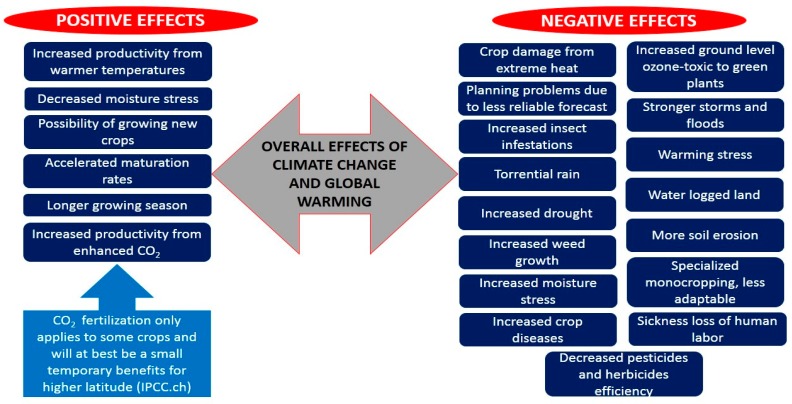
“Overall, global warming and climate change both have some negative and positive effects on agricultural crops as well as on humans as explained in Figure 4.”
The paper relies on this without support.
Environmental variation has a long-lasting influence on agriculture and food security globally.
“Variation in the environment has a long-lasting influence on agriculture and food security globally.”
The paper relies on this without support.
Food security and safety are threatened by severe weather conditions.
“Food security and safety are threatened by the severe weather conditions and it is not a recent problem.”
The paper relies on this without support.
Formerly, no consideration was adopted to tackle the problem of weather variations.
“But formerly, no consideration was adopted to tackle this problem.”
The paper relies on this without support.
The strategies to tackle climate change's impact on agriculture are still ambiguous.
“How to tackle this problem and what strategies we should apply are still ambiguous.”
Claims other papers make about this one
Each is checked against this paper’s own text: does it say what the citing paper says it does?
The source backs part of the claim, not all of it — or backs it for a different population, condition or comparison.
In the citing paper
“Salinity often leads to a decline in photosynthesis, which results in stunted plant growth. This occurs because salinity interferes with essential metabolic processes needed for energy production and development47.”
From Cold plasma technology as a pre-treatment for seed priming enhances germination and reduces salinity stress in Prosopis Koelziana (2025) · cites this paper as [47]
Experimental — accuracy not yet measuredThe check wasn’t confident either way, so it gives no verdict — never disputed.
In the citing paper
“For the fungal pathogen C. gloeosporioides, it has been reported that an elevated CO2 concentration resulted in a modulation of the development and disease severity, which is highly dependent on the variety of the plant host and CO2 concentration.”
From Green Management of Postharvest Anthracnose Caused by Colletotrichum gloeosporioides (2023) · cites this paper as [44]
Experimental — accuracy not yet measured
Self-check
Percentages, sums and reported differences re-computed from the paper’s own numbers.
Each contradiction between two passages listed here was confirmed by an independent check.
Rated minor: it would not touch a result — a value no result rests on, a p-value that stays on the same side of the significance level, or a conflict that is clerical, resolved elsewhere in the paper, or outside its own findings.
In the paper
§ Impact of Climate Change on Crops Adaptation and Strategies to Tackle Its Outcome: A Review > 7. Approaches to Combat Climate Changes > 7.4. Genome Editing Strategies
“CRISPR/Cas9 technology was applied for mutant rice lines, resulting in the enhancement of tolerance under cold stress.”
§ Impact of Climate Change on Crops Adaptation and Strategies to Tackle Its Outcome: A Review > References
“249. Shen C. Que Z. Xia Y. Tang N. Li D. He R. Cao M. Knock out of the annexin gene OsAnn3 via CRISPR/Cas9-mediated genome editing decreased cold tolerance in rice”
Citations
Cites
Abiotic Stress Signaling and Responses in Plants
Zhu, J. (2016) · Cell · doi:10.1016/j.cell.2016.08.029 · Cited by 5,837 · cited 1×
“It was reported that plants have the ability to sense any variation in surrounding environmental signals but in spite of many studies, only some reputed sensors have been recognized [77].”
BackgroundSystems biology: a brief overview
Kitano, H. (2002) · Science · doi:10.1126/science.1069492 · Cited by 4,265 · cited 1×
“This rising concern was revealed in the growing quantity of research papers focused on abiotic problems after the crucial review by Kitano on systems biology [62].”
BackgroundPlant productivity and environment
Boyer, J. S. (1982) · Science · doi:10.1126/science.218.4571.443 · Cited by 3,959 · cited 1×
“Boyer reported that the climate changes have reduced the crop yield up to 70% since 1982 [26].”
BackgroundInfluence of extreme weather disasters on global crop production
Lesk, C., Rowhani, P., & Ramankutty, N. (2016) · Nature · doi:10.1038/nature16467 · Cited by 3,883 · cited 1×
“Recent studies reported that the developed countries have more vulnerability towards climatic changes (8–11%) than developing states [13,14].”
BackgroundParis Agreement climate proposals need a boost to keep warming well below 2 °C
Rogelj, J., den Elzen, M., Höhne, N., Fransen, T., Fekete, H., Winkler, H., Schaeffer, R., Sha, F., Riahi, K., & Meinshausen, M. (2016) · Nature · doi:10.1038/nature18307 · Cited by 3,637 · cited 1×
“Reduction in the productivity of these crops signifies the main threat to food security, particularly in the speedy increase in the world’s population [17].”
BackgroundClimate Change Impacts on Global Food Security
Wheeler, T., & von Braun, J. (2013) · Science · doi:10.1126/science.1239402 · Cited by 3,487 · cited 1×
“To tackle these limitations and guaranteed food security there is a need for production of new climate-smart crop cultivars [6].”
BackgroundNonlinear temperature effects indicate severe damages to U.S. crop yields under climate change
Schlenker, W., & Roberts, M. J. (2009) · Proceedings of the National Academy of Sciences · doi:10.1073/pnas.0906865106 · Cited by 3,420 · cited 2×
“Schlenker and Roberts (2009) described that maize yield was increased at an optimum temperature of 29 ◦C but a further increase in temperature hampered the yield of maize [53].”
BackgroundTemperature increase reduces global yields of major crops in four independent estimates
Zhao, C., Liu, B., Piao, S., Wang, X., Lobell, D. B., Huang, Y., Huang, M., Yao, Y., Bassu, S., Ciais, P., et al. (2017) · Proceedings of the National Academy of Sciences · doi:10.1073/pnas.1701762114 · Cited by 3,311 · cited 2×
“4% in wheat, rice, soybean, and maize respectively [46].”
BackgroundInfluentialLiu, Q., Kasuga, M., Sakuma, Y., Abe, H., Miura, S., Yamaguchi-Shinozaki, K., & Shinozaki, K. (1998) · The Plant Cell · doi:10.1105/tpc.10.8.1391 · Cited by 3,044
Abscisic Acid Inhibits Type 2C Protein Phosphatases via the PYR/PYL Family of START Proteins
Park, S., Fung, P., Nishimura, N., Jensen, D. R., Fujii, H., Zhao, Y., Lumba, S., Santiago, J., Rodrigues, A., Chow, T.-F. F., et al. (2009) · Science · doi:10.1126/science.1173041 · Cited by 2,986 · cited 1×
“Two different group of scientists found the ABA PYR/PYL/RCAR receptors [101,102].”
Background
Research works printed but not linked: 8
- Khan, 2016, Climate Change Implications for Wheat Crop in Dera Ismail Khan District of Khyber Pakhtunkhwa, Pak. J. Meteorol., 13, 17
- Reckling, 2018, Grain legume yield instability has increased over 60 years in long-term field experiments as measured by a scale-adjusted coefficient of variation, Asp. Appl. Biol., 138, 15
- Intergovernmental Panel on Climate Change (IPCC) (2007). Climate Change: Impacts, Adaptation, and Vulnerability, Cambridge University Press. Contribution of Working Group II to the Fourth Assessment Report of the Intergovernmental Panel on Climate Change.
- Intergovernmental Panel on Climate Change (IPCC) (2000). Special Report on Emissions Scenarios, Cambridge University Press. A Special Report of Working Group III of the Intergovernmental Panel on Climate Change.
- Khan, 2017, Effect of Various Temperatures and Duration on Deterioration of Rice Seeds, Science, 36, 79
- Jan, 2017, Impact of salt, drought, heat and frost stresses on morpho-biochemical and physiological properties of Brassica species: An updated review, J. Rural Dev. Agric., 2, 1
- Nasim, 2017, Contemplation of wheat genotypes for enhanced antioxidant enzyme activity, Pak. J. Bot., 49, 647
- Riechmann, 1998, The AP2/EREBP family of plant transcription factors, Biol. Chem., 379, 633
Cited by
Sorted by citations
Items 901–1,000 of 1,000
Plant Growth-Promoting Psychrotrophic Microbes: Current Research and Future Challenges
Joshi, D., Suyal, D. C., Singh, J., Maithani, D., Rajwar, J., Preeti, P., Singh, M., & Singh, D. (2024) · Interdisciplinary biotechnological advances · doi:10.1007/978-981-97-0633-4_11 · Cited by 7
Diallo, S., Badiane, F. A., Diédhiou, I., et al. (2024) · Plant Molecular Biology Reporter · doi:10.1007/s11105-024-01473-2 · Cited by 6
“Therefore, in this context, it will be challenging to feed the continuously growing world population (Raza et al. 2019; Zandalinas et al. 2018).”
Modelling Climate Smart Agriculture with Ontology
Naidoo, N., Lawton, S. R., Ramnanan, M., et al. (2021) · International Conference on Artificial Intelligence, Big Data, Computing and Data Communication Systems (icABCD) · doi:10.1109/icabcd51485.2021.9519380 · Cited by 6
“…influence agriculture and agricultural activities: higher carbon dioxide quantities, increase in atmospheric average temperature and varied rainfall sequences, changes in pests and diseases, ground level ozone concentrations, changes in nutritional quality of food and changes in sea level [1].”
BackgroundPolidoros, A. N., Avdikos, I. D., Gleridou, A., Kostoula, S., Koura, E., Sakellariou, M. A., Stavridou, E., Gerasopoulos, D., Lagopodi, A. L., Mavromatis, A. G., et al. (2021) · Springer eBooks · doi:10.1007/978-3-030-74926-2_11 · Cited by 6
Advances in Input Management for Food and Environmental Security
Sabagh, A. E., Islam, M. S., Hossain, A., Iqbal, M. A., Rahman, M. H. U., Mansour, F., Wasaya, A., Ahmed, S., Singhal, R. K., Kumari, A., et al. (2021) · Springer eBooks · doi:10.1007/978-981-16-5199-1_6 · Cited by 7
Krishna, K., Mohan, Y. C., Krishna, L., et al. (2022) · Electronic Journal of Plant Breeding · doi:10.37992/2022.1303.129 · Cited by 6
Colored cereals: Genetics and chemistry of pigments
Alexandru Vasile, R. U. S. U., Socol, C. T., Bangar, S. P., et al. (2023) · Elsevier eBooks · doi:10.1016/b978-0-323-99733-1.00001-7 · Cited by 6
Microbial Inoculants in the Climate Change Scenario: An Overview
Singh, S., Pranaw, K., Prasanna, R., Kumar, P., & Poria, V. (2023) · Springer eBooks · doi:10.1007/978-981-99-2973-3_1 · Cited by 6
Myconanotechnologies: an approach towards sustainable agriculture
Tyagi, S., Yadav, P., Chakraborty, A., et al. (2023) · Elsevier eBooks · doi:10.1016/b978-0-443-15262-7.00005-x · Cited by 6
Computational modeling for agriculture and climate change relation
Uysal, İ. (2025) · Elsevier eBooks · doi:10.1016/b978-0-443-21905-4.00010-9 · Cited by 5
Sultana, F., Dev, W., Zhi, X., et al. (2025) · Scientific Reports · doi:10.1038/s41598-025-02682-9 · Cited by 5
“Numerous studies have shown that varying planting density and climatic circumstances have a significant impact on crop growth and population structure 12 .”
Saini, D. K., Hein, N. T., Somayanda, I. M., et al. (2025) · The Plant Genome · doi:10.1002/tpg2.70075 · Cited by 5
“Understanding crop responses to environmental variations is essential for effective adaptation strategies (Lobell, 2014; Raza et al., 2019).”
Sharma, R. K., Nwosu, N. J., Singh, L., Kramer, A., Singh, H., Bheemanahalli, R., & Dhillon, J. S. (2025) · Discover Agriculture · doi:10.1007/s44279-025-00287-4 · Cited by 6
“…intense environmental shifts, specifically the increasing temperatures, shifted precipitation trends, rising frequency of extreme weather episodes, and altered growing season durations, are adversely impacting the natural ecosystems, agricultural productivity, and human well-being [1, 11, 12].”
Tao, J., Song, J., Zhang, X., Li, F., Ge, P., Ahiakpa, J. K., Xu, H., Yang, Y., Wang, Z., Ye, Z., et al. (2025) · New Phytologist · doi:10.1111/nph.70635 · Cited by 5
“Every year, significant losses in tomato production are caused by low temperatures (Raza et al ., 2019).”
Self-citationAli, O., Ramsubhag, A., Ramnarine, S. D. B. J., Farrell, A. D., & Jayaraman, J. (2025) · Journal of Applied Phycology · doi:10.1007/s10811-025-03674-y · Cited by 5
“With global climate change, increases in the occurrence and severity of drought stress events are anticipated, which will intensify the challenges faced by agriculture worldwide (Raza et al. 2019).”
Liquid–liquid phase separation at the frontline of plant–pathogen battles
Zou, J., Zhang, B., Cao, J., et al. (2025) · Plant Communications · doi:10.1016/j.xplc.2025.101633 · Cited by 5
“Plants encounter a wide range of environmental challenges, including biotic and abiotic stresses, which together impose substantial yield losses and threaten global food security (Raza et al., 2019).”
Self-citationCommon Buckwheat (Fagopyrum esculentum Mill.) as a Support for Sustainable Agriculture
Żarczyński, P. J., Mackiewicz-Walec, E., Krzebietke, S. J., Sienkiewicz, S., Hlinková, S., & Żarczyńska, K. (2026) · Sustainability · doi:10.3390/su18062823 · Cited by 7
SHORT COMMUNICATION: ADDRESSING VULNERABILITY OF AGRICULTURE SECTOR TO CLIMATE CHANGE IN PAKISTAN
Raza, A., Imtiaz, M., Ali, Z., et al. (2021) · Pakistan Journal of Agriculture Agricultural Engineering and Veterinary Sciences · doi:10.47432/2020.36.2.4 · Cited by 5
“In some areas there will be an increase in crop production due to a favorable shift in rainfall and temperature while in other areas, devastating floods may destroy existing crops (Raza et al., 2019).”
BackgroundSelf-citationSousaraei, N., Torabi, B., Soltani, E., Mashayekhi, K., & Medina, J. (2022) · Seeds · doi:10.3390/seeds1010005 · Cited by 4
“losses in production for wheat, rice, and maize in both temperate and tropical regions by 2 ◦C of local warming [10].”
BackgroundJaved, M. N., Adnan, H. M., Hanan, M. A., et al. (2023) · Heliyon · doi:10.1016/j.heliyon.2023.e21579 · Cited by 5
“Raza et al. [27] determined that agriculture and weather change are fundamentally interconnected in numerous ways, such as how weather change is the primary cause of biotic and abiotic forces that have the greatest impact on agricultural states.”
BackgroundCLIMATE CHANGE IMPACTS ON SOIL PROPERTIES AND AGRICULTURAL PRODUCTIVITY
AMIN, H., Ahsan, M., NIAZ, A., et al. (2023) · Biological and Clinical Sciences Research Journal · doi:10.54112/bcsrj.v2023i1.618 · Cited by 5
Sihag, N., Singh, T., Sheoran, S., Singh, O., Malik, R., Kumar, L., & Singh, J. (2024) · Australian Journal of Agricultural Research · doi:10.1071/cp23183 · Cited by 5
Identification and co-expression analysis of temperature responsive circRNAs in tea plant
Baruah, P. M., Bordoloi, K. S., & Agarwala, N. (2024) · Vegetos · doi:10.1007/s42535-024-00868-6 · Cited by 5
“Agricultural productivity is strongly correlated with the climate change induced stresses on plants (Raza et al. 2019; Chaudhry and Sidhu 2022).”
Plant Growth Under Extreme Climatic Conditions
Zafar, S., Shah, A. A., Ashraf, M. A., Rasheed, R., Muddasar, M., Khan, I. M., Bilal, M., & Iqbal, R. (2024) · Springer eBooks · doi:10.1007/978-3-031-69417-2_5 · Cited by 6
Dong, X., Shi, L., Bao, S., et al. (2024) · Scientific Reports · doi:10.1038/s41598-024-77397-4 · Cited by 5
El-Messiry, H. M., Hamdan, A. M., Ghanem, N. B. E. D., & Hagar, M. (2025) · Scientific Reports · doi:10.1038/s41598-025-03913-9 · Cited by 5
Erokhin, V., Esaulko, A., Pismennaya, E., Golosnoy, E., Vlasova, O., & Ivolga, A. (2021) · Land · doi:10.3390/land10121339 · Cited by 4
Biosafety Issue Related to Genome Editing in Plants Using CRISPR-Cas9
Katam, R., Hasanvand, F., Teniyah, V., Noel, J., & Gottschalk, V. A. (2022) · Springer eBooks · doi:10.1007/978-3-031-08072-2_16 · Cited by 6
Multiomics Approach for Crop Improvement Under Climate Change
Gupta, S., Verma, R., & Ravi, R. K. (2023) · Springer eBooks · doi:10.1007/978-3-031-15568-0_2 · Cited by 6
The sustainability analysis of red chili farming in Taraju District, Tasikmalaya Regency
Nuraini, C., & Mutolib, A. (2023) · IOP Conference Series Earth and Environmental Science · doi:10.1088/1755-1315/1133/1/012060 · Cited by 5
“So those sub-sectors are the most vulnerable to climate change [13],[14].”
BackgroundGautam, R. K., Singh, P. K., Venkatesan, K., et al. (2023) · Frontiers in Nutrition · doi:10.3389/fnut.2023.1088208 · Cited by 5
Pysarenko, N., Sydorchuk, V. I., & Захарчук, Н. А. (2022) · Agriculture and plant sciences theory and practice · doi:10.54651/agri.2022.03.10 · Cited by 5
Hamze, M., Cheviron, B., Baghdadi, N., et al. (2023) · Remote Sensing · doi:10.3390/rs15164081 · Cited by 5
Climate Change and Global Crop Production: An Inclusive Insight
Ghosh, S., Sarkar, S., Garai, S., Roy, A., Saha, S., Dey, S., Santra, S. C., Moulick, D., Mondal, M., & Brahmachari, K. (2023) · Springer eBooks · doi:10.1007/978-3-031-37428-9_1 · Cited by 11
Daemo, B. B., Yohannes, D. B., Beyene, T. M., et al. (2023) · Journal of Agriculture and Food Research · doi:10.1016/j.jafr.2023.100874 · Cited by 5
Hirschman, E. C. (2023) · Social Sciences · doi:10.3390/socsci12120663 · Cited by 5
Water management and crop-resistant varieties adaptation due to climate change by farmers
Towolawi, A. T., Oguntoke, O., Bada, B. S., et al. (2024) · Theoretical and Applied Climatology · doi:10.1007/s00704-024-04825-w · Cited by 5
“Water management and crop variety performance vary with time across agricultural regions (Raza et al. 2019).”
Impact of two Erwinia sp. on the response of diverse Pisum sativum genotypes under salt stress
Ilahi, H., Zampieri, E., Sbrana, C., Brescia, F., Giovannini, L., Mahmoudi, R., Gohari, G., Idrissi, M. M. E., Alfeddy, M. N., Schillaci, M., et al. (2024) · Physiology and Molecular Biology of Plants · doi:10.1007/s12298-024-01419-8 · Cited by 5
“Plants can activate different mechanisms to protect themselves from stressful conditions, such as in high salinity (Raza et al. 2019).”
BackgroundPineda, M., Barón, M., & Pérez‐Bueno, M. L. (2024) · Physiologia Plantarum · doi:10.1111/ppl.14269 · Cited by 6
Cladophora sp. ve Mikoriza Uygulamalarının Mısır Rizosferindeki bazı Toprak Enzimlerine Etkisi
Küçük, Ç., Uslu, P., & Sezen, G. (2024) · Süleyman Demirel Üniversitesi Fen Bilimleri Enstitüsü Dergisi · doi:10.19113/sdufenbed.1473028 · Cited by 5
Quintero, D., Mishra, V., Limaye, A., Abel, N. V., Ross, J. B., & Rashid, A. (2025) · European Journal of Agronomy · doi:10.1016/j.eja.2025.127524 · Cited by 5
Singh, J., Rajput, R. S., Singh, P., Ray, S., Vaishnav, A., M.Singh, S., & B.Singh, H. (2021) · PLANT ARCHIVES · doi:10.51470/plantarchives.2021.v21.no1.235 · Cited by 5
Climate Change and Global Warming Effect(s) on Wheat Landraces: A General Approach
Ulukan, H. (2021) · Springer eBooks · doi:10.1007/978-3-030-77388-5_9 · Cited by 5
Engelhardt, T. B., Zhu, M., Heilmann, C., Schmitz‐Stöwe, S., Schwarz, T., & Stöwe, K. (2021) · Catalysts · doi:10.3390/catal11111351 · Cited by 4
Minh, N. V., & Nguyen, T. V. (2021) · Australian Journal of Crop Science · doi:10.21475/ajcs.21.15.12.p3429 · Cited by 5
“The yield depends on the genetic characteristics of each breed in similar climate, soil type and cultivation techniques (Altieri et al., 2015; Raza et al., 2019).”
BackgroundAbiotic Stress Tolerance in Wheat: Physiological Interventions
Mamrutha, H. M., Rinki, Singh, S. K., et al. (2022) · Springer eBooks · doi:10.1007/978-981-16-4449-8_20 · Cited by 5
Rajkumar, D., Gangadhar Rao, S., Tirupathi, B., et al. (2022) · International Journal of Economic Plants · doi:10.23910/2/2022.0440b · Cited by 5
Hafiane, F. Z., & Fatimi, A. (2022) · doi:10.3390/environsciproc2022016004 · Cited by 5
Abiotic Stress Tolerance in Cereals Through Genome Editing
Khan, I., Zhang, Y., Akbar, F., & Khan, J. (2022) · Springer eBooks · doi:10.1007/978-981-19-0140-9_12 · Cited by 7
Fakhfakh, L. M., & Chaïeb, M. (2022) · Journal of Arid Land · doi:10.1007/s40333-022-0082-0 · Cited by 5
“From this perspective, the decrease in soil water is becoming an important field of research aiming to explore the response of plants to water deficit to improve agricultural management practices and predict the fate of natural vegetation (Raza et al., 2019).”
BackgroundPhotosynthetic Response and Adaptation of Plants in Perspective of Global Climate Change
Ahmadi‐Lahijani, M. J., & Moori, S. (2023) · IntechOpen eBooks · doi:10.5772/intechopen.109544 · Cited by 6
Kwakye, J. (2023) · American Journal of Environment and Climate · doi:10.54536/ajec.v2i1.1328 · Cited by 5
Bonilla, F. R., Tayal, M., Melgar, J. C., et al. (2023) · Journal of Plant Pathology · doi:10.1007/s42161-023-01450-w · Cited by 5
“Ecological dynamics are not static, as climate change is predicted to cause long-term changes in weather patterns, such as mean temperatures (Raza et al. 2019).”
BackgroundKuraklık ve Sıcak Hava Dalgasının Tarımsal Üretim Üzerine Etkileri
Yılmaz, G. (2023) · Doğal Afetler ve Çevre Dergisi · doi:10.21324/dacd.1220462 · Cited by 5
Khalfalla, M., Zsombik, L., Nagy, R., et al. (2024) · Heliyon · doi:10.1016/j.heliyon.2024.e28759 · Cited by 5
институт, Ф. А. Н.-И., & ЯКУШЕВ, В. П. (2020) · Sel skokhozyaistvennaya Biologiya · doi:10.15389/agrobiology.2020.3.451rus · Cited by 5
Schneider, K., Venn, B., & Mühlhaus, T. (2020) · Entropy · doi:10.3390/e22091030 · Cited by 5
Gitonga, N. M., Njeru, E. M., Cheruiyot, R., et al. (2021) · Frontiers in Sustainable Food Systems · doi:10.3389/fsufs.2020.606618 · Cited by 5
“As a result of climate change, global crop production is estimated to decline owing to stressful biotic and abiotic factors (Raza et al., 2019).”
BackgroundEffect of some treatments on heat stress tolerance of Flame Seedless vineyards
El-Salhy, A.-F., Kamal, M., Radwan, E., et al. (2021) · Assiut Journal of Agricultural Sciences/Assuit Journal of Agricultural Sciences · doi:10.21608/ajas.2022.102542.1055 · Cited by 5
“In addition, it maintains turgor, reduce water loss and wilting, hence, increases cold hardiness and resistance of plants to biotic and abiotic stresses (Salisbury and Ross, 1992; Walker et al., 1998; Leigh, 2001; Dhillon et al., 1999; Martin et al., 2004 and Dordas, 2008).”
BackgroundMarahatta, S. (2020) · Journal of Agriculture and Forestry University · doi:10.3126/jafu.v4i1.47056 · Cited by 5
“Poor crop management practices, low soil fertility, extreme climatic conduction induces the physiological abnormalities of maize, both the bareness and sterility, resulted in poor yield (Raza et al., 2019; Sangoi, 2001).”
BackgroundBrar, N. S., Kumar, T., & Kaushik, P. (2020) · Preprints.org · doi:10.20944/preprints202009.0542.v1 · Cited by 4
“Moreover, detailed information regarding the wild relatives that are poorly conserved is entirely essential (Raza et al. 2019).”
BackgroundKhaledi, F., Balouchi, H., Dehnavi, M. M., et al. (2025) · Plants · doi:10.3390/plants14101483 · Cited by 4
“The observed improvement in grain yield aligns with previous studies where nutrient management and microbial inoculation enhanced crop productivity under stress, possibly through improved nutrient uptake and resilience mechanisms [3,7].”
Stress memory increases cane yield and juice quality of field-grown sugarcane
Pissolato, M. D., da Cruz, L. P., Almeida, R. L., et al. (2025) · Plant Science · doi:10.1016/j.plantsci.2025.112598 · Cited by 4
Application of Remote Sensing and Machine Learning in Sustainable Agriculture
Coman, C., Coman, E., Gherheș, V., Bucs, A., & Rad, D. (2025) · Sustainability · doi:10.3390/su17125601 · Cited by 5
Tropospheric Ozone and Its Effect On Crops: in Perspective to Indian Agriculture
Chaudhary, I. J., & Rathore, D. (2025) · Journal of Plant Diseases and Protection · doi:10.1007/s10343-025-01221-w · Cited by 4
Lopez, A., Anzuay, M. S., Loser, Ú. A., et al. (2025) · Symbiosis · doi:10.1007/s13199-025-01080-z · Cited by 4
“Changing climatic conditions have diminished agricultural production and exacerbated food security issues due to direct and indirect effects of abiotic stresses (Arunanondchai et al. 2018; Raza et al. 2019 ).”
Modiba, M. P., Bell, T., & Babalola, O. O. (2025) · Global Challenges · doi:10.1002/gch2.202500320 · Cited by 5
“Due to global warming increasing the atmospheric humidity, the increasing world population, and disease threats, there is a dire need to find solutions to protect and sustain the tomato industry [27].”
Blanco-Álvarez, I., Peris-Costa, P., Martı́nez-Sober, M., et al. (2025) · Expert Systems with Applications · doi:10.1016/j.eswa.2025.130517 · Cited by 4
Sustainable Crops for Future Food Security: Challenges, Innovations, and Solutions
Purohit, A., Kounain, S., Madala, C., Chavan, S., Nehru, G., Kethavathu, S., Behera, P. P., Suprasanna, P., & Thakur, N. R. (2026) · Sustainability Sciences in Asia and Africa · doi:10.1007/978-981-95-2754-0_1 · Cited by 4
Bazakos, C., Vidović, M., Radanović, A., Bacu, A., Francesca, S., & Rigano, M. M. (2026) · Physiologia Plantarum · doi:10.1111/ppl.70760 · Cited by 8
“The accelerated rise of air temperatures has negative effects on flower bud formation, flowering, fruit ripening, and seed germination, resulting in lower seed yields and quality (Raza et al. 2019; Yadav et al. 2022).”
Limbu, S. P., & Avolio, M. L. (2022) · Journal of Plant Ecology · doi:10.1093/jpe/rtac045 · Cited by 5
Setiawan, H. H. (2023) · Sustainable development goals series · doi:10.1007/978-3-031-44397-8_8 · Cited by 4
The use of cover crop for weed suppression and competition in limited-irrigation vineyards
Torun, H. (2024) · Phytoparasitica · doi:10.1007/s12600-024-01124-y · Cited by 4
“In addition to the importance and reduction of water use (Bernardo et al., 2018; Raza et al., 2019), studies conducted in both Türkiye and other countries have commonly examined the use of cover crops to reduce herbicide use (Kaçan & Boz, 2015; Tursun et al., 2018; Demir & Işık, 2020; Hall et al.,…”
Sanjay, P., & Prakash, S. (2024) · Journal of Advances in Biology & Biotechnology · doi:10.9734/jabb/2024/v27i5848 · Cited by 4
Palma, H. H., Santos, V. S., Castro, A. J. O., Jiménez-Coronado, A., Espinoza, R. M., & Plazas-Alvarado, J. (2024) · International Journal of Energy Economics and Policy · doi:10.32479/ijeep.16141 · Cited by 4
Fatima, S., Rashid, M., & Hameed, A. (2024) · Scientifica · doi:10.1155/2024/4373987 · Cited by 4
“Plant growth and development are signifcantly hampered due to water shortage resulting in lower crop yields [4, 5].”
BackgroundCruz-González, A., Arteaga-Ramírez, R., Cohen, I. S., et al. (2025) · Agronomy · doi:10.3390/agronomy15020460 · Cited by 4
Mazibuko, D. M., Maskey, S., Kurashina, K., et al. (2025) · Crops · doi:10.3390/crops5020013 · Cited by 4
Climate Change Hotspots for Türkiye
An, N., Turp, M. T., Bayındır, E., Akverdi, Y., Mirza, Z. N., & Kurnaz, M. L. (2025) · International Journal of Climatology · doi:10.1002/joc.8825 · Cited by 4
“…(Gao et al. 2021; Lu et al. 2021), changing energy supply and demand (Flores-Larsen et al. 2018), increasing agricultural losses and decreasing resources (Ramirez-Villegas et al. 2013; Caminade et al. 2014; Raza et al. 2019) and decreasing food security (Tai et al. 2014; Fujimori et al. 2019).”
Peptide signalling in flowering plants: insights into reproductive thermotolerance
Perkins, C. J., Pryze, K., & Palanivelu, R. (2025) · Journal of Experimental Botany · doi:10.1093/jxb/eraf192 · Cited by 4
Drought and Heat Stress in Fruit Crops: Implications, Mitigation, and Policy Perspectives
Jain, S., Singh, A., & Prakash, J. (2025) · Springer eBooks · doi:10.1007/978-981-96-5735-3_4 · Cited by 5
An, J., He, Q., Xi, J., et al. (2025) · Forests · doi:10.3390/f16081214 · Cited by 4
Evaluation of Climate Resilient Agriculture Practices in Subcontinent
Mishra, H., Gautam, S., Dwivedi, S., Raza, M. Y., Ali, H., & Ikram, S. (2025) · Advances in global change research · doi:10.1007/978-3-032-00190-0_11 · Cited by 5
Chaudhry, I. S., Aslam, A. R., Farooq, F., et al. (2021) · Review of Applied Management and Social Sciences · doi:10.47067/ramss.v4i4.199 · Cited by 4
“The climate conditions are closely related to agriculture output and can dramatically reduce it (Raza et al., 2019).”
BackgroundAltaweel, A. A., Alasoom, A. J., Burshed, H. A., et al. (2022) · Pharmacognosy Journal · doi:10.5530/pj.2022.14.101 · Cited by 4
Application of Nanotechnology in Plant Secondary Metabolites Production
Kumar, G., Puthusseri, B., Divya, P., et al. (2022) · Springer eBooks · doi:10.1007/978-981-19-4811-4_5 · Cited by 4
Bambalaza, S. E., Xakalashe, B. S., Coetsee, Y., van Zyl, P. G., Dyosiba, X., Musyoka, N. M., & Steenkamp, J. D. (2023) · Materials · doi:10.3390/ma16072782 · Cited by 5
“The shift towards clean renewable power generation technologies is inevitably based on the adverse environmental effects caused by increased carbon dioxide (CO2) atmospheric levels [4,5].”
BackgroundSaheewala, H., Mahawar, S., Sanadhaya, S., et al. (2023) · Sustainable plant nutrition in a changing world · doi:10.1007/978-3-031-35147-1_16 · Cited by 4
Kipato, N., Dorward, P., & Clarkson, G. (2023) · Sustainability · doi:10.3390/su151914467 · Cited by 6
Bezandry, R., Dupeyron, M., González-García, L. N., et al. (2024) · PLoS ONE · doi:10.1371/journal.pone.0296362 · Cited by 4
Physiological and molecular pathways of crop plants in response to heat stress
Abasi, F., Ehsan, M., Raja, N. I., Mashwani, Z., Sohail, M., Iqbal, M., Shahbaz, M., Mehmood, A., & Raza, M. U. (2024) · Elsevier eBooks · doi:10.1016/b978-0-443-18927-2.00020-0 · Cited by 4
Hamad, A., & Sawe, J. R. (2022) · Tanzania Journal for Population studies and Development · doi:10.56279/tjpsd.v29i2.173 · Cited by 4
“Raza et al. (2019) also found that communities dependent on agriculture along the coastal areas are the most vulnerable to the impacts of climate change.”
BackgroundInterpretable Machine Learning for Multi-Class Crop Yield Prediction
Nurcahyo, A., Heryadi, Y., Lukas, L., et al. (2023) · International Conference on Intelligent Cybernetics Technology & Applications (ICICyTA) · doi:10.1109/icicyta60173.2023.10428914 · Cited by 4
“Agricultural productivity can be influenced by the complicated conditions of many climatic elements [1].”
BackgroundNatural Occurrences of Soil Dilapidation
Livinus, M. U., Bala, S. Z., Abdulsalam, M., Innocent, M. O., Hassan, M., & Kini, P. (2024) · Earth and environmental sciences library · doi:10.1007/978-3-031-53270-2_9 · Cited by 4
Edible black ant Smith (Carebara vidua) as human food – A systematic review
Siddiqui, S. A., Ho, L., Adimulam, S. C., Nagdalian, A. A., Yudhistira, B., Castro‐Muñoz, R., & Ibrahim, S. A. (2024) · Journal of Insects as Food and Feed · doi:10.1163/23524588-00001091 · Cited by 4
From Fields to Forks: Navigating the New Climate Reality in Agriculture and Health
Saxena, S., & Upadhyay, S. (2024) · Springer eBooks · doi:10.1007/978-3-031-56564-9_5 · Cited by 5
Adaptability and stability of soybean [Glycine max (L.) Merrill] strains in Central-West Brazil
Silva, W. B., Filho, A. C. P. D. M., Reis, M. N. O., et al. (2024) · Brazilian Journal of Science · doi:10.14295/bjs.v3i7.594 · Cited by 4
“However, with abrupt changes in environmental conditions, impacts on plant productivity are progressing at great intensity due to the direct and indirect effects of abiotic stresses (Raza et al., 2019).”
BackgroundBester, A. U., Shimoia, E. P., da-Silva, C. J., Posso, D. A., Carvalho, I. R., Corrêa, F. M., de Oliveira, A. C. B., & do Amarante, L. (2024) · Functional Plant Biology · doi:10.1071/fp24064 · Cited by 4
Reinman, T., Braden, J. L., Miller, N. D., et al. (2024) · Frontiers in Nutrition · doi:10.3389/fnut.2024.1394136 · Cited by 4
“Climate change increases abiotic and biotic stressors that will challenge the resiliency of agricultural production systems around the world (1).”
Background
Metadata
- Authors
- Raza, A., Razzaq, A., Mehmood, S. S., Zou, X., Zhang, X., Lv, Y., & Xu, J.
- Affiliations
- Chinese Academy of Agricultural Sciences (CN)
- University of Agriculture Faisalabad (PK)
- Corresponding author
- Raza, Ali
- Zou, Xiling
- Zhang, Xuekun
- Venue
- Plants
- Publisher
- MDPI AG
- Published
- 2019-01-30
- Volume
- 8
- Issue
- 2
- Pages
- 34
- ISSN
- 2223-7747 (ISSN-L)
- PMC
- PMC6409995
- OpenAlex
- W2913631090
- Semantic Scholar
- 2248987a623f11fd2269233a6084110d9dff68e7
- Cited by
- 1,762
- References
- 253
- Citations by year
- 2026: 144 · 2025: 250 · 2024: 344 · 2023: 349 · 2022: 293 · 2021: 251 · 2020: 116 · 2019: 13
- FWCI
- 18.62
- Type
- journal article
- Language
- en
- Open access
- gold
- dx.doi.org
- Licence
- Locations
- Plants (publishedVersion, cc-by)
- Europe PMC (PubMed Central) (publishedVersion, cc-by)
- PubMed Central (publishedVersion, cc-by)
- PubMed (publishedVersion)
- DOAJ (DOAJ: Directory of Open Access Journals) (submittedVersion, cc-by-sa)
- Funders
- National Basic Research Program of China (2017YFD0101701) and Agricultural Science and Technology Innovation Program of CAAS. (2017YFD0101701)
- Topics
- Life Sciences › Agricultural and Biological Sciences › Agronomy and Crop Science › Climate change impacts on agriculture
- Life Sciences › Agricultural and Biological Sciences › Plant Science › Plant Stress Responses and Tolerance
- Life Sciences › Agricultural and Biological Sciences › General Agricultural and Biological Sciences › Agriculture and Biological Studies
- Keywords
- climate change impacts on crops, crop adaptation, climate-smart agriculture, food security, climate-resilient crops, abiotic stress, biotic stress, heat waves, genetic engineering, transgenic plants, ecosystem resilience
About these checks
Registry, retraction, Cites and statistics results are computed, not judged, with one exception: a printed reference that no index lists is read once by a model before it counts as a citation error. Claims are extracted by a model and kept only when their quote appears verbatim in the text; each cited source is then checked, with a model’s help, for whether it says what the claim relies on. Those verdicts can be wrong — read the claim’s quote and the cited source before relying on one.
A language model drew the claims from the paper on 2026-10-10, under version 3 of the claim definition (model deepseek-v4.1-flash, prompt extract-v3).
A second model labelled each claim on 2026-10-10 (model jev-1.13-20260917, definition revision gold-guideline-v0.2).
Cited sources are checked with a language model’s help (gpt-6-sol).
Statistics and arithmetic are recomputed, not judged.
Confidence bands are shown only for fields calibrated on our annotated test set. None is calibrated yet, so no band is shown.
What counts as a claim ›How we measure confidence ›How we check this ›
Are you an author, or do you see a problem with this page? Request a review
