

Selection history: How reward modulates selectivity of visual attention.
Open accessThe DOI matches its Crossref record; 246 of the 251 references it cites were found in a registry or an index; 127 of the 241 sources its claims cite were checked for support.
Abstract
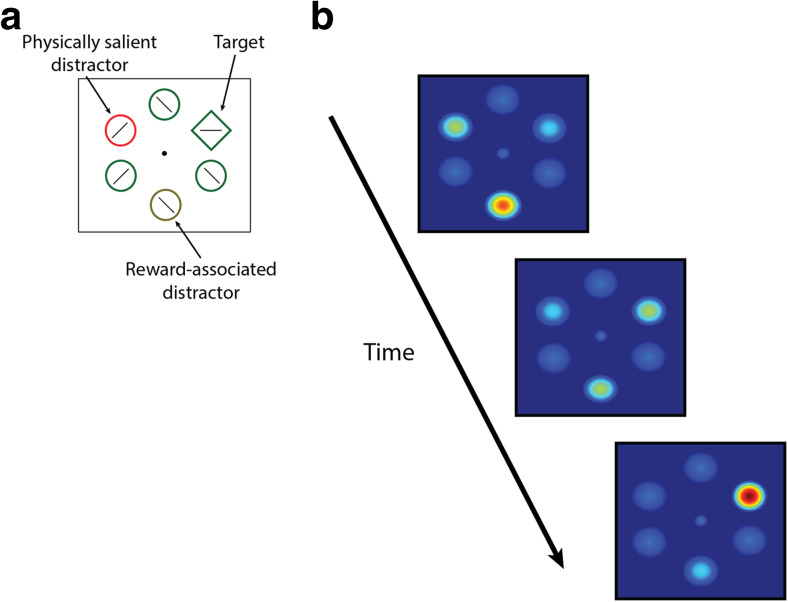
Visual attention enables us to selectively prioritize or suppress information in the environment. Prominent models concerned with the control of visual attention differentiate between goal-directed, top-down and stimulus-driven, bottom-up control, with the former determined by current selection goals and the latter determined by physical salience. In the current review, we discuss recent studies that demonstrate that attentional selection does not need to be the result of top-down or bottom-up processing but, instead, is often driven by lingering biases due to the "history" of former attention deployments. This review mainly focuses on reward-based history effects; yet other types of history effects such as (intertrial) priming, statistical learning and affective conditioning are also discussed. We argue that evidence from behavioral, eye-movement and neuroimaging studies supports the idea that selection history modulates the topographical landscape of spatial "priority" maps, such that attention is biased toward locations having the highest activation on this map.
Overview
CoChat Summary
TL;DR
This review argues that visual attention is shaped not only by top-down goals and bottom-up salience, but also by selection history—persistent biases from past attentional episodes. Reward is the main case reviewed, and the authors conclude that reward-associated stimuli can capture or be suppressed in ways that alter the priority map and influence both covert and overt attention.
Key findings
- The review argues that reward can bias attention beyond strategic control: previously reward-associated stimuli can disrupt performance even when they are non-salient, task-irrelevant, and when avoiding them would be better for reward.
- In intertrial reward priming, Hickey et al. (2010a) found that when participants received a high reward, they were quicker on the next trial if there was no swap between target- and distractor-associated colors, but slower if a swap occurred; with low reward, the pattern reversed.
- Della Libera & Chelazzi (2009) found that, in a training-test design separated by 5 days, distractor shapes associated with high reward as targets in training slowed later responses more than distractors associated with low reward as targets, while shapes associated with high reward as distractors sped later responses.
- The review notes neuroimaging evidence that reward history changes stimulus representation, including elevated activity in visual cortex and reward/attention areas such as basal ganglia, VMPFC, OSC, IPS, FEF, and SC; one cited fMRI study found that less suppression of a reward-associated distractor in OSC was linked to larger performance costs.
- The authors also report that reward can influence temporal attention: in Le Pelley et al. (2017), accuracy dropped significantly when an upright distractor signaled reward compared with when no reward was signaled or the distractor was absent.
Methods
- Narrative review of behavioral, eye-movement, electrophysiological, fMRI, PET, lesion, and pharmacological studies on attention, with emphasis on reward-based selection history and related history effects.
- The paper synthesizes studies using paradigms such as additional singleton search, spatial cueing, training-test designs, RSVP temporal attention, object-based cueing, and fear-conditioning/priming comparisons.
- Main analysis is qualitative/theoretical: the authors compare findings against top-down/bottom-up accounts and argue for a third category, selection history, integrated into a priority-map framework.
Limitations
- The paper explicitly says that several questions remain unresolved, including how reward-based selection history is reflected in the brain, how to model oculomotor effects, how suppression vs prioritization is determined, and how far effects generalize across contexts, tasks, and stimulus features.
- It also notes that many reward studies are hard to interpret because reward manipulations were often congruent with task demands, or because reward-associated stimuli were physically salient or otherwise not fully decoupled from top-down control; this is stated in the paper as a caveat.
- Evident from the text: this is a review, not a new empirical study, so its conclusions depend on the quality and comparability of the cited literature.
Model-written summary of a shortened version of the paper’s full text (it is longer than we read). Check it against the paper before relying on it.
Integrity signals
Registry
Cites
Statistics
Figures
Verification
Claims the paper makes
90 Valid · 7 Not valid · 60 Not checked · 111 Own results and interpretations
The cited sources support only part of this claim — read each source’s verdict below.
In the paper
“In particular, physical salience of a stimulus relative to its immediate surroundings determines how likely it is that this stimulus “grabs,” or captures, attention.”
§ Selection history: How reward modulates selectivity of visual attention > Top-down and bottom-up attentional control
What the sources say
- Not matchedcites Theeuwes, 1991a, 1992, 1994
A range of references, not one source.
- Supportedcites Itti & Koch, 2001 matched to “Computational modelling of visual attention” (2001) source
The Summary says a stimulus’s perceptual saliency depends critically on surrounding context. The opening discussion says conspicuous stimuli can attract attention automatically, and the Saliency section describes attention being drawn toward the most salient location. The paper also recognizes top-down influences, but the claim does not say physical salience is the only influence. (LLM, conf=0.92)
plainstates a cause- Asserted: passes — The authors put it forward as true.
- Checkable: passes — It can be checked against evidence.
- Load-bearing: unclear — It is unclear whether the paper’s conclusions depend on it.
- Based: passes — The paper gives a reason why it holds.
- Not matched
Every source the paper cites for this claim was checked and supports it.
In the paper
“The current review takes the previous paper of Awh et al. (2012) further and discusses recent findings of key behavioral, eye-movement, and neuroimaging studies that demonstrate effects that should be considered to be the result of selection history (i.e., lingering selection biases based on history).”
§ Selection history: How reward modulates selectivity of visual attention > Abstract
What the sources say
- Supportedcites Awh et al., 2012 matched to “Top-down versus bottom-up attentional control: a failed theoretical dichotomy” (2012) source
The citation identifies Awh et al. as the previous paper whose selection-history framework the citing review takes further. In the paper’s “Selection history” section, the authors argue that past selection can bias attention independently of current goals or physical salience. The citing authors’ description of the recent studies their own review discusses is not a finding attributed to Awh et al. (LLM, conf=0.91)
boostedstates a cause- Asserted: passes — The authors put it forward as true.
- Checkable: passes — It can be checked against evidence.
- Load-bearing: passes — The paper’s conclusions depend on it.
- Based: passes — The paper gives a reason why it holds.
- Supported
Every source the paper cites for this claim was checked and supports it.
In the paper
“More specifically, stronger task-set representations (measured as higher classification accuracy) in frontoparietal regions due to incentive reward predicted higher accuracy on the task (Etzel et al., 2015).”
§ Selection history: How reward modulates selectivity of visual attention > Attention and reward > Reward as a motivational incentive
What the sources say
- Supportedcites Etzel et al., 2015 matched to “Reward Motivation Enhances Task Coding in Frontoparietal Cortex” (2016) source
The Relationship with Behavioral Performance section reports that participants with larger incentive-related increases in frontoparietal task-classification accuracy also had larger increases in behavioral accuracy. Its mediation analysis found that the classification-accuracy difference significantly predicted the behavioral-performance difference. (LLM, conf=0.94)
plainstates an association- Asserted: passes — The authors put it forward as true.
- Checkable: passes — It can be checked against evidence.
- Load-bearing: passes — The paper’s conclusions depend on it.
- Based: passes — The paper gives a reason why it holds.
- Supported
Every source the paper cites for this claim was checked and supports it.
In the paper
“Importantly, electrophysiological recordings showed that the N2pc component was also modulated by reward magnitude. The N2pc was earlier and larger in response to high-reward targets compared to low-reward targets.”
§ Selection history: How reward modulates selectivity of visual attention > Attention and reward > Reward as a motivational incentive
What the sources say
- Supportedcites Kiss et al., 2009 matched to “Reward Priority of Visual Target Singletons Modulates Event-Related Potential Signatures of Attentional Selection” (2009) source
The Results (ERP data, N2pc section) report larger N2pc amplitudes for high- than low-reward targets and an earlier onset (187 versus 195 ms). The Results summary explicitly states that the N2pc emerged earlier and had a larger amplitude for high-reward targets. (LLM, conf=0.95)
plainstates an association- Asserted: passes — The authors put it forward as true.
- Checkable: passes — It can be checked against evidence.
- Load-bearing: passes — The paper’s conclusions depend on it.
- Based: passes — The paper gives a reason why it holds.
- Supported
The cited sources support only part of this claim — read each source’s verdict below.
In the paper
“Although initially only demonstrated when both sessions occurred on the same day, subsequent studies showed that such interference can be observed considerably longer—even up to 6 months after the training session (e.g., Anderson & Yantis, 2013).”
§ Selection history: How reward modulates selectivity of visual attention > Attention and reward > Reward history can counteract top-down processes
What the sources say
- Partly supportedcites Anderson & Yantis, 2013 matched to “Attentional bias for nondrug reward is magnified in addiction.” (2013) sourceExperimental — accuracy not yet measured
The Results > Test Phase reports attentional capture by previously reward-associated distractors, supporting the interference part of the claim. The Method > Attentional Capture Task describes training and test phases but does not report a six-month interval between them, so this source does not support the claimed duration. Page numbers are unavailable in our copy. (LLM, conf=0.83)
plainstates a cause- Asserted: passes — The authors put it forward as true.
- Checkable: passes — It can be checked against evidence.
- Load-bearing: passes — The paper’s conclusions depend on it.
- Based: passes — The paper gives a reason why it holds.
- Partly supported
159 more claims · 54 with their cited sources checked
Create a free account to see all 268 claims and to verify the 10 references still open.
- It may state two separate claims as one. 67
- Probably not a substantial claim. 44
- The quote only partly states this claim. 1
Citations
Cites
Control of goal-directed and stimulus-driven attention in the brain
Corbetta, M., & Shulman, G. L. (2002) · Nature Reviews Neuroscience · doi:10.1038/nrn755 · Cited by 12,881 · cited 2×
“…associated with the attentional network and believed to represent a form of priority map (e.g., Balan & Gottlieb, 2006; Bisley & Goldberg, 2010; Corbetta & Shulman, 2002; Gottlieb, Kusunoki, & Goldberg, 1998; Li, 2002; Mazer & Gallant, 2003), most notably area LIP/IPS, frontal eye field (FEF),…”
BackgroundA feature-integration theory of attention.
Treisman, A. M., & Gelade, G. (1980) · Cognitive Psychology · doi:10.1016/0010-0285(80)90005-5 · Cited by 12,366 · cited 1×
“This so-called top-down (also called endogenous or goaldirected) attentional control is thought to be volitional and under the control of the observer at any given point in time (Posner, 1980; Treisman & Gelade, 1980; Theeuwes, 2010; Wolfe, 2007; Yantis, 2000).”
BackgroundPosner, M. I. (1980) · Quarterly Journal of Experimental Psychology · doi:10.1080/00335558008248231 · Cited by 9,670 · cited 2×
“This so-called top-down (also called endogenous or goaldirected) attentional control is thought to be volitional and under the control of the observer at any given point in time (Posner, 1980; Treisman & Gelade, 1980; Theeuwes, 2010; Wolfe, 2007; Yantis, 2000).”
BackgroundNeural Mechanisms of Selective Visual Attention
Desimone, R., & Duncan, J. (1995) · Annual Review of Neuroscience · doi:10.1146/annurev.ne.18.030195.001205 · Cited by 8,388 · cited 3×
“At the heart of the priority map concept lies the idea that its activity profile determines the outcome of the brain’s intrinsically emergent property of competition for neural representation (Desimone, 1998; Desimone & Duncan, 1995).”
BackgroundCarver, C. S., & White, T. L. (1994) · Journal of Personality and Social Psychology · doi:10.1037/0022-3514.67.2.319 · Cited by 7,306 · cited 1×
“…responsiveness (Hickey & Peelen, 2015) as measured by the Barratt Impulsiveness scale (Patton, Stanford, & Barratt, 1995) and BIS/BAS questionnaire (Carver & White, 1994) have been associated with a larger effect of reward on attentional selection, although the contribution of each of these…”
MethodComputational modelling of visual attention
Itti, L., & Koch, C. (2001) · Nature Reviews Neuroscience · doi:10.1038/35058500 · Cited by 4,733 · cited 3×
“Influential theoretical as well as computational models on attentional control assume that all signals driving attention converge on a priority map in the brain (Bisley, 2011; Itti & Koch, 2001; Theeuwes, 2010; Wolfe, 2007; Zelinsky & Bisley, 2015).”
BackgroundA mechanism for cognitive dynamics: neuronal communication through neuronal coherence.
Fries, P. (2005) · Trends in Cognitive Sciences · doi:10.1016/j.tics.2005.08.011 · Cited by 4,284 · cited 1×
“Neuronal synchronization has been proposed as a key mechanism in communicating information from one brain area to another (Fries, 2005) and to play a vital role inmemory (Fell &Axmacher, 2011) as well as attention (Jensen, Gips, Bergmann, & Bonnefond, 2014).”
BackgroundWhat is the role of dopamine in reward: hedonic impact, reward learning, or incentive salience?
Berridge, K. C., & Robinson, T. E. (1998) · Brain Research Reviews · doi:10.1016/s0165-0173(98)00019-8 · Cited by 4,127
Attention and the detection of signals.
Posner, M. I., Snyder, C. R., & Davidson, B. J. (1980) · Journal of Experimental Psychology: General · doi:10.1037/0096-3445.109.2.160 · Cited by 3,778 · cited 2×
“Finding such costs and benefits is considered direct evidence for shifts of spatial attention (Posner & Cohen, 1984; Posner et al., 1980) precluding alternative explanations of interfer-”
BackgroundFears, phobias, and preparedness: toward an evolved module of fear and fear learning
Öhman, A., & Mineka, S. (2001) · Psychological Review · doi:10.1037/0033-295x.108.3.483 · Cited by 3,147 · cited 1×
“In short, there is strong evidence for what has been proposed by major theories on emotion processing (Mathews & Mackintosh, 1998; Öhman & Mineka, 2001): stimuli associated with negative valence have a mandatory and involuntary effect on the allocation of covert and overt attention, which cannot be…”
Background
Cited by
Items 201–300 of 362
Value-modulated attentional capture is augmented by win-related sensory cues
Pearson, D., Piao, M., & Pelley, M. E. L. (2023) · Quarterly Journal of Experimental Psychology · doi:10.1177/17470218231160368 · Cited by 3
“There are a range of factors that influence how we allocate our attention (Awh et al., 2012; Failing & Theeuwes, 2018; Luck et al., 2021), and one of these is an item’s learned value— i.e., prior experience of a relationship between that item and reward.”
BackgroundBasel, D., & Lazarov, A. (2023) · Motivation and Emotion · doi:10.1007/s11031-023-10054-x · Cited by 4
“Indeed, prior research on attention allocation has shown that stimuli that were previously negatively rewarded can later capture one’s attention (Anderson, 2016; Failing & Theeuwes, 2018 ; Hertz-Palmor et al., 2023).”
Gao, T., Liu, X., Geng, W., Yan, C., Wu, M., & Yang, L. (2024) · Experimental Brain Research · doi:10.1007/s00221-023-06776-6 · Cited by 3
“By enhancing attentional control and executive function, rewards can improve overall task performance (Failing et al. 2018).”
Soto, F. A., & Beevers, C. G. (2024) · Biological Psychiatry Cognitive Neuroscience and Neuroimaging · doi:10.1016/j.bpsc.2024.01.011 · Cited by 4
Potthoff, J., Herrmann, C., & Schienle, A. (2024) · Acta Psychologica · doi:10.1016/j.actpsy.2024.104213 · Cited by 4
Task-relevance is causal in eye movement learning and adaptation
Souto, D., & Schütz, A. C. (2020) · The Psychology of learning and motivation/The psychology of learning and motivation · doi:10.1016/bs.plm.2020.06.002 · Cited by 8
Reaching movements are attracted by stimuli that signal reward
Nissens, T., & Fiehler, K. (2020) · Attention Perception & Psychophysics · doi:10.3758/s13414-020-02120-0 · Cited by 3
Diminishing sensitivity and absolute difference in value-driven attention
Kim, S., Harman, J. L., & Beck, M. R. (2022) · Journal of Vision · doi:10.1167/jov.22.1.12 · Cited by 3
“The previous studies using the classic value-driven attention paradigm showed that a more valuable item attracts more attention (for reviews, see Anderson, 2016; Failing & Theeuwes, 2018; Rusz, Le Pelley, Kompier, Mait, & Bijleveld, 2020).”
MethodSelective attention to real-world objects drives their emotional appraisal
Wispinski, N. J., Lin, S., Enns, J. T., & Chapman, C. S. (2020) · Attention Perception & Psychophysics · doi:10.3758/s13414-020-02177-x · Cited by 3
Moving fast and seeing slow? The visual consequences of vigorous movement
Rolfs, M., & Ohl, S. (2021) · Behavioral and Brain Sciences · doi:10.1017/s0140525x2100025x · Cited by 3
How do competing influences of selection history interact? A commentary on Luck et al. (2021)
Pearson, D., Watson, P., & Pelley, M. E. L. (2021) · Visual Cognition · doi:10.1080/13506285.2021.1912234 · Cited by 4
Visual Search P300 Source Analysis Based On ERP-fMRI IntegrationPreprint
Zhang, Q., Luo, C., Zhang, J., Jin, Z., & Li, L. (2020) · bioRxiv (Cold Spring Harbor Laboratory) · doi:10.1101/2020.07.16.206375 · Cited by 3
Temptation Shapes Dishonesty and can Alter Working MemoryPreprint
Pittarello, A., Frătescu, M., & Mathôt, S. (2021) · doi:10.31234/osf.io/3dkfz · Cited by 3
Framing the Fallibility of Computer Aided Detection Aids Cancer DetectionPreprint
Kunar, M. A., & Watson, D. G. (2022) · doi:10.31234/osf.io/uxwjd · Cited by 3
Attentional Capture and ControlPreprint
Theeuwes, J. (2024) · doi:10.31234/osf.io/9g6kn · Cited by 3
Self-citationBiased choice and incentive salience: Implications for addictionPreprint
Pelley, M. E. L., Watson, P., & Wiers, R. W. H. J. (2024) · doi:10.31234/osf.io/vf3rd · Cited by 3
Pinging the Hidden Attentional Priority Map: Suppression Needs AttentionPreprint
Huang, C., van Moorselaar, D., Foster, J. J., et al. (2024) · bioRxiv (Cold Spring Harbor Laboratory) · doi:10.1101/2024.04.17.589855 · Cited by 3
“In addition to top-down and bottom-up control processes (Corbetta & Shulman, 2002; Desimone & Duncan, 1995; Theeuwes, 2010), statistical learning plays a crucial role in attentional selection (Awh et al., 2012; Failing & Theeuwes, 2018; Theeuwes et al., 2022).”
BackgroundSelf-citationOor, E. E., Salinas, E., & Stanford, T. R. (2025) · eLife · doi:10.7554/elife.100280 · Cited by 3
“Given their heterogeneity, selec-48 tion history biases are likely to impact the coding of both intrinsic and extrinsic decision variables — and do so on multiple time scales — to drive choice trends (Awh et al., 2012; Theeuwes, 2018, 2019; Anderson et al., 2021).”
InfluentialLi, X., Liu, M., Liu, B., Yue, H., Cheng, X., & Bao, H. (2025) · Frontiers in Psychology · doi:10.3389/fpsyg.2025.1525216 · Cited by 3
Chen, Y., Guo, J., Huang, C., & Wang, Y. (2025) · Behavioral Sciences · doi:10.3390/bs15091274 · Cited by 2
“If both components stem from a common mechanism that governs learning-based attentional control, their effects may be integrated within a unified attention biasing system, jointly biasing attention and competing for limited cognitive resources (Failing & Theeuwes, 2018; Theeuwes, 2019).”
Roberts, A. I. (2025) · Neuroscience & Biobehavioral Reviews · doi:10.1016/j.neubiorev.2025.106432 · Cited by 2
Is individual attentional bias positive or negative? It depends on trait anxiety
Hu, L., Xiong, M., Liang, J., & Huang, Y. (2025) · Social Cognitive and Affective Neuroscience · doi:10.1093/scan/nsaf123 · Cited by 2
Adaptive visual selection: Predictive control of visual attention
Treviño, M. (2025) · Neuroscience & Biobehavioral Reviews · doi:10.1016/j.neubiorev.2025.106523 · Cited by 3
Attentional Orienting by Non-informative Cue Is Shaped via Reinforcement Learning
Cho, S. A., & Cho, Y. S. (2020) · Frontiers in Psychology · doi:10.3389/fpsyg.2019.02884 · Cited by 3
Bachman, M. D., Hunter, M. N., Huettel, S. A., & Woldorff, M. G. (2021) · Frontiers in Human Neuroscience · doi:10.3389/fnhum.2021.666731 · Cited by 3
The effect of external rewards on declarative memory
Wang, S., Cheng, S., JIANG, T., Liu, X., & ZHANG, M. (2022) · Advances in Psychological Science · doi:10.3724/sp.j.1042.2023.00078 · Cited by 3
“…& Castel, 2014; Castel et al., 2013; Elliott et al., 2020)。这种说法得到了神经证据的支持。fMRI 研究发现,在奖赏对有 意记忆影响的过程中,除了多巴胺中脑奖赏系统(如腹侧纹状体)参与(Shigemune et al., 2010), 注意控制相关的额-颞网络(fronto-temporal network)也卷入其中(Cohen et al., 2014, 2016),各 系统之间还交互连接影响记忆效果(Cohen et al., 2019)。电生理研究也揭示,注意策略相关的 theta 和 alpha…”
Control over reward gain unlocks the reward cue motivational salience
Tommaso, M. D., & Turatto, M. (2022) · Motivation and Emotion · doi:10.1007/s11031-022-10001-2 · Cited by 3
“…attentional salience was measured in a separated visual search task where no control was involved, and thus it can be interpreted as a lingering effect emerging from the previous associative phase, where the locus of control was manipulated (Anderson & Halpern, 2017; Failing & Theeuwes, 2017b).”
BackgroundEmotional capture of spatial attention is suppressed in high anxiety but at a non-spatial time cost
Kim, M. J. B. (2024) · Visual Cognition · doi:10.1080/13506285.2024.2389581 · Cited by 2
“…(e.g., physical salience, current goals etc.) to sensory signals (Awh et al., 2012; Pourtois et al., 2013) but the sensory signals can also be suppressed as proposed by recent studies (Failing & Theeuwes, 2018; Feldmann-Wüstefeld et al., 2021; Geng, 2014; Hickey et al.,2009; Sawaki & Luck, 2010).”
Zhang, Y., Guo, W., Ji, B., & Shi, H. (2025) · Thinking Skills and Creativity · doi:10.1016/j.tsc.2025.101867 · Cited by 4
Jia, O., Tan, Q., Zhang, S., Jia, K., & Gong, M. (2025) · npj Science of Learning · doi:10.1038/s41539-025-00342-1 · Cited by 3
“Thehumanattentionalsystemcan fl exiblyadapttoprioritizetheprocessing of previously rewarded information 7 – 9 .”
Do Reward-Related Distractors Impair Cognitive Performance? Perhaps Not
Rusz, D., Bijleveld, E., & Kompier, M. A. J. (2019) · Collabra Psychology · doi:10.1525/collabra.169 · Cited by 5
Choice-induced inter-trial inhibition is modulated by idiosyncratic choice-consistency
Wolf, C., & Schütz, A. C. (2019) · PLoS ONE · doi:10.1371/journal.pone.0226982 · Cited by 2
“Recent work emphasizes that selection history in addition to bottom-up and topdown signals act upon the priority map [2,4,47].”
BackgroundPauszek, J. R., & Gibson, B. S. (2019) · Visual Cognition · doi:10.1080/13506285.2019.1590488 · Cited by 2
Jiang, Y., Cui, C., Liu, M., & Zhang, X. (2021) · Neuropsychologia · doi:10.1016/j.neuropsychologia.2021.107879 · Cited by 2
On the Influence of Spatial and Value Attentional Cues Across Individuals
Garner, K., Lovell-Kane, M., Carroll, L., & Dux, P. E. (2022) · Journal of Cognition · doi:10.5334/joc.229 · Cited by 1
Adapting attentional control settings in a shape-changing environment
Mu, Y., Schubö, A., & Tünnermann, J. (2024) · Attention Perception & Psychophysics · doi:10.3758/s13414-023-02818-x · Cited by 2
“…specific objects, humans are known to extract statistical regularities from the environment, such as the distractor locations and target location, frequency to guide their attention, which is known as statistical learning (Failing & Theeuwes, 2018; Ferrante et al., 2018; Wang & Theeuwes, 2018a).”
BackgroundValue Associations Modulate Visual Attention and Response Selection
Walle, A., Hübner, R., & Druey, M. D. (2021) · Frontiers in Psychology · doi:10.3389/fpsyg.2021.656185 · Cited by 4
“…even associated with value, the activity Frontiers in Psychology | www.frontiersin.org 10 May 2021 | Volume 12 | Article 656185 signal for this location on the common activity map should rise (cf. Failing and Theeuwes, 2018), which increases the probability that the distractor captures attention.”
BackgroundInfluentialTemptation shapes dishonesty and can alter working memory
Pittarello, A., Frătescu, M., & Mathôt, S. (2021) · Current Psychology · doi:10.1007/s12144-021-02339-6 · Cited by 3
Effects of smartphone cues and online vigilance on well-being and performance
Johannes, N. (2020) · Radboud Repository (Radboud University) · Cited by 4
The diachronic account of attentional selectivityPreprint
Zivony, A., & Eimer, M. (2021) · doi:10.31234/osf.io/zja8f · Cited by 2
Value-driven interference in visual search: Attention to reward-associated distractors.Preprint
Koenig, S., Torrents‐Rodas, D., Uengoer, M., & Lachnit, H. (2021) · PsyArXiv (OSF Preprints) · doi:10.31234/osf.io/gqr9c · Cited by 1
Visual statistical learning requires attentionPreprint
Duncan, D. H., van Moorselaar, D., & Theeuwes, J. (2024) · doi:10.31234/osf.io/6dezr · Cited by 2
Self-citationPinging the Hidden Attentional Priority Map: Suppression Needs AttentionPreprint
Huang, C., van Moorselaar, D., Foster, J. J., Donk, M., & Theeuwes, J. (2024) · eLife · doi:10.7554/elife.98304.1 · Cited by 5
Self-citationThe Impact of Error-Consequence Severity on Cue Processing in Importance-Biased Prospective Memory
Krasich, K., Gjorgieva, E., Murray, S. F., Bhatia, S., Faber, M., Brigard, F. D., & Woldorff, M. G. (2021) · Cerebral Cortex Communications · doi:10.1093/texcom/tgab056 · Cited by 1
“Some have further argued that value-based biases are cognitively (Awh, Belopolsky, and Theeuwes 2012; Failing and Theeuwes 2018) and neurally (MacLean and Giesbrecht 2015) unique from top– down or bottom–up biases.”
BackgroundCavicchi, S., Cesarei, A. D., Valsecchi, M., & Codispoti, M. (2023) · Biological Psychology · doi:10.1016/j.biopsycho.2023.108512 · Cited by 1
High target prevalence may reduce the spread of attention during search tasks
Pinto, J. D. G., & Papesh, M. H. (2023) · Attention Perception & Psychophysics · doi:10.3758/s13414-023-02821-2 · Cited by 3
“Spatial priority maps of the display are then created based on observers’ “history,” biasing how attention is deployed in future trials (for a review, see Failing & Theeuwes, 2018).”
Attentional blur and blink: Effects of adaptive attentional scaling on visual awareness
Wang, S., Karabay, A., & Akyürek, E. G. (2023) · Consciousness and Cognition · doi:10.1016/j.concog.2023.103627 · Cited by 1
“Our results are consistent with previous studies that investigated the role of statistical learning in the control of spatial attention (e.g., Awh et al., 2012; Failing & Theeuwes, 2018; Theeuwes, 2018).”
Meibodi, N., Abbasi, H. A., Schubö, A., & Endres, D. (2024) · Computational Brain & Behavior · doi:10.1007/s42113-024-00197-6 · Cited by 1
“This effect, known as intertrial priming, is one of the lingering biases attributed to selection history (Theeuwes, 2018).”
Dynamics of visual attention in exploration and exploitation for reward-guided adjustment tasks
Higashi, H. (2024) · Consciousness and Cognition · doi:10.1016/j.concog.2024.103724 · Cited by 1
Time is Confidence: Monetary Incentives Metacognitive Profile on Duration Judgment
Sarabi, M. T., & Zimmermann, E. (2025) · Journal of Cognition · doi:10.5334/joc.414 · Cited by 1
Cents and shenshibility: The role of reward in talker-specific phonetic recalibration
Mechtenberg, H., Cummings, S. N., Myers, E. B., & Luthra, S. (2025) · Attention Perception & Psychophysics · doi:10.3758/s13414-025-03048-z · Cited by 1
“These results run in opposition to findings that point to a powerful role for reward in directing selective attention during perceptual tasks (for reviews, see Anderson, 2016b; Failing & Theeuwes, 2018).”
AEGIS: Human Attention-based Explainable Guidance for Intelligent Vehicle Systems
Zhuang, Z., Lu, C.-Y., Chang, Y., Wang, Y., Do, T., & Lin, C. (2025) · CHI Conference on Human Factors in Computing Systems · doi:10.1145/3706598.3713779 · Cited by 6
“Moreover, human visual perception and processing are heavily influenced by top-down cognitive control and prior knowledge [21] that allocates human attention to task-relevant objects [19, 29, 43].”
Basel, D., Asher, R., & Lazarov, A. (2025) · Behavior Therapy · doi:10.1016/j.beth.2025.05.004 · Cited by 1
An examination of how reward associations facilitate and impair Stroop performance
Pitchford, B., & Arnell, K. M. (2025) · Psychological Research · doi:10.1007/s00426-025-02135-y · Cited by 2
“…non-rewarded stimuli) was increased when a larger reward was available relative to a smaller reward, likely due to greater attentional selection for large versus small reward colors and prioritization of large reward color set (Failing & Theeuwes, 2018; Kiss et al., 2009; Locke & Braver, 2008).”
Sengupta, A., & Sridharan, D. (2025) · PLoS Biology · doi:10.1371/journal.pbio.3003234 · Cited by 1
Task-relevant information availability shapes eye movements and perceptual judgment confidence
Desbordes, T. J., Alahyane, N., & Guillaume, A. (2025) · Scientific Reports · doi:10.1038/s41598-025-13814-6 · Cited by 2
Habit-Like Forms of Perceptual Learning
Marchi, F., & Vernazzani, A. (2025) · Topoi · doi:10.1007/s11245-025-10282-5 · Cited by 1
The role of selective attention in value-modulated attentional capture
Garre-Frutos, F., Vadillo, M. A., Theeuwes, J., van Moorselaar, D., & Lupiáñez, J. (2026) · Psychonomic Bulletin & Review · doi:10.3758/s13423-026-02964-x · Cited by 1
“Although VMAC has often been discussed as a form of implicit selection history (Anderson, 2016; Anderson et al., 2021; Failing & Theeuwes, 2018), recent evidence suggests that contingency awareness plays an important role in learning to prioritize signals of value (Garre-Frutos et al., 2025b).”
InfluentialSelf-citationSudden onsets reflexively drive spatial attention, but those that predict reward do more
Butler, D., & Grubb, M. A. (2020) · Journal of Vision · doi:10.1167/jov.20.7.30 · Cited by 1
“…over the past decade (for reviews, see Anderson, 2018; Awh, Belopolsky, & Theeuwes, 2012; Chelazzi, Perlato, Santandrea, & Della Libera, 2013; Failing & Theeuwes, 2018; Le Pelley, Mitchell, Beesley, George, & Wills, 2016), very little is known about the impact of reward-based associative…”
Development of Mechanisms for Visual Attentional Capture
赵, 素. (2023) · Advances in Psychology · doi:10.12677/ap.2023.138426 · Cited by 1
A causal role for the right frontal eye fields in value comparisonPreprint
Mitsumasu, A., Krajbich, I. M., Polanía, R., et al. (2021) · bioRxiv (Cold Spring Harbor Laboratory) · doi:10.1101/2021.03.03.433716 · Cited by 1
Reward encourages reactive, goal-directed suppression of attentionPreprint
Pearson, D., & Pelley, M. E. L. (2021) · doi:10.31234/osf.io/prqmg · Cited by 1
Effects of outcome revaluation on attentional prioritisation of reward-related stimuliPreprint
Le, J. T., Watson, P., & Pelley, M. E. L. (2021) · PsyArXiv (OSF Preprints) · doi:10.31234/osf.io/mwjhk · Cited by 1
A Saliency-Specific and Dimension-Independent Mechanism of Distractor SuppressionPreprint
Gong, D., & Theeuwes, J. (2020) · doi:10.31234/osf.io/a3pkz · Cited by 1
Self-citationValue-modulated attentional capture is augmented by win-related sensory cuesPreprint
Pearson, D., Piao, M., & Pelley, M. E. L. (2022) · doi:10.31234/osf.io/8z3fd · Cited by 1
Hallquist, M. N., Hwang, K., Luna, B., & Dombrovski, A. Y. (2023) · bioRxiv (Cold Spring Harbor Laboratory) · doi:10.1101/2023.05.22.541828 · Cited by 1
Unconscious Neural Activity Predicts Overt Attention in Visual SearchPreprint
Nadra, J. G., Bengson, J. J., & Mangun, G. R. (2025) · bioRxiv (Cold Spring Harbor Laboratory) · doi:10.1101/2025.02.21.639607 · Cited by 3
Individual attentional bias is positive or negative? It depends on trait anxietyPreprint
Hu, L., Xiong, M., Liang, J., & Huang, Y. (2025) · medRxiv · doi:10.1101/2025.04.24.25326135 · Cited by 1
“Previous studies have suggested that the selection history exerts an influence on attention through its impact on current objectives and the salience of stimuli (for a review, see Awh, Belopolsky & Theeuwes, 2012; Failing & Theeuwes, 2018).”
The role of the vestibular system in value attribution to positive and negative reinforcersPreprint
Blini, E., Tilikete, C., Chelazzi, L., Farnè, A., & Hadj‐Bouziane, F. (2020) · bioRxiv (Cold Spring Harbor Laboratory) · doi:10.1101/2020.05.17.100255
Attentional Bias Based on Previous Selection Experience—A Bottom-Up Attention Processing Mechanism
许, 珍. (2019) · Advances in Psychology · doi:10.12677/ap.2019.93049
Previous Experiences Drive Attention
Kim, S. (2020) · Louisiana State University · doi:10.31390/gradschool_dissertations.5332
Reward Influences Masked Free-Choice Priming
Prasad, S. G., & Mishra, R. K. (2020) · Frontiers in Psychology · doi:10.3389/fpsyg.2020.576430
“Both neurophysiological and behavioral evidence exists to suggest that reward drives attentional selection by modulating saliency of the perceptual representations of reward-associated stimuli (Hickey et al., 2010; Bucker et al., 2015; Failing and Theeuwes, 2018).”
BackgroundKudus, A. R., & Teh, C. S. (2021) · Journal of Physics Conference Series · doi:10.1088/1742-6596/1755/1/012012
“Reference [14] explained that there is a lot of objects in human visual field especially in the environment of indoor scene and human eyes cannot simultaneously process all of it [4][6][7].”
BackgroundMethodInfluentialReward does not modulate the preview benefit in visual search
Mine, C., Most, S. B., & Pelley, M. E. L. (2021) · Visual Cognition · doi:10.1080/13506285.2021.1895941
“Notably, evidence suggests that reward-signaling stimuli are more likely (than nonreward stimuli) to capture and hold attention (Anderson, 2016; Failing & Theeuwes, 2018; Le Pelley et al., 2016; Watson et al., 2020) and are particularly difficult to suppress via inhibitory processes (e.g., Pearson…”
BackgroundResultInfluentialMeibodi, N., Abbasi, H. A., Schubö, A., et al. (2021) · doi:10.31234/osf.io/mbe5a
Pittarello, A., Fratescu, M., & Mathôt, S. (2021) · doi:10.31234/osf.io/7cuay
Affective influences on top-down visual attention
Bendall, R. (2021) · University of Salford Institutional Repository (University of Salford)
Reward priming differentially modulates enhancement and inhibition in auditory decision-makingPreprint
Nagamura, H., Onishi, H., Hishitani, M., Murai, S. A., Osako, Y., & Kobayasi, K. I. (2021) · bioRxiv (Cold Spring Harbor Laboratory) · doi:10.1101/2021.12.23.473984
“Psychol Sci 17:222–227 152 [4] Failing M, Theeuwes J (2018) Selection history: How reward modulates selectivity 153 of visual attention.”
BackgroundOn the influence of spatial and value attentional cues across individualsPreprint
Garner, K., Lovell-Kane, M., Carroll, L., et al. (2021) · doi:10.31234/osf.io/t7jbe
Mapping Attention Across Multiple Media TasksPreprint
Fisher, J. T., Hopp, F. R., & Weber, R. (2022) · doi:10.33767/osf.io/txfka
The impact of reward value on early sensory processing and its interaction with selective attention
Vakhrushev, R. (2021) · eDiss (Georg-August-Universität Göttingen) · doi:10.53846/goediss-8953
The Temporal Dynamics of Willed Attention in VisionPreprint
Nadra, J. G., Bengson, J. J., Morales, A. B., & Mangun, G. R. (2022) · bioRxiv (Cold Spring Harbor Laboratory) · doi:10.1101/2022.04.11.487895
“…2006; Goldfarb, Chun, & Phelps, 2016; Theeuwes, 2019; van Moorselaar, Daneshtalab, & Slagter, 2021), reward (Della Libera & Chelazzi, 2009; Failing & Theeuwes, 2018; Hickey, Chelazzi, & Theeuwes, 2010; Meyer, Sheridan, & Hopfinger, 2020; Peck, Jangraw, Suzuki, Efem, & Gottlieb, 2009),…”
Cave, K. R., & Chang, J. (2018) · Oxford University Press eBooks · doi:10.1093/obo/9780199828340-0214
Reward rapidly enhances visual perceptionPreprint
Cheng, P., Rich, A. N., & Pelley, M. E. L. (2020) · PsyArXiv (OSF Preprints) · doi:10.31234/osf.io/qh6y5
Motivation reduces positive and negative emotional distractions
Walsh, A. T. (2019) · Open Access Victoria University of Wellington | Te Herenga Waka (Figshare) · doi:10.26686/wgtn.17138696
Leveling the Viewing Field: The Impact of Target Prevalence on Searcher's Functional Viewing Field
Pinto, J. G. (2020) · Louisiana State University · doi:10.31390/gradschool_dissertations.5182
“This view has received considerable support (e.g., Anderson, 2016; Failing & Theeuwes, 2018; Wang & Theeuwes, 2018), with various studies demonstrating that all three mechanisms impact selective attention independently from one another.”
BackgroundAnticipatory Attention is a Stable State Induced by Transient Control MechanismsPreprint
Noah, S., Meyyappan, S., Ding, M., et al. (2022) · doi:10.31234/osf.io/5g9tc
An examination of how reward associations differentially facilitate and impair Stroop performancePreprint
Pitchford, B., & Arnell, K. M. (2022) · PsyArXiv (OSF Preprints) · doi:10.31234/osf.io/36gp7
Adapting attentional control settings in a shape-changing environmentPreprint
Mu, Y., Schubö, A., & Tünnermann, J. (2022) · doi:10.31234/osf.io/zg2by
Learned cognitive control counteracts value-driven attentional capture
Walle, A., Druey, M. D., & Hübner, R. (2023) · Psychological Research · doi:10.1007/s00426-023-01792-1
Modulation of sensory processing under different modes of reward cueing
Antono, J. E. (2023) · eDiss (Georg-August-Universität Göttingen) · doi:10.53846/goediss-9824
Learning and Retrieval of Crossmodally Associated Valence in Face Perception
Ziereis, A. C. (2023) · eDiss (Georg-August-Universität Göttingen) · doi:10.53846/goediss-9841
Rewards weaken cross-modal inhibition of return with visual targets
Qian, Q., Lu, M., Sun, D., Wang, A., & Zhang, M. (2023) · Perception · doi:10.1177/03010066231175016
For the longer-term benefits: When non-target is preferentially selected in visual search.Preprint
Xu, H., Xu, J., Chen, H., Zhou, J., & shen, M. (2023) · OSF Preprints (OSF Preprints) · doi:10.31219/osf.io/648qu
Murphy, J. (2023) · Open Access Victoria University of Wellington | Te Herenga Waka (Figshare) · doi:10.26686/wgtn.23664465 · Cited by 1
Attentional Blur and Blink: Effects of Adaptive Attentional Scaling on Visual AwarenessPreprint
Wang, S., Karabay, A., & Akyürek, E. G. (2023) · doi:10.31234/osf.io/zncfu
Time is Confidence: Monetary Incentives Metacognitive Profile on Duration JudgmentPreprint
Sarabi, M. T., & Zimmermann, E. (2023) · bioRxiv (Cold Spring Harbor Laboratory) · doi:10.1101/2023.11.10.566595
Gupta, R. S., Simmons, A. N., Dugas, N. N., Stout, D. M., & Harlé, K. M. (2024) · Frontiers in Human Neuroscience · doi:10.3389/fnhum.2024.1357868 · Cited by 1
Impact of relative and absolute values on orienting attention in time
Zhao, J., Gao, Y., Zhou, S., Yan, C., Hu, X., Song, F., Hu, S., Wang, Y., & Kong, F. (2024) · Psychological Research · doi:10.1007/s00426-024-01965-6
“Reward is essential for the survival of individuals and can have an impact on the allocation of our limited attentional resources (Failing & Theeuwes, 2017).”
Effects of instructed and experienced uncertainty on attentional priorityPreprint
Chow, J. Y. L., Garner, K., Pearson, D., et al. (2024) · doi:10.31234/osf.io/n62z8
Metadata
- Authors
- Failing, M., & Theeuwes, J.
- Affiliations
- Vrije Universiteit Amsterdam (NL)
- Corresponding author
- Failing, Michel
- Venue
- Psychonomic Bulletin & Review
- Published
- 2017-10-04
- Volume
- 25
- Issue
- 2
- Pages
- 514-538
- ISSN
- 1069-9384 (ISSN-L)
- 1531-5320
- PMC
- PMC5902518
- OpenAlex
- W2761527597
- Semantic Scholar
- a3bcd5ff4e9b5617868b47add59b9f91ac9298c9
- Cited by
- 345
- References
- 251
- Citations by year
- 2026: 26 · 2025: 43 · 2024: 43 · 2023: 36 · 2022: 33 · 2021: 49 · 2020: 53 · 2019: 39 · 2018: 21 · 2017: 2
- FWCI
- 1.77
- Type
- journal article
- Language
- en
- Open access
- hybrid
- doi.org
- Licence
- cc-by
- creativecommons.org/licenses/by/4.0 (tdm)
- creativecommons.org/licenses/by/4.0 (vor)
- Locations
- Psychonomic Bulletin & Review (publishedVersion, cc-by)
- Europe PMC (PubMed Central) (publishedVersion, other-oa)
- PubMed Central (publishedVersion, cc-by)
- PubMed (publishedVersion)
- VU Research Portal (submittedVersion, other-oa)
- Data Archiving and Networked Services (DANS) (submittedVersion, other-oa)
- Funders
- H2020 European Research Council (ERC-2012-AdG-323413)
- Topics
- Physical Sciences › Computer Science › Computer Vision and Pattern Recognition › Visual Attention and Saliency Detection
- Life Sciences › Neuroscience › Cognitive Neuroscience › Visual perception and processing mechanisms
- Life Sciences › Neuroscience › Cognitive Neuroscience › Neural and Behavioral Psychology Studies
- Keywords
- visual attention, selective attention, selection history, reward, top-down control, bottom-up control, attentional bias, priority map, statistical learning, affective conditioning, eye movements
- MeSH terms
- Attention, Eye Movements, Humans, Learning, Motivation, Reward, Visual Perception, Neuroimaging
About these checks
Registry, retraction, Cites and statistics results are computed, not judged, with one exception: a printed reference that no index lists is read once by a model before it counts as a citation error. Claims are extracted by a model and kept only when their quote appears verbatim in the text; each cited source is then checked, with a model’s help, for whether it says what the claim relies on. Those verdicts can be wrong — read the claim’s quote and the cited source before relying on one.
The claim verdicts this report counts are experimental: their accuracy is not yet measured.
A language model drew the claims from the paper on 2026-10-11, under version 3 of the claim definition (model deepseek-v4.1-flash, prompt extract-v3).
A second model labelled each claim on 2026-10-11 (model jev-1.13-20260917, definition revision gold-guideline-v0.2).
Cited sources are checked with a language model’s help (gpt-6-sol).
Statistics and arithmetic are recomputed, not judged.
Confidence bands are shown only for fields calibrated on our annotated test set. None is calibrated yet, so no band is shown.
What counts as a claim ›How we measure confidence ›How we check this ›
Are you an author, or do you see a problem with this page? Request a review
Data sources
Bibliographic data: Semantic Scholar, OpenAlex, Crossref.
Contains information from the Semantic Scholar Academic Graph Datasets, made available under the ODC Attribution License (ODC-BY 1.0).
Semantic Scholar’s data is described in: Kinney, R., et al. (2023). The Semantic Scholar Open Data Platform. arXiv:2301.10140.
