

Selection history: How reward modulates selectivity of visual attention.
Open accessThe DOI matches its Crossref record; 246 of the 251 references it cites were found in a registry or an index; 127 of the 241 sources its claims cite were checked for support.
Abstract
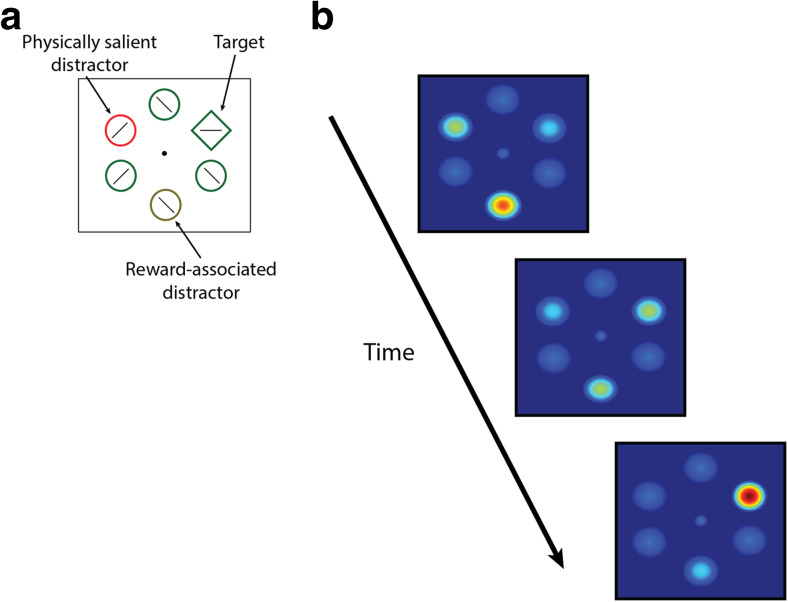
Visual attention enables us to selectively prioritize or suppress information in the environment. Prominent models concerned with the control of visual attention differentiate between goal-directed, top-down and stimulus-driven, bottom-up control, with the former determined by current selection goals and the latter determined by physical salience. In the current review, we discuss recent studies that demonstrate that attentional selection does not need to be the result of top-down or bottom-up processing but, instead, is often driven by lingering biases due to the "history" of former attention deployments. This review mainly focuses on reward-based history effects; yet other types of history effects such as (intertrial) priming, statistical learning and affective conditioning are also discussed. We argue that evidence from behavioral, eye-movement and neuroimaging studies supports the idea that selection history modulates the topographical landscape of spatial "priority" maps, such that attention is biased toward locations having the highest activation on this map.
Overview
CoChat Summary
TL;DR
This review argues that visual attention is shaped not only by top-down goals and bottom-up salience, but also by selection history—persistent biases from past attentional episodes. Reward is the main case reviewed, and the authors conclude that reward-associated stimuli can capture or be suppressed in ways that alter the priority map and influence both covert and overt attention.
Key findings
- The review argues that reward can bias attention beyond strategic control: previously reward-associated stimuli can disrupt performance even when they are non-salient, task-irrelevant, and when avoiding them would be better for reward.
- In intertrial reward priming, Hickey et al. (2010a) found that when participants received a high reward, they were quicker on the next trial if there was no swap between target- and distractor-associated colors, but slower if a swap occurred; with low reward, the pattern reversed.
- Della Libera & Chelazzi (2009) found that, in a training-test design separated by 5 days, distractor shapes associated with high reward as targets in training slowed later responses more than distractors associated with low reward as targets, while shapes associated with high reward as distractors sped later responses.
- The review notes neuroimaging evidence that reward history changes stimulus representation, including elevated activity in visual cortex and reward/attention areas such as basal ganglia, VMPFC, OSC, IPS, FEF, and SC; one cited fMRI study found that less suppression of a reward-associated distractor in OSC was linked to larger performance costs.
- The authors also report that reward can influence temporal attention: in Le Pelley et al. (2017), accuracy dropped significantly when an upright distractor signaled reward compared with when no reward was signaled or the distractor was absent.
Methods
- Narrative review of behavioral, eye-movement, electrophysiological, fMRI, PET, lesion, and pharmacological studies on attention, with emphasis on reward-based selection history and related history effects.
- The paper synthesizes studies using paradigms such as additional singleton search, spatial cueing, training-test designs, RSVP temporal attention, object-based cueing, and fear-conditioning/priming comparisons.
- Main analysis is qualitative/theoretical: the authors compare findings against top-down/bottom-up accounts and argue for a third category, selection history, integrated into a priority-map framework.
Limitations
- The paper explicitly says that several questions remain unresolved, including how reward-based selection history is reflected in the brain, how to model oculomotor effects, how suppression vs prioritization is determined, and how far effects generalize across contexts, tasks, and stimulus features.
- It also notes that many reward studies are hard to interpret because reward manipulations were often congruent with task demands, or because reward-associated stimuli were physically salient or otherwise not fully decoupled from top-down control; this is stated in the paper as a caveat.
- Evident from the text: this is a review, not a new empirical study, so its conclusions depend on the quality and comparability of the cited literature.
Model-written summary of a shortened version of the paper’s full text (it is longer than we read). Check it against the paper before relying on it.
Integrity signals
Registry
Cites
Statistics
Figures
Verification
Claims the paper makes
90 Valid · 7 Not valid · 60 Not checked · 111 Own results and interpretations
The cited sources support only part of this claim — read each source’s verdict below.
In the paper
“In particular, physical salience of a stimulus relative to its immediate surroundings determines how likely it is that this stimulus “grabs,” or captures, attention.”
§ Selection history: How reward modulates selectivity of visual attention > Top-down and bottom-up attentional control
What the sources say
- Not matchedcites Theeuwes, 1991a, 1992, 1994
A range of references, not one source.
- Supportedcites Itti & Koch, 2001 matched to “Computational modelling of visual attention” (2001) source
The Summary says a stimulus’s perceptual saliency depends critically on surrounding context. The opening discussion says conspicuous stimuli can attract attention automatically, and the Saliency section describes attention being drawn toward the most salient location. The paper also recognizes top-down influences, but the claim does not say physical salience is the only influence. (LLM, conf=0.92)
plainstates a cause- Asserted: passes — The authors put it forward as true.
- Checkable: passes — It can be checked against evidence.
- Load-bearing: unclear — It is unclear whether the paper’s conclusions depend on it.
- Based: passes — The paper gives a reason why it holds.
- Not matched
Every source the paper cites for this claim was checked and supports it.
In the paper
“The current review takes the previous paper of Awh et al. (2012) further and discusses recent findings of key behavioral, eye-movement, and neuroimaging studies that demonstrate effects that should be considered to be the result of selection history (i.e., lingering selection biases based on history).”
§ Selection history: How reward modulates selectivity of visual attention > Abstract
What the sources say
- Supportedcites Awh et al., 2012 matched to “Top-down versus bottom-up attentional control: a failed theoretical dichotomy” (2012) source
The citation identifies Awh et al. as the previous paper whose selection-history framework the citing review takes further. In the paper’s “Selection history” section, the authors argue that past selection can bias attention independently of current goals or physical salience. The citing authors’ description of the recent studies their own review discusses is not a finding attributed to Awh et al. (LLM, conf=0.91)
boostedstates a cause- Asserted: passes — The authors put it forward as true.
- Checkable: passes — It can be checked against evidence.
- Load-bearing: passes — The paper’s conclusions depend on it.
- Based: passes — The paper gives a reason why it holds.
- Supported
Every source the paper cites for this claim was checked and supports it.
In the paper
“More specifically, stronger task-set representations (measured as higher classification accuracy) in frontoparietal regions due to incentive reward predicted higher accuracy on the task (Etzel et al., 2015).”
§ Selection history: How reward modulates selectivity of visual attention > Attention and reward > Reward as a motivational incentive
What the sources say
- Supportedcites Etzel et al., 2015 matched to “Reward Motivation Enhances Task Coding in Frontoparietal Cortex” (2016) source
The Relationship with Behavioral Performance section reports that participants with larger incentive-related increases in frontoparietal task-classification accuracy also had larger increases in behavioral accuracy. Its mediation analysis found that the classification-accuracy difference significantly predicted the behavioral-performance difference. (LLM, conf=0.94)
plainstates an association- Asserted: passes — The authors put it forward as true.
- Checkable: passes — It can be checked against evidence.
- Load-bearing: passes — The paper’s conclusions depend on it.
- Based: passes — The paper gives a reason why it holds.
- Supported
Every source the paper cites for this claim was checked and supports it.
In the paper
“Importantly, electrophysiological recordings showed that the N2pc component was also modulated by reward magnitude. The N2pc was earlier and larger in response to high-reward targets compared to low-reward targets.”
§ Selection history: How reward modulates selectivity of visual attention > Attention and reward > Reward as a motivational incentive
What the sources say
- Supportedcites Kiss et al., 2009 matched to “Reward Priority of Visual Target Singletons Modulates Event-Related Potential Signatures of Attentional Selection” (2009) source
The Results (ERP data, N2pc section) report larger N2pc amplitudes for high- than low-reward targets and an earlier onset (187 versus 195 ms). The Results summary explicitly states that the N2pc emerged earlier and had a larger amplitude for high-reward targets. (LLM, conf=0.95)
plainstates an association- Asserted: passes — The authors put it forward as true.
- Checkable: passes — It can be checked against evidence.
- Load-bearing: passes — The paper’s conclusions depend on it.
- Based: passes — The paper gives a reason why it holds.
- Supported
The cited sources support only part of this claim — read each source’s verdict below.
In the paper
“Although initially only demonstrated when both sessions occurred on the same day, subsequent studies showed that such interference can be observed considerably longer—even up to 6 months after the training session (e.g., Anderson & Yantis, 2013).”
§ Selection history: How reward modulates selectivity of visual attention > Attention and reward > Reward history can counteract top-down processes
What the sources say
- Partly supportedcites Anderson & Yantis, 2013 matched to “Attentional bias for nondrug reward is magnified in addiction.” (2013) sourceExperimental — accuracy not yet measured
The Results > Test Phase reports attentional capture by previously reward-associated distractors, supporting the interference part of the claim. The Method > Attentional Capture Task describes training and test phases but does not report a six-month interval between them, so this source does not support the claimed duration. Page numbers are unavailable in our copy. (LLM, conf=0.83)
plainstates a cause- Asserted: passes — The authors put it forward as true.
- Checkable: passes — It can be checked against evidence.
- Load-bearing: passes — The paper’s conclusions depend on it.
- Based: passes — The paper gives a reason why it holds.
- Partly supported
159 more claims · 54 with their cited sources checked
Create a free account to see all 268 claims and to verify the 10 references still open.
- It may state two separate claims as one. 67
- Probably not a substantial claim. 44
- The quote only partly states this claim. 1
Citations
Cites
Control of goal-directed and stimulus-driven attention in the brain
Corbetta, M., & Shulman, G. L. (2002) · Nature Reviews Neuroscience · doi:10.1038/nrn755 · Cited by 12,881 · cited 2×
“…associated with the attentional network and believed to represent a form of priority map (e.g., Balan & Gottlieb, 2006; Bisley & Goldberg, 2010; Corbetta & Shulman, 2002; Gottlieb, Kusunoki, & Goldberg, 1998; Li, 2002; Mazer & Gallant, 2003), most notably area LIP/IPS, frontal eye field (FEF),…”
BackgroundA feature-integration theory of attention.
Treisman, A. M., & Gelade, G. (1980) · Cognitive Psychology · doi:10.1016/0010-0285(80)90005-5 · Cited by 12,366 · cited 1×
“This so-called top-down (also called endogenous or goaldirected) attentional control is thought to be volitional and under the control of the observer at any given point in time (Posner, 1980; Treisman & Gelade, 1980; Theeuwes, 2010; Wolfe, 2007; Yantis, 2000).”
BackgroundPosner, M. I. (1980) · Quarterly Journal of Experimental Psychology · doi:10.1080/00335558008248231 · Cited by 9,670 · cited 2×
“This so-called top-down (also called endogenous or goaldirected) attentional control is thought to be volitional and under the control of the observer at any given point in time (Posner, 1980; Treisman & Gelade, 1980; Theeuwes, 2010; Wolfe, 2007; Yantis, 2000).”
BackgroundNeural Mechanisms of Selective Visual Attention
Desimone, R., & Duncan, J. (1995) · Annual Review of Neuroscience · doi:10.1146/annurev.ne.18.030195.001205 · Cited by 8,388 · cited 3×
“At the heart of the priority map concept lies the idea that its activity profile determines the outcome of the brain’s intrinsically emergent property of competition for neural representation (Desimone, 1998; Desimone & Duncan, 1995).”
BackgroundCarver, C. S., & White, T. L. (1994) · Journal of Personality and Social Psychology · doi:10.1037/0022-3514.67.2.319 · Cited by 7,306 · cited 1×
“…responsiveness (Hickey & Peelen, 2015) as measured by the Barratt Impulsiveness scale (Patton, Stanford, & Barratt, 1995) and BIS/BAS questionnaire (Carver & White, 1994) have been associated with a larger effect of reward on attentional selection, although the contribution of each of these…”
MethodComputational modelling of visual attention
Itti, L., & Koch, C. (2001) · Nature Reviews Neuroscience · doi:10.1038/35058500 · Cited by 4,733 · cited 3×
“Influential theoretical as well as computational models on attentional control assume that all signals driving attention converge on a priority map in the brain (Bisley, 2011; Itti & Koch, 2001; Theeuwes, 2010; Wolfe, 2007; Zelinsky & Bisley, 2015).”
BackgroundA mechanism for cognitive dynamics: neuronal communication through neuronal coherence.
Fries, P. (2005) · Trends in Cognitive Sciences · doi:10.1016/j.tics.2005.08.011 · Cited by 4,284 · cited 1×
“Neuronal synchronization has been proposed as a key mechanism in communicating information from one brain area to another (Fries, 2005) and to play a vital role inmemory (Fell &Axmacher, 2011) as well as attention (Jensen, Gips, Bergmann, & Bonnefond, 2014).”
BackgroundWhat is the role of dopamine in reward: hedonic impact, reward learning, or incentive salience?
Berridge, K. C., & Robinson, T. E. (1998) · Brain Research Reviews · doi:10.1016/s0165-0173(98)00019-8 · Cited by 4,127
Attention and the detection of signals.
Posner, M. I., Snyder, C. R., & Davidson, B. J. (1980) · Journal of Experimental Psychology: General · doi:10.1037/0096-3445.109.2.160 · Cited by 3,778 · cited 2×
“Finding such costs and benefits is considered direct evidence for shifts of spatial attention (Posner & Cohen, 1984; Posner et al., 1980) precluding alternative explanations of interfer-”
BackgroundFears, phobias, and preparedness: toward an evolved module of fear and fear learning
Öhman, A., & Mineka, S. (2001) · Psychological Review · doi:10.1037/0033-295x.108.3.483 · Cited by 3,147 · cited 1×
“In short, there is strong evidence for what has been proposed by major theories on emotion processing (Mathews & Mackintosh, 1998; Öhman & Mineka, 2001): stimuli associated with negative valence have a mandatory and involuntary effect on the allocation of covert and overt attention, which cannot be…”
Background
Cited by
Items 301–362 of 362
The Impact of Statistical Regularities of Distractor Features on Attentional Selection
刘, 雅. (2024) · Advances in Psychology · doi:10.12677/ap.2024.144243
Oor, E. E., Salinas, E., & Stanford, T. R. (2025) · eLife · doi:10.1101/2024.05.29.596532 · Cited by 2
“…other cognitive functions such as working memory (Papadimitriou et al., 2015, 2017; Kuo, 2016; A krami et al., 2018; Boboeva et al., 2023), value assessment (Failing and Theeuwes, 2018; Constantinople et al., 2019), or task switching (Wylie and Allport, 2000; Monsell, 2003; Stoet and Snyder, 2007).”
InfluentialThe Neurocognitive Underpinnings of Social InfluencePreprint
Germar, M. (2024) · doi:10.31234/osf.io/nhpzw
Value-modulated attentional capture depends on explicit awarenessPreprint
Garre-Frutos, F., Lupiáñez, J., & Vadillo, M. A. (2024) · PsyArXiv (OSF Preprints) · doi:10.31234/osf.io/hpexf · Cited by 3
Huang, C., van Moorselaar, D., Foster, J. J., et al. (2024) · eLife · doi:10.7554/elife.98304.1.sa1
Self-citationeLife Assessment: Pinging the Hidden Attentional Priority Map: Suppression Needs Attention
Peelen, M. V. (2024) · eLife · doi:10.7554/elife.98304.1.sa3
Huang, C., van Moorselaar, D., Foster, J. J., et al. (2024) · eLife · doi:10.7554/elife.98304.1.sa0
Self-citationHuang, C., van Moorselaar, D., Foster, J. J., et al. (2024) · eLife · doi:10.7554/elife.98304.1.sa2
Self-citationPuntiroli, M., Perkovic, S., Bezençon, V., & Kocher, B. (2024) · PsyArXiv (OSF Preprints) · doi:10.31234/osf.io/kw7qr
Context-Dependent Modulations of Spatial Attention: A Simulated Driving TaskPreprint
Britt, N., Chau, J., & Sun, H. (2024) · Research Square · doi:10.21203/rs.3.rs-5010340/v1
The rise and fall of durable color-induced attentional bias
Kuo, C., Yeh, Y., & Chao, H.-F. (2024) · Attention Perception & Psychophysics · doi:10.3758/s13414-024-02946-y
Oor, E. E., Salinas, E., & Stanford, T. R. (2024) · eLife · doi:10.7554/elife.100280.1
A recurrent vision transformer shows signatures of primate visual attentionPreprint
Morgan, J., Albanna, B. F., & Herman, J. P. (2024) · bioRxiv (Cold Spring Harbor Laboratory) · doi:10.1101/2024.11.09.622721
“In biological systems, dopamine critically mediates plasticity, enabling more nuanced shaping of attentional priorities over extended time scales [88–90].”
Patil, M., Heinke, D. G., & Zhang, F. (2024) · Lecture notes in networks and systems · doi:10.1007/978-3-031-70687-5_10
Wasserman, T. H., & Wasserman, L. D. (2024) · Springer eBooks · doi:10.1007/978-3-031-78732-4_10
Attention and the Role of the Reward Recognition Network
Wasserman, T. H., & Wasserman, L. D. (2024) · Springer eBooks · doi:10.1007/978-3-031-78732-4_8
Pinging the Hidden Attentional Priority Map: Suppression Needs AttentionPreprint
Huang, C., van Moorselaar, D., Foster, J. J., Donk, M., & Theeuwes, J. (2025) · eLife · doi:10.7554/elife.98304.2 · Cited by 1
Self-citationDynamic modulation of spatial selection: Online and anticipatory adjustments in the flanker task
Villalonga, M. B., Noyce, A. L., & Sekuler, R. (2025) · Attention Perception & Psychophysics · doi:10.3758/s13414-025-03026-5
“…zoom lens account should include selection history and bias effects, particularly when considering reward-modulated fluctuations of selection, due to the strength of reward in attentional modulation (Anderson et al., 2021; Failing & Theeuwes, 2018; Frömer & Shenhav, 2022; Hassett & Hampton, 2022).”
Statistical learning re-shapes the center-surround inhibition of the visuo-spatial attentional focus
Massironi, A., Lega, C., Ronconi, L., & Bricolo, E. (2025) · Scientific Reports · doi:10.1038/s41598-025-91949-2
“Among such mechanisms, reward history 61–63 and statistical learning 64 have been extensively investigated.”
Cueing distractors is effective when the incentive to suppress is high
Heuer, A., & Schubö, A. (2025) · Attention Perception & Psychophysics · doi:10.3758/s13414-025-03075-w · Cited by 1
“For the visual domain, it has, for example, been shown to affect the deployment of attention (Anderson, 2016; Chelazzi et al., 2013; Failing & Theeuwes, 2017), the allocation of memory resources (e.g., Gong & Li, 2014; Heuer & Schubö, 2018; Klink et al., 2017; Thomas et al., 2016), and the…”
Oor, E. E., Salinas, E., & Stanford, T. R. (2025) · eLife · doi:10.7554/elife.100280.2
Zhou, X., Sun, Y., Zhang, Q., & Cui, F. (2025) · Attention Perception & Psychophysics · doi:10.3758/s13414-025-03099-2
“The interference signals on the priority map could be lessened by an efficient anticipatory control system, which would then stop the attentional processing of the prominent distractor (Failing & Theeuwes, 2018; Failing et al., 2019; Pinto et al., 2005; Wolfe, 2021).”
Attentional capture by Pavlovian signals of reward readily generalises across contextsPreprint
Collins, J., & Pearson, D. (2025) · PsyArXiv (OSF Preprints) · doi:10.31234/osf.io/ugy2j_v2
Qiu, N., Li, P., Li, Y., Li, K., Yan, H., Gan, X., Li, Y., Hu, L., Becker, B., & Yao, D. (2025) · medRxiv · doi:10.1101/2025.07.28.25332298
Reward value shapes the time course of self-bias
Jalalian, P., Golubickis, M., Sharma, Y., Kanakraj, R., Selvaraj, E. S., & Macrae, C. N. (2025) · Memory & Cognition · doi:10.3758/s13421-025-01763-4 · Cited by 2
“…of predicted outcomes (i.e., value-driven salience), such that items associated with increasingly positive or negative consequences attract greater attention, thereby facilitating task performance (e.g., faster response times; Anderson et al., 2011; Failing & Theeuwes, 2018; Kim et al., 2021).”
Zou, M., Wang, Y., Tang, Z., Li, Y., & Wang, Y. (2025) · Consciousness and Cognition · doi:10.1016/j.concog.2025.103933
Reward learning in obsessive-compulsive disorder: an attentional perspective
Basel, D., Asher, R., & Lazarov, A. (2025) · Motivation and Emotion · doi:10.1007/s11031-025-10167-5 · Cited by 2
“…finds the VMAC effect, namely, a heightened attentional capture by the high-reward cues relative to low-reward ones (Anderson et al., 2011; Failing & Theeuwes, 2017; Le Pelley et al., 2015), a phenomenon also known as reward-based selection history (Anderson, 2016; Failing & Theeuwes, 2018).”
InfluentialTransient other-perspective contextual cueing in a visuospatial perspective-taking task
Wang, N., Cai, J., Ning, Y., Deng, S., & Geng, H. (2025) · Acta Psychologica · doi:10.1016/j.actpsy.2025.105738
Associative learning of social interaction alters attention to human faces
Tan, Q., Zhang, X., Jia, K., & Gong, M. (2026) · iScience · doi:10.1016/j.isci.2026.117081
Implicit and explicit reversal of trained oculomotor movements
Michiels, M., Luque, D., & Obeso, I. (2025) · Neurobiology of Learning and Memory · doi:10.1016/j.nlm.2025.108114
Villard, S., Zipse, L., & Rohter, S. V. (2025) · Cambridge University Press eBooks · doi:10.1017/9781009202336.011
Language and Cognitive Plasticity and Processing
Andrews, E., & Kiran, S. (2025) · Cambridge University Press eBooks · doi:10.1017/9781009202336.007
Giannakou, I., Mallabone, J., Joseph, M., Jenkinson, N., & Punt, T. D. (2026) · Acta Psychologica · doi:10.1016/j.actpsy.2025.106186
Pupil dilation amplifies gaze bias in value-based choicePreprint
Chen, W. J., & Krajbich, I. M. (2026) · SSRN Electronic Journal · doi:10.2139/ssrn.6042937
Distraction driven by reward history: Attentional capture and sequential effects
Cesarei, A. D., Mastria, S., & Codispoti, M. (2026) · Attention Perception & Psychophysics · doi:10.3758/s13414-025-03167-7 · Cited by 1
“…of their bottom-up salience (e.g., abrupt onset) or of top-down factors (e.g., expectations), other stimuli are salient because of their history of selections or history of rewards, or because they signal the magnitude of a to-be-delivered reward (Awh et al., 2012; Failing & Theeuwes, 2017, 2018).”
The case for value as a common currency in decision-making and intersystem competition
Sripada, C. (2026) · Frontiers in Cognition · doi:10.3389/fcogn.2026.1767189 · Cited by 2
“…do in fact play wide-ranging roles across multiple areas of cognition, including attention allocation (Theeuwes et al., 2022; Anderson, 2019; Failing and Theeuwes, 2018; Anderson and Kim, 2018; Callaway et al., 2021), action selection (Dolan and Dayan, 2013), working memory ( D’Ardenne et…”
Carry-over effect of learned distractor suppression on visual working memory
George, N., & Patel, P. (2026) · Frontiers in Neuroscience · doi:10.3389/fnins.2026.1768751
“This eect is observed when regularity is associated with locations, features (Goschy et al., 2014; Failing and Theeuwes, 2018; Stilwell et al., 2019), and time (Zhao et al., 2013).”
Damasse, J.-B. (2018) · theses.fr (ABES) · doi:10.70675/193e9600zb9f9z4bcazb4c1z4369b97dce0c
Saccadic latencies depend on functional relations with the environment
Vullings, C. (2018) · theses.fr (ABES) · doi:10.70675/8ecbbf81zf4dez431fz9fe4zb7f337ae5224 · Cited by 1
“Another phenomenon has largely interested the community investigating target selection: the oculomotor and attentional capture of the eyes (see Failing & Theeuwes, 2018 for a recent review).”
BackgroundVicteur, Q. (2019) · theses.fr (ABES) · doi:10.70675/1c54b359zaba5z4438z99cdz4c9a4fa733f0 · Cited by 1
Moreira, A. J. F. (2021) · theses.fr (ABES) · doi:10.70675/eeb29b1fz5d56z436dz9b0dz51d1d927828f
Lomas, C. (2026) · Psychological Reports · doi:10.1177/00332941261450494
Value associations modulate visual attention and response selectionPreprint
Hübner, R., & Walle, A. (2021) · OSF Preprints (OSF Preprints)
Reward History and Multisensory Signals Interact in a Localisation Task
Sim, B., Kritikos, A., & Zeljko, M. (2026) · Quarterly Journal of Experimental Psychology · doi:10.1177/17470218261452613
Listeners do not tune in to more rewarding voices
Lim, S.-J., & Zi, L. (2026) · Attention Perception & Psychophysics · doi:10.3758/s13414-026-03276-x
“Reward facilitates goal-directed attention toward task-relevant stimuli, biasing attention to prioritize stimuli that were previously associated with rewards (e.g., Awh et al., 2012; Chelazzi et al., 2013; Failing & Theeuwes, 2018).”
Computational Method for Predicting Visual Attention in Older Adults with Age-Related Features
Li, X. C., Shi, X., Gu, H., et al. (2026) · Multimodal Technologies and Interaction · doi:10.3390/mti10060063
“While older observers exhibit stronger tendency towards central fixation, which is likely a compensatory strategy to reduce peripheral processing demands amid declining acuity [12], their realised attention patterns show greater instability and scatter.”
Peng, M., Huang, L., & Smith, D. M. (2026) · Journal of Retailing and Consumer Services · doi:10.1016/j.jretconser.2026.104917
T1.Faker (2025) · OSF Preprints (OSF Preprints)
Multisensory integration of stimulus-driven and goal-driven signals during urgent saccadic choicesPreprint
Paro, A., Sheikh, B. I., Stanford, T. R., & Salinas, E. (2026) · bioRxiv (Cold Spring Harbor Laboratory) · doi:10.64898/2026.06.18.733213
“The associated biases may be induced by past stimuli, past rewards, or past actions, for instance, or by specific combinations (Fecteau and Munoz, 2003; Awh et al., 2012; Failing and Theeuwes, 2018; Jiang and Sisk, 2019; Theeuwes, 2019; Anderson et al., 2021).”
Chen, S., Müller, H. J., & Shi, Z. (2026) · bioRxiv (Cold Spring Harbor Laboratory) · doi:10.64898/2026.06.24.733323
“…control to minimize capture, while unpredictable distractor events force greater reliance on reactive suppression (Chen et al., 2024; Chen et al., 2025; Failing & Theeuwes, 2018; Gaspar & McDonald, 2014; Gaspelin & Luck, 2018; Geng & Behrmann, 2005; Sauter et al., 2019; Zhang et al., 2019, 2022).”
How visual attention underpins reading: Converging evidence from a meta-analysis of fMRI studies
Gao, Y., Zhu, B., & Zhou, W. (2026) · NeuroImage · doi:10.1016/j.neuroimage.2026.122114
Rogozińska‐Pawełczyk, A. (2026) · Journal of Organizational Change Management · doi:10.1108/jocm-10-2025-0929
Training variability facilitates the flexibility of goal-specific spatial probability learning
Pei, Y., Xu, J., Zhang, K., Yu, Q., Qian, J., & Ren, Y. (2026) · Psychological Research · doi:10.1007/s00426-026-02351-0
Guidance of attention by statistical learning when multiple guidance mechanisms compete
Becker, M. W., Dodd, M., & Janisse, T. (2026) · Attention Perception & Psychophysics · doi:10.3758/s13414-026-03313-9
“…effects are results demonstrating that attention is biased toward features that have been associated with high reward (Anderson, 2013, 2016; Failing & Theeuwes, 2018), toward locations that are likely to contain targets (Chun & Jiang, 1998; Geng & Behrmann, 2005; Jiang, Swallow, Rosenbaum,…”
Bailey, R. L., Park, S. Y., Ichplani, P., & Lee, S. (2026) · Nutrients · doi:10.3390/nu18162620
“Contemporary models therefore conceptualize selective attention as emerging from the interaction of both controlled top-down processes and more automatic bottom-up and learned attentional biases, e.g., [20,42,43].”
InfluentialTomasek, M., Dunster, B., Goverts, Z., Naceur, D., Dufour, V., & Jordan, A. L. (2026) · Proceedings of the National Academy of Sciences · doi:10.1073/pnas.2620602123
The effect of choice and reward on motivation and performance: an eye-tracking study
Hendijani, R., & Steel, P. (2026) · Frontiers in Psychology · doi:10.3389/fpsyg.2026.1905792
“Rewards, especially performance-contingent ones shift the individuals’ attention toward the reward-related stimuli (Chelazzi et al., 2013; Failing and Theeuwes, 2018; Hickey et al., 2010; St˘ani¸sor et al., 2013).”
Shared generalization and dissociable specificity in selection history-driven attentionPreprint
Ouyang, S., Tan, Q., Jia, K., & Gong, M. (2026) · SSRN Electronic Journal · doi:10.2139/ssrn.7506152
Stress reduces loss aversion without increasing reward-cue attentional salience
Tommaso, M. D., Coelli, S., Reali, P., Bianchi, A. M., & Actis-Grosso, R. (2026) · Motivation and Emotion · doi:10.1007/s11031-026-10286-7
Learning to avoid looking: Competing influences of reward on overt attentional selectionPreprint
Pelley, M. E. L., & Pearson, D. (2019) · OSF Preprints (OSF Preprints)
Metadata
- Authors
- Failing, M., & Theeuwes, J.
- Affiliations
- Vrije Universiteit Amsterdam (NL)
- Corresponding author
- Failing, Michel
- Venue
- Psychonomic Bulletin & Review
- Published
- 2017-10-04
- Volume
- 25
- Issue
- 2
- Pages
- 514-538
- ISSN
- 1069-9384 (ISSN-L)
- 1531-5320
- PMC
- PMC5902518
- OpenAlex
- W2761527597
- Semantic Scholar
- a3bcd5ff4e9b5617868b47add59b9f91ac9298c9
- Cited by
- 345
- References
- 251
- Citations by year
- 2026: 26 · 2025: 43 · 2024: 43 · 2023: 36 · 2022: 33 · 2021: 49 · 2020: 53 · 2019: 39 · 2018: 21 · 2017: 2
- FWCI
- 1.77
- Type
- journal article
- Language
- en
- Open access
- hybrid
- doi.org
- Licence
- cc-by
- creativecommons.org/licenses/by/4.0 (tdm)
- creativecommons.org/licenses/by/4.0 (vor)
- Locations
- Psychonomic Bulletin & Review (publishedVersion, cc-by)
- Europe PMC (PubMed Central) (publishedVersion, other-oa)
- PubMed Central (publishedVersion, cc-by)
- PubMed (publishedVersion)
- VU Research Portal (submittedVersion, other-oa)
- Data Archiving and Networked Services (DANS) (submittedVersion, other-oa)
- Funders
- H2020 European Research Council (ERC-2012-AdG-323413)
- Topics
- Physical Sciences › Computer Science › Computer Vision and Pattern Recognition › Visual Attention and Saliency Detection
- Life Sciences › Neuroscience › Cognitive Neuroscience › Visual perception and processing mechanisms
- Life Sciences › Neuroscience › Cognitive Neuroscience › Neural and Behavioral Psychology Studies
- Keywords
- visual attention, selective attention, selection history, reward, top-down control, bottom-up control, attentional bias, priority map, statistical learning, affective conditioning, eye movements
- MeSH terms
- Attention, Eye Movements, Humans, Learning, Motivation, Reward, Visual Perception, Neuroimaging
About these checks
Registry, retraction, Cites and statistics results are computed, not judged, with one exception: a printed reference that no index lists is read once by a model before it counts as a citation error. Claims are extracted by a model and kept only when their quote appears verbatim in the text; each cited source is then checked, with a model’s help, for whether it says what the claim relies on. Those verdicts can be wrong — read the claim’s quote and the cited source before relying on one.
The claim verdicts this report counts are experimental: their accuracy is not yet measured.
A language model drew the claims from the paper on 2026-10-11, under version 3 of the claim definition (model deepseek-v4.1-flash, prompt extract-v3).
A second model labelled each claim on 2026-10-11 (model jev-1.13-20260917, definition revision gold-guideline-v0.2).
Cited sources are checked with a language model’s help (gpt-6-sol).
Statistics and arithmetic are recomputed, not judged.
Confidence bands are shown only for fields calibrated on our annotated test set. None is calibrated yet, so no band is shown.
What counts as a claim ›How we measure confidence ›How we check this ›
Are you an author, or do you see a problem with this page? Request a review
Data sources
Bibliographic data: Semantic Scholar, OpenAlex, Crossref.
Contains information from the Semantic Scholar Academic Graph Datasets, made available under the ODC Attribution License (ODC-BY 1.0).
Semantic Scholar’s data is described in: Kinney, R., et al. (2023). The Semantic Scholar Open Data Platform. arXiv:2301.10140.
