

Mind wandering during first- and foreign-language reading
Open accessThe DOI matches its Crossref record; 61 of the 61 references it cites were found in a registry or an index; none of the 57 sources its claims cite is checked for support yet.
Abstract
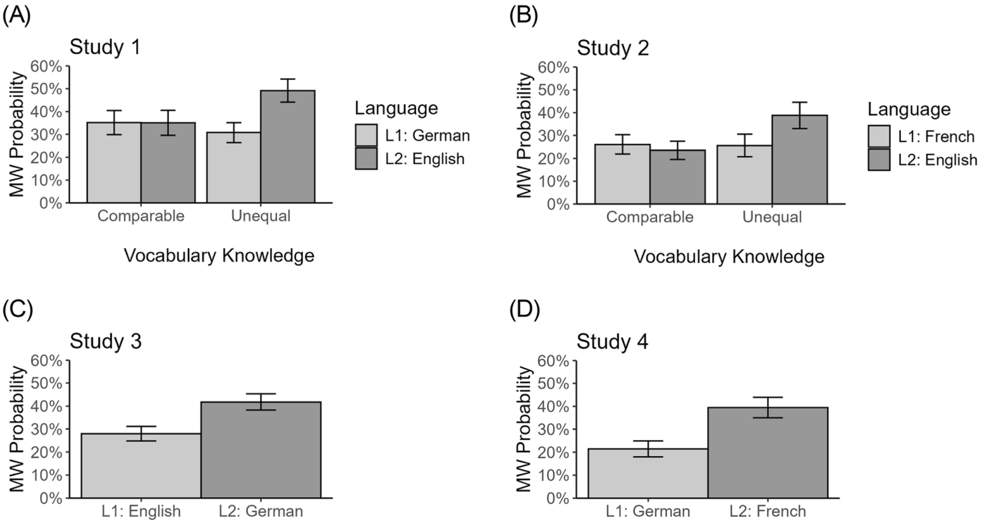
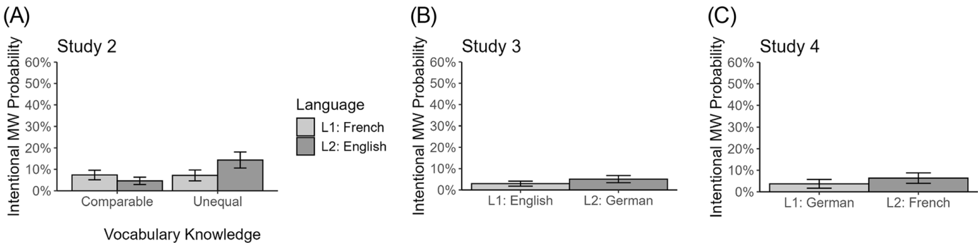
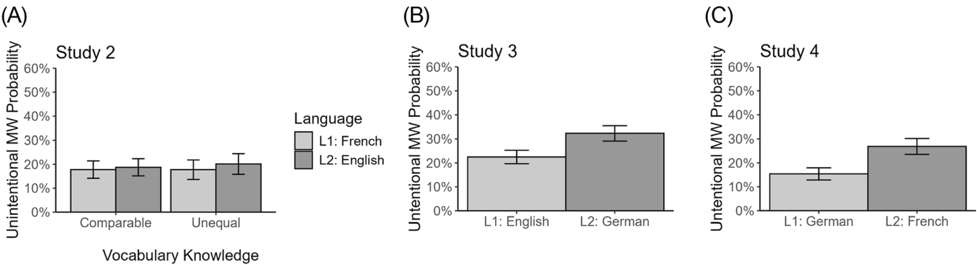
This research investigated whether individual differences in vocabulary knowledge influence mind wandering during first language (L1) and foreign language (L2) reading. In four independent studies involving different L1 and L2 pairings – German and English (Study 1), French and English (Study 2), English and German (Study 3), and German and French (Study 4) – participants completed measures of mind-wandering frequency, perceived reading difficulty, and comprehension. Studies 2–4 additionally assessed the intentionality of mind wandering. Across all studies, participants with lower vocabulary knowledge in their L2 compared to L1 showed higher frequencies of mind wandering during L2 compared to L1 reading. Studies 1 and 2 additionally included participants with comparable L1/L2 vocabulary knowledge and found no significant L1–L2 differences in mind wandering. Consistent with previous research, our findings suggest that the intentionality of mind wandering is sensitive to task demands. When L2 vocabulary knowledge impaired comprehension on the textbase and situation model levels, participants showed increased unintentional but not intentional mind wandering in L2 compared to L1 (Studies 3 and 4). Under these conditions, task demands likely exceeded available executive-control resources, allowing automatic and unintentional task-unrelated thoughts to intrude. In contrast, when L2 vocabulary supported comprehension at least on the textbase level (Studies 1 and 2), metacognitive evaluations became more influential. Specifically, participants showed more intentional but not unintentional mind wandering in L2 compared to L1, and perceived difficulty mediated the relationship between L2 vocabulary knowledge and mind wandering. Here, participants likely disengaged deliberately when the cognitive costs of L2 reading outweighed its perceived benefits.
Overview
CoChat Summary
TL;DR
Across four studies with different L1/L2 pairings, readers with lower L2 than L1 vocabulary knowledge mind-wandered more in L2 than L1, while those with comparable L1/L2 vocabulary showed no significant difference. The effect was linked to perceived difficulty in Studies 1–2 and to unintentional mind wandering in Studies 3–4, suggesting both executive-control failure and metacognitive disengagement mechanisms.
Key findings
- In all four studies, participants with unequal L1/L2 vocabulary knowledge showed more overall mind wandering in L2 than L1: Study 1 OR = 2.17, p = .001; Study 2 OR = 1.84, p = .022; Study 3 OR = 1.85; Study 4 OR = 2.39. Participants with comparable L1/L2 vocabulary knowledge showed no significant L1–L2 difference (Study 1 OR = 1.00, p = .988; Study 2 OR = 0.87, p = .605).
- Intentional vs. unintentional mind wandering differed by study: Study 2 found more intentional mind wandering in L2 than L1 among unequal-vocabulary participants (OR = 2.17, p = .035), but intentional mind wandering did not significantly differ by language in Studies 3 (OR = 1.75) and 4 (OR = 1.76). Studies 3 and 4 found more unintentional mind wandering in L2 than L1 (OR = 1.64 and 2.02, respectively).
- Perceived reading difficulty mediated the L2-vocabulary effect on mind wandering in Studies 1 and 2 (Study 1 indirect = −0.16, p = .010; Study 2 indirect = −0.25, p = .002), but not in Studies 3 and 4 (indirect p = .750 and .280).
- Comprehension was impaired in L2 for unequal-vocabulary participants in Study 1 at the situation-model level (L1 M = 1.56 vs. L2 M = 0.87, p < .001; interaction d = 0.94) and in Studies 3 and 4 at both textbase and situation-model levels (Study 3 d = 0.59 and 0.60; Study 4 d = 0.80 and 0.65). Mind wandering negatively correlated with situation-model comprehension in all studies (r = −.19, −.34, −.19, −.31).
Methods
- Four independent studies used a 2 (between: comparable vs. unequal L1/L2 vocabulary knowledge) × 2 (within: L1 vs. L2) mixed design with L1/L2 pairings German–English (Study 1), French–English (Study 2), English–German (Study 3), and German–French (Study 4). Final samples: Study 1 N = 72 (31 comparable, 41 unequal), Study 2 N = 72 (42 comparable, 30 unequal), Study 3 N = 61 (unequal only; 9 comparable excluded from analysis), Study 4 N = 66 (unequal only; 4 comparable excluded from analysis).
- Participants read two texts sentence-by-sentence in a self-paced moving-window procedure; mind-wandering probes occurred at predetermined target sentences four times per reading in each language, and Studies 2–4 additionally asked whether mind wandering was intentional or unintentional. Vocabulary knowledge was assessed with LexTale; comprehension was assessed with recognition items yielding textbase and situation-model scores.
- Analyses used generalized mixed-effects models (logit link) for overall, intentional, and unintentional mind wandering and linear mixed-effects models for comprehension, with vocabulary balance, language, and their interaction as fixed effects; mediation analyses used a quasi-Bayesian Monte Carlo method with 10,000 simulations.
Limitations
- The paper states that vocabulary knowledge was used as a proxy for language proficiency and that a more comprehensive assessment including reading, listening, speaking, and writing would better capture communicative competence.
- The paper states that LexTale versions are not directly comparable across languages, so the thresholds for “comparable” vs. “unequal” vocabulary knowledge should not be interpreted as precise indicators of balanced proficiency.
- The paper states that comprehension was assessed with a recognition-based method, and future research could complement it with recall tasks or essays; the text also makes evident that Studies 3 and 4 had very few comparable-vocabulary participants (n = 9 and n = 4), so analyses were restricted to the unequal-vocabulary subgroup.
Model-written summary. Check it against the paper before relying on it.
Integrity signals
Registry
Cites
Statistics
Figures

Verification
Claims the paper makes
0 Valid · 1 Not valid · 34 Not checked · 77 Own results and interpretations
A result the paper reports from its own data — it cites no other source for it, so there is none to check. The quote shows it is in the paper.
In the paper
“Studies 1 and 2 additionally included participants with comparable L1/L2 vocabulary knowledge and found no significant L1–L2 differences in mind wandering.”
§ Mind wandering during first- and foreign-language reading > Abstract
plainn = 2- Asserted: passes — The authors put it forward as true.
- Checkable: passes — It can be checked against evidence.
- Load-bearing: passes — The paper’s conclusions depend on it.
- Based: passes — The paper gives a reason why it holds.
A result the paper states — it cites no source for it, so there is none to check. The quote shows it is in the paper.
In the paper
“perceived difficulty mediated the relationship between L2 vocabulary knowledge and mind wandering”
§ Mind wandering during first- and foreign-language reading > Abstract
plainstates a cause- Asserted: passes — The authors put it forward as true.
- Checkable: passes — It can be checked against evidence.
- Load-bearing: passes — The paper’s conclusions depend on it.
- Based: passes — The paper gives a reason why it holds.
- Rests on 2 assumptions not shown here.
A result the paper reports from its own data — it cites no other source for it, so there is none to check. The quote shows it is in the paper.
In the paper
“Across all studies, participants with lower vocabulary knowledge in their L2 compared to L1 showed higher frequencies of mind wandering during L2 compared to L1 reading.”
§ Mind wandering during first- and foreign-language reading > Abstract
plainstates an association- Asserted: passes — The authors put it forward as true.
- Checkable: passes — It can be checked against evidence.
- Load-bearing: passes — The paper’s conclusions depend on it.
- Based: passes — The paper gives a reason why it holds.
A result the paper states — it cites no source for it, so there is none to check. The quote shows it is in the paper.
In the paper
“When L2 vocabulary knowledge impaired comprehension on the textbase and situation model levels, participants showed increased unintentional but not intentional mind wandering in L2 compared to L1 (Studies 3 and 4).”
§ Mind wandering during first- and foreign-language reading > Abstract
plainstates a causen = 2- Asserted: passes — The authors put it forward as true.
- Checkable: passes — It can be checked against evidence.
- Load-bearing: passes — The paper’s conclusions depend on it.
- Based: passes — The paper gives a reason why it holds.
A result the paper reports from its own data — it cites no other source for it, so there is none to check. The quote shows it is in the paper.
In the paper
“and the direct effect of vocabulary knowledge was also significant.”
§ Mind wandering during first- and foreign-language reading > Results > Perceived reading difficulty as a mediator for the effect of L2 vocabulary knowledge on mind wandering
plainstates a cause- Asserted: passes — The authors put it forward as true.
- Checkable: passes — It can be checked against evidence.
- Load-bearing: passes — The paper’s conclusions depend on it.
- Based: passes — The paper gives a reason why it holds.
61 more claims
Create a free account to see all 112 claims and to verify the 52 references still open.
- It may state two separate claims as one. 21
- Probably not a substantial claim. 33
Statistics recomputed
Every reported test result, recomputed from its test statistic and degrees of freedom. A result shows as not adding up only once an independent check has confirmed it.
- Not confirmedz = 2.96reported p = .001 · recomputed p = .003
“z = 2.96, p = .001”
- Not confirmedz = 1.83reported p = .035 · recomputed p = .067
“z = 1.83, p = .035”
- Consistentz = -0.02reported p = .988 · recomputed p = .984
“z = −0.02, p = .988”
- Consistentz = 2.02reported p = .022 · recomputed p = .043
“z = 2.02, p = .022”
The paper states a one-tailed test
- Consistentz = -0.52reported p = .605 · recomputed p = .603
“z = −0.52, p = .605”
3 more recomputed tests
Create a free account to see every test the Stats check recomputed.
Self-check
Percentages, sums and reported differences re-computed from the paper’s own numbers.
Self-check results appear here once an independent check has confirmed them.
Citations
Cites
Fitting Linear Mixed-Effects Models Using lme4
Bates, D., Mächler, M., Bolker, B., & Walker, S. (2015) · Journal of Statistical Software · doi:10.18637/jss.v067.i01 · Cited by 86,835
Faul, F., Erdfelder, E., Lang, A.-G., & Buchner, A. (2007) · Behavior Research Methods · doi:10.3758/bf03193146 · Cited by 65,971
lmerTest Package: Tests in Linear Mixed Effects Models
Kuznetsova, A., Brockhoff, P. B., & Christensen, R. H. B. (2017) · Journal of Statistical Software · doi:10.18637/jss.v082.i13 · Cited by 24,346
ggplot2: Elegant Graphics for Data Analysis
Wickham, H. (2009) · doi:10.1007/978-0-387-98141-3 · Cited by 14,447
Random effects structure for confirmatory hypothesis testing: Keep it maximal
Barr, D. J., Levy, R., Scheepers, C., & Tily, H. J. (2013) · Journal of Memory and Language · doi:10.1016/j.jml.2012.11.001 · Cited by 10,328 · cited 2×
“Additionally, we included by-subject random slopes for the within-subjects fixed-effect language to account for random variation in the repeated measure (Barr et al., 2013; Linck & Cunnings, 2015).”
Mixed-effects modeling with crossed random effects for subjects and items
Baayen, R. H., Davidson, D. J., & Bates, D. M. (2008) · Journal of Memory and Language · doi:10.1016/j.jml.2007.12.005 · Cited by 8,540
Flesch, R. (1948) · Journal of Applied Psychology · doi:10.1037/h0057532 · Cited by 5,391 · cited 2×
“Readability scores were determined with the Flesch Reading Ease Index (Flesch, 1948) for the English texts (therapy text: 30, science text: 34), with the German adaptation of the Flesch Reading Ease Index (Amstad, 1978) for the German texts (therapy text: 29, science text: 33), and with the French…”
Least-Squares Means: The R Package lsmeans
Lenth, R. V. (2016) · Journal of Statistical Software · doi:10.18637/jss.v069.i01 · Cited by 5,075
mediation:R Package for Causal Mediation Analysis
Tingley, D., Yamamoto, T., Hirose, K., Keele, L., & Imai, K. (2014) · Journal of Statistical Software · doi:10.18637/jss.v059.i05 · Cited by 4,155
Working memory span tasks: A methodological review and user’s guide
Conway, A. R. A., Kane, M. J., Bunting, M. F., Hambrick, D. Z., Wilhelm, O., & Engle, R. W. (2005) · Psychonomic Bulletin & Review · doi:10.3758/bf03196772 · Cited by 2,882
Situation models in language comprehension and memory
Zwaan, R. A., & Radvansky, G. A. (1998) · Psychological Bulletin · doi:10.1037/0033-2909.123.2.162 · Cited by 2,877
Reading Ability: Lexical Quality to Comprehension
Perfetti, C. (2007) · Scientific Studies of Reading · doi:10.1080/10888430701530730 · Cited by 2,095
Smallwood, J., & Schooler, J. W. (2006) · Psychological Bulletin · doi:10.1037/0033-2909.132.6.946 · Cited by 2,067
Marian, V., Blumenfeld, H. K., & Kaushanskaya, M. (2007) · Journal of Speech, Language, and Hearing Research · doi:10.1044/1092-4388(2007/067 · Cited by 1,991
An opportunity cost model of subjective effort and task performance
Kurzban, R., Duckworth, A., Kable, J. W., & Myers, J. (2013) · Behavioral and Brain Sciences · doi:10.1017/s0140525x12003196 · Cited by 1,381 · cited 3×
“Participants perceived L2 reading as more effortful, reducing the value of continued engagement and promoting intentional disengagement, which is consistent with the cost–benefit account (Kurzban et al., 2013; Shenhav et al., 2017).”
Introducing LexTALE: A quick and valid Lexical Test for Advanced Learners of English
Lemhöfer, K., & Broersma, M. (2012) · Behavior Research Methods · doi:10.3758/s13428-011-0146-0 · Cited by 1,338 · cited 3×
“…background and vocabulary knowledge were assessed with a language history questionnaire based on the Language Experience and Proficiency Questionnaire (LEAP-Q; Marian et al., 2007), and the lexical decision based LexTale in English, German (Lemhöfer & Broersma, 2012), and French (Brysbaert, 2013).”
Toward a rational and mechanistic account of mental effort
Shenhav, A., Musslick, S., Lieder, F., Kool, W., Griffiths, T. L., Cohen, J. D., & Botvinick, M. M. (2017) · Annual Review of Neuroscience · doi:10.1146/annurev-neuro-072116-031526 · Cited by 1,077
An MTurk Crisis? Shifts in Data Quality and the Impact on Study Results
Chmielewski, M., & Kucker, S. C. (2020) · Social Psychological and Personality Science · doi:10.1177/1948550619875149 · Cited by 1,027 · cited 1×
“…criteria: Participants were excluded if they failed instructed response questions, which served as an attention check (Kennedy et al., 2020), or they provided inconsistent information between their birth year at the start of the study and their age later in the study (Chmielewski & Kucker, 2020).”
McVay, J. C., & Kane, M. J. (2012) · Journal of Experimental Psychology: General · doi:10.1037/a0025250 · Cited by 562 · cited 3×
“One possibility is that the increased cognitive load during L2 reading exceeds available exec-utive-control resources (Kane & McVay, 2012; McVay & Kane, 2012), making it more difficult to maintain task focus and thereby allowing task-unrelated thoughts to intrude (i.e., unintentional mind…”
How many words do we read per minute? A review and meta-analysis of reading rate
Brysbaert, M. (2019) · Journal of Memory and Language · doi:10.1016/j.jml.2019.104047 · Cited by 553
The shape of and solutions to the MTurk quality crisis
Kennedy, R., Clifford, S., Burleigh, T., Waggoner, P. D., Jewell, R., & Winter, N. J. G. (2020) · Political Science Research and Methods · doi:10.1017/psrm.2020.6 · Cited by 506 · cited 1×
“…the following exclusion criteria: Participants were excluded if they failed instructed response questions, which served as an attention check (Kennedy et al., 2020), or they provided inconsistent information between their birth year at the start of the study and their age later in the study…”
Working memory capacity — facets of a cognitive ability construct
Oberauer, K., Süß, H.-M., Schulze, R., Wilhelm, O., & Wittmann, W. W. (2000) · Personality and Individual Differences · doi:10.1016/s0191-8869(99)00251-2 · Cited by 497
L2 Reading Comprehension and Its Correlates: A Meta‐Analysis
Jeon, E. H., & Yamashita, J. (2014) · Language Learning · doi:10.1111/lang.12034 · Cited by 484
When attention matters: The curious incident of the wandering mind
Smallwood, J., McSpadden, M., & Schooler, J. W. (2008) · Memory & Cognition · doi:10.3758/mc.36.6.1144 · Cited by 458
Interrupting the “stream of consciousness”: An fMRI investigation
McKiernan, K. A., D'Angelo, B. R., Kaufman, J. N., & Binder, J. R. (2006) · NeuroImage · doi:10.1016/j.neuroimage.2005.09.030 · Cited by 443
Mrazek, M. D., Phillips, D. T., Franklin, M. S., Broadway, J. M., & Schooler, J. W. (2013) · Frontiers in Psychology · doi:10.3389/fpsyg.2013.00560 · Cited by 400 · cited 1×
“Finally, participants’ L1 and L2 language proficiency and trait-based mind wandering were assessed (Mrazek et al., 2013).”
On the Necessity of Distinguishing Between Unintentional and Intentional Mind Wandering
Seli, P., Risko, E. F., & Smilek, D. (2016) · Psychological Science · doi:10.1177/0956797616634068 · Cited by 349
Unsworth, N., & McMillan, B. D. (2013) · Journal of Experimental Psychology: Learning, Memory, and Cognition · doi:10.1037/a0029669 · Cited by 335 · cited 1×
“Afterwards, they rated their interest in the topic (scale adapted from Soemer & Schiefele, 2019) and motivation (scale adapted from Unsworth & McMillan, 2013).”
Schmalhofer, F., & Glavanov, D. (1986) · Journal of Memory and Language · doi:10.1016/0749-596x(86)90002-1 · Cited by 291
The Utility and Application of Mixed‐Effects Models in Second Language Research
Linck, J. A., & Cunnings, I. (2015) · Language Learning · doi:10.1111/lang.12117 · Cited by 283
What Mind Wandering Reveals About Executive-Control Abilities and Failures
Kane, M. J., & McVay, J. C. (2012) · Current Directions in Psychological Science · doi:10.1177/0963721412454875 · Cited by 261
Mind wandering while reading easy and difficult texts
Feng, S., D’Mello, S., & Graesser, A. C. (2013) · Psychonomic Bulletin & Review · doi:10.3758/s13423-012-0367-y · Cited by 257 · cited 4×
“Contrary to the executive resource hypothesis, several studies suggest that difficult texts are more prone to inducing mind wandering (Feng et al. 2013; Kahmann et al., 2022; Mills et al., 2015; Soemer & Schiefele, 2019).”
InfluentialHarnessing the wandering mind: The role of perceptual load
Forster, S., & Lavie, N. (2009) · Cognition · doi:10.1016/j.cognition.2009.02.006 · Cited by 251
Diependaele, K., Lemhöfer, K., & Brysbaert, M. (2013) · Quarterly Journal of Experimental Psychology · doi:10.1080/17470218.2012.720994 · Cited by 203
Individual differences in visual word recognition: Insights from the English Lexicon Project.
Yap, M. J., Balota, D. A., Sibley, D. E., & Ratcliff, R. (2012) · Journal of Experimental Psychology: Human Perception and Performance · doi:10.1037/a0024177 · Cited by 199
The influence of language proficiency and comprehension skill on situation‐model construction
Zwaan, R. A., & Brown, C. M. (1996) · Discourse Processes · doi:10.1080/01638539609544960 · Cited by 173
Children’s inference generation: The role of vocabulary and working memory
Currie, N. K., & Cain, K. (2015) · Journal of Experimental Child Psychology · doi:10.1016/j.jecp.2015.03.005 · Cited by 173
Text Belief Consistency Effects in the Comprehension of Multiple Texts With Conflicting Information
Abendroth, J., & Richter, T. (2013) · Cognition and Instruction · doi:10.1080/07370008.2013.769997 · Cited by 170
Self-citation(1992) · The Journal of Reading · Cited by 166
Lextale_FR A Fast, Free, and Efficient Test to Measure Language Proficiency in French
Brysbaert, M. (2013) · Psychologica Belgica · doi:10.5334/pb-53-1-23 · Cited by 162
Cognitive and contextual correlates of spontaneous and deliberate mind-wandering.
Robison, M. K., & Unsworth, N. (2018) · Journal of Experimental Psychology Learning Memory and Cognition · doi:10.1037/xlm0000444 · Cited by 159
Text difficulty, topic interest, and mind wandering during reading
Soemer, A., & Schiefele, U. (2019) · Learning and Instruction · doi:10.1016/j.learninstruc.2018.12.006 · Cited by 102 · cited 5×
“Afterwards, they rated their interest in the topic (scale adapted from Soemer & Schiefele, 2019) and motivation (scale adapted from Unsworth & McMillan, 2013).”
InfluentialReceptive vocabulary size and its relationship to EFL language skills
Miralpeix, I., & Muñoz, C. (2018) · International Review of Applied Linguistics in Language Teaching · doi:10.1515/iral-2017-0016 · Cited by 99
The relationship between mind wandering and reading comprehension: A meta-analysis
Bonifacci, P., Viroli, C., Vassura, C., Colombini, E., & Desideri, L. (2023) · Psychonomic Bulletin & Review · doi:10.3758/s13423-022-02141-w · Cited by 83
Interest-based text preference moderates the effect of text difficulty on engagement and learning
Fulmer, S. M., D'Mello, S. K., Strain, A., & Graesser, A. C. (2015) · Contemporary Educational Psychology · doi:10.1016/j.cedpsych.2014.12.005 · Cited by 83
Correll, J., Mellinger, C., & Pedersen, E. J. (2021) · Behavior Research Methods · doi:10.3758/s13428-021-01687-2 · Cited by 72
Ju, Y.-J., & Lien, Y.-W. (2018) · Consciousness and Cognition · doi:10.1016/j.concog.2018.06.006 · Cited by 52 · cited 1×
“…that intentional mind wandering is more frequent during less demanding tasks, whereas unintentional mind wandering is more frequent during cognitively demanding tasks and is often associated with lower working-memory capacity (Barrington & Miller, 2023; Ju & Lien, 2018; Robison & Unsworth, 2018).”
D'Mello, S. K., & Mills, C. S. (2021) · Language and Linguistics Compass · doi:10.1111/lnc3.12412 · Cited by 45
The composite complex span: French validation of a short working memory task
Gonthier, C., Thomassin, N., & Roulin, J. (2015) · Behavior Research Methods · doi:10.3758/s13428-015-0566-3 · Cited by 43
Wong, A. Y., Smith, S. L., McGrath, C. A., Flynn, L. E., & Mills, C. (2022) · Contemporary Educational Psychology · doi:10.1016/j.cedpsych.2022.102098 · Cited by 42
Allocation of Limited Cognitive Resources During Text Comprehension in a Second Language
Morishima, Y. (2013) · Discourse Processes · doi:10.1080/0163853x.2013.846964 · Cited by 41
Mills, C., D'Mello, S. K., & Kopp, K. (2015) · Learning and Instruction · doi:10.1016/j.learninstruc.2015.07.003 · Cited by 37
Working memory capacity and (in)voluntary mind wandering
Soemer, A., & Schiefele, U. (2020) · Psychonomic Bulletin & Review · doi:10.3758/s13423-020-01737-4 · Cited by 37
Mind wandering increases linearly with text difficulty
Kahmann, R., Ozuer, Y., Zedelius, C. M., & Bijleveld, E. (2022) · Psychological Research · doi:10.1007/s00426-021-01483-9 · Cited by 32 · cited 3×
“Contrary to the executive resource hypothesis, several studies suggest that difficult texts are more prone to inducing mind wandering (Feng et al. 2013; Kahmann et al., 2022; Mills et al., 2015; Soemer & Schiefele, 2019).”
On the relation between reading difficulty and mind-wandering: a section-length account
Forrin, N. D., Risko, E. F., & Smilek, D. (2019) · Psychological Research · doi:10.1007/s00426-017-0936-9 · Cited by 31
TL;DR: Longer Sections of Text Increase Rates of Unintentional Mind-Wandering
Forrin, N. D., Mills, C., D’Mello, S. K., Risko, E. F., Smilek, D., & Seli, P. (2021) · The Journal of Experimental Education · doi:10.1080/00220973.2020.1751578 · Cited by 21
Barrington, M., Miller, L. M., & Roodenrys, S. (2022) · Psychology of Consciousness Theory Research and Practice · doi:10.1037/cns0000356 · Cited by 20
Abendroth, J., Richter, T., Nauroth, P., & Gollwitzer, M. (2017) · Journal of Research in Reading · doi:10.1111/1467-9817.12132 · Cited by 19
Self-citationMetacognitive training can reduce mindless reading.
Klimovich, M., & Richter, T. (2024) · Journal of Educational Psychology · doi:10.1037/edu0000884 · Cited by 7
Self-citationMcCarthy, K. S., Kopp, K. J., Allen, L. K., & McNamara, D. S. (2018) · Routledge eBooks · doi:10.4324/9780429439957-7 · Cited by 5
(2003)
Research works printed but not linked: 3
- Amstad, T. (1978). Wie verständlich sind unsere Zeitungen? [How understandable are our newspapers?]. Unpublished doctoral dissertation, University of Zürich, Switzerland.
- Kandel, L., & Moles, A. (1958). Application de l’indice de Flesch à la langue française [Application of the Flesch index to the French language]. Cahiers Études de Radio-Télévision, 19, 253–274.
- van Dijk, T., & Kintsch, W. (1983). Strategies of discourse comprehension. Academic Press.
Cited by
Still being checked.
Metadata
- Authors
- Klimovich, M., Rouet, J.-F., & Richter, T.
- Affiliations
- University of Würzburg (DE)
- Université de Poitiers (FR)
- Corresponding author
- Klimovich, Marina
- Venue
- Psychonomic Bulletin & Review
- Published
- 2026-06-30
- Volume
- 33
- Issue
- 6
- ISSN
- 1069-9384 (ISSN-L)
- 1531-5320
- PMC
- PMC13319127
- OpenAlex
- W7166638282
- Cited by
- 0
- References
- 61
- FWCI
- 0.00
- Type
- journal article
- Language
- en
- Open access
- hybrid
- doi.org
- Licence
- cc-by
- creativecommons.org/licenses/by/4.0 (tdm)
- creativecommons.org/licenses/by/4.0 (vor)
- Locations
- Psychonomic Bulletin & Review (publishedVersion, cc-by)
- PubMed (publishedVersion)
- PubMed Central (publishedVersion, cc-by)
- Funders
- Deutsche Forschungsgemeinschaft (FOR 5254, RI 1100/17-1; Project 450142163)
- Julius-Maximilians-Universität Würzburg
- Topics
- Life Sciences › Neuroscience › Cognitive Neuroscience › Mind wandering and attention
- Social Sciences › Psychology › Developmental and Educational Psychology › Reading and Literacy Development
- Life Sciences › Neuroscience › Cognitive Neuroscience › Neurobiology of Language and Bilingualism
- Keywords
- mind wandering, foreign language reading, first language reading, vocabulary knowledge, reading comprehension, situation model, metacognition, executive function, task demands, metalinguistic awareness
- MeSH terms
- Adult, Attention, Female, Humans, Male, Reading, Thinking, Vocabulary, Multilingualism, Comprehension, Young Adult, Executive Function
About these checks
Registry, retraction, Cites and statistics results are computed, not judged, with one exception: a printed reference that no index lists is read once by a model before it counts as a citation error. Claims are extracted by a model and kept only when their quote appears verbatim in the text; each cited source is then checked, with a model’s help, for whether it says what the claim relies on. Those verdicts can be wrong — read the claim’s quote and the cited source before relying on one.
A language model drew the claims from the paper on 2026-11-19, under version 3 of the claim definition (model deepseek-v4.1-flash, prompt extract-v3).
A second model labelled each claim on 2026-11-19 (model jev-1.13-20260917, definition revision gold-guideline-v0.2).
Statistics and arithmetic are recomputed, not judged.
Confidence bands are shown only for fields calibrated on our annotated test set. None is calibrated yet, so no band is shown.
What counts as a claim ›How we measure confidence ›How we check this ›
Are you an author, or do you see a problem with this page? Request a review
Data sources
Bibliographic data: Semantic Scholar, OpenAlex, Crossref.
Contains information from the Semantic Scholar Academic Graph Datasets, made available under the ODC Attribution License (ODC-BY 1.0).
Semantic Scholar’s data is described in: Kinney, R., et al. (2023). The Semantic Scholar Open Data Platform. arXiv:2301.10140.
