

The DOI matches its Crossref record; 2 of the 2 references it cites were found in a registry or an index.
Investigating the reversed causality of engagement and burnout in job demands-resources theory
Abstract
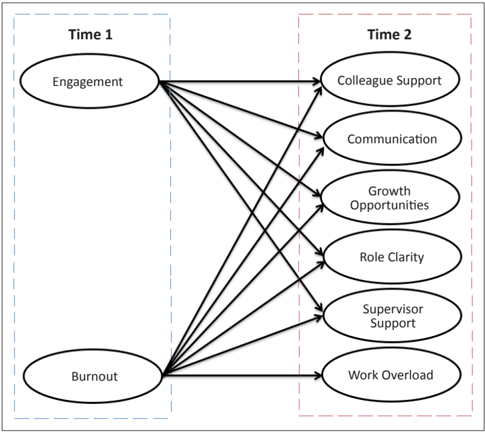
Orientation: Reversed causality is an area that has not commanded major attention within the South African context, specifically pertaining to engagement, burnout and job demands resources. Therefore, this necessitated an investigation to elucidate the potential effects.Research purpose: To investigate the reversed causal hypotheses of burnout and engagement in job demands-resources theory over time.Motivation for the study: Organisations and researchers should be made aware of the effects that burnout and engagement could have over time on resources and demands.Research design, approach and method: A longitudinal design was employed. The availability sample (n = 593) included participants from different demographic backgrounds. A survey was used to measure all constructs at both points in time. Structural equation modelling techniques were implemented with a categorical estimator to investigate the proposed hypotheses.Main findings: Burnout was found to have a significant negative longitudinal relationship with colleague support and supervisor support, whilst the negative relationship with supervisor support over time was more prominent. Engagement showed only one significant but small, negative relationship with supervisor support over time. All other relationships were statistically non-significant.Practical/managerial implications: This study makes organisations aware of the relationship between burnout and relationships at work over time. Proactive measures to promote relationships at work, specifically supervisor support, should be considered in addition to combatting burnout itself and promoting engagement.Contribution/value-add: This study provides insights and information on reversed causality, namely, the effects that engagement and burnout can have over time.
Overview
The claims and statistics of this paper haven’t been checked yet.
Run the check — free, no account needed. It reads the open-access text and checks the sources it cites.
Integrity signals
Registry
Cites
Statistics
Figures

Verification
Claims the paper makes
The claims and statistics of this paper haven’t been checked yet.
Run the check — free, no account needed. It reads the open-access text and checks the sources it cites.
Claims other papers make about this one
Each is checked against this paper’s own text: does it say what the citing paper says it does?
In the citing paper
“Ten Brummelhuis et al. (2011) found in their two-year followup study that employees who scored higher on burnout reported a stronger decrease in social support, a stronger reduction in job autonomy and information, and less opportunities to participate in decision-making (see also, De Beer et al., 2013).”
From Job Demands—Resources theory and self-regulation: New explanations and remedies for job burnout (2021) · cites this paper as De Beer et al., 2013
Self-check
Percentages, sums and reported differences re-computed from the paper’s own numbers.
The self-check needs the paper’s full text.
Citations
Cites
Burnout and work engagement among teachers
Hakanen, J. J., Bakker, A. B., & Schaufeli, W. B. (2006) · Journal of School Psychology · doi:10.1016/j.jsp.2005.11.001 · Cited by 3,067
Melamed, S., Shirom, A., Toker, S., Berliner, S., & Shapira, I. (2006) · Psychological Bulletin · doi:10.1037/0033-2909.132.3.327 · Cited by 943
Research works printed but not linked: 39
- 10.1002/smi.1266 · DOI
- 10.1037/a0020726 · DOI
- 10.1348/096317909X402596 · DOI · Paper page
- 10.1108/02683940710733115 · DOI · Paper page
- 10.1016/S0001-8791(02)00030-1 · DOI
- 10.1080/13594320344000165 · DOI
- 10.1037/1072-5245.10.1.16 · DOI
- 10.1002/hrm.20004 · DOI · Paper page
- 10.1177/0730888404266349 · DOI
- 10.1037/0022-0663.99.2.274 · DOI · Paper page
- 10.1111/j.1464-0597.2010.00429.x · DOI · Paper page
- 10.2466/01.03.10.PR0.111.5.528-544 · DOI
- 10.1201/9780203422809.ch2 · DOI
- 10.1080/02678370802390132 · DOI
- 10.5271/sjweh.843 · DOI
- 10.1037/0021-9010.92.4.1084 · DOI
- 10.1080/02678370802379432 · DOI · Paper page
- 10.1111/1464-0597.00062 · DOI · Paper page
- 10.1037/1082-989X.3.4.424 · DOI · Paper page
- 10.1177/0021886396321002 · DOI
- 10.1016/j.jvb.2007.07.003 · DOI
- 10.1002/9781444306538 · DOI
- 10.1080/10705510701303921 · DOI
- 10.1097/01.psy.0000242860.24009.f0 · DOI
- 10.1080/10615806.2003.10382973 · DOI
- 10.2307/3250982 · DOI
- 10.5465/AMR.2000.3312920 · DOI
- 10.4102/sajip.v29i4.127 · DOI · Paper page
- 10.1002/job.248 · DOI · Paper page
- 10.1002/job.595 · DOI · Paper page
- 10.1023/A:1015630930326 · DOI · Paper page
- 10.1080/02678370500385913 · DOI
- 10.1037/a0019796 · DOI
- 10.1002/smi.1283 · DOI
- 10.1002/0470029307.ch7 · DOI
- 10.1037/1076-8998.2.4.275 · DOI
- 10.1016/S0022-3999(01)00255-0 · DOI
- 10.1080/02678370802393672 · DOI · Paper page
- 10.2307/249075 · DOI
Cited by
Sorted by citations
Salvagioni, D. A. J., Melanda, F. N., Mesas, A. E., González, A. D., Gabani, F. L., & Andrade, S. M. D. (2017) · PLOS ONE · doi:10.1371/journal.pone.0185781 · Cited by 1,508
Job Demands—Resources theory and self-regulation: New explanations and remedies for job burnout
Bakker, A. B., & de Vries, J. D. (2021) · Anxiety, Stress, & Coping · doi:10.1080/10615806.2020.1797695 · Cited by 1,131
“…et al. (2011) found in their two-year followup study that employees who scored higher on burnout reported a stronger decrease in social support, a stronger reduction in job autonomy and information, and less opportunities to participate in decision-making (see also, De Beer et al., 2013).”
BackgroundChronic job burnout and daily functioning: A theoretical analysis
Bakker, A. B., & Costa, P. L. (2014) · Burnout Research · doi:10.1016/j.burn.2014.04.003 · Cited by 468
Metadata
- Authors
- De Beer, L. T., Pienaar, J., & Rothmann, S.
- Venue
- SA Journal of Industrial Psychology
- Publisher
- AOSIS
- Published
- 2013-01-25
- Volume
- 39
- Issue
- 1
- ISSN
- 2071-0763
- 0258-5200
- Cited by
- 14
- References
- 2
About these checks
Registry, retraction, Cites and statistics results are computed, not judged, with one exception: a printed reference that no index lists is read once by a model before it counts as a citation error. Claims are extracted by a model and kept only when their quote appears verbatim in the text; each cited source is then checked, with a model’s help, for whether it says what the claim relies on. Those verdicts can be wrong — read the claim’s quote and the cited source before relying on one.
Statistics and arithmetic are recomputed, not judged.
Confidence bands are shown only for fields calibrated on our annotated test set. None is calibrated yet, so no band is shown.
What counts as a claim ›How we measure confidence ›How we check this ›
Are you an author, or do you see a problem with this page? Request a review
