

The DOI matches its Crossref record; 144 of the 164 references it cites were found in a registry or an index; none of the 74 sources its claims cite is checked for support yet.
Bias in artificial intelligence for medical imaging: fundamentals, detection, avoidance, mitigation, challenges, ethics, and prospects
Open accessAbstract
Although artificial intelligence (AI) methods hold promise for medical imaging-based prediction tasks, their integration into medical practice may present a double-edged sword due to bias (i.e., systematic errors). AI algorithms have the potential to mitigate cognitive biases in human interpretation, but extensive research has highlighted the tendency of AI systems to internalize biases within their model. This fact, whether intentional or not, may ultimately lead to unintentional consequences in the clinical setting, potentially compromising patient outcomes. This concern is particularly important in medical imaging, where AI has been more progressively and widely embraced than any other medical field. A comprehensive understanding of bias at each stage of the AI pipeline is therefore essential to contribute to developing AI solutions that are not only less biased but also widely applicable. This international collaborative review effort aims to increase awareness within the medical imaging community about the importance of proactively identifying and addressing AI bias to prevent its negative consequences from being realized later. The authors began with the fundamentals of bias by explaining its different definitions and delineating various potential sources. Strategies for detecting and identifying bias were then outlined, followed by a review of techniques for its avoidance and mitigation. Moreover, ethical dimensions, challenges encountered, and prospects were discussed.
Overview
AI snapshot
Written from the paper’s full text.
TL;DR
This international collaborative review explains bias in medical imaging artificial intelligence across the full pipeline, from definitions and sources to detection, avoidance, mitigation, ethics, challenges, and prospects. It argues that proactive identification and mitigation are needed, while acknowledging that completely bias-free systems are unrealistic.
Key findings
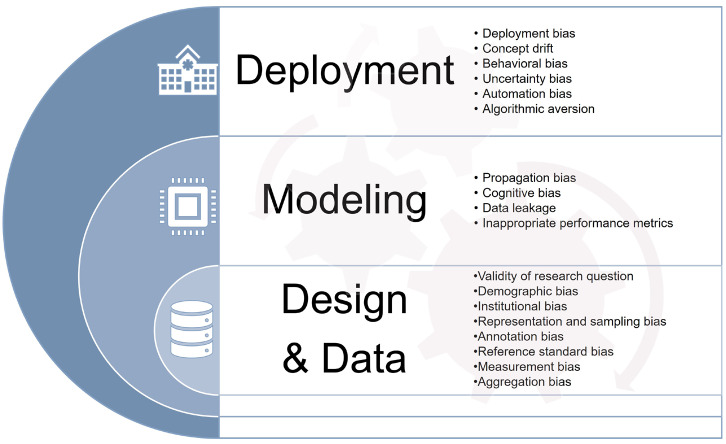
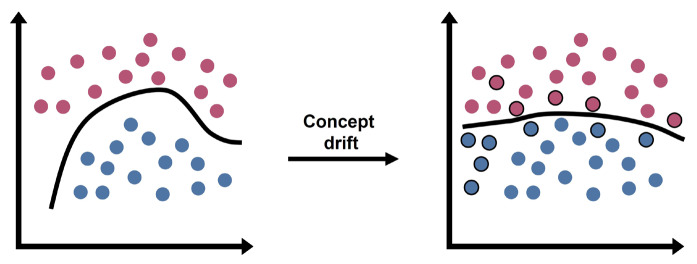
- Bias is framed as systematic error or distance between prediction and truth, with sources spanning study design/dataset, modeling, and deployment, including demographic imbalance, covariate shift, annotation/reference standard bias, data leakage, deployment bias, concept drift, automation bias, and algorithmic aversion.
- Detection strategies include dataset evaluation, unsupervised analysis, subgroup statistical comparison, visualization, independent code review, testing on unseen populations, and explainability analysis; named tools include PROBAST with four bias categories, QUADAS-2 with 14 questions, the under-development PROBAST-AI, TRIPOD-AI, FUTURE-AI, CLEAR, and METRICS.
- Mitigation is divided into preprocessing, during-training, and post-processing approaches; explainable AI methods include perturbation-based methods such as occlusion, LIME, and SHAP, and backpropagation-based methods such as saliency maps and CAM/Grad-CAM.
- Ethical and regulatory discussion cites the WHO’s six key ethical principles for AI in healthcare and the European Union’s AI Act, including Article 10 data governance for high-risk systems and Article 61 post-market surveillance, with full effect in 2026; challenges include limited benchmark diversity and the finding that fewer than approximately 6% of published radiology AI articles partially or completely share experimental data.
Methods
- Design: international collaborative narrative review covering fundamentals, detection, avoidance, mitigation, challenges, ethics, and prospects, explicitly without detailed technical discussion.
- Data or sample: no original dataset or systematic search is described; the paper synthesizes prior literature and references, with figures, tables, and collective recommendations in Table 3.
- Main analysis: conceptual and descriptive synthesis; no quantitative meta-analysis or primary statistical analysis is reported.
Limitations
- Stated: the review does not provide a detailed technical discussion; the authors state that expecting completely bias-free systems may be unrealistic and that complete inclusivity of all data types and sources remains unattainable.
- Stated challenges: ambiguities in interpreting results, limited diversity in benchmark datasets, subjectivity in detecting bias, and constraints related to data sharing and patient privacy.
- Evident: as a narrative review, no systematic search strategy, inclusion criteria, or quantitative synthesis is reported in the text; recommendations are expert-based rather than empirically tested here.
Model-written summary. Check it against the paper before relying on it.
Integrity signals
Registry
Cites
Statistics
Figures
Verification
Claims the paper makes
58 Not checked yet · 22 No basis given · 13 Own interpretation · 6 Sources not found · 1 Own result
The paper states this without a source or data behind it here, so there is nothing to check it against. The quote shows it is in the paper.
In the paper
“Another aspect to carefully consider is the choice of metrics used to estimate the model’s performance, which could introduce bias if those selected do not match the information needed.”
§ Bias in artificial intelligence for medical imaging: fundamentals, detection, avoidance, mitigation, challenges, ethics, and prospects > Bias related to modeling
hedgedconditional- Asserted: passes — The authors put it forward as true.
- Checkable: passes — It can be checked against evidence.
- Load-bearing: unclear — It is unclear whether the paper’s conclusions depend on it.
- Based: passes — The paper gives a reason why it holds.
In the paper
“Additionally, the choice of data preprocessing techniques, such as normalization, augmentation, or cropping, can also influence the model’s output by emphasizing certain features over others.28”
§ Bias in artificial intelligence for medical imaging: fundamentals, detection, avoidance, mitigation, challenges, ethics, and prospects > Bias related to study design and dataset
What the sources say
- Not checked yetcites [28] Tajbakhsh N Jeyaseelan L Li Q Chiang JN Wu Z Ding X Embracing imperfect datasets: a review of deep learning solutions for medical image segmentation. Med Image Anal 2020 63 101693 10.1016/j.media.2020.101693 32289663 source
plaindirect- Asserted: passes — The authors put it forward as true.
- Checkable: passes — It can be checked against evidence.
- Load-bearing: unclear — It is unclear whether the paper’s conclusions depend on it.
- Based: passes — The paper gives a reason why it holds.
The paper states this without a source or data behind it here, so there is nothing to check it against. The quote shows it is in the paper.
In the paper
“Additionally, improper utilization by end-users can also arise when utilizing systems to analyze images from anatomical districts or imaging modalities that differ from those they have been trained and validated with-for example, employing abdominal computed tomography images instead of abdominal magnetic resonance images.”
§ Bias in artificial intelligence for medical imaging: fundamentals, detection, avoidance, mitigation, challenges, ethics, and prospects > Bias related to deployment
plaindirect- Asserted: passes — The authors put it forward as true.
- Checkable: passes — It can be checked against evidence.
- Load-bearing: unclear — It is unclear whether the paper’s conclusions depend on it.
- Based: passes — The paper gives a reason why it holds.
A conclusion the paper draws from its own results — it cites no other source for it, so there is none to check. The quote shows it is in the paper.
In the paper
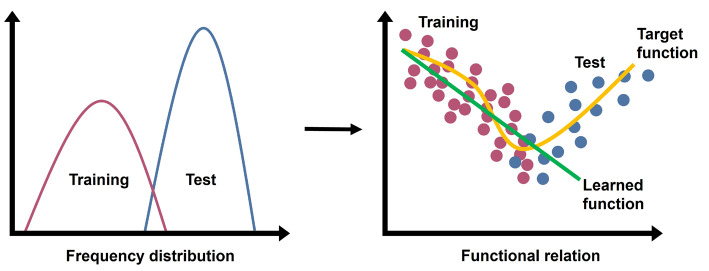
“Such variations can cause AI systems to become overfitted to the characteristics specific to the data they were trained on, reducing their generalizability and effectiveness when deployed in different settings.”
§ Bias in artificial intelligence for medical imaging: fundamentals, detection, avoidance, mitigation, challenges, ethics, and prospects > Bias related to study design and dataset
plaindirect- Asserted: passes — The authors put it forward as true.
- Checkable: passes — It can be checked against evidence.
- Load-bearing: passes — The paper’s conclusions depend on it.
- Based: passes — The paper gives a reason why it holds.
In the paper
“In medical imaging, this bias can manifest when an algorithm designed for segmentation tasks is utilized by human operators, whether intentionally or inadvertently, as a detection tool instead.37”
§ Bias in artificial intelligence for medical imaging: fundamentals, detection, avoidance, mitigation, challenges, ethics, and prospects > Bias related to deployment
What the sources say
- Not checked yetcites [37] Ueda D Kakinuma T Fujita S et al Fairness of artificial intelligence in healthcare: review and recommendations. Jpn J Radiol 2024 42 1 3 15 37540463 PMC10764412 source
plainconditional- Asserted: passes — The authors put it forward as true.
- Checkable: passes — It can be checked against evidence.
- Load-bearing: unclear — It is unclear whether the paper’s conclusions depend on it.
- Based: passes — The paper gives a reason why it holds.
A conclusion the paper draws from its own results — it cites no other source for it, so there is none to check. The quote shows it is in the paper.
In the paper
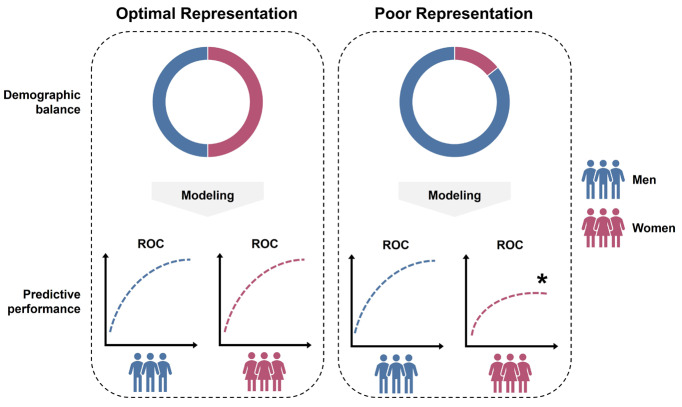
“If these factors are not adequately considered during dataset collection and AI model training, the resulting models may not only perpetuate but also amplify existing disparities.”
§ Bias in artificial intelligence for medical imaging: fundamentals, detection, avoidance, mitigation, challenges, ethics, and prospects > Bias related to study design and dataset
hedgedconditional- Asserted: passes — The authors put it forward as true.
- Checkable: passes — It can be checked against evidence.
- Load-bearing: passes — The paper’s conclusions depend on it.
- Based: passes — The paper gives a reason why it holds.
A conclusion the paper draws from its own results — it cites no other source for it, so there is none to check. The quote shows it is in the paper.
In the paper
“AI in medical imaging is at risk of being compromised by several types of biases, which could adversely affect patient outcomes.”
§ Bias in artificial intelligence for medical imaging: fundamentals, detection, avoidance, mitigation, challenges, ethics, and prospects > Main points
hedgedconditional- Asserted: passes — The authors put it forward as true.
- Checkable: passes — It can be checked against evidence.
- Load-bearing: passes — The paper’s conclusions depend on it.
- Based: unclear — It is unclear why the paper says it holds.
In the paper
“Bias in the dataset collection and preparation phases can significantly affect the outcomes of AI systems, particularly in the critical domain of medical imaging.”
§ Bias in artificial intelligence for medical imaging: fundamentals, detection, avoidance, mitigation, challenges, ethics, and prospects > Bias related to study design and dataset
What the sources say
- Not matchedcites [23] Chen P Wu L Wang L AI fairness in data management and analytics: a review on challenges, methodologies and applications. Appl Sci 2023 13 18 10258
Couldn’t be matched to a paper in Crossref, so it can’t be checked.
plaindirect- Asserted: passes — The authors put it forward as true.
- Checkable: passes — It can be checked against evidence.
- Load-bearing: passes — The paper’s conclusions depend on it.
- Based: passes — The paper gives a reason why it holds.
- Not matched
In the paper
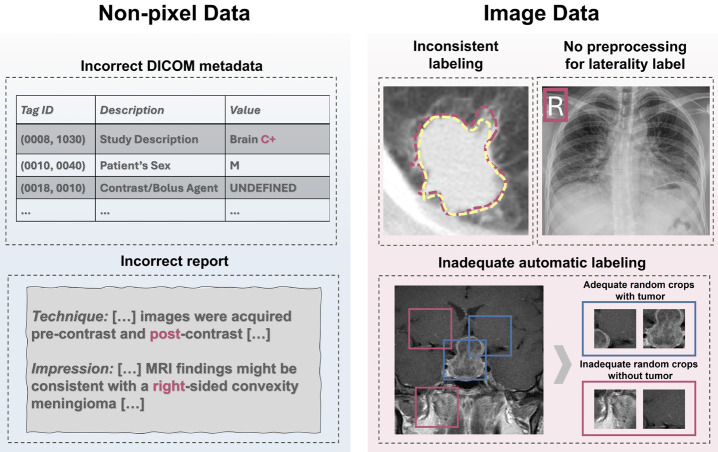
“Different reference standards are often available to confirm radiological diagnosis, which may also lead to systematic errors.26”
§ Bias in artificial intelligence for medical imaging: fundamentals, detection, avoidance, mitigation, challenges, ethics, and prospects > Bias related to study design and dataset
What the sources say
- Not checked yetcites [26] van der Pol CB McInnes MDF Salameh JP et al Impact of reference standard on CT, MRI, and contrast-enhanced US LI-RADS diagnosis of hepatocellular carcinoma: a meta-analysis. Radiology 2022 303 3 544 545 10.1148/radiol.212340 35230186 source
hedgedconditional- Asserted: passes — The authors put it forward as true.
- Checkable: passes — It can be checked against evidence.
- Load-bearing: unclear — It is unclear whether the paper’s conclusions depend on it.
- Based: passes — The paper gives a reason why it holds.
In the paper
“A broader concept than annotation bias is reference standard bias, affecting the way instances are labeled and consequently impacting algorithm development.25”
§ Bias in artificial intelligence for medical imaging: fundamentals, detection, avoidance, mitigation, challenges, ethics, and prospects > Bias related to study design and dataset
What the sources say
- Not checked yetcites [25] Jayakumar S Sounderajah V Normahani P et al Quality assessment standards in artificial intelligence diagnostic accuracy systematic reviews: a meta-research study. NPJ Digit Med 2022 5 1 11 10.1038/s41746-021-00544-y 35087178 PMC8795185 source
plaindirect- Asserted: passes — The authors put it forward as true.
- Checkable: passes — It can be checked against evidence.
- Load-bearing: unclear — It is unclear whether the paper’s conclusions depend on it.
- Based: passes — The paper gives a reason why it holds.
- Probably not a substantial claim. 39
- It may state two separate claims as one. 14
A result the paper reports from its own data — it cites no other source for it, so there is none to check. The quote shows it is in the paper.
In the paper
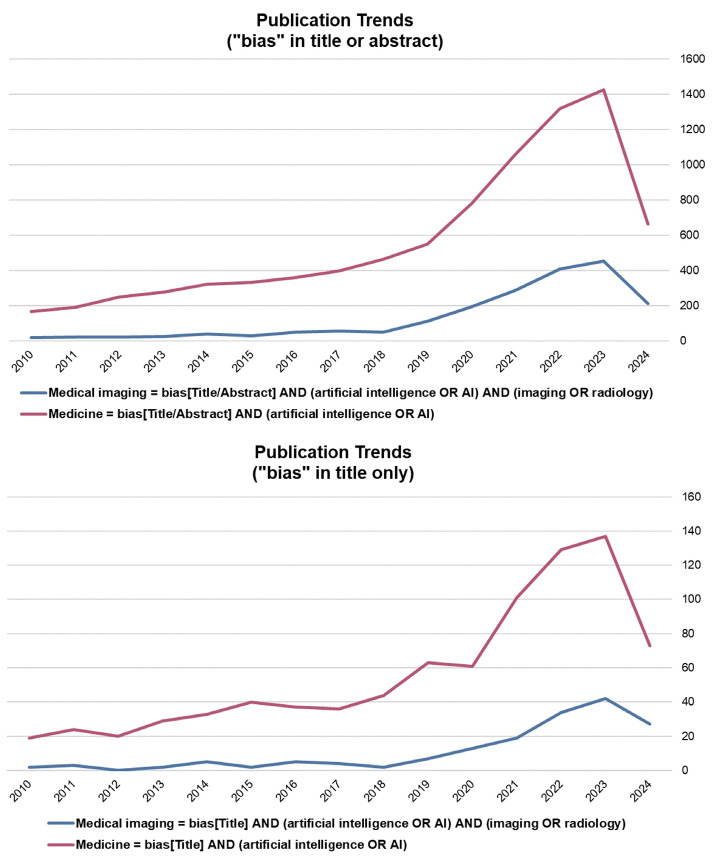
“Medical publication trends indicate a growing interest in bias in AI (Figure 1).”
§ Bias in artificial intelligence for medical imaging: fundamentals, detection, avoidance, mitigation, challenges, ethics, and prospects > Main points
hedgedcorrelational- Asserted: passes — The authors put it forward as true.
- Checkable: passes — It can be checked against evidence.
- Load-bearing: fails — The paper’s conclusions may not depend on it.
- Based: fails — The paper may give no reason why it holds.
Probably not a substantial claim. The paper’s conclusions may not depend on it. The paper may give no reason why it holds.
In the paper
“Some could be highly accurate but also costly and poorly available, whereas others could neglect intermediate findings or be operator-dependent,27 potentially reducing label applicability and reliability.”
§ Bias in artificial intelligence for medical imaging: fundamentals, detection, avoidance, mitigation, challenges, ethics, and prospects > Bias related to study design and dataset
What the sources say
- Not checked yetcites [27] Chen PC Mermel CH Liu Y Evaluation of artificial intelligence on a reference standard based on subjective interpretation. Lancet Digit Health 2021 3 11 e693 e695 10.1016/S2589-7500(21)00216-8 34561202 source
hedgedconditional- Asserted: passes — The authors put it forward as true.
- Checkable: passes — It can be checked against evidence.
- Load-bearing: unclear — It is unclear whether the paper’s conclusions depend on it.
- Based: passes — The paper gives a reason why it holds.
It may state two separate claims as one.
In the paper
“In particular, this bias can lead to skewed data cohorts, incomplete information, heightened uncertainty in outcomes, and potential dismissal of algorithm-assisted medical advice.40”
§ Bias in artificial intelligence for medical imaging: fundamentals, detection, avoidance, mitigation, challenges, ethics, and prospects > Bias related to deployment
What the sources say
- Not checked yetcites [40] Olteanu A Castillo C Diaz F Kıcıman E Social data: biases, methodological pitfalls, and ethical boundaries. Front Big Data 2019 2 13 10.3389/fdata.2019.00013 33693336 PMC7931947 source
plaindirect- Asserted: passes — The authors put it forward as true.
- Checkable: passes — It can be checked against evidence.
- Load-bearing: unclear — It is unclear whether the paper’s conclusions depend on it.
- Based: passes — The paper gives a reason why it holds.
It may state two separate claims as one.
In the paper
“Specifically, it arises when the correlation between input variables, such as images, and output predictions, such as diagnoses, evolves due to fluctuations in data, such as variations in image acquisition hardware or protocols, shifts in disease prevalence, or advancements in gold-standard technologies.38”
§ Bias in artificial intelligence for medical imaging: fundamentals, detection, avoidance, mitigation, challenges, ethics, and prospects > Bias related to deployment
What the sources say
- Not checked yetcites [38] Roland T Böck C Tschoellitsch T et al Domain shifts in machine learning based Covid-19 diagnosis from blood tests. J Med Syst 2022 46 5 23 35348909 PMC8960704 source
plaindirect- Asserted: passes — The authors put it forward as true.
- Checkable: passes — It can be checked against evidence.
- Load-bearing: fails — The paper’s conclusions may not depend on it.
- Based: passes — The paper gives a reason why it holds.
Probably not a substantial claim. The paper’s conclusions may not depend on it.
In the paper
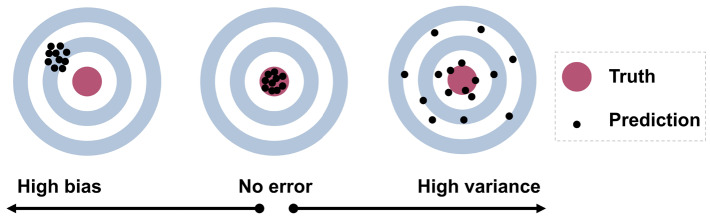
“The concept of bias in machine learning (ML) research and more generally in the field of predictive modeling is intrinsically tied to the concept of variance.14”
§ Bias in artificial intelligence for medical imaging: fundamentals, detection, avoidance, mitigation, challenges, ethics, and prospects > Definition of bias in artificial intelligence
What the sources say
- Not checked yetcites [14] Geman S Bienenstock E Doursat R Neural networks and the bias/variance dilemma. Neural Comput 1992 4 1 1 58 10.1162/neco.1992.4.1.1 source
plaincorrelational- Asserted: passes — The authors put it forward as true.
- Checkable: passes — It can be checked against evidence.
- Load-bearing: fails — The paper’s conclusions may not depend on it.
- Based: passes — The paper gives a reason why it holds.
Probably not a substantial claim. The paper’s conclusions may not depend on it.
In the paper
“Uncertainty bias encompasses the influence of uncertainty on decision-making stemming from AI/ML models.39”
§ Bias in artificial intelligence for medical imaging: fundamentals, detection, avoidance, mitigation, challenges, ethics, and prospects > Bias related to deployment
What the sources say
- Not checked yetcites [39] Drukker K Chen W Gichoya J et al Toward fairness in artificial intelligence for medical image analysis: identification and mitigation of potential biases in the roadmap from data collection to model deployment. J Med Imaging(Bellingham) 2023 10 6 061104 10.1117/1.jmi.10.6.061104 37125409 PMC10129875 source
plaindirect- Asserted: passes — The authors put it forward as true.
- Checkable: passes — It can be checked against evidence.
- Load-bearing: fails — The paper’s conclusions may not depend on it.
- Based: passes — The paper gives a reason why it holds.
Probably not a substantial claim. The paper’s conclusions may not depend on it.
In the paper
“From a mathematical point of view, noise (the joint probability distribution between training and test/inference samples), bias, and variance are the three components that lead to model performance degradation and negatively affect generalization to new data.17”
§ Bias in artificial intelligence for medical imaging: fundamentals, detection, avoidance, mitigation, challenges, ethics, and prospects > Definition of bias in artificial intelligence
What the sources say
- Not checked yetcites [17] Guan X Burton H Bias-variance tradeoff in machine learning: theoretical formulation and implications to structural engineering applications. Structures 2022 46 17 30 10.1016/j.istruc.2022.10.004 source
plaindirect- Asserted: passes — The authors put it forward as true.
- Checkable: passes — It can be checked against evidence.
- Load-bearing: fails — The paper’s conclusions may not depend on it.
- Based: passes — The paper gives a reason why it holds.
Probably not a substantial claim. The paper’s conclusions may not depend on it.
In the paper
“Behavioral bias pertains to the potential distortions in user behavior seen across various platforms, contexts, or datasets.39”
§ Bias in artificial intelligence for medical imaging: fundamentals, detection, avoidance, mitigation, challenges, ethics, and prospects > Bias related to deployment
What the sources say
- Not checked yetcites [39] Drukker K Chen W Gichoya J et al Toward fairness in artificial intelligence for medical image analysis: identification and mitigation of potential biases in the roadmap from data collection to model deployment. J Med Imaging(Bellingham) 2023 10 6 061104 10.1117/1.jmi.10.6.061104 37125409 PMC10129875 source
plain- Asserted: passes — The authors put it forward as true.
- Checkable: passes — It can be checked against evidence.
- Load-bearing: fails — The paper’s conclusions may not depend on it.
- Based: passes — The paper gives a reason why it holds.
Probably not a substantial claim. The paper’s conclusions may not depend on it.
The paper states this without a source or data behind it here, so there is nothing to check it against. The quote shows it is in the paper.
In the paper
“However, it should be made clear that these two entities are interdependent, and reducing one (e.g., variance) typically comes at the expense of increasing the other (i.e., bias), which gives birth to the concept of a bias-variance tradeoff.”
§ Bias in artificial intelligence for medical imaging: fundamentals, detection, avoidance, mitigation, challenges, ethics, and prospects > Definition of bias in artificial intelligence
boosteddirect- Asserted: passes — The authors put it forward as true.
- Checkable: passes — It can be checked against evidence.
- Load-bearing: fails — The paper’s conclusions may not depend on it.
- Based: passes — The paper gives a reason why it holds.
Probably not a substantial claim. The paper’s conclusions may not depend on it. It may state two separate claims as one.
In the paper
“A deployment bias emerges when there is a misalignment between the envisioned purpose of a system or algorithm and its actual application.36”
§ Bias in artificial intelligence for medical imaging: fundamentals, detection, avoidance, mitigation, challenges, ethics, and prospects > Bias related to deployment
What the sources say
- Not checked yetcites [36] Rajpurkar P Chen E Banerjee O Topol EJ AI in health and medicine. Nat Med 2022 28 1 31 38 10.1038/s41591-021-01614-0 35058619 source
plaindirect- Asserted: passes — The authors put it forward as true.
- Checkable: passes — It can be checked against evidence.
- Load-bearing: fails — The paper’s conclusions may not depend on it.
- Based: passes — The paper gives a reason why it holds.
Probably not a substantial claim. The paper’s conclusions may not depend on it.
In the paper
“This starts with a code review that can be carried out by an independent experienced coder/auditor.49”
§ Bias in artificial intelligence for medical imaging: fundamentals, detection, avoidance, mitigation, challenges, ethics, and prospects > Bias detection/identification
What the sources say
- Not checked yetcites [49] Murphy-Hill E Jaspan CN Egelman C Cheng L The Pushback effects of race, ethnicity, gender, and age in code review. Commun ACM 2022 65 3 52 57 10.1145/3474097 source
plain- Asserted: passes — The authors put it forward as true.
- Checkable: passes — It can be checked against evidence.
- Load-bearing: fails — The paper’s conclusions may not depend on it.
- Based: passes — The paper gives a reason why it holds.
Probably not a substantial claim. The paper’s conclusions may not depend on it.
In the paper
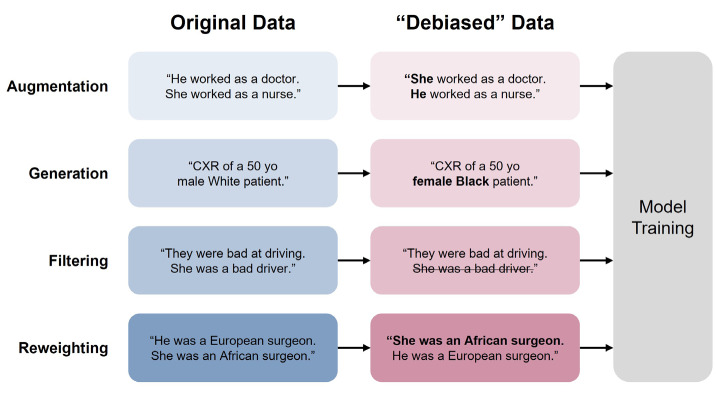
“Apart from collecting more data, strategies at the data processing stage may include the creation of more representative training datasets by data augmentation (e.g., by specifically adding underrepresented examples to the data through additional sampling or data generation) or data filtering (e.g., actively undersampling or filtering out undesirable or non-representative samples).68”
§ Bias in artificial intelligence for medical imaging: fundamentals, detection, avoidance, mitigation, challenges, ethics, and prospects > Avoidance strategies
What the sources say
- Not checked yetcites [68] Gallegos IO, Rossi RA, Barrow J, et al. Bias and Fairness in large language models: a survey. Published online 2023. source
hedgedconditional- Asserted: passes — The authors put it forward as true.
- Checkable: passes — It can be checked against evidence.
- Load-bearing: fails — The paper’s conclusions may not depend on it.
- Based: passes — The paper gives a reason why it holds.
Probably not a substantial claim. The paper’s conclusions may not depend on it.
The paper states this without a source or data behind it here, so there is nothing to check it against. The quote shows it is in the paper.
In the paper
“The composition of the involved teams can influence the AI’s propensity for bias.”
§ Bias in artificial intelligence for medical imaging: fundamentals, detection, avoidance, mitigation, challenges, ethics, and prospects > Avoidance strategies
plainconditional- Asserted: passes — The authors put it forward as true.
- Checkable: passes — It can be checked against evidence.
- Load-bearing: fails — The paper’s conclusions may not depend on it.
- Based: passes — The paper gives a reason why it holds.
Probably not a substantial claim. The paper’s conclusions may not depend on it.
A conclusion the paper draws from its own results — it cites no other source for it, so there is none to check. The quote shows it is in the paper.
In the paper
“By incorporating the above-mentioned considerations early into the design phase, developers can create systems that are less likely to perpetuate or amplify biases.”
§ Bias in artificial intelligence for medical imaging: fundamentals, detection, avoidance, mitigation, challenges, ethics, and prospects > Avoidance strategies
hedgedconditional- Asserted: passes — The authors put it forward as true.
- Checkable: passes — It can be checked against evidence.
- Load-bearing: passes — The paper’s conclusions depend on it.
- Based: passes — The paper gives a reason why it holds.
Probably not a substantial claim.
None of the sources cited for this claim have been checked yet.
In the paper
“The way data are presented to the model during training (affected by the problem formulation and the labeling methodology) and how model parameters are updated (defined through training setup including the objective function) can introduce bias into the model.13, 68”
§ Bias in artificial intelligence for medical imaging: fundamentals, detection, avoidance, mitigation, challenges, ethics, and prospects > Avoidance strategies
What the sources say
- Not checked yetcites [13] Obermeyer Z Powers B Vogeli C Mullainathan S Dissecting racial bias in an algorithm used to manage the health of populations. Science 2019 366 6464 447 453 10.1126/science.aax2342 31649194 source
- Not checked yetcites [68] Gallegos IO, Rossi RA, Barrow J, et al. Bias and Fairness in large language models: a survey. Published online 2023. source
plainconditional- Asserted: passes — The authors put it forward as true.
- Checkable: passes — It can be checked against evidence.
- Load-bearing: passes — The paper’s conclusions depend on it.
- Based: passes — The paper gives a reason why it holds.
It may state two separate claims as one.
In the paper
“Additionally, algorithms can be categorized according to whether they explicitly or implicitly address bias by accessing or not accessing the bias variables during training.77”
§ Bias in artificial intelligence for medical imaging: fundamentals, detection, avoidance, mitigation, challenges, ethics, and prospects > Mitigation strategies
What the sources say
- Not checked yetcites [77] Shrestha R, Kafle K, Kanan C. An investigation of critical issues in bias mitigation techniques. In:IEEE/CVF Winter Conference on Applications of Computer Vision (WACV). IEEE; Waikoloa, HI, USA: 2022:2512-2523.
plain- Asserted: passes — The authors put it forward as true.
- Checkable: passes — It can be checked against evidence.
- Load-bearing: fails — The paper’s conclusions may not depend on it.
- Based: passes — The paper gives a reason why it holds.
Probably not a substantial claim. The paper’s conclusions may not depend on it.
In the paper
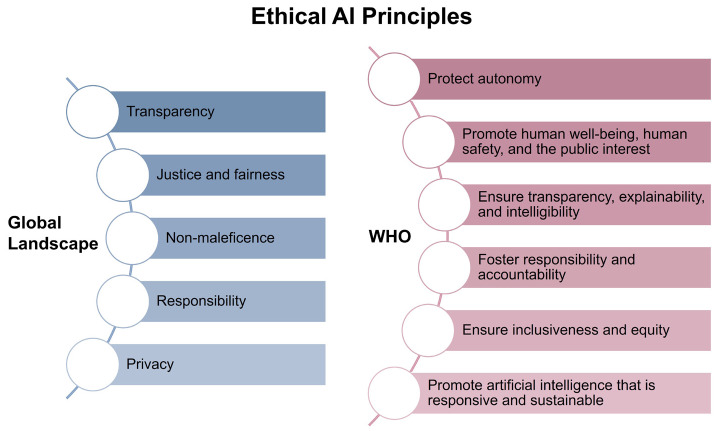
“Guiding principles, such as transparency, fairness, non-maleficence, and respect for privacy from the outset, are widely included in recommendations and position papers and can help to prevent bias (Figure 9).67”
§ Bias in artificial intelligence for medical imaging: fundamentals, detection, avoidance, mitigation, challenges, ethics, and prospects > Avoidance strategies
What the sources say
- Not checked yetcites [67] Jobin A Ienca M Vayena E The global landscape of AI ethics guidelines. Nat Mach Intell 2019 1 9 389 399
plainconditional- Asserted: passes — The authors put it forward as true.
- Checkable: passes — It can be checked against evidence.
- Load-bearing: fails — The paper’s conclusions may not depend on it.
- Based: passes — The paper gives a reason why it holds.
Probably not a substantial claim. The paper’s conclusions may not depend on it.
In the paper
“Additionally, these are independent of the model and can be used in a black-box setting by altering the data distribution to increase model fairness.76”
§ Bias in artificial intelligence for medical imaging: fundamentals, detection, avoidance, mitigation, challenges, ethics, and prospects > Mitigation strategies
What the sources say
- Not checked yetcites [76] Feldman T, Peake A. End-to-end bias mitigation: removing gender bias in deep learning. Published online June 20, 2021. source
plaindirect- Asserted: passes — The authors put it forward as true.
- Checkable: passes — It can be checked against evidence.
- Load-bearing: unclear — It is unclear whether the paper’s conclusions depend on it.
- Based: passes — The paper gives a reason why it holds.
It may state two separate claims as one.
In the paper
“Bias mitigation algorithms can be divided into three types according to the phase in which they are applied: in a preprocessing phase, during model training, or after model training.76”
§ Bias in artificial intelligence for medical imaging: fundamentals, detection, avoidance, mitigation, challenges, ethics, and prospects > Mitigation strategies
What the sources say
- Not matchedcites [76] Feldman T, Peake A. End-to-end bias mitigation: removing gender bias in deep learning. Published online June 20, 2021.
Couldn’t be matched to a paper in Crossref, so it can’t be checked.
plain- Asserted: passes — The authors put it forward as true.
- Checkable: passes — It can be checked against evidence.
- Load-bearing: fails — The paper’s conclusions may not depend on it.
- Based: passes — The paper gives a reason why it holds.
Probably not a substantial claim. The paper’s conclusions may not depend on it.
- Not matched
None of the sources cited for this claim have been checked yet.
In the paper
“Re-sampling and re-weighting algorithms focus on rebalancing the class distribution by adjusting the sample probability/loss weight for majority/minority samples.78, 79, 80, 81, 82, 83”
§ Bias in artificial intelligence for medical imaging: fundamentals, detection, avoidance, mitigation, challenges, ethics, and prospects > Mitigation strategies
What the sources say
- Not checked yetcites [78] Feldman M, Friedler SA, Moeller J, Scheidegger C, Venkatasubramanian S. Certifying and removing disparate impact. In:Proceedings of the 21th ACM SIGKDD International Conference on Knowledge Discovery and Data Mining. KDD ’15. Association for Computing Machinery; 2015:259-268. source
- Not checked yetcites [79] Cui Y, Jia M, Lin TY, Song Y, Belongie S. Class-balanced loss based on effective number of samples. In:IEEE/CVF Conference on Computer Vision and Pattern Recognition (CVPR). Long Beach, CA, USA: 2019:9260-9269. source
- Not checked yetcites [80] Zou Y, Yu Z, Kumar BVKV, Wang J. Domain adaptation for semantic segmentation via class-balanced self-training. Published online October 25, 2018. source
plaindirect- Asserted: passes — The authors put it forward as true.
- Checkable: passes — It can be checked against evidence.
- Load-bearing: fails — The paper’s conclusions may not depend on it.
- Based: passes — The paper gives a reason why it holds.
Probably not a substantial claim. The paper’s conclusions may not depend on it.
In the paper
“Nonetheless, the current version of PROBAST is not suitable for the evaluation of ML studies, and this is the reason that the PROBAST group has initiated the process of developing an AI-specific version of PROBAST called PROBAST-AI, which is still under development.61”
§ Bias in artificial intelligence for medical imaging: fundamentals, detection, avoidance, mitigation, challenges, ethics, and prospects > Bias detection/identification
What the sources say
- Not checked yetcites [61] Collins GS Dhiman P Andaur Navarro CL et al Protocol for development of a reporting guideline (TRIPOD-AI) and risk of bias tool (PROBAST-AI) for diagnostic and prognostic prediction model studies based on artificial intelligence. BMJ Open 2021 11 7 e048008 10.1136/bmjopen-2020-048008 PMC8273461 34244270 source
plaindirect- Asserted: passes — The authors put it forward as true.
- Checkable: passes — It can be checked against evidence.
- Load-bearing: fails — The paper’s conclusions may not depend on it.
- Based: passes — The paper gives a reason why it holds.
Probably not a substantial claim. The paper’s conclusions may not depend on it. It may state two separate claims as one.
The paper states this without a source or data behind it here, so there is nothing to check it against. The quote shows it is in the paper.
In the paper
“Consider this scenario: AI/ML models can be “confidently wrong,” meaning they may yield incorrect outcomes with a high level of certainty.”
§ Bias in artificial intelligence for medical imaging: fundamentals, detection, avoidance, mitigation, challenges, ethics, and prospects > Bias related to deployment
hedgedconditional- Asserted: passes — The authors put it forward as true.
- Checkable: passes — It can be checked against evidence.
- Load-bearing: passes — The paper’s conclusions depend on it.
- Based: fails — The paper may give no reason why it holds.
Probably not a substantial claim. The paper may give no reason why it holds.
In the paper
“Transparent and comprehensive documentation of the AI system’s design choices, data sources, and any assumptions made during development (e.g., through model cards)75 is crucial and can help spot sources of bias before, during, and after training.”
§ Bias in artificial intelligence for medical imaging: fundamentals, detection, avoidance, mitigation, challenges, ethics, and prospects > Avoidance strategies
What the sources say
- Not checked yetcites [75] Mitchell M, Wu S, Zaldivar A, et al. Model cards for model reporting. In:Proceedings of the Conference on Fairness, Accountability, and Transparency. ACM; 2019:220-229.
plaindirect- Asserted: passes — The authors put it forward as true.
- Checkable: fails — It may be too vague to check against evidence.
- Load-bearing: passes — The paper’s conclusions depend on it.
- Based: passes — The paper gives a reason why it holds.
Probably not a substantial claim. It may be too vague to check against evidence. It may state two separate claims as one.
The paper states this without a source or data behind it here, so there is nothing to check it against. The quote shows it is in the paper.
In the paper
“Teams that are diverse in terms of gender, ethnicity, culture, and professional background bring a wide array of perspectives to the table, which can help identify and eliminate potential biases early in the development process.”
§ Bias in artificial intelligence for medical imaging: fundamentals, detection, avoidance, mitigation, challenges, ethics, and prospects > Avoidance strategies
plainconditional- Asserted: passes — The authors put it forward as true.
- Checkable: fails — It may be too vague to check against evidence.
- Load-bearing: fails — The paper’s conclusions may not depend on it.
- Based: fails — The paper may give no reason why it holds.
Probably not a substantial claim. It may be too vague to check against evidence. The paper’s conclusions may not depend on it. The paper may give no reason why it holds.
The paper states this without a source or data behind it here, so there is nothing to check it against. The quote shows it is in the paper.
In the paper
“In general, XAI methods can be categorized into two main groups: perturbation-based and backpropagation-based explanations.”
§ Bias in artificial intelligence for medical imaging: fundamentals, detection, avoidance, mitigation, challenges, ethics, and prospects > Mitigation strategies
plain- Asserted: passes — The authors put it forward as true.
- Checkable: passes — It can be checked against evidence.
- Load-bearing: fails — The paper’s conclusions may not depend on it.
- Based: passes — The paper gives a reason why it holds.
Probably not a substantial claim. The paper’s conclusions may not depend on it.
In the paper
“Algorithmic aversion refers to a phenomenon where clinicians or healthcare professionals exhibit reluctance or skepticism toward relying on AI algorithms for making diagnostic or treatment decisions in medical imaging.46”
§ Bias in artificial intelligence for medical imaging: fundamentals, detection, avoidance, mitigation, challenges, ethics, and prospects > Bias related to deployment
What the sources say
- Not checked yetcites [46] Cadario R Longoni C Morewedge CK Understanding, explaining, and utilizing medical artificial intelligence. Nat Hum Behav 2021 5 12 1636 1642 34183800 source
plain- Asserted: passes — The authors put it forward as true.
- Checkable: passes — It can be checked against evidence.
- Load-bearing: fails — The paper’s conclusions may not depend on it.
- Based: passes — The paper gives a reason why it holds.
Probably not a substantial claim. The paper’s conclusions may not depend on it.
None of the sources cited for this claim have been checked yet.
In the paper
“Reporting guidelines, such as the Fairness Universality Traceability Usability Robustness Explainability-AI and TRIPOD-AI, can assist authors of AI manuscripts in reporting their studies according to the Fairness principle, promoting the identification of bias sources.58, 63, 64”
§ Bias in artificial intelligence for medical imaging: fundamentals, detection, avoidance, mitigation, challenges, ethics, and prospects > Bias detection/identification
What the sources say
- Not checked yetcites [58] Klontzas ME Gatti AA Tejani AS Kahn CE Jr AI reporting guidelines: how to select the best one for your research. Radiol Artif Intell 2023 5 3 e230055 10.1148/ryai.230055 37293341 PMC10245184 source
- Not matchedcites [63] Lekadir K, Osuala R, Gallin C, et al. FUTURE-AI: Guiding principles and consensus recommendations for trustworthy artificial intelligence in medical imaging. Published online October 30, 2023.
Couldn’t be matched to a paper in Crossref, so it can’t be checked.
- Not checked yetcites [64] Collins GS Moons KGM Dhiman P et al TRIPOD+AI statement: updated guidance for reporting clinical prediction models that use regression or machine learning methods. BMJ 2024 385 7996 e078378 10.1038/d41586-024-00173-x 38626948 PMC11019967 source
plaindirect- Asserted: passes — The authors put it forward as true.
- Checkable: passes — It can be checked against evidence.
- Load-bearing: fails — The paper’s conclusions may not depend on it.
- Based: passes — The paper gives a reason why it holds.
Probably not a substantial claim. The paper’s conclusions may not depend on it.
The paper states this without a source or data behind it here, so there is nothing to check it against. The quote shows it is in the paper.
In the paper
“However, there are several challenges in handling bias that can be related to ambiguities in interpreting results, limited diversity in benchmark datasets, and the subjectivity of detecting bias.”
§ Bias in artificial intelligence for medical imaging: fundamentals, detection, avoidance, mitigation, challenges, ethics, and prospects > Potential challenges
plaincorrelational- Asserted: passes — The authors put it forward as true.
- Checkable: passes — It can be checked against evidence.
- Load-bearing: fails — The paper’s conclusions may not depend on it.
- Based: passes — The paper gives a reason why it holds.
Probably not a substantial claim. The paper’s conclusions may not depend on it. It may state two separate claims as one.
In the paper
“Automation bias refers to the tendency of individuals to rely excessively on automated systems, such as AI algorithms, and to disregard or underutilize their own judgment or critical thinking skills.42”
§ Bias in artificial intelligence for medical imaging: fundamentals, detection, avoidance, mitigation, challenges, ethics, and prospects > Bias related to deployment
What the sources say
- Not checked yetcites [42] Khera R Simon MA Ross JS Automation Bias and Assistive AI: Risk of Harm From AI-driven clinical decision support. JAMA 2023 330 23 2255 2257 10.1001/jama.2023.22557 38112824 source
plain- Asserted: passes — The authors put it forward as true.
- Checkable: passes — It can be checked against evidence.
- Load-bearing: fails — The paper’s conclusions may not depend on it.
- Based: passes — The paper gives a reason why it holds.
Probably not a substantial claim. The paper’s conclusions may not depend on it.
A conclusion the paper draws from its own results — it cites no other source for it, so there is none to check. The quote shows it is in the paper.
In the paper
“By identifying and addressing biases, these systems can improve healthcare outcomes and equity.”
§ Bias in artificial intelligence for medical imaging: fundamentals, detection, avoidance, mitigation, challenges, ethics, and prospects > Prospects
plaindirect- Asserted: passes — The authors put it forward as true.
- Checkable: passes — It can be checked against evidence.
- Load-bearing: passes — The paper’s conclusions depend on it.
- Based: passes — The paper gives a reason why it holds.
Probably not a substantial claim.
A conclusion the paper draws from its own results — it cites no other source for it, so there is none to check. The quote shows it is in the paper.
In the paper
“Understanding that medical imaging AI systems are sensitive to biases is key for their effective real-world integration into clinical practice.”
§ Bias in artificial intelligence for medical imaging: fundamentals, detection, avoidance, mitigation, challenges, ethics, and prospects > Final remarks
plaincorrelational- Asserted: passes — The authors put it forward as true.
- Checkable: passes — It can be checked against evidence.
- Load-bearing: passes — The paper’s conclusions depend on it.
- Based: fails — The paper may give no reason why it holds.
Probably not a substantial claim. The paper may give no reason why it holds.
A conclusion the paper draws from its own results — it cites no other source for it, so there is none to check. The quote shows it is in the paper.
In the paper
“Before going into detail, it should be acknowledged that expecting completely bias-free systems may be unrealistic.”
§ Bias in artificial intelligence for medical imaging: fundamentals, detection, avoidance, mitigation, challenges, ethics, and prospects > Prospects
hedged- Asserted: passes — The authors put it forward as true.
- Checkable: fails — It may be too vague to check against evidence.
- Load-bearing: fails — The paper’s conclusions may not depend on it.
- Based: fails — The paper may give no reason why it holds.
Probably not a substantial claim. It may be too vague to check against evidence. The paper’s conclusions may not depend on it. The paper may give no reason why it holds.
A conclusion the paper draws from its own results — it cites no other source for it, so there is none to check. The quote shows it is in the paper.
In the paper
“Despite the aspiration for unbiased AI, complete inclusivity of all data types and sources remains an unattainable goal in model development.”
§ Bias in artificial intelligence for medical imaging: fundamentals, detection, avoidance, mitigation, challenges, ethics, and prospects > Final remarks
plain- Asserted: passes — The authors put it forward as true.
- Checkable: fails — It may be too vague to check against evidence.
- Load-bearing: passes — The paper’s conclusions depend on it.
- Based: fails — The paper may give no reason why it holds.
Probably not a substantial claim. It may be too vague to check against evidence. The paper may give no reason why it holds.
None of the sources cited for this claim have been checked yet.
In the paper
“Concerning monitoring, Article 61 of the legislation mandates that developers of high-risk AI systems establish ongoing, systematic post-market surveillance mechanisms.”
§ Bias in artificial intelligence for medical imaging: fundamentals, detection, avoidance, mitigation, challenges, ethics, and prospects > Ethical considerations
plain- Asserted: passes — The authors put it forward as true.
- Checkable: passes — It can be checked against evidence.
- Load-bearing: fails — The paper’s conclusions may not depend on it.
- Based: passes — The paper gives a reason why it holds.
Probably not a substantial claim. The paper’s conclusions may not depend on it.
A conclusion the paper draws from its own results — it cites no other source for it, so there is none to check. The quote shows it is in the paper.
In the paper
“Additionally, the lack of diversity among developers and researchers can worsen these issues, as teams may unconsciously favor perspectives similar to their own.”
§ Bias in artificial intelligence for medical imaging: fundamentals, detection, avoidance, mitigation, challenges, ethics, and prospects > Ethical considerations
hedgedconditional- Asserted: passes — The authors put it forward as true.
- Checkable: passes — It can be checked against evidence.
- Load-bearing: fails — The paper’s conclusions may not depend on it.
- Based: passes — The paper gives a reason why it holds.
Probably not a substantial claim. The paper’s conclusions may not depend on it.
A conclusion the paper draws from its own results — it cites no other source for it, so there is none to check. The quote shows it is in the paper.
In the paper
“Subjectivity in the detection of bias can be related to personal interpretation and individual perspectives related to the identification of the bias itself.”
§ Bias in artificial intelligence for medical imaging: fundamentals, detection, avoidance, mitigation, challenges, ethics, and prospects > Potential challenges
plaincorrelational- Asserted: passes — The authors put it forward as true.
- Checkable: fails — It may be too vague to check against evidence.
- Load-bearing: fails — The paper’s conclusions may not depend on it.
- Based: fails — The paper may give no reason why it holds.
Probably not a substantial claim. It may be too vague to check against evidence. The paper’s conclusions may not depend on it. The paper may give no reason why it holds.
The paper states this without a source or data behind it here, so there is nothing to check it against. The quote shows it is in the paper.
In the paper
“Article 10 mandates that for high-risk AI systems, training, validation, and testing datasets must be relevant, representative, error-minimal, and complete for their intended use.”
§ Bias in artificial intelligence for medical imaging: fundamentals, detection, avoidance, mitigation, challenges, ethics, and prospects > Ethical considerations
plain- Asserted: passes — The authors put it forward as true.
- Checkable: passes — It can be checked against evidence.
- Load-bearing: fails — The paper’s conclusions may not depend on it.
- Based: passes — The paper gives a reason why it holds.
Probably not a substantial claim. The paper’s conclusions may not depend on it.
The paper states this without a source or data behind it here, so there is nothing to check it against. The quote shows it is in the paper.
In the paper
“The recent European Union’s AI Act serves as a pioneering legal framework aimed at regulating AI use, particularly in high-risk applications such as healthcare (as defined in Article 6).”
§ Bias in artificial intelligence for medical imaging: fundamentals, detection, avoidance, mitigation, challenges, ethics, and prospects > Ethical considerations
plain- Asserted: passes — The authors put it forward as true.
- Checkable: passes — It can be checked against evidence.
- Load-bearing: fails — The paper’s conclusions may not depend on it.
- Based: passes — The paper gives a reason why it holds.
Probably not a substantial claim. The paper’s conclusions may not depend on it.
The paper states this without a source or data behind it here, so there is nothing to check it against. The quote shows it is in the paper.
In the paper
“For example, AI software trained for adult fracture detection is at risk of erroneous results if applied in a pediatric population.”
§ Bias in artificial intelligence for medical imaging: fundamentals, detection, avoidance, mitigation, challenges, ethics, and prospects > Potential challenges
plainconditional- Asserted: passes — The authors put it forward as true.
- Checkable: passes — It can be checked against evidence.
- Load-bearing: fails — The paper’s conclusions may not depend on it.
- Based: fails — The paper may give no reason why it holds.
Probably not a substantial claim. The paper’s conclusions may not depend on it. The paper may give no reason why it holds.
In the paper
“Publicly accessible benchmarks are essential for comparison for AI models and represent a crucial element of open science.122”
§ Bias in artificial intelligence for medical imaging: fundamentals, detection, avoidance, mitigation, challenges, ethics, and prospects > Potential challenges
What the sources say
- Not checked yetcites [122] Bell LC Shimron E Sharing Data Is Essential for the Future of AI in Medical Imaging. Radiol Artif Intell 2024 6 1 e230337 10.1148/ryai.230337 38231036 PMC10831510 source
plain- Asserted: passes — The authors put it forward as true.
- Checkable: fails — It may be too vague to check against evidence.
- Load-bearing: fails — The paper’s conclusions may not depend on it.
- Based: passes — The paper gives a reason why it holds.
Probably not a substantial claim. It may be too vague to check against evidence. The paper’s conclusions may not depend on it. It may state two separate claims as one.
In the paper
“However, although sharing data is essential for developing robust AI tools, patient privacy when collecting medical information can pose significant challenges.124”
§ Bias in artificial intelligence for medical imaging: fundamentals, detection, avoidance, mitigation, challenges, ethics, and prospects > Potential challenges
What the sources say
- Not checked yetcites [124] Ferrara E Fairness and bias in artificial intelligence: a brief survey of sources, impacts, and mitigation strategies. Sci 2023 6 1 3 10.3390/sci6010003 source
plainconditional- Asserted: passes — The authors put it forward as true.
- Checkable: passes — It can be checked against evidence.
- Load-bearing: unclear — It is unclear whether the paper’s conclusions depend on it.
- Based: passes — The paper gives a reason why it holds.
It may state two separate claims as one.
In the paper
“The 2020 Dutch case against the “system risk indication” tool, which violated privacy laws and wrongly identified innocent people as fraud suspects, underscores the impact of such biases.128”
§ Bias in artificial intelligence for medical imaging: fundamentals, detection, avoidance, mitigation, challenges, ethics, and prospects > Ethical considerations
What the sources say
- Not checked yetcites [128] SyRI legislation in breach of European Convention on Human Rights. Accessed April 11, 2024.
plaindirect- Asserted: passes — The authors put it forward as true.
- Checkable: passes — It can be checked against evidence.
- Load-bearing: unclear — It is unclear whether the paper’s conclusions depend on it.
- Based: passes — The paper gives a reason why it holds.
It may state two separate claims as one.
In the paper
“Moreover, different sources of bias can contribute to the generation of bias, including the data source, algorithm, and users, which makes the identification more cumbersome.124”
§ Bias in artificial intelligence for medical imaging: fundamentals, detection, avoidance, mitigation, challenges, ethics, and prospects > Potential challenges
What the sources say
- Not checked yetcites [124] Ferrara E Fairness and bias in artificial intelligence: a brief survey of sources, impacts, and mitigation strategies. Sci 2023 6 1 3 10.3390/sci6010003 source
plaindirect- Asserted: passes — The authors put it forward as true.
- Checkable: passes — It can be checked against evidence.
- Load-bearing: unclear — It is unclear whether the paper’s conclusions depend on it.
- Based: passes — The paper gives a reason why it holds.
It may state two separate claims as one.
The paper states this without a source or data behind it here, so there is nothing to check it against. The quote shows it is in the paper.
In the paper
“Set to fully take effect in 2026, the act governs the development, deployment, and use of AI, ensuring safety, transparency, and adherence to ethical standards across the EU.”
§ Bias in artificial intelligence for medical imaging: fundamentals, detection, avoidance, mitigation, challenges, ethics, and prospects > Ethical considerations
plaindirect- Asserted: passes — The authors put it forward as true.
- Checkable: passes — It can be checked against evidence.
- Load-bearing: fails — The paper’s conclusions may not depend on it.
- Based: passes — The paper gives a reason why it holds.
Probably not a substantial claim. The paper’s conclusions may not depend on it. It may state two separate claims as one.
In the paper
“The WHO principles 2 and 5 address bias, mandating that AI tools prioritize human well-being, safety, and public interest.”
§ Bias in artificial intelligence for medical imaging: fundamentals, detection, avoidance, mitigation, challenges, ethics, and prospects > Ethical considerations
What the sources say
- Not checked yetcites [127] Ethics and Governance of Artificial Intelligence for Health: WHO guidance. Published online 2021.
plaindirect- Asserted: passes — The authors put it forward as true.
- Checkable: passes — It can be checked against evidence.
- Load-bearing: fails — The paper’s conclusions may not depend on it.
- Based: passes — The paper gives a reason why it holds.
Probably not a substantial claim. The paper’s conclusions may not depend on it.
In the paper
“The World Health Organization (WHO) poses six key ethical principles for AI in healthcare in their framework (Figure 9): (1) protect autonomy, (2) promote human well-being, human safety, and the public interest, (3) ensure transparency, explainability, and intelligibility, (4) foster responsibility and accountability, (5) ensure inclusiveness and equity, and (6) promote AI that is responsive and s”
§ Bias in artificial intelligence for medical imaging: fundamentals, detection, avoidance, mitigation, challenges, ethics, and prospects > Ethical considerations
What the sources say
- Not checked yetcites [127] Ethics and Governance of Artificial Intelligence for Health: WHO guidance. Published online 2021.
plain- Asserted: passes — The authors put it forward as true.
- Checkable: passes — It can be checked against evidence.
- Load-bearing: fails — The paper’s conclusions may not depend on it.
- Based: passes — The paper gives a reason why it holds.
Probably not a substantial claim. The paper’s conclusions may not depend on it. It may state two separate claims as one.
The paper relies on this without support.
AI has been more progressively and widely embraced in medical imaging than in any other medical field.
“This concern is particularly important in medical imaging, where AI has been more progressively and widely embraced than any other medical field.”
The paper relies on this without support.
The general sources and types of bias in machine learning apply to medical imaging AI.
“This section focuses on the most common sources of bias that medical imaging professionals, particularly radiologists, may encounter.”
The authors state this as an assumption.
AI models are biased.
“Even though AI models are assumed to be biased, AI-based bias auditing tools may be leveraged to help mitigate bias.132, 133”
Claims other papers make about this one
Each is checked against this paper’s own text: does it say what the citing paper says it does?
In the citing paper
“Incorrect estimation can lead to misinformed decisions, compromising patient safety and treatment efficacy32,33.”
From Probabilistic medical predictions of large language models (2024) · cites this paper as [32]
Citations
Cites
SMOTE synthetic minority over-sampling technique
Chawla, N. V., Bowyer, K. W., Hall, L. O., & Kegelmeyer, W. P. (2002) · Journal of Artificial Intelligence Research · doi:10.1613/jair.953 · Cited by 32,865
Focal Loss for Dense Object Detection
Lin, T.-Y., Goyal, P., Girshick, R., He, K., & Dollar, P. (2017) · 2017 IEEE International Conference on Computer Vision (ICCV) · doi:10.1109/iccv.2017.324 · Cited by 30,581
A Unified Approach to Interpreting Model Predictions
Lundberg, S., & Lee, S.-I. (2017) · arXiv · doi:10.48550/arxiv.1705.07874 · Cited by 23,707
QUADAS-2: a revised tool for the quality assessment of diagnostic accuracy studies
Whiting, P. F., Rutjes, A. W. S., Westwood, M. E., Mallett, S., Deeks, J. J., Reitsma, J. B., Leeflang, M. M. G., Sterne, J. A. C., Bossuyt, P. M. M., & the QUADAS-2 Group* (2011) · Annals of Internal Medicine · doi:10.7326/0003-4819-155-8-201110180-00009 · Cited by 14,199 · cited 1×
“62 The QUADAS-2 tool includes 14 questions and provides an estimate of the risk of bias in the study, categorizing it as high, low, or unclear.”
Gauriat, C.-M., Pencolé, Y., Ribot, P., et al. (2024) · HAL · doi:10.4230/oasics.dx.2024.27 · Cited by 12,623
Learning Deep Features for Discriminative Localization
Zhou, B., Khosla, A., Lapedriza, A., Oliva, A., & Torralba, A. (2016) · 2016 IEEE Conference on Computer Vision and Pattern Recognition (CVPR) · doi:10.1109/cvpr.2016.319 · Cited by 11,428
Dissecting racial bias in an algorithm used to manage the health of populations
Obermeyer, Z., Powers, B., Vogeli, C., & Mullainathan, S. (2019) · Science · doi:10.1126/science.aax2342 · Cited by 7,137 · cited 1×
“13,68 A classic example is optimizing a model for overall accuracy, which may severely impact the model performance on minority class samples in imbalanced setups.”
Grad-CAM: Visual Explanations from Deep Networks via Gradient-Based Localization
Selvaraju, R. R., Cogswell, M., Das, A., Vedantam, R., Parikh, D., & Batra, D. (2020) · International Journal of Computer Vision · doi:10.1007/s11263-019-01228-7 · Cited by 6,909 · cited 1×
“116-118”
“Why Should I Trust You?”: Explaining the Predictions of Any Classifier
Ribeiro, M., Singh, S., & Guestrin, C. (2016) · Proceedings of the 2016 Conference of the North American Chapter of the Association for Computational Linguistics: Demonstrations · doi:10.18653/v1/n16-3020 · Cited by 6,682
The global landscape of AI ethics guidelines
Jobin, A., Ienca, M., & Vayena, E. (2019) · Nature Machine Intelligence · doi:10.1038/s42256-019-0088-2 · Cited by 6,220 · cited 1×
“67 Transparency increases explainability, interpretability, and similar acts of communication and disclosure, which in the context of bias mitigation applies to the explicit, proactive thought about which training data are used, and how they are collected, processed, and employed.”
A Survey on Bias and Fairness in Machine Learning
Mehrabi, N., Morstatter, F., Saxena, N., Lerman, K., & Galstyan, A. (2022) · ACM Computing Surveys · doi:10.1145/3457607 · Cited by 5,812
Deep Inside Convolutional Networks: Visualising Image Classification Models and Saliency Maps
Simonyan, K., Vedaldi, A., & Zisserman, A. (2013) · arXiv · doi:10.48550/arxiv.1312.6034 · Cited by 5,370
ADASYN: Adaptive synthetic sampling approach for imbalanced learning
He, H., Bai, Y., Garcia, E. A., & Shutao Li, A. (2008) · International Joint Conference on Neural Networks (IJCNN) · doi:10.1109/ijcnn.2008.4633969 · Cited by 5,271
Collins, G. S., Moons, K. G. M., Dhiman, P., Riley, R. D., Beam, A. L., Van Calster, B., Ghassemi, M., Liu, X., Reitsma, J. B., van Smeden, M., et al. (2024) · BMJ · doi:10.1136/bmj-2023-078378 · Cited by 4,718
Grad-CAM++: Generalized Gradient-Based Visual Explanations for Deep Convolutional Networks
Chattopadhay, A., Sarkar, A., Howlader, P., & Balasubramanian, V. N. (2018) · 2018 IEEE Winter Conference on Applications of Computer Vision (WACV) · doi:10.1109/wacv.2018.00097 · Cited by 3,639
Neural Networks and the Bias/Variance Dilemma
Geman, S., Bienenstock, E., & Doursat, R. (1992) · Neural Computation · doi:10.1162/neco.1992.4.1.1 · Cited by 3,578 · cited 1×
“14 In this context, bias can be defined as the distance (or error) between the prediction and the actual target variable, whereas variance signifies the dependence of predictions on the randomness in the training data sampling (Figure 2).”
Rajpurkar, P., Chen, E., Banerjee, O., & Topol, E. J. (2022) · Nature Medicine · doi:10.1038/s41591-021-01614-0 · Cited by 3,212
Class-Balanced Loss Based on Effective Number of Samples
Cui, Y., Jia, M., Lin, T.-Y., Song, Y., & Belongie, S. (2019) · 2019 IEEE/CVF Conference on Computer Vision and Pattern Recognition (CVPR) · doi:10.1109/cvpr.2019.00949 · Cited by 3,094
PROBAST: A Tool to Assess the Risk of Bias and Applicability of Prediction Model Studies
Wolff, R. F., Moons, K. G. M., Riley, R. D., Whiting, P. F., Westwood, M., Collins, G. S., Reitsma, J. B., Kleijnen, J., Mallett, S., & for the PROBAST Group† (2019) · Annals of Internal Medicine · doi:10.7326/m18-1376 · Cited by 2,984 · cited 1×
“60 Nonetheless, the current version of PROBAST is not suitable for the evaluation of ML studies, and this is the reason that the PROBAST group has initiated the process of developing an AI-specific version of PROBAST called PROBAST-AI, which is still under development.”
Model Cards for Model Reporting
Mitchell, M., Wu, S., Zaldivar, A., Barnes, P., Vasserman, L., Hutchinson, B., Spitzer, E., Raji, I. D., & Gebru, T. (2019) · Proceedings of the Conference on Fairness, Accountability, and Transparency · doi:10.1145/3287560.3287596 · Cited by 2,681 · cited 1×
“Transparent and comprehensive documentation of the AI system’s design choices, data sources, and any assumptions made during development (e.g., through model cards) 75 is crucial and can help spot sources of bias before, during, and after training.”
Equality of Opportunity in Supervised Learning
Hardt, M., Price, E., & Srebro, N. (2016) · arXiv · doi:10.48550/arxiv.1610.02413 · Cited by 2,536 · cited 1×
“76 Hardt et al. 102 proposed a methodology for achieving equalized odds and equality of opportunity, whereas Pleiss et al. 103 proposed calibrated equalized odds.”
Delage, E., & Yinyu Ye, Y. (2010) · Operations Research · doi:10.1287/opre.1090.0741 · Cited by 1,916 · cited 1×
“Other algorithms, such as distribution-ally robust optimization 85 and variations, 86 ensembling approaches, 87-89 adversarial debiasing, 90-95 invariant risk minimization, 96 invariant causal predictors, 96,97 limited capacity models, 98-100 and gradient starvation mitigation, 101 have been…”
Aleatoric and epistemic uncertainty in machine learning: an introduction to concepts and methods
Hüllermeier, E., & Waegeman, W. (2021) · Machine Learning · doi:10.1007/s10994-021-05946-3 · Cited by 1,834
Certifying and Removing Disparate Impact
Feldman, M., Friedler, S. A., Moeller, J., Scheidegger, C., & Venkatasubramanian, S. (2015) · Proceedings of the 21th ACM SIGKDD International Conference on Knowledge Discovery and Data Mining · doi:10.1145/2783258.2783311 · Cited by 1,827
Reconciling modern machine-learning practice and the classical bias–variance trade-off
Belkin, M., Hsu, D., Ma, S., & Mandal, S. (2019) · Proceedings of the National Academy of Sciences · doi:10.1073/pnas.1903070116 · Cited by 1,595 · cited 1×
“17-20 Types and sources of bias One way to comprehend imaging AI bias is by examining sources of bias related to fundamental components of the AI life cycle: study design and dataset (formulating the research question, collection, annotation,”
Score-CAM: Score-Weighted Visual Explanations for Convolutional Neural Networks
Wang, H., Wang, Z., Du, M., Yang, F., Zhang, Z., Ding, S., Mardziel, P., & Hu, X. (2020) · IEEE/CVF Conference on Computer Vision and Pattern Recognition Workshops (CVPRW) · doi:10.1109/cvprw50498.2020.00020 · Cited by 1,553 · cited 1×
“116-118”
Unsupervised Domain Adaptation for Semantic Segmentation via Class-Balanced Self-training
Zou, Y., Yu, Z., Vijaya Kumar, B. V. K., & Wang, J. (2018) · Lecture Notes in Computer Science · doi:10.1007/978-3-030-01219-9_18 · Cited by 1,464
Leakage and the reproducibility crisis in machine-learning-based science
Kapoor, S., & Narayanan, A. (2023) · Patterns · doi:10.1016/j.patter.2023.100804 · Cited by 1,387 · cited 1×
“31 An example of data leak in medical imaging is represented by the inclusion of different scans from the same patient both in the training and validation dataset, which increases the risk of overfitting.”
Mitigating Unwanted Biases with Adversarial Learning
Zhang, B. H., Lemoine, B., & Mitchell, M. (2018) · Proceedings of the 2018 AAAI/ACM Conference on AI, Ethics, and Society · doi:10.1145/3278721.3278779 · Cited by 1,387
Bias and Fairness in Large Language Models: A Survey
Gallegos, I. O., Rossi, R. A., Barrow, J., Tanjim, M. M., Kim, S., Dernoncourt, F., Yu, T., Zhang, R., & Ahmed, N. K. (2024) · Computational Linguistics · doi:10.1162/coli_a_00524 · Cited by 1,245
Benjamens, S., Dhunnoo, P., & Meskó, B. (2020) · npj Digital Medicine · doi:10.1038/s41746-020-00324-0 · Cited by 1,215 · cited 1×
“138 Instead of becoming outdated after a few years, the AI model could be updated continuously as it learns from new data.”
Sagawa, S., Koh, P. W., Hashimoto, T., & Liang, P. (2019) · arXiv (Cornell University) · doi:10.48550/arxiv.1911.08731 · Cited by 1,178 · cited 1×
“Other algorithms, such as distribution-ally robust optimization 85 and variations, 86 ensembling approaches, 87-89 adversarial debiasing, 90-95 invariant risk minimization, 96 invariant causal predictors, 96,97 limited capacity models, 98-100 and gradient starvation mitigation, 101 have been…”
Automation bias: a systematic review of frequency, effect mediators, and mitigators
Goddard, K., Roudsari, A., & Wyatt, J. C. (2012) · Journal of the American Medical Informatics Association · doi:10.1136/amiajnl-2011-000089 · Cited by 1,162
Interpretable Explanations of Black Boxes by Meaningful Perturbation
Fong, R. C., & Vedaldi, A. (2017) · 2017 IEEE International Conference on Computer Vision (ICCV) · doi:10.1109/iccv.2017.371 · Cited by 1,097
Embracing imperfect datasets: A review of deep learning solutions for medical image segmentation
Tajbakhsh, N., Jeyaseelan, L., Li, Q., Chiang, J. N., Wu, Z., & Ding, X. (2020) · Medical Image Analysis · doi:10.1016/j.media.2020.101693 · Cited by 1,095 · cited 1×
“28 Moreover, bias can stem from broader historical and societal inequities that are reflected in the data.”
Redefining Radiology: A Review of Artificial Intelligence Integration in Medical Imaging
Najjar, R. (2023) · Diagnostics · doi:10.3390/diagnostics13172760 · Cited by 1,025
Legal and Ethical Consideration in Artificial Intelligence in Healthcare: Who Takes Responsibility?
Naik, N., Hameed, B. M. Z., Shetty, D. K., Swain, D., Shah, M., Paul, R., Aggarwal, K., Ibrahim, S., Patil, V., Smriti, K., et al. (2022) · Frontiers in Surgery · doi:10.3389/fsurg.2022.862322 · Cited by 931 · cited 1×
“56,57 .”
Seyyed-Kalantari, L., Zhang, H., McDermott, M. B. A., Chen, I. Y., & Ghassemi, M. (2021) · Nature Medicine · doi:10.1038/s41591-021-01595-0 · Cited by 928
Ferrara, E. (2023) · Sci · doi:10.3390/sci6010003 · Cited by 875 · cited 2×
“124 Ultimately, identifying and addressing bias in AI will require significant effort for algorithm transparency, data source and processing, and final model utilization.”
The Clinician and Dataset Shift in Artificial Intelligence
Finlayson, S. G., Subbaswamy, A., Singh, K., Bowers, J., Kupke, A., Zittrain, J., Kohane, I. S., & Saria, S. (2021) · New England Journal of Medicine · doi:10.1056/nejmc2104626 · Cited by 855 · cited 1×
“10,48,140 By identifying and addressing biases, these systems can improve healthcare outcomes and equity.”
Collins, G. S., Dhiman, P., Andaur Navarro, C. L., Ma, J., Hooft, L., Reitsma, J. B., Logullo, P., Beam, A. L., Peng, L., Van Calster, B., et al. (2021) · BMJ Open · doi:10.1136/bmjopen-2020-048008 · Cited by 852 · cited 1×
“61 For systematic reviews of AI studies, the Quality Assessment of Diagnostic Accuracy Studies (QUADAS-2) has been widely used to detect the risk of bias.”
Machine learning for medical imaging: methodological failures and recommendations for the future
Varoquaux, G. P., & Cheplygina, V. (2022) · npj Digital Medicine · doi:10.1038/s41746-022-00592-y · Cited by 815
Addressing bias in artificial intelligence in health care
Parikh, R. B., Teeple, S., & Navathe, A. S. (2019) · JAMA · doi:10.1001/jama.2019.18058 · Cited by 764 · cited 1×
“10,48,140 By identifying and addressing biases, these systems can improve healthcare outcomes and equity.”
Social Data: Biases, Methodological Pitfalls, and Ethical Boundaries
Olteanu, A., Castillo, C., Diaz, F., & Kıcıman, E. (2019) · Frontiers in Big Data · doi:10.3389/fdata.2019.00013 · Cited by 763 · cited 1×
“40 Uncertainty bias encompasses the influence of uncertainty on decision-making stemming from AI/ML models.”
Larrazabal, A. J., Nieto, N., Peterson, V., Milone, D. H., & Ferrante, E. (2020) · Proceedings of the National Academy of Sciences · doi:10.1073/pnas.1919012117 · Cited by 685
Towards a guideline for evaluation metrics in medical image segmentation
Müller, D., Soto-Rey, I., & Kramer, F. (2022) · BMC Research Notes · doi:10.1186/s13104-022-06096-y · Cited by 668 · cited 1×
“32 Finally, the model’s performance needs to be put into context, correctly selecting valid baseline alternatives for comparison, such as already recognized diagnostic tests, and formally evaluating with statistical approaches the added value that the model may bring.”
Fairness of artificial intelligence in healthcare: review and recommendations
Ueda, D., Kakinuma, T., Fujita, S., Kamagata, K., Fushimi, Y., Ito, R., Matsui, Y., Nozaki, T., Nakaura, T., Fujima, N., et al. (2024) · Japanese Journal of Radiology · doi:10.1007/s11604-023-01474-3 · Cited by 607 · cited 1×
“37 Additionally, improper utilization by end-users can also arise when utilizing systems to analyze images from anatomical districts or imaging modalities that differ from those they have been trained and validated with-for example, employing abdominal computed tomography images instead of…”
A Framework of Potential Sources of Harm Throughout the Machine Learning Life Cycle
Suresh, H., & Guttag, J. V. (2021) · DSpace@MIT (Massachusetts Institute of Technology) · Cited by 576
Kocak, B., Baessler, B., Bakas, S., Cuocolo, R., Fedorov, A., Maier-Hein, L., Mercaldo, N., Müller, H., Orlhac, F., Pinto dos Santos, D., et al. (2023) · Insights into Imaging · doi:10.1186/s13244-023-01415-8 · Cited by 471
Self-citationEthics and discrimination in artificial intelligence-enabled recruitment practices
Chen, Z. (2023) · Humanities and Social Sciences Communications · doi:10.1057/s41599-023-02079-x · Cited by 450 · cited 1×
“56,57 .”
Geis, J. R., Brady, A. P., Wu, C. C., Spencer, J., Ranschaert, E., Jaremko, J. L., Langer, S. G., Borondy Kitts, A., Birch, J., Shields, W. F., et al. (2019) · Radiology · doi:10.1148/radiol.2019191586 · Cited by 388
Don’t Take the Easy Way Out: Ensemble Based Methods for Avoiding Known Dataset Biases
Clark, C., Yatskar, M., & Zettlemoyer, L. (2019) · Proceedings of the 2019 Conference on Empirical Methods in Natural Language Processing and the 9th International Joint Conference on Natural Language Processing (EMNLP-IJCNLP) · doi:10.18653/v1/d19-1418 · Cited by 381
Dratsch, T., Chen, X., Rezazade Mehrizi, M., Kloeckner, R., Mähringer-Kunz, A., Püsken, M., Baeßler, B., Sauer, S., Maintz, D., & Pinto dos Santos, D. (2023) · Radiology · doi:10.1148/radiol.222176 · Cited by 369 · cited 1×
“45 Algorithmic aversion refers to a phenomenon where clinicians or healthcare professionals exhibit reluctance or skepticism toward relying on AI algorithms for making diagnostic or treatment decisions in medical imaging.”
Learning Not to Learn: Training Deep Neural Networks With Biased Data
Kim, B., Kim, H., Kim, K., Kim, S.-J., & Kim, J. (2019) · IEEE Computer Society Conference on Computer Vision and Pattern Recognition/Proceedings - IEEE Computer Society Conference on Computer Vision and Pattern Recognition/Proceedings · doi:10.1109/cvpr.2019.00922 · Cited by 360 · cited 1×
“Other algorithms, such as distribution-ally robust optimization 85 and variations, 86 ensembling approaches, 87-89 adversarial debiasing, 90-95 invariant risk minimization, 96 invariant causal predictors, 96,97 limited capacity models, 98-100 and gradient starvation mitigation, 101 have been…”
Understanding, explaining, and utilizing medical artificial intelligence
Cadario, R., Longoni, C., & Morewedge, C. K. (2021) · Nature Human Behaviour · doi:10.1038/s41562-021-01146-0 · Cited by 342 · cited 1×
“46 This bias can manifest due to several reasons, such as trust issues on algorithms’ reliability, transparency, or inter-pretability or a lack of familiarity, fear of job displacement, or even ethical and legal concerns.”
Assessing the trustworthiness of saliency maps for localizing abnormalities in medical imaging
Arun, N., Gaw, N., Singh, P., Chang, K., Aggarwal, M., Chen, B., Hoebel, K., Gupta, S., Patel, J., Gidwani, M., et al. (2021) · Radiology: Artificial Intelligence · doi:10.1148/ryai.2021200267 · Cited by 342 · cited 1×
“53,54 To detect bias related to the use of the developed algorithm, human factors as well as economic, ethical, and legal factors need to be evaluated.”
Oren, O., Gersh, B. J., & Bhatt, D. L. (2020) · The Lancet Digital Health · doi:10.1016/s2589-7500(20)30160-6 · Cited by 335
Koçak, B., D’Antonoli, T. A., Mercaldo, N. D., Alberich‐Bayarri, Á., Baeßler, B., Ambrosini, I., Андрейченко, А. Е., Bakas, S., Beets‐Tan, R. G. H., Bressem, K. K., et al. (2024) · Insights into Imaging · doi:10.1186/s13244-023-01572-w · Cited by 326
Self-citationDecision Theory for Discrimination-Aware Classification
Kamiran, F., Karim, A., & Zhang, X. (2012) · 2012 IEEE 12th International Conference on Data Mining · doi:10.1109/icdm.2012.45 · Cited by 300 · cited 1×
“Woodworth et al. 104 used equalized odds to propose learning non-discriminatory predictors, and Kamiran et al. 105 used decision theory to suggest reject option-based classification and discrimination-aware ensemble for discrimination-aware classification.”
Implicit bias in healthcare: clinical practice, research and decision making
Gopal, D. P., Chetty, U., O'Donnell, P., Gajria, C., & Blackadder-Weinstein, J. (2021) · Future Healthcare Journal · doi:10.7861/fhj.2020-0233 · Cited by 298
AI pitfalls and what not to do: mitigating bias in AI
Gichoya, J. W., Thomas, K., Celi, L. A., Safdar, N., Banerjee, I., Banja, J. D., Seyyed-Kalantari, L., Trivedi, H., & Purkayastha, S. (2023) · The British Journal of Radiology · doi:10.1259/bjr.20230023 · Cited by 277 · cited 2×
“10,48,140 By identifying and addressing biases, these systems can improve healthcare outcomes and equity.”
Bias in Radiology: The How and Why of Misses and Misinterpretations
Busby, L. P., Courtier, J. L., & Glastonbury, C. M. (2018) · RadioGraphics · doi:10.1148/rg.2018170107 · Cited by 277
CheXclusion: Fairness gaps in deep chest X-ray classifiers
Seyyed-Kalantari, L., Liu, G., McDermott, M., Chen, I. Y., & Ghassemi, M. (2020) · Biocomputing 2021 · doi:10.1142/9789811232701_0022 · Cited by 275
RUBi: Reducing Unimodal Biases in Visual Question AnsweringPreprint
Cadène, R., Dancette, C., Ben-younes, H., Cord, M., & Parikh, D. (2019) · arXiv (Cornell University) · doi:10.48550/arxiv.1906.10169 · Cited by 262
The role of artificial intelligence in medical imaging research
Tang, X. (2019) · BJR|Open · doi:10.1259/bjro.20190031 · Cited by 236
Borys, K., Schmitt, Y. A., Nauta, M., Seifert, C., Krämer, N., Friedrich, C. M., & Nensa, F. (2023) · European Journal of Radiology · doi:10.1016/j.ejrad.2023.110786 · Cited by 233 · cited 1×
“107 In general, XAI methods can be categorized into two main groups: pertur-bation-based and backpropagation-based explanations.”
Human-Centered Design to Address Biases in Artificial Intelligence
Chen, Y., Clayton, E. W., Novak, L. L., Anders, S. H., & Malin, B. (2023) · Journal of Medical Internet Research · doi:10.2196/43251 · Cited by 226 · cited 1×
“132,133 To reflect diverse healthcare landscapes and disparities across countries and regions, initiatives to improve diversity and representativeness in datasets, possibly globally, may support this goal.”
Automation Bias and Assistive AI: Risk of Harm From AI-Driven Clinical Decision Support
Khera, R., Simon, M. A., & Ross, J. S. (2023) · JAMA · doi:10.1001/jama.2023.22557 · Cited by 222 · cited 1×
“42 In the context of AI in medical imaging, automation bias can manifest when clinicians or radiologists place un-due trust in the outputs or recommendations provided by AI algorithms, leading them to overlook potentially important information or make errors in diagnosis or treatment planning.”
Assessment of radiologic tests: control of bias and other design considerations.
Begg, C. B., & McNeil, B. J. (1988) · Radiology · doi:10.1148/radiology.167.2.3357976 · Cited by 214
Learning Deep Features for Discriminative LocalizationPreprint
Zhou, B., Khosla, A., Lapedriza, À., et al. (2015) · arXiv (Cornell University) · doi:10.48550/arxiv.1512.04150 · Cited by 202
Latent bias and the implementation of artificial intelligence in medicine
DeCamp, M., & Lindvall, C. (2020) · Journal of the American Medical Informatics Association · doi:10.1093/jamia/ocaa094 · Cited by 198 · cited 1×
“139 Continuous monitoring of models should address biases that may arise over time to ensure the integrity of AI medical imaging systems in real-world clinical settings.”
Learning Non-Discriminatory Predictors
Woodworth, B., Gunasekar, S., Ohannessian, M. I., & Srebro, N. (2017) · arXiv · doi:10.48550/arxiv.1702.06081 · Cited by 182
Unlearn Dataset Bias in Natural Language Inference by Fitting the Residual
He, H., Zha, S., & Wang, H. (2019) · Workshop on Deep Learning Approaches for Low-Resource NLP (DeepLo) · doi:10.18653/v1/d19-6115 · Cited by 178
Implicit Regularization in Matrix Factorization
Gunasekar, S., Woodworth, B., Bhojanapalli, S., Neyshabur, B., & Srebro, N. (2018) · 2018 Information Theory and Applications Workshop (ITA) · doi:10.1109/ita.2018.8503198 · Cited by 170
Generative models improve fairness of medical classifiers under distribution shifts
Wiles, O., Albuquerque, I., Rebuffi, S.-A., Tanno, R., Roy, A. G., Azizi, S., Belgrave, D., Kohli, P., Cemgil, T., Karthikesalingam, A., et al. (2023) · doi:10.21203/rs.3.rs-2976332/v1 · Cited by 165
Generative models improve fairness of medical classifiers under distribution shifts
Ktena, I., Wiles, O., Albuquerque, I., Rebuffi, S.-A., Tanno, R., Roy, A. G., Azizi, S., Belgrave, D., Kohli, P., Cemgil, T., et al. (2024) · Nature Medicine · doi:10.1038/s41591-024-02838-6 · Cited by 165 · cited 1×
“68 71-73 An overview of bias avoidance strategies at the data processing phase is presented in Figure 10.”
AI Fairness in Data Management and Analytics: A Review on Challenges, Methodologies and Applications
Chen, P., Wu, L., & Wang, L. (2023) · Applied Sciences · doi:10.3390/app131810258 · Cited by 155 · cited 1×
“23 One of the primary sources of bias in medical imaging datasets is demographic imbalance.”
RoentGen: Vision-Language Foundation Model for Chest X-ray GenerationPreprint
Chambon, P., Blüthgen, C., Delbrouck, J.-B., van der Sluijs, R., Połacin, M., Chaves, J. M. Z., Abraham, T., Purohit, S., Langlotz, C., & Chaudhari, A. (2022) · arXiv.org · doi:10.48550/arxiv.2211.12737 · Cited by 152
Self-citationDrukker, K., Chen, W., Gichoya, J. W., Gruszauskas, N. P., Kalpathy-Cramer, J., Koyejo, S., Myers, K. J., Sá, R. C., Sahiner, B., Whitney, H. M., et al. (2023) · Journal of Medical Imaging · doi:10.1117/1.jmi.10.6.061104 · Cited by 149 · cited 3×
“39 Precisely characterizing and estimating uncertainty is pivotal in ensuring the thorough evaluation and transparent reporting of AI/ML models.”
InfluentialMitigating Bias in Radiology Machine Learning: 1. Data Handling
Rouzrokh, P., Khosravi, B., Faghani, S., Moassefi, M., Vera Garcia, D. V., Singh, Y., Zhang, K., Conte, G. M., & Erickson, B. J. (2022) · Radiology: Artificial Intelligence · doi:10.1148/ryai.210290 · Cited by 145
Understanding and Mitigating Bias in Imaging Artificial Intelligence
Tejani, A. S., Ng, Y. S., Xi, Y., & Rayan, J. C. (2024) · RadioGraphics · doi:10.1148/rg.230067 · Cited by 138 · cited 2×
“120,121 Publicly accessible benchmarks are essential for comparison for AI models and represent a crucial element of open science.”
“Shortcuts” Causing Bias in Radiology Artificial Intelligence: Causes, Evaluation, and Mitigation
Banerjee, I., Bhattacharjee, K., Burns, J. L., Trivedi, H., Purkayastha, S., Seyyed-Kalantari, L., Patel, B. N., Shiradkar, R., & Gichoya, J. W. (2023) · Journal of the American College of Radiology · doi:10.1016/j.jacr.2023.06.025 · Cited by 131
Towards Debiasing NLU Models from Unknown Biases
Utama, P. A., Moosavi, N. S., & Gurevych, I. (2020) · Conference on Empirical Methods in Natural Language Processing (EMNLP) · doi:10.18653/v1/2020.emnlp-main.613 · Cited by 113 · cited 1×
“…approaches, 87-89 adversarial debiasing, 90-95 invariant risk minimization, 96 invariant causal predictors, 96,97 limited capacity models, 98-100 and gradient starvation mitigation, 101 have been proposed to mitigate bias during model training by updating the objective function or…”
Jayakumar, S., Sounderajah, V., Normahani, P., Harling, L., Markar, S. R., Ashrafian, H., & Darzi, A. (2022) · npj Digital Medicine · doi:10.1038/s41746-021-00544-y · Cited by 110 · cited 1×
“25 Different reference standards are often available to confirm radiological diagnosis, which may also lead to systematic errors.”
Approaching autonomy in medical artificial intelligence
Bitterman, D. S., Aerts, H. J. W. L., & Mak, R. H. (2020) · The Lancet Digital Health · doi:10.1016/s2589-7500(20)30187-4 · Cited by 107 · cited 1×
“43 Automation bias can occur in busy clinical settings where clinicians may feel pressure to make rapid decisions, leading them to rely on AI-generated results as a shortcut rather than engaging in thorough analysis.”
Representation Learning with Statistical Independence to Mitigate Bias
Adeli, E., Zhao, Q., Adolf Pfefferbaum, A., Sullivan, E. V., Fei-Fei, L., Niebles, J. C., & Pohl, K. M. (2021) · IEEE Winter Conference on Applications of Computer Vision · doi:10.1109/wacv48630.2021.00256 · Cited by 99
Continual learning in medical devices: FDA's action plan and beyond
Vokinger, K. N., Feuerriegel, S., & Kesselheim, A. S. (2021) · The Lancet Digital Health · doi:10.1016/s2589-7500(21)00076-5 · Cited by 95
Score-CAM: Score-Weighted Visual Explanations for Convolutional Neural NetworksPreprint
Wang, H., Wang, Z., Du, M., et al. (2019) · arXiv (Cornell University) · doi:10.48550/arxiv.1910.01279 · Cited by 92 · cited 1×
“116-118”
Machine Learning and Bias in Medical Imaging: Opportunities and Challenges
Vrudhula, A., Kwan, A. C., Ouyang, D., & Cheng, S. C. (2024) · Circulation Cardiovascular Imaging · doi:10.1161/circimaging.123.015495 · Cited by 92
Understanding Deep Networks via Extremal Perturbations and Smooth Masks
Fong, R., Patrick, M., & Vedaldi, A. (2019) · IEEE/CVF International Conference on Computer Vision (ICCV) · doi:10.1109/iccv.2019.00304 · Cited by 89
Mitigating Bias in Radiology Machine Learning: 2. Model Development
Zhang, K., Khosravi, B., Vahdati, S., Faghani, S., Nugen, F., Rassoulinejad-Mousavi, S. M., Moassefi, M., Jagtap, J. M. M., Singh, Y., Rouzrokh, P., et al. (2022) · Radiology Artificial Intelligence · doi:10.1148/ryai.220010 · Cited by 87 · cited 1×
“51 Simulation methods testing algorithms in various scenarios with Bayesian parameter search have been proposed to identify bias sources of algorithmic performance reduction.”
Assuring the Machine Learning Lifecycle: Desiderata, Methods, and ChallengesPreprint
Ashmore, R., Călinescu, R., & Paterson, C. (2019) · arXiv (Cornell University) · doi:10.48550/arxiv.1905.04223 · Cited by 86
The proposed EU Directives for AI liability leave worrying gaps likely to impact medical AI
Duffourc, M., & Gerke, S. (2023) · npj Digital Medicine · doi:10.1038/s41746-023-00823-w · Cited by 84 · cited 1×
“131”
Digital Education for the Deployment of Artificial Intelligence in Health Care
Malerbi, F. K., Nakayama, L. F., Dychiao, R. G., Ribeiro, L. Z., Villanueva, C., Celi, L. A., & Regatieri, C. V. (2023) · Journal of Medical Internet Research · doi:10.2196/43333 · Cited by 83 · cited 1×
“35 A deployment bias emerges when there is a misalignment between the envisioned purpose of a system or algorithm and its actual application.”
A Framework for Understanding Sources of Harm throughout the Machine Learning Life Cycle
Suresh, H., & Guttag, J. (2021) · Equity and Access in Algorithms, Mechanisms, and Optimization · doi:10.1145/3465416.3483305 · Cited by 82 · cited 1×
“69,70 These issues warrant thoughtful data collection and processing to ensure that datasets are representative of the diversity of the population or phenomena they are intended to model.”
Adversarial Regularization for Visual Question Answering: Strengths, Shortcomings, and Side Effects
Grand, G., & Belinkov, Y. (2019) · doi:10.18653/v1/w19-1801 · Cited by 80
Learning from Failure: Training Debiased Classifier from Biased ClassifierPreprint
Nam, J., Cha, H., Ahn, S. S., Lee, J., & Shin, J. (2020) · arXiv (Cornell University) · doi:10.48550/arxiv.2007.02561 · Cited by 78 · cited 1×
“…approaches, 87-89 adversarial debiasing, 90-95 invariant risk minimization, 96 invariant causal predictors, 96,97 limited capacity models, 98-100 and gradient starvation mitigation, 101 have been proposed to mitigate bias during model training by updating the objective function or…”
Understanding Biases and Disparities in Radiology AI Datasets: A Review
Tripathi, S., Gabriel, K., Dheer, S., Parajuli, A., Augustin, A. I., Elahi, A., Awan, O., & Dako, F. (2023) · Journal of the American College of Radiology · doi:10.1016/j.jacr.2023.06.015 · Cited by 75
Memorizing without overfitting: Bias, variance, and interpolation in overparameterized models
Rocks, J. W., & Mehta, P. (2022) · Physical Review Research · doi:10.1103/physrevresearch.4.013201 · Cited by 74
Hammond, M. E., Stehlik, J., Drakos, S. G., & Kfoury, A. G. (2021) · JACC Basic to Translational Science · doi:10.1016/j.jacbts.2020.07.012 · Cited by 72
Learning from others' mistakes: Avoiding dataset biases without modeling themPreprint
Sanh, V., Wolf, T., Belinkov, Y., & Rush, A. M. (2020) · arXiv (Cornell University) · doi:10.48550/arxiv.2012.01300 · Cited by 69
Can Explainable AI Explain Unfairness? A Framework for Evaluating Explainable AIPreprint
Alikhademi, K., Richardson, B., Drobina, E., & Gilbert, J. E. (2021) · arXiv (Cornell University) · doi:10.48550/arxiv.2106.07483 · Cited by 66
AI Reporting Guidelines: How to Select the Best One for Your Research
Klontzas, M. E., Gatti, A. A., Tejani, A. S., & Kahn, C. E. (2023) · Radiology: Artificial Intelligence · doi:10.1148/ryai.230055 · Cited by 66 · cited 2×
“58,63,64 When dealing with radiomics studies, the CheckList for EvaluA-tion of Radiomics (CLEAR) and METhodolog-ical RadiomICs Score (METRICS) have been developed to evaluate the reporting and methodological study quality.”
Self-citationOncologic Imaging and Radiomics: A Walkthrough Review of Methodological Challenges
Stanzione, A., Cuocolo, R., Ugga, L., Verde, F., Romeo, V., Brunetti, A., & Maurea, S. (2022) · Cancers · doi:10.3390/cancers14194871 · Cited by 64 · cited 1×
“29 Therefore, potential bias present in any of the algorithms will propagate down the pipeline and be inherited by the final model or even amplified in it, resulting in propagation bias.”
Self-citationMust-have Qualities of Clinical Research on Artificial Intelligence and Machine Learning
Koçak, B., Cuocolo, R., Santos, D. P. D., Stanzione, A., & Ugga, L. (2023) · Balkan Medical Journal · doi:10.4274/balkanmedj.galenos.2022.2022-11-51 · Cited by 64
Self-citationEvaluation of artificial intelligence on a reference standard based on subjective interpretation
Chen, P.-H. C., Mermel, C. H., & Liu, Y. (2021) · The Lancet Digital Health · doi:10.1016/s2589-7500(21)00216-8 · Cited by 63 · cited 1×
“26 Some could be highly accurate but also costly and poorly available, whereas others could neglect intermediate findings or be operator-dependent, 27 potentially reducing label applicability and reliability.”
Fairness-Aware Machine Learning Engineering: How Far Are We?
Ferrara, C., Sellitto, G., Ferrucci, F., Palomba, F., & De Lucia, A. (2024) · Empirical Software Engineering · doi:10.1007/s10664-023-10402-y · Cited by 60 · cited 1×
“134 These algorithms can ensure equitable outcomes across patient populations.”
The Bias-Variance Tradeoff: How Data Science Can Inform Educational Debates
Doroudi, S. (2020) · AERA Open · doi:10.1177/2332858420977208 · Cited by 59 · cited 1×
“16 Interestingly, the concepts of bias and variance are not limited to the domain of statistical or ML modeling alone, but they also affect human learning and have been extensively studied in cognitive sciences.”
Bias and Fairness in Large Language Models: A SurveyPreprint
Gallegos, I. O., Rossi, R. A., Barrow, J., et al. (2023) · arXiv (Cornell University) · doi:10.48550/arxiv.2309.00770 · Cited by 58 · cited 4×
“68,69 At the data collection and processing phase, these include measurement bias (how particular features are chosen, used, or measured), omitted variable bias (when one or more relevant variables are omitted or context is neglected), representation and sampling bias (incorrect sampling leads to…”
InfluentialLekadir, K., Osuala, R., Gallin, C., Lazrak, N., Kushibar, K., Tsakou, G., Aussó, S., Alberich, L. C., Marias, K., Tsiknakis, M., et al. (2021) · arXiv · doi:10.48550/arxiv.2109.09658 · Cited by 58
Revisiting the Trustworthiness of Saliency Methods in Radiology AI
Zhang, J., Chao, H., Dasegowda, G., Wang, G., Kalra, M. K., & Yan, P. (2024) · Radiology: Artificial Intelligence · doi:10.1148/ryai.220221 · Cited by 57 · cited 1×
“53,54 To detect bias related to the use of the developed algorithm, human factors as well as economic, ethical, and legal factors need to be evaluated.”
Domain Adaptation for Semantic Segmentation via Class-Balanced Self-TrainingPreprint
Zou, Y., Yu, Z., Kumar, B. V. K. V., & Wang, J. (2018) · arXiv (Cornell University) · doi:10.48550/arxiv.1810.07911 · Cited by 51
Raghavan, M. (2023) · ACM eBooks · doi:10.1145/3603195.3603207 · Cited by 49
Towards reproducible radiomics research: introduction of a database for radiomics studies
Akinci D’Antonoli, T., Cuocolo, R., Baessler, B., & Pinto dos Santos, D. (2023) · European Radiology · doi:10.1007/s00330-023-10095-3 · Cited by 49 · cited 1×
“50 Once the code has been scrutinized for potential bias, comprehensive testing should be initiated.”
Self-citationGuan, X., & Burton, H. (2022) · Structures · doi:10.1016/j.istruc.2022.10.004 · Cited by 47 · cited 1×
“17 Given the somewhat irreducible nature of noise, ML has focused mostly on addressing bias and variance when optimizing model performance during the hyperparam-eter tuning process.”
AI-Enhanced Healthcare: Not a new Paradigm for Informed Consent
Pruski, M. (2024) · Journal of Bioethical Inquiry · doi:10.1007/s11673-023-10320-0 · Cited by 45
Explainable Artificial Intelligence for Bias Detection in COVID CT-Scan Classifiers
Palatnik de Sousa, I., Vellasco, M. M. B. R., & Costa da Silva, E. (2021) · Sensors · doi:10.3390/s21165657 · Cited by 43
Seven technologies to watch in 2024
Eisenstein, M. S. (2024) · Nature · doi:10.1038/d41586-024-00173-x · Cited by 43
Domain Shifts in Machine Learning Based Covid-19 Diagnosis From Blood Tests
Roland, T., Böck, C., Tschoellitsch, T., Maletzky, A., Hochreiter, S., Meier, J., & Klambauer, G. (2022) · Journal of Medical Systems · doi:10.1007/s10916-022-01807-1 · Cited by 42 · cited 1×
“38 Behavioral bias pertains to the potential distortions in user behavior seen across various platforms, contexts, or datasets.”
Putting explainable AI in context: institutional explanations for medical AI
Theunissen, M., & Browning, J. (2022) · Ethics and Information Technology · doi:10.1007/s10676-022-09649-8 · Cited by 42
van der Pol, C. B., McInnes, M. D. F., Salameh, J.-P., Chernyak, V., Tang, A., Bashir, M. R., for the LI-RADS IPD Group, Allen, B. C., Burke, L. M. B., Choi, J.-Y., et al. (2022) · Radiology · doi:10.1148/radiol.212340 · Cited by 38 · cited 1×
“26 Some could be highly accurate but also costly and poorly available, whereas others could neglect intermediate findings or be operator-dependent, 27 potentially reducing label applicability and reliability.”
Carrillo-Perez, F., Pizurica, M., Zheng, Y., Nandi, T. N., Madduri, R., Shen, J., & Gevaert, O. (2024) · Nature Biomedical Engineering · doi:10.1038/s41551-024-01193-8 · Cited by 37
Kulkarni, V., Gawali, M., & Kharat, A. T. (2021) · JMIR Medical Informatics · doi:10.2196/28776 · Cited by 36 · cited 1×
“34 It involves assessing the model’s performance in real-world scenarios, including potential application in clinical practice.”
Identifying Bias in AI using SimulationPreprint
McDuff, D., Cheng, R., & Kapoor, A. (2018) · arXiv (Cornell University) · doi:10.48550/arxiv.1810.00471 · Cited by 31 · cited 1×
“52 Several explainability methods have been used that include saliency maps, such as gradient-weighted class activation mapping (CAM) and integrated gradients.”
Venkatesh, K., Santomartino, S. M., Sulam, J., & Yi, P. H. (2022) · Radiology: Artificial Intelligence · doi:10.1148/ryai.220081 · Cited by 31 · cited 1×
“125 Finally, data labeling for model training can be affected by the human image interpretation and diagnostic performance of the selected reference standard for the investigated condition.”
An EU landmark for AI governance
Gasser, U. (2023) · Science · doi:10.1126/science.adj1627 · Cited by 31
The pushback effects of race, ethnicity, gender, and age in code review
Murphy-Hill, E., Jaspan, C., Egelman, C., & Cheng, L. (2022) · Communications of the ACM · doi:10.1145/3474097 · Cited by 30 · cited 2×
“49 Such a code review can be also performed retrospectively by the scientific community for manuscripts published with open-access code.”
Sharing Data Is Essential for the Future of AI in Medical Imaging
Bell, L. C., & Shimron, E. (2024) · Radiology: Artificial Intelligence · doi:10.1148/ryai.230337 · Cited by 30 · cited 1×
“122 Multicentric databases can potentially overcome this challenge by collecting a large number of diverse and representative data in rarer conditions.”
Artificial Intelligence in Radiology: Opportunities and Challenges
Flory, M. N., Napel, S., & Tsai, E. B. (2024) · Seminars in Ultrasound, CT and MRI · doi:10.1053/j.sult.2024.02.004 · Cited by 29
Implications of Bias in Artificial Intelligence: Considerations for Cardiovascular Imaging
van Assen, M., Beecy, A., Gershon, G., Newsome, J. M., Trivedi, H., & Gichoya, J. W. (2024) · Current Atherosclerosis Reports · doi:10.1007/s11883-024-01190-x · Cited by 25 · cited 1×
“132,133 To reflect diverse healthcare landscapes and disparities across countries and regions, initiatives to improve diversity and representativeness in datasets, possibly globally, may support this goal.”
Learning Not to Learn: Training Deep Neural Networks with Biased DataPreprint
Kim, B., Kim, H., Kim, K., et al. (2018) · arXiv (Cornell University) · doi:10.48550/arxiv.1812.10352 · Cited by 22 · cited 1×
“Other algorithms, such as distribution-ally robust optimization 85 and variations, 86 ensembling approaches, 87-89 adversarial debiasing, 90-95 invariant risk minimization, 96 invariant causal predictors, 96,97 limited capacity models, 98-100 and gradient starvation mitigation, 101 have been…”
An Investigation of Critical Issues in Bias Mitigation Techniques
Shrestha, R., Kafle, K., & Kanan, C. (2022) · 2022 IEEE/CVF Winter Conference on Applications of Computer Vision (WACV) · doi:10.1109/wacv51458.2022.00257 · Cited by 22
Nabi, R., & Shpitser, I. (2018) · Proceedings of the AAAI Conference on Artificial Intelligence · doi:10.1609/aaai.v32i1.11553 · Cited by 20
Ploug, T., & Holm, S. (2023) · Bioethics · doi:10.1111/bioe.13124 · Cited by 20
Unlearn Dataset Bias in Natural Language Inference by Fitting the ResidualPreprint
He, H., Zha, S., & Wang, H. (2019) · arXiv (Cornell University) · doi:10.48550/arxiv.1908.10763 · Cited by 19
End-To-End Bias Mitigation: Removing Gender Bias in Deep Learning
Feldman, T., & Peake, A. (2021) · arXiv · doi:10.48550/arxiv.2104.02532 · Cited by 19 · cited 5×
“76 To achieve this effect, discriminatory effects within data are first quantified and then removed or accounted for.”
InfluentialTechniques to Elimenate Human Bias in Machine Learning
Sengupta, E., Garg, D., Choudhury, T., & Aggarwal, A. (2018) · International Conference on System Modeling & Advancement in Research Trends (SMART) · doi:10.1109/sysmart.2018.8746946 · Cited by 17 · cited 1×
“55 Auditing by legal and ethics experts can also reveal issues related to the successful deployment of the model.”
Bias-variance tradeoff in hybrid generative-discriminative models
Bouchard, G. (2007) · Sixth International Conference on Machine Learning and Applications (ICMLA 2007) · doi:10.1109/icmla.2007.85 · Cited by 16
van Leeuwen, K. G., Hedderich, D. M., Harvey, H., & Schalekamp, S. (2024) · Insights into Imaging · doi:10.1186/s13244-024-01616-9 · Cited by 15 · cited 1×
“119 For example, AI software trained for adult fracture detection is at risk of erroneous results if applied in a pediatric population.”
Considerations on the regulation of AI systems in the financial sector by the AI Act
Mazzini, G., & Bagni, F. (2023) · Frontiers in Artificial Intelligence · doi:10.3389/frai.2023.1277544 · Cited by 14
Santinha, J., Matos, C., Figueiredo, M. A. T., & Papanikolaou, N. K. (2021) · Journal of medical imaging · doi:10.1117/1.jmi.8.3.031905 · Cited by 12 · cited 1×
“…85 and variations, 86 ensembling approaches, 87-89 adversarial debiasing, 90-95 invariant risk minimization, 96 invariant causal predictors, 96,97 limited capacity models, 98-100 and gradient starvation mitigation, 101 have been proposed to mitigate bias during model training by updating the…”
Self-citationKoçak, B., Keleş, A., & Köse, F. (2024) · Diagnostic and Interventional Radiology · doi:10.4274/dir.2024.232604 · Cited by 12 · cited 1×
“58,59 One of these tools is the Prediction Model Risk of Bias ASsesment Tool (PROBAST), which was developed in 2019 to enable the critical evaluation of studies presenting predictive models.”
Self-citationThe Bias–Variance Tradeoff in Cognitive Science
Doroudi, S., & Rastegar, S. A. (2023) · Cognitive Science · doi:10.1111/cogs.13241 · Cited by 9 · cited 2×
“15 From a mathematical point of view, noise (the joint probability distribution between training and test/inference samples), bias, and variance are the three components that lead to model performance degradation and negatively affect generalization to new data.”
METhodological RadiomICs Score (METRICS)
Kocak, B., & Knipe, H. (2024) · Radiopaedia.org · doi:10.53347/rid-188491 · Cited by 6
Radiology under siege? Adversarial attacks against deep learning algorithms
Ponsiglione, A., & Cuocolo, R. (2023) · European Journal of Radiology · doi:10.1016/j.ejrad.2023.111156 · Cited by 4
Self-citation
Research works printed but not linked: 11
- 21. Gong J, Currano RM, Sirkin D, Yeung S, Holsinger FC. NICE: Four Human-Centered AI principles for bridging the AI-to-clinic translational gap. In: 2021. Accessed April 8, 2024. [CrossRef]
- 74. Hooker S, Moorosi N, Clark G, Bengio S, Denton E. Characterising bias in compressed models. Published online 2020. [CrossRef]
- Waikoloa, HI, USA: 2022:2512-2523. [CrossRef]
- 92. Ramakrishnan S, Agrawal A, Lee S. Overcoming language priors in visual question answering with adversarial regularization. Published online November 8, 2018. [CrossRef]
- 96. Arjovsky M, Bottou L, Gulrajani I, Lopez-Paz D. Invariant risk minimization. Published online March 27, 2020. [CrossRef]
- 101. Pezeshki M, Kaba SO, Bengio Y, Courville A, Precup D, Lajoie G. Gradient starvation: a learning proclivity in neural networks. Published online November 24, 2021. [CrossRef]
- 106. Lohia PK, Ramamurthy KN, Bhide M, Saha D, Varshney KR, Puri R. Bias mitigation post-processing for individual and group fairness. Published online December 14, 2018. [CrossRef]
- 108. Zeiler MD, Fergus R. Visualizing and understanding convolutional networks. Published online November 28, 2013. [CrossRef]
- 112. Dabkowski P, Gal Y. Real time image saliency for black box classifiers. Published online May 22, 2017. [CrossRef]
- 127. Ethics and Governance of Artificial Intelligence for Health: WHO guidance. Published online 2021. [CrossRef]
- 128. SyRI legislation in breach of European Convention on Human Rights. Accessed April 11, 2024. [CrossRef]
Cited by
Sorted by citations
Bias in medical AI: Implications for clinical decision-making
Cross, J. L., Choma, M. A., & Onofrey, J. A. (2024) · PLOS Digital Health · doi:10.1371/journal.pdig.0000651 · Cited by 607
“While some reviews concentrate on a single medical domain, particularly in medical imaging [23,24], our discussions integrate real-world examples across diverse medical domains, enabling unique analysis of cross-domain challenges and broader systemic issues, such as biases in funding and…”
BackgroundOgut, E. (2025) · Clinics and Practice · doi:10.3390/clinpract15090169 · Cited by 107
“Otherwise, AI could inadvertently perpetuate or exacerbate healthcare disparities [43].”
Simon, B. D., Ozyoruk, K. B., Gelikman, D. G., Harmon, S. A., & Türkbey, B. (2024) · Diagnostic and Interventional Radiology · doi:10.4274/dir.2024.242631 · Cited by 73
“With evidence that multimodal AI may be more accurate for some AI applications 27,59-69, 80 , 93 and that multimodal Considering the dynamic medical environment and its quickly changing technology and guidelines, AI and the data on which it is trained will have to change as quickly as the clinic.”
BackgroundRadiology AI and sustainability paradox: environmental, economic, and social dimensions
Koçak, B., Ponsiglione, A., Romeo, V., Ugga, L., Huisman, M., & Cuocolo, R. (2025) · Insights into Imaging · doi:10.1186/s13244-025-01962-2 · Cited by 61
Self-citationProbabilistic medical predictions of large language models
Gu, B., Desai, R. J., Lin, K. J., & Yang, J. (2024) · npj Digital Medicine · doi:10.1038/s41746-024-01366-4 · Cited by 50
Metadata
- Authors
- Koçak, B., Ponsiglione, A., Stanzione, A., Bluethgen, C., Santinha, J., Ugga, L., Huisman, M., Klontzas, M. E., Cannella, R., & Cuocolo, R.
- Affiliations
- Sağlık Bilimleri Üniversitesi (TR)
- University of Naples Federico II (IT)
- Champalimaud Foundation (PT)
- Radboud University Medical Center (NL)
- University of Crete (GR)
- University of Palermo (IT)
- University of Salerno (IT)
- Corresponding author
- Koçak, Burak
- ORCID
- Venue
- Diagnostic and Interventional Radiology
- Publisher
- Galenos Yayinevi
- Published
- 2024-07-02
- Volume
- 31
- Issue
- 2
- Pages
- 75-88
- ISSN
- 1300-4360 (ISSN-L)
- 1305-3825
- 1305-3612
- PMC
- PMC11880872
- OpenAlex
- W4400252889
- Semantic Scholar
- a42554ce8fc8a3c3b6235abac522bc2a27158281
- Cited by
- 168
- References
- 164
- Citations by year
- 2026: 66 · 2025: 93 · 2024: 9
- FWCI
- 3.83
- Type
- journal article
- Language
- en
- Open access
- diamond
- doi.org
- Licence
- cc-by-nc
- Locations
- Diagnostic and Interventional Radiology (publishedVersion, cc-by-nc)
- PubMed Central (publishedVersion, cc-by-nc)
- PubMed (publishedVersion)
- Zurich Open Repository and Archive (University of Zurich) (acceptedVersion, cc-by-nc)
- Radboud Repository (Radboud University) (submittedVersion, other-oa)
- DOAJ (DOAJ: Directory of Open Access Journals) (submittedVersion, cc-by-sa)
- Archivio Istituzionale della Ricerca - Università degli Studi della Campania "Luigi Vanvitelli" (submittedVersion)
- Nova Science Publishers (Nova Science Publishers, Inc.) (submittedVersion, other-oa)
- Zurich Open Repository and Archive (University of Zurich) (submittedVersion, cc-by-nc)
- Zurich Open Repository and Archive (University of Zurich)
- Topics
- Health Sciences › Medicine › Health Informatics › Artificial Intelligence in Healthcare and Education
- Physical Sciences › Computer Science › Artificial Intelligence › Ethics and Social Impacts of AI
- Physical Sciences › Computer Science › Artificial Intelligence › Explainable Artificial Intelligence (XAI)
- Keywords
- algorithmic bias, diagnostic imaging, bias detection, bias mitigation, bias avoidance, ethical implications of AI, clinical implementation of AI, patient outcomes
- MeSH terms
- Algorithms, Artificial Intelligence, Diagnostic Imaging, Humans, Bias
About these checks
Registry, retraction, Cites and statistics results are computed, not judged, with one exception: a printed reference that no index lists is read once by a model before it counts as a citation error. Claims are extracted by a model and kept only when their quote appears verbatim in the text; each cited source is then checked, with a model’s help, for whether it says what the claim relies on. Those verdicts can be wrong — read the claim’s quote and the cited source before relying on one.
A language model drew the claims from the paper on 2026-10-09, under version 3 of the claim definition (model deepseek-v4.1-flash, prompt extract-v3).
A second model labelled each claim on 2026-10-09 (model jev-1.13-20260917, definition revision gold-guideline-v0.2).
Statistics and arithmetic are recomputed, not judged.
Confidence bands are shown only for fields calibrated on our annotated test set. None is calibrated yet, so no band is shown.
What counts as a claim ›How we measure confidence ›How we check this ›
Are you an author, or do you see a problem with this page? Request a review
