

Chronos: Learning the Language of Time Series
Open accessThe DOI matches its DataCite record; 95 of the 95 references it cites were found in a registry or an index; none of the 21 sources its claims cite is checked for support yet.
Abstract
We introduce Chronos, a simple yet effective framework for pretrained probabilistic time series models. Chronos tokenizes time series values using scaling and quantization into a fixed vocabulary and trains existing transformer-based language model architectures on these tokenized time series via the cross-entropy loss. We pretrained Chronos models based on the T5 family (ranging from 20M to 710M parameters) on a large collection of publicly available datasets, complemented by a synthetic dataset that we generated via Gaussian processes to improve generalization. In a comprehensive benchmark consisting of 42 datasets, and comprising both classical local models and deep learning methods, we show that Chronos models: (a) significantly outperform other methods on datasets that were part of the training corpus; and (b) have comparable and occasionally superior zero-shot performance on new datasets, relative to methods that were trained specifically on them. Our results demonstrate that Chronos models can leverage time series data from diverse domains to improve zero-shot accuracy on unseen forecasting tasks, positioning pretrained models as a viable tool to greatly simplify forecasting pipelines.
Overview
CoChat Summary
TL;DR
Chronos adapts language-model architectures to probabilistic time series forecasting by scaling and quantizing values into tokens and training T5/GPT-2 models with cross-entropy. Across 42 benchmark datasets, it achieves strong in-domain and zero-shot forecasting, often matching or beating task-specific models.
Key findings
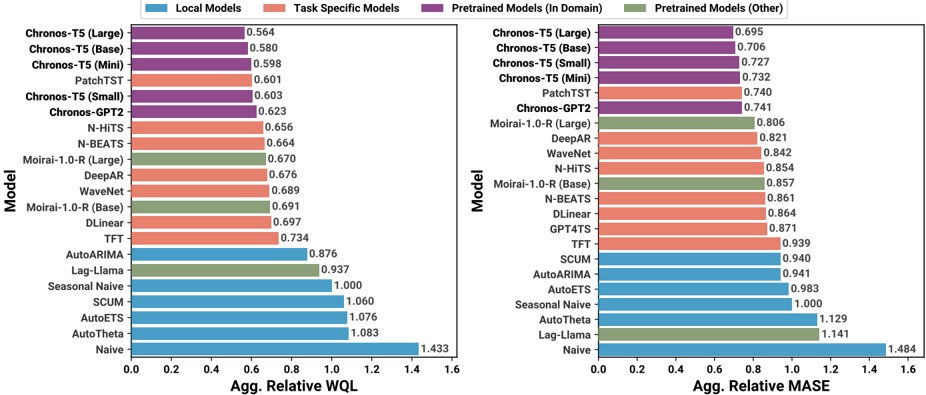
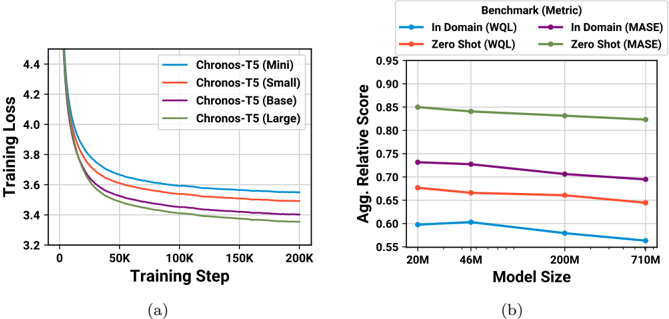
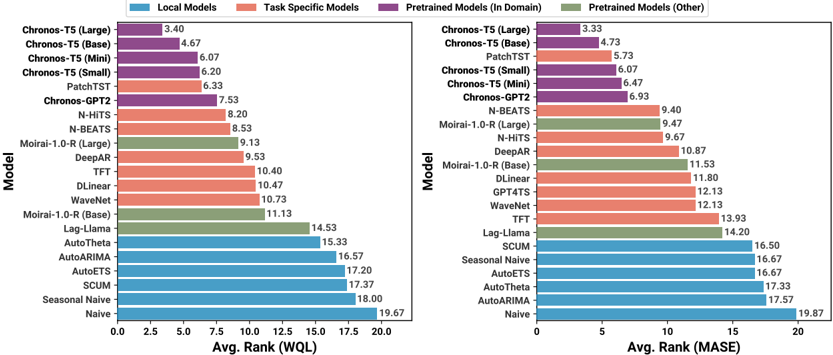
- On in-domain Benchmark I (15 datasets), Chronos-T5 Base/Large obtain the best aggregated relative scores: WQL 0.580/0.564 and MASE 0.706/0.695 versus Seasonal Naive 1.000, outperforming local, task-specific, and other pretrained baselines.
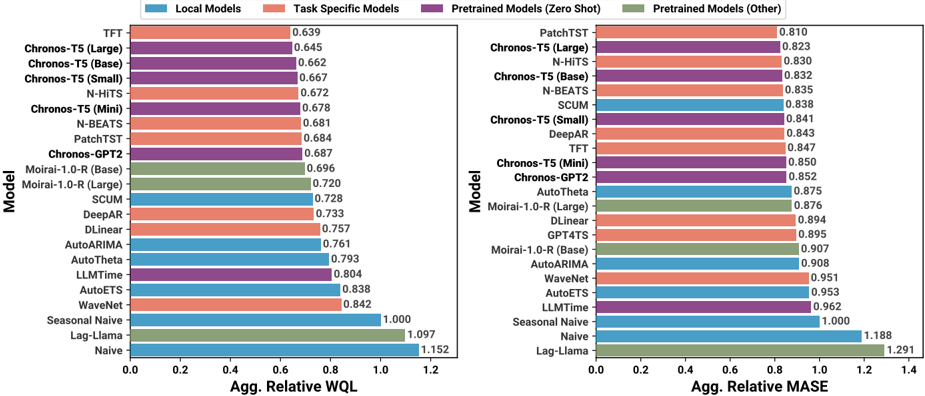
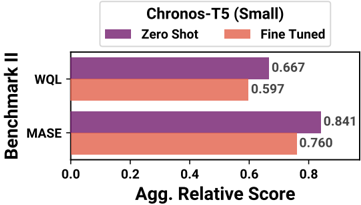
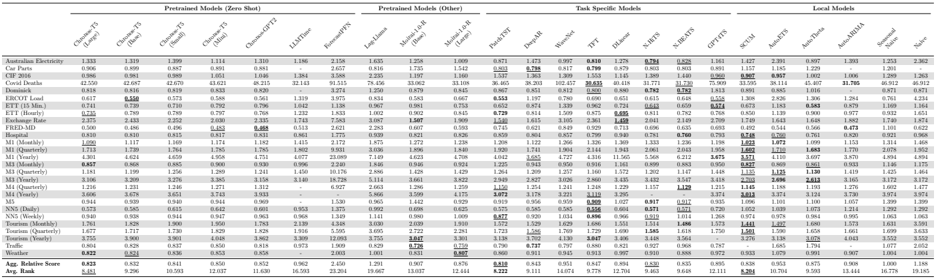
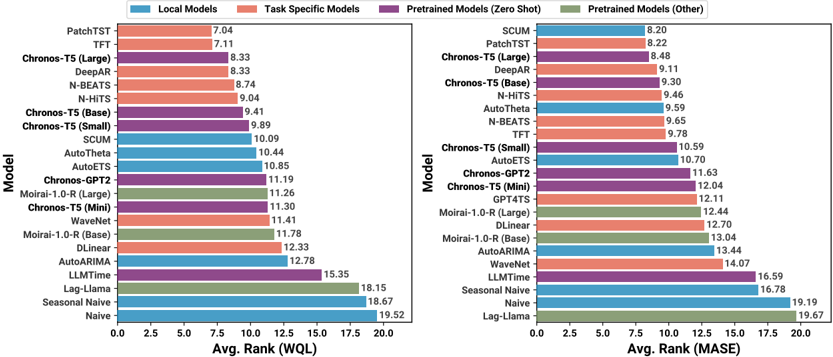
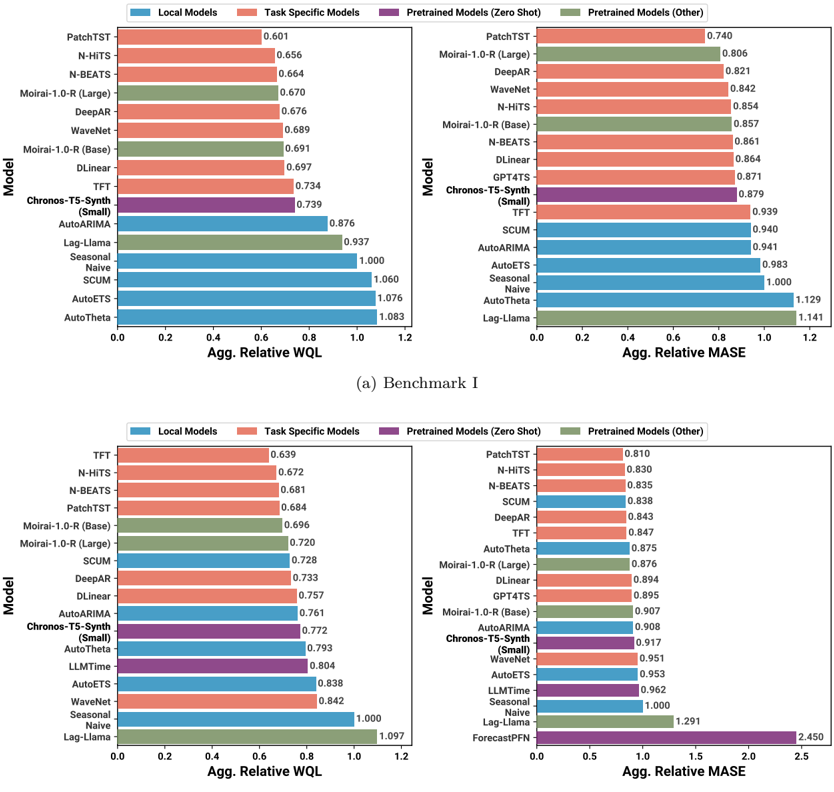
- On zero-shot Benchmark II (27 datasets), Chronos models rank 2nd–4th on WQL and Chronos-T5 Large ranks 2nd on MASE; aggregated relative WQL is 0.645 (Large), 0.662 (Base), 0.667 (Small), 0.678 (Mini), and MASE is 0.823, 0.832, 0.841, 0.850 versus Seasonal Naive 1.000. Fine-tuned Chronos-T5 Small becomes the best model on Benchmark II.
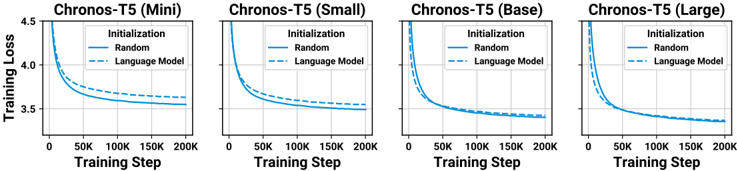
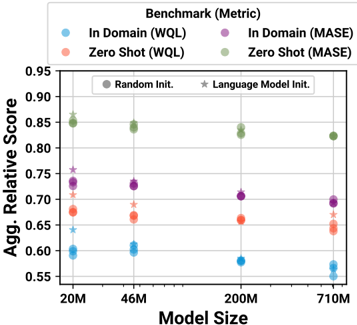
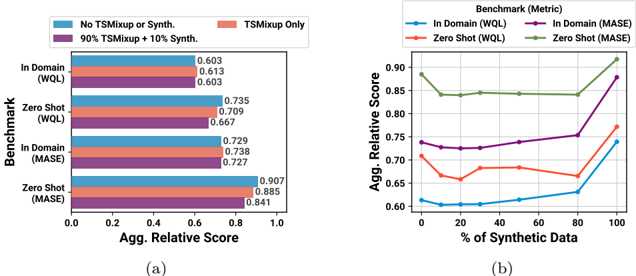
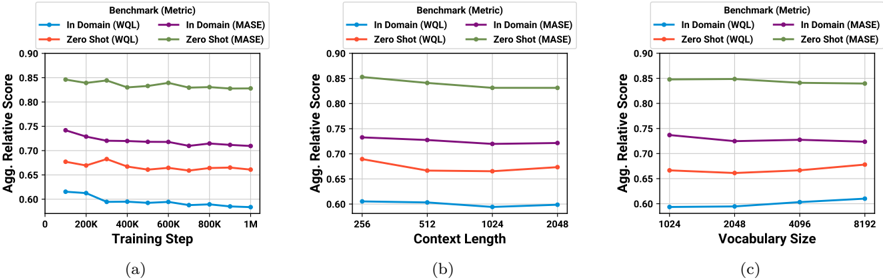
- Ablations show performance improves with model size; language-model-weight initialization offers little/no advantage over random initialization; TSMixup improves zero-shot performance; about 10% KernelSynth synthetic data is best; context length up to 1024 helps; larger vocabulary improves MASE but WQL deteriorates.
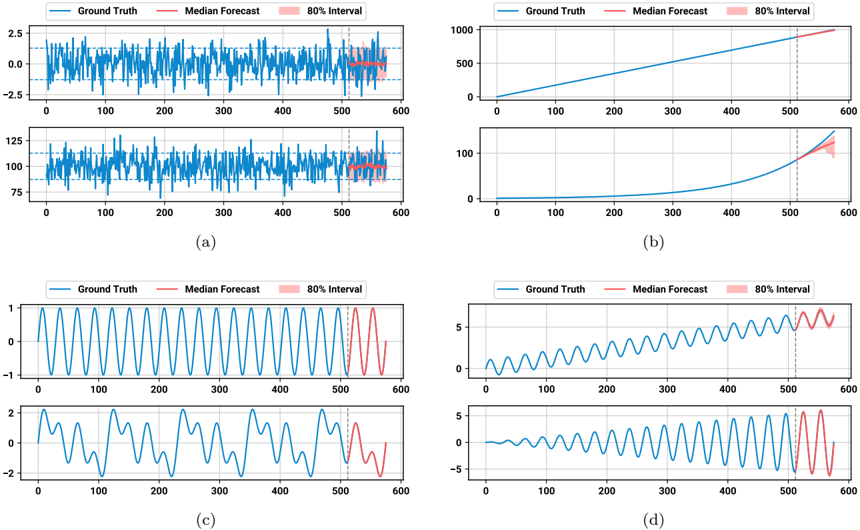
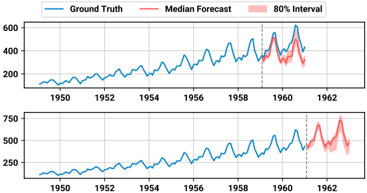
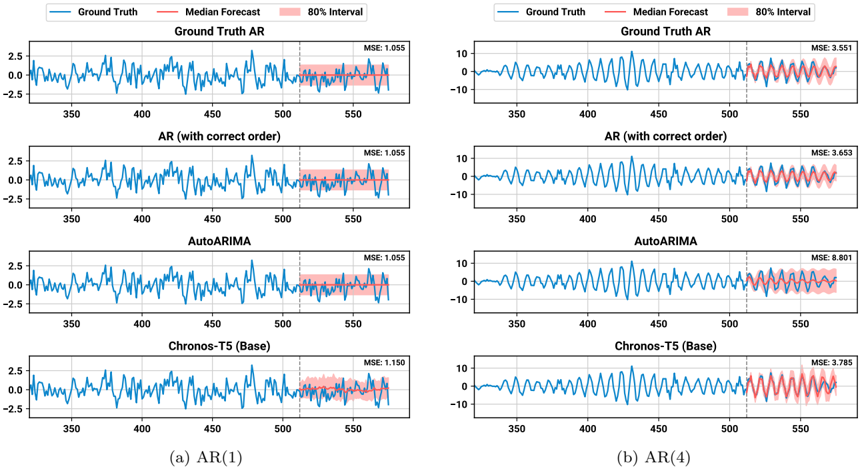
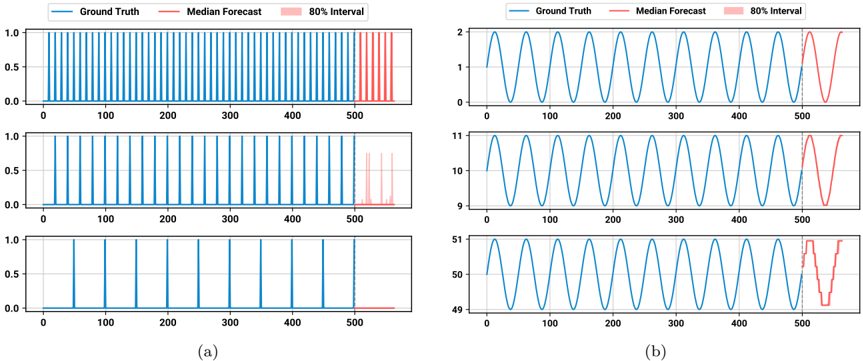
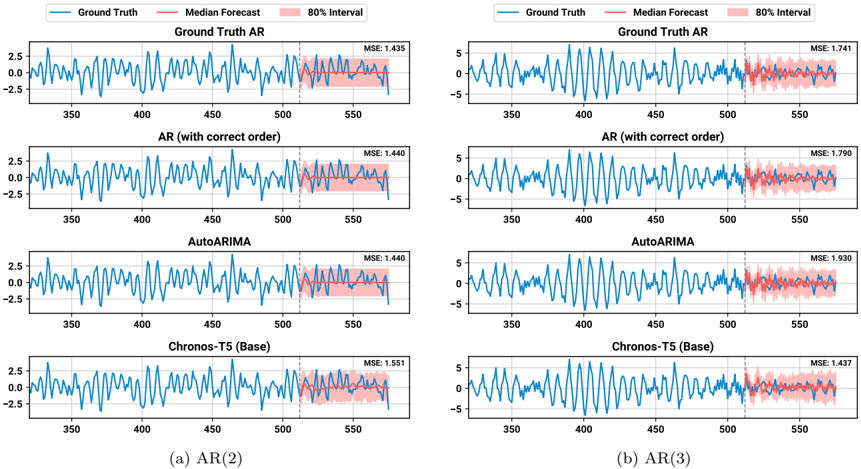
- Qualitatively, Chronos handles Gaussian noise, seasonality, additive/multiplicative trend+seasonality, and AR processes, but struggles with exponential trends and underestimates trend when context is short.
Methods
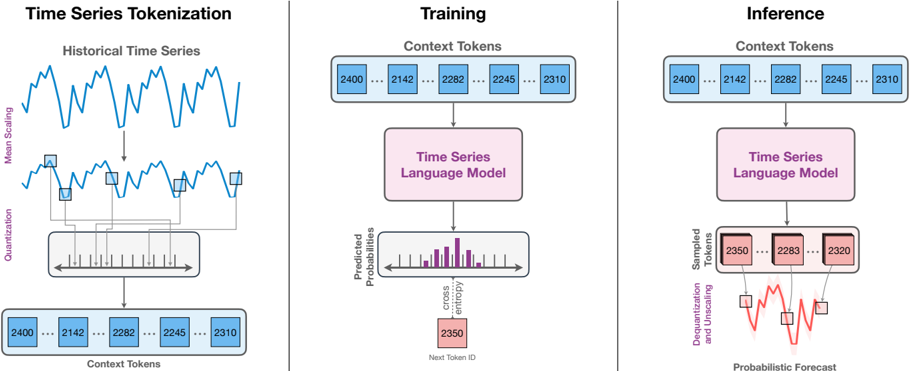
- Chronos mean-scales time series, uniformly quantizes values into B=4094 bins plus PAD/EOS (V_ts=4096), and trains off-the-shelf transformer language models with categorical cross-entropy; forecasts are produced by autoregressively sampling token paths and dequantizing/unscaling them.
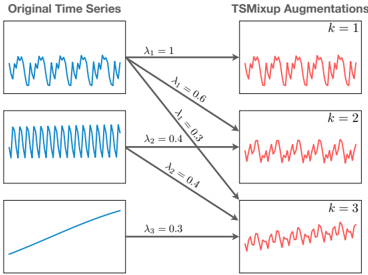
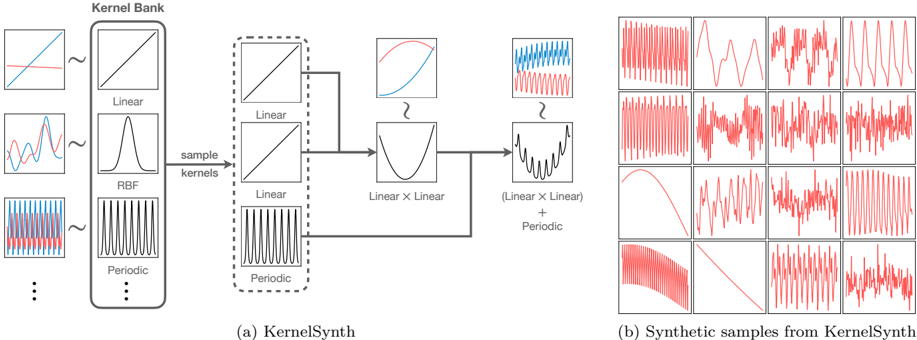
- Training used 55 datasets total: 13 pretraining-only, 15 Benchmark I in-domain, and 27 Benchmark II zero-shot; 28 training datasets comprised about 890K univariate series and approximately 84B observations/tokens. Models included T5 Mini 20M, Small 46M, Base 200M, Large 710M, and GPT-2 90M, trained with 10M TSMixup augmentations plus 1M KernelSynth GP synthetic series, context length 512, prediction length 64, and 200K AdamW steps.
- Evaluation used 42 benchmark datasets with WQL (9 quantiles) and MASE; relative scores versus Seasonal Naive were aggregated by geometric mean and compared against local, task-specific, and pretrained baselines, plus a fine-tuning experiment on Benchmark II.
Limitations
- The paper states tokenization limits: representable values are in [-15s, 15s] where s is the mean absolute scale; small s relative to range causes overflow, while large s relative to variance causes precision loss. It also notes poor exponential-trend forecasts, trend underestimation with short context, and that categorical cross-entropy is not distance-aware; ordinal modeling is left as future work.
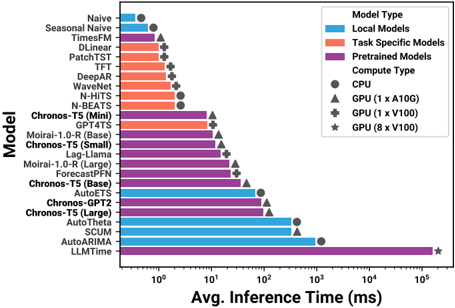
- The paper states scope limits: only univariate, uniformly spaced forecasting is studied; exogenous covariates, multivariate forecasting, and irregular sampling are not handled. Larger models were not explored due to slow inference, inference is slower than task-specific models, evaluation lacks enough high-frequency datasets to study long contexts, and public time series data remain limited.
- Text-evident: the zero-shot comparison may favor Moirai-1.0-R because many Benchmark II datasets were part of its pretraining corpus, as the paper notes; Chronos also ignores time and frequency information by design.
Model-written summary. Check it against the paper before relying on it.
Integrity signals
Registry
Cites
Statistics
Figures

Verification
Claims the paper makes
0 Valid · 4 Not valid · 14 Not checked · 146 Own results and interpretations
A result the paper reports from its own data — it cites no other source for it, so there is none to check. The quote shows it is in the paper.
In the paper
“Between the two baseline pretrained models studied in this experiment, Moirai-1.0-Rclearly outperforms Lag-Llama.”
§ Chronos: Learning the Language of Time Series > 5.5 Main Results
boosted- Asserted: passes — The authors put it forward as true.
- Checkable: passes — It can be checked against evidence.
- Load-bearing: unclear — It is unclear whether the paper’s conclusions depend on it.
- Based: passes — The paper gives a reason why it holds.
A result the paper reports from its own data — it cites no other source for it, so there is none to check. The quote shows it is in the paper.
In the paper
“Unsurprisingly, the training loss improves with the model capacity, as shown in Figure 7a.”
§ Chronos: Learning the Language of Time Series > Model size.
plainstates a cause- Asserted: passes — The authors put it forward as true.
- Checkable: passes — It can be checked against evidence.
- Load-bearing: unclear — It is unclear whether the paper’s conclusions depend on it.
- Based: passes — The paper gives a reason why it holds.
A result the paper reports from its own data — it cites no other source for it, so there is none to check. The quote shows it is in the paper.
In the paper
“Our comprehensive evaluation across 42 datasets establishes Chronos as a benchmark for both in-domain and zero-shot forecasting, surpassing both traditional models and task-specific deep learning approaches.”
§ Chronos: Learning the Language of Time Series > Time Series Tokenization Training Inference
plain- Asserted: passes — The authors put it forward as true.
- Checkable: passes — It can be checked against evidence.
- Load-bearing: passes — The paper’s conclusions depend on it.
- Based: passes — The paper gives a reason why it holds.
A result the paper reports from its own data — it cites no other source for it, so there is none to check. The quote shows it is in the paper.
In the paper
“consistent improvement is observed around the 10% synthetic data proportion.”
§ Chronos: Learning the Language of Time Series > Model size.
plainstates an association- Asserted: passes — The authors put it forward as true.
- Checkable: passes — It can be checked against evidence.
- Load-bearing: unclear — It is unclear whether the paper’s conclusions depend on it.
- Based: passes — The paper gives a reason why it holds.
A result the paper states — it cites no source for it, so there is none to check. The quote shows it is in the paper.
In the paper
“Further increasing the proportion of synthetic data tends to worsen performance.”
§ Chronos: Learning the Language of Time Series > Model size.
hedgedstates a possible cause- Asserted: passes — The authors put it forward as true.
- Checkable: passes — It can be checked against evidence.
- Load-bearing: unclear — It is unclear whether the paper’s conclusions depend on it.
- Based: passes — The paper gives a reason why it holds.
- Rests on an assumption not shown here.
94 more claims
Create a free account to see all 164 claims and to verify the 17 references still open.
- It may state two separate claims as one. 42
- Probably not a substantial claim. 30
Self-check
Percentages, sums and reported differences re-computed from the paper’s own numbers.
Each contradiction between two passages listed here was confirmed by an independent check.
Rated minor: it would not touch a result — a value no result rests on, a p-value that stays on the same side of the significance level, or a conflict that is clerical, resolved elsewhere in the paper, or outside its own findings.
In the paper
§ Chronos: Learning the Language of Time Series > Additional information
“Dominick (Godahewa et al., 2021) contains weekly time series representing the profit of individual stock keeping units from a retailer.”
§ Chronos: Learning the Language of Time Series > Covid Deaths
“Dominick retail 1D 100014 201 296 399 8”
Rated minor: it would not touch a result — a value no result rests on, a p-value that stays on the same side of the significance level, or a conflict that is clerical, resolved elsewhere in the paper, or outside its own findings.
In the paper
§ Chronos: Learning the Language of Time Series > C Baselines
“We considered a total of 17 baseline methods for benchmarking Chronos.”
§ Chronos: Learning the Language of Time Series > Chronos-GPT2 Chronos-T5 (Mini)
“Figure: Naive, SeasonalNaive, AutoETS, Auto-Theta, SCUM, AutoARIMA, DeepAR, TFT, PatchTST, DLinear, WaveNet, N-BEATS, N-HiTS, GPT4TS, Lag-Llama, Moirai-1.evaluationAll the above, LLMTime and ForecastPFN”
Citations
Cites
Exploring the Limits of Transfer Learning with a Unified Text-to-Text Transformer
Raffel, C., Shazeer, N., Roberts, A., Lee, K., Narang, S., Matena, M., Zhou, Y., Li, W., & Liu, P. J. (2019) · arXiv · doi:10.48550/arxiv.1910.10683 · Cited by 31,859
LoRA: Low-Rank Adaptation of Large Language Models
Hu, E. J., Shen, Y., Wallis, P., Allen-Zhu, Z., Li, Y., Wang, S., Wang, L., & Chen, W. (2021) · arXiv · doi:10.48550/arxiv.2106.09685 · Cited by 13,453
LightGBM: A Highly Efficient Gradient Boosting Decision Tree
(2017) · HAL · Cited by 10,512
Lewis, M., Liu, Y., Goyal, N., Ghazvininejad, M., Mohamed, A., Levy, O., Stoyanov, V., & Zettlemoyer, L. (2020) · Proceedings of the 58th Annual Meeting of the Association for Computational Linguistics · doi:10.18653/v1/2020.acl-main.703 · Cited by 8,821
Lewis, M., Liu, Y., Goyal, N., Ghazvininejad, M., Mohamed, A., Levy, O., Stoyanov, V., & Zettlemoyer, L. (2019) · arXiv · doi:10.48550/arxiv.1910.13461 · Cited by 8,816
Transformers: State-of-the-Art Natural Language Processing
Wolf, T., Debut, L., Sanh, V., Chaumond, J., Delangue, C., Moi, A., Cistac, P., Rault, T., Louf, R., Funtowicz, M., et al. (2020) · Proceedings of the 2020 Conference on Empirical Methods in Natural Language Processing: System Demonstrations · doi:10.18653/v1/2020.emnlp-demos.6 · Cited by 8,741
Informer: Beyond Efficient Transformer for Long Sequence Time-Series Forecasting
Zhou, H., Zhang, S., Peng, J., Zhang, S., Li, J., Xiong, H., & Zhang, W. (2021) · Proceedings of the AAAI Conference on Artificial Intelligence · doi:10.1609/aaai.v35i12.17325 · Cited by 7,752
mixup: Beyond Empirical Risk Minimization
Zhang, H., Cisse, M., Dauphin, Y. N., & Lopez-Paz, D. (2017) · arXiv · doi:10.48550/arxiv.1710.09412 · Cited by 5,831
Strictly Proper Scoring Rules, Prediction, and Estimation
Gneiting, T., & Raftery, A. E. (2007) · Journal of the American Statistical Association · doi:10.1198/016214506000001437 · Cited by 5,793
Another look at measures of forecast accuracy
Hyndman, R. J., & Koehler, A. B. (2006) · International Journal of Forecasting · doi:10.1016/j.ijforecast.2006.03.001 · Cited by 5,757
Research works printed but not linked: 8
- George Athanasopoulos, Rob J. Hyndman, Haiyan Song, and Doris C. Wu. The tourism forecasting compe- tition. International Journal of Forecasting, 27(3):822-844, 2011.
- Tom B. Brown, Benjamin Mann, Nick Ryder, Melanie Subbiah, Jared Kaplan, Prafulla Dhariwal, Arvind Neelakantan, Pranav Shyam, Girish Sastry, Amanda Askell, Sandhini Agarwal, Ariel Herbert-Voss, Gretchen Krueger, Tom Henighan, Rewon Child, Aditya Ramesh, Daniel M. Ziegler, Jeffrey Wu, Clemens Winter, Christopher Hesse, Mark Chen, Eric Sigler, Mateusz Litwin, Scott Gray, Benjamin Chess, Jack Clark, Christopher Berner, Sam McCandlish, Alec Radford, Ilya Sutskever, and Dario Amodei. Language models are few-shot learners. In Advances in Neural Information Processing Systems, 2020. 2, 3, 4
- Rob Hyndman, Anne B Koehler, J Keith Ord, and Ralph D Snyder. Forecasting with exponential smoothing: the state space approach. Springer Science & Business Media, 2008. 3, 9
- Alec Radford, Jeffrey Wu, Rewon Child, David Luan, Dario Amodei, Ilya Sutskever, et al. Language models are unsupervised multitask learners. OpenAI blog, 1(8):9, 2019. 4, 6
- Yaniv Romano, Evan Patterson, and Emmanuel Candes. Conformalized quantile regression. Advances in neural information processing systems, 32, 2019.
- Kai Ming Ting and Ian H Witten. Stacking bagged and dagged models. In Proceedings of the Fourteenth International Conference on Machine Learning, 1997. 20
- Ashish Vaswani, Noam Shazeer, Niki Parmar, Jakob Uszkoreit, Llion Jones, Aidan N. Gomez, Lukasz Kaiser, and Illia Polosukhin. Attention Is All You Need. In Advances in Neural Information Processing Systems, 2017.
- Yun Zhou, Liwen You, Wenzhen Zhu, and Panpan Xu. Improving time series forecasting with mixup data augmentation. In ECML PKDD 2023 International Workshop on Machine Learning for Irregular Time Series, 2023b. 7
Cited by
Items 1,101–1,200 of 2,048
Ma, H., Fang, J., Shi, D., Shao, Z., & Gao, J. (2026) · Information Fusion · doi:10.1016/j.inffus.2026.104325 · Cited by 1
VAN-AD: Visual Masked Autoencoder with Normalizing Flow for Time Series Anomaly Detection
Chen, P., Wang, S., Shi, X., Chang, Y., Sun, Y., & Das, S. K. (2026) · IEEE Transactions on Dependable and Secure Computing · doi:10.1109/tdsc.2026.3732446 · Cited by 1
Time Series Attributes Guided Pretraining Data Selection For Time Series Foundation Models
Saurav, K., Baghel, V., Jain, A., & Guruprasad, R. (2026) · IEEE International Conference on Acoustics Speech and Signal Processing · doi:10.1109/icassp55912.2026.11462456 · Cited by 1
Liu, H., Liu, Q., & Hu, Y. (2026) · Electronics · doi:10.3390/electronics15101988 · Cited by 1
Ravindran, S. M., & B, S. K. M. (2026) · Water Resources Management · doi:10.1007/s11269-026-04908-5 · Cited by 1
“Chronos models are pretrained time-series foundation models developed using large and diverse collections of real and synthetic time-series data, enabling forecasting on previously unseen series (Ansari et al. 2024).”
InfluentialInnecco, H., & Barreto, G. D. A. (2025) · Anais do ... Simpósio Brasileiro de Automação Inteligente/Simpósio Brasileiro de Automação Inteligente · Cited by 1
Rethinking Network Foundation Models: From Bigger Models to Better Data
Daneshamooz, J., Manda, H., Moghimi, M., Beltiukov, R., Willinger, W., & Gupta, A. K. (2026) · doi:10.1145/3843199.3857225 · Cited by 1
KineFlow: Kinematic Second-Order Flow Matching for Time-Series Forecasting
Jiang, H., & Xiong, H. (2026) · International Conference on Machine Learning · Cited by 1
Filter, Augment, Forecast: Online Data Selection for Robust Time Series Forecasting
Taga, E. O., Gozeten, H. A., Tire, K., Dalvi, R., Heckel, R., & Oymak, S. (2026) · International Conference on Artificial Intelligence and Statistics · Cited by 1
ConFlux: Multivariate Time Series in Flux, One Unified Forecast in Confluence
Wang, S., Ni, J., Zhang, Z., Mo, B., Zhong, X., Wang, C., Fang, Y., Ye, Z., & Xiang, Y. (2026) · International Conference on Machine Learning · Cited by 1
Cruz, J. B., Cuatianquiz, J. B. P., Roldán, R. E. M., & Ramos, D. R. (2026) · CEUR Workshop Proceedings · Cited by 1
Saleh, P., Armitage, J., Curtis, P., Abielmona, R., & Petriu, E. M. (2025) · IEEE International Systems Conference (SysCon) · doi:10.1109/syscon64521.2025.11014806 · Cited by 1
Li, Y., & Lu, X. (2025) · ACM International Joint Conference on Pervasive and Ubiquitous Computing (UbiComp) · doi:10.1145/3714394.3756199 · Cited by 1
Akella, A., & Farah, J. (2025) · arXiv · doi:10.48550/arxiv.2508.11680 · Cited by 1
“Contemporary foundation models include Chronos [1], which frames time series as a language modeling task using T5 architecture, and Moirai-MoE [10], which employs mixture-of-experts to handle heterogeneous series.”
Towards Explainable and Reliable AI in FinancePreprint
Isufaj, A., Mollá, P., & Prendinger, H. (2025) · SSRN Electronic Journal · doi:10.2139/ssrn.5632772 · Cited by 1
Predicting Missing Waste Data with Machine Learning
Andreasson, E., & Grafström, O. (2025) · Lund University Publications Student Papers (Lund University) · Cited by 1
Kristoffersen, S., & Nordby, P. S. (2024) · NVA (Nasjonalt vitenarkiv) · Cited by 1
Cisco Time Series Model Technical ReportPreprint
Gou, L., Khare, A., Pabolu, P., Patel, P., Ross, J., Shen, H., Yuhan, Song, Sun, J., Curtis, K., et al. (2025) · arXiv · doi:10.48550/arxiv.2511.19841 · Cited by 1
Self-citationTimeSynth: A Framework for Uncovering Systematic Biases in Time Series ForecastingPreprint
Haque, M. R., Goudar, V., Elhabian, S., & Pettine, W. W. (2026) · arXiv · doi:10.48550/arxiv.2602.11413 · Cited by 1
Don't Learn the Shape: Forecasting Periodic Time Series by Rank-1 DecompositionPreprint
Honda, T. (2026) · arXiv · doi:10.48550/arxiv.2605.07222 · Cited by 1
“We evaluate on GIFT-Eval [Aksu et al., 2024] (97 configurations, 23 datasets, 7 domains, 5-minute to yearly) and Chronos zero-shot [Ansari et al., 2024] (25 datasets via FEV [AutoGluon Team, 2025]).”
Yield Curve Forecasting using Machine Learning and Econometrics: A Comparative AnalysisPreprint
Singh, A., Ogunfunmi, T., & Das, S. (2026) · arXiv · doi:10.48550/arxiv.2605.09842 · Cited by 1
In-Context Learning for Data-Driven Censored Inventory ControlPreprint
Mukherjee, S., Pham, A.-D., Pibernik, R., & Xu, Y. (2026) · arXiv · doi:10.48550/arxiv.2605.14840 · Cited by 1
Does Normalization Choice Matter for Causal Large Time-Series Models?Preprint
Vilhes, S.-M., Gasso, G., & Alaya, M. Z. (2026) · arXiv · doi:10.48550/arxiv.2606.09954 · Cited by 1
Time-Series Foundation Model Embeddings for Remaining Useful Life EstimationPreprint
El-Ghoussani, A., Vita, M. D., Naumann, R., & Belagiannis, V. (2026) · arXiv · doi:10.48550/arxiv.2606.11990 · Cited by 1
“Recent approaches such as Chronos [8] and its successor C HRONOS -2 [16] are probabilistic transformer-based TSFMs.”
Stable Multivariate Functional Time Series Prediction for Major Geomagnetic IndicesPreprint
Yu, Y., Zou, S., Pulkkinen, T. I., & Chen, Y. (2026) · arXiv · doi:10.48550/arxiv.2606.14417 · Cited by 1
“Two are nonlinear: an LSTM encoder– decoder network (Tan et al. 2018) and the pretrained time series foundation model CHRONOS (Ansari et al. 2024).”
InfluentialPublic transit gains and spatially uneven travel demand changes after NYC congestion pricingPreprint
Li, D., Zhuang, D., Li, Y., Shen, C., Cao, N., Zheng, Y., Wang, S., & Zhao, J. (2026) · arXiv · doi:10.48550/arxiv.2606.17530 · Cited by 1
From Forecasting Leaderboards to Deployment Decisions: A Fail-Closed Certification ProtocolPreprint
Kim, G. (2026) · arXiv · doi:10.48550/arxiv.2606.24996 · Cited by 1
Crossing-Free Probabilistic K-Line Forecasts Without RetrainingPreprint
Yu, R., Tao, Y., Chen, Y., Wang, W., & Bunn, D. W. (2026) · arXiv · doi:10.48550/arxiv.2607.26792 · Cited by 1
Transforms All the Way Down -Automatic Online Distributional Forecasting by ConjugationPreprint
Cotton, P. (2026) · SSRN Electronic Journal · doi:10.2139/ssrn.7220478 · Cited by 1
When the Martingale Never Stops Firing: Anytime-Valid Gating on Real Forecast StreamsPreprint
Han, W., & Qu, L. (2026) · arXiv · doi:10.48550/arxiv.2608.30502 · Cited by 1
“We use TiRex [Auer et al., 2025], Chronos-2 [Ansari et al., 2024, 2025], and TimesFM 2.5 [Das et al., 2024], the last a checkpoint release of the cited model line.”
InfluentialHorizon-specific Expert Fusion for Photovoltaic Power ForecastingPreprint
Yuqing, X., Liguo, Z., Ze, S., Lei, Y., & Mingming, J. (2026) · arXiv · doi:10.48550/arxiv.2609.15035 · Cited by 1
“Chronos and TimesFM study transfer from heterogeneous time series [14, 15]; Chronos-2 extends forecasting to multivariate inputs and future covariates [16].”
OrderFusion+: Probabilistic Buy--Sell Price Trajectory Forecasting in Intraday Electricity MarketsPreprint
Yu, R., & Bunn, D. W. (2026) · arXiv · doi:10.48550/arxiv.2609.23598 · Cited by 1
“Additionally, foundation models are increasingly being explored for time-series forecasting, including TimesFM [32], Chronos [33], Moirai [34], and TabPFN-TS [35].”
TRACE: A Reproducible Benchmark for Electricity Price Forecasting with Official Operational TextPreprint
Yi, X., Yuan, M., & Lestas, I. (2026) · arXiv · doi:10.48550/arxiv.2610.02256 · Cited by 1
“Seven zero-shot time-series foundation models serve as baselines: TimesFM 2.5 [26], TimesFM 3.0 [27], Chronos-Bolt-Tiny/Base [28], Chronos-2 [29], Moirai-2 [30], and Sundial [31], using 336 hours of history to forecast 24 hours.”
InfluentialWorld2TS: Real-World Event Context for Time-Series ForecastingPreprint
Liu, Z., Yang, J., Cheng, M., Li, Z., & Chen, E. (2026) · arXiv · doi:10.48550/arxiv.2610.14861 · Cited by 1
“Discrete language models quantize time-series values into tokens for probabilistic forecasting [29].”
GIFT-Eval-CTX: A Benchmark For Contextual Forecasting Model EvaluationPreprint
Liu, X., Yan, H., Aksu, T., Pham, Q., Qiao, Z., Liew, J. H., Savarese, S., Sahoo, D., & Li, J. (2026) · arXiv · doi:10.48550/arxiv.2610.17794 · Cited by 1
IND-Eval: Aligning Evaluation and Simulation for Industrial Time Series Foundation ModelsPreprint
Haugland, V., Gulin, P., Foss, D., Cremer, P., Aune, E., Casolo, S., Solbrå, A., & Mobarhan, M. (2026) · arXiv · doi:10.48550/arxiv.2610.16652 · Cited by 1
“TSFMs are increasingly trained on simulated data (Das et al., 2024; Ansari et al., 2024), and simulator composition materially affects downstream performance (Nagpal et al., 2026).”
Look Back, Correct Forward: Error Feedback Calibration for Time Series ForecastingPreprint
Yang, H., He, Y., Li, Z., Zhao, J., & Tan, H. (2026) · arXiv · doi:10.48550/arxiv.2610.22872 · Cited by 1
“…5 state-of-the-art forecasting backbones with diverse architectures, including Transformer-based models: PatchTST [36], iTransformer [34], TimeBridge [48]; MLP-based models: DLinear [44], PatchMLP [49]; and 5 foundation models: VisionTS [42], Sundial [40], Chronos-Bolt [50], Moirai [37], TimesFM-2.”
Haresamudram, H., Tang, C. I., Suh, S., Lukowicz, P., & Ploetz, T. (2024) · arXiv · Cited by 31
“Chronos [4] is a family of time-series foundation models trained on a large collection of publicly available datasets.”
Efficient Time Series Processing for Transformers and State-Space Models through Token Merging
Götz, L., Kollovieh, M., Günnemann, S., & Schwinn, L. (2024) · arXiv · doi:10.48550/arxiv.2405.17951
Test-time regression: a unifying framework for designing sequence models with associative memory
Wang, K. A., Shi, J., & Fox, E. B. (2025) · arXiv · doi:10.48550/arxiv.2501.12352
Bees and bytes: A systematic review of artificial intelligence in honey bee research (2011–2025)
Moshavash, M., Suresh, H., Eftekhari, M., & Vahdati, S. (2026) · Computers and Electronics in Agriculture · doi:10.1016/j.compag.2026.112426
Lin, Y., Ouyang, H., Chen, H., Xiong, L., Hong, Z., & Wang, Z. (2026) · Research Square · doi:10.21203/rs.3.rs-9833534/v1
GridCL for fine-grained load profiling in smart grids under limited labels
Zhang, L., Wang, J., Zhang, W., Li, K., Yao, D., Yang, B., Ke, X., Zhao, H., & Yao, Y. (2026) · PLoS ONE · doi:10.1371/journal.pone.0354752
ForExAI: Time Series Inference and News Article Analysis Reveal Profitable Foreign Exchange Signals
Lemeneh, B., Hadad, E., Ajith, A. G., Hou, Y., Zha, C., Scarozza, G., Baannou, Z., Liyeh, E., Tomasic, A., & Shasha, D. E. (2026) · Mathematics · doi:10.3390/math14132319
Statistical Predictability versus Economic Value: Evaluating Time Series Models against GARCH-MIDASPreprint
Chuang, O., Xiao, H.-Y., & Chuang, H.-C. (2026) · SSRN Electronic Journal · doi:10.2139/ssrn.7383932
Iklassov, Z., Madmoun, H., Duhot, J.-J., & Lahlou, S. (2026) · ACM SIGKDD Conference on Knowledge Discovery and Data Mining (KDD) · doi:10.1145/3770855.3816459
TimesFNP: Contrastive Learning for Financial Domain with Noise-Resilient Prediction
Shen, S., Li, Q., Chen, Y., Cheng, R., & Zheng, Y. (2025) · International Conference on Computing and Artificial Intelligence (ICCAI) · doi:10.1109/iccai66501.2025.00111
Pretrained Deep Learning Models in Economic Forecasting: A New Frontier
Szabados, L., & Obadovics, C. (2025) · Springer proceedings in business and economics · doi:10.1007/978-3-031-91686-1_8
An, F., Ma, X., Shen, N., He, Y., Hao, Y., Jiang, L., & Duan, J. (2026) · IEEE Sensors Journal · doi:10.1109/jsen.2026.3720358
“Masked autoencoding [19], [20], contrastive pretraining [21], [22], [23], [24], and, more recently, general-purpose time-series representation models [24], [25], [26], [27], [28], [29] have demonstrated strong transferability in natural-image, natural-language, and generic time-series settings.”
DiffNator: Generating Structured Explanations of Time-Series Differences
Dohi, K., Nishida, T., Purohit, H., Endo, T., & Kawaguchi, Y. (2026) · IEEE International Conference on Acoustics Speech and Signal Processing · doi:10.1109/icassp55912.2026.11461949
Cui, W., Zhou, X., Wang, H., Xu, X., & Weng, L. (2026) · Applied Sciences · doi:10.3390/app16157765
Self-citationBaşar, T., Djehiche, B., & Tembiné, H. (2025) · Static & dynamic game theory: foundations & applications · doi:10.1007/978-3-032-07031-9_8
Dense Feature Learning via Linear Structure Preservation in Medical DataPreprint
Zhang, Y., Zhang, M., Li, S., Wang, Z., Chen, H., Zhou, W., & Li, S. (2026) · arXiv · doi:10.48550/arxiv.2602.07706
RAMTime: Retrieval-Augmented Memory for Time Series Forecasting
Wu, Y., & Li, J. (2026) · IEEE International Conference on Acoustics Speech and Signal Processing · doi:10.1109/icassp55912.2026.11462579
Omar, N., Vengadeswaran, S., & Mohamedsipli, M. (2026) · International Conference on Signal Processing and Communications (SPCOM) · doi:10.1109/spcom71105.2026.11622975
Kow, P. E., & Kow, P.-Y. (2026) · Results in Engineering · doi:10.1016/j.rineng.2026.112663
Leveraging regulatory policy and media signal for carbon price forecasting
Yang, Q., & He, K. (2026) · Procedia Computer Science · doi:10.1016/j.procs.2026.08.056
Unsupervised Representation Learning for Time Series Anomaly Detection: Overview and new Trends
Hamida, O. I., Boudane, F., & Berrichi, A. (2026) · International Conference on Pattern Analysis and Intelligent Systems (PAIS) · doi:10.1109/pais69842.2026.11605406
“1) The Zero Shot Approach: Inspired by the success of Large Language Models (LLMs), TSFMs such as TimeGPT [16], MOMENT [18], and Chronos [5] are pre-trained on massive, heterogeneous repositories of time series data.”
Сравнение современных методов прогнозирования доходностей криптовалют с бенчмарком SARIMA
Синельникова-Мурылева, Е. В., & Shkanov, B. (2026) · Higher School of Economics Economic Journal · doi:10.17323/ej.2026.33618
Reducing Experimentation Training Overhead in Time Series Forecasting through LLM Adaptation
Germán-Morales, M., Rivera, A. J., del Jesús, M. J., & Carmona, C. J. (2025) · Lecture notes in computer science · doi:10.1007/978-3-032-10489-2_26
Reliable Stock Prediction: Data, Models, Testing
Xie, G. (2026) · Frontiers in Computing and Intelligent Systems · doi:10.54097/rk4ss359
“…established a strong baseline using low-complexity linear decomposition [4]; Nie et al. proposed PatchTST integrated cross-scale information through shard tokenization [5]; TimeGPT-1 [6] and Chronos [7] provide a unified risk interface with cross-domain pre-training and probabilistic output.”
TimeHome: Heterogeneous Mixture-of-Experts for Time-Series Foundation Model
Zhang, T., Wu, X., Li, X., & Wu, D. (2026) · Remote Sensing · doi:10.3390/rs18152533
Foundation models do not beat simple volatility benchmarks: Evidence from 5000 Chinese stocks
Zhong, Y., Fu, Y., & Zhu, S. (2026) · Finance research letters · doi:10.1016/j.frl.2026.110606
He, Q., Zhu, X., Zhou, Y., Ding, F., & Chen, W. (2026) · International Conference on Intelligent Control and Information Processing · doi:10.1109/icicip67436.2026.11417616
“Chronos [31] abandons traditional numerical normalization methods and quantifies continuous time series values into a series of discrete Token vocabularies.”
Akbarifar, F., Maghsoodi, N., Dukelow, S. P., Scott, S. H., & Mousavi, P. (2026) · Journal of NeuroEngineering and Rehabilitation · doi:10.1186/s12984-026-02012-8
“In our experiments we instantiate this idea with two representative forecasters, Chronos [28] and MOMENT [29], compared with a classical baseline (ARIMA) [30].”
InfluentialYashwante, P., Gombatto, S. P., Velazquez, Y., Wyckoff, E., Lalwani, A., Patrick, K., Loh, K. J., Farcas, E., & Yu, R. (2026) · Sensors · doi:10.3390/s26134187
“Recent work has proposed pretrained TSFMs as general-purpose representations that can transfer across diverse temporal domains [35,36].”
Xu, S., Wang, R., Tong, X., & Wu, X. (2026) · International Conference on Artificial Intelligence and Industrial Technology Applications (AIITA) · doi:10.1109/aiita69518.2026.11567369
“In industrial scenarios, traditional temporal abstraction methods (e.g., TimeGPT [8] , Chronos [9] ) use fixed-time windows for aggregation, which are designed for pure numerical data and cannot handle mixed “text+numerical+event” industrial logs; fixed windows also fail to adapt to dynamic…”
A State-Of-The-Art Review of Industrial Time Series Data Analysis: Methods and Applications
Liu, L., Zhang, Y., Sun, Y., Cai, H., & Wang, C. (2026) · ACM Computing Surveys · doi:10.1145/3844497
Ploszajski, M., Tam, G. K. L., & Xie, X. (2026) · Lecture notes in computer science · doi:10.1007/978-3-032-35387-0_10
Generative temporal alignment and market knowledge discovery for financial news streams
Sun, X. (2026) · Applied Soft Computing · doi:10.1016/j.asoc.2026.116608
Exploring the Use of Time Series Foundation Model for Car-Following Behavior Analysis
Zeng, L., & Yan, R. (2025) · ASCE International Conference on Transportation and Development (ICTD) · doi:10.1061/9780784486191.026
Foundation Model-Driven Auto-Annotation: A Multi-Modal Toolbox for General-Purpose Data Labeling*
Ntampakis, N., Tziolas, G., Dimitriadis, V., Vasilakis, C., Tsiamitas, G., Markakis, A., Kolokouris, C., Argyriou, V., & Sarigiannidis, P. (2026) · IEEE Conference on Artificial Intelligence (CAI) · doi:10.1109/cai68641.2026.11536544
“AutoAnnotate-TimeSeries Embeddings: The temporal tool extends the embedding extraction to time series data using the Chronos [4] family of foundation models.”
ChronoTab: Forecasting Multivariate Time Series with Tabular LLMs
Zeakis, A., Chatzigeorgakidis, G., Lentzos, K., & Skoutas, D. (2025) · IEEE International Conference on Data Engineering Workshops (ICDEW) · doi:10.1109/icdew67478.2025.00025
Recovering Dark Geometry to Forecast Complex SystemsPreprint
Stavroglou, S. K., & Pantelous, A. A. (2026) · SSRN Electronic Journal · doi:10.2139/ssrn.6081526
Robust Short-Term OEE Forecasting in Industry 4.0 via Topological Data AnalysisPreprint
Anapa, K., Güzel, İ., & Yozgatlıgil, C. (2026) · SSRN Electronic Journal · doi:10.2139/ssrn.6207839
Deceptive Synthetic Updates: Stealth Free-Rider Attack on Model Aggregation in Federated Learning
Lee, Y., Gong, J., & Kang, J. (2025) · ACM International Conference on Information and Knowledge Management (CIKM) · doi:10.1145/3746252.3760949
Wang, R. (2026) · SSRN Electronic Journal · doi:10.2139/ssrn.7239483
PRICE: A Systematic Study of LLM Adaptation Choices for Bitcoin Price ForecastingPreprint
Fakhari, M., & Safayani, M. (2026) · arXiv · doi:10.48550/arxiv.2609.05235
“Chronos [25] adopts a tokenization-based formulation that converts continuous signals into discrete representations, enabling compatibility with language model architectures and supporting zero-shot inference.”
Chen, T., Ma, X., Zhang, Y., Zhan, T., Sun, M., & Cui, L. (2026) · arXiv · doi:10.48550/arxiv.2608.20005
“Encoder-decoder models such as LightGTS [19] and Chronos [13] use parallel decoding or discretized objectives.”
Luo, J., Zhi, X., Han, R., Kumbara, A., Shomali, M. E., Iyer, A. K., Agarwal, R., & Gao, G. G. (2026) · ACM SIGKDD Conference on Knowledge Discovery and Data Mining (KDD) · doi:10.1145/3770855.3817572
ReasonCast: Towards Explainable Time Series Forecasting with ReasoningPreprint
Lee, S., Seo, J., Lee, J., Kang, J., Han, S., Yoo, S., Kim, M., Lim, T. Y., Kang, D., Choi, H., et al. (2026) · arXiv · doi:10.48550/arxiv.2608.01875
“Time series (TS) models have traditionally been built for forecasting by generating future numeric values from past observations (i.e., generation ( G )) (Nie et al. 2023; Ansari et al. 2024).”
RAID: Semantic Graph Diffusion for True Cold-Start and Cross-Lingual ForecastingPreprint
Arunkumar, V., Gandhudi, M., R, G. G., Prakash, A., & Senthilkumar, S. (2026) · arXiv · doi:10.48550/arxiv.2606.16925
“Foundation models like TimesFM [2] and Chronos [1] claim zero-shot capabilities, yet their published “zero-shot” setting still requires each test item to carry its own history window ( L > 0) [3–5].”
FoRSe: A Retrieval-Augmented Framework for Time Series Forecasting
Wang, X., Sun, M., Ran, H., Wang, Z., Shi, N., Ma, Y., & Hu, Q. (2026) · IEEE International Conference on Acoustics Speech and Signal Processing · doi:10.1109/icassp55912.2026.11463579
Frequency-Guided Deformable Networks for Continuous Phase AlignmentPreprint
Jiang, W., Yang, H., Xu, J., & Zhang, J. (2026) · arXiv · doi:10.48550/arxiv.2603.21718
“Furthermore, in zero-shot forecasting tasks, its capability of large-scale pre-training on massive, heterogeneous multi-domain datasets has resolved many real-world cold-start problems, as seen in TimeGPT-1 [22], Chronos [23], and Moirai [24].”
Do Your Own Research: Learning to Forecast by Learning to SearchPreprint
Afifi, Y., Kiulian, A., Polishko, A., Khandoga, M., Naanaa, H., & Krasnobrizha, A. (2026) · arXiv · doi:10.48550/arxiv.2610.01955
Can Language Models Learn to Forecast Stock Prices?Preprint
Guo, J., Huang, S., Li, S., Gao, Y., Cheng, Z., Ge, J., Liang, S., Li, Z., Lu, H., Yin, M., et al. (2026) · arXiv · doi:10.48550/arxiv.2609.36914
“Time-series approaches use language-model representations or specialized forecasting models (Ansari et al., 2024; Gruver et al., 2023; Jin et al., 2024).”
Aurora-X: Built for Extreme Time Series ForecastingPreprint
Wu, X., Guo, C., Qiu, X., Hu, Z., Cheng, H., Chen, P., Shu, Y., Hu, J., & Yang, B. (2026) · arXiv · doi:10.48550/arxiv.2609.31038
“Moirai uses mixture distributions, Chronos-2 and Toto-2.”
InfluentialGRAM: Correcting Frozen Time-Series Foundation Models via Graph-Retrieved Amplitude MemoryPreprint
Yu, X., Qiu, X., Huang, Y., Tang, S., Dong, N., Ouyang, W., Pu, G., Qi, H., Hu, J., & Chen, X. (2026) · arXiv · doi:10.48550/arxiv.2610.04827
Gao, T., Shen, L., & Lu, Z. (2026) · Journal of Marine Science and Engineering · doi:10.3390/jmse14191832
“Through pre-training augmented by massive synthetic data, models have attained robust fine-tuning and zero-shot predictive capabilities, including Moirai [54], Chronos [55] and Ti-Rex [56].”
Least Squares for Time Series ForecastingPreprint
Ciang, W.-Q., Hong, Y., & Chen, S. (2026) · arXiv · doi:10.48550/arxiv.2610.03812
“Time-series foundation models that are scored on those windows (Ansari et al., 2024; Yue et al., 2022; Dong et al., 2023; Ekambaram et al., 2023) should be read by which program their loss implements.”
UniVQ: Vector quantization is effective for unified time series forecasting
Zhang, X., Chen, Z., Liu, W., & Zhu, M. (2026) · Neural Networks · doi:10.1016/j.neunet.2026.109704
Self-citationLatent Inference-Time Guidance of Time Series Foundation ModelsPreprint
Hashimoto-Cullen, C., Durand, A., Bozzi, L., Guedj, B., Goude, Y., & Corff, S. L. (2026) · arXiv · doi:10.48550/arxiv.2609.38058
“A wealth of these models are currently available (Grinsztajn et al., 2025; Ansari et al., 2025; Liu et al., 2025a; Auer et al., 2026; Qu et al., 2026), with benchmarks such as GIFT-Eval, fev-bench and Chronos available to compare them (Aksu et al., 2024; Shchur et al., 2025; Ansari et al., 2024).”
ALICE: In-context, Zero-shot, Mutual Information EstimationPreprint
Franzese, G., Rossi, S., & Michiardi, P. (2026) · arXiv · doi:10.48550/arxiv.2609.34962
“Our method builds on recent work on in-context learning and set transformers, including the scalar tokenization of Chronos (Ansari et al., 2024), the any-variate attention of Moirai (Woo et al., 2024), and the amortized in-context inference of TabPFN (Hollmann et al., 2023) and TabICL (QU et al.,…”
One-Step Next-Latent Prediction Is Not a World ModelPreprint
Wang, S., Cai, Z., & Hong, Y. (2026) · arXiv · doi:10.48550/arxiv.2609.36227
“Decomposition transformers and time-series foundation models are scored on the same long window (Wu et al., 2022a; Ansari et al., 2024; Yue et al., 2022).”
Fracast-0: Fractal Weight Sharing for a Time Series Foundation Model with Only 85K ParametersPreprint
Zhan, T., Zhang, H., & He, Y. (2026) · arXiv · doi:10.48550/arxiv.2609.32209
“The scaling study compares released checkpoints of Moirai and Moirai 2.0 (Woo et al., 2024; Liu et al., 2025), TimesFM (Das et al., 2024), Chronos-Bolt and Chronos-2 (Ansari et al., 2024, 2025), Toto 2.0 (Khwaja et al., 2026), TiRex and TiRex-2 (Auer et al., 2025; Podest et al., 2026), FlowState (Graf et al., 2026), K…”
InfluentialZhu, M., Han, X., Wu, J., Zhu, H., & Chai, W. (2026) · Air Quality Atmosphere & Health · doi:10.1007/s11869-026-02105-2
“Most graph forecasting architectures require synchronized observations from multiple stations and an explicit adjacency structure at inference time, whereas the common numerical setting uses only the current 96 h sequence from the target station.”
Palomero, L., García, V., & Sánchez, J. S. (2026) · International Journal of Computational Intelligence Systems · doi:10.1007/s44196-026-01582-8
Parameter-Efficient Adaptation of Pretrained Language Models for Time-Series ForecastingPreprint
Kumavat, T., Brunner, G., & Flouris, K. (2026) · arXiv · doi:10.48550/arxiv.2609.15344
“This has motivated growing interest in repurposing pretrained Transformers for time-series forecasting [9,1,8,14,27].”
InfluentialYang, Z. (2026) · Exploring Science Academic Conference Series · doi:10.70267/aitia.2026316325
“Representative models such as Chronos, TimeGPT, TimesFM, and Lag-Llama demonstrate the potential of large-scale pretraining to learn reusable temporal representations that can be applied across diverse forecasting scenarios [28 – 31].”
A Multi-Resolution Multi-Domain Pre-Training Framework for Universal Traffic ForecastingPreprint
Liu, Z., Han, J., Wang, H., Liu, X., Gao, H., Li, D., & Liu, H. (2026) · arXiv · doi:10.48550/arxiv.2609.13878
Self-citation
Metadata
- Authors
- Ansari, A. F., Stella, L., Turkmen, C., Zhang, X., Mercado, P., Shen, H., Shchur, O., Rangapuram, S. S., Arango, S. P., Kapoor, S., Zschiegner, J., Maddix, D. C., Wang, H., Mahoney, M. W., Torkkola, K., Wilson, A. G., Bohlke-Schneider, M., & Wang, Y.
- Affiliations
- Amazon (United States) (US)
- University of California San Diego (US)
- University of Freiburg (DE)
- Rutgers, The State University of New Jersey (US)
- ORCID
- Venue
- arXiv
- Publisher
- arXiv
- Published
- 2024
- ISSN
- 2835-8856 (ISSN-L)
- arXiv
- 2403.07815
- OpenAlex
- W4392781393
- Cited by
- 2,046
- References
- 92
- Citations by year
- 2026: 1398 · 2025: 520 · 2024: 126
- FWCI
- 245.30
- Type
- journal article
- Language
- en
- Open access
- diamond
- openreview.net
- Licence
- Locations
- Transactions on machine learning research (publishedVersion, cc-by)
- arXiv (submittedVersion, public-domain)
- Topics
- Physical Sciences › Computer Science › Signal Processing › Time Series Analysis and Forecasting
- Social Sciences › Decision Sciences › Management Science and Operations Research › Forecasting Techniques and Applications
- Social Sciences › Decision Sciences › Management Science and Operations Research › Stock Market Forecasting Methods
- Keywords
- time series forecasting, transformer language models, T5, zero-shot forecasting, Chronos
About these checks
Registry, retraction, Cites and statistics results are computed, not judged, with one exception: a printed reference that no index lists is read once by a model before it counts as a citation error. Claims are extracted by a model and kept only when their quote appears verbatim in the text; each cited source is then checked, with a model’s help, for whether it says what the claim relies on. Those verdicts can be wrong — read the claim’s quote and the cited source before relying on one.
A language model drew the claims from the paper on 2026-11-28, under version 3 of the claim definition (model deepseek-v4.1-flash, prompt extract-v3).
A second model labelled each claim on 2026-11-28 (model jev-1.13-20260917, definition revision gold-guideline-v0.2).
Statistics and arithmetic are recomputed, not judged.
Confidence bands are shown only for fields calibrated on our annotated test set. None is calibrated yet, so no band is shown.
What counts as a claim ›How we measure confidence ›How we check this ›
Are you an author, or do you see a problem with this page? Request a review
Data sources
Bibliographic data: Semantic Scholar, OpenAlex, Crossref.
Contains information from the Semantic Scholar Academic Graph Datasets, made available under the ODC Attribution License (ODC-BY 1.0).
Semantic Scholar’s data is described in: Kinney, R., et al. (2023). The Semantic Scholar Open Data Platform. arXiv:2301.10140.
