

Chronos: Learning the Language of Time Series
Open accessThe DOI matches its DataCite record; 95 of the 95 references it cites were found in a registry or an index; none of the 21 sources its claims cite is checked for support yet.
Abstract
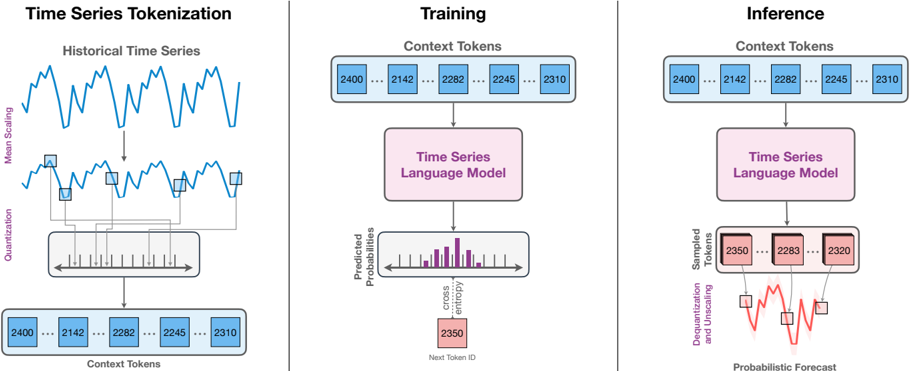
We introduce Chronos, a simple yet effective framework for pretrained probabilistic time series models. Chronos tokenizes time series values using scaling and quantization into a fixed vocabulary and trains existing transformer-based language model architectures on these tokenized time series via the cross-entropy loss. We pretrained Chronos models based on the T5 family (ranging from 20M to 710M parameters) on a large collection of publicly available datasets, complemented by a synthetic dataset that we generated via Gaussian processes to improve generalization. In a comprehensive benchmark consisting of 42 datasets, and comprising both classical local models and deep learning methods, we show that Chronos models: (a) significantly outperform other methods on datasets that were part of the training corpus; and (b) have comparable and occasionally superior zero-shot performance on new datasets, relative to methods that were trained specifically on them. Our results demonstrate that Chronos models can leverage time series data from diverse domains to improve zero-shot accuracy on unseen forecasting tasks, positioning pretrained models as a viable tool to greatly simplify forecasting pipelines.
Overview
CoChat Summary
TL;DR
Chronos adapts language-model architectures to probabilistic time series forecasting by scaling and quantizing values into tokens and training T5/GPT-2 models with cross-entropy. Across 42 benchmark datasets, it achieves strong in-domain and zero-shot forecasting, often matching or beating task-specific models.
Key findings
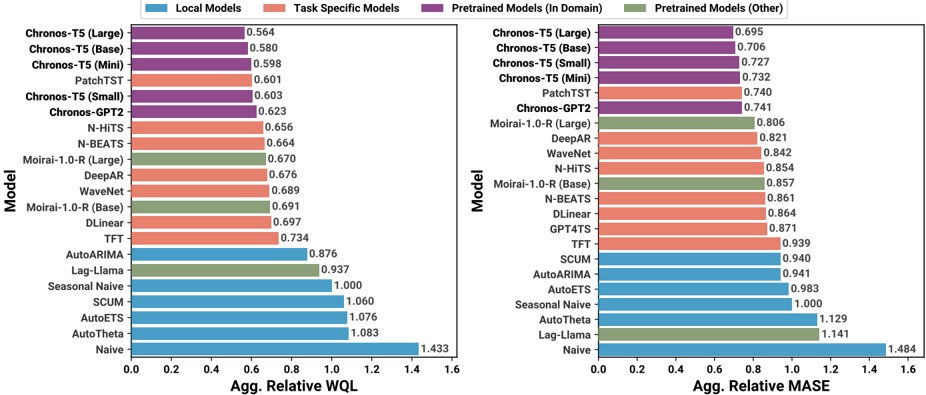
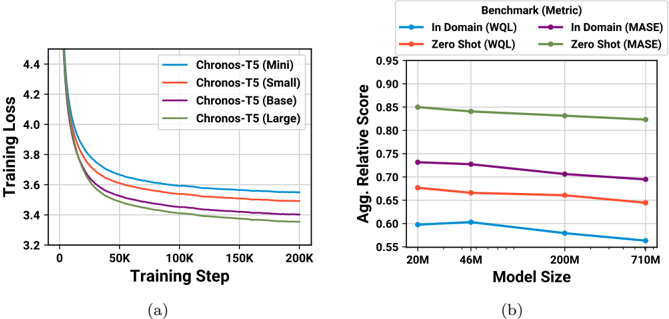
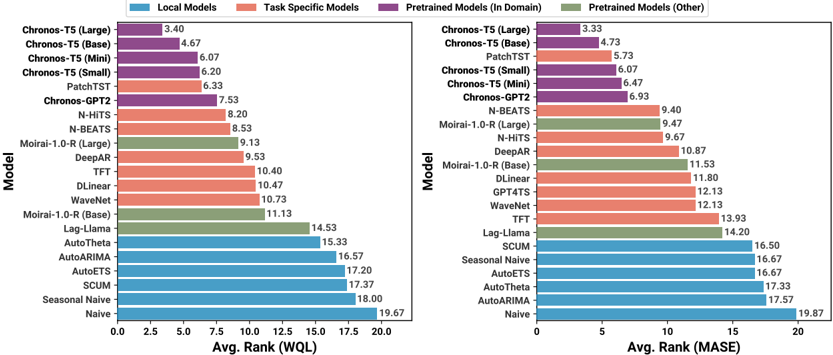
- On in-domain Benchmark I (15 datasets), Chronos-T5 Base/Large obtain the best aggregated relative scores: WQL 0.580/0.564 and MASE 0.706/0.695 versus Seasonal Naive 1.000, outperforming local, task-specific, and other pretrained baselines.
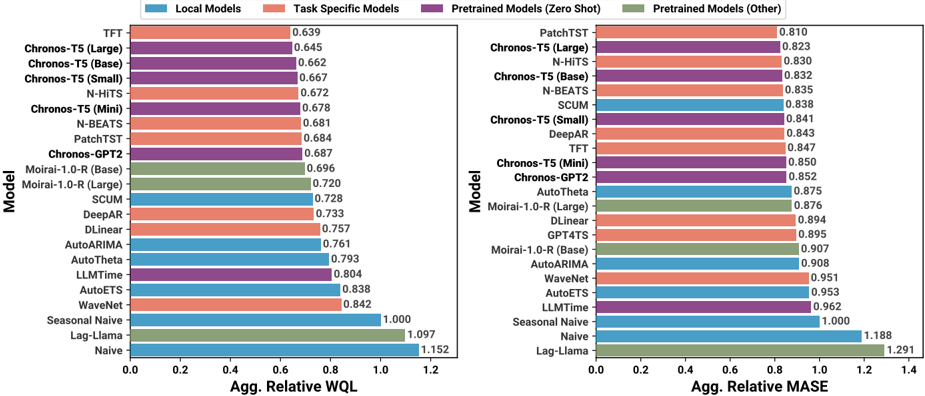
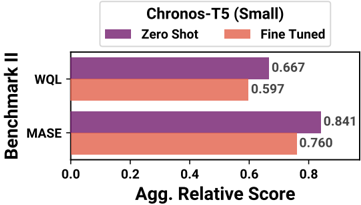
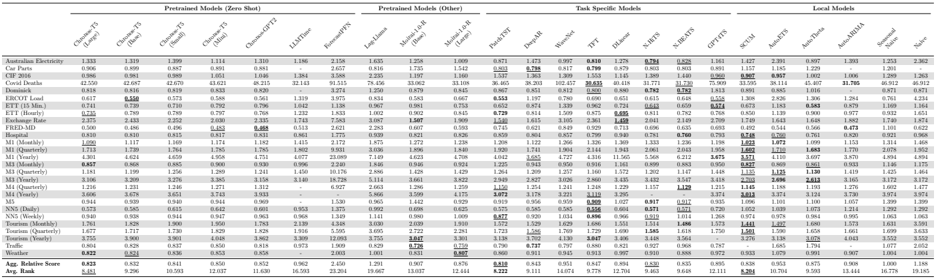
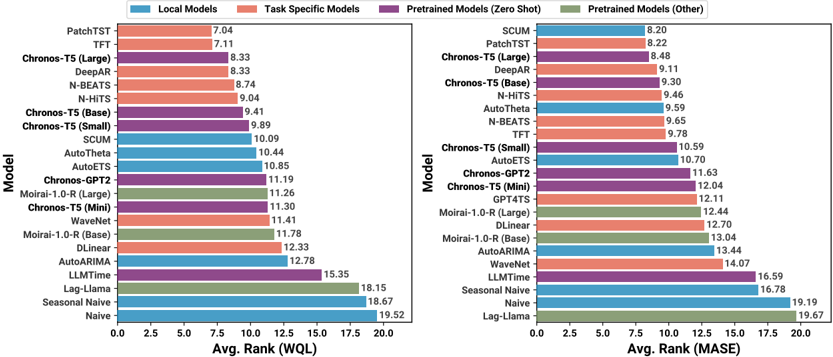
- On zero-shot Benchmark II (27 datasets), Chronos models rank 2nd–4th on WQL and Chronos-T5 Large ranks 2nd on MASE; aggregated relative WQL is 0.645 (Large), 0.662 (Base), 0.667 (Small), 0.678 (Mini), and MASE is 0.823, 0.832, 0.841, 0.850 versus Seasonal Naive 1.000. Fine-tuned Chronos-T5 Small becomes the best model on Benchmark II.
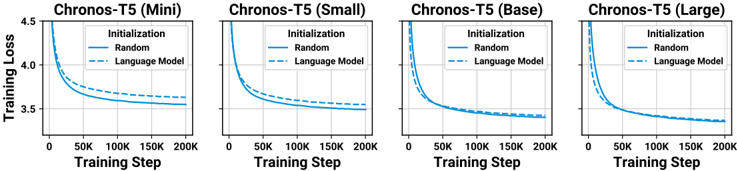
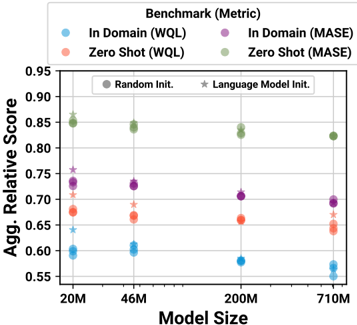
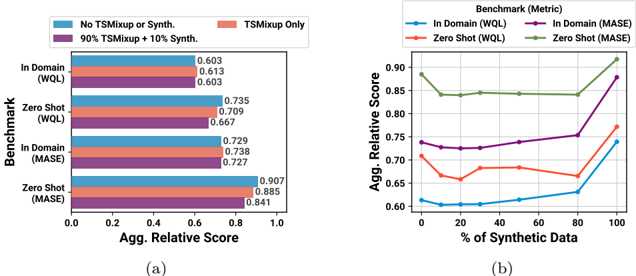
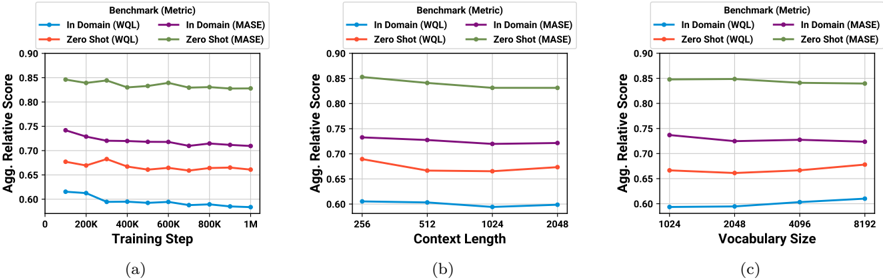
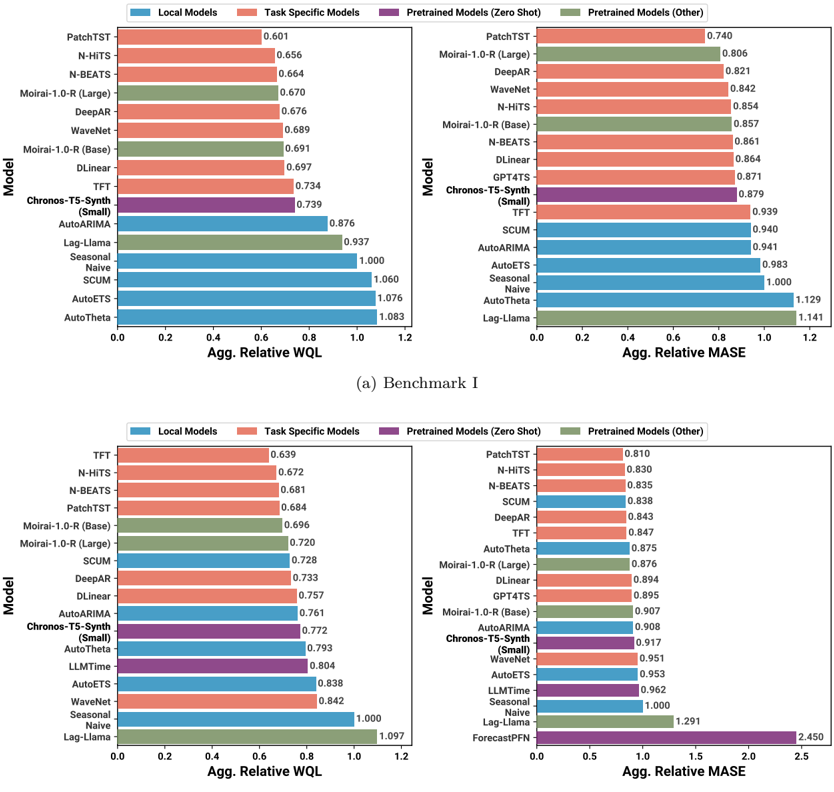
- Ablations show performance improves with model size; language-model-weight initialization offers little/no advantage over random initialization; TSMixup improves zero-shot performance; about 10% KernelSynth synthetic data is best; context length up to 1024 helps; larger vocabulary improves MASE but WQL deteriorates.
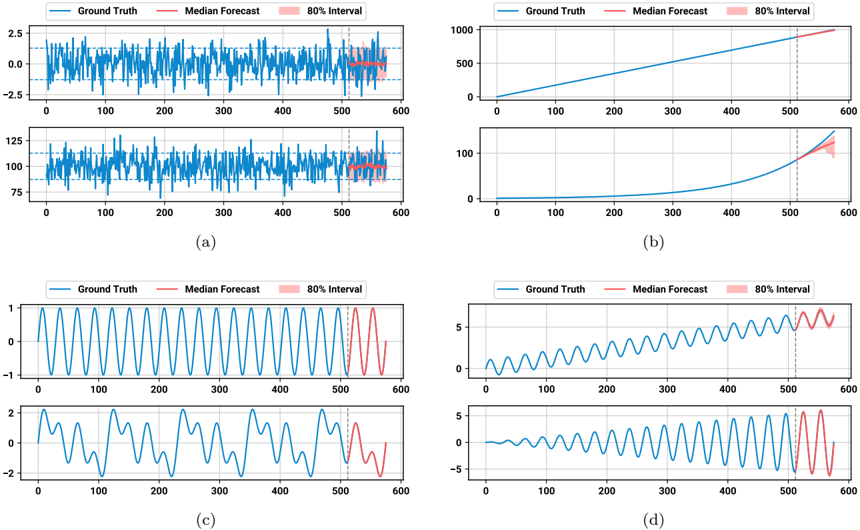
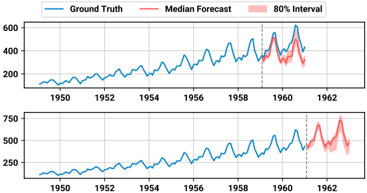
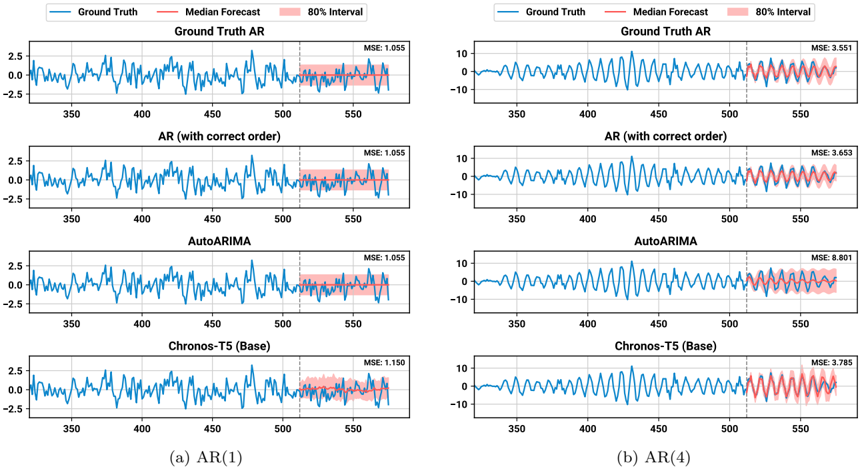
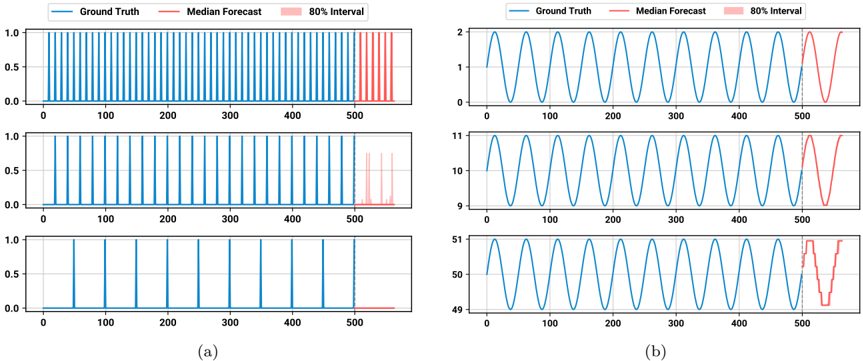
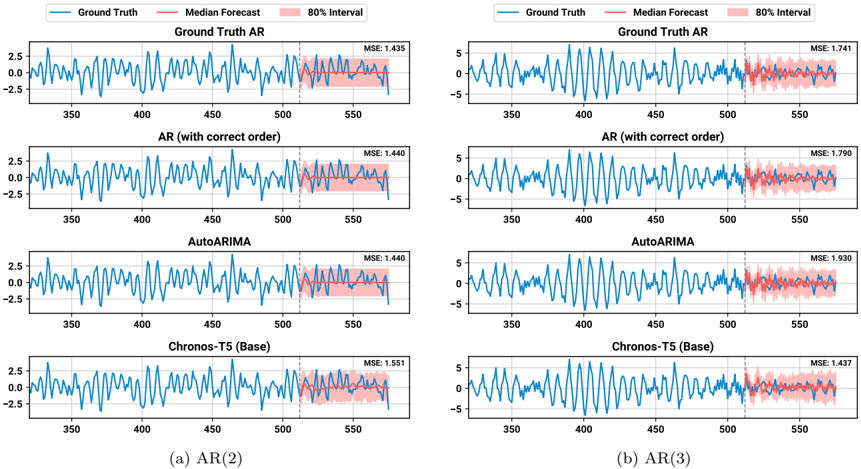
- Qualitatively, Chronos handles Gaussian noise, seasonality, additive/multiplicative trend+seasonality, and AR processes, but struggles with exponential trends and underestimates trend when context is short.
Methods
- Chronos mean-scales time series, uniformly quantizes values into B=4094 bins plus PAD/EOS (V_ts=4096), and trains off-the-shelf transformer language models with categorical cross-entropy; forecasts are produced by autoregressively sampling token paths and dequantizing/unscaling them.
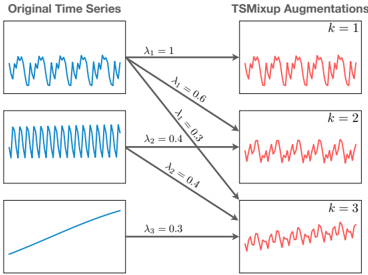
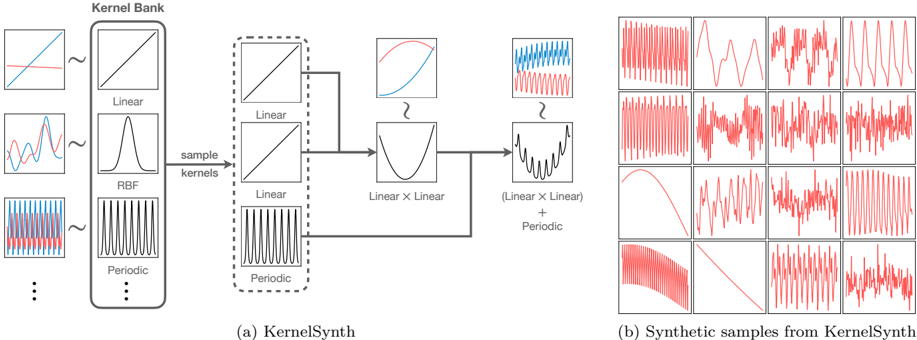
- Training used 55 datasets total: 13 pretraining-only, 15 Benchmark I in-domain, and 27 Benchmark II zero-shot; 28 training datasets comprised about 890K univariate series and approximately 84B observations/tokens. Models included T5 Mini 20M, Small 46M, Base 200M, Large 710M, and GPT-2 90M, trained with 10M TSMixup augmentations plus 1M KernelSynth GP synthetic series, context length 512, prediction length 64, and 200K AdamW steps.
- Evaluation used 42 benchmark datasets with WQL (9 quantiles) and MASE; relative scores versus Seasonal Naive were aggregated by geometric mean and compared against local, task-specific, and pretrained baselines, plus a fine-tuning experiment on Benchmark II.
Limitations
- The paper states tokenization limits: representable values are in [-15s, 15s] where s is the mean absolute scale; small s relative to range causes overflow, while large s relative to variance causes precision loss. It also notes poor exponential-trend forecasts, trend underestimation with short context, and that categorical cross-entropy is not distance-aware; ordinal modeling is left as future work.
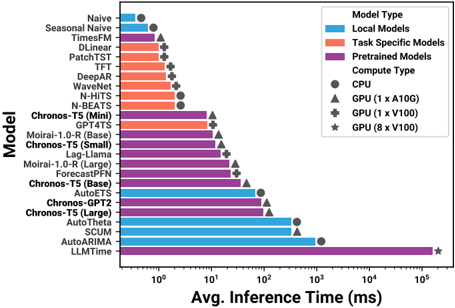
- The paper states scope limits: only univariate, uniformly spaced forecasting is studied; exogenous covariates, multivariate forecasting, and irregular sampling are not handled. Larger models were not explored due to slow inference, inference is slower than task-specific models, evaluation lacks enough high-frequency datasets to study long contexts, and public time series data remain limited.
- Text-evident: the zero-shot comparison may favor Moirai-1.0-R because many Benchmark II datasets were part of its pretraining corpus, as the paper notes; Chronos also ignores time and frequency information by design.
Model-written summary. Check it against the paper before relying on it.
Integrity signals
Registry
Cites
Statistics
Figures

Verification
Claims the paper makes
0 Valid · 4 Not valid · 14 Not checked · 146 Own results and interpretations
A result the paper reports from its own data — it cites no other source for it, so there is none to check. The quote shows it is in the paper.
In the paper
“Between the two baseline pretrained models studied in this experiment, Moirai-1.0-Rclearly outperforms Lag-Llama.”
§ Chronos: Learning the Language of Time Series > 5.5 Main Results
boosted- Asserted: passes — The authors put it forward as true.
- Checkable: passes — It can be checked against evidence.
- Load-bearing: unclear — It is unclear whether the paper’s conclusions depend on it.
- Based: passes — The paper gives a reason why it holds.
A result the paper reports from its own data — it cites no other source for it, so there is none to check. The quote shows it is in the paper.
In the paper
“Unsurprisingly, the training loss improves with the model capacity, as shown in Figure 7a.”
§ Chronos: Learning the Language of Time Series > Model size.
plainstates a cause- Asserted: passes — The authors put it forward as true.
- Checkable: passes — It can be checked against evidence.
- Load-bearing: unclear — It is unclear whether the paper’s conclusions depend on it.
- Based: passes — The paper gives a reason why it holds.
A result the paper reports from its own data — it cites no other source for it, so there is none to check. The quote shows it is in the paper.
In the paper
“Our comprehensive evaluation across 42 datasets establishes Chronos as a benchmark for both in-domain and zero-shot forecasting, surpassing both traditional models and task-specific deep learning approaches.”
§ Chronos: Learning the Language of Time Series > Time Series Tokenization Training Inference
plain- Asserted: passes — The authors put it forward as true.
- Checkable: passes — It can be checked against evidence.
- Load-bearing: passes — The paper’s conclusions depend on it.
- Based: passes — The paper gives a reason why it holds.
A result the paper reports from its own data — it cites no other source for it, so there is none to check. The quote shows it is in the paper.
In the paper
“consistent improvement is observed around the 10% synthetic data proportion.”
§ Chronos: Learning the Language of Time Series > Model size.
plainstates an association- Asserted: passes — The authors put it forward as true.
- Checkable: passes — It can be checked against evidence.
- Load-bearing: unclear — It is unclear whether the paper’s conclusions depend on it.
- Based: passes — The paper gives a reason why it holds.
A result the paper states — it cites no source for it, so there is none to check. The quote shows it is in the paper.
In the paper
“Further increasing the proportion of synthetic data tends to worsen performance.”
§ Chronos: Learning the Language of Time Series > Model size.
hedgedstates a possible cause- Asserted: passes — The authors put it forward as true.
- Checkable: passes — It can be checked against evidence.
- Load-bearing: unclear — It is unclear whether the paper’s conclusions depend on it.
- Based: passes — The paper gives a reason why it holds.
- Rests on an assumption not shown here.
94 more claims
Create a free account to see all 164 claims and to verify the 17 references still open.
- It may state two separate claims as one. 42
- Probably not a substantial claim. 30
Self-check
Percentages, sums and reported differences re-computed from the paper’s own numbers.
Each contradiction between two passages listed here was confirmed by an independent check.
Rated minor: it would not touch a result — a value no result rests on, a p-value that stays on the same side of the significance level, or a conflict that is clerical, resolved elsewhere in the paper, or outside its own findings.
In the paper
§ Chronos: Learning the Language of Time Series > Additional information
“Dominick (Godahewa et al., 2021) contains weekly time series representing the profit of individual stock keeping units from a retailer.”
§ Chronos: Learning the Language of Time Series > Covid Deaths
“Dominick retail 1D 100014 201 296 399 8”
Rated minor: it would not touch a result — a value no result rests on, a p-value that stays on the same side of the significance level, or a conflict that is clerical, resolved elsewhere in the paper, or outside its own findings.
In the paper
§ Chronos: Learning the Language of Time Series > C Baselines
“We considered a total of 17 baseline methods for benchmarking Chronos.”
§ Chronos: Learning the Language of Time Series > Chronos-GPT2 Chronos-T5 (Mini)
“Figure: Naive, SeasonalNaive, AutoETS, Auto-Theta, SCUM, AutoARIMA, DeepAR, TFT, PatchTST, DLinear, WaveNet, N-BEATS, N-HiTS, GPT4TS, Lag-Llama, Moirai-1.evaluationAll the above, LLMTime and ForecastPFN”
Citations
Cites
Exploring the Limits of Transfer Learning with a Unified Text-to-Text Transformer
Raffel, C., Shazeer, N., Roberts, A., Lee, K., Narang, S., Matena, M., Zhou, Y., Li, W., & Liu, P. J. (2019) · arXiv · doi:10.48550/arxiv.1910.10683 · Cited by 31,859
LoRA: Low-Rank Adaptation of Large Language Models
Hu, E. J., Shen, Y., Wallis, P., Allen-Zhu, Z., Li, Y., Wang, S., Wang, L., & Chen, W. (2021) · arXiv · doi:10.48550/arxiv.2106.09685 · Cited by 13,453
LightGBM: A Highly Efficient Gradient Boosting Decision Tree
(2017) · HAL · Cited by 10,512
Lewis, M., Liu, Y., Goyal, N., Ghazvininejad, M., Mohamed, A., Levy, O., Stoyanov, V., & Zettlemoyer, L. (2020) · Proceedings of the 58th Annual Meeting of the Association for Computational Linguistics · doi:10.18653/v1/2020.acl-main.703 · Cited by 8,821
Lewis, M., Liu, Y., Goyal, N., Ghazvininejad, M., Mohamed, A., Levy, O., Stoyanov, V., & Zettlemoyer, L. (2019) · arXiv · doi:10.48550/arxiv.1910.13461 · Cited by 8,816
Transformers: State-of-the-Art Natural Language Processing
Wolf, T., Debut, L., Sanh, V., Chaumond, J., Delangue, C., Moi, A., Cistac, P., Rault, T., Louf, R., Funtowicz, M., et al. (2020) · Proceedings of the 2020 Conference on Empirical Methods in Natural Language Processing: System Demonstrations · doi:10.18653/v1/2020.emnlp-demos.6 · Cited by 8,741
Informer: Beyond Efficient Transformer for Long Sequence Time-Series Forecasting
Zhou, H., Zhang, S., Peng, J., Zhang, S., Li, J., Xiong, H., & Zhang, W. (2021) · Proceedings of the AAAI Conference on Artificial Intelligence · doi:10.1609/aaai.v35i12.17325 · Cited by 7,752
mixup: Beyond Empirical Risk Minimization
Zhang, H., Cisse, M., Dauphin, Y. N., & Lopez-Paz, D. (2017) · arXiv · doi:10.48550/arxiv.1710.09412 · Cited by 5,831
Strictly Proper Scoring Rules, Prediction, and Estimation
Gneiting, T., & Raftery, A. E. (2007) · Journal of the American Statistical Association · doi:10.1198/016214506000001437 · Cited by 5,793
Another look at measures of forecast accuracy
Hyndman, R. J., & Koehler, A. B. (2006) · International Journal of Forecasting · doi:10.1016/j.ijforecast.2006.03.001 · Cited by 5,757
Research works printed but not linked: 8
- George Athanasopoulos, Rob J. Hyndman, Haiyan Song, and Doris C. Wu. The tourism forecasting compe- tition. International Journal of Forecasting, 27(3):822-844, 2011.
- Tom B. Brown, Benjamin Mann, Nick Ryder, Melanie Subbiah, Jared Kaplan, Prafulla Dhariwal, Arvind Neelakantan, Pranav Shyam, Girish Sastry, Amanda Askell, Sandhini Agarwal, Ariel Herbert-Voss, Gretchen Krueger, Tom Henighan, Rewon Child, Aditya Ramesh, Daniel M. Ziegler, Jeffrey Wu, Clemens Winter, Christopher Hesse, Mark Chen, Eric Sigler, Mateusz Litwin, Scott Gray, Benjamin Chess, Jack Clark, Christopher Berner, Sam McCandlish, Alec Radford, Ilya Sutskever, and Dario Amodei. Language models are few-shot learners. In Advances in Neural Information Processing Systems, 2020. 2, 3, 4
- Rob Hyndman, Anne B Koehler, J Keith Ord, and Ralph D Snyder. Forecasting with exponential smoothing: the state space approach. Springer Science & Business Media, 2008. 3, 9
- Alec Radford, Jeffrey Wu, Rewon Child, David Luan, Dario Amodei, Ilya Sutskever, et al. Language models are unsupervised multitask learners. OpenAI blog, 1(8):9, 2019. 4, 6
- Yaniv Romano, Evan Patterson, and Emmanuel Candes. Conformalized quantile regression. Advances in neural information processing systems, 32, 2019.
- Kai Ming Ting and Ian H Witten. Stacking bagged and dagged models. In Proceedings of the Fourteenth International Conference on Machine Learning, 1997. 20
- Ashish Vaswani, Noam Shazeer, Niki Parmar, Jakob Uszkoreit, Llion Jones, Aidan N. Gomez, Lukasz Kaiser, and Illia Polosukhin. Attention Is All You Need. In Advances in Neural Information Processing Systems, 2017.
- Yun Zhou, Liwen You, Wenzhen Zhu, and Panpan Xu. Improving time series forecasting with mixup data augmentation. In ECML PKDD 2023 International Workshop on Machine Learning for Irregular Time Series, 2023b. 7
Cited by
Items 1,401–1,500 of 2,048
REGEN: Reference-Guided Synthetic Multivariate Time Series Generation for ForecastingPreprint
Gupta, M., Kumar, D. S., Mandal, M., & Deshpande, S. (2026) · arXiv · doi:10.48550/arxiv.2606.05264
Diaz-Velazco, R. C., Gudiño-Ochoa, A., García-Rodríguez, J. A., Chávez, J. I. C., & Ruiz-Velazquez, E. (2026) · Technologies · doi:10.3390/technologies14070399
“Chronos is a foundation model for probabilistic time-series forecasting that reformu-lates forecasting as a language modeling problem [53].”
Period-Aware Analog Retrieval for Probabilistic Financial RiskForecastingPreprint
Hung, H., Thanh, N. P., & Bao, N. (2026) · Research Square · doi:10.21203/rs.3.rs-9840504/v1
Improving Business Forecasting With AI: Cases of Revenue- and Cost-Forecasting
Hyytiäinen, T., Luukka, P., & Collan, M. (2026) · Advances in computational intelligence and robotics book series · doi:10.4018/979-8-3373-3053-2.ch009
Foundation Enhanced Hybrid Framework for Interpretable Multi-Horizon Energy Consumption Forecasting
Kundal, A., & Gupta, D. K. (2026) · International Conference on Secure Cyber Computing and Communications (ICSCCC) · doi:10.1109/icsccc69031.2026.11600220
“009 Chronos Zero-Shot [4] 0 .”
InfluentialKoley, T., Das, R., Bera, S., Chatterjee, I., Chakraborty, A., & Das, A. (2026) · Journal of Banking and Financial Technology · doi:10.1007/s42786-026-00064-x
Adversarial generative forecasting of daily Fraud Amount for sparse transaction time series
Mueller, M. (2025) · Portuguese National Funding Agency for Science, Research and Technology (RCAAP Project by FCT)
A survey of deep multivariate time-series models with an empirical reproducibility audit
Vats, V., Kim, H., Linares, E., & Suh, Y. (2026) · Artificial Intelligence Review · doi:10.1007/s10462-026-11674-8
Dewage, K., Silva, S. D., & Mondal, S. (2026) · International Joint Conference on Neural Networks (IJCNN) · doi:10.1109/ijcnn69854.2026.11729021
Le, T.-T.-H., Shin, D., Lee, S., & Kim, H. (2026) · Sensors · doi:10.3390/s26165118
“Chronos treats forecasting as probabilistic sequence modeling, while Chronos-Bolt uses patch-based direct multi-step quantile prediction [11].”
Liu, Z., Guo, R., Yang, Y., Zhang, G., & Chen, Z. (2026) · Scientific Reports · doi:10.1038/s41598-026-63730-6
“Recent iTransformer, TimesFM, and Chronos studies further indicate that variable-dimension restructuring, pretraining, and time-series foundation models are becoming important directions 29–31 .”
Do Time-Series Foundation Models Pay Off for Industrial Monitoring? A Cost-Aware Empirical StudyPreprint
Wen, G.-H., & Chen, K.-Y. (2026) · arXiv · doi:10.48550/arxiv.2608.22968
“TSFMs promise representations or forecasts that transfer with little target-specific adaptation [Goswami et al., 2024, Ansari et al., 2024, Das et al., 2024], but their deployment value is uncertain when target-normal data and competitive lightweight models are available.”
InfluentialGuarino, S., Buscemi, A., & Brano, V. L. (2026) · Energy Conversion and Management · doi:10.1016/j.enconman.2026.122078
Velalopoulos, M. A. (2026) · DSpace - NTUA (National Technical University of Athens) · doi:10.26240/heal.ntua.33378
A Novel Tokenization-Free GPT-2 Mechanism for Intermittent Demand Forecasting
Tsantilis, I., Giannopoulos, P. G., Dasaklis, T. K., & Patsakis, C. (2026) · IEEE Access · doi:10.1109/access.2026.3730371
Chen, K., Perera, M., Wang, W., Seneviratne, S., Weeratunge, H., & Halgamuge, S. K. (2026) · arXiv · doi:10.48550/arxiv.2609.11135
“A parallel line of work explores time-series foundation models, such as TimesFM [35] and Chronos [36], which are pretrained for zero-shot forecasting and have recently been extended to support multivariate targets and numerical covariates.”
Miseta, T., Fodor, A., & Vathy-Fogarassy, Á. (2026) · Energy and AI · doi:10.1016/j.egyai.2026.100886
Cioni, L. (2026) · Electronic Theses and Dissertations Repository (University of Pisa)
Cell-Attentive LSTM With Lag-Aware Feature Selection for Multi-Week Epidemic Forecasting
Kim, M., & Jang, B. (2026) · IEEE Access · doi:10.1109/access.2026.3738355
Alkhulaifi, N. (2026) · arXiv · doi:10.48550/arxiv.2609.35013
Universality and Generalization of Causal Transformers Across Context LengthsPreprint
Furuya, T., de Hoop, M. V., & Peyré, G. (2026) · arXiv · doi:10.48550/arxiv.2609.35055
Buczyński, M., Woźniak, M., Kaczyński, K., Wróblewska, A., & Kuk, S. P. (2026) · arXiv · doi:10.48550/arxiv.2610.10727
“Future research should explore: (i) hybrid architectures with explicit probabilistic or conformal uncertainty quantification; (ii) multimodal extensions incorporating textual listing descriptions or product images; (iii) cross-market evaluation to assess generalisability beyond the Polish market; and (iv) time series…”
Gao, Y., Liu, H., Li, J., Ma, L., Liu, B., & Zhang, S. (2026) · Ironmaking & Steelmaking Processes Products and Applications · doi:10.1177/03019233261494785
HydroPrior: Offline LLM-Prior-Guided Residual Warning for Hydropower Bearing Vibration
Dong, Z., Zhong, D., & Zhang, Y. (2026) · Sensors · doi:10.3390/s26206497
“LLMTime performs zero-shot forecasting by representing numerical sequences as text-like tokens [13]; Time-LLM aligns time-series patches with textual prototypes [14]; and Chronos trains probabilistic token models across heterogeneous series [15].”
Zeynali, M., shendi, M. B., Gheshlaghi, R., Yeganeh, A., & Mahdavi, M. A. (2026) · Biochemical Engineering Journal · doi:10.1016/j.bej.2026.110433
Zhang, Y., Duan, J., Zou, Y., Feng, K., & Xiao, J. (2026) · npj Artificial Intelligence · doi:10.1038/s44387-026-00166-3
Bedoya, A. P., Varon, J. G. B., Becerra, J. E. M., Rojas, J., & Valencia, J. A. (2026) · SSRN Electronic Journal · doi:10.2139/ssrn.7634817
Machine Learning for Satellite Link Fade Nowcasting
RUSSO, G. G. (2026) · Electronic Theses and Dissertations Repository (University of Pisa)
A Hybrid CNN-LSTM and XGBoost Ensemble for Short-Term Energy Demand Forecasting in Smart Grids
Saravanan, H., Sivakumar, K. V., & Venkatesan, A. K. (2026) · International Conference on Smart Electronics and Communication (ICOSEC) · doi:10.1109/icosec70158.2026.11736073
“…architectures extend this line: PatchTST [16] tokenises long series into patches for channel-independent attention, TimesNet [17] models multi-periodicity through temporal two-dimensional variation, and pretrained time-series foundation models such as Chronos [18] enable zero-shot forecasting.”
VRATF: Vision-based Retrieval-Augmented Time Series ForecastingPreprint
Xie, Z., Ling, J., Zhang, Z., & Xia, G. (2026) · Research Square · doi:10.21203/rs.3.rs-11111645/v1
A Model-Agnostic Correction Framework for Short-Term Building Load ForecastingPreprint
Zhou, S., Lyu, H., Schöner, H., Wu, Z., Deuschel, J., Wentzel, F., Wilson, I., & Wang, S. (2026) · arXiv · doi:10.48550/arxiv.2610.31959
“Representative methods include LLMTime, Time-LLM, TimesFM and Chronos [22, 29, 10, 5].”
Physics-Anchored Ramp-Aware Multi-Horizon Learning for Reliable Photovoltaic Power Forecasting
Iqbal, A., Mahmood, D., Nawaz, F., Siddiqui, M. F., & Arif, M. (2026) · Computer Modeling in Engineering & Sciences · doi:10.32604/cmes.2026.087379
Hewage, H. H. (2026) · ORCA Online Research @Cardiff (Cardiff University)
SolarPatchTST: A Linear-Anchored Patch Transformer for Short-Term Photovoltaic Power Forecasting
Kang, T., Zhao, Y., & Yang, L. (2026) · IEEE International Conference on Signal Processing, Communications and Computing (ICSPCC) · doi:10.1109/icspcc70129.2026.11754338
“Foundation-style models such as TimesFM [9], Chronos [10], and ViTime [11] show that general temporal representations are promising.”
SitePrompt-PV: Metadata-Aware Cross-Site Few-Shot Forecasting for Cold-Start Photovoltaic Power
Wang, Q., Li, G., Wang, Y., Yang, L., & Zhao, Y. (2026) · IEEE International Conference on Signal Processing, Communications and Computing (ICSPCC) · doi:10.1109/icspcc70129.2026.11754493
“Foundation-style models such as TimesFM and Chronos [9], [10] further explore zero-shot forecasting.”
Self-citationLeppich, R., Stenger, M., Bauer, A., Grillmeyer, D., & Kounev, S. (2026) · International Joint Conference on Neural Networks (IJCNN) · doi:10.1109/ijcnn69854.2026.11728655
“Foundation and LLM-based approaches such as Chronos [17] and TEMPO [24] apply large-scale pretraining or adapt language models to TS inputs at the cost of substantially higher parameter counts.”
BERTO: Intent-Driven Network Time Series Forecasting via Natural Language Operator Preferences
Shankar, N. P., Singh, V., Kalyani, S., & Maciocco, C. (2026) · IEEE Wireless Communications Letters · doi:10.1109/lwc.2026.3707434
“Transformer-based predictors, such as Autoformer [5] and Chronos [15], further extend this set of baselines: Auto-former introduces a decomposition-based architecture with a periodicity-driven Auto-Correlation mechanism to model sub-series dependencies.”
St John Lynch, N., Loughran, R., Mc Hugh, M., & McCaffery, F. (2025) · STOR (Dundalk Institute of Technology)
Self-Supervised Learning via Flow-Guided Neural Operator on Time-Series Data
Nguyen, D., Yao, J., Wang, J., Berner, J., & Anandkumar, A. (2026) · Transactions on machine learning research · doi:10.48550/arxiv.2602.12267
KI für die Arbeitswelt von morgen: Erkenntnisse und Best Practices aus dem industriellen Mittelstand
Dumitrescu, R. (2026) · Intelligente Technische Systeme, Lösungen aus dem Spitzencluster it’s OWL · doi:10.1007/978-3-662-73053-9
Long-Context and Multimodal Language Models for Financial Forecasting
Koval, R. (2026) · eScholarship (California Digital Library)
Time Series Classification with Language Models
Lin, C.-C., & Yeh, Y.-R. (2025) · Procedia Computer Science · doi:10.1016/j.procs.2025.09.543
Wang, Y., Lu, X., & Wang, J. (2026) · Sensors · doi:10.3390/s26154986
“Forecasting-oriented architectures such as Informer [38], PatchTST [39], TimesNet [40], Chronos [41], MOMENT [42], and Timer [43] provide additional context for time-series feature transfer.”
Self-citationMFDNet: Adaptive Multi‐scale Frequency Decomposition Network for Long‐term Time Series Forecasting
Wang, L., Zhou, F., & Zhou, L. (2026) · Concurrency and Computation Practice and Experience · doi:10.1002/cpe.70998
“Alongside LLMs, dedicated time-series foundation models pretrained on large collections of heteroge - neous series have emerged, including Chronos [ 44], TimesFM [ 45], Moirai [ 46], and Lag-Llama [ 47], which learn universal temporal representations and exhibit remarkable zero-shot transfer.”
SurfaceEncoder: Semi-supervised Representation Learning for Global Wheelchair Accessibility
Mahmud, N., Gani, M. O., Raychoudhury, V., & Saha, S. (2026) · Lecture notes in computer science · doi:10.1007/978-3-032-37679-4_10
From Fragmentation to Fusion: A Survey and Roadmap for Omnimodal EmbeddingsPreprint
Zhang, Z., Guo, Y., Zhang, Y., Xue, S., Liao, Z., Qin, J., Yang, W., Yang, S., Li, S., Chen, C., et al. (2026) · arXiv · doi:10.48550/arxiv.2611.00172
Can LLMs Access their World Knowledge for Event Prediction?
Wu, Z., Zhang, Z., Hajimirsadeghi, H., Dvornik, N., & Pashevich, A. (2026) · Findings of the Association for Computational Linguistics: EMNLP (Findings of EMNLP) · doi:10.18653/2026.findings-emnlp.823
“Chronos (Ansari et al., 2024) tokenizes time series values into a fixed vocabulary and trains trans-former language models directly on them.”
KairosVL: Orchestrating Time Series and Semantics for Unified ReasoningPreprint
Si, H., Pei, C., He, X., Li, Z., Xie, Z., Wang, Z., Hu, J., Yu, Z., Zhang, T., Pei, D., et al. (2026) · arXiv · doi:10.48550/arxiv.2602.20494
Iyer, K. (2026) · SSRN Electronic Journal · doi:10.2139/ssrn.7627718
Liu, J., Liu, T., & Zhang, C. (2026) · Reliability Engineering & System Safety · doi:10.1016/j.ress.2026.113770
Καρανικόλας, Ν., Kyriakidou, E., & Athanasouli, E. (2026) · Real Estate · doi:10.3390/realestate3040025
Sousa, J., & Henriques, R. (2026) · Emerging Science Journal · doi:10.28991/esj-2026-010-05-03
“The forecasting landscape has been transformed by foundation models trained on massive time series corpora, including Chronos [27], Chronos-2 [28], TimesFM [29], and Moirai 2.0 [30].”
InfluentialScaling Next-Brain-Token Prediction for MEGPreprint
Csáky, R. (2026) · arXiv · doi:10.48550/arxiv.2601.20138
“Outside neuroscience, time-series foundation models and discretization approaches provide scalable forecasting recipes (Das et al., 2024; Ansari et al., 2024), and token-stream multimodal decoders in vision and audio motivate treating high-bandwidth signals as tokens for a single causal backbone…”
Hu, Y., Zhang, Q., Wang, W., & Li, P. (2026) · Computers and Electronics in Agriculture · doi:10.1016/j.compag.2026.111614
Neural Fractional Stochastic Differential EquationsPreprint
Yang, Y., & Hospedales, T. M. (2025) · SSRN Electronic Journal · doi:10.2139/ssrn.5753542
Guo, C., & Lu, R.-S. (2026) · IEEE Access · doi:10.1109/access.2026.3727460
TimeAgent: A Training-Free LLM Agent for Time Series Foundation Models
Wang, Y., Chen, Z., Shi, Z., Liu, Y., Wang, S., Ye, Z., Wang, J., & Long, M. (2026) · IEEE Transactions on Knowledge and Data Engineering · doi:10.1109/tkde.2026.3736409
“5 [15], Moirai-Base [37], Chronos-Bolt [38], Sundial-Base [36], Moirai-2.”
Self-citationKiT: A Foundation Model for Financial Time-Series Forecasting using DiffusionTransformersPreprint
Zhang, B., & Li, H. (2026) · arXiv · doi:10.48550/arxiv.2609.34507
“Representative examples include Chronos (Ansari et al., 2024), TimesFM (Das et al., 2024), Moirai (Woo et al., 2024), MOMENT (Goswami et al., 2024), Timer (Liu et al., 2024b), Lag-Llama (Rasul et al., 2024), Time-LLM (Jin et al., 2024), Sundial (Liu et al., 2025), FinCast (Zhu et al., 2025), and…”
InfluentialDualCast: A Dual-Path Language Model for Bimodal Financial Time-Series ForecastingPreprint
Zhao, W.-T., Wu, H.-Q., Liu, S.-H., Zan, Z.-C., Zhang, Y., & Huang, B.-Q. (2026) · arXiv.org · doi:10.48550/arxiv.2609.38197
“…signals into the embedding space of a frozen LLM [1, 2, 3], converting numerical values into textual representations and leveraging next-token prediction directly [4], and quantizing time series into discrete tokens so that forecasting becomes language modeling over an extended vocabulary [5, 6].”
Rezaee, K. (2026) · arXiv · doi:10.48550/arxiv.2608.28980
Uncertainty Quantification for Financial Foundation Models: A Survey
Sun, M., Zhao, Z., & Xu, S. (2026) · ACM International Conference on AI in Finance (ICAIF) · doi:10.2139/ssrn.7323498
Multi-View Data Exploration Recipes for Making Sense of Multi-Source Industrial Data
Fingerhut, F., & Tsiporkova, E. (2026) · IEEE Access · doi:10.1109/access.2026.3696380
Velocity-Guided Representation Learning for Time Series Anomaly Detection
Cencillo, A. D. (2026) · Institutional Repository of the University of Granada (University of Granada)
Wu, X., Teng, F., Yang, C., & Li, T. (2026) · ACM SIGKDD Conference on Knowledge Discovery and Data Mining (KDD) · doi:10.1145/3770855.3817771
Islam, M. R., & Mohammed, W. (2026) · Engineering Archive (engrXiv) · doi:10.31224/7508
Abdalla, R., Gönczi, D., Toumi, O., & Namburu, S. (2026) · Abu Dhabi International Petroleum Exhibition & Conference (ADIPEC) · doi:10.2118/235943-ms
Sukkuea, A., Rungwallapa, T., Tharu, N. K., & Akkajit, P. (2026) · Machine Learning and Knowledge Extraction · doi:10.3390/make8110366
From Big Time Series Forecasting to Foundation Models for Structured Data
Zhang, X., Ansari, A. F., Faloutsos, C., Karypis, G., & Wang, Y. (2026) · Proceedings of the VLDB Endowment · doi:10.14778/3827998.3828154
Self-citationLapras: Latent Reasoning for Time Series Language ModelsPreprint
Chen, Y., Wu, Y. Y., Langer, P., Pillai, A., Regmi, S., Maritsch, M., Liu, J., Jakob, R., Kaar, T., Griffin, T. Z., et al. (2026) · arXiv · doi:10.48550/arxiv.2610.11111
Transformer Applying in the Time Series Prediction
Li, W. (2026) · Mathematical Modeling and Algorithm Application · doi:10.54097/82pw7746
“[24] proposed to convert the continuous time series into discrete vocabularies through scaling and quantization, and simultaneously construct a vocabulary applicable to time series.”
A Multi-Dimensional Benchmark of Large Language Models for Time Series Forecasting
Bastos, Z., Scarcela, F., Barbosa, W., Souza, A. H., Madeiro, J. P. D. V., Franco, W., & Caminha, C. (2026) · International Conference on Machine Learning and Applications · doi:10.1109/icmla69890.2026.00080
“More recently, Time Series Foundation Models (TSFMs), including Moirai [22], Chronos [23], and TimesFM [24], aim to generalize across tasks by pre-training on large-scale heterogeneous datasets and treating time series as token sequences.”
Memory in Deep Time-Series ModelsPreprint
Nguyen, M. H., Nguyen, H. H., Nguyen, M., Do, V. D., Nguyen, D., & Le, H. (2026) · Research Square · doi:10.48550/arxiv.2609.06006
Wu, Y., & Fu, X. (2026) · Energies · doi:10.3390/en19225429
Zou, Y., Zhang, Y., & Lv, K. (2026) · Batteries · doi:10.3390/batteries12080284
Occupancy Prediction in Office Space from Environmental Sensors with MLPsPreprint
Sakai, Y., Nagano, H., Kayo, G., Tomita, K., Yamaguchi, H., Takahashi, Y., Ishibashi, Y., & Takahashi, H. (2026) · SSRN Electronic Journal · doi:10.2139/ssrn.7454800
Shah, R., & Matam, R. (2026) · Journal of Geochemical Exploration · doi:10.1016/j.gexplo.2026.108283
Zhang, X. (n.d.) · PolyU Institutional Research Archive (Hong Kong Polytechnic University)
Self-citationUnderstanding and Formulating Training Objectives: Key Insights for Deep Learning
Stewart, L. (2025) · HAL
A Minimal Interpretable Architecture for Zero-Shot Reconstruction of Dynamical SystemsPreprint
Hemmer, C. J., Plaswig, F., & Durstewitz, D. (2026) · arXiv · doi:10.48550/arxiv.2607.14937
“…ML/AI models on each particular dataset [13, 45, 41, 70, 71], inspired by the success of in-context learning in large language and time-series foundation models (FMs) [4, 5, 11], a new line of research explored whether zero-shot generalization to previously unseen DS is also feasible [43, 53].”
InfluentialChakrabarti, I., Xiong, Z., Sharma, P., & Srivastava, M. (2026) · arXiv · doi:10.48550/arxiv.2609.12412
“For TSFMs, we evaluate Chronos [4] (8M to 46M), MOMENT [23] (385M), and Granite-TS [25] (2M), whose single-pass windowed inference path produces hardware utilization patterns distinct from autoregressive models.”
The Premise Is the Problem: Exchangeability Failure in Self-Monitored Test-Time AdaptationPreprint
Han, W., Qu, L., Li, Z., & Liang, L. (2026) · arXiv · doi:10.48550/arxiv.2610.07038
Toward Forecast-Aware LLM Agents for Network Management
Choi, J., Jung, T., Kim, K. S., Na, J., & Hong, E. (2026) · International Conference on Artificial Intelligence in Information and Communication (ICAIIC) · doi:10.1109/icaiic68212.2026.11454207
“In contrast, forecasting foundation models such as Chronos and Chronos-2 are designed to be used in a plug-and-play manner across diverse series and horizons, providing probabilistic forecasts without per-series retraining [10], [11].”
Yin, T., Wang, J., Wang, C., Wang, H., Cai, J., Liu, M., Ma, Y., Gao, K., Song, Y., & Shen, W. (2025) · arXiv · doi:10.48550/arxiv.2511.11685
Self-citationSEER: Self-Evolving Event Reasoning and Retrieval for Time Series ForecastingPreprint
Tan, M., Goyal, P., Parmar, M., Das, S. S. S., Li, C., Peng, N., Hartvigsen, T., Yoon, J., & Pfister, T. (2026) · arXiv · doi:10.48550/arxiv.2610.04109
“By actively extracting transferable strategies from historical success or failure Alazraki et al. (2025); Zhang et al. (2024), these systems generalize to unseen tasks rather than rigidly executing memorized routines.”
InfluentialKundu, R. K., Ahmed, I., Dennison, M., & Hoque, K. A. (2026) · IEEE Access · doi:10.1109/access.2026.3726296
Maurer, T., Müller-Kett, C., & Zöller, T. (2026) · Research Square · doi:10.21203/rs.3.rs-11243482/v1
MACTS-EM: Multi-Agent Collaborative Time Series Forecasting with Emergent MemoryPreprint
Shahi, A., & Yousefi, M. (2026) · arXiv · doi:10.48550/arxiv.2610.02255
Liu, Z., Wang, Y., Du, Y., Wei, T., Ma, Q., Wu, M., Zhang, J., & Sun, Z. (2026) · arXiv · doi:10.48550/arxiv.2610.26114
“• Chronos 20 : Ansari et al. [74] propose Chronos for time series forecasting, a probabilistic Transformer that tokenizes time series into discrete vocabularies for large-scale pre-training.”
Self-citationContinual learning from a probabilistic perspective
Lee, T. L. (2026) · ERA · doi:10.7488/era/7512
Jeon, H., Lee, J., & Kim, M. (2026) · Conference on Empirical Methods in Natural Language Processing (EMNLP) · doi:10.18653/2026.emnlp-main.1397
Gangappa, M., Ramesh, C., Thummalapally, S., & Kumar, A. P. (2026) · International journal of intelligent engineering and systems · doi:10.22266/ijies2026.1031.15
Liu, Y., Liu, X., Xu, C., & Huo, H. (2026) · ACM International Conference on Multimedia (ACM MM) · doi:10.1145/3767308.3835855
Lamo, P., & de Toro, L. C. D. L. C. (2026) · IEEE Access · doi:10.1109/access.2026.3727573
Obádovics, C., & Szabados, L. (2025) · Statisztikai Szemle · doi:10.20311/stat2025.1.hu0021
Ribeiro, B. M. C. (2025) · Portuguese National Funding Agency for Science, Research and Technology (RCAAP Project by FCT)
Advances in Machine Learning for Sensor Data with Applications in Smart Agriculture and Beyond
Deforce, B. (2025) · Lirias
Palomero, L. (2026) · Tesis Doctorals en Xarxa (Consorci de Serveis Universitaris de Catalunya)
Chiazagomekpere, I. (2026) · International Journal of Information Technology and Computer Science Applications · doi:10.58776/ijitcsa.v4i2.254
“Chronos shows that tokenization and language-model style pretraining can be effective for probabilistic time-series transfer [9].”
WinoTS: Wavelet-based Self-Distillation for Time Series ModelsPreprint
Major, N., Razmadze, K., & Shavit, Y. (2026) · arXiv · doi:10.48550/arxiv.2609.39337
Metadata
- Authors
- Ansari, A. F., Stella, L., Turkmen, C., Zhang, X., Mercado, P., Shen, H., Shchur, O., Rangapuram, S. S., Arango, S. P., Kapoor, S., Zschiegner, J., Maddix, D. C., Wang, H., Mahoney, M. W., Torkkola, K., Wilson, A. G., Bohlke-Schneider, M., & Wang, Y.
- Affiliations
- Amazon (United States) (US)
- University of California San Diego (US)
- University of Freiburg (DE)
- Rutgers, The State University of New Jersey (US)
- ORCID
- Venue
- arXiv
- Publisher
- arXiv
- Published
- 2024
- ISSN
- 2835-8856 (ISSN-L)
- arXiv
- 2403.07815
- OpenAlex
- W4392781393
- Cited by
- 2,046
- References
- 92
- Citations by year
- 2026: 1398 · 2025: 520 · 2024: 126
- FWCI
- 245.30
- Type
- journal article
- Language
- en
- Open access
- diamond
- openreview.net
- Licence
- Locations
- Transactions on machine learning research (publishedVersion, cc-by)
- arXiv (submittedVersion, public-domain)
- Topics
- Physical Sciences › Computer Science › Signal Processing › Time Series Analysis and Forecasting
- Social Sciences › Decision Sciences › Management Science and Operations Research › Forecasting Techniques and Applications
- Social Sciences › Decision Sciences › Management Science and Operations Research › Stock Market Forecasting Methods
- Keywords
- time series forecasting, transformer language models, T5, zero-shot forecasting, Chronos
About these checks
Registry, retraction, Cites and statistics results are computed, not judged, with one exception: a printed reference that no index lists is read once by a model before it counts as a citation error. Claims are extracted by a model and kept only when their quote appears verbatim in the text; each cited source is then checked, with a model’s help, for whether it says what the claim relies on. Those verdicts can be wrong — read the claim’s quote and the cited source before relying on one.
A language model drew the claims from the paper on 2026-11-28, under version 3 of the claim definition (model deepseek-v4.1-flash, prompt extract-v3).
A second model labelled each claim on 2026-11-28 (model jev-1.13-20260917, definition revision gold-guideline-v0.2).
Statistics and arithmetic are recomputed, not judged.
Confidence bands are shown only for fields calibrated on our annotated test set. None is calibrated yet, so no band is shown.
What counts as a claim ›How we measure confidence ›How we check this ›
Are you an author, or do you see a problem with this page? Request a review
Data sources
Bibliographic data: Semantic Scholar, OpenAlex, Crossref.
Contains information from the Semantic Scholar Academic Graph Datasets, made available under the ODC Attribution License (ODC-BY 1.0).
Semantic Scholar’s data is described in: Kinney, R., et al. (2023). The Semantic Scholar Open Data Platform. arXiv:2301.10140.
