

Chronos: Learning the Language of Time Series
Open accessThe DOI matches its DataCite record; 95 of the 95 references it cites were found in a registry or an index; none of the 21 sources its claims cite is checked for support yet.
Abstract
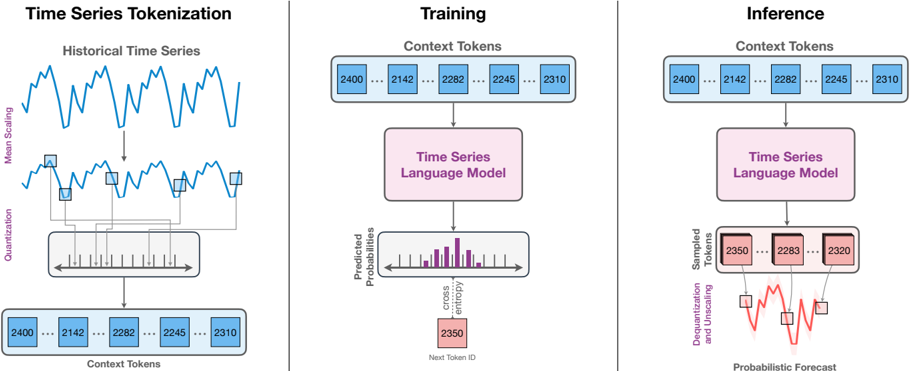
We introduce Chronos, a simple yet effective framework for pretrained probabilistic time series models. Chronos tokenizes time series values using scaling and quantization into a fixed vocabulary and trains existing transformer-based language model architectures on these tokenized time series via the cross-entropy loss. We pretrained Chronos models based on the T5 family (ranging from 20M to 710M parameters) on a large collection of publicly available datasets, complemented by a synthetic dataset that we generated via Gaussian processes to improve generalization. In a comprehensive benchmark consisting of 42 datasets, and comprising both classical local models and deep learning methods, we show that Chronos models: (a) significantly outperform other methods on datasets that were part of the training corpus; and (b) have comparable and occasionally superior zero-shot performance on new datasets, relative to methods that were trained specifically on them. Our results demonstrate that Chronos models can leverage time series data from diverse domains to improve zero-shot accuracy on unseen forecasting tasks, positioning pretrained models as a viable tool to greatly simplify forecasting pipelines.
Overview
CoChat Summary
TL;DR
Chronos adapts language-model architectures to probabilistic time series forecasting by scaling and quantizing values into tokens and training T5/GPT-2 models with cross-entropy. Across 42 benchmark datasets, it achieves strong in-domain and zero-shot forecasting, often matching or beating task-specific models.
Key findings
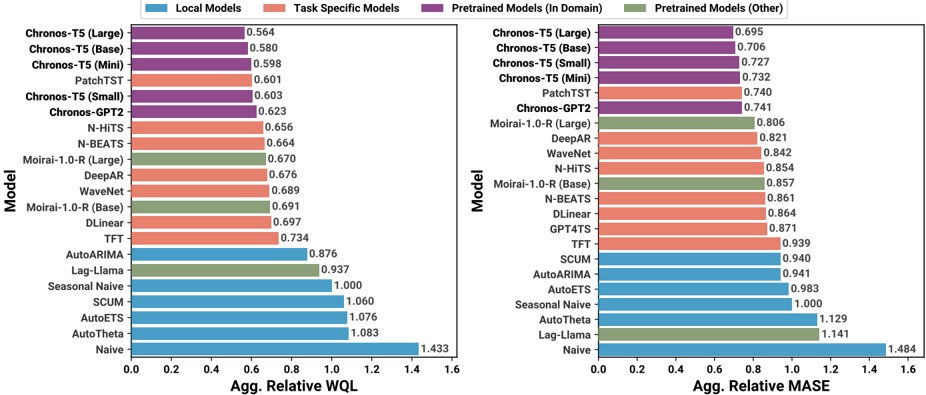
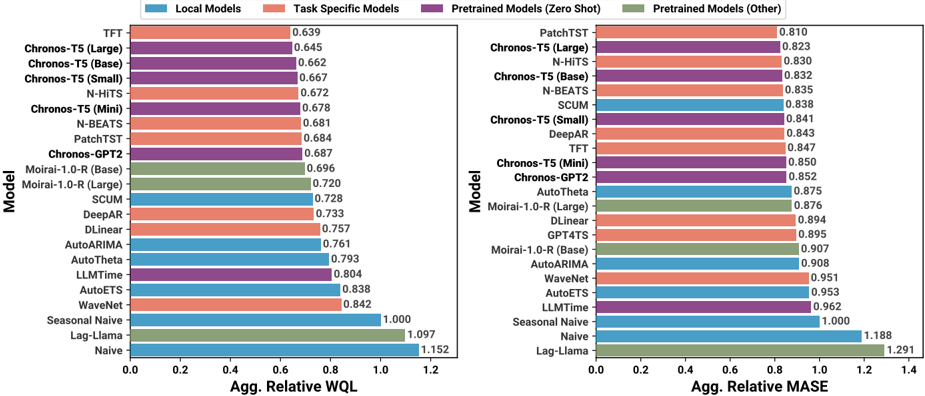
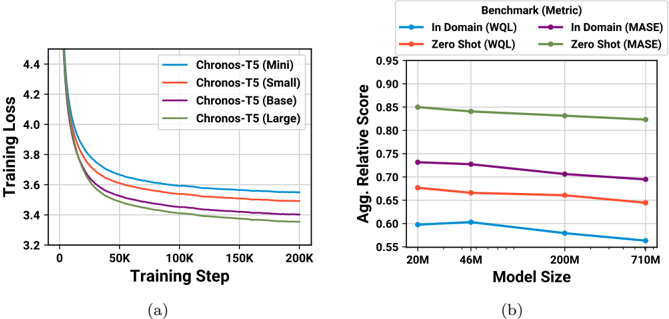
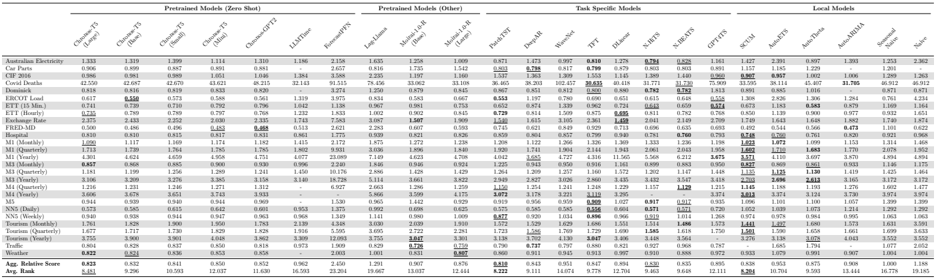
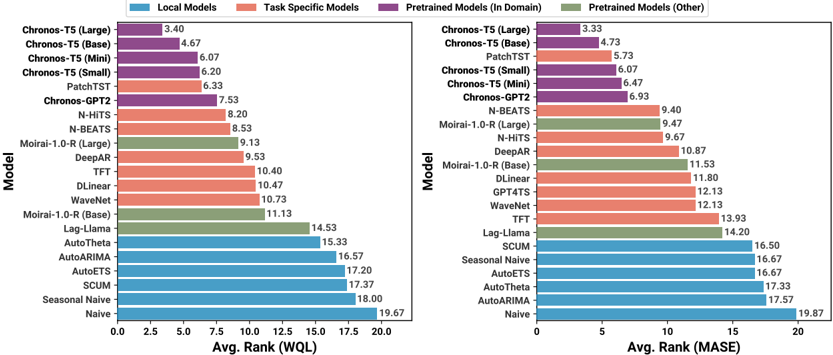
- On in-domain Benchmark I (15 datasets), Chronos-T5 Base/Large obtain the best aggregated relative scores: WQL 0.580/0.564 and MASE 0.706/0.695 versus Seasonal Naive 1.000, outperforming local, task-specific, and other pretrained baselines.
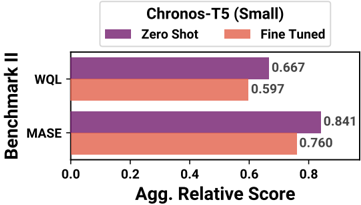
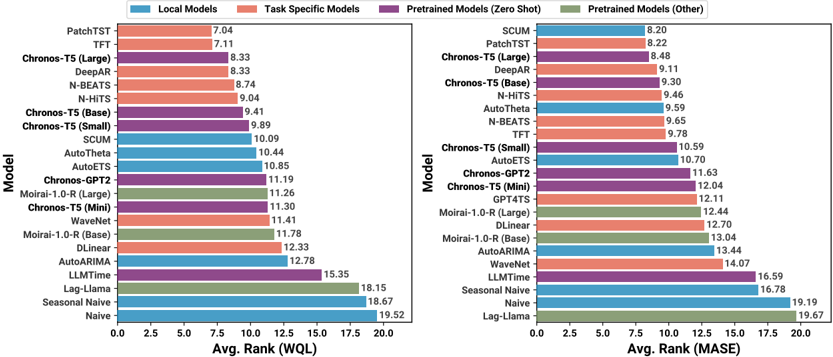
- On zero-shot Benchmark II (27 datasets), Chronos models rank 2nd–4th on WQL and Chronos-T5 Large ranks 2nd on MASE; aggregated relative WQL is 0.645 (Large), 0.662 (Base), 0.667 (Small), 0.678 (Mini), and MASE is 0.823, 0.832, 0.841, 0.850 versus Seasonal Naive 1.000. Fine-tuned Chronos-T5 Small becomes the best model on Benchmark II.
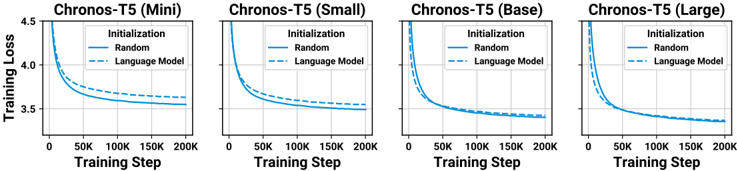
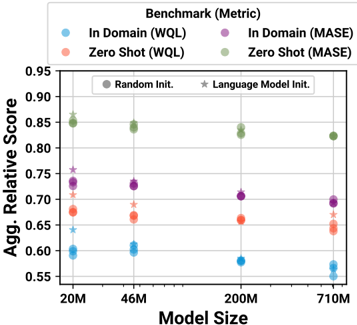
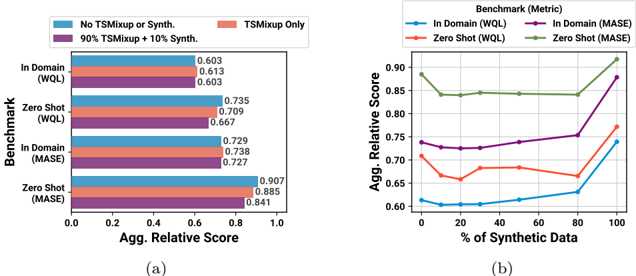
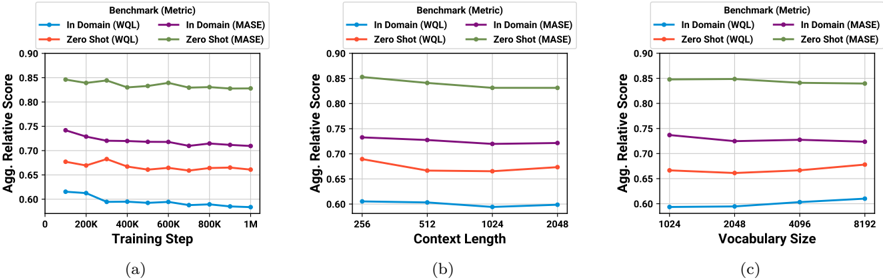
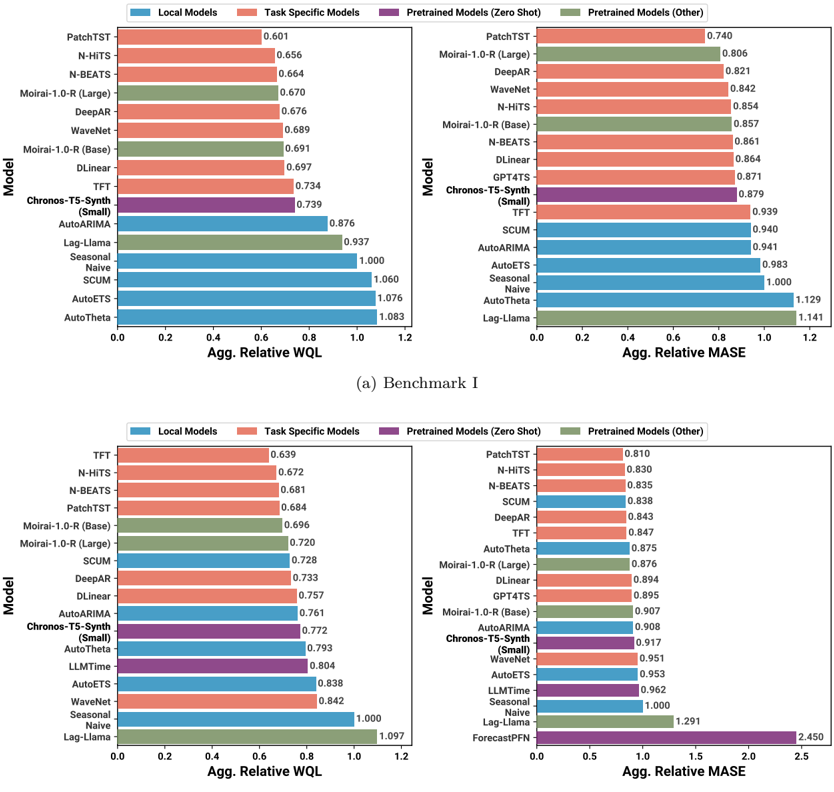
- Ablations show performance improves with model size; language-model-weight initialization offers little/no advantage over random initialization; TSMixup improves zero-shot performance; about 10% KernelSynth synthetic data is best; context length up to 1024 helps; larger vocabulary improves MASE but WQL deteriorates.
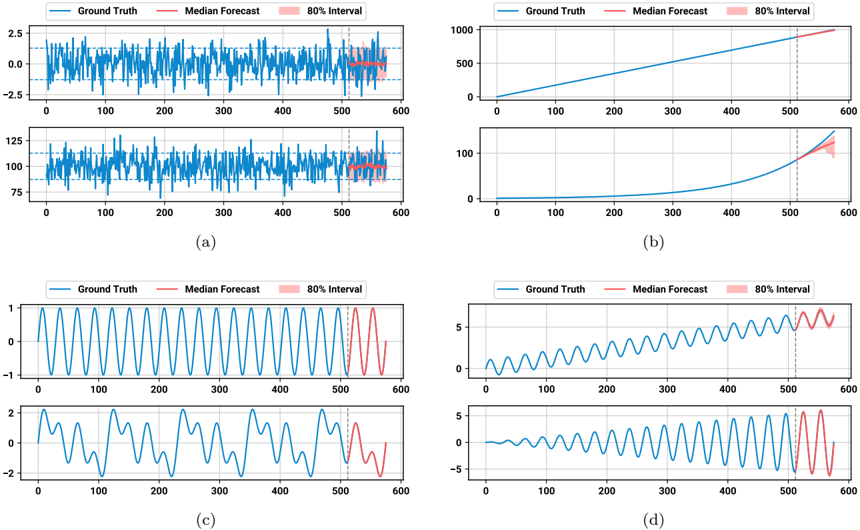
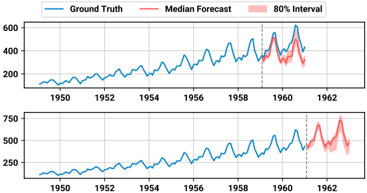
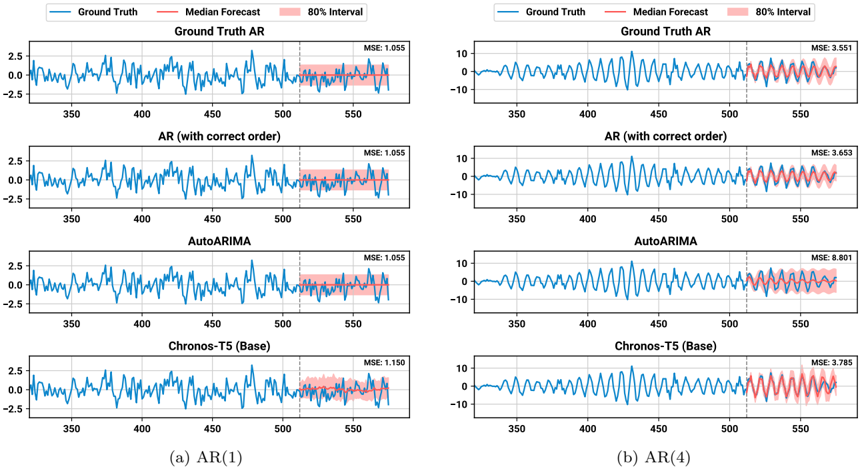
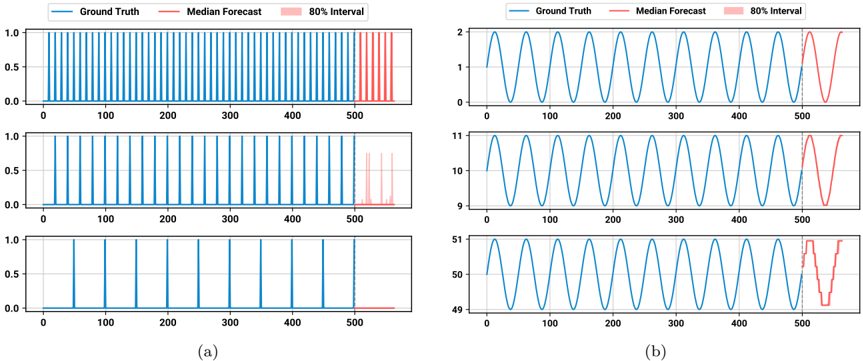
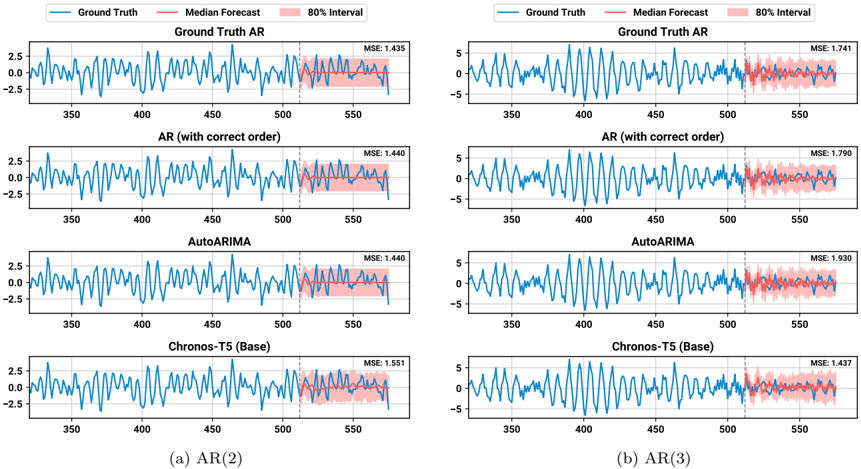
- Qualitatively, Chronos handles Gaussian noise, seasonality, additive/multiplicative trend+seasonality, and AR processes, but struggles with exponential trends and underestimates trend when context is short.
Methods
- Chronos mean-scales time series, uniformly quantizes values into B=4094 bins plus PAD/EOS (V_ts=4096), and trains off-the-shelf transformer language models with categorical cross-entropy; forecasts are produced by autoregressively sampling token paths and dequantizing/unscaling them.
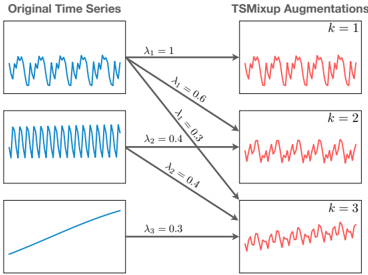
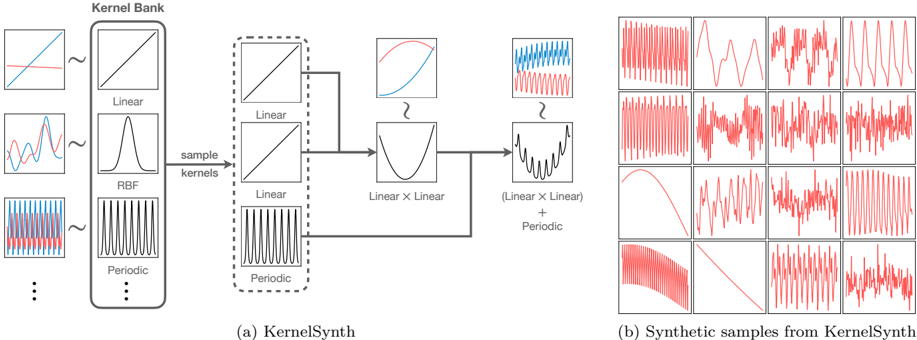
- Training used 55 datasets total: 13 pretraining-only, 15 Benchmark I in-domain, and 27 Benchmark II zero-shot; 28 training datasets comprised about 890K univariate series and approximately 84B observations/tokens. Models included T5 Mini 20M, Small 46M, Base 200M, Large 710M, and GPT-2 90M, trained with 10M TSMixup augmentations plus 1M KernelSynth GP synthetic series, context length 512, prediction length 64, and 200K AdamW steps.
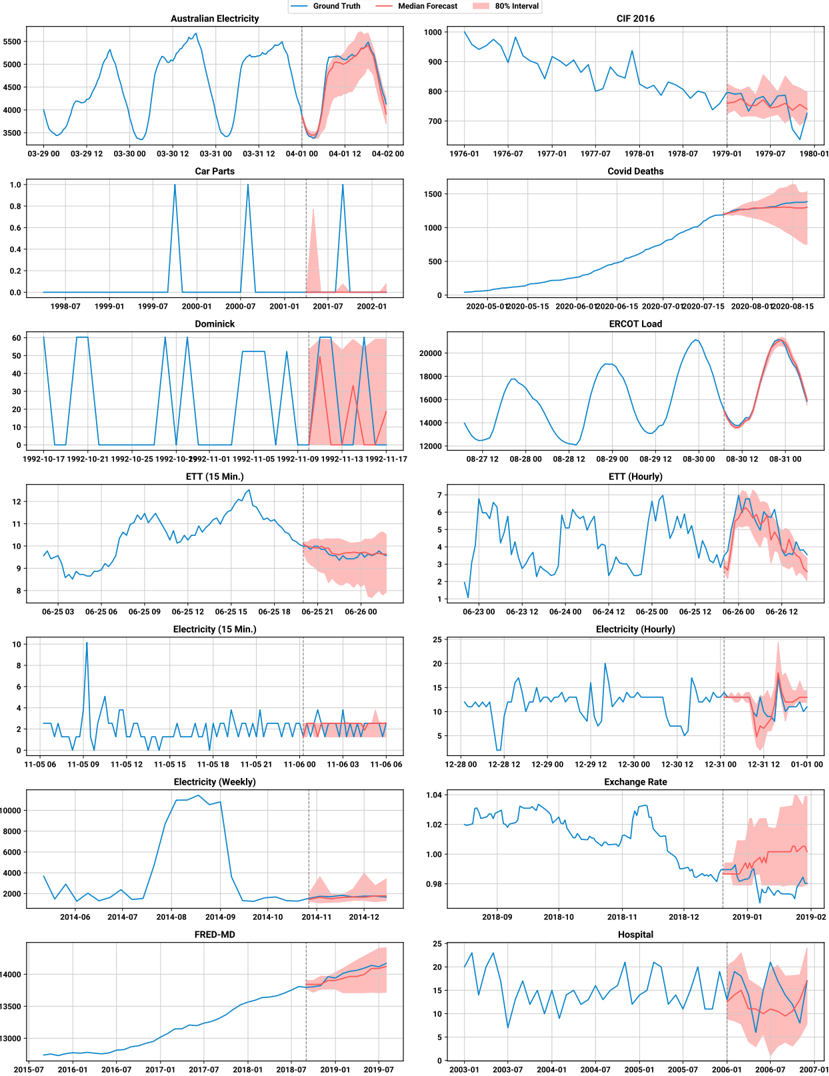
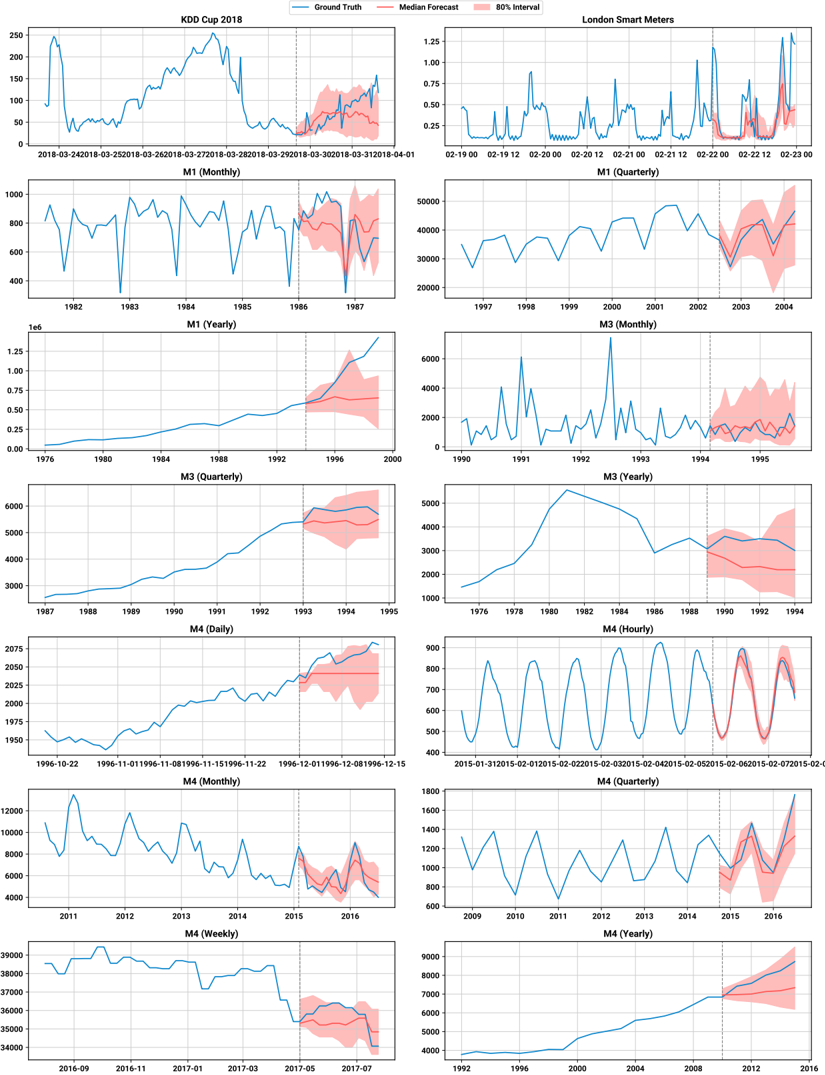
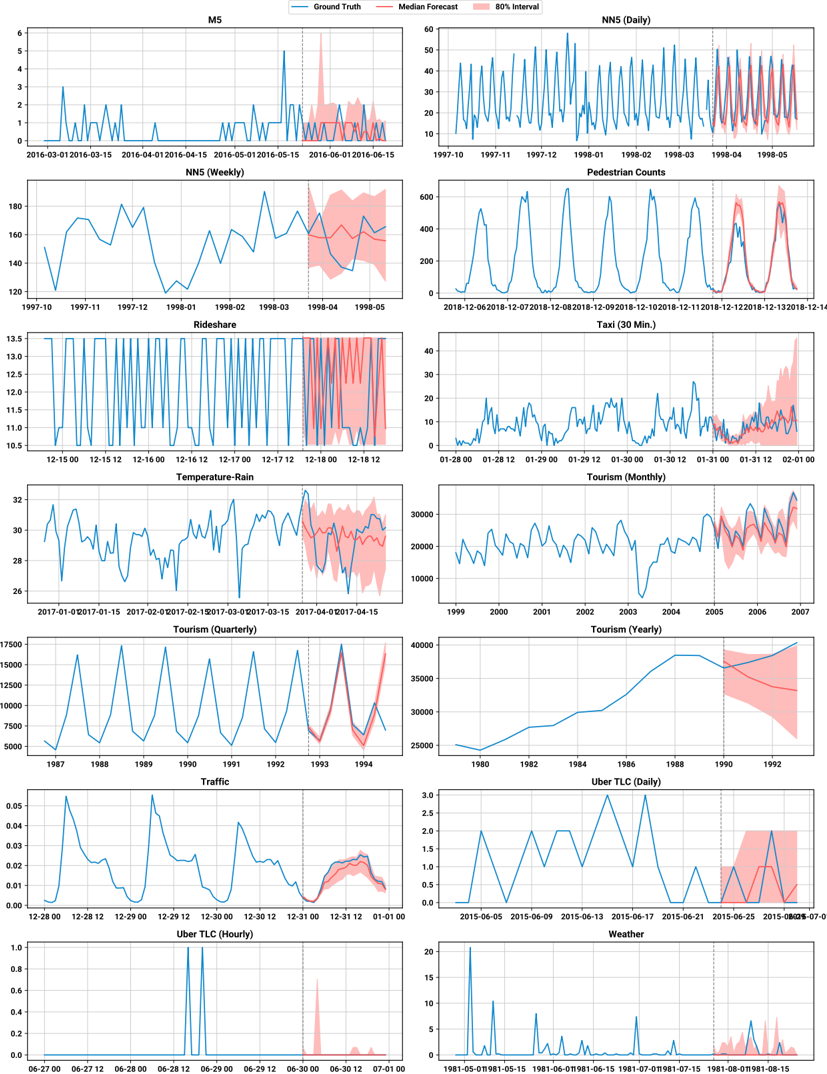
- Evaluation used 42 benchmark datasets with WQL (9 quantiles) and MASE; relative scores versus Seasonal Naive were aggregated by geometric mean and compared against local, task-specific, and pretrained baselines, plus a fine-tuning experiment on Benchmark II.
Limitations
- The paper states tokenization limits: representable values are in [-15s, 15s] where s is the mean absolute scale; small s relative to range causes overflow, while large s relative to variance causes precision loss. It also notes poor exponential-trend forecasts, trend underestimation with short context, and that categorical cross-entropy is not distance-aware; ordinal modeling is left as future work.
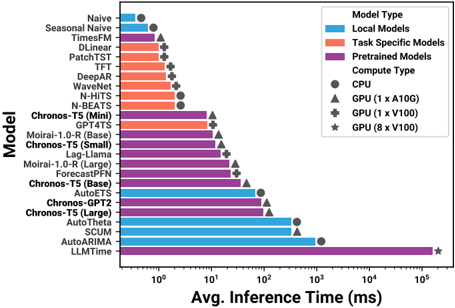
- The paper states scope limits: only univariate, uniformly spaced forecasting is studied; exogenous covariates, multivariate forecasting, and irregular sampling are not handled. Larger models were not explored due to slow inference, inference is slower than task-specific models, evaluation lacks enough high-frequency datasets to study long contexts, and public time series data remain limited.
- Text-evident: the zero-shot comparison may favor Moirai-1.0-R because many Benchmark II datasets were part of its pretraining corpus, as the paper notes; Chronos also ignores time and frequency information by design.
Model-written summary. Check it against the paper before relying on it.
Integrity signals
Registry
Cites
Statistics
Figures

Verification
Claims the paper makes
0 Valid · 4 Not valid · 14 Not checked · 146 Own results and interpretations
A result the paper reports from its own data — it cites no other source for it, so there is none to check. The quote shows it is in the paper.
In the paper
“Between the two baseline pretrained models studied in this experiment, Moirai-1.0-Rclearly outperforms Lag-Llama.”
§ Chronos: Learning the Language of Time Series > 5.5 Main Results
boosted- Asserted: passes — The authors put it forward as true.
- Checkable: passes — It can be checked against evidence.
- Load-bearing: unclear — It is unclear whether the paper’s conclusions depend on it.
- Based: passes — The paper gives a reason why it holds.
A result the paper reports from its own data — it cites no other source for it, so there is none to check. The quote shows it is in the paper.
In the paper
“Unsurprisingly, the training loss improves with the model capacity, as shown in Figure 7a.”
§ Chronos: Learning the Language of Time Series > Model size.
plainstates a cause- Asserted: passes — The authors put it forward as true.
- Checkable: passes — It can be checked against evidence.
- Load-bearing: unclear — It is unclear whether the paper’s conclusions depend on it.
- Based: passes — The paper gives a reason why it holds.
A result the paper reports from its own data — it cites no other source for it, so there is none to check. The quote shows it is in the paper.
In the paper
“Our comprehensive evaluation across 42 datasets establishes Chronos as a benchmark for both in-domain and zero-shot forecasting, surpassing both traditional models and task-specific deep learning approaches.”
§ Chronos: Learning the Language of Time Series > Time Series Tokenization Training Inference
plain- Asserted: passes — The authors put it forward as true.
- Checkable: passes — It can be checked against evidence.
- Load-bearing: passes — The paper’s conclusions depend on it.
- Based: passes — The paper gives a reason why it holds.
A result the paper reports from its own data — it cites no other source for it, so there is none to check. The quote shows it is in the paper.
In the paper
“consistent improvement is observed around the 10% synthetic data proportion.”
§ Chronos: Learning the Language of Time Series > Model size.
plainstates an association- Asserted: passes — The authors put it forward as true.
- Checkable: passes — It can be checked against evidence.
- Load-bearing: unclear — It is unclear whether the paper’s conclusions depend on it.
- Based: passes — The paper gives a reason why it holds.
A result the paper states — it cites no source for it, so there is none to check. The quote shows it is in the paper.
In the paper
“Further increasing the proportion of synthetic data tends to worsen performance.”
§ Chronos: Learning the Language of Time Series > Model size.
hedgedstates a possible cause- Asserted: passes — The authors put it forward as true.
- Checkable: passes — It can be checked against evidence.
- Load-bearing: unclear — It is unclear whether the paper’s conclusions depend on it.
- Based: passes — The paper gives a reason why it holds.
- Rests on an assumption not shown here.
94 more claims
Create a free account to see all 164 claims and to verify the 17 references still open.
- It may state two separate claims as one. 42
- Probably not a substantial claim. 30
Self-check
Percentages, sums and reported differences re-computed from the paper’s own numbers.
Each contradiction between two passages listed here was confirmed by an independent check.
Rated minor: it would not touch a result — a value no result rests on, a p-value that stays on the same side of the significance level, or a conflict that is clerical, resolved elsewhere in the paper, or outside its own findings.
In the paper
§ Chronos: Learning the Language of Time Series > Additional information
“Dominick (Godahewa et al., 2021) contains weekly time series representing the profit of individual stock keeping units from a retailer.”
§ Chronos: Learning the Language of Time Series > Covid Deaths
“Dominick retail 1D 100014 201 296 399 8”
Rated minor: it would not touch a result — a value no result rests on, a p-value that stays on the same side of the significance level, or a conflict that is clerical, resolved elsewhere in the paper, or outside its own findings.
In the paper
§ Chronos: Learning the Language of Time Series > C Baselines
“We considered a total of 17 baseline methods for benchmarking Chronos.”
§ Chronos: Learning the Language of Time Series > Chronos-GPT2 Chronos-T5 (Mini)
“Figure: Naive, SeasonalNaive, AutoETS, Auto-Theta, SCUM, AutoARIMA, DeepAR, TFT, PatchTST, DLinear, WaveNet, N-BEATS, N-HiTS, GPT4TS, Lag-Llama, Moirai-1.evaluationAll the above, LLMTime and ForecastPFN”
Citations
Cites
Exploring the Limits of Transfer Learning with a Unified Text-to-Text Transformer
Raffel, C., Shazeer, N., Roberts, A., Lee, K., Narang, S., Matena, M., Zhou, Y., Li, W., & Liu, P. J. (2019) · arXiv · doi:10.48550/arxiv.1910.10683 · Cited by 31,859
LoRA: Low-Rank Adaptation of Large Language Models
Hu, E. J., Shen, Y., Wallis, P., Allen-Zhu, Z., Li, Y., Wang, S., Wang, L., & Chen, W. (2021) · arXiv · doi:10.48550/arxiv.2106.09685 · Cited by 13,453
LightGBM: A Highly Efficient Gradient Boosting Decision Tree
(2017) · HAL · Cited by 10,512
Lewis, M., Liu, Y., Goyal, N., Ghazvininejad, M., Mohamed, A., Levy, O., Stoyanov, V., & Zettlemoyer, L. (2020) · Proceedings of the 58th Annual Meeting of the Association for Computational Linguistics · doi:10.18653/v1/2020.acl-main.703 · Cited by 8,821
Lewis, M., Liu, Y., Goyal, N., Ghazvininejad, M., Mohamed, A., Levy, O., Stoyanov, V., & Zettlemoyer, L. (2019) · arXiv · doi:10.48550/arxiv.1910.13461 · Cited by 8,816
Transformers: State-of-the-Art Natural Language Processing
Wolf, T., Debut, L., Sanh, V., Chaumond, J., Delangue, C., Moi, A., Cistac, P., Rault, T., Louf, R., Funtowicz, M., et al. (2020) · Proceedings of the 2020 Conference on Empirical Methods in Natural Language Processing: System Demonstrations · doi:10.18653/v1/2020.emnlp-demos.6 · Cited by 8,741
Informer: Beyond Efficient Transformer for Long Sequence Time-Series Forecasting
Zhou, H., Zhang, S., Peng, J., Zhang, S., Li, J., Xiong, H., & Zhang, W. (2021) · Proceedings of the AAAI Conference on Artificial Intelligence · doi:10.1609/aaai.v35i12.17325 · Cited by 7,752
mixup: Beyond Empirical Risk Minimization
Zhang, H., Cisse, M., Dauphin, Y. N., & Lopez-Paz, D. (2017) · arXiv · doi:10.48550/arxiv.1710.09412 · Cited by 5,831
Strictly Proper Scoring Rules, Prediction, and Estimation
Gneiting, T., & Raftery, A. E. (2007) · Journal of the American Statistical Association · doi:10.1198/016214506000001437 · Cited by 5,793
Another look at measures of forecast accuracy
Hyndman, R. J., & Koehler, A. B. (2006) · International Journal of Forecasting · doi:10.1016/j.ijforecast.2006.03.001 · Cited by 5,757
Research works printed but not linked: 8
- George Athanasopoulos, Rob J. Hyndman, Haiyan Song, and Doris C. Wu. The tourism forecasting compe- tition. International Journal of Forecasting, 27(3):822-844, 2011.
- Tom B. Brown, Benjamin Mann, Nick Ryder, Melanie Subbiah, Jared Kaplan, Prafulla Dhariwal, Arvind Neelakantan, Pranav Shyam, Girish Sastry, Amanda Askell, Sandhini Agarwal, Ariel Herbert-Voss, Gretchen Krueger, Tom Henighan, Rewon Child, Aditya Ramesh, Daniel M. Ziegler, Jeffrey Wu, Clemens Winter, Christopher Hesse, Mark Chen, Eric Sigler, Mateusz Litwin, Scott Gray, Benjamin Chess, Jack Clark, Christopher Berner, Sam McCandlish, Alec Radford, Ilya Sutskever, and Dario Amodei. Language models are few-shot learners. In Advances in Neural Information Processing Systems, 2020. 2, 3, 4
- Rob Hyndman, Anne B Koehler, J Keith Ord, and Ralph D Snyder. Forecasting with exponential smoothing: the state space approach. Springer Science & Business Media, 2008. 3, 9
- Alec Radford, Jeffrey Wu, Rewon Child, David Luan, Dario Amodei, Ilya Sutskever, et al. Language models are unsupervised multitask learners. OpenAI blog, 1(8):9, 2019. 4, 6
- Yaniv Romano, Evan Patterson, and Emmanuel Candes. Conformalized quantile regression. Advances in neural information processing systems, 32, 2019.
- Kai Ming Ting and Ian H Witten. Stacking bagged and dagged models. In Proceedings of the Fourteenth International Conference on Machine Learning, 1997. 20
- Ashish Vaswani, Noam Shazeer, Niki Parmar, Jakob Uszkoreit, Llion Jones, Aidan N. Gomez, Lukasz Kaiser, and Illia Polosukhin. Attention Is All You Need. In Advances in Neural Information Processing Systems, 2017.
- Yun Zhou, Liwen You, Wenzhen Zhu, and Panpan Xu. Improving time series forecasting with mixup data augmentation. In ECML PKDD 2023 International Workshop on Machine Learning for Irregular Time Series, 2023b. 7
Cited by
Items 1,201–1,300 of 2,048
Distillation of Synthetic Data for Time Series Foundation ModelsPreprint
Biswas, N., & Karoui, N. E. (2026) · arXiv · doi:10.48550/arxiv.2609.09586
“Rows one to five are the TempoPFN generators [11], which subsume KernelSynth [1] and ForecastPFN [6]; the last row is from Chronos [1].”
Chimba, D., Matongo, T., Yeboah, A. S., & Sharma, R. (2026) · Big Data and Cognitive Computing · doi:10.3390/bdcc10090306
Wireless Foundation Models: State-of-the-Art and Open ChallengesPreprint
Huachaca, A. M. P., Rodriguez, J. J. R., Aboulfotouh, A., da Fonseca, N. L. S., Astudillo, C. A., & Abou-Zeid, H. (2026) · arXiv · doi:10.48550/arxiv.2609.04707
Demirci, Y., Mantelet, G., Martel, S., Frigon, J., & Kurt, G. K. (2026) · IEEE Journal of Radio Frequency Identification · doi:10.1109/jrfid.2026.3731895
“…based models can be further divided into domain specific models such as Informer [21] which is trained solely on a specific dataset and foundation models such as Chronos [22] and TimesFM [23] which are pre-trained on massive, diverse datasets to enable zero-shot forecasting across any domain.”
Lu, Y., & Zhang, H. (2026) · Algorithms · doi:10.3390/a19090760
“Chronos quantizes scaled time-series values into discrete tokens and trains language-model architectures to generate probabilistic future sequences [36].”
PhyTTA: Physics-Informed Test-Time Adaptation of Foundation Models for Regional Drought Prediction
Gao, W., Li, J., Liu, L., Le, T. D., Liu, J., Chen, Y., & Zhao, Y. (2026) · International Joint Conference on Artificial Intelligence · doi:10.24963/ijcai.2026/795
“Time series foundation models (TSFMs) such as TimesFM [Das et al. , 2024], Chronos [Ansari et al. , 2024], and Moirai [Woo et al. , 2024] have demonstrated strong zero shot forecasting across regions.”
InfluentialNovi, D. D., Carnevale, L., Marino, R. A., Balouek‐Thomert, D., Parashar, M., & Villari, M. (2026) · Telematics and Informatics Reports · doi:10.1016/j.teler.2026.100361
MDFTS: A multi-domain feature-aware dual-stream model for zero-shot time series forecasting
Guo, J., Zhang, X., Li, X., Lyu, X., Wang, L., Chen, J., & Bi, Y. (2026) · Neurocomputing · doi:10.1016/j.neucom.2026.135204
Self-citationAMAD: AutoMasked Attention for unsupervised multivariate time series anomaly detection
Huang, T., Li, G., Li, Y., & Zhang, W. (2026) · Knowledge-Based Systems · doi:10.1016/j.knosys.2026.117110
A Numerical–Textual Dual-Channel Forecasting Framework for Short-Term Load Forecasting
Xin, X., Xu, J., Wang, X., Xu, W., Yue, Y., Wang, C., Yang, J., & Sun, B. (2026) · Energies · doi:10.3390/en19163930
“…of GPT4TS [15] and Time-LLM [33], three domain-specific time-series foundation models evaluated zero-shot—TimeMoE-50M [34], Sundial-128M [35] and Chronos-Bolt-Base [36]—and a numerical encoder matched to NTSForecast in architecture and trainable-parameter count but with the backbone removed.”
Learning to Forecast Crop Growth from Earth Observation DataPreprint
Senti, D., Türkoglu, M. Ö., Volpi, M., & Aasen, H. (2026) · arXiv · doi:10.48550/arxiv.2608.14281
“More recently, the field has moved towards pretrained foundation models that forecast previously unseen time-series in a zero-shot setup [6, 17, 35, 47, 98].”
ConTemPreT: Contextual temporal pre-trained transformer-based forecasting
Midilli, Y. E., & Parshutin, S. (2026) · Applied Intelligence · doi:10.1007/s10489-026-07423-7
“The authors of [15, 16] pre-train a transformer decoder with single-task supervised learning.”
A two-stage learning architecture for reliable financial time series forecasting
Isufaj, A., Mollá, P., Li, J., Matsuo, Y., & Prendinger, H. (2026) · Neurocomputing · doi:10.1016/j.neucom.2026.134703
Gudla, R., & Chang, N. (2026) · Expert Systems with Applications · doi:10.1016/j.eswa.2026.134013
Hsieh, C.-C., & Chen, M. (2026) · Applied Soft Computing · doi:10.1016/j.asoc.2026.116252
Conditional Multimodal Fusion for Time-Series Anomaly Detection
Wang, B., Du, M., Zhang, M., Xu, K., Xu, Z., Xu, S., & Yang, Y. (2026) · International Conference on Big Data and Information Analytics (BigDIA) · doi:10.1109/bigdia71496.2026.11684663
“We also compare with recent time-series foundation models, including Chronos [24] and MOMENT [25].”
Gao, W., Li, J., Liu, L., Le, T. D., Liu, J., Zhao, Y., & Chen, Y. (2026) · International Conference on Machine Learning · doi:10.48550/arxiv.2607.17507
“Recent advances in time series foundation models (TSFMs) have demonstrated strong performance across diverse forecasting domains (Das et al., 2024; Rasul et al., 2024; Ansari et al., 2024).”
VAIOM: Continuous-Input, Discrete-Output Decoder-Only Financial Sequence ModelingPreprint
Ma, Y., & Chen, X. (2026) · arXiv · doi:10.48550/arxiv.2607.13929
“These variables are noisy, heavy-tailed, regime-dependent and language-like modeling problem: values are scaled, quantized into a fixed vocabulary and modeled by Transformer language-model architectures using cross-entropy loss [Ansari et al., 2024].”
From Vector Autoregressions to AI-based Time Series Forecasting: A ReviewPreprint
Chen, L., & Wang, W. (2026) · arXiv · doi:10.48550/arxiv.2607.14279
“Foundation models [3, 11, 63] push this logic further by pretraining once on a large and diverse collection of time series, then forecasting new series without task-specific estimation.”
PFGCNet: A multi-view collaborative network for industrial multivariate time-series forecasting
Xiang, L. I. U., Xu, K., Wang, Y., Ma, H., Zhang, X., & Ji, Z. (2026) · Journal of Process Control · doi:10.1016/j.jprocont.2026.103752
Self-citationGLST: An Efficient and Modular Framework for Spatio-Temporal Service Flow Forecasting
Xie, W., Xu, X., Qu, J., Fan, H., Di, K., Yu, S., Liu, M., & Wang, Z. (2026) · IEEE International Conference on Web Services (ICWS) · doi:10.1109/icws72778.2026.00055
“Other approaches like Chronos [18] explore diffusion-based generation, and UniTS [19] develops unified architectures for improved task transferability, PatchTST [20] is a Transformer for multivariate forecasting and self-supervised representation learning that converts each series into sub-series…”
EvoTS: Evolutionary Transformer Search for Time Series Forecasting
Elsaid, A., & Pulatov, D. (2026) · Genetic and Evolutionary Computation Conference (GECCO) · doi:10.1145/3795095.3805078
“Pretrained models such as Chronos [15] resort to data augmentation and the use of synthetic datasets in addition to real-world datasets while models such as ForecastPFN [17] and TabPFN-v2 [18] resort to training models purely on synthetic data.”
Yuce, A. B., Leffler, C. J., Varghese, S., Spiliopoulou, M., & Stober, S. (2026) · arXiv · doi:10.48550/arxiv.2606.30104
“Models such as Chronos (Ansari et al., 2024) and TimesFM (Das et al., 2024) are primarily designed for univariate forecasting, employing encoder-decoder and decoder-only transformer architectures, respectively.”
A cross-modal alignment-based time-series large model for water supply networks flow forecasting
Yang, T., Gui, H., Xu, J. Q., Li, X., Ding, X., & Liu, Y. (2026) · Mechatronics Technology · doi:10.55092/mt20260002
“The other line develops dedicated time-series foundation models, such as TimeGPT [29], Chronos[30], TimesFM [31], and Time-MoE [32].”
Gan, X., & Hou, Y. (2026) · Connection Science · doi:10.1080/09540091.2026.2682059
Time Series and Econometric Modeling using Small Language Models
Katharakis, K., García, A. P., Maior, J. R., Nagel, S. S., & Mukkamala, R. R. (2025) · IEEE International Conference on Big Data (BigData) · doi:10.1109/bigdata66926.2025.11400841
“This study aims to address the above research question by conducting a comparative evaluation of three open-source Small Language Models: Chronos [10], Moirai [12], and TimesFM [11], in forecasting three key macroeconomic variables and one demographic variable across all 27 EU member states.”
Omori, A., Hashiura, R., & Nakano, N. (2025) · Proceedings of the ISCIE International Symposium on Stochastic Systems Theory and its Applications · doi:10.5687/sss.2025.7
Jerome, N. T., Aouadi, N., Köhler, C., Chilingaryan, S. A., & Kopmann, A. (2025) · IEEE ... International Conference on Data Mining workshops · doi:10.1109/icdmw69685.2025.00038
“Chronos [23] departed from this approach by training a dedicated LLM from scratch on a tokenized time-series corpus, prioritizing scalability and generalization.”
The Trajectory of Deep Learning in Time Series Forecasting: A Survey
Zhang, W., Yang, B., & Dai, C. (2025) · IEEE International Conference on Internet of Things (iThings) and IEEE Green Computing and Communications (GreenCom) and IEEE Cyber, Physical and Social Computing (CPSCom) and IEEE Smart Data (SmartData) · doi:10.1109/ithings-greencom-cpscom-smartdata-cybermatics67059.2025.00037
“Time-LLM [19] Chronos [20] Fig.”
Pakhrin, S. C., Tack, S. C., Keymanesh, P., & Chauhan, N. (2026) · SSRN Electronic Journal · doi:10.2139/ssrn.7238275
Papadopoulos, D. N., & Sartipi, A. (2026) · International Conference on Electrical, Computer and Energy Technologies (ICECET) · doi:10.1109/icecet65726.2026.11632832
“TSFMs such as Chronos, Lag-Llama and TimesFM are pretrained on large, heterogeneous collections of time series and have demonstrated robust zero-shot and few-shot capabilities across diverse benchmark suites and industrial case studies [11]–[14].”
Hybrid Machine Learning Approach for Short-Term Load Forecasting in Small Commercial Buildings
Mateo, A. D., Garay-Martinez, R., Borges, C. E., & Garre, A. G. (2026) · doi:10.3390/engproc2026155004
Rogers, S., Way, D. A., Roche, R., & Jin, H. (2026) · SSRN Electronic Journal · doi:10.2139/ssrn.7493378
Frequency-Based Spatial–Temporal Mixture Learning for Load Forecasting
Shen, A., Wang, X., Xu, H., Zhan, J., Zhou, S., & Kong, Y. (2025) · Sustainability · doi:10.3390/su18010171
Kim, J., & Chi, M. (2026) · IEEE International Conference on Acoustics Speech and Signal Processing · doi:10.1109/icassp55912.2026.11464566
Gan, Y., & Liu, G. P. (2025) · Conference on Fully Actuated System Theory and Applications (FASTA) · doi:10.1109/fasta65681.2025.11138167
“The emerging foundation models for time series, such as Chronos [12], represent another promising direction by pre-training on diverse time series datasets to generalize forecasting capabilities.”
Cardiovascular Risk Prediction Using ECG via a Time–Frequency Embedding Pre-Trained Model
Lin, J., Ren, G., Jing, C., Wu, H., Shen, Y., Zhao, B.-C., Liu, K., Lei, B., Yanchun, P., Tsang, K.-F., et al. (2026) · IEEE Transactions on Consumer Electronics · doi:10.1109/tce.2026.3687190
“Chronos, proposed by Ansari et al., leverages scale-quantization to adapt existing language model architectures and training workflows for probabilistic time series forecasting [25].”
FUELSIGHT: MODEL FOR PREDICTING SHIP FUEL CONSUMPTION AND PROVIDING EXPLANATIONS
Appazov, E., & Kochubei, P. (2026) · Vodnij transport · doi:10.33298/2226-8553.2026.1.45.16
Towards foundation models for insurance risk modellingPreprint
Blier-Wong, C. (2026) · arXiv · doi:10.48550/arxiv.2609.14576
“Time series foundation models, including Chronos (Ansari et al., 2024) and TimesFM (Das et al., 2024), learn temporal patterns from many series and reuse those patterns to forecast a new series.”
FMplex: Model Virtualization for Serving Extensible Foundation ModelsPreprint
Shastri, H., Sharma, P., Hanafy, W. A., Irwin, D., Srivastava, M. B., & Shenoy, P. J. (2026) · arXiv · doi:10.48550/arxiv.2606.09643
“Foundation models now span many domains and modalities, including time series [3, 19], vision [49, 54], and natural language [8, 23, 41, 73].”
Training and Scaling Compute-Optimal Physiological Waveform Foundation ModelsPreprint
Li, P., Peng, J., Luo, S., Plotkin, Z., & Chen, T. (2026) · arXiv · doi:10.48550/arxiv.2610.05649
A Unified Scaling Law for Time Series Foundation ModelsPreprint
Dai, X., Liu, Y., Dong, Z., Yang, J.-M., & Xu, Q. (2026) · arXiv · doi:10.48550/arxiv.2610.05269
“Forecasting has progressed from statistical methods to Transformer and linear models (Nie et al., 2023; Zeng et al., 2023; Dai et al., 2026c), and to TSFMs pretrained across datasets (Ansari et al., 2024; Das et al., 2024; Woo et al., 2024; Khwaja et al., 2026).”
Time Series Forecasting Benchmarks Need Scenario-Grounded Stress TestingPreprint
Zhao, Y., Xu, L., & Xue, H. (2026) · arXiv · doi:10.48550/arxiv.2610.02608
“In the foundation-model era, this guarantee weakens as TSFMs are pretrained on large, partially unauditable corpora [4, 13, 79, 44, 27] drawn from the same public repositories that later supply benchmark test sets.”
SGA: Uncertainty Quantification for Multi-Step Forecasting in Time Series Foundation ModelsPreprint
Hu, X., Liang, S., Feng, C., & Zhang, S.-Q. (2026) · arXiv · doi:10.48550/arxiv.2609.28582
“Existing studies primarily focus on UQ for one-step forecasting, where uncertainty is typically quantified by quantile-based interval widths [1] either directly produced by the model [2] or empirically estimated from multiple forecast samples [3].”
InfluentialVandeventer, R., Imrem, D., & Wild, D. J. (2026) · arXiv · doi:10.48550/arxiv.2609.12105
“Closer to our concern, a growing literature builds foundation models directly on tabular [21, 22] and time-series data [2, 12, 46], motivated by the recognition that the statistical character of such data—non-stationarity, heavy tails, heterogeneous feature types, small samples—is not captured by…”
When Do Foundation Models Pay Off? A Break-Even Analysis of Pretrained Time Series ForecastersPreprint
Jerome, N. T., & Simon, F. (2026) · arXiv · doi:10.48550/arxiv.2607.04919
“Models like Chronos [1], Moirai [2], and Lag-Llama [3] have demonstrated impressive zero-shot performance across benchmarks, leading to widespread adoption: the Chronos model family has tens of millions of downloads on Hugging Face across all variants.”
An Open-Source Training Dataset for Foundation Models for Hyperparameter OptimizationPreprint
Klein, A., Rakotoarison, H., Thale-Bombien, L., & Salinas, D. (2026) · arXiv · doi:10.48550/arxiv.2605.23417
“Training budget 100% 70% 60% 50% 20% 10% Synthetic data has been proven effective for tabular and time-series foundation models [21, 22, 3] as it allows one to further improve coverage and diversity.”
MedMIX: Modality-Internal Expert Fusion for Multimodal Medical DiagnosisPreprint
Cho, S., Li, A., & Qiu, W. (2026) · arXiv · doi:10.48550/arxiv.2605.16639
“For temporal physiological signals, MOIRAI [Woo et al., 2024] and Chronos [Ansari et al., 2024] provide universal time-series representations pretrained across diverse domains.”
Continuity Laws for Sequential ModelsPreprint
Yu, A., Lyu, D., & Erichson, N. B. (2026) · arXiv · doi:10.48550/arxiv.2605.08539
“The recent surge of interest in sequential modeling, spanning language [Vaswani et al., 2017, Devlin et al., 2019, Brown et al., 2020], time series [Ansari et al., 2024, Das et al., 2023], and scientific data [Li et al., 2020a, Lu et al., 2019, Li et al., 2020b], has produced many new architectures…”
Instance-Adaptive Prompts as Context for Time-Series Foundation ModelsPreprint
Xiao, Z., Xie, S., Zan, L., Zhang, J., Pan, L., Redko, I., Tiomoko, M., & Zhang, K. (2026) · arXiv · doi:10.48550/arxiv.2609.34786
“Chronos (Ansari et al., 2024) discretizes individual values into tokens, whereas patch-based approaches group consecutive observations to reduce sequence length.”
Liu, M., Kang, Q., Wang, Y., Kai, S., Liang, K., Zhen, H.-L., Zhong, T., Yuan, M., & Song, L. (2026) · arXiv · doi:10.48550/arxiv.2606.03097
“For Chronos (Ansari et al., 2024), we adopt the ”amazon/chronos-bolt-mini” variant.”
InfluentialSelf-citationTeaching LLMs to Move: Generation of Human Activity Sensor Traces with BERT
Bigelli, L., Bogliolo, A., Calisti, L., Contoli, C., Kania, N., & Lattanzi, E. (2025) · International Conference on Advances in Artificial Intelligence (ICAAI) · doi:10.1145/3787279.3787304
Menna, F. D., Traini, L., & Cortellessa, V. (2026) · Journal of Systems and Software · doi:10.1016/j.jss.2026.112937
A survey and benchmark for household electricity forecasting: From statistical to foundation models
Dube, D. C., Xiang, Y., van Westering, W., Zdrnja, F., Kok, K., & Meratnia, N. (2026) · Energy Reports · doi:10.1016/j.egyr.2026.109594
Nagaonkar, S., Garg, R., Raj, A., Choithani, A., & Trivedi, A. (2026) · arXiv · doi:10.48550/arxiv.2608.08075
“…models, which confronted the same question for continuous signals and answered it with patch-based tokenizations learned at scale (Das et al., 2024; Ansari et al., 2024); visual streams add two spatial dimensions to that problem, and video transformers’ spatio-temporal tokens are early, mutually…”
Berghaus, D. (2026) · arXiv · doi:10.48550/arxiv.2610.01223
“…PatchTST [22], iTransformer [18], CATCH [42], DUET [27], and the Anomaly Transformer [44]), together with the foundation models Time-RCD [14], TSPulse [6], and Chronos [1] (the last scored by its one-step forecast residuals, univariate only), all run from their released checkpoints without tuning.”
Papadopoulos, D. N., Sinha, R., Bak‐Jensen, B., & Anvari‐Moghaddam, A. (2026) · SSRN Electronic Journal · doi:10.2139/ssrn.7038281
Ali, M. N. B., Lassoued, N., Amor, B. B., Nasr, S., & Aouididi, M. A. (2026) · medRxiv · doi:10.64898/2026.10.15.26365634
Ru, X., Wan, H., Yin, M., & Wang, M. (2026) · Energy and Buildings · doi:10.1016/j.enbuild.2026.118223
VAE-based Multivariate Nowcasting of the Japanese Economy
Ueda, T., Izumi, K., & Murayama, Y. (2025) · Computational Economics · doi:10.1007/s10614-025-11140-7
“Lately, time series foundation models pre-trained on large-scale time series data have appeared, eliminating the need for constructing task-specific models (Das et al., 2023; Ansari et al., 2024).”
Multi-Level Text Alignment for Interpretable and Uncertainty-Aware Time Series Forecasting with LLMs
Zhao, T., Sun, M., & Chen, X. (2026) · ACM Transactions on Knowledge Discovery from Data · doi:10.1145/3849700
“For example, Chronos [4] tokenizes continuous time series into discrete representations and performs large-scale pretraining, while Chronos-2 [3] extends this paradigm to universal, cross-domain forecasting.”
Farimani, S. A., Nia, R. G. N. N., & Jahan, M. V. (2025) · Signal and Data Processing · doi:10.61882/jsdp.22.2.109
Storage and recall of multiple chaotic attractors in minimal reservoir computers
Martinuzzi, F., & Kantz, H. (2026) · Chaos An Interdisciplinary Journal of Nonlinear Science · doi:10.1063/5.0334052
Beyond RMSE: Do the most accurate building load forecasts deliver the most operational value?
Jeon, B.-K., Kim, M., & Kim, J.-K. (2026) · Energy and Buildings · doi:10.1016/j.enbuild.2026.118339
Lima, A. M. D. A., Oliveira, A. L. I., & Zanchettin, C. (2025) · Conference proceedings/Conference proceedings - IEEE International Conference on Systems, Man, and Cybernetics · doi:10.1109/smc58881.2025.11343101
A Benchmark Dataset for Bus Travel and Dwell Time Prediction
Horn, A., Adam, P.-R., & Schmidtner, S. (2025) · IEEE International Conference on Intelligent Transportation Systems (ITSC) · doi:10.1109/itsc60802.2025.11423733
“We compute each metric per split and forecast horizon, then aggregate them using the geometric mean, as it is recommended by Fleming et al. when summarizing benchmark results [38], [39].”
Yu, X., Zhu, K., Jiang, H., & Chen, R. (2026) · Sustainability · doi:10.3390/su18094404
TFB-2: benchmarking and automated ensemble for time series forecasting
Li, Z., Wu, X., Qiu, X., Hu, J., Zhou, L., Guo, C., Zhou, A., Jensen, C. S., Sheng, Z., & Yang, B. (2026) · The VLDB Journal · doi:10.1007/s00778-026-01007-0
“We further compare AutoTFB with representative time series foundationmodels,includingChronos[4]andTimesFM[26], following the evaluation setting of TSFM-Bench [58].”
Karmanov, A. A. (2026) · Sovremennye informacionnye tehnologii i IT-obrazovanie. · doi:10.25559/sitito.022.202601.117-125
Wu, R., Dong, X., & Peng, M. (2026) · IEEE Access · doi:10.1109/access.2026.3743063
Exploring Different Machine Learning-Based Methods for Learning the Language of Shepna Stock Price
Ansari, Z., Gahruei, J. R., & Khademi, M. (2025) · doi:10.1109/icee67339.2025.11213927
Raszka, L., & Grycz, O. (2026) · SSRN Electronic Journal · doi:10.2139/ssrn.7668994
Technical pathways and outlook for waterflooding development and adjustment enabled by large models
Liu, H., Liu, J.-Y., Li, Y., & Wang, S. (2026) · Petroleum Science · doi:10.1016/j.petsci.2026.10.008
Beyond point accuracy: reliability-aware evaluation of multi-horizon OHLC path forecastingPreprint
Yoon, Y., & Kim, K. S. (2026) · SSRN Electronic Journal · doi:10.2139/ssrn.7313392
Proios, D., Bornet, A., Vindas, Y., Jia, Y., Quintard, H., Sitek, A., & Teodoro, D. (2026) · doi:10.2196/preprints.112136
Zero-Shot and Few-Shot Hydrogen Demand Forecasting with Time Series Foundation Models
Liu, Y., Chong, B., Zhang, Z., Wu, X., Chen, Y., Zhang, S., Xu, K., Wu, T. B., Zhou, P., & He, P. (2026) · ACM Transactions on Knowledge Discovery from Data · doi:10.1145/3857281
“Chronos [2] represents a pioneering approach that treats time series forecasting as a language modeling problem.”
Li, F., Nie, J., & Li, Z. (2026) · Journal of King Saud University - Computer and Information Sciences · doi:10.21203/rs.3.rs-9352751/v1
Calibration-Aware Zero-Shot Time-Series Anomaly Detection with Time-Series Foundation Models
Abbas, S. M., Bangash, Y. A., Du, J., Murtaza, G., & Easwaramoorthy, S. V. (2026) · doi:10.1109/icsl-dsga70378.2026.11736385
“These models are pretrained on large corpora and produce a forecast or a reconstruction of a series without any training on the target data [5]–[8].”
InfluentialDong, Q., Yu, J., Fan, K., Wang, Z., Hao, S., & Qiao, Y. (2026) · Frontiers in Environmental Science · doi:10.3389/fenvs.2026.1843074
EnergyFM: Pretrained Models for Energy Meter Data Analytics
Arjunan, P., Srivastava, N., Kajeeth Kumar, G., Jati, A., Ekambaram, V., & Dayama, P. S. (2026) · ACM International Conference on Future Energy Systems (e-Energy) · doi:10.1145/3744255.3798119
Liu, S., Lei, Z., & Dong, Y. (2026) · Lecture notes in computer science · doi:10.1007/978-981-92-5693-8_22
Lalwani, A., Gombatto, S. P., Velazquez, Y., Wyckoff, E., Yashwante, P., Patrick, K., Loh, K. J., Yu, R., & Farcas, E. (2026) · Sensors · doi:10.3390/s26123800
“MOMENT and Chronos were used to generate embeddings from our strain signals [63,64].”
Scaling Multi-Agent Systems with Prospect-State Propagation
Chen, Z., Chen, M., & Karray, F. (2026) · Findings of the Association for Computational Linguistics: EMNLP (Findings of EMNLP) · doi:10.18653/2026.findings-emnlp.1585
Beckers, M., Rodrigues, P. J., Leitão, P., Tacla, C. A., & Filho, P. L. D. P. (2026) · IFIP advances in information and communication technology · doi:10.1007/978-3-032-28939-1_23
PromptTimer: Prompt-Guided Generative Transformer for Time Series Analysis
Liu, Y., Yang, P., Luo, Y., & Song, X. (2026) · IEEE International Conference on Pattern Recognition, Machine Vision and Artificial Intelligence (PRMVAI) · doi:10.1109/prmvai70103.2026.11605654
“Other models, including Moirai [4], TimesFM [5], Chronos [6], Lag-Llama [7], and TimeGPT [8], further demonstrate the value of large-scale temporal pre-training.”
HC-DDA: Horizon Conditioned Dual Domain Adaptation for Few Shot Forecasting with SEMPO
Lin, S., & Shang, W. (2026) · International Symposium on E-CARGO and Applications (E-CARGO) · doi:10.1109/e-cargo70110.2026.11671076
“Representative examples include MOMENT [1], Moirai [2], Timer [3], Chronos [4], and Time-LLM [5].”
DPL-SOH: Discharge-Informed Physics-Guided Language Modeling for Battery SOH Forecasting
Zhang, X., Luo, X., Tang, Y., Dong, S., Jia, J., & Xiao, H. (2026) · International Conference on Electrical Engineering and Mechatronics Technology (ICEEMT) · doi:10.1109/iceemt71099.2026.11686333
Self-citationTemporalFusion: Vision-Language Integration for Unified Time Series Reasoning
Althorman, A. F., Almarzooq, A., & Alotaibi, M. S. (2026) · Asia Conference on Machine Learning and Computing (ACMLC) · doi:10.1109/acmlc70381.2026.11700501
“More recent approaches, including Time-LLM, Chronos, and TimesFM, investigate how large pretrained models can be adapted to temporal prediction [1]–[3].”
Tang, Y., Jiang, N., Suo, H., Li, L., Gu, Z., Qin, R., & Hu, H. (2026) · Processes · doi:10.3390/pr14182998
Carbon Intensity Forecasting with On-Site Renewables for Sustainable AI Workload Scheduling
Zanotto, M., Padovani, G., Iacca, G., & Fiore, S. (2026) · doi:10.1145/3802973.3804455
DynaRoute: Dynamics-Conditioned Routing for Universal Time Series Forecasting
Mao, X., & Yang, H. (2026) · Lecture notes in computer science · doi:10.1007/978-981-92-3384-7_48
Ren, J., Li, M., Wang, Y., Xin, Y., Wu, A., Zhao, S., & Li, Y. (2026) · Expert Systems with Applications · doi:10.1016/j.eswa.2026.133799
Self-citationTransformer or Not? A Review of Recent Progress in Time Series Analysis
Liu, M., Yang, D., & Zhao, L. (2026) · Springer eBooks · doi:10.1007/978-3-032-18509-9_5
Evidence-Constrained Multimodal Report Generation for Power-System Transient Simulation ReviewPreprint
Xiang, X., Zhang, J., Li, J., Zeng, J., Wang, H., & Zhang, D. (2026) · SSRN Electronic Journal · doi:10.2139/ssrn.7228108
Self-citationFew Labels, Many Breaths: Adapting Electronic Noses for Lung Cancer Detection
Zhang, Q. (2026) · Respirology · doi:10.1002/resp.70292
TimeCausal: Causal Reasoning for Interpretable Time Series Event PredictionPreprint
Jiang, M., Zhu, T., Xu, Y., Liu, M., & Jia, Y. (2026) · SSRN Electronic Journal · doi:10.2139/ssrn.7389861
FAMoE-ST: Hierarchically Frozen Attention with Hybrid-Memory Experts for Traffic-Flow Forecasting
Li, C., Wang, Z., & Zhu, F. (2026) · Applied Sciences · doi:10.3390/app16189140
Zhou, X., Peng, J., Zhang, Q., Ma, Z., Lu, F., & Liu, Q. (2026) · Applied Sciences · doi:10.3390/app16199433
Metadata
- Authors
- Ansari, A. F., Stella, L., Turkmen, C., Zhang, X., Mercado, P., Shen, H., Shchur, O., Rangapuram, S. S., Arango, S. P., Kapoor, S., Zschiegner, J., Maddix, D. C., Wang, H., Mahoney, M. W., Torkkola, K., Wilson, A. G., Bohlke-Schneider, M., & Wang, Y.
- Affiliations
- Amazon (United States) (US)
- University of California San Diego (US)
- University of Freiburg (DE)
- Rutgers, The State University of New Jersey (US)
- ORCID
- Venue
- arXiv
- Publisher
- arXiv
- Published
- 2024
- ISSN
- 2835-8856 (ISSN-L)
- arXiv
- 2403.07815
- OpenAlex
- W4392781393
- Cited by
- 2,046
- References
- 92
- Citations by year
- 2026: 1398 · 2025: 520 · 2024: 126
- FWCI
- 245.30
- Type
- journal article
- Language
- en
- Open access
- diamond
- openreview.net
- Licence
- Locations
- Transactions on machine learning research (publishedVersion, cc-by)
- arXiv (submittedVersion, public-domain)
- Topics
- Physical Sciences › Computer Science › Signal Processing › Time Series Analysis and Forecasting
- Social Sciences › Decision Sciences › Management Science and Operations Research › Forecasting Techniques and Applications
- Social Sciences › Decision Sciences › Management Science and Operations Research › Stock Market Forecasting Methods
- Keywords
- time series forecasting, transformer language models, T5, zero-shot forecasting, Chronos
About these checks
Registry, retraction, Cites and statistics results are computed, not judged, with one exception: a printed reference that no index lists is read once by a model before it counts as a citation error. Claims are extracted by a model and kept only when their quote appears verbatim in the text; each cited source is then checked, with a model’s help, for whether it says what the claim relies on. Those verdicts can be wrong — read the claim’s quote and the cited source before relying on one.
A language model drew the claims from the paper on 2026-11-28, under version 3 of the claim definition (model deepseek-v4.1-flash, prompt extract-v3).
A second model labelled each claim on 2026-11-28 (model jev-1.13-20260917, definition revision gold-guideline-v0.2).
Statistics and arithmetic are recomputed, not judged.
Confidence bands are shown only for fields calibrated on our annotated test set. None is calibrated yet, so no band is shown.
What counts as a claim ›How we measure confidence ›How we check this ›
Are you an author, or do you see a problem with this page? Request a review
Data sources
Bibliographic data: Semantic Scholar, OpenAlex, Crossref.
Contains information from the Semantic Scholar Academic Graph Datasets, made available under the ODC Attribution License (ODC-BY 1.0).
Semantic Scholar’s data is described in: Kinney, R., et al. (2023). The Semantic Scholar Open Data Platform. arXiv:2301.10140.
