

Chronos: Learning the Language of Time Series
Open accessThe DOI matches its DataCite record; 95 of the 95 references it cites were found in a registry or an index; none of the 21 sources its claims cite is checked for support yet.
Abstract
We introduce Chronos, a simple yet effective framework for pretrained probabilistic time series models. Chronos tokenizes time series values using scaling and quantization into a fixed vocabulary and trains existing transformer-based language model architectures on these tokenized time series via the cross-entropy loss. We pretrained Chronos models based on the T5 family (ranging from 20M to 710M parameters) on a large collection of publicly available datasets, complemented by a synthetic dataset that we generated via Gaussian processes to improve generalization. In a comprehensive benchmark consisting of 42 datasets, and comprising both classical local models and deep learning methods, we show that Chronos models: (a) significantly outperform other methods on datasets that were part of the training corpus; and (b) have comparable and occasionally superior zero-shot performance on new datasets, relative to methods that were trained specifically on them. Our results demonstrate that Chronos models can leverage time series data from diverse domains to improve zero-shot accuracy on unseen forecasting tasks, positioning pretrained models as a viable tool to greatly simplify forecasting pipelines.
Overview
CoChat Summary
TL;DR
Chronos adapts language-model architectures to probabilistic time series forecasting by scaling and quantizing values into tokens and training T5/GPT-2 models with cross-entropy. Across 42 benchmark datasets, it achieves strong in-domain and zero-shot forecasting, often matching or beating task-specific models.
Key findings
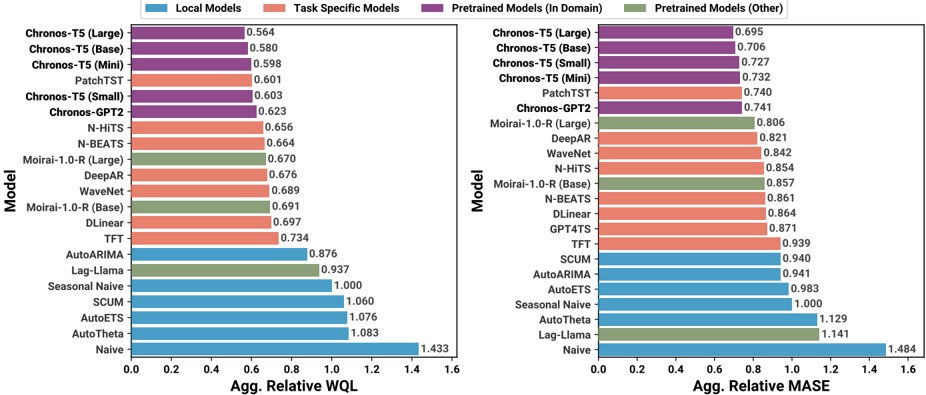
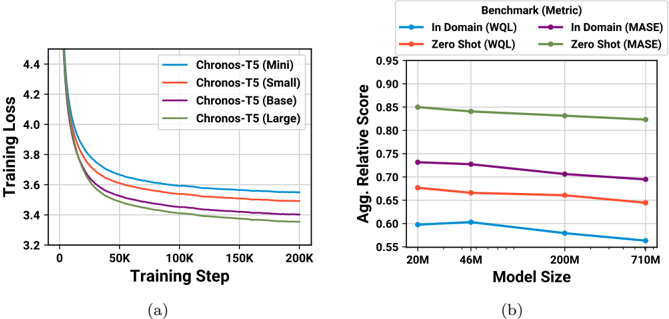
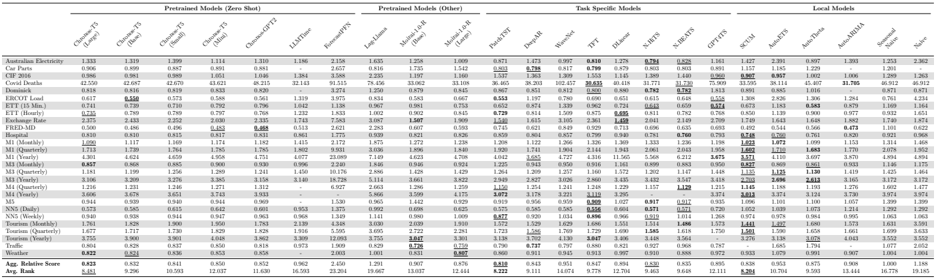
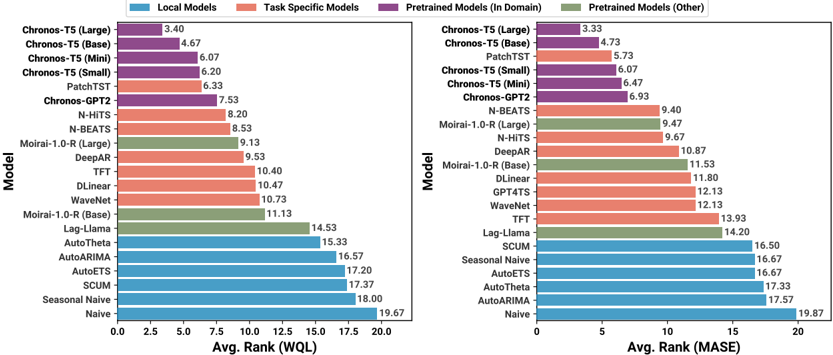
- On in-domain Benchmark I (15 datasets), Chronos-T5 Base/Large obtain the best aggregated relative scores: WQL 0.580/0.564 and MASE 0.706/0.695 versus Seasonal Naive 1.000, outperforming local, task-specific, and other pretrained baselines.
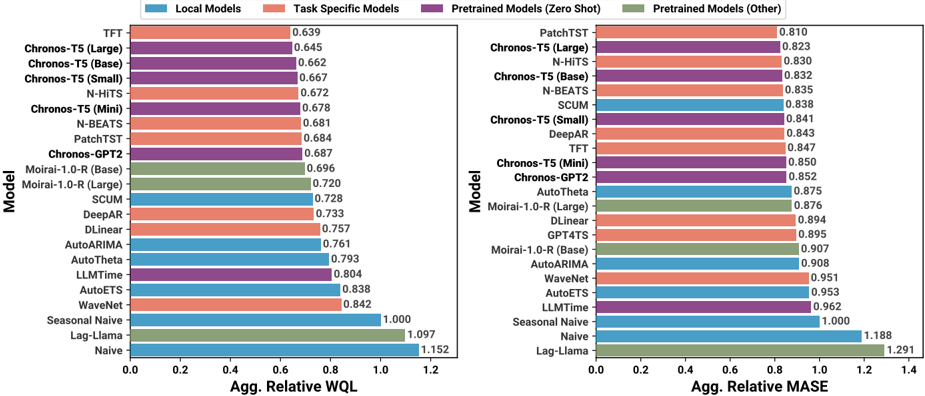
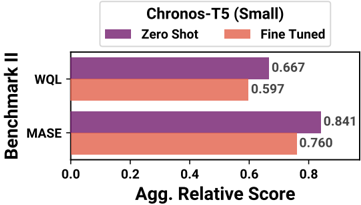
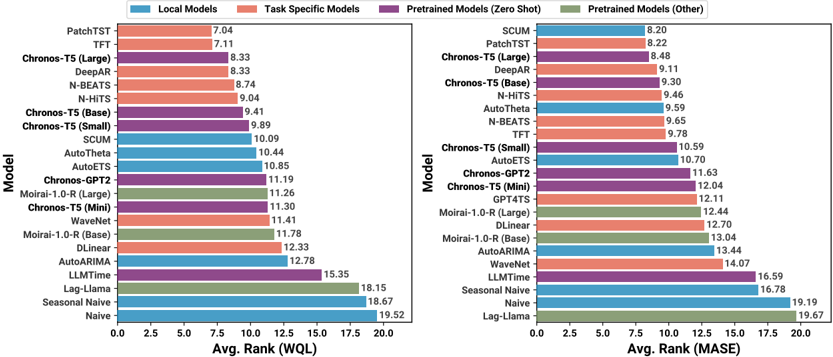
- On zero-shot Benchmark II (27 datasets), Chronos models rank 2nd–4th on WQL and Chronos-T5 Large ranks 2nd on MASE; aggregated relative WQL is 0.645 (Large), 0.662 (Base), 0.667 (Small), 0.678 (Mini), and MASE is 0.823, 0.832, 0.841, 0.850 versus Seasonal Naive 1.000. Fine-tuned Chronos-T5 Small becomes the best model on Benchmark II.
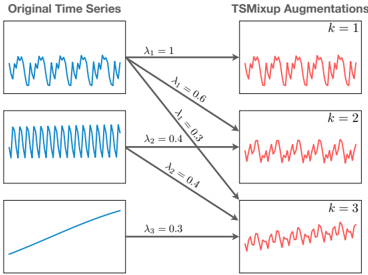
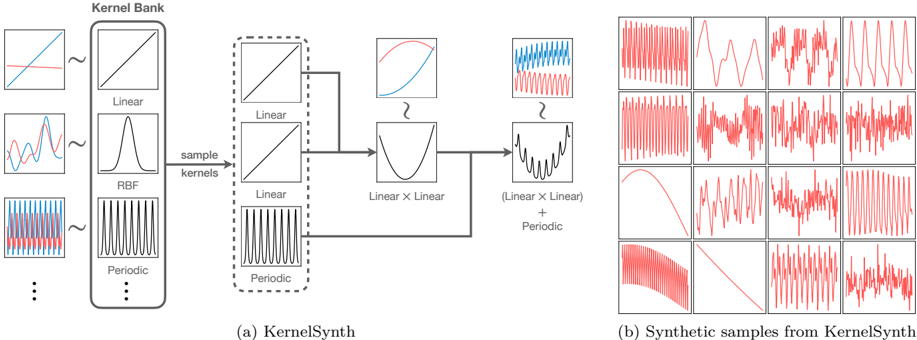
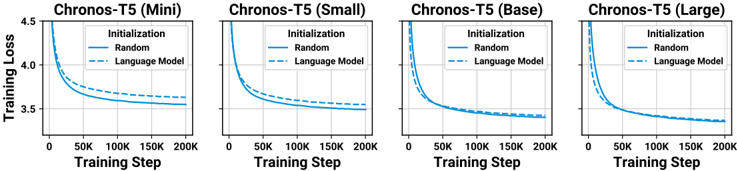
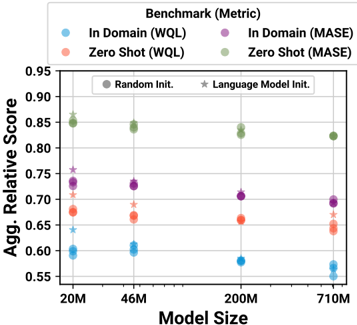
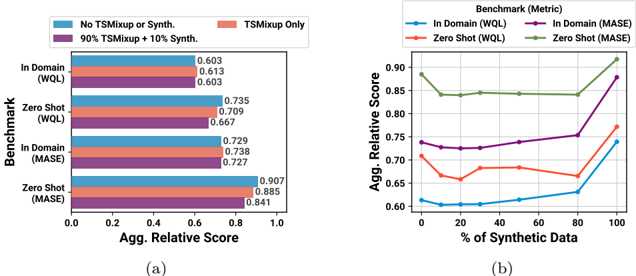
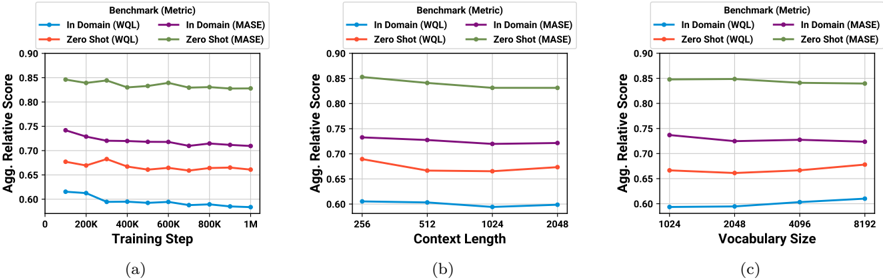
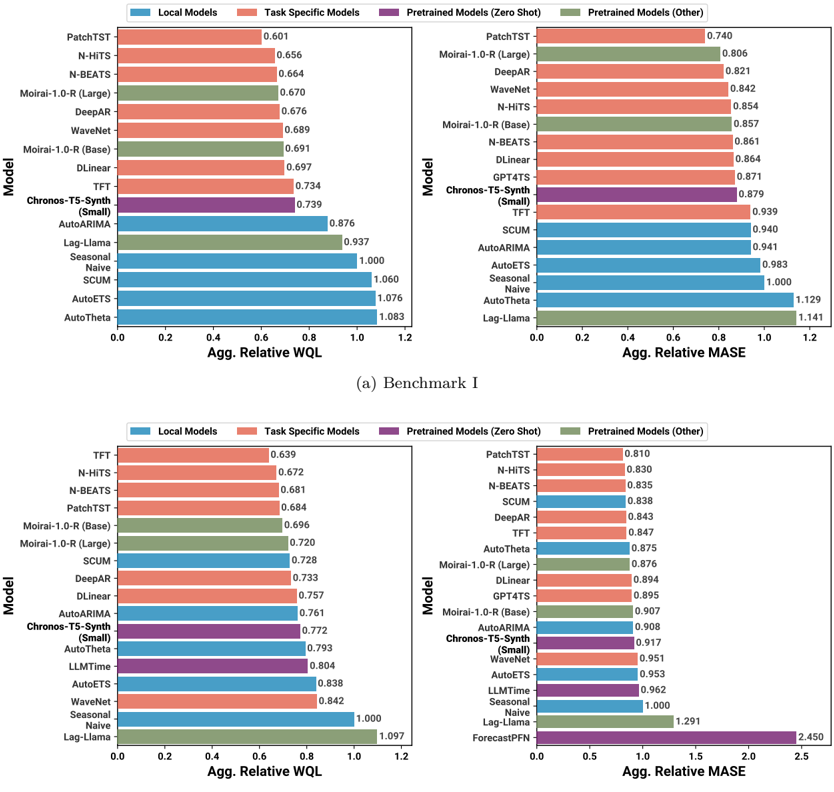
- Ablations show performance improves with model size; language-model-weight initialization offers little/no advantage over random initialization; TSMixup improves zero-shot performance; about 10% KernelSynth synthetic data is best; context length up to 1024 helps; larger vocabulary improves MASE but WQL deteriorates.
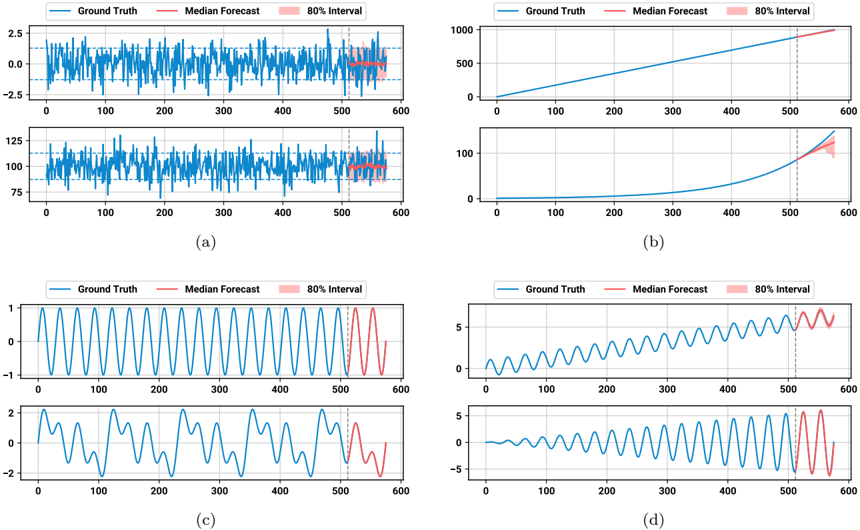
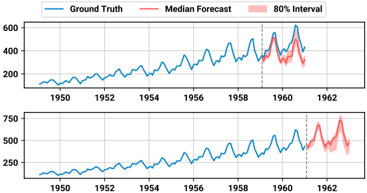
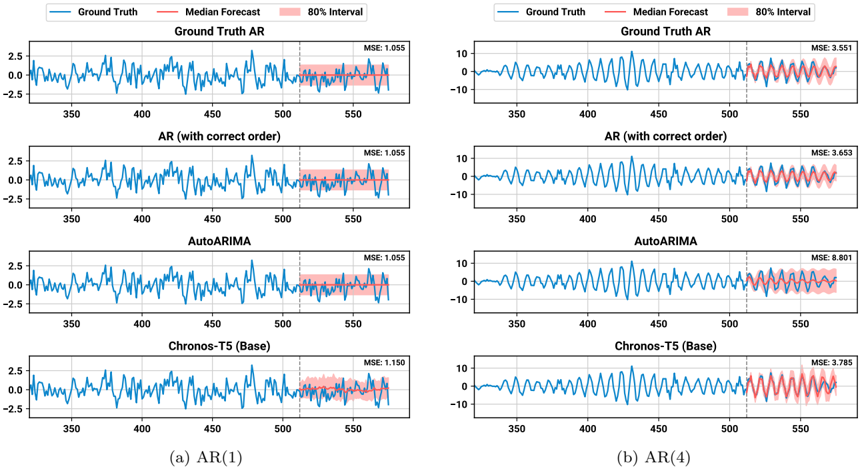
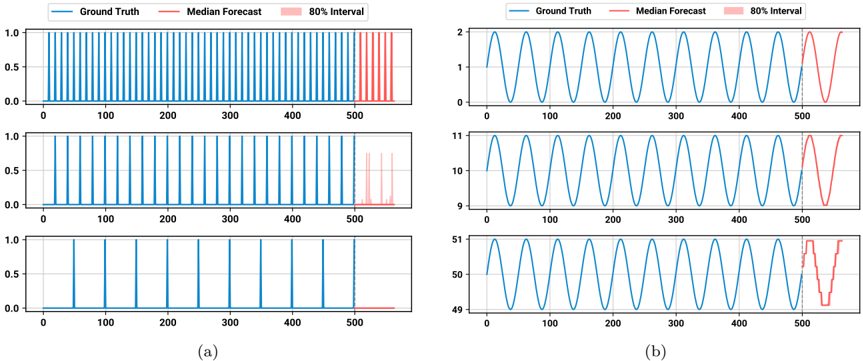
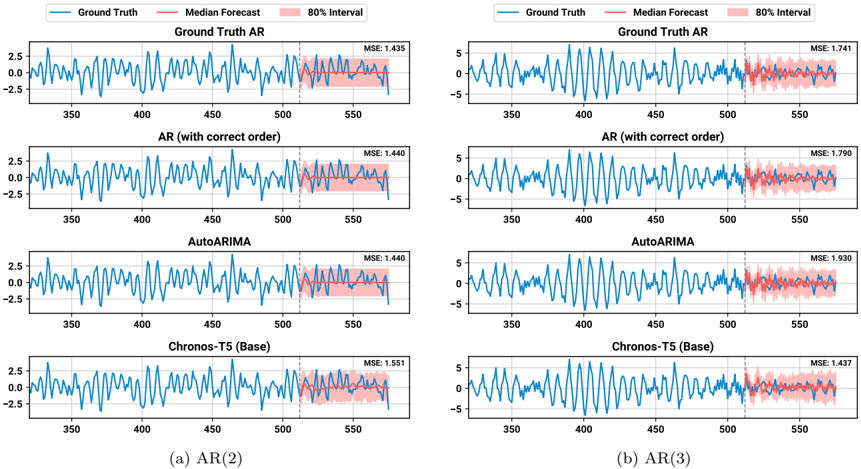
- Qualitatively, Chronos handles Gaussian noise, seasonality, additive/multiplicative trend+seasonality, and AR processes, but struggles with exponential trends and underestimates trend when context is short.
Methods
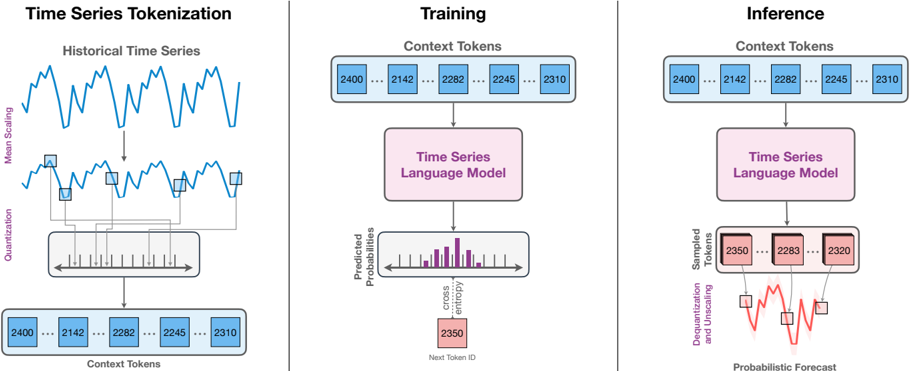
- Chronos mean-scales time series, uniformly quantizes values into B=4094 bins plus PAD/EOS (V_ts=4096), and trains off-the-shelf transformer language models with categorical cross-entropy; forecasts are produced by autoregressively sampling token paths and dequantizing/unscaling them.
- Training used 55 datasets total: 13 pretraining-only, 15 Benchmark I in-domain, and 27 Benchmark II zero-shot; 28 training datasets comprised about 890K univariate series and approximately 84B observations/tokens. Models included T5 Mini 20M, Small 46M, Base 200M, Large 710M, and GPT-2 90M, trained with 10M TSMixup augmentations plus 1M KernelSynth GP synthetic series, context length 512, prediction length 64, and 200K AdamW steps.
- Evaluation used 42 benchmark datasets with WQL (9 quantiles) and MASE; relative scores versus Seasonal Naive were aggregated by geometric mean and compared against local, task-specific, and pretrained baselines, plus a fine-tuning experiment on Benchmark II.
Limitations
- The paper states tokenization limits: representable values are in [-15s, 15s] where s is the mean absolute scale; small s relative to range causes overflow, while large s relative to variance causes precision loss. It also notes poor exponential-trend forecasts, trend underestimation with short context, and that categorical cross-entropy is not distance-aware; ordinal modeling is left as future work.
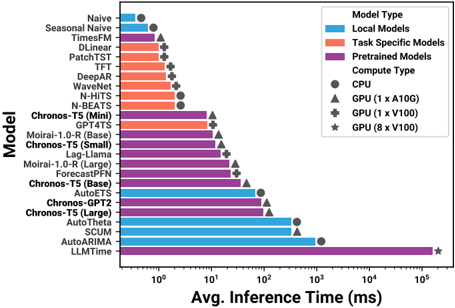
- The paper states scope limits: only univariate, uniformly spaced forecasting is studied; exogenous covariates, multivariate forecasting, and irregular sampling are not handled. Larger models were not explored due to slow inference, inference is slower than task-specific models, evaluation lacks enough high-frequency datasets to study long contexts, and public time series data remain limited.
- Text-evident: the zero-shot comparison may favor Moirai-1.0-R because many Benchmark II datasets were part of its pretraining corpus, as the paper notes; Chronos also ignores time and frequency information by design.
Model-written summary. Check it against the paper before relying on it.
Integrity signals
Registry
Cites
Statistics
Figures

Verification
Claims the paper makes
0 Valid · 4 Not valid · 14 Not checked · 146 Own results and interpretations
A result the paper reports from its own data — it cites no other source for it, so there is none to check. The quote shows it is in the paper.
In the paper
“Between the two baseline pretrained models studied in this experiment, Moirai-1.0-Rclearly outperforms Lag-Llama.”
§ Chronos: Learning the Language of Time Series > 5.5 Main Results
boosted- Asserted: passes — The authors put it forward as true.
- Checkable: passes — It can be checked against evidence.
- Load-bearing: unclear — It is unclear whether the paper’s conclusions depend on it.
- Based: passes — The paper gives a reason why it holds.
A result the paper reports from its own data — it cites no other source for it, so there is none to check. The quote shows it is in the paper.
In the paper
“Unsurprisingly, the training loss improves with the model capacity, as shown in Figure 7a.”
§ Chronos: Learning the Language of Time Series > Model size.
plainstates a cause- Asserted: passes — The authors put it forward as true.
- Checkable: passes — It can be checked against evidence.
- Load-bearing: unclear — It is unclear whether the paper’s conclusions depend on it.
- Based: passes — The paper gives a reason why it holds.
A result the paper reports from its own data — it cites no other source for it, so there is none to check. The quote shows it is in the paper.
In the paper
“Our comprehensive evaluation across 42 datasets establishes Chronos as a benchmark for both in-domain and zero-shot forecasting, surpassing both traditional models and task-specific deep learning approaches.”
§ Chronos: Learning the Language of Time Series > Time Series Tokenization Training Inference
plain- Asserted: passes — The authors put it forward as true.
- Checkable: passes — It can be checked against evidence.
- Load-bearing: passes — The paper’s conclusions depend on it.
- Based: passes — The paper gives a reason why it holds.
A result the paper reports from its own data — it cites no other source for it, so there is none to check. The quote shows it is in the paper.
In the paper
“consistent improvement is observed around the 10% synthetic data proportion.”
§ Chronos: Learning the Language of Time Series > Model size.
plainstates an association- Asserted: passes — The authors put it forward as true.
- Checkable: passes — It can be checked against evidence.
- Load-bearing: unclear — It is unclear whether the paper’s conclusions depend on it.
- Based: passes — The paper gives a reason why it holds.
A result the paper states — it cites no source for it, so there is none to check. The quote shows it is in the paper.
In the paper
“Further increasing the proportion of synthetic data tends to worsen performance.”
§ Chronos: Learning the Language of Time Series > Model size.
hedgedstates a possible cause- Asserted: passes — The authors put it forward as true.
- Checkable: passes — It can be checked against evidence.
- Load-bearing: unclear — It is unclear whether the paper’s conclusions depend on it.
- Based: passes — The paper gives a reason why it holds.
- Rests on an assumption not shown here.
94 more claims
Create a free account to see all 164 claims and to verify the 17 references still open.
- It may state two separate claims as one. 42
- Probably not a substantial claim. 30
Self-check
Percentages, sums and reported differences re-computed from the paper’s own numbers.
Each contradiction between two passages listed here was confirmed by an independent check.
Rated minor: it would not touch a result — a value no result rests on, a p-value that stays on the same side of the significance level, or a conflict that is clerical, resolved elsewhere in the paper, or outside its own findings.
In the paper
§ Chronos: Learning the Language of Time Series > Additional information
“Dominick (Godahewa et al., 2021) contains weekly time series representing the profit of individual stock keeping units from a retailer.”
§ Chronos: Learning the Language of Time Series > Covid Deaths
“Dominick retail 1D 100014 201 296 399 8”
Rated minor: it would not touch a result — a value no result rests on, a p-value that stays on the same side of the significance level, or a conflict that is clerical, resolved elsewhere in the paper, or outside its own findings.
In the paper
§ Chronos: Learning the Language of Time Series > C Baselines
“We considered a total of 17 baseline methods for benchmarking Chronos.”
§ Chronos: Learning the Language of Time Series > Chronos-GPT2 Chronos-T5 (Mini)
“Figure: Naive, SeasonalNaive, AutoETS, Auto-Theta, SCUM, AutoARIMA, DeepAR, TFT, PatchTST, DLinear, WaveNet, N-BEATS, N-HiTS, GPT4TS, Lag-Llama, Moirai-1.evaluationAll the above, LLMTime and ForecastPFN”
Citations
Cites
Exploring the Limits of Transfer Learning with a Unified Text-to-Text Transformer
Raffel, C., Shazeer, N., Roberts, A., Lee, K., Narang, S., Matena, M., Zhou, Y., Li, W., & Liu, P. J. (2019) · arXiv · doi:10.48550/arxiv.1910.10683 · Cited by 31,859
LoRA: Low-Rank Adaptation of Large Language Models
Hu, E. J., Shen, Y., Wallis, P., Allen-Zhu, Z., Li, Y., Wang, S., Wang, L., & Chen, W. (2021) · arXiv · doi:10.48550/arxiv.2106.09685 · Cited by 13,453
LightGBM: A Highly Efficient Gradient Boosting Decision Tree
(2017) · HAL · Cited by 10,512
Lewis, M., Liu, Y., Goyal, N., Ghazvininejad, M., Mohamed, A., Levy, O., Stoyanov, V., & Zettlemoyer, L. (2020) · Proceedings of the 58th Annual Meeting of the Association for Computational Linguistics · doi:10.18653/v1/2020.acl-main.703 · Cited by 8,821
Lewis, M., Liu, Y., Goyal, N., Ghazvininejad, M., Mohamed, A., Levy, O., Stoyanov, V., & Zettlemoyer, L. (2019) · arXiv · doi:10.48550/arxiv.1910.13461 · Cited by 8,816
Transformers: State-of-the-Art Natural Language Processing
Wolf, T., Debut, L., Sanh, V., Chaumond, J., Delangue, C., Moi, A., Cistac, P., Rault, T., Louf, R., Funtowicz, M., et al. (2020) · Proceedings of the 2020 Conference on Empirical Methods in Natural Language Processing: System Demonstrations · doi:10.18653/v1/2020.emnlp-demos.6 · Cited by 8,741
Informer: Beyond Efficient Transformer for Long Sequence Time-Series Forecasting
Zhou, H., Zhang, S., Peng, J., Zhang, S., Li, J., Xiong, H., & Zhang, W. (2021) · Proceedings of the AAAI Conference on Artificial Intelligence · doi:10.1609/aaai.v35i12.17325 · Cited by 7,752
mixup: Beyond Empirical Risk Minimization
Zhang, H., Cisse, M., Dauphin, Y. N., & Lopez-Paz, D. (2017) · arXiv · doi:10.48550/arxiv.1710.09412 · Cited by 5,831
Strictly Proper Scoring Rules, Prediction, and Estimation
Gneiting, T., & Raftery, A. E. (2007) · Journal of the American Statistical Association · doi:10.1198/016214506000001437 · Cited by 5,793
Another look at measures of forecast accuracy
Hyndman, R. J., & Koehler, A. B. (2006) · International Journal of Forecasting · doi:10.1016/j.ijforecast.2006.03.001 · Cited by 5,757
Research works printed but not linked: 8
- George Athanasopoulos, Rob J. Hyndman, Haiyan Song, and Doris C. Wu. The tourism forecasting compe- tition. International Journal of Forecasting, 27(3):822-844, 2011.
- Tom B. Brown, Benjamin Mann, Nick Ryder, Melanie Subbiah, Jared Kaplan, Prafulla Dhariwal, Arvind Neelakantan, Pranav Shyam, Girish Sastry, Amanda Askell, Sandhini Agarwal, Ariel Herbert-Voss, Gretchen Krueger, Tom Henighan, Rewon Child, Aditya Ramesh, Daniel M. Ziegler, Jeffrey Wu, Clemens Winter, Christopher Hesse, Mark Chen, Eric Sigler, Mateusz Litwin, Scott Gray, Benjamin Chess, Jack Clark, Christopher Berner, Sam McCandlish, Alec Radford, Ilya Sutskever, and Dario Amodei. Language models are few-shot learners. In Advances in Neural Information Processing Systems, 2020. 2, 3, 4
- Rob Hyndman, Anne B Koehler, J Keith Ord, and Ralph D Snyder. Forecasting with exponential smoothing: the state space approach. Springer Science & Business Media, 2008. 3, 9
- Alec Radford, Jeffrey Wu, Rewon Child, David Luan, Dario Amodei, Ilya Sutskever, et al. Language models are unsupervised multitask learners. OpenAI blog, 1(8):9, 2019. 4, 6
- Yaniv Romano, Evan Patterson, and Emmanuel Candes. Conformalized quantile regression. Advances in neural information processing systems, 32, 2019.
- Kai Ming Ting and Ian H Witten. Stacking bagged and dagged models. In Proceedings of the Fourteenth International Conference on Machine Learning, 1997. 20
- Ashish Vaswani, Noam Shazeer, Niki Parmar, Jakob Uszkoreit, Llion Jones, Aidan N. Gomez, Lukasz Kaiser, and Illia Polosukhin. Attention Is All You Need. In Advances in Neural Information Processing Systems, 2017.
- Yun Zhou, Liwen You, Wenzhen Zhu, and Panpan Xu. Improving time series forecasting with mixup data augmentation. In ECML PKDD 2023 International Workshop on Machine Learning for Irregular Time Series, 2023b. 7
Cited by
Items 1,301–1,400 of 2,048
Ma, K., & Yu, M. (2026) · Journal of King Saud University - Computer and Information Sciences · doi:10.1007/s44443-026-01368-0
“…et al. 2024a; Wang et al. 2024); Time-LLM and One-Fits-All repurpose pretrained language models (Jin et al. 2024; Zhou et al. 2023); and MOMENT, Timer, Chronos, and Time-MoE scale pretraining across heterogeneous series (Ansari et al. 2024; Goswami et al. 2024; Liu et al. 2024b; Shi et al. 2025).”
Tackling Workload Forecasting Challenges with an Offline-Online Dynamic Framework
Jiang, J., Liu, Y., Li, J., Han, L., Lu, W., Deng, Q., Zhu, Z., Lu, X., & Ma, L. (2026) · IEEE International Conference on Data Engineering (ICDE) · doi:10.1109/icde65706.2026.00270
“• Chronos-Bolt-Base [29] is an advanced TSFM.”
InfluentialCodeTS: Verifiable Text-to-Time Series Generation via Executable CodePreprint
Yuan, X., Liu, S., Zheng, T., Zhuang, H., Song, M., & Chen, K. (2026) · arXiv · doi:10.48550/arxiv.2609.15393
Deep Learning Methods for Time Series Forecasting: A Comprehensive Review
Dere, D. (2026) · INTERANTIONAL JOURNAL OF SCIENTIFIC RESEARCH IN ENGINEERING AND MANAGEMENT · doi:10.55041/ijsrem67051
Leveraging Large Language Models for Time Series Prediction on Low-Frequency Data
Parracho, R., Alexandrino, F. Q. D. L., Figueiredo, M. D. S., da Silva, L. P., Macedo, B., Vaz, A. L., Louback, D., Desouzart, V. C., Salles, R. P., Porto, F. A. M., et al. (2025) · Simpósio Brasileiro de Bancos de Dados (SBBD) · doi:10.5753/sbbd.2025.247062
“Another contributing factor may be the relative ineffectiveness of Lag-Llama’s data augmentation methods (Freq-Mix and Freq-Mask) compared to Chronos’ techniques (TSMixup and KernelSynth) [Rasul et al., 2024; Ansari et al., 2024].”
Sag-moe: statistics-guided expert weighting for multivariate time series forecasting
Xiao, B., Yang, Z., He, X., Wang, M., Zhang, X., Hu, S., & Wu, Y. (2026) · Pattern Analysis and Applications · doi:10.1007/s10044-026-01791-z
“Its core self-attention mechanism, however, has Θ(𝑁𝑁 2 ) complexity in the variable dimension, posing a significant challenge for high-dimen - sional data.”
Self-citationOnline Multiscale Conformal Calibration for Response-Defined Wind-Ramp Groups
He, X., Wang, Z., Yuan, K., & Tong, Y. (2026) · Processes · doi:10.3390/pr14193119
TelecomAudit: Origin-Aware Benchmark Auditing and Calibration for 5G Anomaly Detection
Salavati, C., Wu, L., Wan, K., Darbari, M., & Hong, L. (2026) · ACM International Conference on Information and Knowledge Management (CIKM) · doi:10.1145/3799682.3840150
Zheng, Y., Fan, H., Sun, T., Wei, W., & Huang, S. (2026) · Energy Conversion and Management X · doi:10.2139/ssrn.7292120
ForeT2F: Enhancing Zero-Shot Prediction via Two-Stage Temporal-Frequency PretrainingPreprint
Shen, P., Xu, L., Xu, P., Liu, Y., & Li, H. (2026) · SSRN Electronic Journal · doi:10.2139/ssrn.6170129
Wang, H., Yu, S., & Liu, W. (2026) · SSRN Electronic Journal · doi:10.2139/ssrn.6538785
Self-citationMao, D., Li, S., Zhang, G., Wang, W., & Wang, Y. (2026) · Lecture notes in computer science · doi:10.1007/978-981-92-0372-7_32
Self-citationLi, X. F., Zheng, Y., & Wei, Z. (2026) · Frontiers of Computer Science · doi:10.1007/s11704-026-50462-z
Deng, C., Wang, H., Xu, F., Luo, G., & Fan, Z. (2026) · IEEE Signal Processing Letters · doi:10.1109/lsp.2026.3739688
Self-citationFAME: Frequency-Enhanced Pre-trained Model for Time Series Forecasting
Guo, H., Yang, R., Zhao, H., Fu, Y., Jiang, W., & Ren, W. (2026) · ACM International Conference on Information and Knowledge Management (CIKM) · doi:10.1145/3799682.3840811
Yim, K. S. (2025) · IEEE International Conference on Big Data (BigData) · doi:10.1109/bigdata66926.2025.11402485
Kordjukovs, N., Cigada, A., & Pau, D. P. (2026) · Computers · doi:10.3390/computers15110742
One-Shot Price Forecasting with Covariate-Guided Experts under Privacy Constraints
He, R., Xu, Y., Wang, J., Watson, J. D., & Song, J. (2025) · IEEE Conference on Energy Internet and Energy System Integration (EI2) · doi:10.1109/ei268505.2025.11425422
“Unless otherwise specified, we adopt the training configurations and preprocessing pipeline from Chronos [18] for fair comparison.”
Smart Battery Management: Leveraging Prognostics for Improved System Performance
Pourgol, M., Pishahang, M. H., & Chan, E. (2026) · Annual Reliability and Maintainability Symposium (RAMS) · doi:10.1109/rams50514.2026.11424469
“The Chronos framework [14] exemplifies how existing language model architectures and training procedures can be adapted for probabilistic time-series (e.g. sensor records) forecasting.”
InfluentialInnovative and Effective Prognostics and Health Management in Data Center Cooling Systems
Pourgol, M., Pishahang, M. H., Hu, Y., & Chan, E. (2026) · Annual Reliability and Maintainability Symposium (RAMS) · doi:10.1109/rams50514.2026.11424443
“In the context of time-series, foundation models such as the Chronos family process sensor data as sequences of discrete values, similar to how language models interpret sequences of tokens [15].”
Forecasting Gait Dynamics with Foundation Models
Riano, F. C., Malovini, A. L., Coccia, A., Amitrano, F., D’Addio, G., & Bellazzi, R. (2026) · Lecture notes in computer science · doi:10.1007/978-3-032-30813-9_76
DeXposure-Claw: An Agent System for DeFi Risk Supervision
Shu, A., Chen, B., Wu, W., Chen, C. Y., & He, F. (2026) · Workshop on Financial Technology and Natural Language Processing (FinNLP) · doi:10.18653/2026.finnlp-1.49
Zero-Shot Dengue Forecasting with LLM-Based Time Series Foundation Models
Machchar, P. S., & Ramanuj, P. N. (2026) · International Journal of Computer Applications · doi:10.5120/ijcab17db3823872
Park, E., Park, J., & Kim, T. (2026) · ESS Open Archive · doi:10.22541/essoar.15011386/v1
Wind Power Forecasting Based on Multi-Source Data Fusion and Progressive Fine-Tuning Strategy
Zhang, Z., He, H., Luo, D., Huang, S., Yang, X., & Li, S. (2026) · IEEE/IAS Industrial and Commercial Power System Asia (I&CPS Asia) · doi:10.1109/icpsasia70813.2026.11692002
“Chronos converts numerical time series into tokens through quantization and tokenization, thereby allowing a single model to be applied across domains such as energy, transportation, finance, and healthcare [10].”
Chaikin, G. A., & Blekanov, I. S. (2026) · Modelling and Data Analysis · doi:10.17759/mda.2026160301
Xu, M., Deng, S., Qiao, S., & Zhang, X. (2026) · Journal of Systems Architecture · doi:10.1016/j.sysarc.2026.104063
Self-citationWang, Y. (2026) · Computer Science and Application · doi:10.12677/csa.2026.1611322
Self-citationHORVÁTH, G. M. (2026) · Pécsi Egyetemi Archívum (University of Pécs) · doi:10.15170/xviippn-tk-ktk-2026
Khaledian, A., Kargarzadeh, A., Khaledian, N., Parvini, N., & Ghatak, S. (2026) · SSRN Electronic Journal · doi:10.2139/ssrn.7674961
Ryu, D., & Yoo, W. (2026) · Applied Sciences · doi:10.3390/app16168270
Benchmark-grounded self-supervised contrastive learning for AMI-based distribution grid monitoring
Zhang, L., Yang, B., Ke, X., Zhao, H., Zhang, W., & Yao, Y. (2026) · Frontiers in Artificial Intelligence · doi:10.3389/frai.2026.1868885
Monotone-Constrained Diffusion Models for Long-Horizon Production ForecastingPreprint
Abraha, T. M., & Lucet, Y. (2026) · arXiv · doi:10.48550/arxiv.2609.22643
“In British Columbia specifically, Physics-SIMS-TS is more accurate than CSDI on 64.2% of wells, Diffusion-TS on 73.8%, TSDiff on 72.6%, TimeGrad on 76.0%, Chronos-2 on 90.0%, and Chronos-Bolt on 93.3%.”
InfluentialSemCast: Bridging semantic reasoning and probabilistic forecasting for traffic intelligence
Yan, H., Xu, Y., Bian, J., Li, Y., Pu, Z., & Ma, X. (2026) · Artificial Intelligence for Transportation · doi:10.1016/j.ait.2026.100066
Zhang, Y. Y., Chun, E., Mao, Z., Wu, Y., & Wang, J. (2026) · ACM SIGKDD Conference on Knowledge Discovery and Data Mining (KDD) · doi:10.1145/3770855.3817927
A Survey of Transformer-Based Time Series Forecasting Methods
Niu, H., Li, W., Chen, D., & Huang, M. (2026) · International Conference on Artificial Intelligence and Materials (ICAIM) · doi:10.1109/icaim69488.2026.11601445
“Chronos [47] converts the numerical value into tokens and reuses the pre-training ability of language models like T5, however this appears to lose the continuous nature of the numerical data.”
Varverakis, E., Michael, P., & Trihinas, D. (2026) · Future Internet · doi:10.3390/fi18100550
Encoder or Reader? Identifying the Operative Role of LLMs in Multimodal Time-Series Forecasting
Bonkoungou, A. A., Rajput, P., Djiré, A. E., Khaledian, N., Kaboré, A. K., Klein, J., & Bissyandé, T. F. (2026) · International Conference on Machine Learning and Applications · doi:10.1109/icmla69890.2026.00064
“Concurrent work on time-series foundation models [13]–[15] has produced zero-shot forecasters whose calibrated quantile outputs make them well suited to serve as a numerical backbone.”
TS-Aligner: Mamba-Based Prompt Alignment for LLM-Enhanced Time Series Anomaly Detection
Nie, S., Yu, Z., Ran, J., Zhu, W., Wang, J., Lin, Y., & Xing, T. (2026) · Lecture notes in computer science · doi:10.1007/978-981-92-7735-3_4
Li, T., Yu, Z., Chen, F., Zhu, W., Li, J., Nie, S., Lin, Y., & Wang, J. (2026) · Lecture notes in computer science · doi:10.1007/978-981-92-7735-3_3
Detecting Fugitive Gas Emissions from IIoT Telemetry
Bashtovyi, A., Hollema, A., Williams, K., & Korjani, M. (2026) · SPE Annual Technical Conference and Exhibition · doi:10.2118/233937-ms
Hallucination Detection and Mitigation with Diffusion in Multi-Variate Time-Series Foundation Models
Wichitwechkarn, V., Fox, C. E., & Choudhary, R. (2026) · Transactions on machine learning research · doi:10.48550/arxiv.2508.00881
Computer Modeling and Optimization of Complex Systems
Anisimov, V., & Ostashko, I. (2025) · PhilPapers (PhilPapers Foundation)
Xu, J., Gui, H., Dai, M., Liu, P., Yu, X., & Li, X. (2025) · International Conference on Sensing, Measurement & Data Analytics in the era of Artificial Intelligence (ICSMD) · doi:10.1109/icsmd67131.2025.11365370
Time series foundation models for emergency department forecasting
Järvi, V. (2025) · Tampere University Institutional Repository (Tampere University)
Dirichlet-Guided Group Forecasting for Alleviating Over-smoothing in Time Series ForecastingPreprint
Zhang, X., Wang, J., Yu, X., Song, Z., Zhang, J., Zheng, C., & Qiang, W. (2026) · arXiv · doi:10.48550/arxiv.2606.10592
Self-citationBıst yenilenebilir enerji hisselerinin derin ögrenme modelleriyle tahmini ve portföy optimizasyonu
Alp, O. (2025) · Yildiz Technical University - AVESIS
Event-Level Cough Detection Using a Whisper-Based Foundation Model
Peh, W. Y., Zhang, H., Ruan, G., & Yang, J. (2026) · International Conference on Computer Research and Development · doi:10.1145/3796263.3796301
LightFreq: Adaptive frequency learning for efficient and multi-domain time series forecasting
Wu, W., Li, X., Liang, X., Yang, C., Gui, W., Liu, Y., & Zhou, N. (2026) · Knowledge-Based Systems · doi:10.1016/j.knosys.2026.115556
Memory Mechanisms in Multivariate Time Series: A Survey of Architectures, Retrieval, and EvolutionPreprint
Qi, S., Chen, P., & Luo, W. (2026) · Research Square · doi:10.21203/rs.3.rs-10171809/v1
L-MTSF: large-scale datasets for re-evaluating long-term multivariate time series forecasting
Niu, H., Cao, D., Habault, G., Ung, H. Q., Legaspi, R., Ye, W., Enouen, J., Taya, M., Wada, S., Ono, C., et al. (2026) · npj Artificial Intelligence · doi:10.1038/s44387-026-00146-7
Benchmarking System One Models for Time-Series Decision Making: A Case Study of JevPreprint
Wang, J., Zhang, K., Xiong, J., & Xue, H. (2026) · arXiv · doi:10.48550/arxiv.2610.33410
“Time-LLM maps temporal patches into the representation space of a frozen language model, Chronos quantizes time-series values for pretraining across domains, and Chronos-2 further supports zero-shot multivariate and covariate-informed forecasting [14, 2, 3].”
FM-CAC: Carbon-Aware Control for Battery-Buffered Edge AI via Time-Series Foundation Models
Yang, K., Hanafy, W. A., Shenoy, P. J., & Srivastava, M. B. (2026) · International Symposium on Low Power Electronics and Design (ISLPED) · doi:10.1145/3816440.3818532
Expert-Guided Forecast Editing for Time-Series Foundation ModelsPreprint
Le, H., Nguyen, M. H., Nguyen, M., Nguyen, H. S., & Do, D. (2026) · arXiv · doi:10.48550/arxiv.2607.19659
“The Chronos benchmark (ChronosBench) [Ansari et al., 2024] comprises 42 datasets (27 zero-shot, 15 in-domain) spanning horizons from 6 to 56 steps across monthly, quarterly, daily, hourly, and sub-hourly frequencies.”
InfluentialSeeing, Hearing, and Reasoning: A Holographic World Model for Multimodal Financial Intelligence
Gu, F., Ren, X., Zhang, Z., Jiang, Z., García‐Fernández, Á. F., Stefanidis, A., Zhou, M., Su, J., & Li, H. (2026) · ACM International Conference on Multimedia (ACM MM) · doi:10.1145/3767308.3835533
Large Language Models (LLMs) for Wireless Network Resource Management and Forecasting Applications
Khan, M. U. (2026) · YorkSpace (York University)
Deep Learning for Solar Power Forecasting: A Transformer-Based In-Context Learning Approach
Simionato, C. (2026) · AMS Laurea Institutional Research Repository (University of Bologna)
Tiny-TSM: Efficiently Training a Lightweight SOTA Time Series Foundation ModelPreprint
Birkel, F. (2025) · arXiv · doi:10.48550/arxiv.2511.19272
Transfer learning approaches for Business Forecasting
Azevedo, F. M. R. D. (2024) · Portuguese National Funding Agency for Science, Research and Technology (RCAAP Project by FCT)
LISA: Laplacian In-context Spectral AnalysisPreprint
Candanedo, J. (2026) · arXiv · doi:10.48550/arxiv.2602.04906
“Sepa-rately, time-series foundation models (Ansari et al., 2024) and recent work on in-context prediction for time series (Lu et al., 2024) motivate studying test-time adaptation mechanisms.”
Signed Dual Attention: Capturing Signed Dependencies in Time Series ForecastingPreprint
Courvoisier, B., & Cazenave, T. (2026) · arXiv · doi:10.48550/arxiv.2606.04833
“This mechanism underpins success of transformer architectures across diverse domains, including computer vision (e.g., ViT (Dosovitskiy et al. 2021)), video understanding (Bertasius, Wang, and Torresani 2021), and time series forecasting (Zhou et al. 2022; Lim et al. 2020; Ansari et al. 2024).”
Gao, W., Du, X., Chen, X., Guo, Y., Bernal, A. M. C., Luo, R., & Xu, Z. (2026) · International World Wide Web Conference (WWW) · doi:10.1145/3774904.3792998
Cheng, Y., & Wang, C. (2026) · IEEE Access · doi:10.1109/access.2026.3725033
Fahim, M. M., & Karim, M. R. (2026) · Scientific Reports · doi:10.1038/s41598-026-73372-3
Ding, J., Cai, Y., & Li, Y. (2026) · Applied Soft Computing · doi:10.1016/j.asoc.2026.116777
Li, Y., Zhao, Q., & Wang, M. (2025) · Enlighten: Publications (University of Glasgow)
Carpinelli, C., Broucke, S. V., Baesens, B., Sigridur Islind, A., & Óskarsdóttir, M. (2024) · Ghent University Academic Bibliography (Ghent University)
A Survey on Behavioral Data Representation LearningPreprint
Chen, X., Zhang, S., Jia, K., Peng, S., Wang, Y., Su, L., Huang, X., Xu, J., Xiong, Y., & Yu, P. S. (2026) · TechRxiv · doi:10.36227/techrxiv.176945766.69882506/v1
Self-citationRepresentation Learning for Multivariate Time-Series
Ilbert, R. (2025) · theses.fr (ABES) · doi:10.70675/b20f4057z068dz49f6zb7c1z116023738b33
InA-Probe: Instruction-Aware Active Probing for Time Series Forecasting with LLMsPreprint
Gong, P., Eldele, E., Liu, C., Jia, Z., Ding, Y., Zhou, X., Gu, L., Zhu, Q., Liu, Y., Zhang, D., et al. (2026) · arXiv · doi:10.48550/arxiv.2606.08601
TimeVista: Exploring and Exploiting Vision-Language Models as Judges for Time Series ForecastingPreprint
Chen, Z., Wang, Y., Wu, J., Liu, Y., Zhang, H., Su, X., Wang, J., & Long, M. (2026) · arXiv · doi:10.48550/arxiv.2606.16173
Self-citationChoi, Y., Jeong, D., Kim, B., & Han, K. (2026) · Research Square · doi:10.21203/rs.3.rs-9919190/v1
Small Language Models for Time Series Prediction: Advances, Challenges, and Future DirectionsPreprint
MirAhmadi, A., Salari, E., Eftekhari, M., & Vahdati, S. (2026) · Research Square · doi:10.21203/rs.3.rs-9938847/v1
Aprendizaje por transferencia en contexto de dependencia de datos : Aplicación en series de tiempo
Gadea, F. E. S. (2025) · LA Referencia (Red Federada de Repositorios Institucionales de Publicaciones Científicas)
A Hierarchy of Entropy-Shapley Games for Multivariate Predictive UncertaintyPreprint
Koenen, N., Battistin, C., den Abeele, J. V., & Jullum, M. (2026) · arXiv · doi:10.48550/arxiv.2609.35217
“(4) We demonstrate the framework on a range of probabilistic models, from NGBoost [7] and DeepAR [1] to the zero-shot foundation model Chronos-T5 [9].”
InfluentialWu, T., Yu, J., Hu, X., Wu, X., Wu, H., Anupkrishnan, S., Radmehr, A., Liu, Y. C., Nguyen, P., Wu, Y., et al. (2026) · arXiv · doi:10.48550/arxiv.2610.06450
“To our knowledge, it is the first benchmark to evaluate this question through matched representation-and initialization-level controls.”
Zhao, H., Wang, L., Wang, X., Wang, M., & Nie, X. (2026) · Transportation Research Part E Logistics and Transportation Review · doi:10.1016/j.tre.2026.105311
Language Models as Forecasters
Yuan, M. (2026) · Apollo (University of Cambridge) · doi:10.17863/cam.136270
Predictive Language Grounding for Event-Driven Time Series Forecasting via Dual-Path Event Injection
Wu, J., Xue, X., Cao, Y., Peng, Q. I., Zhao, S., Chen, S., Lin, W., Chen, T., & Zhou, H. (2026) · Findings of the Association for Computational Linguistics: EMNLP (Findings of EMNLP) · doi:10.18653/2026.findings-emnlp.1764
Mousa, R., & MahmoudpourHarris, Z. (2026) · SSRN Electronic Journal · doi:10.2139/ssrn.7331261
Simethy, G., Ortíz-Arroyo, D., & Durdevic, P. (2026) · arXiv · doi:10.48550/arxiv.2608.05151
da Costa, L. D. A. (2026) · Portuguese National Funding Agency for Science, Research and Technology (RCAAP Project by FCT)
Explore the Use of Time Series Foundation Model for Car-Following Behavior AnalysisPreprint
Zeng, L., & Yan, R. (2025) · arXiv · doi:10.48550/arxiv.2501.07034
PLuG: Pairwise Logit Gating for Expressive Attention Modulation in Vision Transformers
Lee, D., Yoon, S., Kim, S. K., & Paik, J. (2026) · IEEE Access · doi:10.1109/access.2026.3701015
GenTS: Unified Generative Modeling for Multimodal Time Series Analysis
Gu, S., Zhao, Y., Jing, B., & Ren, K. (2026) · ACM International Conference on Multimedia (ACM MM) · doi:10.1145/3767308.3836409
ProbRes: Volatility Learning for Probabilistic Time-Series ForecastingPreprint
Wang, T., Zhang, Y., & Wang, B. (2026) · arXiv · doi:10.48550/arxiv.2606.02117
“…to existing probabilistic forecasting methods—including bootstrap methods [8, 4], quantile-based wrappers [9, 10], and end-to-end models [11, 12, 6]— ProbRes explicitly models the functional dependence of conditional volatility on past observations, in the spirit of classical volatility…”
Online Joint Beat and Downbeat Tracking with Time Series Forecasting Model
Zhang, C., & Li, W. (2025) · Lecture notes in electrical engineering · doi:10.1007/978-981-96-4783-5_2
Laglil, M., Devijver, É., Gaussier, É., & Pracca, B. (2025) · arXiv · doi:10.48550/arxiv.2511.22674
“Ansari et al. (2024) ont développé un modèle appelé Chronos , basé sur une architecture Transformer de type encodeur-décodeur (combinant les deux architectures de la Figure 1).”
Drietomský, T. (2025) · reposiTUm (TU Wien) · doi:10.34726/hss.2025.109341
Comparative Analysis of Classical Models and Foundation Models for Retail Sales Forecasting
Nascimento, M. M. M. D. M. B. D. (2025) · Portuguese National Funding Agency for Science, Research and Technology (RCAAP Project by FCT)
Suemitsu, I., Kono, T., Wakabayashi, R. H., Tsunoda, J., Yamaguchi, Y., & Wei, W. (2026) · Advanced Energy and Sustainability Research · doi:10.1002/aesr.202500355
Haxaire, N., Mourad-Chehade, F., Yalaoui, A., Nader, P., & Chehade, H. (2025) · International Conference on Computer and Applications (ICCA) · doi:10.1109/icca66035.2025.11430752
“Foundation models, such as Chronos [13] and TimesFM [14], represent a paradigm shift by pretraining on vast and diverse time series datasets.”
Fan, Y., Jiang, Y., Liu, C., Zhi, F. A. N., & Jiang, D. (2026) · Lecture notes in mechanical engineering · doi:10.1007/978-3-032-03725-1_23
Wang, M., You, X., Zhang, C., Wei, X., Shen, W., & Gu, Z. (2026) · Smart Agricultural Technology · doi:10.1016/j.atech.2026.102124
Leveraging Time Series Foundation Models to Detect Performance Anomalies in Software Systems
Menna, F. D., Traini, L., & Cortellessa, V. (2026) · ACM/SPEC International Conference on Performance Engineering (ICPE) · doi:10.1145/3777911.3800632
“Specifically, our foundation models selection comprises Chronos [2] and TSPulse [13].”
InfluentialPrakash, G. S. V. S. S. V. D. (2026) · International Journal on Recent and Innovation Trends in Computing and Communication · doi:10.17762/ijritcc.v14i1.12006
Jing, C., Duan, R., Yan, R., & Jin, G. (2026) · Mathematics · doi:10.3390/math14101686
Trees Still Beat Transformers for Day-Ahead Electricity Price ForecastingPreprint
Ansari, M. Q. (2026) · SSRN Electronic Journal · doi:10.2139/ssrn.6866491
Metadata
- Authors
- Ansari, A. F., Stella, L., Turkmen, C., Zhang, X., Mercado, P., Shen, H., Shchur, O., Rangapuram, S. S., Arango, S. P., Kapoor, S., Zschiegner, J., Maddix, D. C., Wang, H., Mahoney, M. W., Torkkola, K., Wilson, A. G., Bohlke-Schneider, M., & Wang, Y.
- Affiliations
- Amazon (United States) (US)
- University of California San Diego (US)
- University of Freiburg (DE)
- Rutgers, The State University of New Jersey (US)
- ORCID
- Venue
- arXiv
- Publisher
- arXiv
- Published
- 2024
- ISSN
- 2835-8856 (ISSN-L)
- arXiv
- 2403.07815
- OpenAlex
- W4392781393
- Cited by
- 2,046
- References
- 92
- Citations by year
- 2026: 1398 · 2025: 520 · 2024: 126
- FWCI
- 245.30
- Type
- journal article
- Language
- en
- Open access
- diamond
- openreview.net
- Licence
- Locations
- Transactions on machine learning research (publishedVersion, cc-by)
- arXiv (submittedVersion, public-domain)
- Topics
- Physical Sciences › Computer Science › Signal Processing › Time Series Analysis and Forecasting
- Social Sciences › Decision Sciences › Management Science and Operations Research › Forecasting Techniques and Applications
- Social Sciences › Decision Sciences › Management Science and Operations Research › Stock Market Forecasting Methods
- Keywords
- time series forecasting, transformer language models, T5, zero-shot forecasting, Chronos
About these checks
Registry, retraction, Cites and statistics results are computed, not judged, with one exception: a printed reference that no index lists is read once by a model before it counts as a citation error. Claims are extracted by a model and kept only when their quote appears verbatim in the text; each cited source is then checked, with a model’s help, for whether it says what the claim relies on. Those verdicts can be wrong — read the claim’s quote and the cited source before relying on one.
A language model drew the claims from the paper on 2026-11-28, under version 3 of the claim definition (model deepseek-v4.1-flash, prompt extract-v3).
A second model labelled each claim on 2026-11-28 (model jev-1.13-20260917, definition revision gold-guideline-v0.2).
Statistics and arithmetic are recomputed, not judged.
Confidence bands are shown only for fields calibrated on our annotated test set. None is calibrated yet, so no band is shown.
What counts as a claim ›How we measure confidence ›How we check this ›
Are you an author, or do you see a problem with this page? Request a review
Data sources
Bibliographic data: Semantic Scholar, OpenAlex, Crossref.
Contains information from the Semantic Scholar Academic Graph Datasets, made available under the ODC Attribution License (ODC-BY 1.0).
Semantic Scholar’s data is described in: Kinney, R., et al. (2023). The Semantic Scholar Open Data Platform. arXiv:2301.10140.
